
South America Metro Dense Wave Division Multiplexing (DWDM) Market Size and Share
Market Overview
| Study Period | 2020 - 2031 |
|---|---|
| Forecast Data Period | 2026 - 2031 |
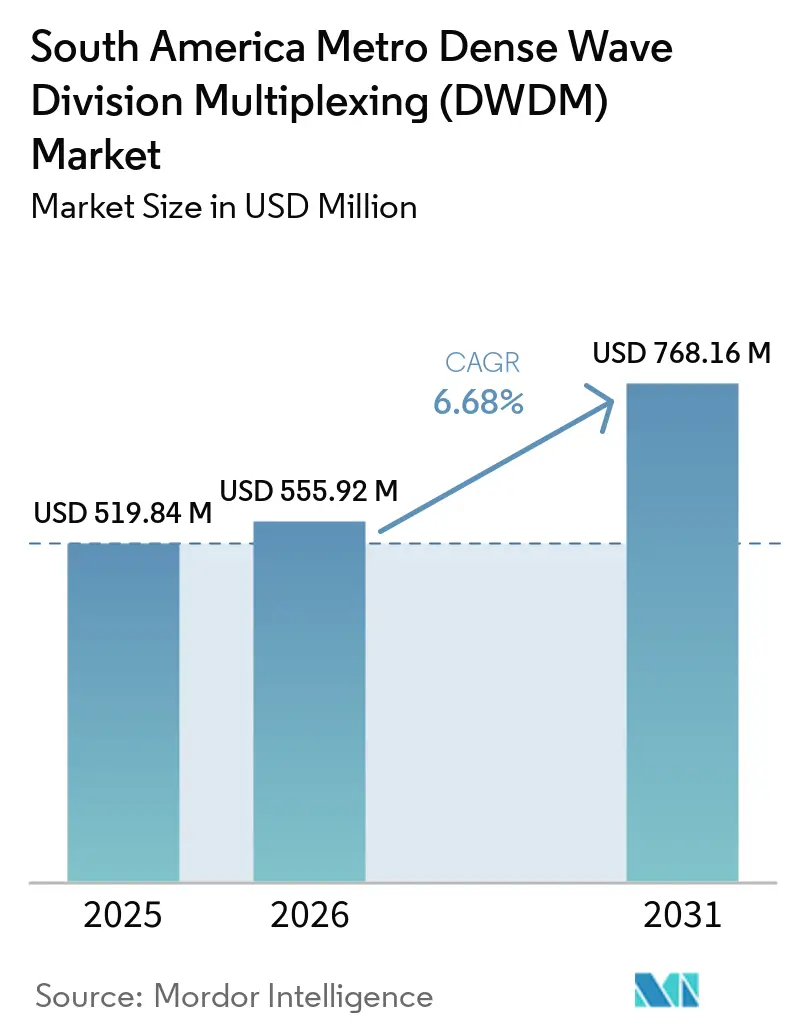
| Base Year Market Size (2025) | USD 519.84 Million |
| Market Size (2026) | USD 555.92 Million |
| Market Size (2031) | USD 768.16 Million |
| Growth Rate (2026 - 2031) | 6.68 % |
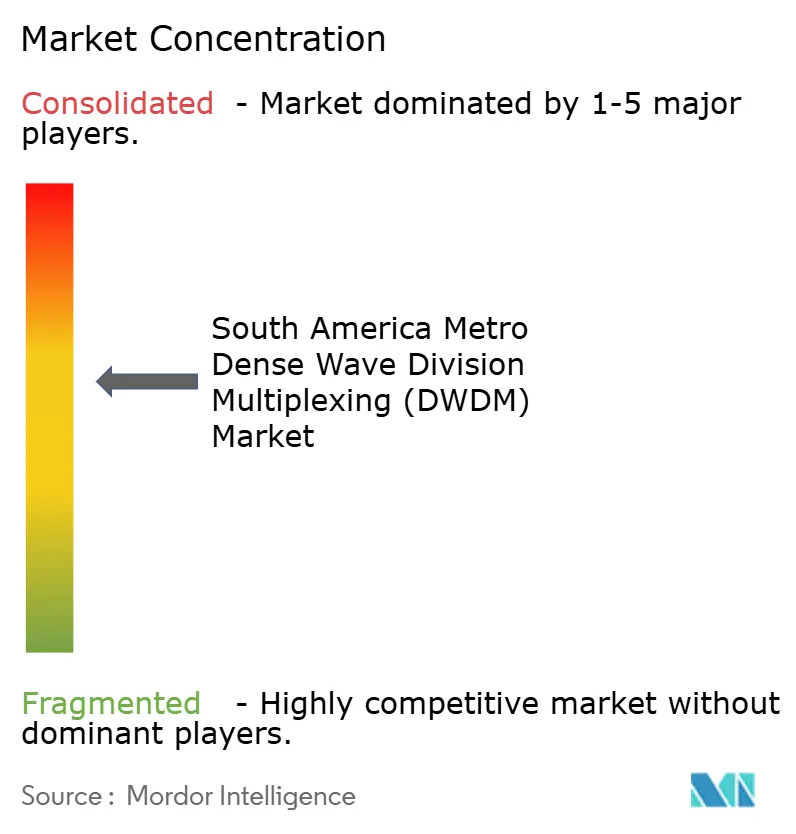
| Market Concentration | Medium |
Major Players *Disclaimer: Major Players sorted in no particular order Image © Mordor Intelligence. Reuse requires attribution under CC BY 4.0. | |
South America Metro Dense Wave Division Multiplexing (DWDM) Market Analysis by Mordor Intelligence
The South America Metro Dense Wave Division Multiplexing (DWDM) Market size is expected to grow from USD 519.84 million in 2025 to USD 555.92 million in 2026, and is forecast to reach USD 768.16 million by 2031, at a 6.68% CAGR over 2026-2031. Demand is shifting toward metropolitan optical networks as AI infrastructure, 5G transport needs, and fiber expansion require more capacity within major cities. Sao Paulo and Buenos Aires are receiving attention because data centers and mobile networks need low-latency connections between local network points. Brazil’s 5G coverage obligations make it difficult for operators to postpone part of the required fiber investment. Higher-capacity coherent optics and network automation are also changing equipment selection and procurement methods. Vendors that combine transport equipment, software management, local support, and regulatory knowledge are positioned to address these requirements.
Key Report Takeaways
- By component, hardware held 85.73% of the South America Metro Dense Wave Division Multiplexing (DWDM) Market in 2025, while software is projected to expand at a 10.17% CAGR through 2031.
- By transmission capacity, up to 100 Gbps accounted for 36.84% of the South America metro dense wave division multiplexing (DWDM) market in 2025, while above 400 Gbps is projected to expand at a 10.22% CAGR through 2031.
- By application, mobile backhaul and fronthaul accounted for 34.16% of the South America metro DWDM market in 2025, while data center interconnect is projected to expand at a 9.93% CAGR through 2031.
- By end-user, communication service providers held 67.78% of the South America metro DWDM market in 2025, while cloud and data center providers are projected to expand at a 10.16% CAGR through 2031.
- By country, Brazil held 66.42% of the South America metro dense wave division multiplexing (DWDM) market in 2025 and is projected to expand at a 7.07% CAGR through 2031.
Note: Market size and forecast figures in this report are generated using Mordor Intelligence’s proprietary estimation framework, updated with the latest available data and insights as of January 2026.
South America Metro Dense Wave Division Multiplexing (DWDM) Market Trends and Insights
Drivers Impact Analysis*
| Driver | (~) % Impact on CAGR Forecast | Geographic Relevance | Impact Timeline |
|---|---|---|---|
| 5G Mobile Backhaul and Fronthaul Upgrades | +2.1% | Brazil, with priority in cities above 200,000 population, and Argentina, including Buenos Aires, Cordoba, and Rosario | Short term (≤ 2 years) |
| Cloud and Hyperscale Data Center Interconnect Expansion | +1.8% | Brazil, including Sao Paulo, Fortaleza, and Rio de Janeiro, with spillover into Buenos Aires | Short term (≤ 2 years) |
| Migration to 400G and 800G Coherent Optics | +1.2% | Brazil, with spillover into Argentina and Chile | Medium term (2-4 years) |
| Fiberization and FTTH Aggregation | +0.9% | Brazil nationwide and Argentina, including Telecom Argentina and Claro buildouts | Medium term (2-4 years) |
| AI Workload Concentration in São Paulo Metro Hubs | +0.6% | Sao Paulo, Campinas, Barueri, and Fortaleza | Medium term (2-4 years) |
| Funding-Enabled Regional ISP DWDM Buildout | +0.4% | Brazil’s Midwest, North, and Northeast regions, plus secondary Argentine cities | Long term (≥ 4 years) |
| Source: Mordor Intelligence | |||
5G Mobile Backhaul and Fronthaul Capacity Upgrades
Brazil’s 5G standalone rollout reached 464 cities by the end of 2024. Anatel’s spectrum commitments require fiber backhaul at 530 municipal seats by December 31, 2026. This deadline establishes a defined period for transport investment by operators that need to meet coverage obligations. Mid-band 5G networks use fiber-based fronthaul because eCPRI traffic can exceed the capacity of older microwave connections. DWDM systems allow operators to add transport capacity where fiber already reaches base station areas. In Argentina, Telecom Argentina ended 2025 with 1,000 5G sites after adding more than 800 locations that year, and it targeted more than 2,000 sites by the end of 2026. The effect is concentrated in metropolitan aggregation networks rather than only in long-distance routes. Each new radio cluster needs adequate capacity between the access network and the metro core. Operators also need low latency at each aggregation point to support standalone 5G services. The South America metro dense wave division multiplexing (DWDM) market, therefore, benefits when coverage targets lead operators to increase fiber-backed transport capacity. Anatel’s 2025-2029 network plan identified 1,207 municipalities without optical backhaul, indicating continued work beyond the current rollout phase.[1]Agência Nacional de Telecomunicações, “Anatel Aprova Plano Estrutural de Redes de Telecomunicações, PERT, Edição 2025-2029,” Anatel Official Website, gov.br
Cloud and Hyperscale Data Center Interconnect Expansion
Sao Paulo has become the region’s main location for AI infrastructure and large data center campuses. These campuses require low-latency optical rings that connect availability zones and nearby facilities. This need differs from traditional traffic patterns that depended mainly on backbone links between cities. Ascenty secured 150 MW of new AI contracts and announced a USD 1.2 billion plan for 4 hyperscale data centers in the Sao Paulo metropolitan area.[2]Ascenty, “Ascenty Secures 150 Megawatts of New AI Contracts,” Ascenty, ascenty.com The plan includes a facility designed for large-scale AI workloads. These projects create direct demand for high-capacity metro data center interconnect links.
Fiberization and FTTH Aggregation
Fiber-to-the-home accounted for 77% of Brazil’s fixed broadband access by mid-2025. The metro aggregation layer must collect traffic from these access loops and carry it to backbone networks. Many secondary cities still need stronger optical aggregation at their metro nodes. That gap supports a replacement-and-expansion cycle for DWDM systems. Telefonica Brasil acquired full control of FiBrasil for BRL 850 million (USD 168 million). The transaction increased Vivo’s homes passed to 30.1 million across 444 cities. Network consolidation can influence transport purchasing even when there is no new greenfield build. A combined network often needs common equipment, operating procedures, and management tools across its footprint. This can lead acquirers to standardize previously mixed aggregation platforms.
Migration to 400G and 800G Coherent Optics
Higher-capacity transponders enable operators to make greater use of existing fiber assets. This is important in dense urban corridors where new duct construction can be difficult and costly. Padtec sold 1,000 TMD400G optical transponders across South America by mid-2025.[3]Padtec, “Padtec Reaches One Thousand Units Sold of Its 400G Optical Transponder,” Padtec, padtec.com.br Internet service providers accounted for 64% of these unit sales. The result shows that 400G coherent equipment has moved beyond a limited group of tier-1 operators. It also indicates that regional providers are preparing their transport networks for higher traffic levels. BR.Digital deployed Ciena WaveLogic 6 Extreme during August 2025 and achieved 1.1 Tb/s transmission on a single wavelength over links exceeding 800 km. The deployment demonstrated the use of high-capacity coherent technology across extended routes in Brazil.
Restraints Impact Analysis*
| Restraint | (~) % Impact on CAGR Forecast | Geographic Relevance | Impact Timeline |
|---|---|---|---|
| Imported Equipment Exposure and Financing Costs | -1.2% | Brazil and Argentina | Short term (≤ 2 years) |
| Shortage of Optical Engineering and Maintenance Skills | -0.8% | Brazil nationwide and Argentina’s urban centers | Long term (≥ 4 years) |
| Municipal Right-of-Way and Permitting Delays | -0.5% | Brazilian metro areas and Buenos Aires | Medium term (2-4 years) |
| Power and Site Constraints in Dense Metro Corridors | -0.3% | Sao Paulo and Buenos Aires metropolitan areas | Medium term (2-4 years) |
| Source: Mordor Intelligence | |||
High Imported-Equipment Exposure and Financing Costs
Brazil depends on imported equipment for 75-85% of the value of DWDM hardware. This exposure became more significant after GECEX Resolution 852/2026 raised duties on selected IT and telecommunications products in February 2026. The listed rates were 7.2%, 12.6%, or 20%, depending on product classification. Optical transport apparatus can face headline import duties of 12-16% before IPI and ICMS are added. Operators that do not qualify for the ex-tariff program may face total landed-cost increases of 40-60%. The ex-tariff process averages 180 days, which can extend equipment planning. Brazil also applied a definitive anti-dumping duty of USD 2.42 per kilogram on optical fiber cables from China for 5 years. This adds a separate cost element for projects that require new fiber and active transport equipment. Argentina faces high benchmark interest rates and periodic foreign exchange restrictions. Those conditions can extend financing cycles for imported coherent optical systems. Locally assembled systems and access to domestic financing can therefore affect vendors’ commercial position.
Shortage of Specialized Optical Engineering and Maintenance Skills
Brazil trains 53,000 technology professionals each year, while demand is 159,000.[4]Brasscom, “Brazil Trains Only 53,000 Technology Professionals per Year, but the Market Needs 159,000,” Brasscom, brasscom.org.br The reported shortfall reached 530,000 positions across 2021-2025. Optical networking positions are among the more specialized roles within that skills gap. Coherent optical networks need staff who can commission ROADMs, troubleshoot OSNR issues, and plan WDM links. These tasks require knowledge of photonics and vendor-specific field experience. The available evidence indicates that companies have difficulty finding people with this combination of skills.
*Our forecasts treat driver/restraint impacts as directional, not additive. The impact forecasts reflect baseline growth, mix effects, and variable interactions.
Segment Analysis
By Component: Software Management Supports a Hardware-Led Base
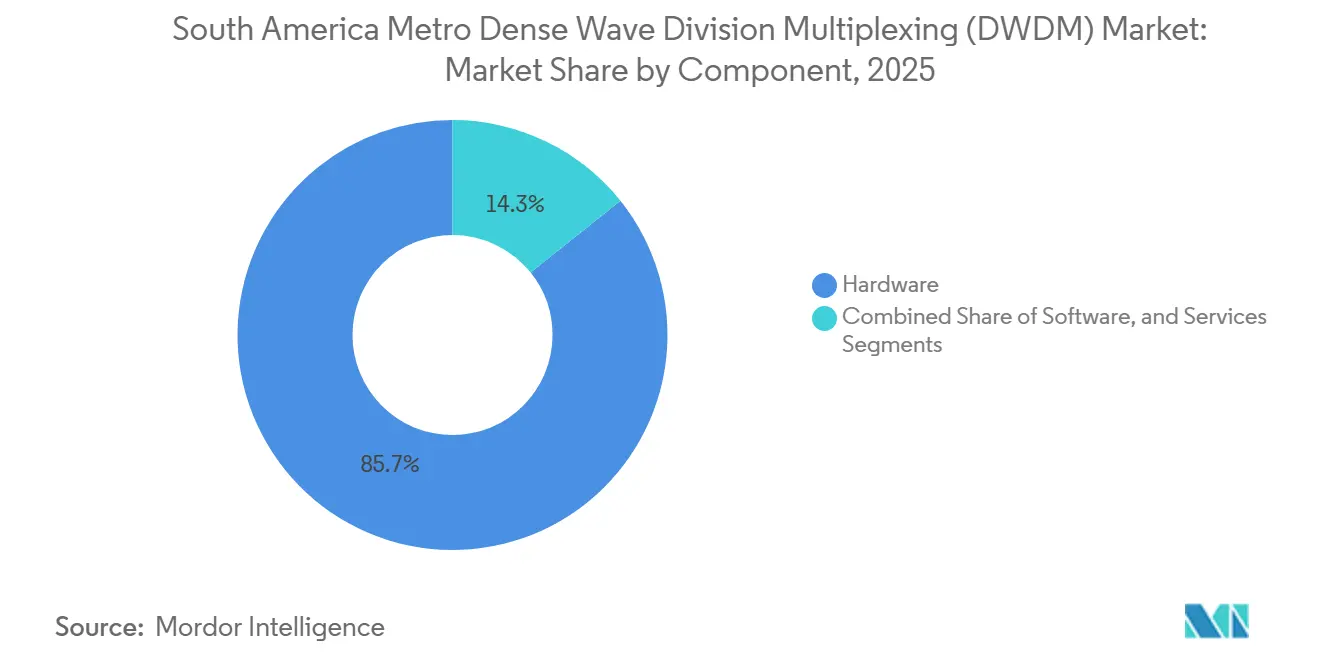
Hardware held 85.73% of the South America Metro DWDM market share in 2025. The share reflected the capital required for 400G coherent line cards and flex-grid ROADM chassis. These systems remain central to major network construction projects across the region. Hardware spending also includes equipment needed to expand capacity at established metro sites. Services account for the remaining component demand through integration, deployment, and support contracts. NEC coordinated system integration for Eletronet’s backbone modernization, spanning 8,000 km of new fiber routes across 23 Brazilian states.
Software is projected to expand at a 10.17% CAGR through 2031, the highest rate among components. Operators use software to manage multivendor networks, automate wavelength provisioning, and analyze performance across layers. These functions become more valuable as networks add more sites and higher-capacity wavelengths. Adtran introduced a terabit-scale edge router in 2026 that integrates with its FSP 3000 IP OLS and ZR or ZR+ coherent optics. The design extends 400G edge transport and reduces the need for separate transponder equipment. Software management can consequently become a larger part of each deployed network element.



By Transmission Capacity: Higher Speeds Change Metro Network Economics
The up-to-100 Gbps tier accounted for 36.84% of the South America metro dense wave division multiplexing (DWDM) market in 2025. Its position reflects a sizeable installed base of older metro systems. Many operators have not reached the financial threshold to fully replace these systems. The 200 Gbps and 400 Gbps tiers serve as transition options for operators upgrading selected core nodes. This approach allows operators to improve key routes while retaining older equipment in aggregation rings. It also supports equipment demand across more than 1 speed tier simultaneously.
The above-400 Gbps segment is projected to expand at a 10.22% CAGR through 2031. The segment is supported by data center interconnect routes between hyperscale campuses and colocation facilities in Brazil. Scala Data Centers, Lightera, and Nokia completed South America’s first AccuCore hollow-core fiber proof of concept at Scala’s Sao Paulo campus in November 2025. Nokia’s 1830 PSI-M platform and sixth-generation PSE-6 photonic chipset were used in the demonstration. The project showed a possible path to higher wavelength capacity over time. Its relevance lies in testing capacity improvements that could reduce limitations of conventional single-mode fiber.
By Application: Data Center Interconnect Adds New Demand
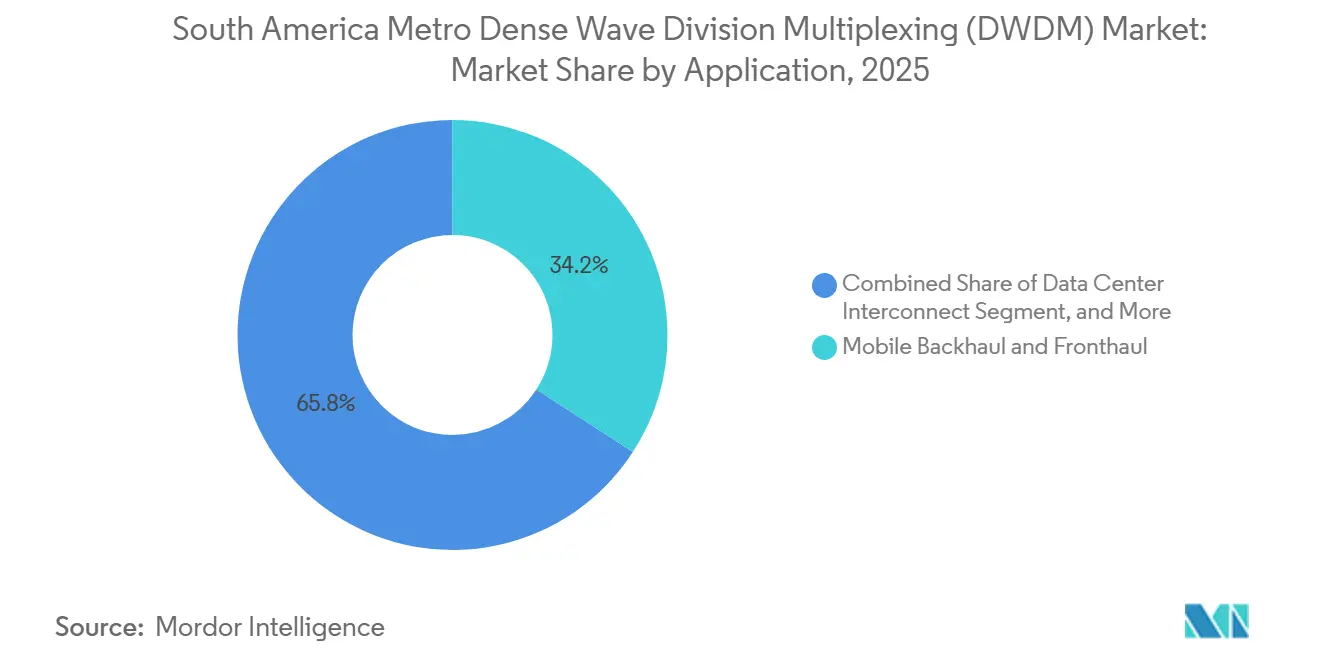
Mobile backhaul and fronthaul held 34.16% of the South America Metro DWDM market share in 2025. Binding 5G rollout requirements in Brazil and Argentina supported the application’s leading position. Each expansion of a mobile radio cluster increases the need for fiber-based transport at metro aggregation sites. Backhaul links carry traffic from cell sites toward core networks. Fronthaul links support the connection between radio units and centralized processing functions. The application remains tied closely to the pace of 5G deployment and fiber availability.
Data center interconnect is projected to expand at a 9.93% CAGR through 2031. Tecto Data Centers deployed 864 optical fibers using rollable ribbon technology with V.tal and Lightera during August 2026. The deployment interconnected its TFOR2 and TFOR3 facilities in Fortaleza. This project showed that data center interconnect investment is moving beyond Sao Paulo to other AI and cloud locations. Broadband aggregation also remains important, as regional internet service providers upgrade metro rings. Utility networks, government optical services, and private enterprise networks provide a stable group of other applications.
By End-User: Cloud Providers Gain Influence in Equipment Buying
Communication service providers held 67.78% of the South America Metro DWDM market share in 2025. Their position is based on the simultaneous operation of 5G sites, fiber broadband networks, and long-distance backbone routes. This combination creates a broad need for metro transport capacity among service providers. They remain important buyers of equipment, integration services, and network management systems. Government organizations also support demand through connectivity programs. Brazil’s Norte Conectado initiative allocated BRL 1.3 billion (USD 254.85 million) for 12,000 km of river-submerged fiber in the Amazon region.
Cloud and data center providers are projected to expand at a 10.16% CAGR through 2031. These buyers are increasing their role as new facilities need direct optical connections between sites. Their 3-6-month procurement windows are shorter than the 12-18-month cycles common in telecom procurement. This changes the timing of supplier engagement and commercial planning. Enterprises also represent a distinct source of demand. Silica Networks extended fiber to lithium mining sites in Salta, Argentina, during August 2026, showing an early use case for optical transport in industrial locations.
Geography Analysis
Brazil accounted for 66.42% of the South America Metro DWDM market size in 2025 and is projected to expand at a 7.07% CAGR through 2031. Its demand combines 5G compliance activity, data center construction, and investment in neutral optical infrastructure. Sao Paulo accounted for around 76% of Brazil’s live data center capacity. New campuses from Ascenty, Equinix, Odata, and Ada Infrastructure are adding AI-ready capacity across the Campinas, Osasco, and Barueri corridor. Each site becomes a local demand point for data center interconnect rings.
Google’s Firmina submarine cable is due to enter service in 2026 and will connect the United States East Coast to Brazil, Uruguay, and Argentina. The 14,517 km system adds international traffic that must be distributed at landing points in Sao Paulo and Rio de Janeiro. This increases the importance of local optical capacity around those locations. Anatel’s 2025-2029 plan identified 1,207 municipalities without optical backhaul. The plan provides a continuing framework for network investment after the main 5G rollout period. Brazil’s broad geography means that regional routes and metro aggregation upgrades must progress together.
Argentina is the second-largest market, with spending concentrated in Buenos Aires and, to a lesser extent, Cordoba and Rosario. Telecom Argentina reported ARS 1.48 trillion (USD 1.02 billion) in capital expenditure during 2025. Claro Argentina committed USD 500 million for 2026 across fiber, 5G, and its first Buenos Aires data center. Telecentro’s USD 400 million migration from hybrid fiber-coaxial to fiber was 25% complete in 2026 and progressed at 225,000-250,000 homes each quarter. Peru is also gaining attention after AWS launched 100 Gbps Direct Connect connections with MACsec encryption at the Cirion Lima data center in July 2026.
Competitive Landscape
The South America metro dense wave division multiplexing (DWDM) market is moderately concentrated, with Huawei Technologies, Nokia, and Ciena holding the largest revenue positions. Padtec has a differentiated role in Brazil as the only domestically listed optical systems manufacturer with access to BNDES-eligible project financing. This access matters where imported equipment costs and financing conditions influence project decisions. Silica Networks Argentina, Datacom, Smartoptics, Ribbon Communications, and PacketLight Networks serve selected opportunities in internet service provider aggregation, compact metro systems, and data center interconnect. These companies address use cases in which buyers may seek a narrower product scope or more flexible commercial engagement.
Nokia participated in Eletronet’s 2026 modernization project through its 1830 PSS and GX platforms. It also supported the Scala, Lightera, and Nokia hollow-core fiber proof-of-concept in 2025 through its 1830 PSI-M optical platform. These projects demonstrate Nokia’s presence in both large backbone modernization and early-stage optical technology trials. Ciena’s WaveLogic 6 Extreme was deployed by BR.Digital in August 2025 for a 1.1 Tb/s single-wavelength transmission over links of more than 800 km. The result supported Ciena’s position in the above-400G capacity category.
Padtec signed a distribution agreement with Argentina’s Grupo Datco in July 2026. The agreement covers Padtec DWDM equipment, routers, and switches across Argentina, Brazil, Chile, Peru, Puerto Rico, and Uruguay. It builds on an 18-year relationship between Padtec and Datco subsidiary Silica Networks. Padtec also created Padtec Marine Networks and acquired an 85% stake in LEV Brasil in June 2026. These actions extend the company’s participation in submarine and coastal optical infrastructure.
South America Metro Dense Wave Division Multiplexing (DWDM) Industry Leaders
Huawei Technologies Co., Ltd.
Nokia Corporation
Ciena Corporation
Padtec S.A.
PacketLight Networks Ltd.
- *Disclaimer: Major Players sorted in no particular order

Recent Industry Developments
- August 2026: Tecto Data Centers, in partnership with V.tal and Lightera, deployed 864 optical fibers using rollable ribbon technology to interconnect its TFOR2 and TFOR3 facilities in Fortaleza, supporting growth in AI and cloud workloads in one of South America’s emerging hyperscale locations.
- August 2026: DE-CIX and Eletronet announced a partnership to expand Brazil’s interconnection infrastructure. The partnership uses Eletronet’s 18,000 km OPGW network and 170 Edge Data Centers, with expansion planned to 26,000 km and 255 Edge Data Centers across 23 states by the end of 2026.
- July 2026: Padtec signed a strategic distribution agreement with Argentina’s Grupo Datco to distribute DWDM equipment, routers, and switches across Argentina, Brazil, Chile, Peru, Puerto Rico, and Uruguay.
- July 2026: AWS expanded Direct Connect at the Cirion Lima data center to 100 Gbps dedicated connections with MACsec encryption, the first such capacity in Peru.


South America Metro Dense Wave Division Multiplexing (DWDM) Market Report Scope
The South America metro dense wave division multiplexing (DWDM) market revenue is generated through the sale of DWDM hardware, software licenses and subscriptions, and associated deployment, integration, network management, maintenance, and support services provided to communication service providers, cloud and data center providers, enterprises, government organizations, and other end-users.
The South America metro dense wave division multiplexing (DWDM) market report is segmented by component (hardware, software, and services), transmission capacity (up to 100 Gbps, 200 Gbps, 400 Gbps, and above 400 Gbps), application (data center interconnect, mobile backhaul and fronthaul, broadband and access network aggregation, and other applications), end-user (communication service providers, cloud and data center providers, enterprises, and government and public sector), and country (Brazil, Argentina, and rest of South America). The market forecasts are provided in terms of value (USD).
| Hardware |
| Software |
| Services |
| Up to 100 Gbps |
| 200 Gbps |
| 400 Gbps |
| Above 400 Gbps |
| Data Center Interconnect |
| Mobile Backhaul and Fronthaul |
| Broadband and Access Network Aggregation |
| Other Applications |
| Communication Service Providers |
| Cloud and Data Center Providers |
| Enterprises |
| Government and Public Sector |
| Brazil |
| Argentina |
| Rest of South America |
| By Component | Hardware |
| Software | |
| Services | |
| By Transmission Capacity | Up to 100 Gbps |
| 200 Gbps | |
| 400 Gbps | |
| Above 400 Gbps | |
| By Application | Data Center Interconnect |
| Mobile Backhaul and Fronthaul | |
| Broadband and Access Network Aggregation | |
| Other Applications | |
| By End-User | Communication Service Providers |
| Cloud and Data Center Providers | |
| Enterprises | |
| Government and Public Sector | |
| By Country | Brazil |
| Argentina | |
| Rest of South America |


Key Questions Answered in the Report
What is the South America metro dense wave division multiplexing (DWDM) market size?
The South America metro dense wave division multiplexing (DWDM) market size is estimated at USD 555.92 million in 2026 and is forecast to reach USD 768.16 million by 2031.
What is driving demand for metro DWDM systems in South America?
5G backhaul requirements, AI-oriented data center construction, fiber access expansion, and higher-capacity coherent optics are supporting demand.
Which country leads metro dense wave division multiplexing (DWDM) demand in South America?
Brazil held 66.42% share in 2025 and is projected to expand at a 7.07% CAGR through 2031.
Which application is expanding fastest through 2031?
Data center interconnect is projected to expand at a 9.93% CAGR through 2031 as facilities need low-latency optical links.
Which end users are increasing purchases most quickly?
Cloud and data center providers are projected to expand at a 10.16% CAGR through 2031, supported by new campus development.
What constraints affect deployment of metro optical systems?
Import costs, financing conditions, shortages of specialized optical skills, permitting delays, and dense-site power limitations can delay deployment.
Page last updated on:





