
Market Overview
| Study Period | 2020 - 2031 |
|---|---|
| Forecast Data Period | 2026 - 2031 |
| Base Year Market Size (2025) | USD 9.40 Billion |
| Market Size (2026) | USD 9.73 Billion |
| Market Size (2031) | USD 11.56 Billion |
| Growth Rate (2026 - 2031) | 3.51 % |
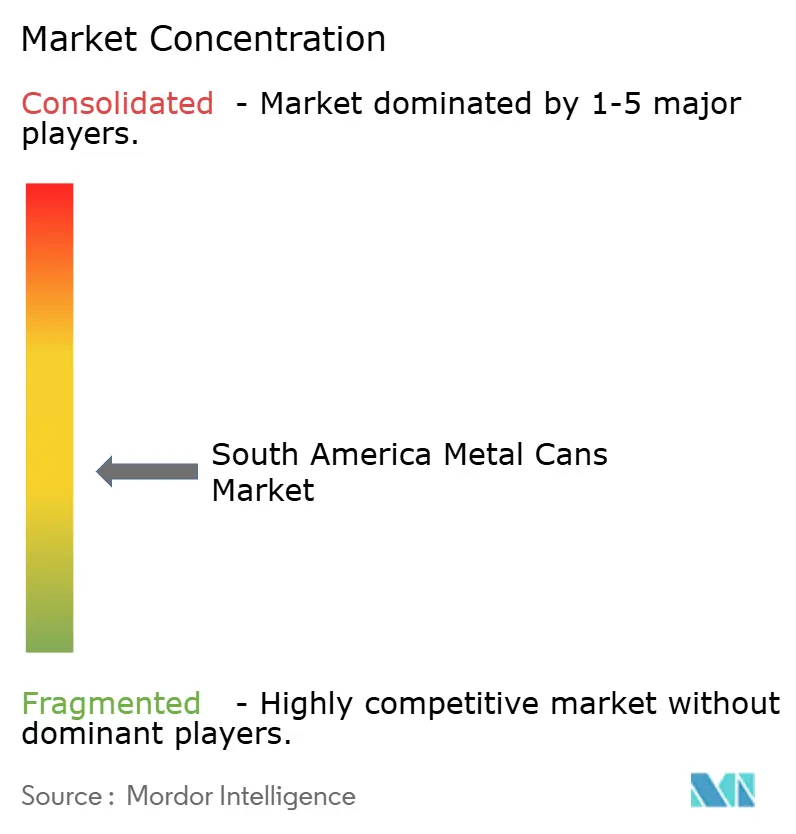
| Market Concentration | Medium |
Major Players *Disclaimer: Major Players sorted in no particular order Image © Mordor Intelligence. Reuse requires attribution under CC BY 4.0. | |
South America Metal Cans Market Analysis by Mordor Intelligence
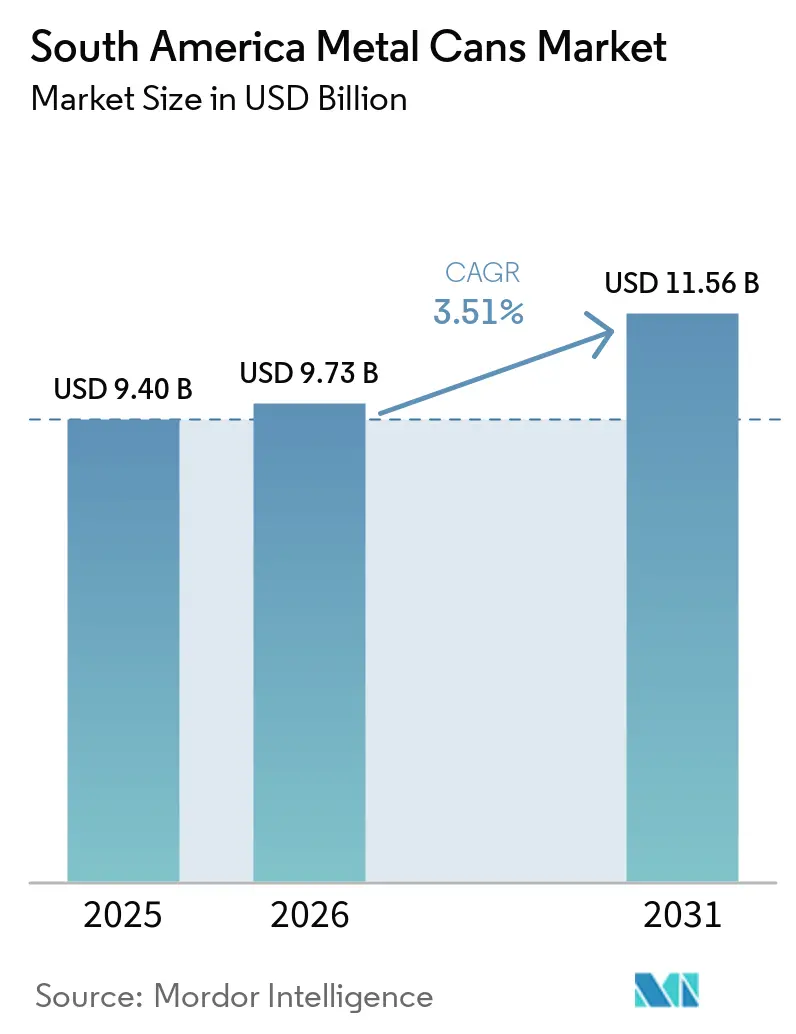
The South America Metal Cans Market size was valued at USD 9.40 billion in 2025 and estimated to grow from USD 9.73 billion in 2026 to reach USD 11.56 billion by 2031, at a CAGR of 3.51% during the forecast period (2026-2031). Aluminum can demand remains tied to a broad beverage base that now includes energy drinks, ready-to-drink beverages, canned water, and established beer and carbonated soft drink lines. Brazil’s recovery system supports a steady supply of secondary aluminum and strengthens metal packaging’s position in procurement decisions. Producers are adding capacity where beverage demand is rising and where retail distribution supports high-volume can formats. The South America Metal Cans Market also faces input-cost exposure because aluminum and steel prices affect converter margins and customer pricing. Competition from PET, glass, and flexible packaging remains a key factor in price-sensitive beverage and food categories.
Key Report Takeaways
- By material type, aluminum held 68.47% of the South America Metal Cans Market share in 2025, while aluminum is forecast to grow at a CAGR of 4.83% through 2031.
- By can structure, two-piece cans held 74.21% share in 2025, while monobloc aerosol cans are forecast to grow at a CAGR of 5.12% through 2031.
- By capacity and size, the 250-500 ml tier held 51.84% South America Metal Cans Market share in 2025, while the sub-250 ml tier is forecast to grow at a CAGR of 4.69% through 2031.
- By manufacturing process, drawn and ironed production held 81.36% share in 2025, while impact extrusion is forecast to grow at a CAGR of 4.77% through 2031.
- By end-user industry, beverages held 62.93% share in 2025, while energy drinks are forecast to grow at a CAGR of 5.24% through 2031.
- By geography, Brazil held 58.19% of the South America Metal Cans Market share in 2025, while the Rest of South America is forecast to grow at a CAGR of 4.56% through 2031.
Note: Market size and forecast figures in this report are generated using Mordor Intelligence’s proprietary estimation framework, updated with the latest available data and insights as of January 2026.
Market Trends and Insights
Category Diversification in Beverages Redefining Can Demand
Abralatas reported 34.1 billion aluminum beverage cans sold in Brazil in 2025, the second-highest annual volume recorded by the association. Beer and carbonated soft drink volumes declined slightly, but canned water, energy drinks, ready-to-drink beverages, juices, and canned cachaça supported demand. Canned water sales increased 24% from 2024, which showed that consumption was broadening beyond traditional beverage categories. Abralatas expects a renewed growth cycle in 2026 as recent investments mature and the consumption calendar includes extended holidays and the FIFA World Cup. This mix gives can makers opportunities to serve a broader set of beverage pack sizes and brand formats. The South America Metal Cans Market benefits when new beverage categories adopt familiar can-filling and distribution systems.
Aluminum Recycling and Circular Economy Momentum Shaping Procurement
Brazil recycled 97.3% of aluminum beverage cans sold in 2024, according to Recicla Latas and its independent audit process. The rate had remained above 95% for more than 15 consecutive years, and the system had reached 100% in 2022 and 2025. Recycling secondary aluminum uses 5% of the energy required for primary aluminum production from bauxite. Abralatas stated that Brazil’s aluminum can value chain avoided more than 18 million tonnes of greenhouse gas emissions over the past decade. The collection network gives the South America Metal Cans Market a practical supply and environmental advantage over packaging formats with weaker recovery systems.[1]
Urbanization, Income Growth, and Modern Retail Expanding Demand
Higher household incomes and broader access to modern retail are supporting demand for packaged goods in Brazil and Colombia. This shift brings more consumers into categories that rely on standardized, portable packaging. Ball’s beverage packaging business in South America generated USD 2.16 billion in 2025 revenue, compared with USD 1.95 billion in 2024. The company linked the increase to volume growth and a stronger price mix, including demand for premium sleek cans. Retail growth, therefore, supports both higher volumes and a wider range of can specifications. The South America Metal Cans Market has greater access to consumers as formal retail and digital ordering channels expand.[2]
Manufacturing Process Innovation Improving Yield and Product Fit
Drawn and ironed technology supports high-volume beverage production by using less metal per container and operating at high line speeds. The process achieved wall-thickness tolerances below 0.1 mm for standard beverage cans in the supplied analysis. This efficiency supports the South America Metal Cans Market, where material cost remains central to converter economics. Impact extrusion serves a different requirement by producing seam-free containers for aerosol, personal care, and pharmaceutical uses. Aluminum monobloc containers provide pressure resistance, decoration flexibility, and recyclability for these applications. These separate process choices enable the South America Metal Cans Market to meet both mass-volume and specialty packaging requirements.
Restraints Impact Analysis of South America Metal Cans Market*
| Restraint | (~) % Impact on CAGR Forecast | Geographic Relevance | Impact Timeline |
|---|---|---|---|
| Aluminum and Steel Price Volatility and Tariff Pressure | -0.8% | Argentina and other South American markets with limited pass-through coverage | Short term (≤ 2 years) |
| Weak Reverse Logistics and Recycling Infrastructure | -0.2% | Bolivia, Ecuador, Peru, Venezuela, and parts of Argentina | Long term (≥ 4 years) |
| Currency Depreciation and Inflation Exposure | -0.1% | Argentina and other South American markets with local-currency cost pressure | Short term (≤ 2 years) |
| Weak Reverse Logistics and Recycling Infrastructure | -0.2% | Bolivia, Ecuador, Peru, Venezuela, and parts of Argentina | Long term (≥ 4 years) |
| Source: Mordor Intelligence | |||
Aluminum and Steel Price Volatility Creating Margin Pressure
Aluminum and steel price movements create immediate pressure on can converters with limited pass-through provisions. Regional recycling networks reduce some exposure, yet producers remain linked to primary metal pricing and local currency movements. Ball reported that sales in the South America segment rose 24% year over year to USD 591 million in the second quarter of 2026. The company said higher aluminum prices contributed to the increase, indicating that cost recovery varied across customers. The South America Metal Cans Market will remain exposed to raw material inflation outpacing contracted selling prices.
PET, Glass, and Flexible Packaging Competing for Applications
PET bottles, glass, and flexible pouches remain established options in lower-priced beverage and food products. Returnable glass and lightweight PET can retain logistics advantages in selected channels. This limits metal containers' ability to win every stock-keeping unit, even where performance is favorable. Flexible formats are particularly relevant for food products that do not need the pressure resistance or shelf-life profile of steel cans. The South America Metal Cans Market, therefore, depends on product categories where portability, rapid chilling, barrier protection, and visual differentiation matter most. It is strongest where brands place value on handling, cooling performance, and printed presentation.
*Our forecasts treat driver/restraint impacts as directional, not additive. The impact forecasts reflect baseline growth, mix effects, and variable interactions.
South America Metal Cans Market Segment Analysis
By Material Type:
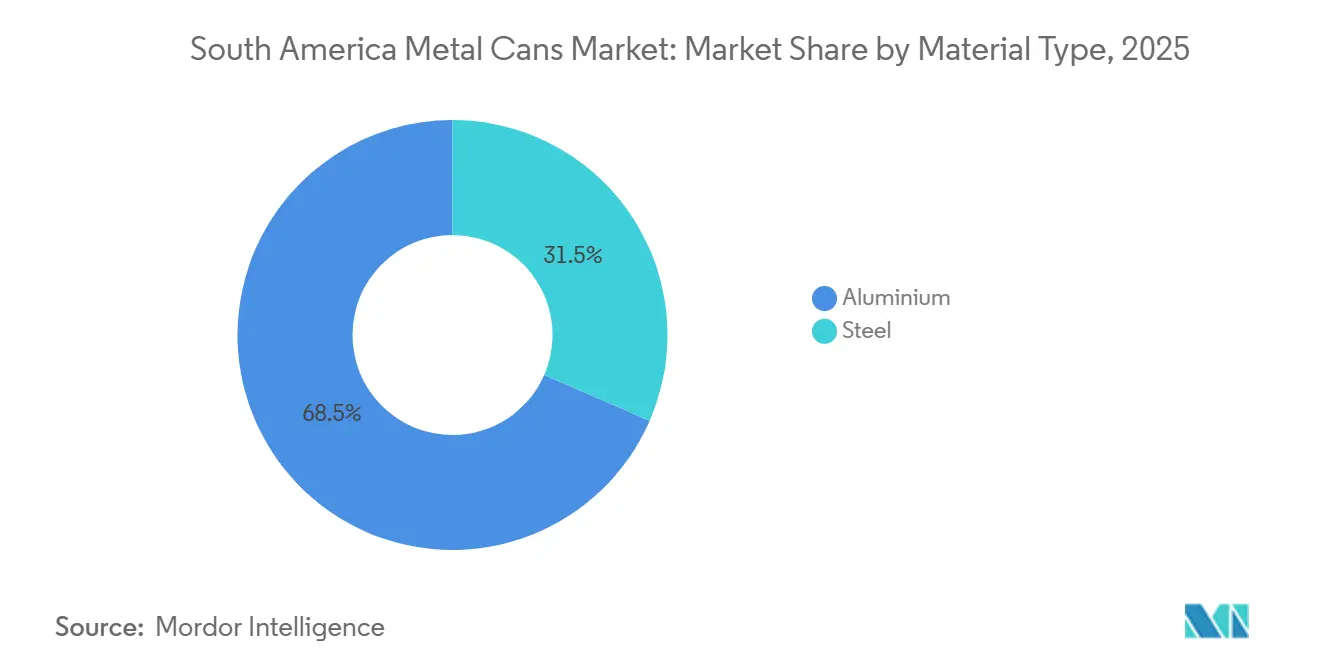
Aluminum Extends Its Lead Through Beverage DemandAluminum held a 68.47% regional value share in 2025 and is forecast to grow at a 4.83% CAGR through 2031. Its lead reflects the scale of beverage can lines and the country’s established collection and recycling system. Ball shipped nearly 20 billion aluminum containers from 12 South American facilities in 2025. The company identified an addressable regional aluminum beverage can base of nearly 43 billion containers. Aluminum offers low weight and broad design flexibility for beverage brands.
Steel remains relevant in fish and seafood, processed food, and industrial chemical packaging. These products use steel where durability, processing requirements, and shelf life are important. The material has lost ground in beverage applications as aluminum formats expanded. Ardagh’s Brazilian facilities recorded 14% year-over-year volume growth in the first quarter of 2026. The company attributed the result to a stronger category mix, including energy drinks and canned water.[3]
By Can Structure:
Two-Piece Cans Lead as Monobloc Aerosols AdvanceTwo-piece cans accounted for 74.21% regional value share in 2025. Their position comes from use across beer, carbonated soft drinks, and energy drinks. High-speed drawn and ironed lines support low unit costs in these high-volume formats. Two-piece designs are also well-suited to conventional beverage diameters and filling systems. Their established base keeps them central to the South America Metal Cans Market.
Monobloc aerosol cans are forecast to grow at a CAGR of 5.12% through 2031. Personal care and cosmetics brands use the structure because it has no side seam and maintains pressure integrity. The format also supports full-surface decoration and shaped external designs. Three-piece cans continue to play a role in food processing, including packaging for fruit, vegetables, and seafood. Smaller-diameter drawn-and-ironed technology is increasing competitive pressure on three-piece formats.
By Capacity and Size:
Mid-Range Formats Remain the Volume BaseThe 250-500 ml tier accounted for 51.84% of regional value share in 2025. Standard 350 ml and 473 ml beer cans underpin much of its demand in Brazil, Argentina, and Chile. The size is familiar to consumers and fits high-volume beverage distribution. It also supports carbonated soft drinks and several ready-to-drink formats. This tier remains the main operating base for established beverage lines.
The sub-250 ml tier is forecast to grow at a CAGR of 4.69% through 2031. Single-serve energy drinks and canned water are driving demand for compact formats. Abralatas reported that canned water sales in Brazil increased 24% in 2025. Ardagh supplies 269 ml and 355 ml sleek cans alongside standard formats in Brazil. This wider size range helps converters meet demand without moving away from established aluminum can technology.
By Manufacturing Process:
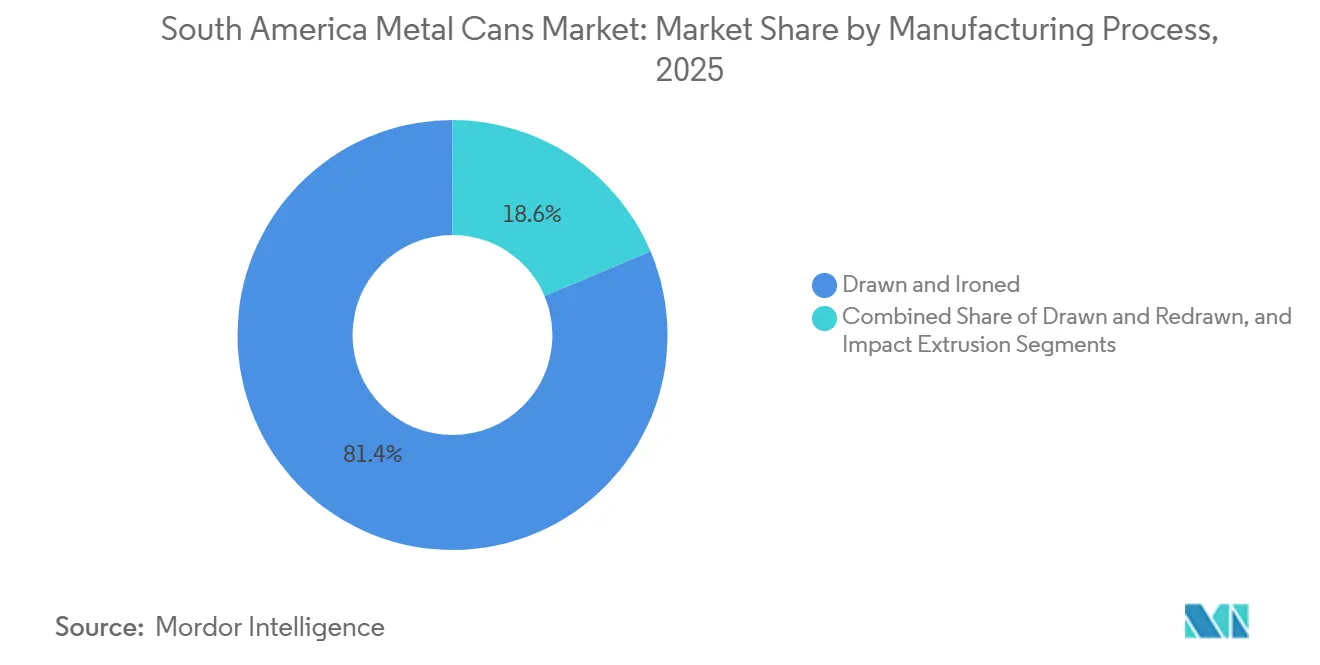
Drawn and Ironed Lines Set the Cost BaseDrawn and ironed production accounted for 81.36% of the regional value share in 2025. The process aligns with a beverage-heavy demand profile and high-speed filling lines. It supports aluminum efficiency at standard beverage volumes. The process remains appropriate for beer, carbonated soft drinks, and energy drinks. This cost position is maintained across major can manufacturing sites.
Impact extrusion is forecast to grow at a CAGR of 4.77% through 2031. The process is used to produce aluminum monobloc aerosol containers for personal care and pharmaceutical applications. It creates a seamless package that can withstand internal pressure. This capability supports deodorant, hair care, and spray products. The South America Metal Cans Market can therefore serve both high-volume beverages and smaller premium aerosol uses.

By End-User Industry:
Beverages Lead While Food and Personal Care Add DemandBeverages accounted for 62.93% of the regional value share in 2025. Beer and carbonated soft drinks remained the largest-volume uses despite a modest decline in Brazil during 2025. Energy drinks are the fastest-growing beverage subsegment at a CAGR of 5.24% through 2031. New beverage categories provide manufacturers with demand that is less dependent on traditional beer volumes. This keeps beverage production at the center of capacity planning.
Food applications support the demand for steel cans for seafood, fruit, vegetables, and wet pet food. The South America pet food sector was valued at USD 16.09 billion in 2026 and is forecast to reach USD 24.01 billion by 2031 at a CAGR of 8.33%. This demand supports wet pet food volumes without requiring a separate packaging estimate. Personal care and industrial users add demand for aerosols, paints, automotive fluids, and lubricants. These uses give the South America Metal Cans industry exposure beyond mainstream beverages.
Geography Analysis
Brazil Metal Cans Market
Brazil held 58.19% regional value share in 2025. A large aluminum beverage anchor anchors the country’s scale base and an advanced collection system. Abralatas reported sales of 34.1 billion aluminum beverage cans in Brazil during 2025. Recicla Latas reported a 97.3% recycling rate for beverage cans sold in 2024. The South America metal cans market in Brazil benefits from local production, availability of recycled materials, and established beverage demand.
Minas Gerais and Paraná Metal Cans Market
Brazil’s food packaging rules and aluminum can quality standards support localized supply. Ball reopened its Pouso Alegre facility in Minas Gerais in 2025 to serve regional beverage demand. Crown is adding a third line at its Ponta Grossa facility in Paraná. The project will expand annual capacity from 2.4 billion to 3.6 billion cans. Commercial production from the line is expected in the third quarter of 2026.[4]
South America Metal Cans Market
Argentina remains a major user of steel food cans for seafood, fruit, and vegetables, as well as for automotive fluid applications, while currency volatility and inflation continue to affect converter margins and investment visibility. The Rest of South America is forecast to grow at a CAGR of 4.56% through 2031. Chile supports demand for industrial chemicals and seafood, while Colombia is attracting investment for aluminum beverage capacity. CANPACK began construction of a plant near Barranquilla in early 2026, with an annual capacity of 1 billion can bodies and commercial production targeted for the first quarter of 2027.
Competitive Landscape
The South America Metal Cans Market is concentrated in aluminum beverage cans and more dispersed in steel food and industrial products. Ball stated that 4 companies account for substantially all aluminum beverage containers in the South American markets it serves. Ball held an estimated 46% share of regional aluminum beverage can shipments in 2025. This position reflects its regional manufacturing footprint and established customer relationships. Crown Holdings and Ardagh Metal Packaging are Ball’s principal competitors in aluminum beverage cans.
Crown announced a third high-speed line for its Ponta Grossa plant in May 2025, which will increase annual capacity from 2.4 billion to 3.6 billion cans. Ardagh’s Brazilian operations reported 14% year-over-year volume growth in the first quarter of 2026. CANPACK started construction of its second Colombian aluminum beverage can plant in March 2026. A long-term agreement with Bavaria supported the project and targets 1 billion cans a year.
Food cans and aerosols provide room for specialist producers because their production needs differ from high-speed beverage lines. Argentine and Chilean companies retain positions in seafood and agricultural canning. Ardagh Metal Packaging Brasil received the Aluminum Stewardship Initiative Performance Standard certification in February 2026. Sustainability certification may become a supplier qualification requirement for global beverage brands. Producers without comparable credentials could face a weaker position in premium brand supply chains.
South America Metal Cans Industry Leaders
-
Ball Corporation
-
Crown Holdings, Inc.
-
Ardagh Metal Packaging S.A.
-
CANPACK Group, Inc.
-
Silgan Holdings Inc.
- *Disclaimer: Major Players sorted in no particular order
South America Metal Cans Market Companies Covered in this Report
- Ball Corporation
- Crown Holdings, Inc.
- Ardagh Metal Packaging S.A.
- Silgan Holdings Inc.
- CANPACK Group, Inc.
- Toyo Seikan Group Holdings, Ltd.
- CPMC Holdings Limited
- Showa Denko K.K.
- Mauser Packaging Solutions Holding Company
- DS Containers, Inc.
- CCL Container Inc.
- Independent Can Company
- Hindustan Tin Works Limited
- Saudi Arabian Packaging Industry Company
- Kian Joo Can Factory Berhad
- Colep Packaging S.A.
- Can-One Berhad
- Massilly Holding SAS
- Universal Can Corporation
- Pacific Can China Holdings Limited
- Brasilata S.A. Embalagens
- Envases del Plata S.A.
- Impress Brasil Embalagens Metálicas Ltda.
- Metalgráfica Industria e Comércio Ltda.
Recent Industry Developments in South America Metal Cans Market
- August 2026: Ball Corporation reported Q2 2026 South America segment sales of USD 591 million, up from USD 477 million in Q2 2025, reflecting higher aluminum beverage can volumes and favorable price and mix across Brazil, Argentina, Chile, and Paraguay. The results demonstrated demand resilience despite macroeconomic uncertainty and elevated raw material costs. Higher aluminum prices contributed to reported sales growth because some costs were passed through to customers. This update showed that pricing discipline remained important across the South America Metal Cans Market.
- March 2026: Construction began on CANPACK's second aluminum beverage can plant in Colombia, representing COP 548 billion (USD 140 million) in investment for capacity of 1 billion can bodies per year, with commercial production targeted for Q1 2027. The investment is backed by a long-term agreement with Bavaria. The project adds capacity outside Brazil as the South America Metal Cans Market develops across more national beverage systems.
- February 2026: Ardagh Metal Packaging Brasil received Aluminum Stewardship Initiative Performance Standard certification. The certification confirmed that its Brazilian facilities met sustainability, supply-chain traceability, and responsible sourcing requirements. The facilities have combined aluminum beverage can capacity exceeding 6 billion units annually. The certification can support supplier qualification as sustainability expectations grow in the South America Metal Cans Market.
- February 2026: Ball Corporation released its 2025 Annual and Sustainability Report. It disclosed that its South America beverage packaging segment generated USD 2.16 billion in revenue and USD 327 million in comparable operating earnings during 2025. The report also confirmed that Ball reopened its Pouso Alegre plant in Minas Gerais during 2025. The reopening added capacity to meet regional beverage demand within the South America Metal Cans Market.
South America Metal Cans Market Report Scope
The South America Metal Cans Market refers to the production and distribution of rigid metal containers, primarily aluminum and steel. These cans are manufactured by processes such as drawn-and-ironed or impact extrusion into two-piece, three-piece, or monobloc aerosol structures in various capacities. They are widely utilized across the region to safely package and preserve food, beverages, personal care products, and industrial chemicals, offering durability, extended shelf life, and recyclability.
The South America Metal Cans Market Report is Segmented by Material Type (Aluminium, and Steel), Can Structure (Two-Piece, Three-Piece, and Monobloc Aerosol), Capacity / Size (≤250 ml, 250-500 ml, 500-1,000 ml, and Above 1,000 ml), Manufacturing Process (Drawn and Ironed, Drawn and Redrawn, and Impact Extrusion), End-User Industry (Food (Fish and Seafood, Fruits and Vegetables, Processed Food, Pet Food, Ready Meals, and Powder Products), Beverage (Beer, Carbonated Soft Drinks, Energy Drinks, Ready-to-Drink Coffee and Tea, Juices and Non-Carbonated Beverages, and Water and Sparkling Water), Personal Care and Cosmetics, Pharmaceuticals, Paints and Industrial Chemicals, Automotive Fluids and Lubricants, and Other End-User Industry), and Geography (Brazil, Argentina, and Rest of South America). The Market Forecasts are Provided in Terms of Value (USD).
Segmentation Overview
By Material Type
| Aluminium |
| Steel |
By Can Structure
| Two-Piece |
| Three-Piece |
| Monobloc Aerosol |
By Capacity / Size
| ≤250 ml |
| 250-500 ml |
| 500-1,000 ml |
| 1,000 ml |
By Manufacturing Process
| Drawn and Ironed |
| Drawn and Redrawn |
| Impact Extrusion |
By End-User Industry
| Food | Fish and Seafood |
| Fruits and Vegetables | |
| Processed Food | |
| Pet Food | |
| Ready Meals | |
| Powder Products | |
| Beverage | Beer |
| Carbonated Soft Drinks | |
| Energy Drinks | |
| Ready-to-Drink Coffee and Tea | |
| Juices and Non-Carbonated Beverages | |
| Water and Sparkling Water | |
| Personal Care and Cosmetics | |
| Pharmaceuticals | |
| Paints and Industrial Chemicals | |
| Automotive Fluids and Lubricants | |
| Other End-User Industry |
By Geography
| Brazil |
| Argentina |
| Rest of South America |
| By Material Type | Aluminium | |
| Steel | ||
| By Can Structure | Two-Piece | |
| Three-Piece | ||
| Monobloc Aerosol | ||
| By Capacity / Size | ≤250 ml | |
| 250-500 ml | ||
| 500-1,000 ml | ||
| 1,000 ml | ||
| By Manufacturing Process | Drawn and Ironed | |
| Drawn and Redrawn | ||
| Impact Extrusion | ||
| By End-User Industry | Food | Fish and Seafood |
| Fruits and Vegetables | ||
| Processed Food | ||
| Pet Food | ||
| Ready Meals | ||
| Powder Products | ||
| Beverage | Beer | |
| Carbonated Soft Drinks | ||
| Energy Drinks | ||
| Ready-to-Drink Coffee and Tea | ||
| Juices and Non-Carbonated Beverages | ||
| Water and Sparkling Water | ||
| Personal Care and Cosmetics | ||
| Pharmaceuticals | ||
| Paints and Industrial Chemicals | ||
| Automotive Fluids and Lubricants | ||
| Other End-User Industry | ||
| By Geography | Brazil | |
| Argentina | ||
| Rest of South America | ||
Key Questions Answered in the Report
What is the size of the South America Metal Cans Market?
The South America Metal Cans Market was valued at USD 9.40 billion in 2025 and is estimated at USD 9.73 billion in 2026. It is forecast to reach USD 11.56 billion by 2031 at a CAGR of 3.51%.
Which material leads metal can demand in South America?
Aluminum led with 68.47% share in 2025. Its beverage packaging base and recycling infrastructure support its position.
What is driving demand for aluminum beverage cans in Brazil?
Canned water, energy drinks, ready-to-drink beverages, juices, and canned cachaça are adding demand beyond beer and carbonated soft drinks.
Which can format is growing fastest?
Monobloc aerosol cans are forecast to grow at a CAGR of 5.12% through 2031. Personal care and cosmetics demand supports this format.
Which country has the largest share of demand?
Brazil held 58.19% of regional value in 2025. Its large beverage can base and recycling network support the countrys position.
What are the main risks to metal can producers?
Aluminum and steel price movements can compress margins, while PET, glass, and flexible packaging compete for selected food and beverage products.