
South America Mattress Market Size and Share
Market Overview
| Study Period | 2020 - 2031 |
|---|---|
| Forecast Data Period | 2026 - 2031 |
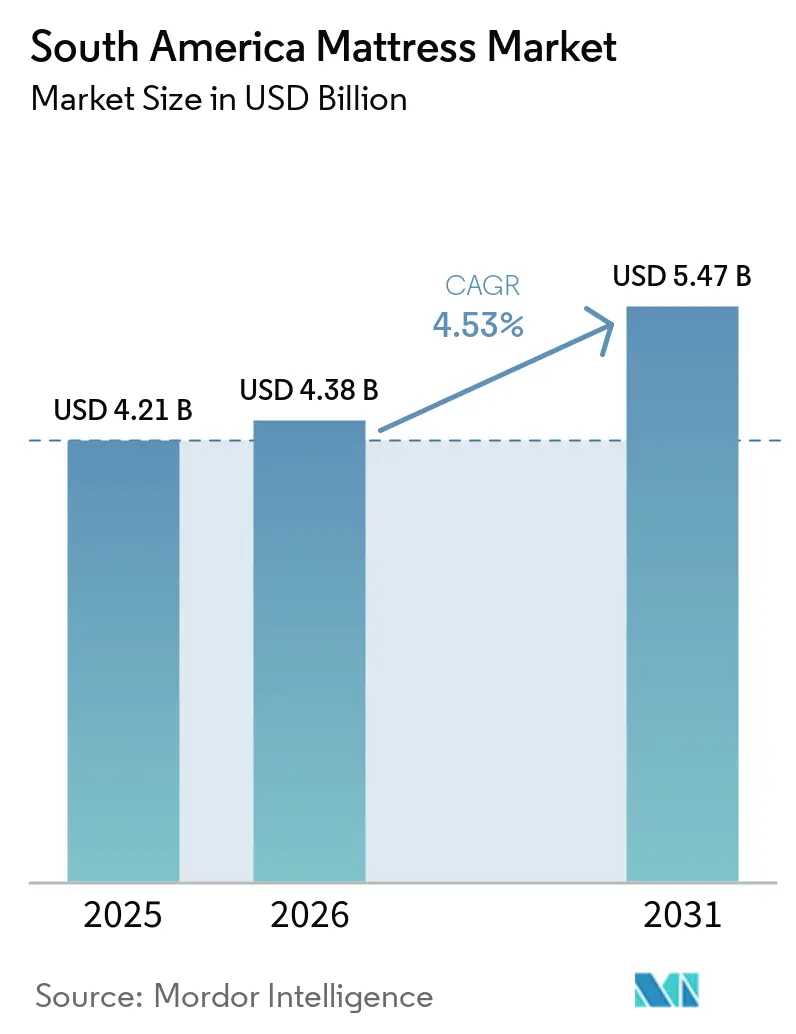
| Base Year Market Size (2025) | USD 4.21 Billion |
| Market Size (2026) | USD 4.38 Billion |
| Market Size (2031) | USD 5.47 Billion |
| Growth Rate (2026 - 2031) | 4.53 % |
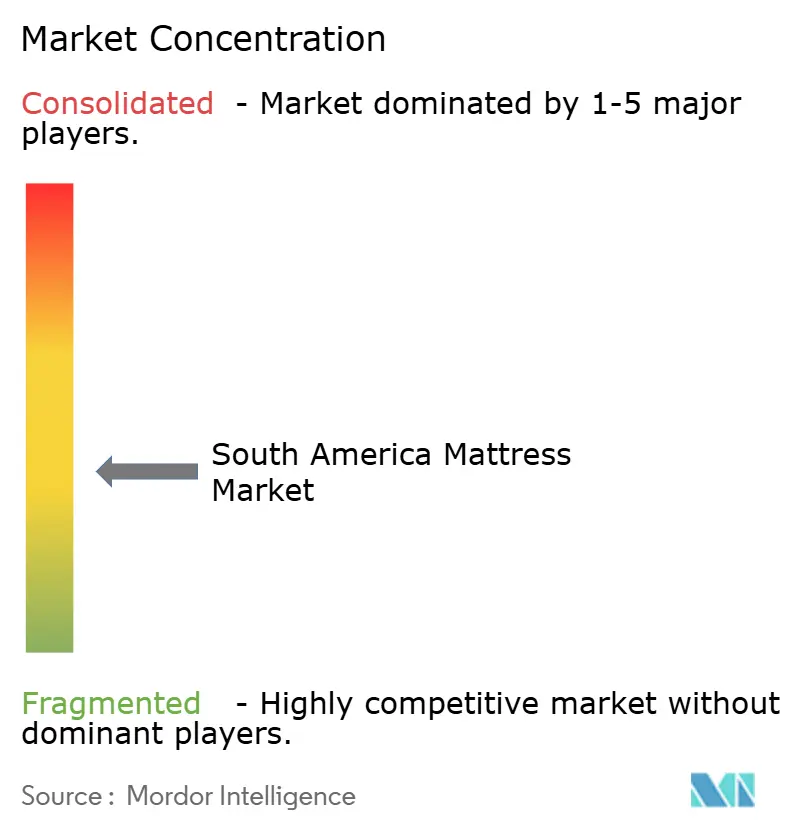
| Market Concentration | Medium |
Major Players *Disclaimer: Major Players sorted in no particular order Image © Mordor Intelligence. Reuse requires attribution under CC BY 4.0. | |
South America Mattress Market Analysis by Mordor Intelligence
The South America mattress market size was valued at USD 4.21 billion in 2025 and estimated to grow from USD 4.38 billion in 2026 to reach USD 5.47 billion by 2031, at a CAGR of 4.53% during the forecast period (2026-2031). Hospitality investment, wider digital retail access, and consumer interest in sleep quality support demand across the South America mattress market. Brazil remains the central production and consumption base, while Argentina’s improving consumer conditions support a faster expansion path. Producers are using vertical integration, direct commercial sales, and online distribution to protect margins and reach new buyers. The main constraints are imported input costs, currency movements, and long residential replacement cycles. MercadoLibre’s 2026 fulfillment investment also extends the South America mattress market’s online reach beyond the main metropolitan areas
Key Report Takeaways
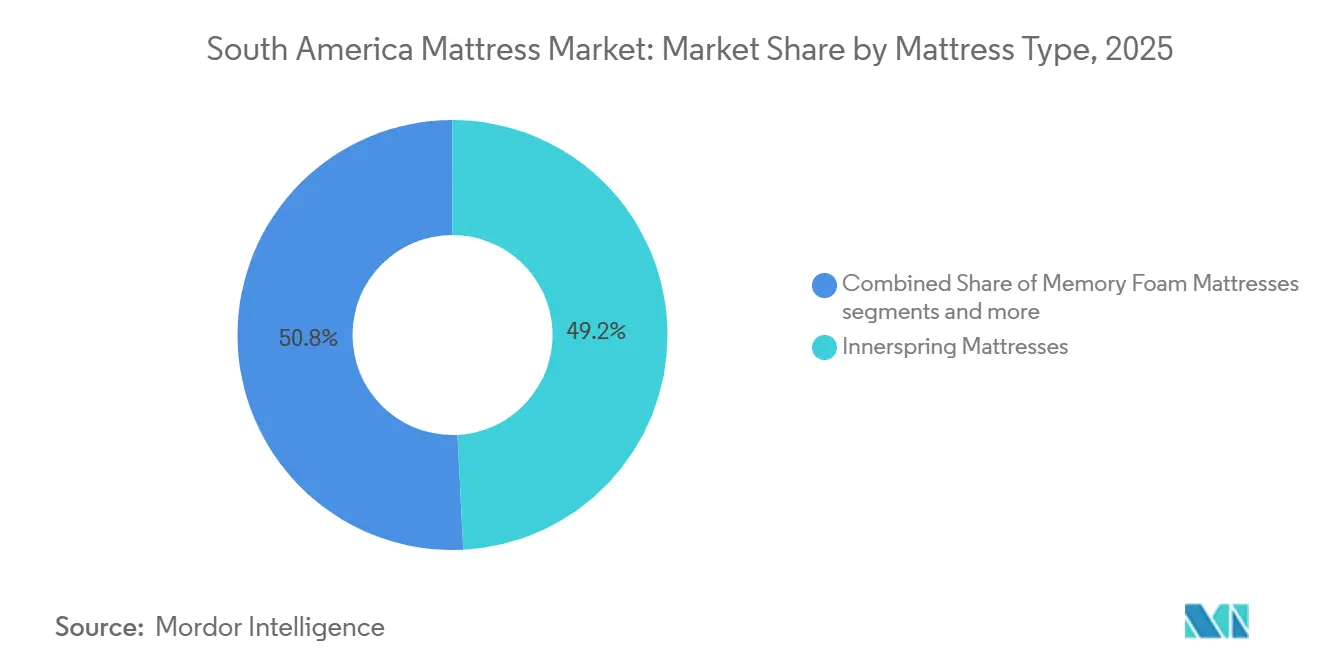
- By mattress type, innerspring held 49.2% of the South America mattress market share in 2025, while hybrid mattresses are forecast to grow at a 6.2% CAGR through 2031.
- By size, queen-size accounted for 44.6% of the South America mattress market size in 2025 and is projected to expand at a 6.9% CAGR through 2031.
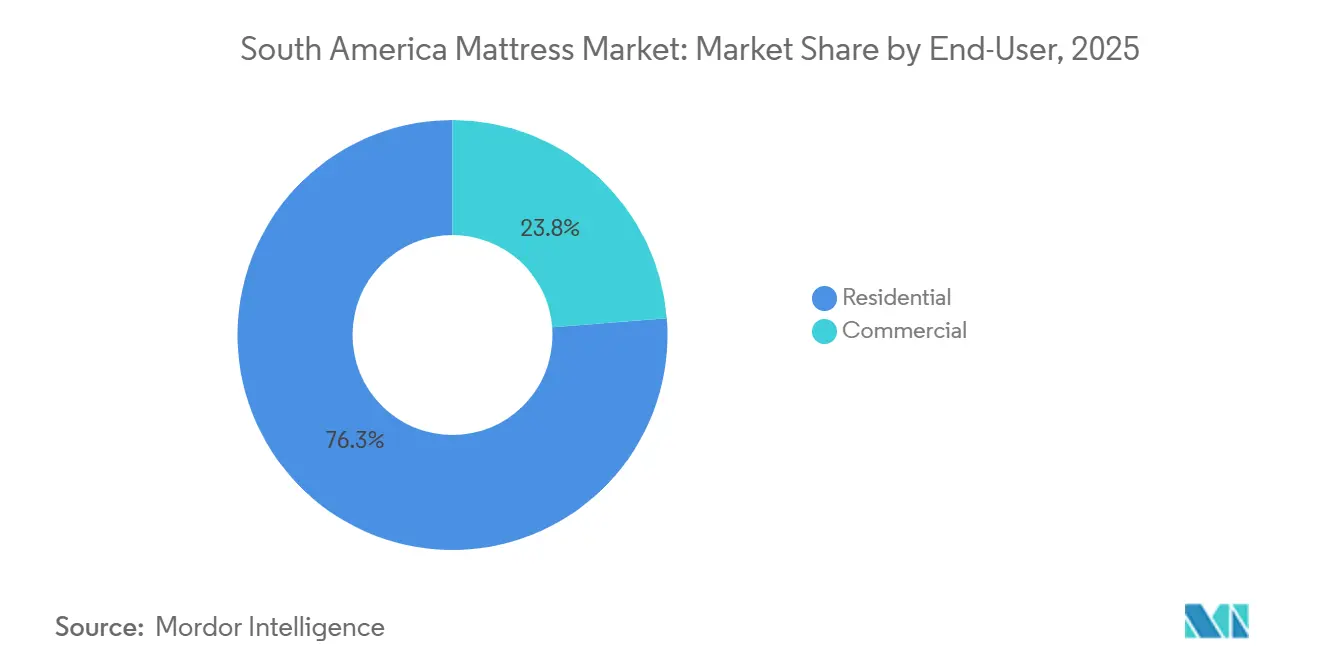
- By end-user, residential users held 76.3% of the revenue share in 2025, while commercial users are forecast to grow at a 7.6% CAGR through 2031.
- By distribution channel, B2C and retail held 75.6% revenue share in 2025, while B2B and direct manufacturer sales are forecast to grow at a 7.2% CAGR through 2031.
- By geography, Brazil held 48.6% revenue share in 2025, while Argentina is forecast to grow at a 6.2% CAGR through 2031.
Note: Market size and forecast figures in this report are generated using Mordor Intelligence’s proprietary estimation framework, updated with the latest available data and insights as of January 2026.
South America Mattress Market Trends and Insights
Drivers Impact Analysis*
| Driver | (~) % Impact on CAGR Forecast | Geographic Relevance | Impact Timeline |
|---|---|---|---|
| Growing Hospitality and Tourism Infrastructure | +1.2% | Brazil, Chile, Argentina, Peru | Short term (≤ 2 years) |
| Rising Sleep-Quality Awareness and Premiumization | +0.9% | Brazil, Chile, urban Argentina | Medium term (2-4 years) |
| Expansion of E-Commerce and Mattress-in-a-Box Models | +0.8% | Brazil, spill-over to Chile and Argentina | Medium term (2-4 years) |
| Growth of Local Manufacturing and Regional Exports | +0.6% | Brazil, Andean markets | Medium term (2-4 years) |
| Demand for Sustainable and Certified Materials | +0.4% | Brazil, Chile, Argentina | Long term (≥ 4 years) |
| Adoption of Smart, Adjustable, and Pressure-Relieving Mattresses | +0.3% | Brazil, Argentina, spill-over to Chile | Long term (≥ 4 years) |
| Source: Mordor Intelligence | |||
Growing Hospitality and Tourism Infrastructure
Brazil’s hospitality investment cycle is widening commercial procurement demand in the South America mattress market. Brazil received 9.3 million international visitors in 2025, a 37.1% increase from 2024[1].https://www.oecd.org/en/publications/oecd-tourism-trends-and-policies-2026_3fd3cd75-en/full-report/brazil_64ed15fb.html Hotel operators need room-ready bedding when they add properties or refresh existing rooms. Commercial mattresses generally follow replacement cycles of 5 to 7 years, which creates recurring purchasing needs. Grupo Wish added 2 properties in Florianópolis in early 2026 and increased its room capacity from 2,000 to 2,500 units[2]https://valorinternacional.globo.com/business/news/2026/05/05/hotels-expand-amid-foreign-tourism-growth.ghtml. Higher-grade hotel specifications favor hybrid and premium products, which can lift order values beyond the increase in room count.
Rising Sleep-Quality Awareness and Premiumization
Sleep quality has become more relevant to purchasing decisions in urban areas of the South America mattress market. ResMed’s 2025 Global Sleep Survey found that respondents lost nearly 3 nights of restorative sleep per week on average[3]https://newsroom.resmed.com/news-releases/news-details/2025/ResMeds-Fifth-Annual-Global-Sleep-Survey-Reveals-a-World-Struggling-with-Poor-Sleep/default.aspx. The survey also found that 89% linked sleep quality to self-worth, while 24% said they would take active steps to address poor sleep. This gap leaves room for mattress brands that make comfort and ergonomic benefits easier to understand. Orthopedic and pressure-relief products are gaining attention among middle-income consumers in São Paulo, Buenos Aires, and Santiago. The result is a gradual shift toward higher-value construction types rather than entry-level replacements alone.
Expansion of E-Commerce and Mattress-in-a-Box Models
Online retail is changing how manufacturers and brands serve the South America mattress market. MercadoLibre is investing USD 10.9 billion in Brazil in 2026 and is adding 14 fulfillment centers, raising its total to 42[4]https://www.reuters.com/business/finance/mercadolibre-invest-11-billion-brazil-this-year-2026-03-24. The company expects 75% of express deliveries to reach customers within 48 hours. This network reduces a long-standing delivery barrier for bulky, compressed mattresses. Luuna uses Dow’s Predictive Intelligence platform to speed foam formulation development and reduce product testing cycles. Better fulfillment and faster product development make digital channels more viable outside the largest cities.
Adoption of Smart, Adjustable, and Pressure-Relieving Mattresses
Smart and adjustable products remain small within the South America mattress market, but their early use is becoming more visible. Grupo Piero introduced the DF-Smart in Argentina in June 2025 through its Bitali division. The product tracks sleep phases, posture, nighttime movements, and recovery patterns through integrated sensors. It is available in pocket-spring and foam versions, showing that connected features can work across construction types. Such products can support repeat engagement through consumer applications and personalized recommendations. Their broader adoption depends on local product development and a consumer base willing to pay for added comfort functions.
Restraints Impact Analysis*
| Restraint | (~) % Impact on CAGR Forecast | Geographic Relevance | Impact Timeline |
|---|---|---|---|
| Inflation and Household Purchasing-Power Volatility | -0.9% | Argentina, Brazil, Peru | Short term (≤ 2 years) |
| High Replacement-Cycle Duration in Residential Markets | -0.7% | South America residential markets | Long term (≥ 4 years) |
| Raw-Material and Foreign-Exchange Cost Exposure | -0.7% | Brazil, Argentina | Medium term (2-4 years) |
| Reverse Logistics and End-of-Life Mattress Disposal Constraints | -0.3% | Brazil, Chile | Medium term (2-4 years) |
| Source: Mordor Intelligence | |||
Inflation and Household Purchasing-Power Volatility
Household purchasing power remains a demand constraint for the South America mattress market. Argentina’s annual inflation fell from 211% in December 2023 to 44.7% in May 2025, according to the OECD. The OECD projected private consumption growth of 9.6% in 2025 and 3.8% in 2026 as inflation decelerates and real wages improve. Consumers that delayed purchases during high inflation may initially choose basic replacement products. That behavior can limit price realization even as unit demand recovers. Credit costs and price-sensitive demand also continue to limit innovation spending among smaller Brazilian producers.
Raw-Material and Foreign-Exchange Cost Exposure
Imported inputs expose manufacturers in the South America mattress market to cost volatility. Polyurethane foam uses petrochemical feedstocks traded in USD, while quality steel wire is sourced through global commodity markets. Currency weakness increases local-currency material costs before producers can adjust retail prices. This pressure is more acute for foam and hybrid products that rely on higher-specification materials. Flex Group’s ZeeFlex sustainable foam used Brazilian-sourced materials in 90% of its mattresses by 2024, showing one way to reduce this exposure. Larger firms with integrated input supply therefore have a cost advantage that smaller companies may find difficult to match.
*Our forecasts treat driver/restraint impacts as directional, not additive. The impact forecasts reflect baseline growth, mix effects, and variable interactions.
Segment Analysis
By Mattress Type: Innerspring Leads While Hybrid Products Grow Faster
Innerspring mattresses held 49.2% of revenue in 2025, making them the leading type in the South America mattress market. Their position reflects price accessibility and established manufacturing capabilities in Brazil. Leggett & Platt operates an innerspring facility near São Paulo that the supplied research describes as the largest in the Southern Hemisphere. Memory foam and related foam products form the next major group for buyers seeking pressure relief. Latex serves a smaller premium category among allergy-sensitive and environmentally conscious consumers. Gel, air, and water models remain specialized offerings outside the main residential replacement cycle. Innerspring products still suit value-focused households and familiar retail purchasing patterns. The category’s scale gives manufacturers an established base for production and distribution.
Hybrid mattresses are forecast to grow at a 6.2% CAGR through 2031, the fastest rate among mattress types. This South America mattress market size opportunity is linked to hospitality upgrades and premium urban household demand. Hybrids combine pocket-spring support with foam comfort layers. That design supports motion isolation for couples and durability needs in hotels. Breathability also suits warm regional conditions when compared with some all-foam designs. Hotel buyers increasingly consider material traceability in procurement specifications. Global Organic Latex Standard and OEKO-TEX STANDARD 100 certifications can support supplier qualification for commercial accounts. The South America mattress industry is therefore seeing product competition shift from basic construction toward comfort, durability, and documented materials.



By Size: Queen-Size Combines Scale With Faster Growth
Queen-size products accounted for 44.6% of revenue in 2025 and lead the size category in the South America mattress market. They are also projected to grow at a 6.9% CAGR through 2031. Queen-size beds are a common specification for 3-star and higher hotel properties. Urban households in São Paulo, Buenos Aires, and Santiago also increasingly select larger sleep surfaces. This combination links commercial procurement with residential premiumization. Double-size mattresses remain important for middle-income households in secondary cities and rural areas. Their lower price point and fit with smaller homes preserve their role in unit volumes. Queen-size demand nevertheless has a stronger effect on revenue because of its higher unit value.
Single-size products serve students, children, and lower-income households across the South America mattress market. Their demand is closely tied to household needs and population replacement. King-size products remain focused on luxury hotels and higher-income households. They represent a modest share of total sales despite their high price point. Queen-size models commonly sell at a 25% to 40% premium over comparable double-size units. This mix helps revenue increase faster than the number of mattresses sold. Larger sizes also give manufacturers more scope to add premium materials and features. The South America mattress market size for queen-size products benefits from both volume needs and higher average selling prices.
By End-User: Commercial Demand Outpaces Residential Replacement
Residential users accounted for 76.3% of revenue in 2025 and remain the largest end-user group. The South America mattress market depends heavily on household formation, urbanization, and periodic replacement purchases. Modern mattress durability extends the residential replacement cycle to 8 to 12 years. This limits the annual number of replacement purchases. Residential buyers also respond strongly to disposable income and access to consumer credit. Entry-level products remain important when households return after periods of deferred spending. E-commerce offers these buyers a broader choice of brands and constructions. Residential sales will remain central, although durable-product behavior limits rapid volume growth.
Commercial users are forecast to grow at a 7.6% CAGR through 2031, faster than residential demand. Hotels, resorts, hospitals, student housing, and serviced apartments are key purchasers. Commercial accounts place larger orders and reduce per-unit distribution costs for manufacturers. Hotel upgrades also create recurring relationships based on renovation and brand standards. Brazil’s REVIVE Brazil Programme uses public-private partnerships to repurpose historic buildings as tourism accommodation. This can add room inventory in heritage cities where traditional development is less viable. Hospital capacity upgrades add another source of institutional demand. These customers give the South America mattress industry a demand stream that is less directly tied to household sentiment.
By Distribution Channel: Retail Remains Largest as Direct Sales Expand
B2C and retail channels retained 75.6% of revenue in 2025, the largest share among distribution routes. Specialty bedding stores and multi-brand home centers remain central to the South America mattress market. Branded stores can support higher average transaction values through product demonstrations and staffed sales. Home centers and hypermarkets reach price-sensitive buyers at mid-range price points. Online retail is moving some purchases from physical trials toward at-home trial models. Compressed-pack shipping makes this option easier to use for selected mattress designs. Digital sales also give newer brands a route into areas with limited specialty retail coverage. Physical retail remains important because many consumers still value trying a mattress before purchase.
B2B and direct manufacturer sales are forecast to grow at a 7.2% CAGR through 2031. Hotel groups can negotiate direct supply agreements that avoid retail intermediaries. Large manufacturers can accept logistics costs in exchange for contracts covering many rooms. Direct orders can also give producers clearer information on replacement schedules and future production needs. This can improve inventory planning and reduce carrying costs. MercadoLibre’s Brazil logistics investment strengthens the ability of online sellers to handle large mattress deliveries. The shift creates stronger competition between retail networks, direct commercial suppliers, and digital platforms. It also favors companies with reliable fulfillment and regional service capabilities.
Geography Analysis
Brazil held 48.6% of revenue in 2025, giving it the largest South America mattress market share. The country had 339 factories and employed 39,000 people directly in mattress production, according to ABICOL data provided in the research. Brazil’s apparent mattress consumption grew by more than 4% in 2024. Tourism adds a second source of demand as hotels refresh bedding and add rooms. International visitor spending reached USD 7.9 billion in Brazil in 2025. Ortobom and other integrated producers make fabrics, springs, foam, and packaging within their supply chains. This integration gives Brazilian producers greater protection from external supply disruptions.
Argentina is projected to grow at a 6.2% CAGR through 2031, the fastest geographic rate in the South America mattress market. The OECD projected GDP growth of 5.2% in 2025 and 4.3% in 2026. Private consumption was projected to rise 9.6% in 2025 and 3.8% in 2026. Deferred replacement purchases can return as inflation moderates and household incomes stabilize. Grupo Piero’s June 2025 DF-Smart launch also shows demand for new premium products. Argentina’s recovery may first favor essential replacements, then create more room for upgrades as consumer conditions improve.
Chile and Peru form the Andean growth tier of the South America mattress market. Their smaller scale is paired with higher average selling prices in premium products. Rosen operates more than 600 points of sale across Argentina, Bolivia, Peru, and Colombia in addition to Chile. Its Peru operation reported growth above 33% for premium products priced over PEN 8,000 in the first half of 2025. Chile’s imports show demand for higher-specification products from China, Lithuania, Italy, Brazil, and New Zealand. Colombia, Bolivia, Uruguay, and Paraguay remain fragmented markets that Brazilian and Chilean manufacturers often serve through cross-border distribution. Lower incomes and limited modern retail density continue to limit their development.
Competitive Landscape
The South America mattress market is moderately fragmented, with Brazilian producers holding strong positions through integrated production and broad store networks. Ortobom states that it has 13 industrial units, 24 manufacturing facilities, and more than 2,400 franchise and own-brand stores. Its scale supports service coverage in secondary and tertiary cities. Herval Group, Flex Group, and Colchões Castor are important domestic competitors. International brands compete most actively in premium and direct-to-consumer channels. Their distributor and licensee structures can limit investment risk but may also reduce their control over shelf space. The absence of a combined share figure for leading firms prevents a numeric concentration assessment.
Tempur Sealy completed its Mattress Firm acquisition and changed its name to Somnigroup International in February 2025. The transaction supports a broader retail integration strategy that could affect licensee arrangements in Latin America. Emma Sleep expanded its Brazilian offer with Hybrid Premium and Basic Duo lines in 2025. Luuna is using Dow’s predictive technology to accelerate foam formulation work. Grupo Piero’s DF-Smart launch created an early position in Argentina’s smart mattress category. These moves show that product features, retail access, and digital capabilities are becoming important competitive tools. They also increase the pressure on conventional manufacturers to differentiate beyond basic price and product availability.
Opportunities remain in connected mattress hardware, mid-priced hybrid products for secondary cities, and certified sustainable materials in the South America mattress market. Grupo Piero addressed the connected product gap through its DF-Smart offering. Local product development is still important because comfort preferences, climate, and delivery conditions differ across countries. The Leggett & Platt patent portfolio covers innerspring designs in 23 countries, including Brazil, and creates licensing considerations for some coil designs. Vertical integration remains a material advantage for large Brazilian firms. It allows greater control over quality, input availability, and delivery commitments.
South America Mattress Industry Leaders
Ortobom
Colchões Castor
Rosen S.A.
Herval Group
Flex Group
- *Disclaimer: Major Players sorted in no particular order

Recent Industry Developments
- March 2026: MercadoLibre announced an investment of BRL 57 billion, USD 10.9 billion, in Brazil for 2026, including 14 new fulfillment centers that will bring the total to 42. The logistics expansion reduces last-mile delivery costs for bulky, compressed mattresses and extends the addressable geography for online mattress brands beyond the existing metropolitan focus.
- June 2025: Grupo Piero launched the DF-Smart through its Bitali division in Argentina. The product was described commercially as Argentina’s first smart mattress. It integrates sensors that track sleep phases, body posture, and recovery cycles, feeding information to a proprietary application that provides a sleep score and behavioral recommendations
- February 2025: Tempur Sealy International completed the acquisition of Mattress Firm, the United States’ largest mattress specialty retailer. The company subsequently rebranded as Somnigroup International, reflecting a global retail integration strategy that could extend its proprietary distribution approach through Latin American licensee relationships.


South America Mattress Market Report Scope
| Innerspring Mattresses |
| Memory Foam Mattresses |
| Latex Mattresses |
| Hybrid Mattresses |
| Gel Mattresses |
| Air Mattresses |
| Water Mattresses |
| Other Mattress Types |
| Single-size |
| Double-size |
| Queen-size |
| King-size |
| Other Sizes |
| Residential |
| Commercial |
| B2B/Directly from the Manufacturers | |
| B2C/Retail Channels | Specialty Bedding and Mattress Stores |
| Multi-brand Stores/Home Centers | |
| Online | |
| Other Distribution Channels |
| Brazil |
| Peru |
| Chile |
| Argentina |
| Rest of South America |
| By Mattress Type | Innerspring Mattresses | |
| Memory Foam Mattresses | ||
| Latex Mattresses | ||
| Hybrid Mattresses | ||
| Gel Mattresses | ||
| Air Mattresses | ||
| Water Mattresses | ||
| Other Mattress Types | ||
| By Size | Single-size | |
| Double-size | ||
| Queen-size | ||
| King-size | ||
| Other Sizes | ||
| By End-User | Residential | |
| Commercial | ||
| By Distribution Channel | B2B/Directly from the Manufacturers | |
| B2C/Retail Channels | Specialty Bedding and Mattress Stores | |
| Multi-brand Stores/Home Centers | ||
| Online | ||
| Other Distribution Channels | ||
| By Geography | Brazil | |
| Peru | ||
| Chile | ||
| Argentina | ||
| Rest of South America | ||


Key Questions Answered in the Report
What is the forecast for the South America mattress market?
The sector is forecast to rise from USD 4.4 billion in 2026 to USD 5.5 billion by 2031, at a 4.5% CAGR.
Which mattress type leads sales in South America?
Innerspring mattresses led revenue with a 49.2% share in 2025, while hybrid products are forecast to grow faster at a 6.2% CAGR.
Why are commercial mattress purchases growing faster than residential sales?
Commercial demand is projected to grow at a 7.6% CAGR because hotels, resorts, hospitals, and other institutions place recurring bulk orders.
Which country has the largest mattress demand in South America?
Brazil held 48.6% of regional revenue in 2025, supported by its manufacturing base and hotel-sector demand.
Page last updated on:





