
South America Inland Waterway Transport Market Size and Share
Market Overview
| Study Period | 2020 - 2031 |
|---|---|
| Forecast Data Period | 2026 - 2031 |
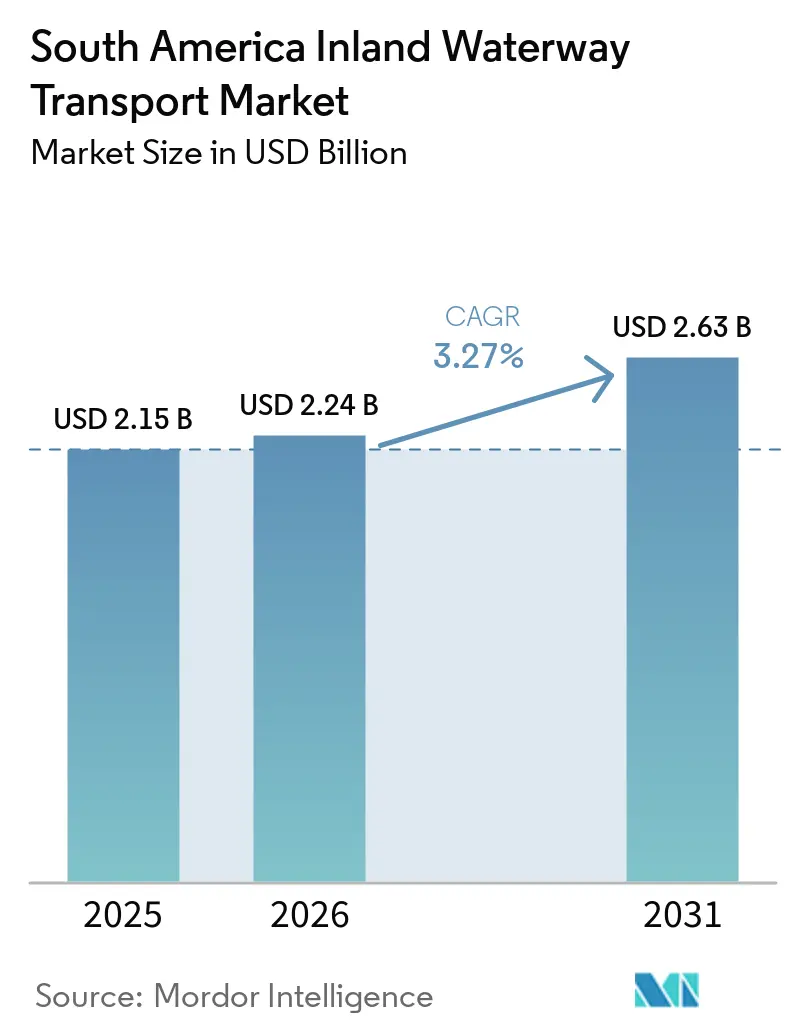
| Base Year Market Size (2025) | USD 2.15 Billion |
| Market Size (2026) | USD 2.24 Billion |
| Market Size (2031) | USD 2.63 Billion |
| Growth Rate (2026 - 2031) | 3.27 % |
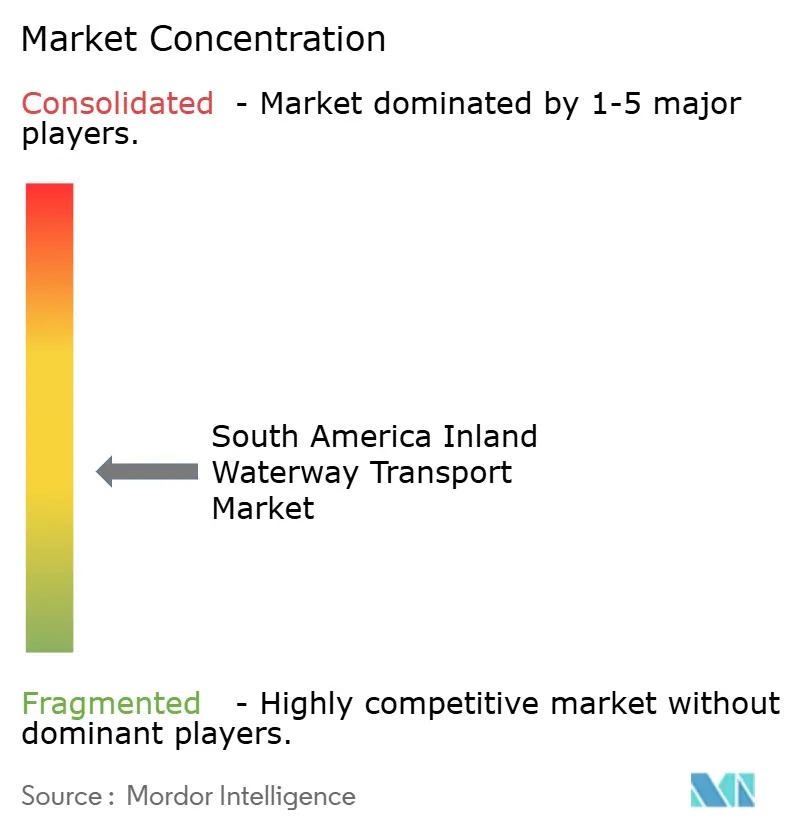
| Market Concentration | Medium |
Major Players
*Disclaimer: Major Players sorted in no particular order Image © Mordor Intelligence. Reuse requires attribution under CC BY 4.0. |
|
South America Inland Waterway Transport Market Analysis by Mordor Intelligence
The South America inland waterway transport market size was valued at USD 2.15 billion in 2025 and estimated to grow from USD 2.24 billion in 2026 to reach USD 2.63 billion by 2031, at a CAGR of 3.27% during the forecast period (2026-2031).
The South America inland waterway transport market is being shaped by the movement of soybean and corn cargo from roads toward river corridors in Brazil, Paraguay, and Argentina. This shift strengthens the role of rivers in export supply chains and increases the value of dependable access to terminals. Operators are also responding to buyer expectations for lower-emission logistics and to the need for better coordination between river, rail, port, and road networks. Low water levels remain a material operating risk, especially on the Amazon and Paraguay River systems, and can raise costs or limit vessel loads. Investment in terminals, dredging, fleet design, and navigation planning will therefore influence how the South America inland waterway transport market develops through 2031.[1]“Terminal Manaus Moderna, Amazonas,” Ministry of Ports and Airports, gov.br
Key Report Takeaways
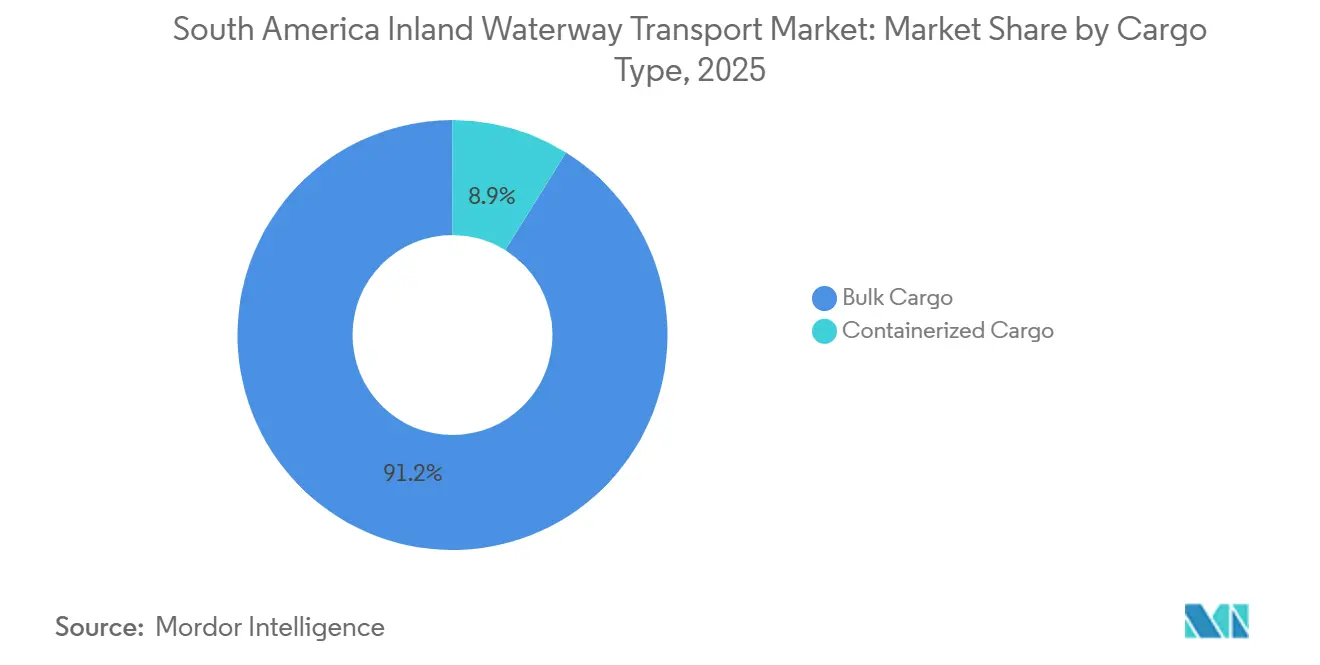
- By cargo type, bulk cargo led with 91.15% of the South America inland waterway transport market size in 2025, while container cargo is forecast to expand at a 5.81% CAGR through 2031.
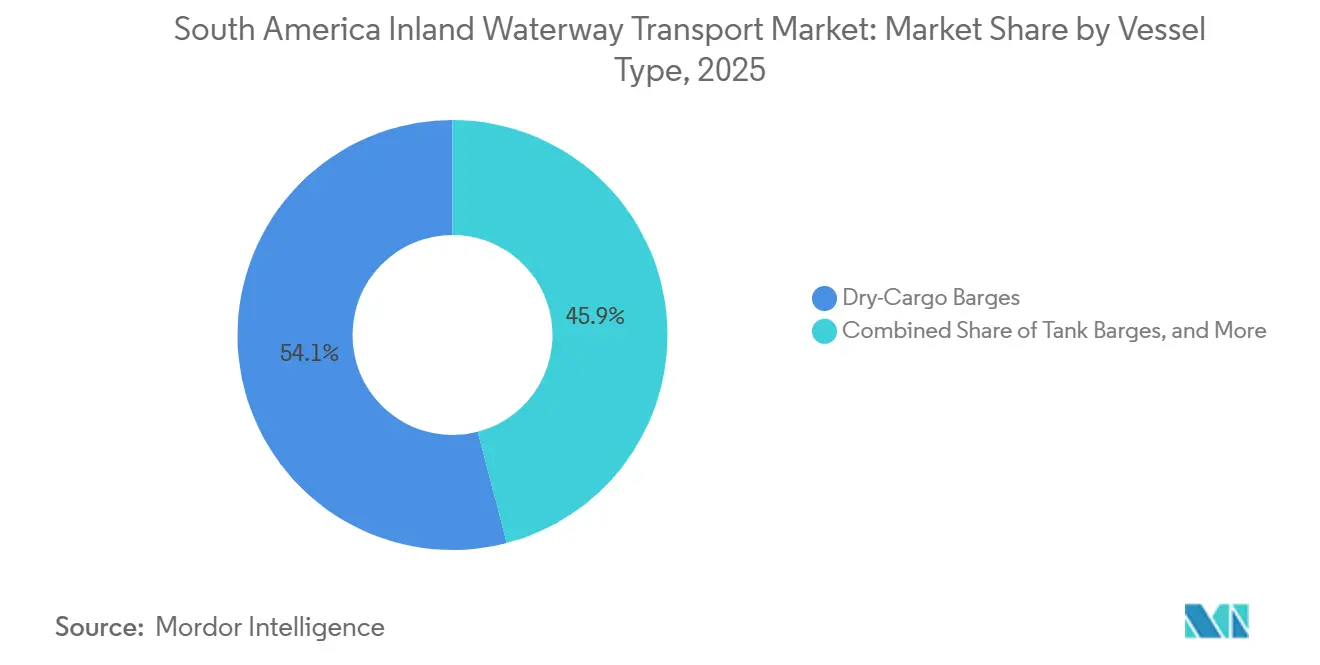
- By vessel type, dry-cargo barges led with 54.06% of the South America inland waterway transport market share in 2025, while container barges and feeder vessels are forecast to expand at a 6.12% CAGR through 2031.
- By end-user industry, agriculture and agribusiness led with 31.82% of the South America inland waterway transport market share in 2025, while chemicals and fertilizers are forecast to expand at a 5.03% CAGR through 2031.
- By country, Brazil held 57.43% of the South America inland waterway transport market share in 2025, while Peru recorded the highest projected CAGR at 4.57% through 2031.
Note: Market size and forecast figures in this report are generated using Mordor Intelligence’s proprietary estimation framework, updated with the latest available data and insights as of January 2026.
South America Inland Waterway Transport Market Trends and Insights
Drivers Impact Analysis*
| Driver | (~) % Impact on CAGR Forecast | Geographic Relevance | Impact Timeline |
|---|---|---|---|
| Agricultural Export Volumes Shifting Toward River Corridors | +0.9% | Brazil, Paraguay, Argentina | Medium term (2-4 years) |
| Inland-Port and Multimodal Integration Investments | +0.7% | Brazil, Colombia | Long term (≥ 4 years) |
| Expansion of Paraguay-Paraná Cross-Border Trade | +0.6% | Argentina, Paraguay, Brazil | Medium term (2-4 years) |
| Lower Fuel Intensity and Decarbonization Pressure Versus Road Freight | +0.5% | Brazil, Argentina | Medium term (2-4 years) |
| Digital Draft Monitoring Enabling Higher Vessel Utilization | +0.4% | Brazil, Paraguay | Long term (≥ 4 years) |
| Low-Water-Resilient Fleet Design Extending Navigable Operating Windows | +0.3% | Brazil, Paraguay, Argentina | Short term (≤ 2 years) |
| Source: Mordor Intelligence | |||
Agricultural Export Volumes Shifting Toward River Corridors
River corridors are taking a larger role in agricultural export movements across the South America inland waterway transport market. The main driver is the cost difference between barges and trucks on long-distance commodity routes. Argentina’s river grain cabotage reached 805,805 tons in 2025, which was 18% above 2024 and the strongest result in 5 years. Total domestic cargo on the Paraguay-Paraná Waterway reached 8.49 million tons in 2025, increasing 5.8% from the prior year. On the Tapajós River, soybeans and corn accounted for 88.4% of 2025 throughput, and a 36-barge convoy demonstrated 110,000-ton carrying capacity per movement. These flows reduce dependence on trucking where navigable river access is available, while areas without it continue to face heavier pressure on road networks.
Inland-Port and Multimodal Integration Investments
Investment in inland ports and multimodal links is expanding the operating base for the South America inland waterway transport market. Brazil’s Merchant Marine Fund approved more than USD 706 million for maritime and river logistics projects in March 2026, including USD 80 million for 41 inland navigation projects in Amazonas State. The ministry also advanced an integrated concession covering port-access channels and inland waterway stretches at Rio Grande, Pelotas, and Porto Alegre. These developments support dredging, terminal capacity, and more coordinated access between river routes and seaports. They can also lower transfer friction for shippers that depend on multiple transport modes. Investment decisions remain tied to the clarity of concession terms and the timing of channel improvements.
Lower Fuel Intensity and Decarbonization Pressure Versus Road Freight
Fuel efficiency is becoming more important in freight procurement across the South America inland waterway transport market. Waterway transport can reduce emissions relative to road freight on long commodity movements, which matters to exporters responding to customer requirements on supply-chain emissions.[2]"2026 Agrologistics Yearbook – Volume 3, datamarnews.com In December 2025, Navegacao Aliança and Be8 completed a 50-hour trial using 100% Be8 BeVant biofuel on inland waterways in Rio Grande do Sul. The trial reported a 99.41% reduction in greenhouse gas emissions compared with conventional marine diesel. Hermasa Navegacao began building 2 pusher tugs in February 2026 that can run on B100 biodiesel and are designed to move 20 barges carrying 32,000 tons on the Amazon. The vessels were designed with engines that can operate on diesel and biodiesel, helping operators retain fuel flexibility.
Expansion of Paraguay-Parana Cross-Border Trade
The Paraguay-Parana Waterway, a 3,400-kilometer corridor connecting five countries' production zones to Atlantic export terminals, carried over 100 million metric tons annually across all users and is forecast to move 28 million tons through its Paraguay-Argentina section in 2026. The waterway moves approximately 80% of Argentina's grain exports and derivatives, generating roughly USD 30 billion in annual export value. Paraguay's dependence is more concentrated still: nine of every ten export tons leave the country via 45 private river terminals that processed USD 21–24 billion in trade value in 2025. A July 2026 joint statement from waterway-user associations CAPECO and CAPPRO warned that unresolved Argentine toll disputes and new tariff proposals on the Paraguay River section could accumulate corridor-wide costs that undermine the waterway's freight competitiveness.
Restraints Impact Analysis*
| Restraint | (~) % Impact on CAGR Forecast | Geographic Relevance | Impact Timeline |
|---|---|---|---|
| Seasonal Draft Variability and Drought Exposure | -0.8% | Brazil (Amazon basin), Argentina, Paraguay | Short term (≤ 2 years) |
| Fragmented Cross-Border Customs and Regulatory Procedures | -0.5% | Paraguay-Paraná 5-country corridor | Long term (≥ 4 years) |
| Shortage of Qualified River Pilots and Towboat Crews | -0.4% | Brazil, Paraguay, Argentina | Medium term (2-4 years) |
| Environmental Permitting and Retrofit Delays | -0.3% | Brazil (Amazon waterways) | Medium term (2-4 years) |
| Source: Mordor Intelligence | |||
Seasonal Draft Variability and Drought Exposure
Seasonal changes in water depth are a direct operating constraint for the South America inland waterway transport market. Brazil’s Geological Service projected in September 2026 that the Rio Negro at Manaus could fall to 12.31 meters during the dry season. This level approaches conditions that disrupted regional supply chains in 2023. CMA CGM raised its Amazon Low Water Surcharge to USD 2,315 per TEU for shipments to and from Manaus, effective October 2, 2026, because of falling river levels and the related cost of draft restrictions, floating piers, pilotage, and barge logistics. Low water can force operators to reduce cargo loads, alter convoy arrangements, or delay sailings. These actions can erode the cost advantage that river transport normally offers on high-volume freight movements.
The impact extends beyond vessel operators because exporters and importers also need to manage less predictable transit conditions. The Tapajos River could shift 3–5 million tons of soybeans from barges to trucks if channel dredging does not proceed, adding USD 29-48 per ton in freight costs and up to USD 164 million in supply-chain losses during the October through February dry season. Lower-draft vessels can extend operating windows and can reduce the severity of load restrictions. They cannot fully eliminate disruption during extreme drought. The South America inland waterway transport market therefore requires contingency capacity in roads, storage, terminals, and schedules. Navigation forecasts and more responsive dredging plans have become central to protecting cargo flows during dry months.
Fragmented Cross-Border Customs and Regulatory Procedures
The Paraguay-Paraná corridor crosses 5 national regulatory systems, creating procedural complexity for the South America inland waterway transport market. Each country applies its own port clearance practices, cargo inspection requirements, and vessel certification rules. Paraguay’s waterway-user associations raised concerns in July 2026 regarding overlapping tolls and concession discussions on the Vía Navegable Troncal. Such changes can create uncertainty in freight costs across the corridor. Documentation mismatches can also extend port stays when inspection schedules or certificate requirements are not aligned. These delays are particularly relevant for containerized cargo, which often requires more standardized and time-sensitive handling.
The Intergovernmental Committee for the Waterway has continued discussions on common practices, but binding protocols remain limited. As a result, operators and cargo owners must account for the decisions of individual customs authorities at each port call. This can make voyage timing and pricing less predictable than on a domestic route. The South America inland waterway transport market would gain from more consistent recognition of documents and vessel approvals. Until that occurs, cross-border operators need to maintain detailed local compliance capabilities. The absence of harmonized procedures can reduce the benefit of the corridor’s physical connection to Atlantic export terminals.
*Our forecasts treat driver/restraint impacts as directional, not additive. The impact forecasts reflect baseline growth, mix effects, and variable interactions.
Segment Analysis
By Cargo Type: Bulk Dominates, but Containerization Adds Strategic Weight
Bulk cargo accounted for 91.15% of the South America inland waterway transport market share in 2025. The category is supported by the large volumes of soybeans, corn, iron ore, petroleum products, and other commodities that move efficiently in barge convoys. Dry bulk transportation is closely linked to grain harvests and export cycles. Liquid bulk transportation supports fuel distribution across the Amazon and Parana systems. Fertilizer movements on the Tapajós River increased 46.8% in 2025, while liquid bulk volumes on the same corridor rose 40% year over year. The figures show that bulk traffic includes a broader set of flows than grain cargo alone. Bulk operations remain dependent on terminal capacity, river depth, and access to export ports. Large convoys can create strong unit-cost advantages when channel conditions permit full loads. This structure helps explain the leading position of bulk cargo in the South America inland waterway transport market. The category also benefits from the region’s agricultural and extractive production base. Its concentration in high-volume commodities leaves it exposed to drought, harvest timing, and disruptions at key river access points. Operators are therefore investing in fleet availability and loading infrastructure that can maintain high cargo movement during favorable navigation periods.
Container Cargo is forecast to grow at a 5.81% CAGR through 2031 within the South America inland waterway transport market. Its growth reflects increased use of containers for industrial goods and consumer products moving between inland locations and coastal ports. Container services can provide a structured alternative to truck-only distribution where river terminals have suitable handling equipment. They can also improve connections between interior production zones and Atlantic deepwater terminals. The limited number of purpose-built container terminals along interior waterways remains a constraint. This limits faster adoption even where shippers could benefit from barge-based distribution. The first inland waterway concession auctions expected to close in 2026 were intended to support private investment in terminals and related river infrastructure. Better handling capacity can reduce the transfer burden between barges, trucks, and ocean services. Documentation standards and cargo classifications also shape planning decisions for container operators. The South America inland waterway transport market may see container growth accelerate where terminal investment is paired with reliable channel access. General cargo shippers will still compare river services with direct trucking on transit time and schedule certainty. Containerization therefore adds strategic value, but it does not displace the present bulk-led cargo structure.[3]"Gobierno anuncia inversión de $248.633 millones para garantizar la navegabilidad del río Magdalena." agenciapi.co


By Vessel Type: Dry-Cargo Barges Lead, Shallow-Draft Design Reshapes the Competitive Field
Dry-Cargo Barges held 54.06% of the South America inland waterway transport market size in 2025. Their position reflects the large grain, ore, and agribusiness volumes that require open-hull capacity at scale. These vessels are central to commodity convoys on the Amazon, Tapajos, and Paraguay-Parana systems. Tank Barges were the second-largest vessel category and served fuel and liquid chemical movements. Their activity is visible in Amazon logistics and in Paraguay’s fuel import routes. Pushboats and Tugboats generate demand through fleet expansion, operating day rates, and the need to move larger barge formations. Fleet configuration determines how much cargo can move during both normal and low-water periods. River operators need sufficient power, cargo capacity, and maneuverability to operate on long corridors with variable depths. Shallow-draft design has gained importance because load restrictions can quickly reduce revenue during drought periods. The South America inland waterway transport market rewards operators that can match vessel design with the seasonal conditions of each route. Dry-Cargo barges remain essential because of their suitability for bulk movements. Their leading position is likely to continue as agricultural and mineral cargoes remain the foundation of river freight volumes.
Container Barges and Feeder Vessels are forecast to advance at a 6.12% CAGR through 2031. This growth follows the wider use of containers for general cargo and stronger feeder connections between river ports and Atlantic terminals. These vessels can support scheduled links for cargo that cannot move efficiently in bulk barge configurations. The segment also benefits when inland terminals can receive, store, and transfer containers reliably. Its expansion depends on navigable depth, terminal equipment, and the commercial stability of feeder routes. Low water surcharges can weaken the value of river feeders during severe dry periods. A shallow-draft river pusher delivered to Girona S.A. in Paraguay in 2025 was designed to operate at depths as low as 6.0 feet. Hermasa Navegacao also began building 2 shallow-draft pusher tugs in Manaus in February 2026, with each designed to push 20 barges carrying 32,000 tons. These projects show why vessel design is becoming an important competitive factor in the South America inland waterway transport market. Operators that preserve more payload during low-water periods can provide more dependable service to cargo owners. The benefit does not remove the need for dredging and channel management. It does give operators another practical way to protect utilization when rivers become shallower.
By End-User Industry: Agriculture Leads on Volume, Chemicals Accelerate on Supply-Chain Realignment
Agriculture and Agribusiness represented 31.82% of South America inland waterway transport market share in 2025. The category is supported by the region’s major soybean and corn export base. Producers use river corridors to move high-volume crops toward export terminals. Dedicated loading infrastructure can lower unit freight costs as volumes rise. This creates a reinforcing pattern, because lower transport costs can make river access more attractive for additional agricultural cargo. The segment is also sensitive to harvest cycles, channel conditions, and the capacity of port connections. Agricultural demand supports recurring traffic on Brazil’s northern river routes and on the Paraguay-Paraná system. It also encourages investment in loading facilities, barges, and terminal storage. The South America inland waterway transport industry depends heavily on these flows because they provide the volumes needed for efficient convoy operations. Mining and Metals adds iron ore and bauxite movements from interior production areas to transshipment points. Oil and Gas uses barges for fuel distribution in the Amazon. Petrobras and Transpetro committed USD 549 million in May 2026 for barge construction and new Urucu well drilling at the Bertolini Shipyard.
Chemicals and Fertilizers are forecast to grow at a 5.03% CAGR through 2031. The category is supported by fertilizer movements into agricultural regions and by the need for dependable inland distribution. Fertilizer imports through Brazil’s North Arc terminals increased 62.7% between 2021 and 2025. The federal government activated an emergency supply committee in mid-2026 to secure phosphate fertilizer raw materials from Russia, China, and Morocco. These conditions underline the importance of river logistics to agricultural inputs. They also create demand for transshipment and storage infrastructure near inland waterway connections. Chemicals and fertilizer cargo requires safe handling and regular delivery to inland demand centers. This can favor operators with tank capacity, specialized terminals, and strong compliance procedures. Forestry, Pulp and Paper, Manufacturing and Industrial Goods, and Construction Materials complete the end-user mix. Construction Materials benefit from public infrastructure activity near navigable rivers. The South America inland waterway transport market has room to serve these smaller flows, although their volumes do not match agriculture. The faster growth of Chemicals and Fertilizers shows that river logistics is being used for both export cargo and inbound supply chains.
Geography Analysis
Brazil accounted for 57.43% of South America inland waterway transport market revenue in 2025, supported by the Amazon, Tapajos, Madeira, and Tiete-Parana systems. Total inland waterway cargo in Brazil reached 140 million tons in 2025, the highest level in the historical series, as grain movements through the North Arc and fertilizer return movements added volume. Brazil also directed USD 706 million of Merchant Marine Fund approvals toward maritime and river logistics projects in March 2026. Its broad river system supports agricultural, fuel, and general cargo routes, while making Brazil the main setting for terminal, shipbuilding, dredging, and concession investment. The 2026 Amazon dry season remains a near-term risk because lower water levels can reduce export capacity from North Arc corridors.
Argentina, Paraguay, and the Paraguay-Parana corridor form the next tier of activity, with Argentina’s Parana River complex handling 80% of national grain exports and generating USD 30 billion in annual export value. Argentine river grain cabotage reached 805,805 tons in 2025, while domestic waterway cargo increased 5.8% from the prior year. Paraguay processed USD 21 billion to USD 24 billion in trade value through 45 private river terminals in 2025 and projected 28 million tons of throughput in 2026. Toll issues, customs differences, and concession decisions can affect freight costs across the corridor. Peru’s Amazon system supports agricultural and extractive cargo but lacks the port connectivity for a meaningful regional position, while Chile’s role is limited to southern lake-river systems.
Colombia is forecast to be the fastest-growing national segment at a 4.57% CAGR through 2031, supported by investment in the Magdalena River connection between the Andean interior and the Caribbean coast. The Colombian government committed USD 59 million for 2026 to support year-round navigability and permanent dredging, while Cormagdalena presented a plan for more than USD 191 million of works over the following 3 years. Colombia’s CONPES body approved a USD 82 million Fluvial and Cabotage Connectivity Program for 2026 to 2029 covering 14 river infrastructure interventions. Delivery will depend on permanent dredging, construction execution, and integration with other transport modes.[4]"Terminal Manaus Moderna, no Amazonas, vai receber R$ 875,9 milhões em investimentos.", gov.br
Competitive Landscape
The South America inland waterway transport market is moderately fragmented. Domestic river specialists have strong positions on nationally bounded corridors, with Hidrovias do Brasil, Hermasa Navegação, and Chibatao active in Brazil and Compania Navios Argentina, UABL/ATRIA, and Naviera Fluvial Paraguaya active on the Paraguay-Parana system. CMA CGM and Maersk compete principally on the Manaus corridor through feeder and related logistics services. Hidrovias do Brasil reduced net debt through a capital raise by parent Ultrapar and confirmed a USD 53 million investment plan for 2026. CMA CGM’s low-water surcharge reached USD 2,315 per TEU in September 2026, showing the cost exposure facing Amazon feeder services.
Opportunities are concentrated in container terminals on mid-corridor river stretches, chemical and fertilizer transshipment near the North Arc, and navigation tools that improve fleet use. Hidrovias invested in 15-day hydrological forecasting to support convoy scheduling and better draft monitoring. These tools can help operators configure loads and dispatch vessels, although they cannot remove the physical effect of sustained low water. MRS Logistica’s planned Tiete-Parana terminals, targeted for January 2027, show how rail providers are moving into river freight. Maersk announced a 70,000 square meter multipurpose depot at Rio Grande and a 3,160 square meters expansion at Paranagua in April 2026, linking port facilities with Aliança cabotage services and regional inland logistics.
These investments can strengthen end-to-end offerings and increase pressure on operators that provide only one transport service. River conditions, terminal access, fleet design, and cross-border compliance favor experienced local participants. Global carriers add scale and customer relationships where containers connect rivers to ocean services, while domestic operators retain local navigation and terminal coordination advantages.
South America Inland Waterway Transport Industry Leaders
-
Hermasa Navegacao Da Amazonia Ltda
-
UABL Paraguay S.A.
-
Navemar S.A.
-
Hidrovias do Brasil S.A.
-
Compania Navios Argentina S.A.
- *Disclaimer: Major Players sorted in no particular order

Recent Industry Developments
- September 2026: CMA CGM raised its Amazon Low Water Surcharge to USD 2,315 per TEU for shipments to and from Manaus, effective October 2, 2026, citing rapidly falling Negro and Amazon River levels approaching 2023 severity. The surcharge reflects additional costs from draft restrictions, floating pier operations, and increased pilotage and barge logistics.
- September 2026: Maersk issued a customer advisory projecting Amazon River navigation restrictions from October, weeks 41-44, a possible closure in November, weeks 45-48, and further capacity restrictions into early 2027, based on Western Amazon River Authority and ANA gauge data.
- August 2026: CMA CGM introduced an initial Low Water Surcharge of USD 753 per TEU for Manaus cargo effective September 2026, subsequently raised to USD 2,315 per TEU for October 2026, as Amazon River levels fell faster than in recent years.
- April 2026: Maersk announced a 70,000 square meters multipurpose depot at Rio Grande and a 3,160 square meters expansion at Paranagua, integrating Southern Brazil’s port network with the Aliança cabotage service and strengthening inland logistics connectivity across the region.


South America Inland Waterway Transport Market Report Scope
| Bulk Cargo | Dry Bulk Transportation |
| Liquid Bulk Transportation | |
| Container Cargo |
| Dry-Cargo Barges |
| Tank Barges |
| Container Barges and Feeder Vessels |
| Pushboats and Tugboats |
| Agriculture and Agribusiness |
| Mining and Metals |
| Oil and Gas |
| Chemicals and Fertilizers |
| Manufacturing and Industrial Goods |
| Forestry, Pulp and Paper |
| Construction Materials |
| Others |
| Argentina |
| Brazil |
| Chile |
| Colombia |
| Peru |
| Rest of South America |
| By Cargo Type | Bulk Cargo | Dry Bulk Transportation |
| Liquid Bulk Transportation | ||
| Container Cargo | ||
| By Vessel Type | Dry-Cargo Barges | |
| Tank Barges | ||
| Container Barges and Feeder Vessels | ||
| Pushboats and Tugboats | ||
| By End-User Industry | Agriculture and Agribusiness | |
| Mining and Metals | ||
| Oil and Gas | ||
| Chemicals and Fertilizers | ||
| Manufacturing and Industrial Goods | ||
| Forestry, Pulp and Paper | ||
| Construction Materials | ||
| Others | ||
| By Country | Argentina | |
| Brazil | ||
| Chile | ||
| Colombia | ||
| Peru | ||
| Rest of South America |


Key Questions Answered in the Report
What is the value of South America inland waterway transport in 2026?
The sector is valued at USD 2.24 billion in 2026 and is forecast to reach USD 2.63 billion by 2031.
What is driving river freight demand in South America?
Agricultural export flows, intermodal investment, lower-emission logistics needs, and Paraguay-Paraná trade are supporting demand.
Which cargo type leads South America inland waterway transport?
Bulk Cargo led with 91.15% revenue share in 2025 because grain, ore, fuel, and other high-volume cargoes suit barge operations.
Which vessel category is expanding fastest?
Container Barges and Feeder Vessels are forecast to grow at a 6.12% CAGR through 2031 as containerized inland distribution expands.
Why is Brazil important for river logistics in South America?
Brazil held 57.43% of regional revenue in 2025 and moved 140 million tons of inland waterway cargo during that year.
What is the main operational risk for inland waterway carriers?
Seasonal low water can reduce vessel loads, delay service, and increase freight costs, particularly on Amazon routes.
Page last updated on:





