
Market Overview
| Study Period | 2019 - 2031 |
|---|---|
| Forecast Data Period | 2026 - 2031 |
| Base Year Market Size (2025) | USD 0.72 Billion |
| Market Size (2026) | USD 0.79 Billion |
| Market Size (2031) | USD 1.26 Billion |
| Growth Rate (2026 - 2031) | 9.79 % |
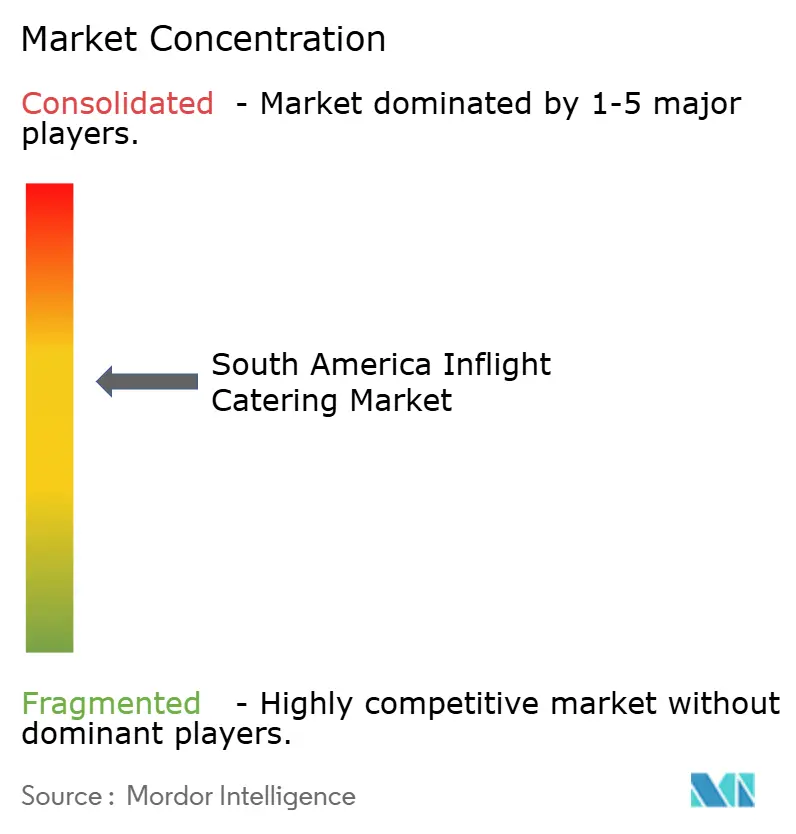
| Market Concentration | Medium |
Major Players *Disclaimer: Major Players sorted in no particular order Image © Mordor Intelligence. Reuse requires attribution under CC BY 4.0. | |
South America Inflight Catering Market Analysis by Mordor Intelligence
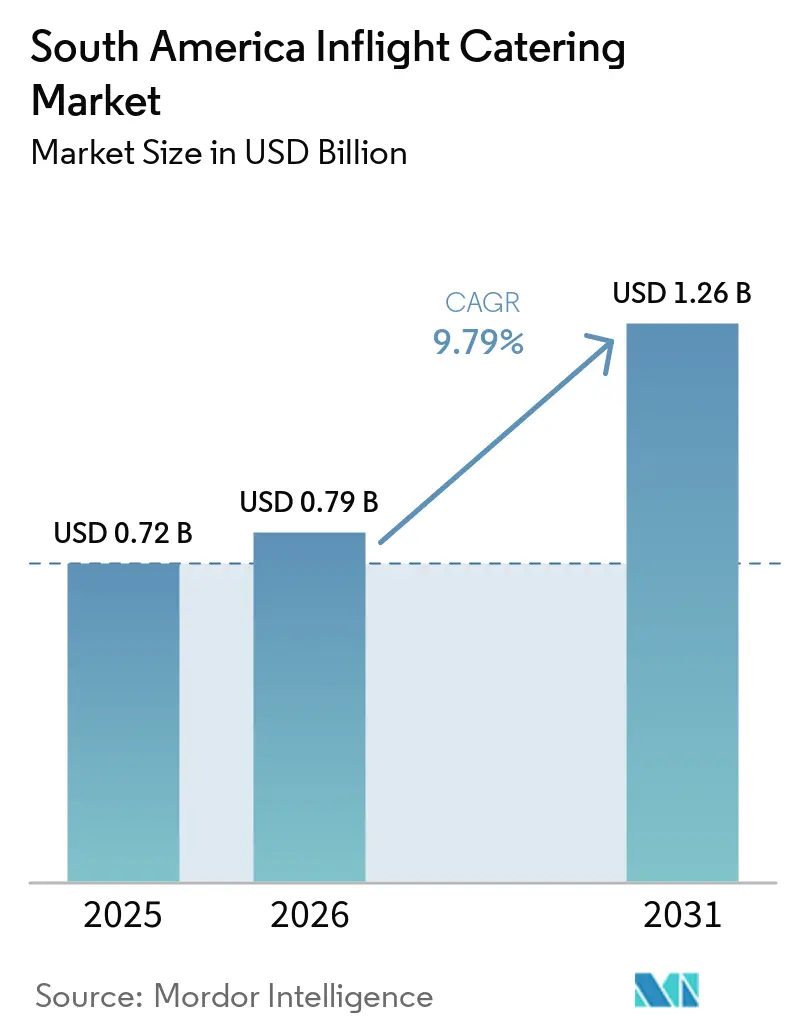
The South America inflight catering market size was valued at USD 0.72 billion in 2025, and is forecast to grow from USD 0.79 billion in 2026 to reach USD 1.26 billion by 2031, at a 9.79% CAGR during the forecast period (2026-2031). Higher passenger volumes are increasing meal uplift requirements at major airports. Airlines are also using food and beverage choices to distinguish their onboard service. This change supports investment in kitchen capacity, menu planning, and supply chains. Providers that can meet airline schedules and food safety requirements have a stronger position in major hubs. Cost pressure and airline budget decisions remain important limits on contract profitability.
Key Report Takeaways
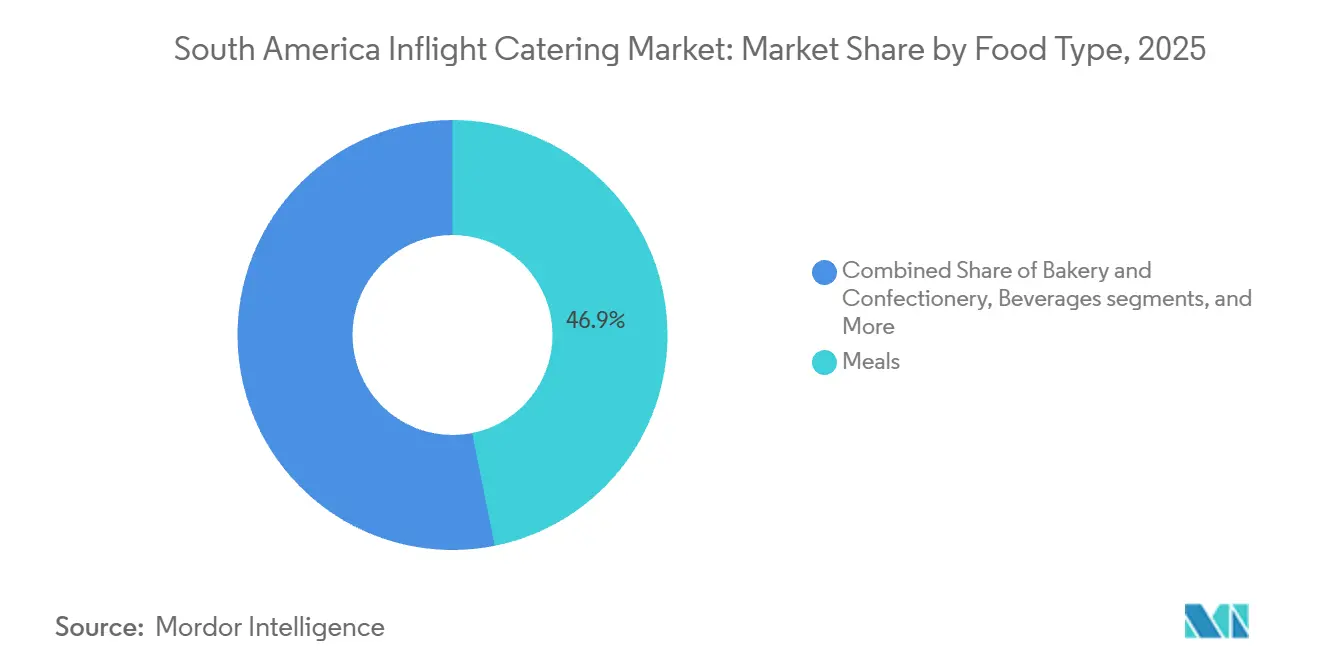
- By food type, meals accounted for 46.85% of the South America inflight catering market in 2025, while beverages are projected to grow at an 11.30% CAGR through 2031.
- By flight service type, full-service carriers (FSCs) accounted for 56.10% of the market share in 2025, while the low-cost carriers (LCCs) segment is forecast to grow at a 12.10% CAGR through 2031.
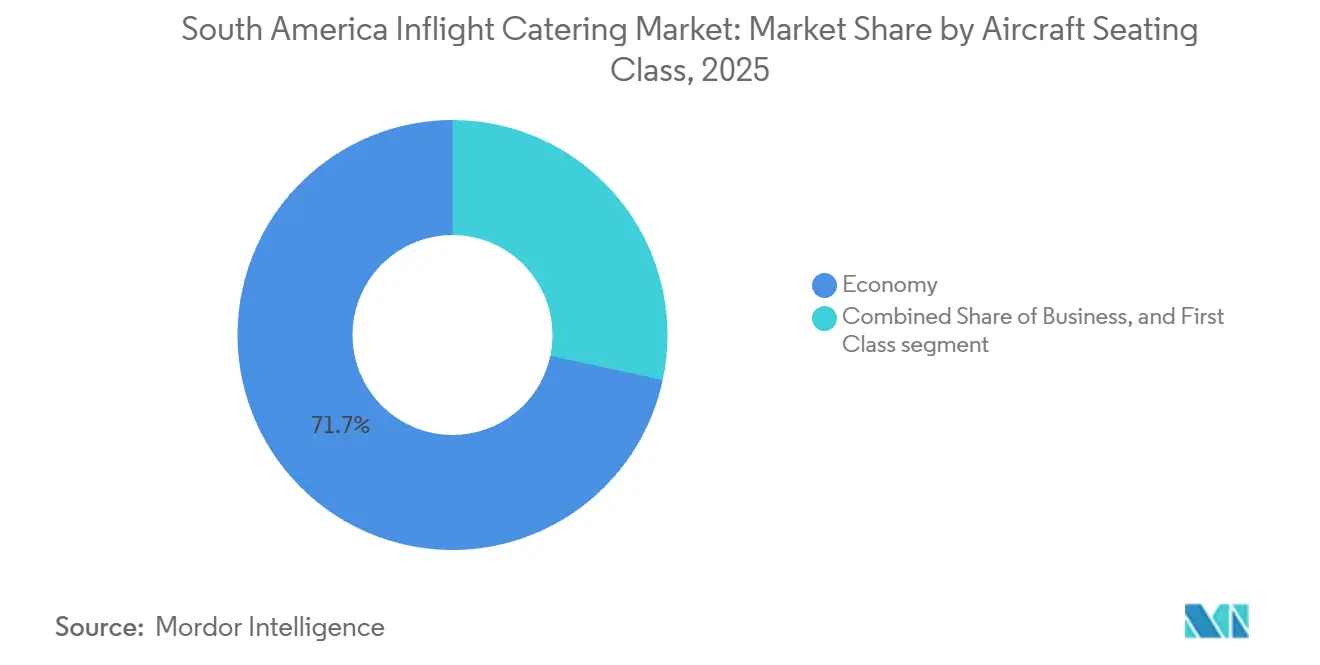
- By aircraft seating class, economy class accounted for 71.65% of the South America inflight catering market in 2025, while business class is projected to grow at an 11.25% CAGR through 2031.
- By catering type, classic catering remained dominant, accounting for 74.50% of the South America inflight catering market in 2025, while retail on board is forecast to grow at an 11.55% CAGR through 2031.
- By flight duration, short-haul flights accounted for 63.25% of the South America inflight catering market in 2025, while long-haul services are forecast to grow at an 11.90% CAGR through 2031.
- By geography, Brazil accounted for 47.55% of the South America inflight catering market in 2025, while Peru is forecast to grow at an 11.75% CAGR through 2031.
Note: Market size and forecast figures in this report are generated using Mordor Intelligence’s proprietary estimation framework, updated with the latest available data and insights as of January 2026.
Market Trends and Insights
Drivers Impact Analysis of South America Inflight Catering Market*
| Driver | (~) % Impact on CAGR Forecast | Geographic Relevance | Impact Timeline |
|---|---|---|---|
| Air passenger traffic and flight frequency recovery | +2.50% | Brazil, Colombia, Peru, Argentina | Short term (≤ 2 years) |
| Narrowbody fleet expansion and network development | +1.50% | Brazil, Argentina, Chile, Peru | Medium term (2-4 years) |
| Premium cabins, branded meals, and local cuisine | +1.20% | Brazil, Argentina, Colombia | Medium term (2-4 years) |
| Outsourcing to specialized catering providers | +1.00% | Hub markets across South America | Medium term (2-4 years) |
| Pre-order, personalization, and waste-optimized programs | +0.80% | Brazil, Colombia, Chile | Medium term (2-4 years) |
| Regional, dietary-specific, and sustainable options | +0.70% | Brazil, Colombia, Argentina | Long term (≥ 4 years) |
| Source: Mordor Intelligence | |||
Air Passenger Traffic And Flight Frequency Recovery
South American airlines’ international passenger traffic increased by 8.6% in 2025, surpassing global international RPK growth of 7.1%. IATA’s latest outlook forecasts 5.0% growth in South American RPK in 2026.[1] Brazil recorded 129.6 million passengers in 2025, including 101.2 million domestic passengers, while Peru and Argentina recorded 28.5 million and 33.3 million passengers, respectively. Rising passenger volumes and expanding flight frequencies are increasing catering demand and operational requirements at major airports. Higher aircraft utilization shortens turnaround windows. The South America inflight catering market, therefore, favors operators that can deliver meals on time and maintain food safety records. This requires practical coordination among airline planners, kitchen teams, loading crews, and transport staff. It also makes dependable daily execution more important than isolated menu changes. Providers must match production plans to flight schedules and customer requirements. Strong operating controls can limit waste, missed uplifts, and last-minute substitutions during busy periods.
Narrowbody Fleet Expansion And Network Development
Narrowbody aircraft are expected to support airline network growth across South America. In September 2025, LATAM placed orders for up to 74 Embraer E195-E2 aircraft, including 24 firm orders, with Brazilian operations scheduled to commence from November 2026. LATAM is also expected to receive six A320neo aircraft and one A321neo aircraft during Q2 2026.[2] Abra Group’s previously announced A320neo expansion is progressing, with 50 aircraft from its remaining order receiving LEAP-1A engines in July 2026. These additions will support new routes and increased flight frequencies, creating additional catering opportunities. The South America inflight catering market will require standardized meal boxes for single-aisle aircraft that accommodate dietary needs on international routes. Airline procurement teams are likely to evaluate both price and service reliability. This places greater value on providers that can maintain quality across different airports and flight schedules, including during peak holiday travel periods.
Premium Cabins, Branded Meals, And Local Cuisine
Airlines are using local cuisine and tailored menus to differentiate their onboard service. LATAM's Sabores que Transportan program featured menus developed with 16 female chefs from Chile, Peru, Ecuador, and Colombia between July 2024 and June 2025, covering both Premium and Economy cabins on long-haul flights. Such programs increase requirements for consistent ingredient sourcing, food safety, and reliable catering logistics. Gate Gourmet's Guarulhos facility prepares around 18,000 meals daily and serves more than 30 long-haul flights. The South America inflight catering market benefits when caterers combine regional menu development with reliable large-scale production and aircraft delivery.
Outsourcing To Specialized Catering Providers
Airlines are delegating catering operations to specialists capable of managing food safety, cold chain logistics, and dietary requirements, which creates an advantage for providers operating across multiple countries. In Brazil, airport and onboard catering are subject to ANVISA food safety requirements, including controls for food transport and temperature. In Colombia, onboard food safety is monitored by sanitary authorities alongside aviation oversight. Maintaining compliance across multiple countries can be challenging for smaller operators. Large providers can distribute compliance and technology costs across several airports, supporting longer-term contracts and more consistent operating models. Outsourcing also increases the importance of traceability and coordination among airlines, caterers, airport teams, and suppliers.
Restraints Impact Analysis of South America Inflight Catering Market*
| Restraint | (~) % Impact on CAGR Forecast | Geographic Relevance | Impact Timeline |
|---|---|---|---|
| Food, labor, logistics, and cold-chain cost inflation | -1.20% | Brazil, Argentina, Venezuela | Short term (≤ 2 years) |
| Airline margin pressure and passenger demand volatility | -0.80% | Brazil, Colombia, Argentina | Medium term (2-4 years) |
| Capacity concentration at major aviation hubs | -0.50% | Brazil, Colombia, Argentina | Medium term (2-4 years) |
| Country-specific food safety, customs, and traceability rules | -0.40% | All countries, especially Venezuela and Argentina | Long term (≥ 4 years) |
| Source: Mordor Intelligence | |||
Food, Labor, Logistics, And Cold-Chain Cost Inflation
Food, labor, logistics, and cold-chain costs continue to pressure South American airline catering supply chains. Brazil's food-away-from-home prices increased 6.97% in 2025, while Argentina also faced elevated food costs. Argentina maintained collective bargaining arrangements covering catering and food-service workers in 2025. Fixed-price contracts can compress caterer margins when input costs rise, while cost-linked pricing can increase airline spending. These conditions can limit menu flexibility and investment within the South America inflight catering market. Providers must manage ingredient sourcing, staffing, airport logistics, and cold-chain requirements while maintaining consistent service across their networks.
Airline Margin Pressure And Passenger Demand Volatility
Passenger growth has varied widely across South American countries. Colombia's domestic traffic declined 1.2% in 2025, while passenger traffic with origin or destination in Bogotá fell 3.8%. Chile recorded 0.8% overall passenger growth, while domestic traffic declined 1.5% during the same period.[3] Lower flight volumes can affect minimum commitments in catering contracts. Exchange-rate volatility in Argentina also creates cost exposure for imported packaging, ingredients, and equipment. Growth in LCC operations shifts some onboard spending toward buy-on-board sales. As a result, the South America inflight catering market must manage both volume and cost risks alongside airline efforts to protect margins. This places greater importance on consistent daily execution and coordination across airline planners, kitchen teams, loading crews, and transport staff.
*Our forecasts treat driver/restraint impacts as directional, not additive. The impact forecasts reflect baseline growth, mix effects, and variable interactions.
South America Inflight Catering Market Segment Analysis
By Food Type:
Beverages Gain Momentum Alongside Structural Meal DominanceMeals accounted for 46.85% of the market in 2025, making them the largest food category. FSCs continue to provide onboard meals, with more extensive hot-meal service on longer flights. This requirement supports routine production at hub kitchens. Gategroup's Guarulhos facility produces around 18,000 meals each day and serves more than 30 long-haul flights. Bakery and confectionery products provide practical snack options on shorter flights and fit buy-on-board models where products are sold individually. Snacks, condiments, and dietary products remain smaller categories. These items require ingredient traceability and careful stock control. The South America inflight catering market continues to depend on meal volumes at major airports. Providers must match production plans to flight schedules and customer requirements. Strong operating controls can limit waste, missed uplifts, and last-minute substitutions during busy periods.
Beverages are forecast to grow at an 11.30% CAGR through 2031. LCCs monetize beverage menus that cover water, coffee, soft drinks, juices, and other beverages, while premium travel supports demand for more varied beverage selections. LATAM's Pre-Select service allows eligible Premium Business passengers to select meals in advance, with WhatsApp invitations sent 44 hours before departure; the airline links the service to improved operational efficiency and lower food waste. ANVISA and INVIMA requirements also influence food handling, packaging, and imported-input compliance. The South America inflight catering market for beverages is supported by onboard sales and digital service models. Airline procurement teams must balance price with service reliability, placing greater value on providers that can maintain quality across airports and flight schedules.

By Flight Service Type:
FSC Dominance Masks Rapid LCC Revenue MonetizationFSCs accounted for 56.10% of revenue in 2025. LATAM and Avianca operate extensive regional and long-haul networks, while Copa serves a broad South American network through its Panama hub. Their service models include cabin-specific menus and special dietary options such as gluten-free, vegetarian, and kosher meals. Multi-year catering agreements, including LATAM's renewed partnership with gategroup in March 2026, provide greater visibility into demand for catering providers. The revenue share held by FSCs reflects the continued role of included meals, particularly in premium cabins and on longer international routes. Charter and business aviation represent smaller but specialized catering opportunities. As passenger volumes and daily departures increase, facilities require clear procedures for sourcing, preparation, storage, and aircraft delivery.
LCCs are forecast to grow at a 12.10% CAGR through 2031. Their expansion supports demand for buy-on-board food and beverages. JetSMART is targeting a fleet of 100 aircraft by 2028, while Flybondi's USD 1.70 billion fleet expansion plan covers 35 new aircraft, with deliveries beginning in 2027. SKY Airline is preparing to introduce the A321XLR in late 2026, with Santiago–Punta Cana service scheduled from December 2026. Its service model now includes Economy Premier, which offers added benefits and an onboard snack. The South America inflight catering market therefore serves both premium meal programs and retail-led onboard models. IATA standards reinforce standardized ground and turnaround procedures across airline and airport operations.
By Aircraft Seating Class:
Business Class Investment Signals Long-Term Premium IntentEconomy class accounted for 71.65% of seating-class revenue in 2025. South America's domestic routes carry high volumes of economy passengers. Standardized meal and snack formats support efficient kitchen planning, while buy-on-board sales remain important on LCC services. Airlines use these passenger volumes to plan routine catering output. Given its scale, the class remains central to the South America inflight catering market. First class remains limited, with major regional airlines generally offering Business or Premium Business instead. Economic output, therefore, remains the base workload for large airport kitchens. Local conditions affect ingredient supply, staffing, airport access, and service requirements. Providers must adapt to these operational factors without compromising consistency across their networks.
Business class is forecast to grow at an 11.25% CAGR through 2031. LATAM began operating refurbished B787s with upgraded Premium Business cabins in 2025, with its 24-aircraft retrofit program scheduled for completion by the end of 2026. Avianca also expanded Business Class Americas in January 2026 across more than 40 domestic and 100 international routes. Premium catering includes differentiated menus, local ingredients, wine, and broader beverage selections. Special meal requirements include low-gluten, kosher, vegan, and vegetarian options. The South America inflight catering market gains value where providers can meet these detailed requirements while maintaining dependable daily execution across kitchen, loading, and transport operations.
By Catering Type:
Retail On Board Emerges as the Fastest-Growing Revenue ModelClassic catering accounted for 74.50% of revenue in 2025. Complimentary meals remain important on full-service routes, while pre-selection is increasingly used on long-haul and premium services. LATAM's Pre-Select service allows Premium Business passengers to choose their onboard menu before departure, while vegetarian and low-gluten meals are requested separately in advance. These choices must be integrated with loading and delivery schedules. Pre-ordering can improve meal planning and reduce food waste. Included meals remain important to product positioning on longer flights. The South America inflight catering market continues to rely on this model as its primary revenue base. Providers must align production plans with flight schedules and customer requirements while limiting waste, missed uplifts, and last-minute substitutions.
Retail on board is forecast to grow at an 11.55% CAGR through 2031. LCC growth remains a key driver, with airlines such as JetSMART offering onboard food and beverages for purchase. FSCs are also combining included catering with optional onboard purchases on selected routes. Digital payment capability can reduce transaction friction, although onboard payment methods vary by airline and market. Brazil's airport waste-management requirements and Chile's restrictions on single-use food-service products are increasing the importance of waste and packaging management. The South America inflight catering market stands to benefit where retail systems, reliable service, and waste management are effectively coordinated.
By Flight Duration:
Long-Haul Routes Drive Per-Passenger Catering ValueShort-haul flights accounted for 63.25% of revenue in 2025. Brazil's domestic network handled 101.2 million passengers during the year, generating high volumes of snacks, light meals, and retail products. Guarulhos, Congonhas, and Galeão are among the country's largest passenger hubs and support substantial catering demand, making production efficiency and timely delivery important operational priorities. Dense domestic and intra-regional networks support the South America inflight catering market share for short-haul services. High volumes allow caterers to standardize production while coordinating sourcing, preparation, storage, loading, and aircraft delivery across daily flight schedules.
Long-haul flights are forecast to grow at an 11.90% CAGR through 2031. IATA reported 5.6% year-on-year growth in Europe–South America traffic in April 2026. Long-haul services typically require broader meal, beverage, and special-diet provisioning than short-haul flights. gategroup's Guarulhos facility produces around 18,000 meals daily and serves more than 30 long-haul departures. The South America inflight catering market benefits from expanding long-haul connectivity and higher catering requirements per departure. Providers must manage ingredient supply, staffing, airport access, and delivery schedules while maintaining consistent service.
Geography Analysis
Brazil Inflight Catering Market
Brazil accounted for 47.55% of regional revenue in 2025. The country recorded 129.6 million passengers, comprising 101.2 million domestic and 28.4 million international passengers, both at record levels. Newrest added British Airways to its Brazilian inflight operations in May 2025 and began operating LATAM's Terminal 3 VIP lounge at Guarulhos in March 2025. Brazil-Argentina passenger traffic increased 29.7% in 2025. Aviation and sanitary requirements continue to raise compliance thresholds for caterers serving major airports. As the largest operational base in the South America inflight catering market, Brazil requires dependable coordination across kitchens, airlines, airport teams, and transport staff.
Argentina and Colombia Inflight Catering Market
Argentina recorded 33.3 million passengers in 2025, up 13.2% year-on-year, while international traffic increased 18.2% year-on-year. Gate Gourmet opened a 1,500-square-meter production facility at Buenos Aires Aeroparque in December 2024, with a daily capacity of 10,000 meals, an average production of 6,800 meals, and service to 130 flights per day. Colombia handled 57.5 million passengers in 2025, with international growth concentrated on routes to Peru, Ecuador, and Brazil. Argentina and Colombia present further opportunities in the South America inflight catering market for providers with strong production and compliance capabilities.
South America Inflight Catering Market
Peru is forecast to grow at an 11.75% CAGR through 2031. The country handled 28.5 million passengers in 2025, with international traffic up 7.6% year-on-year. Lima's new Jorge Chávez terminal has been fully operational since June 2025, supporting additional aviation capacity. Chile grew 0.8% in 2025, while SKY is preparing for A321XLR deliveries during 2026–2027 and will launch Santiago–Punta Cana service in December 2026. Venezuela's international connectivity remains centered on Caracas, where Avianca has resumed daily service, and Copa continues to operate. Smaller South American markets remain dependent on expanding regional connectivity, creating selective opportunities for scalable catering operations.
Competitive Landscape
gategroup, LSG Group, and Newrest Group Services SAS are key competitors at major South American hubs. gategroup operates 16 catering units across eight South American countries, producing more than 148,000 meals daily for over 1,500 flights. In March 2026, gategroup and LATAM extended their multi-year catering partnership across South America, covering menu development, standardized processes, planning, and digital tools. LSG Group operates catering services at major South American airports and provides premium dining and lounge services. The South America inflight catering market is more fragmented at secondary airports, where regional providers compete alongside larger operators. Reliable sourcing, preparation, storage, and aircraft delivery remain important as flight volumes increase.
Newrest strengthened its South American operating base following the acquisition of Compass Group's operations in Chile and Colombia. Its 2024/25 report identifies the integration of 16,000 employees and 700 contracts across more than 1,000 sites, although much of the acquired business is outside of inflight catering. Newrest also extended its partnership with British Airways in Chile and Brazil in May 2025. gategroup's Buenos Aires facility is another example of investment in airport catering capacity. Large operators can support multi-hub contracts and specialized dietary requirements, while local providers retain advantages in regional cuisine and procurement. The market, therefore, rewards both operating scale and local knowledge.
Further opportunities exist in secondary airports, dietary specialization, and digital capabilities. Halal certification capacity is expanding across South America, with recognized certification activity in markets including Argentina, Brazil, Colombia, Paraguay, and Uruguay. gategroup is also investing in AI-based demand forecasting, inventory management, and digital catering tools to improve planning and reduce waste. Digital payment capabilities can further support buy-on-board models, although payment methods vary by airline and country. Competition remains strongest where airlines require reliable compliance, technology capabilities, and broad hub coverage.
South America Inflight Catering Industry Leaders
-
gategroup
-
Air Culinaire Worldwide, LLC
-
GCG
-
Newrest Group Services SAS
-
LSG Group (AURELIUS Group)
- *Disclaimer: Major Players sorted in no particular order
South America Inflight Catering Market Companies Covered in this Report
- gategroup
- LSG Group (AURELIUS Group)
- Newrest Group Services SAS
- GCG
- RAMIREZ ARANA Y CIA S.A.S
- SCI Nutrición Institucional
- Marcia’s Catering
- Air Culinaire Worldwide, LLC
- Inflight Chef Delight
- Dark Wing Inflight
- Altitude Dining
- Inflight Gourmet
- Inflight Supply
- Aevias Onboard Supply Services
- CVL Food Service (Assis Inernational Holding)
Recent Industry Developments in South America Inflight Catering Market
- March 2026: LATAM Airlines Group and gategroup extended their multi-year inflight catering partnership across South America. The agreement supports LATAM's ability to standardize passenger experience across stations while reinforcing gategroup's operational scale, with catering quality and process reliability serving as key elements of airline differentiation and customer retention.
- May 2025: Newrest expanded its inflight catering partnership with British Airways to include operations in Chile and Brazil. This expansion marked the start of Newrest's catering services for British Airways in Brazil and reinforced the caterer's presence in two key international aviation markets in South America.
South America Inflight Catering Market Report Scope
Inflight food is the food served to passengers onboard a commercial airliner. Specialist airline catering services prepare these meals and usually serve them to passengers using an airline service trolley.
The inflight catering market is segmented by food type, flight type, aircraft seating class, catering type, flight duration, and geography. By food type, the market is segmented into meals, bakery and confectionery, beverages, and other food types. By flight type, the market is segmented into full-service carriers (FSCs), low-cost carriers (LCCs), and other flight types. By seating class, the market is segmented into economy, business, and first class. By catering type, the market is segmented into retail onboard and classic catering. By flight duration, the market is segmented into long-haul and short-haul. The report also covers the market sizes and forecasts for the inflight catering market in six countries across the region. For each segment, the market size is provided in terms of value (USD).
Segmentation Overview
By Food Type
| Meals |
| Bakery and Confectionery |
| Beverages |
| Other Food Types |
By Flight Service Type
| Full‑Service Carriers (FSCs) |
| Low‑Cost Carriers (LCCs) |
| Other Flight Types |
By Aircraft Seating Class
| Economy |
| Business |
| First |
By Catering Type
| Classic (Complimentary and Pre‑ordered) |
| Retail On Board (Buy‑on‑board) |
By Flight Duration
| Short‑Haul |
| Long‑Haul |
By Geography
| Brazil |
| Colombia |
| Argentina |
| Chile |
| Peru |
| Venezuela |
| Rest of South America |
| By Food Type | Meals |
| Bakery and Confectionery | |
| Beverages | |
| Other Food Types | |
| By Flight Service Type | Full‑Service Carriers (FSCs) |
| Low‑Cost Carriers (LCCs) | |
| Other Flight Types | |
| By Aircraft Seating Class | Economy |
| Business | |
| First | |
| By Catering Type | Classic (Complimentary and Pre‑ordered) |
| Retail On Board (Buy‑on‑board) | |
| By Flight Duration | Short‑Haul |
| Long‑Haul | |
| By Geography | Brazil |
| Colombia | |
| Argentina | |
| Chile | |
| Peru | |
| Venezuela | |
| Rest of South America |
Key Questions Answered in the Report
What is the South America inflight catering market forecast through 2031?
The forecast values rise from USD 0.79 billion in 2026 to USD 1.26 billion by 2031, at a 9.79% CAGR. Higher passenger volumes, airline service differentiation, and added network capacity support this forecast period. The forecast also depends on caterers maintaining suitable kitchen capacity, cold-chain handling, timely aircraft loading, and reliable sourcing as airline networks develop across major hubs and secondary airports.
Which food category leads inflight catering in South America?
Meals led with 46.85% share in 2025, supported by FSC meal requirements. Hot meals remain important on domestic and international services, particularly where airline product standards include a meal.
Which airline catering model is growing fastest in South America?
Retail on board is forecast to grow at 11.55% CAGR through 2031, supported by LCC expansion. Airline retail programs also use premium beverages and upgraded food options to generate ancillary revenue.
Why is Brazil important for airline catering providers?
Brazil held 47.55% of regional revenue in 2025 and handled 129.6 million passengers during the year. Its scale, airport infrastructure, and compliance requirements make it central to hub-level catering contracts.
What is driving long-haul catering demand in South America?
Europe-South America traffic grew 5.6% year-on-year in April 2026, while long-haul meals have higher spending per passenger. These flights require more complex cabin service and can generate larger catering orders per departure.
Which companies compete at South American airline catering hubs?
Gategroup, LSG Group, and Newrest Group Services SAS are key competitors, while regional providers are active at secondary airports. Large companies compete through hub coverage and compliance capability, while local providers use local sourcing knowledge and flexibility. Contract outcomes can depend on an operators ability to support different dietary requirements, work within airport procedures, manage menu changes, and deliver a consistent service across a range of flight schedules.