
South America Home Mortgage Finance Market Size and Share
Market Overview
| Study Period | 2020 - 2031 |
|---|---|
| Forecast Data Period | 2026 - 2031 |
| Base Year Market Size (2025) | USD 349.46 Billion |
| Market Size (2026) | USD 366.23 Billion |
| Market Size (2031) | USD 480.93 Billion |
| Growth Rate (2026 - 2031) | 5.60 % |
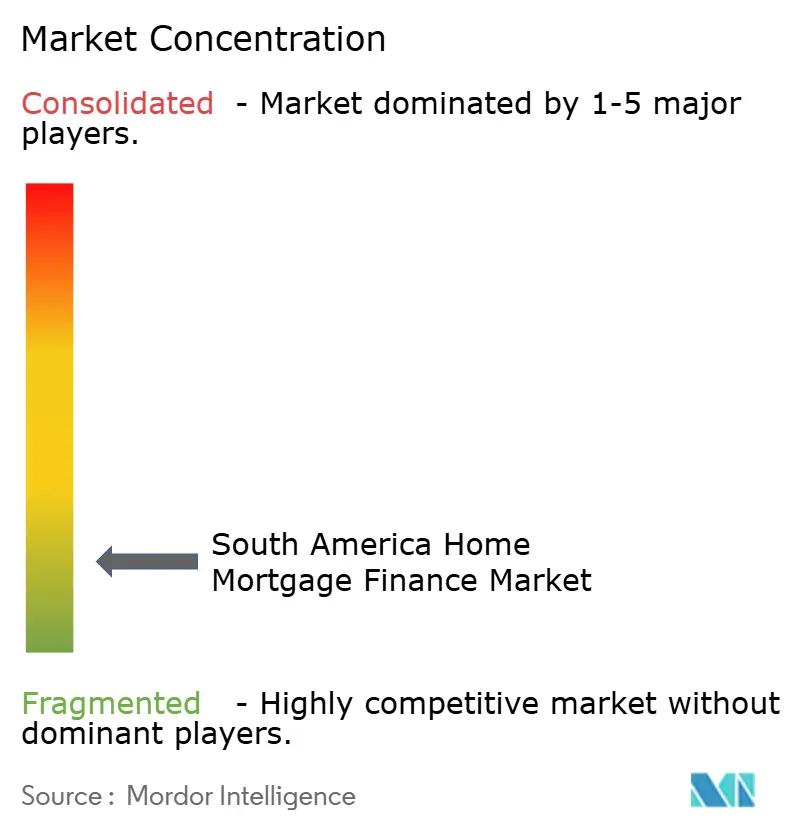
| Market Concentration | Low |
Major Players *Disclaimer: Major Players sorted in no particular order Image © Mordor Intelligence. Reuse requires attribution under CC BY 4.0. | |
South America Home Mortgage Finance Market Analysis by Mordor Intelligence
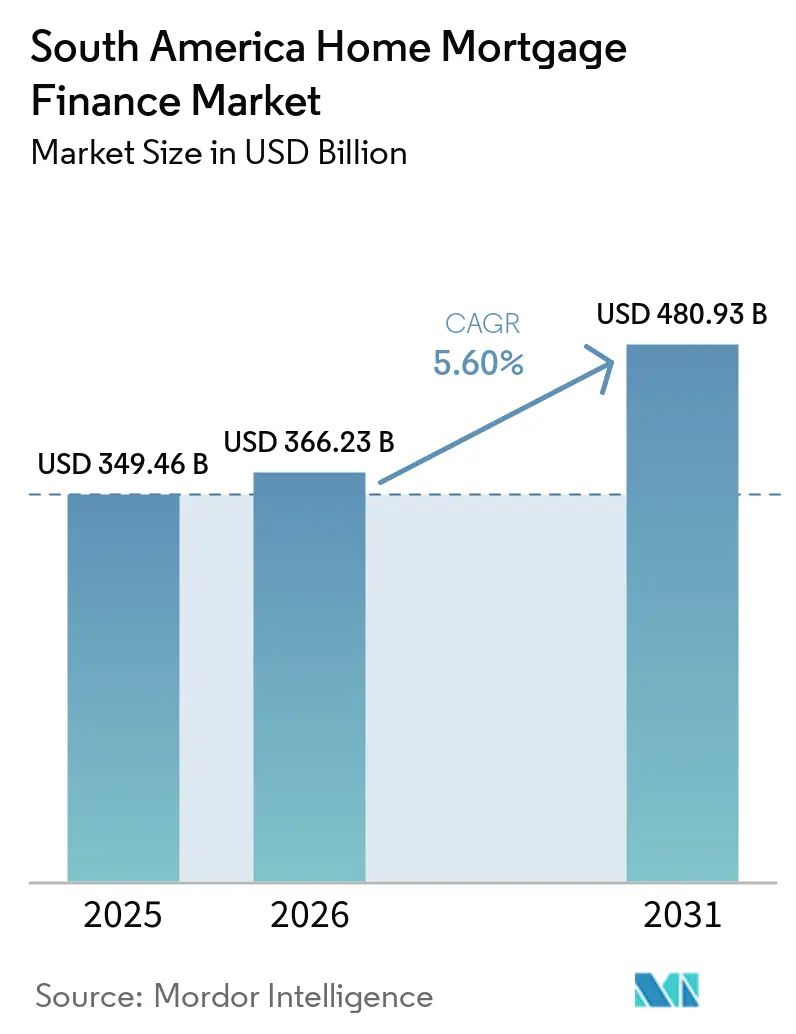
The South America Home Mortgage Finance Market size was valued at USD 349.46 billion in 2025 and is estimated to grow from USD 366.23 billion in 2026 to reach USD 480.93 billion by 2031, at a CAGR of 5.60% during the forecast period (2026-2031).
State-supported housing programs remain central to lending volumes because they combine subsidies, guarantees, and dedicated funding channels for lower-income borrowers. Persistent housing shortages sustain demand even when private mortgage costs limit household purchasing power. Digital origination is widening the pool of applicants by using transaction data and automated document checks. Competition is strongest above subsidy income limits, where private banks, housing finance companies, and digital lenders pursue borrowers with stable credit profiles. Capital rules and limited long-term funding still restrain faster lending growth across much of the South America home mortgage finance market.
Key Report Takeaways
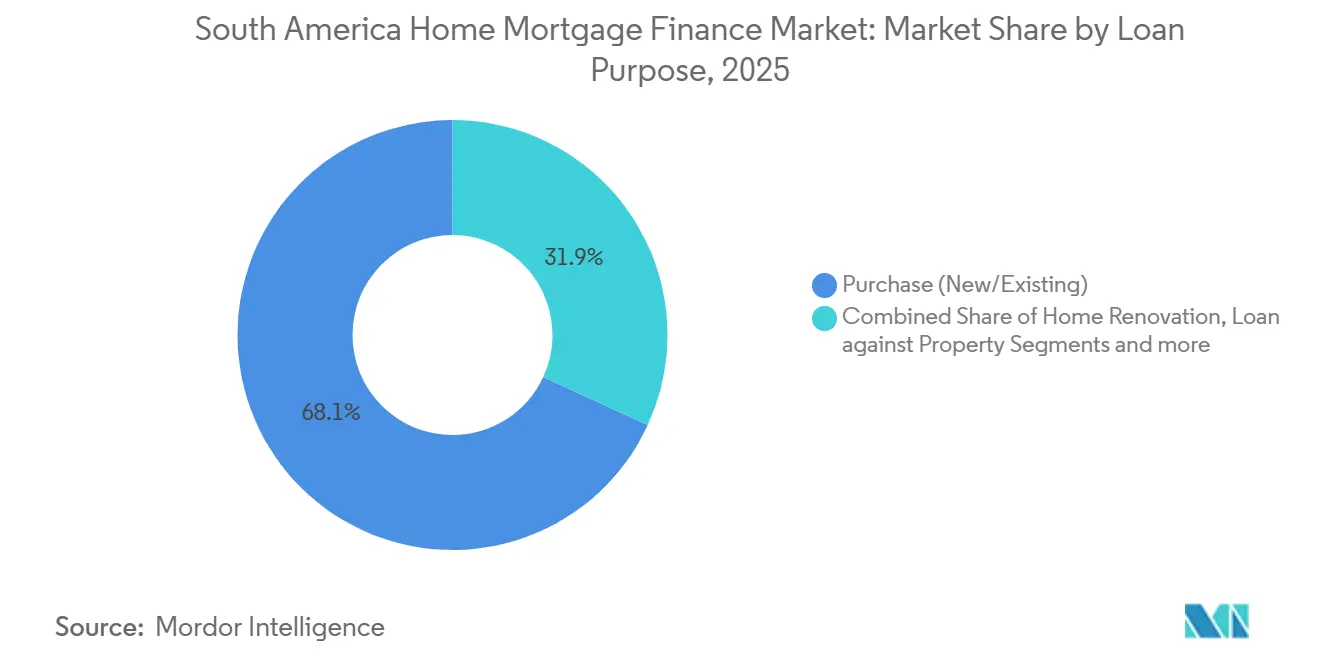
- By loan purpose, purchase (new/existing) held 68.12% of the South America home mortgage finance market share in 2025, while home improvement/renovation is forecast to grow at a 6.51% CAGR through 2031.
- By provider, banks held 78.21% of the South America home mortgage finance market share in 2025, while others (digital lenders, fintechs, cooperatives) are forecast to grow at a 7.52% CAGR through 2031.
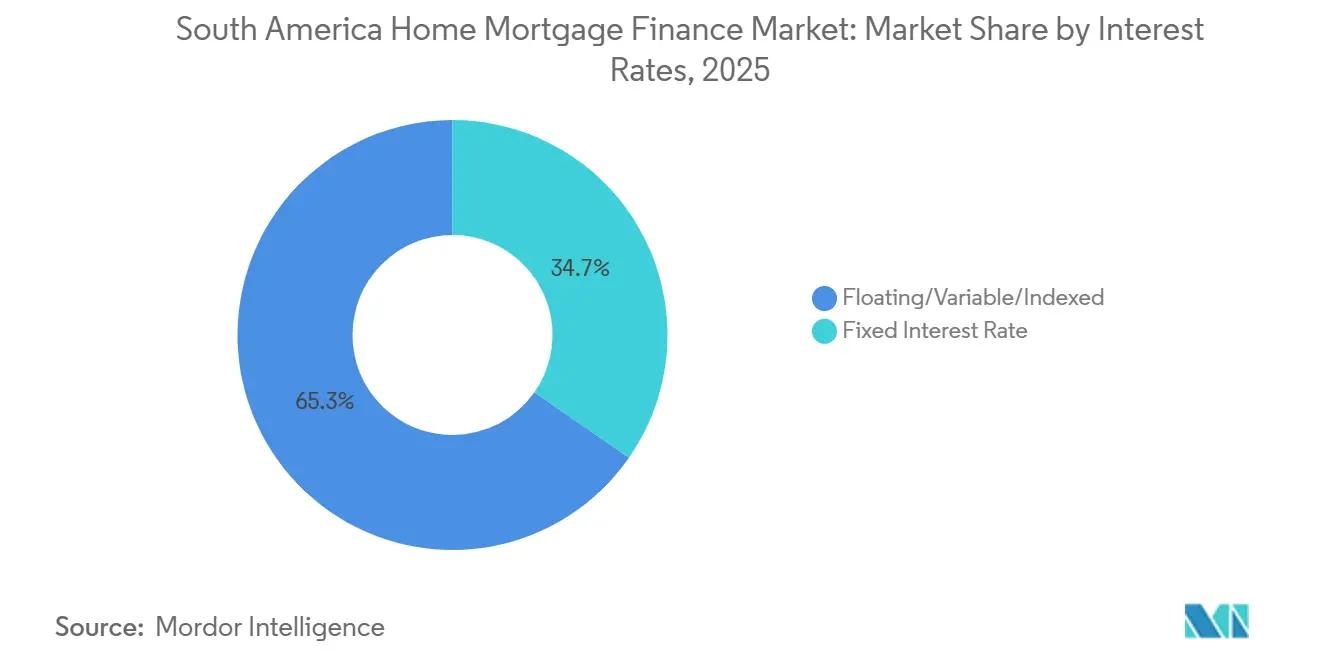
- By interest rate, floating, variable, and indexed products accounted for 65.32% of outstanding balances in 2025, while fixed-rate mortgages are forecast to grow at a 6.53% CAGR through 2031.
- By loan tenure, products exceeding 20 years held 46.53% of outstanding balances in 2025, while the 11–20 year segment is forecast to grow at a 6.51% CAGR through 2031.
- By geography, Brazil accounted for 54.34% of regional volume in 2025, while Colombia is forecast to grow at a 6.85% CAGR through 2031.
Note: Market size and forecast figures in this report are generated using Mordor Intelligence’s proprietary estimation framework, updated with the latest available data and insights as of January 2026.
South America Home Mortgage Finance Market Trends and Insights
Drivers Impact Analysis*
| Driver | (~) % Impact on CAGR Forecast | Geographic Relevance | Impact Timeline |
|---|---|---|---|
| Government-Supported Housing Finance and Mortgage Subsidy Programs | +1.3% | Brazil, Colombia, Chile, Peru | Short term (≤ 2 years) |
| Urban Household Formation and Persistent Housing Deficits | +0.8% | Brazil, Colombia, Chile | Medium term (2-4 years) |
| Expansion of Digital Mortgage Origination and Credit Assessment | +0.7% | Brazil, Colombia, Chile, Peru | Medium term (2-4 years) |
| Improving Access to Credit for Informal and Non-Salaried Income Earners | +0.5% | Brazil, Peru, Colombia | Long term (≥ 4 years) |
| Development of Property Registration and Collateral Infrastructure | +0.3% | Peru, Brazil, Colombia | Long term (≥ 4 years) |
| Growth in Demand for Homeownership and Formal Housing Finance | +0.6% | Regional | Medium term (2-4 years) |
| Source: Mordor Intelligence | |||
Government-Backed Subsidy Programs Anchoring Affordable Mortgage Demand
Government programs provide the demand base for the South America home mortgage finance market because they reduce the gap between household income and formal lending requirements. Brazil expanded Minha Casa, Minha Vida in April 2026 to include families earning up to BRL 13,000 (USD 2,321) per month, with property limits of BRL 600,000 (USD 107,143) under Faixa 4. The expansion combined BRL 15 billion (USD 2.7 billion) from the Pre-Sal Social Fund with FGTS resources, giving the program funding that is less dependent on annual budget decisions. Caixa Econômica Federal and Banco do Brasil began originating loans under the updated rules during the approval week. Peru’s Fondo Mivivienda reported 8.4% growth in credit placements during the first quarter of 2026 and disbursed 2,335 loans, its strongest quarterly result in 3 years. These programs also keep underwriting within formal regulatory systems, which supports lending discipline while extending access to subsidized borrowers.
Urban Household Formation and Structural Housing Deficits Creating a Durable Demand Floor
Housing shortages and new household formation continue to support the South America home mortgage finance market across the region’s largest urban centers. Brazil’s housing deficit stood close to 6 million units in 2025. Colombia’s deficit covered 25.6% of households in 2025, or 4.81 million families, while Chile needed 980,000 additional homes in early 2026. The greater Santiago area represented 42% of Chile’s identified housing requirement. Demand, therefore, extends beyond new construction because renters facing high housing costs can shift toward ownership when financing becomes more accessible. This need creates a more stable lending base than headline affordability measures alone suggest.
Digital Mortgage Origination Compressing Approval Timelines and Broadening Credit Eligibility
Digital tools are changing the operating model of the South America home mortgage finance market by reducing processing time and improving access to applicant data. Brazil’s Open Finance framework allows lenders to use authorized transaction information alongside conventional income documents. Colombia’s Decreto 0368 supports real-time mortgage rate comparison across 10 banks, including programs for foreign buyers without residency. These systems move competition toward data quality, digital workflows, and response time rather than branch coverage alone. BancoEstado launched Casaverso in December 2025, offering online mortgage preapprovals and connections to more than 100 properties from 8 developers. The platform plans to add subsidy integration, savings tools, and secondary-market listings during 2026.
Credit Access Expansion for Informal and Non-Salaried Income Earners
Improved access to mortgage finance for informal and non-salaried earners could support the long-term expansion of the South American home mortgage finance market. A significant share of housing development in countries such as Peru has occurred on informally held land through irregular settlements, creating challenges for households seeking formal housing finance[1]Andrés Nahoum et al., “Property Without Law? Why Land Titling and Adverse Possession Do Not Solve the Problem of Informal Property,” Iberoamerican Journal of Development Studies, papiro.unizar.es.. Informal income sources and unclear or incomplete property documentation can prevent otherwise creditworthy borrowers from meeting conventional mortgage eligibility requirements. In Brazil, the REURB framework provides eligible occupants of informal settlements with a Land Regularization Certificate, enabling possessory rights to be converted into registrable property rights. Formal recognition of property rights is critical to mortgage lending, as lenders require legally enforceable collateral to register and enforce mortgage liens. Consequently, greater property regularization can broaden borrower eligibility, strengthen collateral quality, and increase lender confidence, thereby supporting the formalization and expansion of mortgage finance across the region.
Restraints Impact Analysis*
| Restraint | (~) % Impact on CAGR Forecast | Geographic Relevance | Impact Timeline |
|---|---|---|---|
| High Mortgage Interest Rates and Borrowing Costs | -0.9% | Brazil, Colombia, Argentina | Short term (≤ 2 years) |
| Housing Affordability Constraints and Limited Household Purchasing Power | -0.7% | Argentina, Chile, Colombia | Medium term (2-4 years) |
| Informal Property Ownership and Incomplete Collateral Documentation | -0.5% | Peru, Brazil, Colombia | Long term (≥ 4 years) |
| Limited Availability of Long-Term Mortgage Funding | -0.4% | Argentina, Rest of South America | Medium term (2-4 years) |
| Source: Mordor Intelligence | |||
High Borrowing Costs Constraining Mid-Market Demand Despite Policy Rate Reductions
High interest rates continue to limit the commercially financed portion of the South America home mortgage finance market. Brazil’s Selic benchmark stood at 14.75% in March 2026, keeping open-market mortgage rates well above subsidized products[2]“Relatório de Política Monetária 2026,” Banco Central do Brasil, bcb.gov.br.. Colombia set its policy rate at 10.25% in early 2026, and non-VIS mortgage rates exceeded 11%. Argentina’s UVA mortgage relaunch also remained exposed to inflation-indexation risk and uncertain real wage growth. Chile offered a contrasting case, with mortgage rates falling to 3.98% in April 2026. Rate differences divide borrowers into subsidized, commercially viable, and underserved groups rather than creating one consistent regional borrowing environment.
Affordability Constraints and Household Income Gaps Limiting First-Time Buyer Access
Affordability pressures restrict first-time buyer participation in the South America home mortgage finance market even when credit availability improves. The Lincoln Institute of Land Policy identified housing deficits, low mortgage penetration, and housing costs rising faster than incomes as linked pressures across South America[3]López et al., “A New Way to Compare Housing Markets in Latin America,” Land Lines Magazine, lincolninst.edu.. In Argentina, households required 22.7 years of full income to buy an average home, compared with a global average of 11.2 years. Chile’s price-to-income ratio was 15.6 in 2025. Digital platforms can broaden eligibility, but they do not remove the underlying pressure on households with limited disposable income. Lenders must therefore balance wider access against repayment capacity and credit risk.
*Our forecasts treat driver/restraint impacts as directional, not additive. The impact forecasts reflect baseline growth, mix effects, and variable interactions.
Segment Analysis
By Loan Purpose: Purchase Financing Dominates While Renovation Borrowing Accelerates
Purchase (new/existing) financing commanded 68.12% of the South America home mortgage finance market size in 2025, as public programs largely direct support toward property acquisition. This structure makes purchase transactions the principal use of formal mortgage credit across Brazil, Chile, Peru, and Colombia. Home improvement/renovation is projected to grow at a 6.51% CAGR through 2031 as existing homeowners favor upgrades when purchase transactions are costly. Existing collateral, lower loan-to-value requirements, and shorter repayment periods can make renovation borrowing less exposed to high-rate conditions. Loan Against Property, construction lending, and refinancing remain smaller uses but are gaining relevance alongside primary mortgages.
Bancolombia disbursed COP 3.7 trillion (USD 925 million) in construction financing during 2025, supporting 58,000 new housing units, of which 67% were social housing. That activity supports future housing supply while individual buyers obtain mortgages for completed homes. Brazil’s Law No. 14,711/2023 streamlined the extrajudicial enforcement of real estate collateral. Better enforcement can reduce legal uncertainty for second-lien and home-equity products. These uses remain more established in major financial centers than in smaller cities.



By Provider: Banks Retain Structural Dominance, but Fintechs Are Rewriting the Origination Stack
Banks held 78.21% of the South America home mortgage finance market size in 2025, supported by capital reserves, savings-linked funding, and their role in administering government subsidies. Caixa Econômica Federal’s housing portfolio reached BRL 1 trillion (USD 178.6 billion) in June 2026 after rising 14.2% year on year. This scale provides a funding and distribution advantage that private lenders cannot readily replicate. Housing finance companies remain important in Colombia, where some borrowers do not meet commercial banks’ income-documentation requirements. The Others category, including digital lenders, fintechs, and cooperatives, is forecast to grow at a 7.52% CAGR through 2031.
These providers target applicant groups that large lenders do not always serve efficiently. The South America home mortgage finance market share is shifting toward alternative credit assessment as consent-based transaction histories become more available. Private banks are responding with their own digital mortgage platforms and faster processing systems. Bradesco expects mortgage credit to increase 10% to 15% in 2026. Digital origination is now a core operating requirement for established banks and newer providers.
By Interest Rates: Floating Rate Prevalence Masks a Structural Rotation Toward Fixed Products
Floating, variable, and indexed mortgages held 65.32% of the South America home mortgage finance market share in 2025, reflecting the long-standing practice of transferring interest-rate risk to borrowers during high-inflation periods. Fixed-rate mortgages are forecast to grow at a 6.53% CAGR through 2031 as monetary easing, government guarantees, and demand for stable payments improve their appeal. In Chile, Unidad de Fomento loans are commonly classified as variable products. Their payments retain a fixed real-value structure because the index follows consumer prices with a lag. This distinction matters when comparing product risk across the regional portfolio.
BancoEstado offered FOGAES-backed mortgages from 3.1% in June 2026, with terms of up to 30 years. State guarantees can help lenders support long-duration fixed products by lowering credit risk. Argentina’s UVA loans use inflation-indexed principal with a fixed nominal spread. The Central Bank of Argentina allows borrowers to extend the loan term by up to 25% when inflation exceeds wage growth by more than 10%. Product structures, therefore, respond differently to inflation, household incomes, and monetary policy.
By Loan Tenure: Long-Duration Products Anchor the Affordable Segment While Mid-Tenor Lending Gains Ground
Mortgages with tenures exceeding 20 years held 46.53% of the South America home mortgage finance market share in 2025, because longer repayment periods reduce monthly payments for low- and middle-income households. BancoEstado’s FOGAES-backed Hipotecazo campaign offered 30-year terms from 3.1% with a 10% down payment. The 11–20 year category is projected to grow at a 6.51% CAGR through 2031. Argentina’s UVA loans, Colombia’s non-VIS segment, and Peru’s sol-denominated lending support this tenure range. The 10-years-or-less category is smaller and mainly serves equity releases, construction bridge loans, and refinancing.
Shorter products are more sensitive to near-term interest-rate movements because payments reset over a more limited period. The South America home mortgage finance market share is supported by limited covered-bond and mortgage-backed securities activity outside Brazil. Banks, therefore, retain many long-duration assets on their balance sheets. This restricts their ability to recycle funds into new organizations when demand increases. Deeper capital markets could ease this funding constraint without replacing the role of banks.
Geography Analysis
Brazil held 54.34% of the South America home mortgage finance market share in 2025, supported by FGTS funding and the Minha Casa, Minha Vida program. Caixa originated BRL 137.6 billion (USD 24.6 billion) of housing credit during the first half of 2026, up 29.3% from the first half of 2025. FGTS-funded housing loans rose 13.9% in the same period. Dedicated savings resources provide stable long-term funding for affordable lending. Future growth also depends on the capacity of those resources and on capital-market development.
Colombia is projected to grow at a 6.85% CAGR through 2031, the fastest rate among regional geographies. Its housing credit portfolio increased 12.1% year on year in the first quarter of 2026 despite weaker construction starts. Bancolombia committed COP 1 trillion (USD 250 million) to 227 active housing projects in June 2026, supporting 41,792 units under development. Chile’s mortgage rate reached 3.98% in April 2026, and residential sales increased 26.6% year on year in the third quarter of 2025. Peru’s mortgage credit rose 7.6% year on year in July 2026, while 94.4% of new originations were denominated in soles[4]“BCR: Mortgage Lending Accelerates in Peru, Up 7.6% Year-on-Year in July 2026,” Andina, andina.pe..
Argentina remains in a recovery stage in the South America home mortgage finance market share. Mortgage credit financed 11% of home purchases in Buenos Aires City in 2026. The government announced an ARS 2 trillion (USD 1.3 billion) mortgage guarantee plan in August 2026 to support long-term bank deposits and new home loans. The Rest of South America remains underpenetrated because formal secondary-market infrastructure is limited and informal ownership is widespread.
Competitive Landscape
The South America home mortgage finance market is fragmented across the region. State-backed lenders hold an advantage in affordable housing because they distribute public guarantees and use dedicated funding channels. Caixa’s housing portfolio reached BRL 1 trillion (USD 178.6 billion) in June 2026. BancoEstado received International Banker’s Best Mortgage Lender recognition in Chile for 2026. Banco de la Nación Argentina accounted for 85% of new UVA mortgage originations.
Green finance differentiates private lenders in the South America home mortgage finance market. IFC committed a USD 100 million green loan to Banco Santander Chile in April 2025 for EDGE-certified sustainable construction. Davivienda and IDB Invest issued Colombia’s first sustainability-linked bond for social and sustainable housing in February 2026, valued at COP 300 billion (USD 75 million). BCI launched Crédito Hipotecario Verde in July 2025 for homes with Chile’s energy-efficiency certification. These measures connect mortgage products with recognized environmental standards and specialized funding.
Technology investment is reshaping competition in the South America home mortgage finance market. BancoEstado’s Casaverso provides digital preapprovals and a property search channel. Bancolombia’s developer network connects construction financing with future mortgage demand. Digital lenders and cooperatives can expand among informal-income borrowers, while green products have scope beyond the largest cities.
South America Home Mortgage Finance Industry Leaders
Santander
Caixa Econômica Federal
Banco do Brasil
Itaú
Bradesco
- *Disclaimer: Major Players sorted in no particular order

Recent Industry Developments
- August 2026: Argentina's Economy Ministry announced an ARS 2 trillion (USD 1.3 billion) plan to revive mortgage lending by guaranteeing long-term bank deposits, enabling regulated institutions to extend new home loans at structured rates. The government projected the program would provide housing solutions for 17,000–18,000 additional families, and Banco Nación continued to lead the UVA market with 85% of new originations.
- July 2026: The Climate Bonds Initiative approved the CASA Colombia certification standard, developed by the Colombia Green Building Council, as a recognized proxy under the Climate Bonds Standard. The standard covers over 8.2 million square meters representing 101,600 housing units, creating a formal pipeline for green-bond financing of Colombian residential housing.
- June 2026: BancoEstado Chile launched the "Hipotecazo" campaign offering FOGAES-backed mortgage rates from 3.1% at up to 90% loan-to-value and 30-year terms, targeting 12,000 units across June and July 2026. Chile's Ministry of Housing and Urbanism introduced middle-income subsidy tiers for properties up to 4,000 UF, with 5,000 quota slots and plans to expand in 2027.
- June 2026: Bancolombia committed COP 1 trillion (USD 250 million) in construction financing across 227 active housing projects, supporting 41,792 units in active development and 51,000 families. A further COP 4 trillion (USD 1 billion) was approved for 110 projects entering the pre-construction phase.


South America Home Mortgage Finance Market Report Scope
The South America home mortgage finance market encompasses the provision of residential mortgage financing by banks, housing finance institutions, and other regulated lenders to individuals and households for the purchase, construction, renovation, or refinancing of residential properties, typically secured by a mortgage or other legally enforceable claim over the underlying property.
The South America Home Mortgage Finance Market Report is Segmented by Loan Purpose (Purchase, Home Improvement/Renovation, Loan Against Property, Others), by Provider (Banks, Housing Finance Companies, Others), by Interest Rates (Fixed, Floating), by Loan Tenure (≤10, 11–20, >20 Years), and by Geography (Brazil, Argentina, Colombia, Chile, Peru, Rest of South America). The Market Forecasts are Provided in Terms of Value (USD).
| Purchase (New/Existing) |
| Home Improvement/Renovation |
| Loan Against Property |
| Others (Construction, Refinance, etc.) |
| Banks |
| Housing Finance Companies |
| Others |
| Fixed Interest Rates |
| Floating Interest Rates |
| ≤ 10 Years |
| 11 – 20 Years |
| > 20 Years |
| Brazil |
| Argentina |
| Colombia |
| Chile |
| Peru |
| Rest of South America (Uruguay, Paraguay, Bolivia, Venezuela, and Ecuador) |
| By Loan Purpose | Purchase (New/Existing) |
| Home Improvement/Renovation | |
| Loan Against Property | |
| Others (Construction, Refinance, etc.) | |
| By Provider | Banks |
| Housing Finance Companies | |
| Others | |
| By Interest Rates | Fixed Interest Rates |
| Floating Interest Rates | |
| By Loan Tenure | ≤ 10 Years |
| 11 – 20 Years | |
| > 20 Years | |
| By Geography | Brazil |
| Argentina | |
| Colombia | |
| Chile | |
| Peru | |
| Rest of South America (Uruguay, Paraguay, Bolivia, Venezuela, and Ecuador) |


Key Questions Answered in the Report
What is driving demand for home mortgage finance in South America?
Subsidized housing programs, housing shortages, household formation, and digital origination support demand across the region.
Which loan purpose leads in South American home mortgage finance?
Purchase financing led with 68.12% of lending value in 2025, while Home Improvement/Renovation is projected to grow at a 6.51% CAGR through 2031.
Which providers dominate home mortgage lending in South America?
Banks held 78.21% of lending value in 2025, supported by funding access, capital capacity, and their role in subsidy distribution.
Why are fixed-rate mortgages gaining relevance in South America?
Fixed-rate mortgages are projected to grow at a 6.53% CAGR through 2031 as lower rates and government guarantees improve payment certainty.
Which country is growing fastest for home mortgage finance in South America?
Colombia is forecast to expand at a 6.85% CAGR through 2031, supported by rising housing credit and construction financing.
What limits mortgage access for first-time homebuyers in South America?
High borrowing costs, weak purchasing power, informal income, and incomplete property records continue to limit access.
Page last updated on:





