
Market Overview
| Study Period | 2021 - 2031 |
|---|---|
| Forecast Data Period | 2026 - 2031 |
| Base Year Market Size (2025) | USD 319.79 Million |
| Market Size (2026) | USD 336.87 Million |
| Market Size (2031) | USD 442.24 Million |
| Growth Rate (2026 - 2031) | 5.59 % |
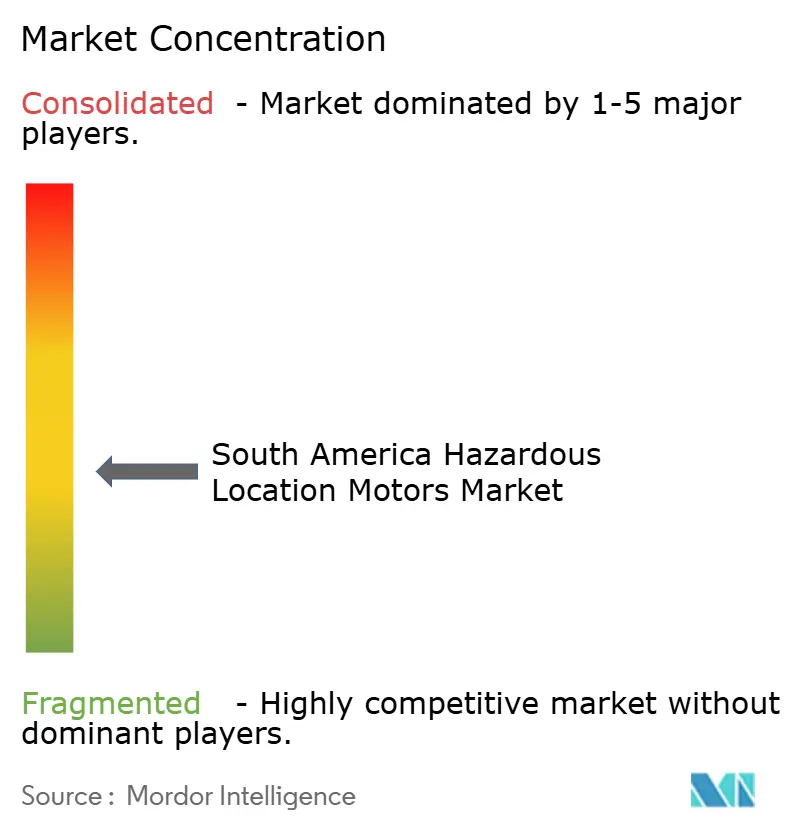
| Market Concentration | Medium |
Major Players *Disclaimer: Major Players sorted in no particular order Image © Mordor Intelligence. Reuse requires attribution under CC BY 4.0. | |
South America Hazardous Location Motors Market Analysis by Mordor Intelligence
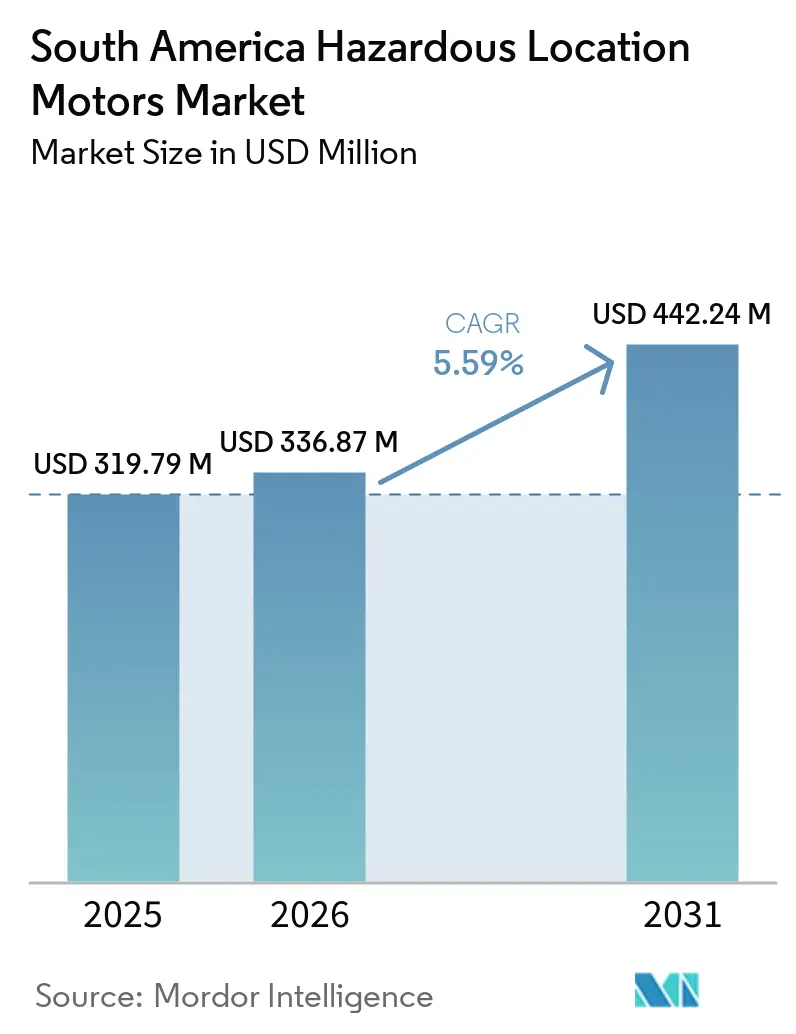
The South America hazardous location motors market size was valued at USD 319.8 million in 2025 and estimated to grow from USD 336.9 million in 2026 to reach USD 442.2 million by 2031, at a CAGR of 5.6% during the forecast period (2026-2031). The South America hazardous location motors market is supported by planned investment in offshore production, refining, shale development, and chemical processing assets. Petrobras’s 2026-2030 plan directs USD 69.2 billion to exploration and production and includes 8 new FPSO systems by 2030, which creates a long procurement horizon for certified motors used in compression, crude transfer, water injection, and utility systems. Safety rules and energy-efficiency requirements are also bringing replacement activity forward at older assets. Suppliers with pre-certified products, local service capacity, and established relationships with large operators are better placed to convert these projects into orders. This leaves opportunities in peripheral process areas, dust-hazard applications, and intelligent starter replacements, although certification capacity and currency conditions can delay purchasing decisions.
Key Report Takeaways
- By motor construction, explosion-proof/flameproof motors led with 54.6% revenue share in 2025 and are projected to record the highest CAGR of 7.0% through 2031.
- By power rating, 10-100 kW motors led with 46.8% revenue share in 2025, while 100-500 kW motors are projected to record the highest CAGR of 6.8% through 2031.
- By zone, Zone 0-related applications led with 43.7% revenue share in 2025, while Zone 20-related applications are projected to record the highest CAGR of 6.8% through 2031.
- By end-user industry, oil and gas represented the largest segment in 2025 with 29.71% share, while mining and metals is projected to record the highest growth of 6.45% through 2031, supported by expanding mineral extraction and processing investments across South America.
- By country, Brazil led with 57.9% revenue share in 2025 and is projected to record the highest CAGR of 7.1% through 2031.
Note: Market size and forecast figures in this report are generated using Mordor Intelligence’s proprietary estimation framework, updated with the latest available data and insights as of January 2026.
South America Hazardous Location Motors Market Trends and Insights
Drivers Impact Analysis*
| Driver | (~) % Impact on CAGR Forecast | Geographic Relevance | Impact Timeline |
|---|---|---|---|
| Expansion of Offshore and Shale Hydrocarbon Production | +1.8% | Brazil (pre-salt offshore), Argentina (Vaca Muerta, Neuquén) | Medium term (2–4 years) |
| Industrial Safety Compliance and Accident-Prevention Spending | +1.4% | Brazil, Colombia; spill-over to Chile | Short term (≤ 2 years) |
| Energy-Efficient Motor Replacement and Total-Cost-of-Ownership Savings | +0.9% | Brazil (INMETRO IR3 mandate), Argentina, Chile | Medium term (2–4 years) |
| Automation of Hazardous Process Operations | +0.7% | Brazil, Argentina, Colombia | Medium term (2–4 years) |
| Brazil-Led Regional Manufacturing and Service Localization | +0.5% | Brazil (core), spill-over to Argentina, Chile, Colombia | Long term (≥ 4 years) |
| Retrofit Demand from Certification Gaps in Legacy Assets | +0.3% | Brazil, Argentina, Chile | Short term (≤ 2 years) |
| Source: Mordor Intelligence | |||
Expansion of Offshore and Shale Hydrocarbon Production
Petrobras has committed to 8 new FPSO production systems by 2030, with 7 already contracted, creating a material demand base for certified motors across offshore systems. This requires a clear fit between the motor, the starter, and the classified location. The company signed contracts for the SEAP-I and SEAP-II FPSO units in May 2026, with a combined investment exceeding BRL 60 billion and production scheduled for 2030 and 2031.[1]Petrobras, “Petrobras Signs FPSO Contracts for Sergipe Deepwater SEAP Project,” U.S. Securities and Exchange Commission, sec.gov. The equipment choice was shaped by certification requirements, maintenance access, and the operating environment. These projects require equipment for gas compression, crude transfer, water injection, and utilities in classified areas, with project teams considering both operating continuity and the formal compliance record. In Argentina, Vaca Muerta expansion directs activity toward wellhead, compression, and gas-processing infrastructure, where vibration, temperature cycles, and abrasive fluids increase equipment demands, which links procurement decisions to plant reliability, safety obligations, and planned maintenance windows. These conditions can shorten the operating life of installed motors and increase recurring replacement needs, thereby increasing the value of readily available certified configurations for replacement work. The South America hazardous location motors market, therefore, benefits from both new construction and the more frequent replacement cycle associated with shale operations, while buyers balance installed-base compatibility, delivery timing, and the required level of protection.
Industrial Safety Compliance and Accident-Prevention Spending
Brazil’s NR-10 and NR-20 rules require operators to maintain certified equipment in classified areas across oil and gas, chemical, and grain-handling facilities.[2]Associação Brasileira de Ensaios Não Destrutivos e Inspeção, “Instalações e Equipamentos Elétricos e Mecânicos em Atmosferas Explosivas,” ABENDI, abendi.org.br. The final specification reflects both process conditions and the planned operating duty. Compliance activity draws attention to older motors that are uncertified or no longer suited to the applicable hazardous-zone classification, making product availability and documented compliance important during project execution. This creates replacement demand in the South America hazardous-location motors market, even when the plant is not expanding capacity, making service support important after installation as operating needs evolve. Refinery and petrochemical assets often require corrective work in Zone 0 and Zone 1 locations after safety reviews, while the operating duty determines the required enclosure, controls, and service capability. Wastewater investment can create a similar need when methane-rich pump stations are classified as Zone 1 locations, with facility operators seeking products that can be integrated into established maintenance plans. The South America hazardous location motors market gains a steadier replacement channel as safety audits turn deferred equipment purchases into required remediation work, keeping replacement planning closely tied to shutdown schedules and operating risk.
Energy-Efficient Motor Replacement and Total-Cost-of-Ownership Savings
Brazil requires IR3 efficiency, equivalent to IEC IE3, for three-phase squirrel-cage induction motors from 0.75 kW to 375 kW under INMETRO Portaria 290/2021.[3]Instituto Nacional de Metrologia, Qualidade e Tecnologia, “Motores Elétricos Trifásicos, Efficiency Requirements,” INMETRO, gov.br. It requires a clear fit between the motor, the starter, and the classified location. The requirement extends to increased-safety hazardous-location motors and moves legacy IE1 and IE2 assets toward replacement, while suppliers need to match certified product configurations with local technical support. A 1.5 percentage-point efficiency improvement on a 75 kW motor operating 6,000 hours annually was associated with USD 2,000–3,000 in annual electricity savings and a payback period below 30 months in the supplied evidence, with project teams considering operating continuity as well as the formal compliance record. Safety reviews increasingly consider efficiency alongside certification status, strengthening the case for upgraded motors and making lifecycle needs relevant alongside the initial equipment purchase price. WEG announced a BRL 160 million wire-manufacturing investment in Linhares, with production scheduled for 2027, supporting local motor supply and vertical integration. This raises the value of readily available certified configurations for replacement work. The South America hazardous location motors market is therefore shaped by lifecycle cost decisions as well as mandatory efficiency compliance, with the equipment choice shaped by certification requirements, maintenance access, and the operating environment.
Automation of Hazardous Process Operations
Integration of distributed control systems and safety instrumented systems is eliminating manual motor start/stop operations in hazardous zones, shifting procurement toward intelligent motor starters with fieldbus communication and integrated protection relays. Schneider Electric's engagement on the RNEST Abreu e Lima refinery Train 2 automation project illustrates how OEM-level automation partnerships generate co-dependent motor starter upgrade cycles, as DCS replacement routinely requires co-certification of associated starters to maintain system-level SIL integrity. At Vaca Muerta, reduced on-site personnel targets are driving the expansion of intelligent motor starter installations in Zone 2 wellsite environments that were previously served by simpler full-voltage products.
Restraints Impact Analysis*
| Restraint | (~) % Impact on CAGR Forecast | Geographic Relevance | Impact Timeline |
|---|---|---|---|
| High Procurement Costs and Lengthy Certification Lead Times | -1.5% | Brazil, Argentina, Chile | Medium term (2–4 years) |
| Macroeconomic Instability and Currency Depreciation Constraining Capital Investment | -1.0% | Argentina, Colombia, Rest of South America | Short term (≤2 years) |
| Dependence on Imported Specialized Motors and Components | -0.7% | Argentina, Chile, Colombia, Peru | Medium term (2–4 years) |
| Shortage of Ex-Qualified Installation and Maintenance Personnel | -0.5% | Chile, Colombia, Peru, Rest of South America | Long term (>4 years) |
| Source: Mordor Intelligence | |||
High Procurement Costs and Lengthy Certification Lead Times
INMETRO Portaria 115/2022 requires a standalone INMETRO certificate for every explosion-proof motor sold in Brazil, even for products already holding IECEx or ATEX certification, with complex motor assemblies facing evaluation lead times of 14 to 18 months for new product entries. Cumulative certification costs, including third-party testing, quality auditing, and local importer registration, can exceed USD 50,000–80,000 per model series, an entry barrier that limits buyer choice and sustains price premiums for incumbents. Argentina requires IRAM certification, while Colombia's RETIE compliance framework demands supplementary verification for mining and oilfield installations, creating a multi-standard burden that few mid-tier manufacturers maintain region-wide. Certification queue timelines force buyers at mid-sized chemical plants to procure over-specified pre-certified motors rather than optimally sized alternatives, inflating per-project equipment budgets.
Macroeconomic Instability and Currency Depreciation Constraining Capital Investment
Argentina's persistent peso depreciation and capital control cycles create structural procurement unpredictability for Vaca Muerta equipment buyers, as imported motor prices can translate to 30–40% higher peso costs within a single annual budget cycle. Colombia's peso weakened materially over 2024–2025, prompting procurement teams to extend motor service life through rewinding and refurbishment rather than certified replacements, a practice that carries increasing safety risks as motors age out of compliance with classification standards. The downstream consequence is a deferred-replacement backlog that materializes rapidly when conditions stabilize, producing procurement surge patterns that complicate inventory planning for OEMs holding regional stock. Brazil's relative stability provides some buffer, but secondary-market currency exposure means region-wide volume growth consistently falls short of what a Brazil-isolated demand trajectory would otherwise imply.
*Our forecasts treat driver/restraint impacts as directional, not additive. The impact forecasts reflect baseline growth, mix effects, and variable interactions.
Segment Analysis
By Motor Construction - Flameproof Designs Anchor Hazardous-Area Motor Demand
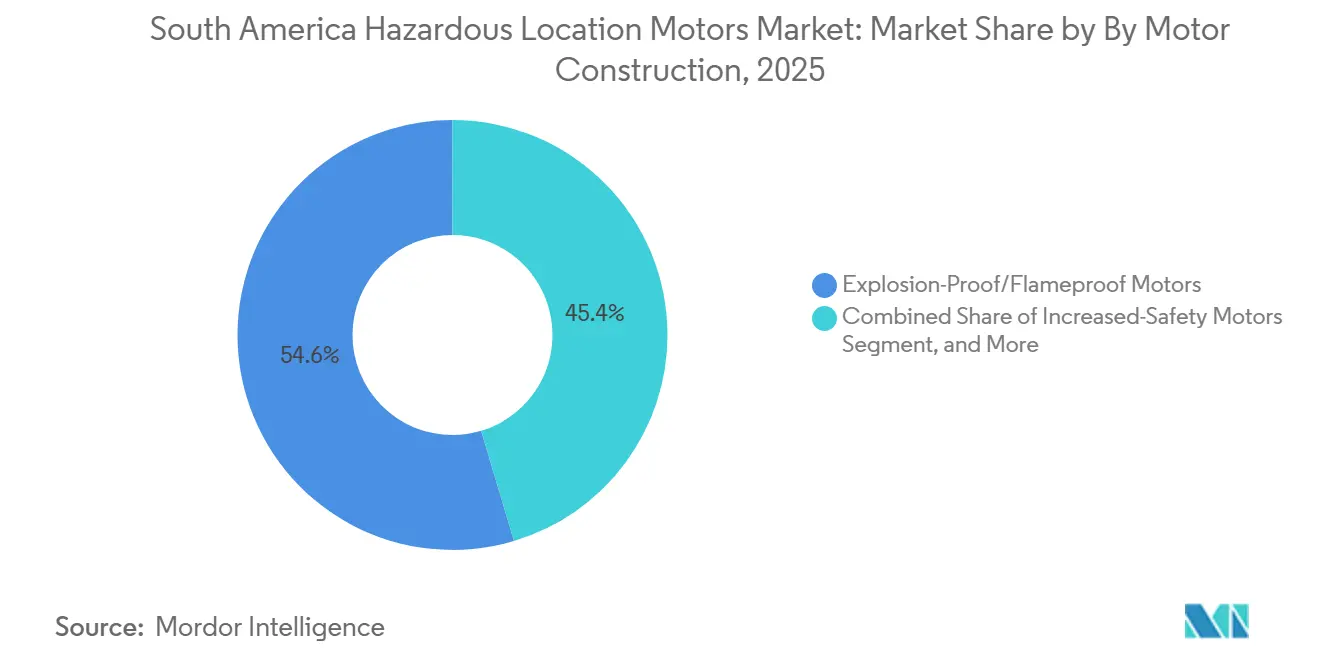
Explosion-proof/flameproof motors accounted for 54.62% of market revenue in 2025, supported by extensive deployment across oil and gas, refining, petrochemicals, chemicals, and other industries where flammable gases and vapors create ignition risks. These motors are widely integrated with pumps, compressors, fans, conveyors, mixers, and other rotating equipment operating in classified environments. Their ability to contain an internal explosion and prevent ignition of the surrounding atmosphere makes them particularly important in high-risk industrial processes. Brazil's large hydrocarbon and process-industry infrastructure, combined with established hazardous-area motor manufacturing and certification capabilities, reinforces the segment's substantial installed base and recurring replacement demand.
Explosion-proof/flameproof motors are also projected to register the highest CAGR of 6.98% during 2026–2031, driven by expansion and modernization of hazardous industrial infrastructure. Offshore energy projects, petrochemical capacity, mining operations, and brownfield facility upgrades are creating incremental requirements for certified motor systems. Replacement demand is increasingly shifting toward premium-efficiency designs offering improved thermal performance, variable-frequency-drive compatibility, enhanced reliability, and condition-monitoring capabilities. Manufacturers with locally available IEC/INMETRO-compliant products are positioned to benefit as industrial operators standardize equipment specifications and strengthen safety compliance. These factors should allow flameproof motors to retain their structural leadership while simultaneously achieving the strongest growth within the motor-construction segment.



By Power Rating - Medium-Power Dominance Shifts Toward Higher-Capacity Applications
Motors rated 10-100 kW accounted for 46.83% of market revenue in 2025, reflecting their broad applicability across a range of medium-duty hazardous industrial equipment. This power range supports pumps, fans, blowers, conveyors, mixers, agitators, and material-handling systems used throughout oil and gas, chemicals, mining, food processing, and wastewater facilities. Compared with very-high-power motors, these products benefit from substantially higher installation volumes and a broader replacement base. Their versatility across continuous-process applications reinforces demand from both new facilities and existing plants, while replacing aging motors with premium-efficiency alternatives provides additional aftermarket opportunities without requiring major redesigns of established motor-driven industrial systems.
The 100-500 kW segment is projected to register the fastest CAGR of 6.78% during 2026–2031, as investment shifts toward larger pumps, compressors, ventilation systems, conveyors, and heavy process machinery. Offshore oil and gas developments, mining and mineral-processing expansions, and the modernization of petrochemical facilities are increasing the demand for higher-output hazardous-duty motors capable of reliable, continuous operation. Adoption should also benefit from growing use of variable-speed drives, premium-efficiency motor architectures, advanced thermal protection, remote condition monitoring, and predictive maintenance. These technologies can reduce electricity consumption and unplanned downtime, strengthening the economic case for replacing older high-power motors across South America's capital-intensive process industries.
By Zone - Severe Gas Hazards Lead While Combustible-Dust Applications Accelerate
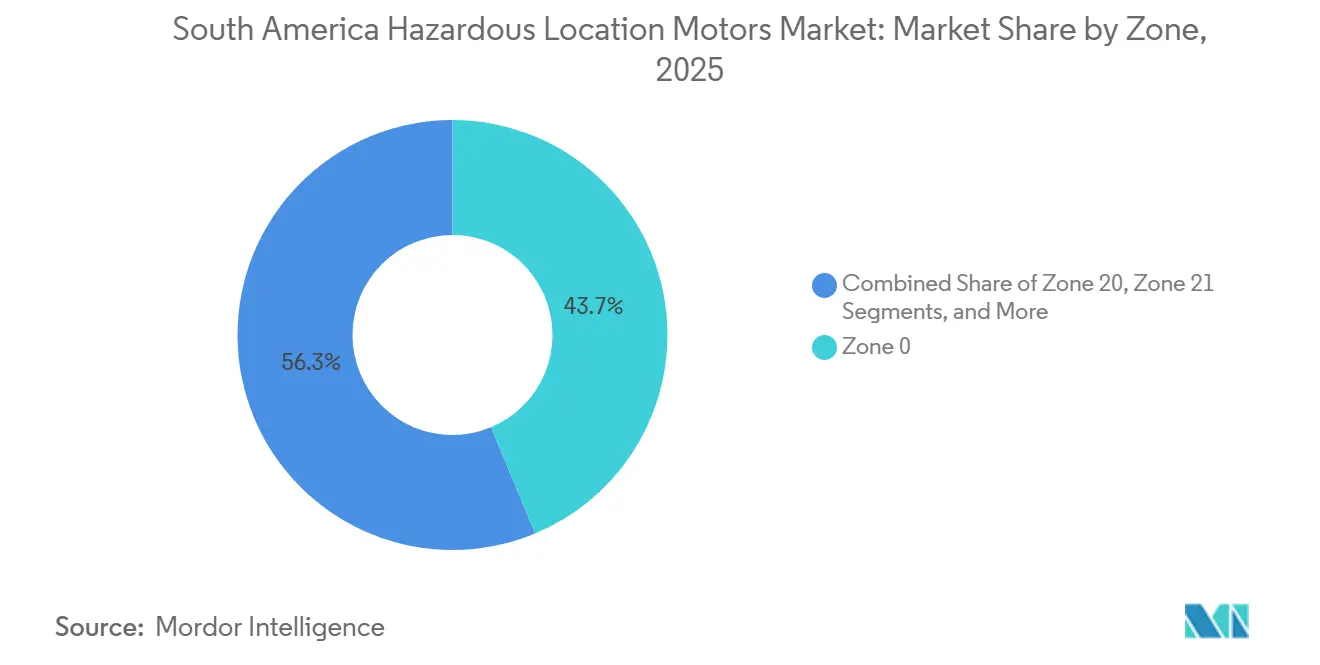
Zone 0-related applications accounted for 43.72% of revenue in 2025 in the provided market model, reflecting significant equipment demand for industrial processes with continuously or frequently present explosive gas atmospheres. Oil and gas production, petroleum storage, refining, chemical processing, and related hydrocarbon-handling operations create environments requiring stringent ignition-risk management. Demand is particularly concentrated around equipment supporting tanks, vessels, processing systems, and other highly classified operations. However, conventional motors are generally positioned outside the actual Zone 0 environment, meaning the segment should primarily represent motor demand associated with facilities and processes containing Zone 0 areas rather than motors physically operating inside continuously explosive atmospheres.
Zone 20-related applications are projected to register the highest CAGR of 6.83% through 2031, reflecting growing management of combustible dust hazards across grain processing, food production, chemicals, biomass, mining, and material-handling facilities. Brazil and Argentina's substantial agricultural-processing industries provide a particularly important demand base, while mining and powdered-material processing expand opportunities elsewhere in South America. Modernization of older facilities, greater attention to dust-explosion prevention, and automation of material-handling operations should increase requirements for appropriately protected motor systems. As with Zone 0, growth primarily represents motors supporting facilities containing severe Zone 20 dust hazards, with equipment typically installed in adjacent classified areas appropriate to its protection certification.
By End-User Industry - Oil and Gas Leadership Meets Accelerating Mining Investment
Oil and gas represents the largest end-user industry for hazardous-location motors in South America with 29.71% share, supported by extensive offshore production, refineries, pipelines, terminals, storage infrastructure, and hydrocarbon-processing facilities. Brazil provides the largest demand concentration through its offshore and pre-salt activities, supplemented by Argentina's hydrocarbon development and production across Colombia and other regional markets. Hazardous-area motors are widely used for pumps, compressors, fans, cooling equipment, ventilation systems, and other rotating machinery operating in the presence of combustible hydrocarbons. The industry's large installed equipment base also generates substantial recurring aftermarket demand as operators replace aging motors, improve energy efficiency, enhance operational reliability, and modernize facilities to meet contemporary hazardous-area equipment requirements.
Mining and metals is expected to be the fastest-growing end-user industry of 6.45% CAGR through 2031, supported by investment in copper, lithium, iron ore, and other mineral resources across Chile, Peru, Brazil, and Argentina. New mines and the expansion of mineral-processing facilities create demand for motors that support pumps, conveyors, crushers, ventilation equipment, material-handling systems, and processing machinery operating under demanding conditions. Mine electrification and automation should further increase requirements for efficient and reliable electric-drive systems. Meanwhile, operators are increasingly adopting premium-efficiency motors, variable-speed operation, condition monitoring, and predictive-maintenance technologies to reduce energy consumption and downtime, supporting both greenfield installations and accelerated replacement of aging motor fleets.
Geography Analysis
By Country - Brazil Leads Regional Demand While Mining Economies Broaden Growth Opportunities
Brazil accounted for approximately 57.92% of the South America hazardous location motors market in 2025, supported by its extensive oil and gas, refining, petrochemical, mining, chemical, pulp and paper, and industrial-processing base. Large populations of pumps, compressors, fans, conveyors, and processing equipment create sustained demand for hazardous-duty motors. The presence of established domestic motor manufacturing, engineering expertise, certification infrastructure, and aftermarket service capabilities further reinforces Brazil's leadership by improving product availability and reducing dependence on fully imported hazardous-area motor systems.
Brazil is also projected to register the fastest CAGR of approximately 7.05% during 2026-2031, supported by offshore oil and gas development, industrial modernization, mining investment, and replacement of aging motor-driven equipment. Growth is increasingly supported by the adoption of premium-efficiency motors, variable-frequency drives, condition monitoring, and predictive-maintenance technologies. Domestic manufacturing provides an additional advantage through shorter supply chains, application-specific engineering, certification support, and faster maintenance services, enabling Brazil to capture demand from both new industrial projects and brownfield modernization programs.
Chile, Argentina, Colombia, Peru, and other South American markets provide an increasingly diversified secondary demand base. Chile and Peru benefit particularly from copper and mineral-processing activities, while Argentina offers growth opportunities from mining and expanding oil and gas development. Colombia's hydrocarbons, chemicals, mining, and processing industries generate additional requirements for certified motors. Although these markets remain considerably smaller than Brazil individually, investment in mining, energy infrastructure, industrial automation, and facility modernization should gradually broaden regional demand and create opportunities for global suppliers and specialized hazardous-location motor manufacturers.
Competitive Landscape
The South America hazardous location motors market is moderately concentrated, with WEG S.A. holding the dominant position through manufacturing scale in Jaraguá do Sul, the broadest INMETRO-certified product portfolio, and deep channel integration with Petrobras. WEG's April 2024 acquisition of Regal Rexnord's Industrial Motors and Generators business for USD 400 million expanded certified frame-size coverage in medium-voltage hazardous-duty applications, absorbing an important installed base and narrowing supplier diversity for large-scale buyers.
ABB differentiates through IECEx-certified product depth across multiple protection types, Ex ec, Ex db, Ex de, and technical service density in Andean mining corridors; Siemens competes with SIMOGEAR explosion-protected geared motors certified for Zone 2 gas and Zone 22 dust. Emerson and Rockwell Automation position motor starter procurement as secondary to broader automation platform decisions, generating dependency-based hardware revenue. White-space opportunities remain in Zone 20 combustible-dust applications across Brazil's inland grain and sugar processing sectors, as well as in medium-voltage motors for Vaca Muerta gas compression duty.
Competitive dynamics are shifting as digitalization creates pathways beyond enclosure certification. WEG's BRL 3.6 billion CapEx program for 2026 includes automation and robotics upgrades enabling configurable motor starter assemblies with embedded IIoT connectivity. A patent and standards-body filing pattern reflects growing interest in intrinsically safe (Ex i) motor auxiliary systems that allow sensor integration in Zone 0 environments without full motor re-certification, a development reducing the cost of retrofitting intelligent monitoring onto legacy certified assets. Brook Crompton and Nidec (LEROY-SOMER brand) are building mid-tier replacement market position across Brazil's chemical and food processing sectors by competing on INMETRO-certified inventory availability and shorter delivery lead times against incumbent OEMs.
South America Hazardous Location Motors Industry Leaders
Rockwell Automation, Inc.
WEG S.A.
ABB Ltd.
Siemens AG
Emerson Electric Co.
- *Disclaimer: Major Players sorted in no particular order

Recent Industry Developments
- August 2026: Tenaris started operations of its third hydraulic fracturing set in Vaca Muerta, Argentina, following a USD 110 million investment, at Los Toldos II Este (operated by Tecpetrol). The expansion raises demand for Zone 1 certified drive equipment in surface compression and fluid-handling circuits in Neuquén.
- July 2026: Fértil Pampa S.A.U. (Pampa Energía subsidiary) reached final investment decision on a USD 2.7 billion granular urea complex at the Bahía Blanca Industrial Complex, Argentina, 2.1 million tonnes per year, the largest urea plant in South America. Procurement of Zone 1 and Zone 21 certified motors for ammonia synthesis, granulation, and utilities circuits will span the following 24 months.
- July 2026: Mega's NGL expansion at the Bahía Blanca petrochemical complex received RIGI approval, adding approximately 1,500 tonnes per day of NGL production (27% capacity increase), requiring additional Division 1 motor installations across gas separation and liquid transfer systems in Argentina.
- May 2026: Petrobras signed contracts with SBM Offshore for two FPSO-type production units for the Sergipe Deepwater (SEAP) project under a Build, Operate and Transfer model, with combined Petrobras investment exceeding BRL 60 billion. SEAP-II (P-87) oil production is scheduled for 2030 and SEAP-I (P-81) for 2031, requiring extensive Class I, Zone 0 certified motor installations.


South America Hazardous Location Motors Market Report Scope
The South America Hazardous Location Motors Market is segmented by Motor Construction (Explosion-Proof/Flameproof Motors, Increased-Safety Motors, Non-Sparking Motors, Dust-Ignition-Protected Motors, and Other Motor Types), Power Rating (Up to 1 kW, 1–10 kW, 10–100 kW, 100–500 kW, and Above 500 kW), Zone (Zone 0, Zone 1, Zone 2, Zone 20, Zone 21, and Zone 22), End-User Industry (Oil and Gas, Chemicals and Petrochemicals, Mining and Metals, Food and Beverage/Grain Processing, Water and Wastewater, Pulp and Paper, Pharmaceuticals, Paints and Coatings, Power and Utilities, and Other End-User Industries), and Geography (Brazil, Argentina, Chile, Colombia, Peru, and Rest of South America). The Market forecasts are provided in terms of Value (USD).
By Motor Construction
| Explosion-Proof/Flameproof Motors |
| Increased-Safety Motors |
| Non-Sparking Motors |
| Dust-Ignition-Protected Motors |
| Other Hazardous Location Motors |
By Power Rating
| Up to 1 kW |
| 1–10 kW |
| 10–100 kW |
| 100–500 kW |
| Above 500 kW |
By Zone
| Zone 0 |
| Zone 20 |
| Zone 1 |
| Zone 21 |
| Zone 2 |
| Zone 22 |
By End-User Industry
| Oil and Gas |
| Chemicals and Petrochemicals |
| Mining and Metals |
| Energy and Power |
| Pharmaceuticals |
| Food and Beverage Processing |
| Wastewater Treatment |
| Hydrogen Production and Fuel Cells |
| Other End-User Industries |
By Country
| Brazil |
| Argentina |
| Chile |
| Colombia |
| Rest of South America |
| By Motor Construction | Explosion-Proof/Flameproof Motors |
| Increased-Safety Motors | |
| Non-Sparking Motors | |
| Dust-Ignition-Protected Motors | |
| Other Hazardous Location Motors | |
| By Power Rating | Up to 1 kW |
| 1–10 kW | |
| 10–100 kW | |
| 100–500 kW | |
| Above 500 kW | |
| By Zone | Zone 0 |
| Zone 20 | |
| Zone 1 | |
| Zone 21 | |
| Zone 2 | |
| Zone 22 | |
| By End-User Industry | Oil and Gas |
| Chemicals and Petrochemicals | |
| Mining and Metals | |
| Energy and Power | |
| Pharmaceuticals | |
| Food and Beverage Processing | |
| Wastewater Treatment | |
| Hydrogen Production and Fuel Cells | |
| Other End-User Industries | |
| By Country | Brazil |
| Argentina | |
| Chile | |
| Colombia | |
| Rest of South America |


Key Questions Answered in the Report
What is the forecast for the South America hazardous location motors market?
The market is projected to grow from USD 336.9 million in 2026 to USD 442.2 million by 2031, registering a 5.6% CAGR during the forecast period.
Which motor construction segment holds the largest market share?
Explosion-proof/flameproof motors held the largest position with 54.6% of revenue in 2025 and are also projected to record the fastest CAGR of approximately 7.0% through 2031.
Which power rating dominates the South America hazardous location motors market?
10–100 kW motors accounted for 46.8% of revenue in 2025, supported by widespread use in pumps, fans, compressors, conveyors, mixers, and other medium-duty industrial equipment.
Which end-user industries are driving hazardous location motor demand?
Oil and gas represented the largest end-user industry in 2025, supported by offshore production, refining, storage, and processing infrastructure, while mining and metals is expected to record the fastest growth through 2031.
Why does Brazil dominate the South America hazardous location motors market?
Brazil accounted for approximately 57.9% of revenue in 2025, supported by its large oil and gas, refining, petrochemical, mining, and processing industries, alongside domestic motor manufacturing and hazardous-area certification capabilities.
Page last updated on:





