
South America Food Cans Market Size and Share
Market Overview
| Study Period | 2020 - 2031 |
|---|---|
| Forecast Data Period | 2026 - 2031 |
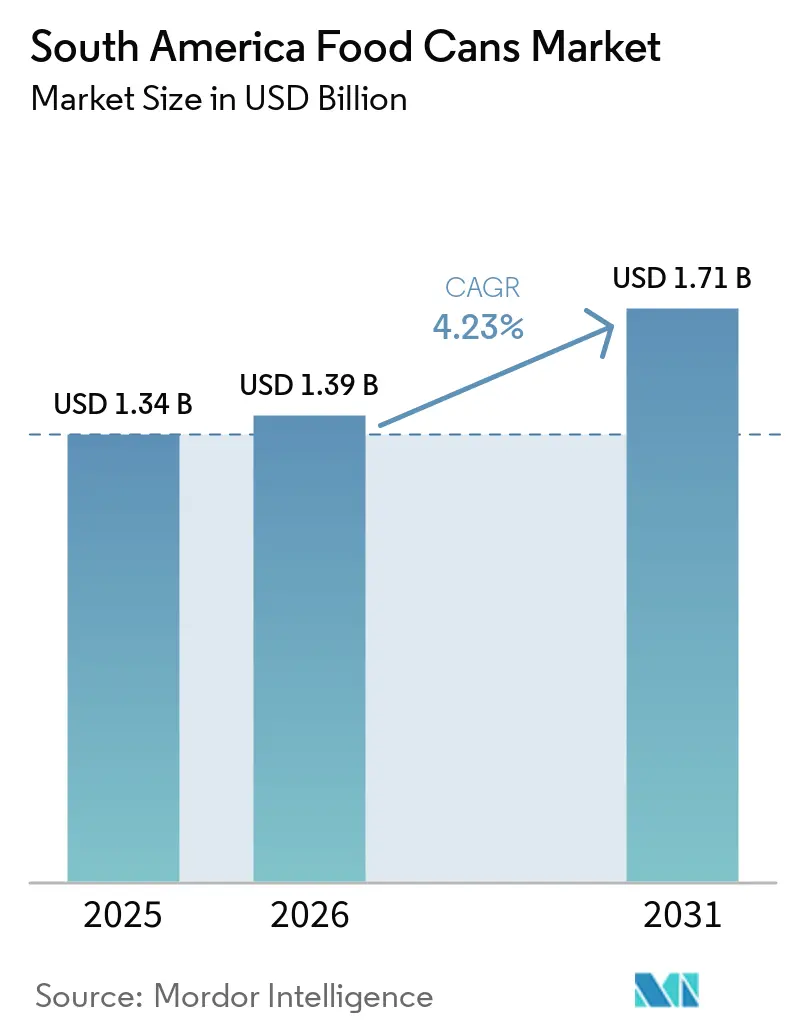
| Base Year Market Size (2025) | USD 1.34 Billion |
| Market Size (2026) | USD 1.39 Billion |
| Market Size (2031) | USD 1.71 Billion |
| Growth Rate (2026 - 2031) | 4.23 % |
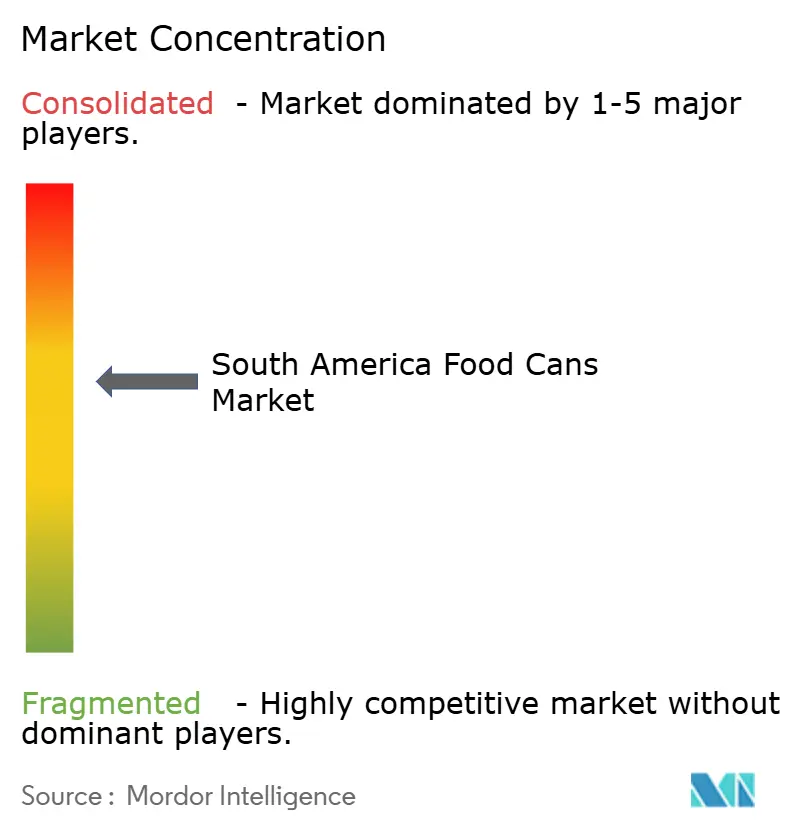
| Market Concentration | Medium |
Major Players *Disclaimer: Major Players sorted in no particular order Image © Mordor Intelligence. Reuse requires attribution under CC BY 4.0. | |
South America Food Cans Market Analysis by Mordor Intelligence
The South America food cans market size was valued at USD 1.34 billion in 2025 and estimated to expand from USD 1.39 billion in 2026 to reach USD 1.71 billion by 2031, at a CAGR of 4.23% during the forecast period (2026-2031). Demand is supported by greater use of shelf-stable foods in urban households, where wider retail access has continued to shape purchasing habits. Steel and tin remain central to applications that need high-temperature retort sterilization, including sardines, canned meat, and legumes. Brazil remains the regional production and consumption center, while Colombia provides a faster-moving demand environment. Producers are balancing capacity additions, aluminum traceability requirements, and pressure from flexible packs. The South America food cans market also depends on whether suppliers can manage metal costs and strengthen recovery systems beyond Brazil.
Key Report Takeaways
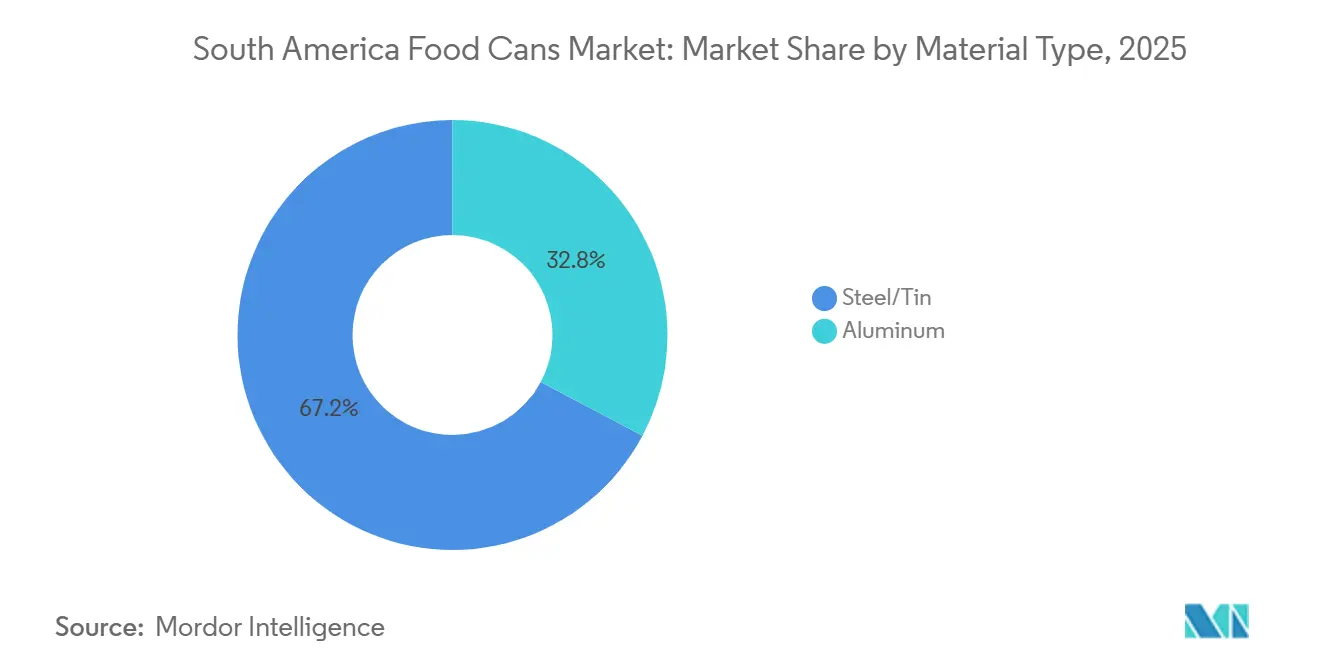
- By material type, steel and tin held 67.23% of the South America food cans market share in 2025, while aluminum is expected to be the fastest-growing material through 2031.
- By can type, three-piece cans held 50.66% of the market in 2025, while two-piece cans are projected to expand at a 4.72% CAGR through 2031.
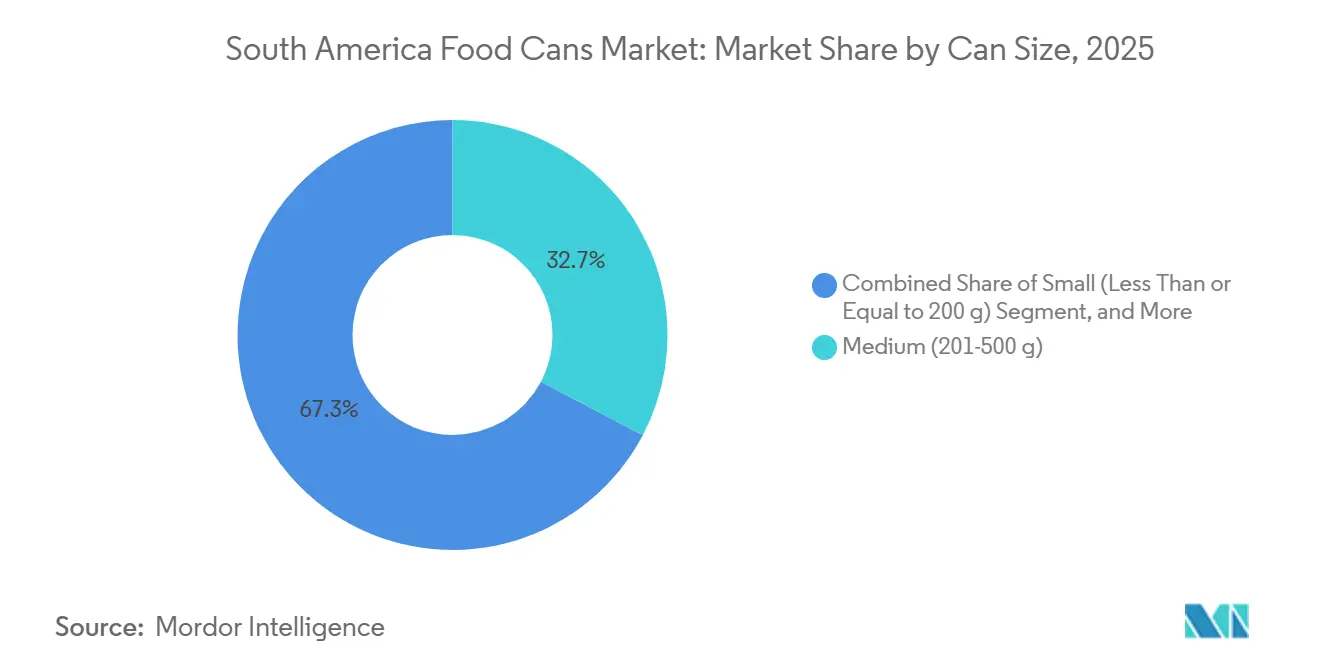
- By can size, medium cans of 201-500 g commanded 32.73% of the market in 2025, while small cans of 200 g or less are expected to expand at a 4.66% CAGR through 2031.
- By food application, processed food held 41.37% of the market in 2025, while ready meals are projected to expand at a 4.82% CAGR through 2031.
- By geography, Brazil held 41.37% of the South America food cans market share in 2025, while Colombia is expected to expand at a 4.77% CAGR through 2031.
Note: Market size and forecast figures in this report are generated using Mordor Intelligence’s proprietary estimation framework, updated with the latest available data and insights as of January 2026.
Market Trends and Insights
Drivers Impact Analysis of South America Food Cans Market*
| Driver | (~) % Impact on CAGR Forecast | Geographic Relevance | Impact Timeline |
|---|---|---|---|
| Demand for Convenient, Shelf-Stable Food | +1.5% | South America, with strongest relevance in Brazil, Argentina, and Colombia | Medium term (2-4 years) |
| Expansion of Ready Meals and Processed Foods | +1.0% | Brazil, Argentina, and Colombia | Medium term (2-4 years) |
| Growth in Pet Food Consumption | +0.7% | Brazil, with spillover to Argentina and Chile | Medium term (2-4 years) |
| Expansion of Seafood and Horticultural Processing | +0.5% | Chile, Peru, and Brazil | Long term (≥ 4 years) |
| Regional Small-Batch Canning for Specialty Foods | +0.3% | Colombia, Peru, and Argentina | Long term (≥ 4 years) |
| Traceable Low-Carbon Aluminum Packaging Adoption | +0.2% | Brazil, with early adoption in Chile and Colombia | Short term (≤ 2 years) |
| Source: Mordor Intelligence | |||
Demand for Convenient, Shelf-Stable Food
Supply disruptions between 2022 and 2024 increased pantry-stocking behavior among South American households. This created a steadier base for canned vegetables, tomato products, and canned proteins. Metal containers remain important for foods that require ambient storage over extended periods. Brazil's ANVISA Resolution RDC No. 854/2024 tightened limits for heavy-metal contaminants and strengthened hygiene and migration controls for metallic food packaging.[1] These rules increase compliance requirements for imported cans and reinforce the position of established material suppliers. Social programs in Brazil and Argentina also support recurring institutional purchases of canned protein products.
Expansion of Ready Meals and Processed Foods
Canned ready meals are moving beyond traditional corned beef and stew products. Producers are introducing seasoned, portion-controlled, and more varied protein products for urban households. Processed food accounted for a significant share of demand, reflecting the importance of canned tomato products, beans, meat, and sauces. Ready meals are expected to expand steadily as consumers seek convenient products with longer shelf life. This shift favors medium and small formats suited to individual servings. The South America food cans market benefits when processors use decorated cans to distinguish ready meals in modern retail channels.
Growth in Pet Food Consumption
Brazil's pet food sector generates substantial revenue, with pet food accounting for more than half of total pet-sector revenue. The increasing use of wet pet food supports demand for retort-processed cans. These formats provide durable sealing and support premium product positioning. Nestlé Purina PetCare established a wet pet food facility in Brazil, indicating continued investment in this category. The regional pet food sector is expected to expand steadily over the forecast period. This application provides food-can manufacturers with demand that is less exposed to pouch substitution than vegetables and sauces.
Expansion of Seafood and Horticultural Processing
Chile and Peru remain important centers for seafood canning in South America. Peru's seafood exports increased from the prior year. Anchovy, tuna, and squid supported export volumes and processing activity. Peru's National Fisheries Policy seeks to increase the sector's contribution to gross domestic product and identifies substantial annual trade potential. Hermetically sealed metal cans remain well suited to fish sterilization requirements, which limits substitution in this application.
Restraints Impact Analysis of South America Food Cans Market*
| Restraint | (~) % Impact on CAGR Forecast | Geographic Relevance | Impact Timeline |
|---|---|---|---|
| Competition From Flexible Pouches and Plastic Packaging | -0.8% | Brazil, Colombia, and Argentina | Medium term (2-4 years) |
| Volatility in Metal, Energy, and Freight Costs | -0.6% | South America, with strongest exposure in Brazil and Colombia | Short term (≤ 2 years) |
| Fragmented Recovery of Food-Can Steel and Coated Scrap | -0.3% | Brazil, Colombia, and Chile | Long term (≥ 4 years) |
| Import Exposure for Specialty Sheet, Ends, and Coatings | -0.2% | Colombia, Chile, and Peru | Medium term (2-4 years) |
| Source: Mordor Intelligence | |||
Competition From Flexible Pouches and Plastic Packaging
Flexible pouches and aseptic cartons remain a competitive constraint in packaged meals. Their appeal is strongest in informal retail and online channels where the price per serving is important. Food cans retain advantages in institutional procurement, retort processing, and longer pantry storage. Younger consumers in Brazil and Colombia have shown a stronger preference for pouch formats in convenience meals. This makes filling-line choices more difficult for food brands. Pet food and seafood continue to offer a more defensible base for the South America food cans market because pouch use is more limited in those applications.
Volatility in Metal, Energy, and Freight Costs
LME aluminum prices increased following disruptions to global smelting capacity. Tin prices also remained elevated on the London Metal Exchange. Brazil imposed anti-dumping duties on Chinese tinplate imports. These factors can increase costs for can-body production and imported coil. Converters are especially exposed when metal prices rise faster than contracted selling prices. Delayed capital spending can follow when margins narrow.
*Our forecasts treat driver/restraint impacts as directional, not additive. The impact forecasts reflect baseline growth, mix effects, and variable interactions.
South America Food Cans Market Segment Analysis
By Material Type:
Steel Retains Scale While Aluminum Broadens Its RoleSteel and tin held 67.23% of the market in 2025, giving the material the leading South America food cans market share. Three-piece tinplate cans remain widely used for sardines, tuna, mackerel, legumes, and other products requiring demanding sterilization cycles. Seafood processors in Chile, Peru, and Brazil depend on these cans because they withstand high retort pressure and prolonged heat treatment. Existing filling systems and supply relationships also support continued steel use. These factors make a rapid replacement of steel unlikely over the forecast period.
Aluminum is the fastest-growing material segment through 2031. Its position is strongest in premium pet food and ready-meal formats where lower weight and printed decoration are valued. Brazil's Selo Verde framework under ABNT NBR 17298:2026 has made carbon accounting and energy traceability more relevant for laminated aluminum supply.[2] Ball Corporation and Grupo Mariza launched Brazil's first canned juice carrying the ASI Responsible Aluminum Sourcing label in March 2026.[3] Smaller converters face a more difficult choice because two-piece aluminum equipment requires capital investment. The South America food cans industry is therefore likely to retain parallel steel and aluminum supply chains.
By Can Type:
Three-Piece Cans Remain Established While Two-Piece Cans AdvanceThree-piece cans held 50.66% of the market in 2025, supported by the installed base of compatible filling, retort, and logistics systems. Sardine, tuna, and legume processors have long used welded cylinders in their production lines. Replacing this equipment can require major capital spending. The format also remains cost-effective for staple foods and institutional packs. These conditions preserve a large role for three-piece cans in the South America food cans market.
Two-piece cans are projected to expand at a 4.72% CAGR through 2031. New pet food and ready-meal investments increasingly favor drawn-and-ironed lines because they reduce material weight and remove interior welds. Trivium Packaging reported in 2025 that a major pet food customer was shifting from steel three-piece cans to aluminum two-piece cans. Two-piece designs also suit inline printing and faster production throughput. Brasilata maintains FSSC 22000 certification for food can production and offers multi-format food can capability. Greater use of this format increases demand for verified aluminum coil and compliant food-contact coatings.
By Can Size:
Medium Cans Support Household Demand While Small Cans Gain UseMedium cans of 201-500 g held 32.73% of the market in 2025. They serve household portions of fish, legumes, vegetables, processed meat, and tomato products. A 400 g can can provide a useful family meal component in many South American households. Large cans above 500 g remain relevant for hospitals, school meal programs, and military catering. Foodservice procurement continues to support multi-serving formats in Brazil and Argentina.
Small cans of 200 g or less are projected to expand at a 4.66% CAGR through 2031. Individual meal occasions, portioned pet food, and specialty products are supporting this change. Compact packs can also reduce shipping volume in e-commerce channels. Small aluminum cans can deliver higher revenue per ton of input metal than larger three-piece tinplate formats. This improves the commercial case for aluminum capacity in selected applications. The South America food cans market size for smaller formats is supported by products designed for single-serving needs.

By Food Application:
Processed Food Leads While Ready Meals Change Format DemandProcessed food held 41.37% of the market in 2025, making it the largest application within the South America food cans market size. The category includes canned tomato products, corned beef, beans, and sauces. Brazil supports this demand through its broad base of tomato and poultry-based packaged food production. Fish and seafood remain another key application because Chile and Peru process products for export. Gomes da Costa's Itajaí operation processes more than 2 million cans each day, which illustrates the scale of regional sardine canning.
Ready meals are projected to expand at a 4.82% CAGR through 2031. Brazil and Colombia are supported by urban convenience demand, while Argentina also sees value-oriented purchases of shelf-stable foods. Peru offers developing opportunities centered on Lima's food processing base. Premium ready meals are increasingly placed in smaller decorated cans to improve shelf appeal. This supports the shift toward two-piece aluminum designs in modern retail. Pet food and fruits and vegetables also remain relevant applications, shaped by premiumization and food-contact compliance requirements.
Geography Analysis
Brazil Food Cans Market
Brazil held 41.37% of the South America food cans market share in 2025. Its position reflects extensive food processing, domestic can manufacturing, and established consumption of canned proteins and tomato products. Brazil achieved a complete beverage-can recycling rate, reinforcing its established recycling infrastructure and supporting brands seeking traceable aluminum packaging. Crown's Ponta Grossa expansion is expected to significantly increase annual can capacity when its additional production line enters commercial operation. CANPACK also began constructing a new facility in Poços de Caldas, which will add substantial annual can production capacity.
Argentina and Colombia Food Cans Market
Argentina remains the second-largest market, supported by demand for canned meat and legumes. Economic pressure can reinforce the appeal of shelf-stable food products. Colombia is projected to expand at a 4.77% CAGR through 2031, the fastest rate in the region. Urban growth in Bogotá and Medellín, and wider modern retail access, support the country’s demand outlook. Colombia’s aluminum scrap system remains fragmented and has limited domestic industrial consolidation. This may constrain local recycled-content availability as production increases.
South America Food Cans Market
Chile and Peru are important export-oriented seafood processing centers. Peru's fisheries policy supports continued demand for tinplate cans in coastal facilities. Ecuador also has localized demand from tuna processing for North American and European export markets. Uruguay, Paraguay, and Bolivia form a smaller but increasing demand base for processed food packaging. These countries are likely to depend on imports from Brazil, Chile, and independent regional converters. Dedicated large-scale can plants are less likely in these markets in the near term.
Competitive Landscape
Crown Holdings, Ball Corporation, and CANPACK S.A. maintain substantial regional positions through South American manufacturing operations. Brasilata, Metalgráfica Rojek Ltda., and Companhia Metalgraphica Paulista compete through proximity to food-processing centers and specialized production capability. Global suppliers focus more heavily on high-volume two-piece aluminum lines. Regional converters remain important in three-piece tinplate production for staple food and institutional uses. This split allows different producers to serve distinct application requirements. The South America food cans market is moderately concentrated, with multinational scale balanced by regional manufacturing expertise.
Crown announced a third high-speed line at its Ponta Grossa plant in May 2025. CANPACK started its Poços de Caldas project under a municipal investment protocol in January 2025. Ardagh Metal Packaging Brasil achieved ASI Performance Standard V3.1 certification for its Alagoinhas site in February 2026. These actions show how capacity, certification, and supply-chain documentation have become central competitive tools. Established companies can use compliance capability to respond to ABNT and ANVISA requirements. New entrants face higher costs when they lack comparable material, coating, and traceability systems.
Trivium Packaging Argentina became the first South American company to use post-consumer recycled aluminum in can production through its partnership with Creando Conciencia. This creates a route to compete through recycled content rather than volume alone. ASI-certified supply remains an opportunity where multinational food brands require traceable, lower-carbon metal packaging. Brasilata's food safety systems support its ability to serve regulated food applications. Companies that combine regional supply access with verified materials may be better placed in premium food segments. Competition will continue to differ between large aluminum systems and smaller steel-focused operations.
South America Food Cans Industry Leaders
-
Brasilata
-
Crown Holdings, Inc.
-
CANPACK S.A.
-
Metalpren
-
Gomes da Costa Embalagens
- *Disclaimer: Major Players sorted in no particular order
South America Food Cans Market Companies Covered in this Report
- Crown Holdings, Inc.
- CANPACK S.A.
- Ball Corporation
- Trivium Packaging B.V.
- Brasilata
- Metalpren
- Gomes da Costa Embalagens
- Conservas Oderich S.A.
- Industrias El Nihuil
- Companhia Metalgraphica Paulista
- Envases Universales, S.A.P.I. de C.V.
- Massilly
- Mauser Packaging Solutions Holding Company
- Sonoco Products Company
- Greif, Inc.
- Ardagh Metal Packaging S.A.
- Wells Can Company Ltd.
- Allstate Can Corporation
- Silgan Holdings Inc.
Recent Industry Developments in South America Food Cans Market
- June 2026: Brazil's Secretariat of Green Economy expanded the Selo Verde Brasil eco-label program to laminated aluminum sheets under ABNT NBR 17298:2026. The measure requires manufacturers to calculate carbon footprints under ISO 14040 and ISO 14044 and trace renewable grid-energy sources. It raises sourcing and documentation requirements for aluminum food-can producers in Brazil.
- March 2026: Ball Corporation partnered with Grupo Mariza to launch Nutrinéctar, Brazil's first juice packaged in a can with the ASI Responsible Aluminium Sourcing label. The launch set a commercial precedent for food brands seeking certified aluminum supply chains beyond beverage uses.
- February 2026: Ardagh Metal Packaging Brasil achieved ASI Performance Standard V3.1 certification for its Alagoinhas, Bahia, aluminum can facility after an independent audit. The certification covers centralized management functions in São Paulo and aligns Brazilian output with supply-chain transparency requirements from food and beverage customers.
- January 2026: Crown's 2026 capital expenditure program of approximately USD 550 million includes capacity expansions and facility upgrades in Brazil, supporting its broader packaging manufacturing network.
South America Food Cans Market Report Scope
South America Food Cans Market refers to the production, distribution, and use of rigid metal containers, primarily steel, tinplate, and aluminum, designed for thermal processing, hermetic sealing, and long-term ambient storage of food products. It includes two-piece and three-piece cans in various sizes used for canned fruits, vegetables, meats, seafood, soups, sauces, ready meals, and pet food.
The South America Food Cans Market Report is Segmented by Material Type (Steel/Tin, and Aluminum), Can Type (2-Piece Cans, and 3-Piece Cans), Can Size (Small (Less Than or Equal to 200 g), Medium (201-500 g), and Large (Greater than 500 g)), Food Application (Ready Meals, Fish and Seafood, Fruits and Vegetables, Processed Food, Pet Food, and Other Food Applications), and Geography (Brazil, Argentina, Colombia, Chile, Peru, and Rest of South America). The Market Forecasts are Provided in Terms of Value (USD).
Segmentation Overview
| Steel/Tin |
| Aluminum |
| 2-Piece Cans |
| 3-Piece Cans |
| Small (Less Than or Equal to 200 g) |
| Medium (201-500 g) |
| Large (More Than 500 g) |
| Ready Meals |
| Fish and Seafood |
| Fruits and Vegetables |
| Processed Food |
| Pet Food |
| Other Food Applications |
| Brazil |
| Argentina |
| Colombia |
| Chile |
| Peru |
| Rest of South America |
| By Material Type | Steel/Tin |
| Aluminum | |
| By Can Type | 2-Piece Cans |
| 3-Piece Cans | |
| By Can Size | Small (Less Than or Equal to 200 g) |
| Medium (201-500 g) | |
| Large (More Than 500 g) | |
| By Food Application | Ready Meals |
| Fish and Seafood | |
| Fruits and Vegetables | |
| Processed Food | |
| Pet Food | |
| Other Food Applications | |
| By Geography | Brazil |
| Argentina | |
| Colombia | |
| Chile | |
| Peru | |
| Rest of South America |
Key Questions Answered in the Report
What is the South America food cans market size?
The sector is estimated at USD 1.39 billion in 2026 and is forecast to reach USD 1.71 billion by 2031 at a 4.23% CAGR.
Which material leads food can demand in South America?
Steel and tin led with 67.23% share in 2025 because they remain suited to demanding retort and sterilization applications.
Which food application is expanding fastest through 2031?
Ready meals are projected to expand at a 4.82% CAGR through 2031, supported by demand for convenient shelf-stable products.
Why are two-piece cans gaining use in the region?
Two-piece cans are expected to expand at a 4.72% CAGR because they offer lower material weight, weld-free interiors, and printing flexibility.
Which country has the largest demand for food cans in South America?
Brazil led with 41.37% share in 2025, supported by its food-processing base, manufacturing capacity, and established canned-food consumption.
What is limiting wider use of metal cans?
Flexible pouches compete strongly in price-sensitive convenience channels, while metal, energy, and freight costs can pressure converter margins.