
South America Data Center Real Estate Market Size and Share
Market Overview
| Study Period | 2020 - 2031 |
|---|---|
| Forecast Data Period | 2026 - 2031 |
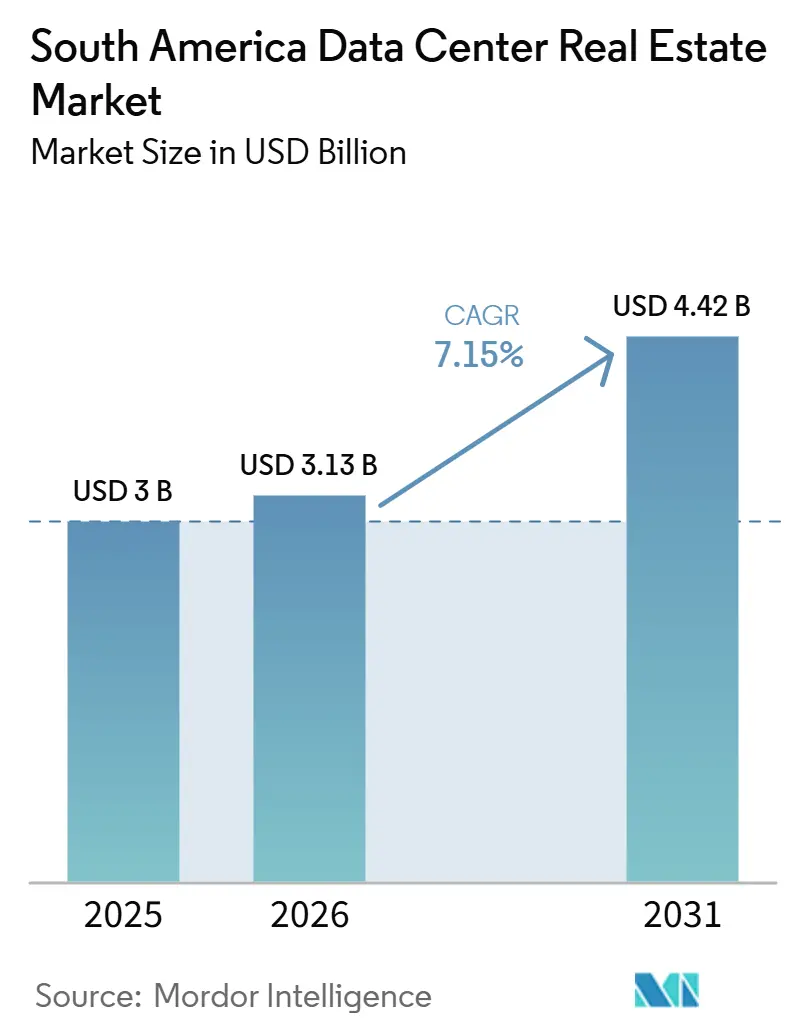
| Base Year Market Size (2025) | USD 3 Billion |
| Market Size (2026) | USD 3.13 Billion |
| Market Size (2031) | USD 4.42 Billion |
| Growth Rate (2026 - 2031) | 7.15 % |
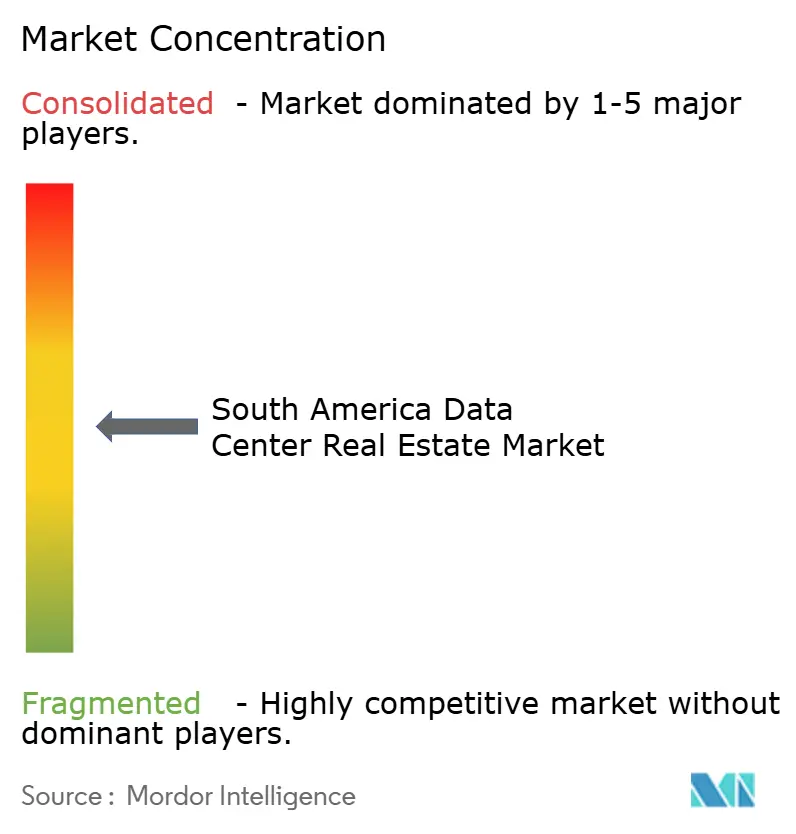
| Market Concentration | Medium |
Major Players *Disclaimer: Major Players sorted in no particular order Image © Mordor Intelligence. Reuse requires attribution under CC BY 4.0. | |
South America Data Center Real Estate Market Analysis by Mordor Intelligence
The South America Data Center Real Estate Market size is projected to expand from USD 3 billion in 2025 and USD 3.13 billion in 2026 to USD 4.42 billion by 2031, registering a CAGR of 7.15% between 2026 to 2031.
Demand from hyperscale cloud operators and enterprise colocation users is keeping build pipelines active and is raising the strategic value of power-ready land across the region. Policy support in Brazil is also reinforcing the case for local infrastructure, especially where sovereign and sensitive workloads must remain in-country[1] Imprensa Nacional, “Medida Provisória No. 1.318, de 17 de Setembro de 2025,” Imprensa Nacional, in.gov.br. Competition in the South America data center real estate market is now shaped less by raw floor area and more by access to grid capacity, dense connectivity, and AI-ready cooling environments. Shortfalls in transmission capacity, land availability in core metro corridors, and a shortage of technical labor are pushing new activity toward secondary-city clusters where power economics and developable land are better. That shift is widening the opportunity set for the South America data center real estate market and is supporting a deeper regional pipeline through 2031.
Key Report Takeaways
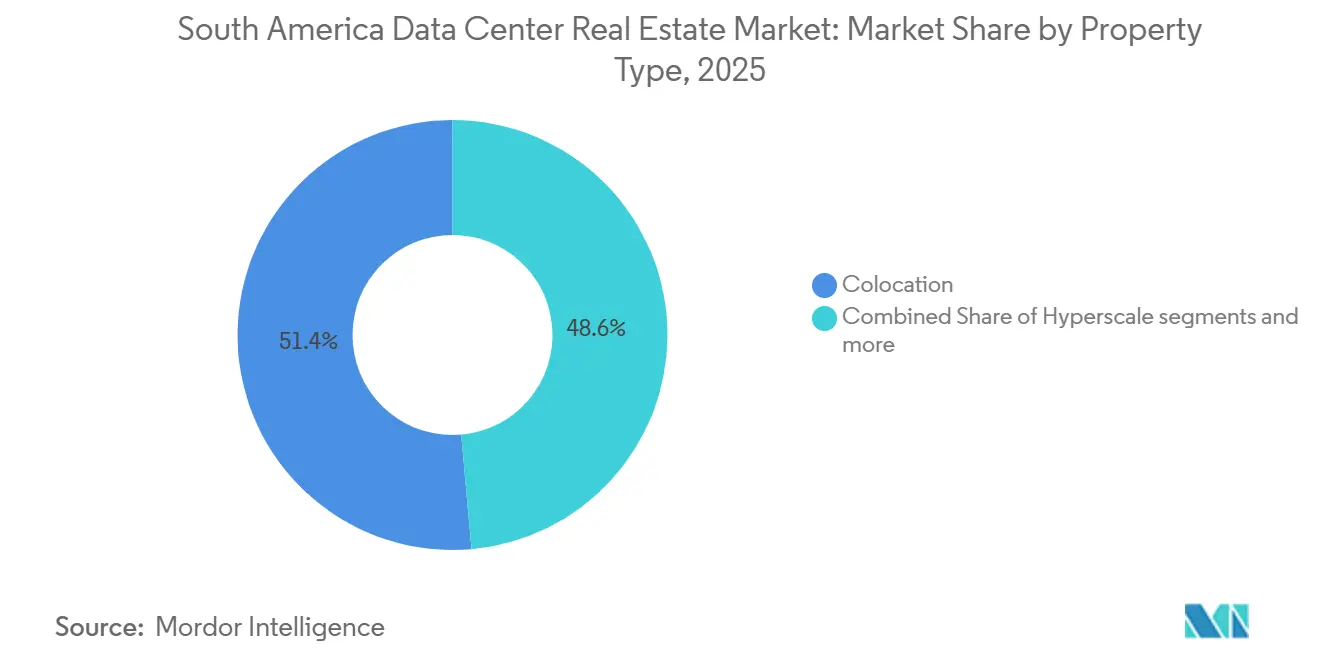
- By property type, colocation held 51.40% of the South America data center real estate market size in 2025, while edge data center properties are projected to expand at a 10.20% CAGR through 2031.
- By ownership, leased infrastructure held a 77.30% share in 2025, while owner-occupied facilities remained the smaller, slower-moving part of the demand base.
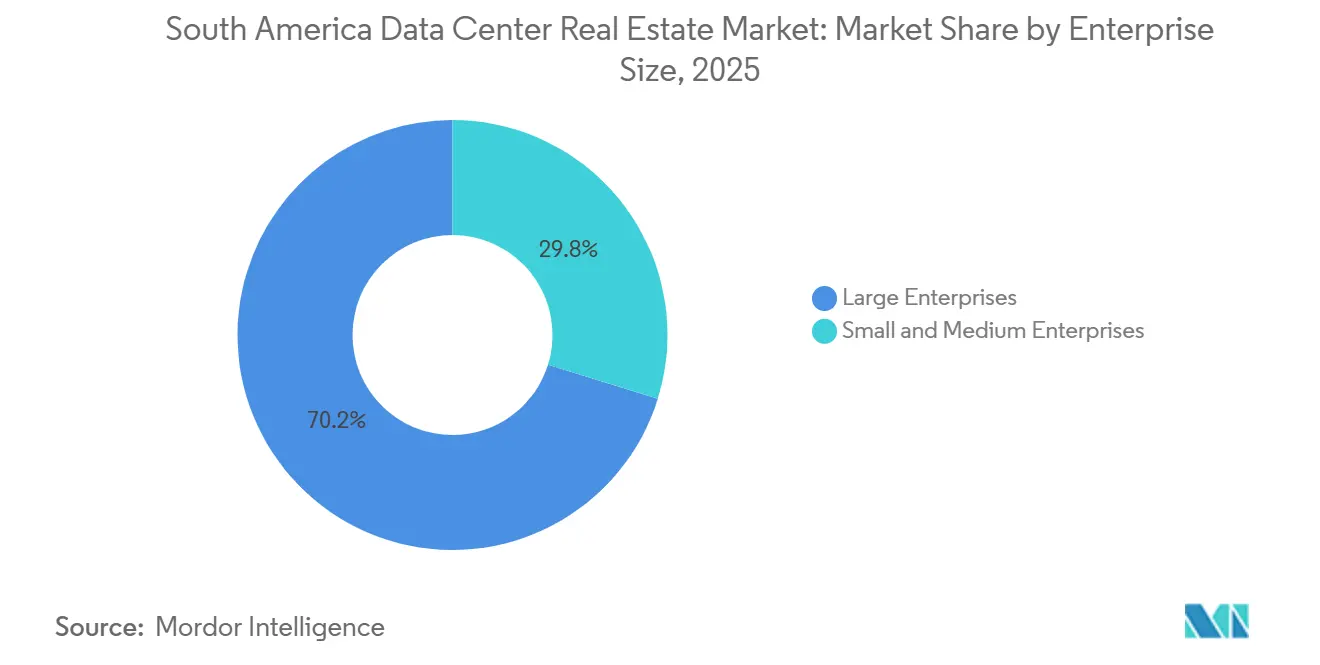
- By enterprise size, large enterprises held a 70.20% share in 2025, while small and medium enterprises are projected to expand at an 8.80% CAGR through 2031.
- By end-users, information technology and telecom held a 45.90% share in 2025, while banking, financial services, and insurance are projected to grow at a 9.30% CAGR through 2031.
- By geography, Brazil held a 61.80% of the South America data center real estate market share in 2025, while Chile is projected to expand at a 10.60% CAGR through 2031.
Note: Market size and forecast figures in this report are generated using Mordor Intelligence’s proprietary estimation framework, updated with the latest available data and insights as of January 2026.
South America Data Center Real Estate Market Trends and Insights
Drivers Impact Analysis*
| Drivers | (~) % Impact on CAGR Forecast | Geographic Relevance | Impact Timeline |
|---|---|---|---|
| Hyperscale Cloud Expansion Drives Data Center Capacity Growth | +2.2% | Brazil, Chile | Medium term (2-4 years) |
| Enterprise Shift to Colocation Increases Leasing Demand | +1.5% | Brazil, Colombia, Argentina | Short term (≤ 2 years) |
| Data Sovereignty Policies Boost Local Data Center Investments | +1.1% | Brazil, Chile | Medium term (2-4 years) |
| Power Constraints Increase Demand for High-Density Facilities | +0.7% | Brazil, Chile | Short term (≤ 2 years) |
| Renewable Energy Demand Supports Sustainable Data Center Development | +0.5% | Brazil Northeast, Chile | Long term (≥ 4 years) |
| Fiber Connectivity Expansion Enhances Data Center Location Appeal | +0.4% | Brazil Northeast, Colombia | Medium term (2-4 years) |
| Source: Mordor Intelligence | |||
Hyperscale Cloud Expansion Drives Data Center Capacity Growth
South America is no longer being treated as a slow, future buildout market by global cloud platforms. Large pre-commitments are changing how operators phase land, power, and shell delivery across the South America data center real estate market. Ascenty’s 2026 plan to add 150 MW of AI-focused capacity across 4 new facilities in São Paulo state shows how quickly provider road maps are now aligning with large-scale AI and cloud demand[2]Ascenty, “Ascenty Secures 150 Megawatts of New AI Contracts,” Ascenty Press Release, ascenty.com. Very large hyperscale deals also remove a meaningful share of powered land from the pool that smaller tenants can access. That tightens effective vacancy and strengthens pricing for providers that already control grid-ready campuses. It also makes site selection more strategic in the South America data center real estate market because a campus with secure power and fast delivery now carries more value than a larger site with uncertain utility timing.
Enterprise Shift to Colocation Increases Leasing Demand
The enterprise move toward colocation is becoming a structural feature of the South America data center real estate market rather than a temporary sourcing preference. Colocation held a 51.40% share in 2025, and leased ownership held 77.30%, indicating how far customers have already moved away from owning infrastructure directly. Enterprises are choosing leased capacity because it gives them access to modern cooling, higher uptime standards, and faster deployment without tying up capital in a single-owned site. This shift is especially relevant for AI workloads, where the cost and operating complexity of building internally is rising. The result is a broader tenant base that now includes traditional enterprise users, regulated institutions, and organizations with mixed cloud and on-premises environments. It is also pushing leasing demand into secondary cities where smaller but underserved enterprise clusters want reliable capacity close to operations.
Data Sovereignty Policies Boost Local Data Center Investments
Policy support has become a direct demand driver for the South America data center real estate market, especially in Brazil. Provisional Measure No. 1.318/2025 created a stronger national policy framework for data centers and prioritized energy access for the sector. The legislative path also shows that local processing of strategic and sensitive workloads is moving from a preference toward a more formal requirement in Brazil. That creates a durable domestic demand floor that is less exposed to normal cloud spending cycles. It also underscores the importance of carrier-neutral facilities that can support public-sector and regulated workloads under strict local hosting conditions. As a result, policy is doing more than supporting growth; it is also shaping where new capacity is built and which operators are best positioned to capture demand.
Power Constraints Increase Demand for High-Density Facilities
Grid access has become one of the clearest differentiators in the South America data center real estate market. Where power is harder to secure, operators are focusing on facilities that extract more computing value from each square meter and each approved watt. Ascenty’s Sumaré development plan, built around large-scale AI workloads, reflects this shift toward campuses designed for higher rack density and more advanced thermal management. That is raising the premium for facilities that can support high-density deployments from day one. It is also widening the gap between standard colocation buildings and sites that can meet AI-grade performance needs without major retrofits. In practice, this means the South America data center real estate market is rewarding early movers that secured power, land, and transformer capacity before utility bottlenecks became more severe.
Restraints Impact Analysis*
| Restraint | (~) % Impact on CAGR Forecast | Geographic Relevance | Impact Timeline |
|---|---|---|---|
| Grid Instability and High Electricity Costs Increase Operating Expenses | -1.8% | Brazil, Chile | Short term (≤ 2 years) |
| Land Scarcity in Core Metro Areas Limits New Developments | -0.7% | Brazil, Chile | Medium term (2-4 years) |
| Water Stress and Environmental Approvals Delay Project Execution | -0.6% | Brazil Southeast, Rio Grande do Sul, Chile | Medium term (2-4 years) |
| Shortage of Skilled Operations and Maintenance Talent Constrains Growth | -0.5% | Brazil, Colombia, Argentina | Long term (≥ 4 years) |
| Source: Mordor Intelligence | |||
Grid Instability and High Electricity Costs Increase Operating Expenses
Power delivery remains a more immediate problem than power generation for the South America data center real estate market. In Brazil, demand is concentrated in areas where transmission systems were not built to handle large, continuous digital infrastructure loads. In Chile, the issue is less a lack of renewable power than the ability to efficiently deliver that power to the main demand nodes. Electricity remains one of the largest operating cost items for colocation providers, and cost swings directly affect margin assumptions for new campuses. These pressures matter even more for AI-oriented facilities because higher rack density increases both power draw and cooling intensity. Grid uncertainty, therefore, slows development decisions, raises the value of approved utility connections, and adds another layer of risk to site economics across the South America data center real estate market.
Land Scarcity in Core Metro Areas Limits New Developments
Land scarcity is becoming a real cap on expansion in the main corridors that anchor the South America data center real estate market. The São Paulo metro area and the Greater Santiago corridor remain the most desirable locations, but both are facing tighter site availability and longer approval cycles. The challenge is not only access to land but also to zoning clearance, environmental permissions, and infrastructure that can support high-load facilities. This combination makes large greenfield development harder in the most mature nodes. It also increases the value of operators that secured large parcels before 2025 and still have a phased runway to expand over many years. A direct consequence is that more capital is moving toward secondary cities where developers can still combine land, power, and future campus scale in a single investment thesis.
*Our forecasts treat driver/restraint impacts as directional, not additive. The impact forecasts reflect baseline growth, mix effects, and variable interactions.
Segment Analysis
By Property Type: Colocation Anchors Amid Structural Differentiation Across Tiers
Colocation held a 51.40% share of the South America data center real estate market in 2025, and it remains the most established property type across the regional footprint. Its strength comes from carrier-neutral hubs that combine enterprise demand, cloud access, and dense interconnection in a way that is hard to replicate elsewhere. These assets gain value as more tenants join the ecosystem, which makes occupancy depth as important as physical capacity. Equinix opened SP6 in Greater São Paulo in 2026 with a USD 114 million investment, reinforcing the role of premium interconnection campuses in the South America data center real estate market. The colocation segment also benefits from customer demand for flexible contract structures, especially where enterprises want cloud adjacency without committing to owned real estate.
Hyperscale properties are becoming a more distinct investment class within the South America data center real estate market. Large campuses with multi-phase expansion potential are attracting the biggest commitments because they can support long lead times, higher density, and tailored utility planning. Edge data center properties are projected to grow at a 10.20% CAGR, making them the fastest-growing property type within the South America data center real estate market size through 2031. Their appeal stems from low-latency use cases tied to 5G, distributed applications, and workloads that cannot be confined to primary metros. Modular formats are also gaining traction because they can shorten deployment cycles in markets where permanent, large-scale campuses take longer to entitle and energize. At the same time, traditional enterprise-owned property formats are losing relative importance as customers shift spending toward leased environments that already support modern performance and resilience standards.


By Ownership: Leased Infrastructure Defines the Market's Capital Logic
Leased ownership accounted for a 77.30% share of the South America Data Center Real Estate Market in 2025 and is projected to register a CAGR of 7.90% through the forecast period. Enterprises and cloud customers increasingly prefer leasing data center capacity rather than owning the underlying property. This lowers upfront capital needs and reduces exposure to design mistakes, grid delays, and technology obsolescence. It also allows tenants to contract around power density and service levels, rather than tying decisions to a single owned building. In the South America data center real estate market, that flexibility has become more important as AI workloads require faster deployment and more specialized infrastructure than legacy server rooms can provide.
Owner-occupied facilities still matter in a limited set of use cases. Government bodies, telecom operators, and some financial institutions continue to keep part of their computing base under direct control for security, compliance, or operating reasons. Even so, many of these users are moving toward hybrid operating models that combine owned environments with leased capacity for cloud, AI, and elastic workloads. This means the owner-occupied segment is not disappearing, but it is losing strategic weight relative to leased supply. The South America data center real estate market is therefore becoming more finance-driven, with long-term lease visibility, utility access, and campus scalability carrying greater weight than simple building ownership.
By Enterprise Size: Large Enterprises Lead, Small and Medium Enterprises Accelerate
Large enterprises held a 70.20% share of the South America data center real estate market in 2025, which confirms that the current revenue base is still anchored by large-scale commitments. These customers sign bigger contracts, consume more power, and often require stronger interconnection and security standards than smaller users. Their importance will remain high because they include large banks, telecom companies, software platforms, and global cloud tenants. Even so, small and medium enterprises are projected to grow at an 8.80% CAGR through 2031, making them the fastest-moving demand pool. That shift reflects better cloud economics, wider digital adoption, and greater acceptance of outsourced infrastructure among companies that previously relied on in-house rooms or small hosting arrangements.
Small- and medium-sized enterprise demand is also changing the geographic spread of the South America data center real estate market. Growth is increasingly visible in secondary cities where local businesses want nearby infrastructure, lower latency, and more flexible lease sizes. In these markets, operators can build smaller multi-tenant facilities and still capture attractive occupancy because supply remains thinner than in the largest hubs. Large enterprises, by contrast, are consolidating into fewer, larger agreements that give them greater commercial leverage and more room to scale. This creates a split provider strategy in which some operators pursue anchor contracts above 10 MW, while others target retail colocation blocks closer to enterprise clusters. The result is a more layered demand profile that broadens the customer base without displacing the dominance of the largest buyers.

By End-Users: Information Technology and Telecom Dominates While Banking, Financial Services, and Insurance Redefines its Data Footprint
Information technology and telecom accounted for a 45.90% share of the South America data center real estate market in 2025, making them the leading end-user group. Their position reflects a dual role in the ecosystem because they are both major tenants and major demand enablers for other tenants. Cloud platforms, software providers, telecom carriers, and connectivity-heavy businesses all rely on carrier-neutral environments to support service delivery. That creates a self-reinforcing cycle where the same facilities attract both digital infrastructure providers and the enterprises that depend on them. Within the South America data center real estate market, this makes information technology and telecom the foundation of occupancy depth and network value.
Banking, financial services, and insurance is projected to grow at a 9.30% CAGR through 2031, the fastest rate among end-user groups. The segment is being driven by stricter governance requirements, rising cloud adoption, digital payments infrastructure, and AI-led fraud-detection needs. These users need resilience, access controls, and local hosting options that meet compliance requirements without slowing deployment. Government and public sector demand is also expanding as sovereign data requirements support domestic processing and storage. Healthcare is smaller today, but its role is increasing as digital patient workflows and telemedicine require more reliable infrastructure support. The remaining end-user pool, including retail, logistics, media, and fintech, is adding further breadth to the South America data center real estate market because these sectors increasingly prefer facilities that combine connectivity, security, and scalable power in one service environment.
Geography Analysis
Brazil held a 61.80% share of the South America data center real estate market in 2025, and it remains the regional anchor across investment, capacity, and operator activity. The São Paulo corridor still concentrates the deepest mix of interconnection, carrier-neutral campuses, enterprise demand, and cloud availability in the region. Brazil also benefits from policy momentum that gives the sector a clearer national profile and a stronger case for long-term infrastructure buildout. At the same time, Brazil faces the region’s hardest combination of grid congestion, metro land scarcity, and rising demand for AI-ready capacity. Those pressures are pushing investment into subregions such as the Northeast and southern nodes where power conditions and land availability can support the next phase of the South America data center real estate market.
Chile is projected to grow at a 10.60% CAGR through 2031, making it the fastest-growing country segment in the South American data center real estate market over the forecast period. Its appeal stems from renewable energy availability, strong connectivity, and a strategic position for traffic flows along the Pacific corridor. Scala Data Centers secured USD 328 million in 2025 to build 3 hyperscale facilities and a power substation in Chile, which shows the scale of capital being directed to this market. Chile is also drawing large follow-on commitments from operators that want AI-ready inventory near Santiago and adjacent power infrastructure. Colombia is smaller today, but it is becoming more relevant as operators expand regional footprints beyond the two leading markets.
Colombia is benefiting from broader regional diversification as providers add capacity and network depth outside Brazil and Chile. Equinix stated in 2026 that Latin America was its fastest-growing and most dynamic region, and the company committed USD 28 million in Colombia over 2025 and 2026[3]Equinix, “América Latina É a Região de Maior Crescimento e Mais Dinâmica Para a Equinix,” Equinix Latin America Newsroom, newsroom.equinix.com. Argentina and the rest of South America remain smaller in current scale, but they hold strategic importance because under-supplied enterprise demand can support future colocation expansion once power, permitting, and customer density align. This leaves the South America data center real estate market with a clear hierarchy today, but it also leaves room for a broader multi-country footprint by the end of the forecast period.
Competitive Landscape
The South America data center real estate market is moderately concentrated in its primary hubs, with a limited group of regional operators controlling much of the most valuable colocation and hyperscale inventory. Ascenty, ODATA, Scala Data Centers, Elea Data Centers, Equinix, and Cirion Technologies are the names shaping capacity decisions in the largest corridors. Their strategies increasingly center on locking in power access early, securing campuses with room for phased expansion, and designing for higher rack density from the start. This means competitive advantage is less about being present in the market and more about controlling sites that can actually deliver at scale. It also means the South America data center real estate market is becoming harder for smaller entrants to penetrate in the most mature nodes unless they already hold land, permits, or a specialized edge proposition.
Private capital is also changing the competitive structure. Institutional investors are willing to back platforms that can show long-term lease visibility, expansion runway, and technical readiness for AI workloads. That favors operators with established campus networks and relationships with hyperscale tenants. It also supports a wave of recapitalization and consolidation in which financial sponsors can accelerate build schedules that would otherwise be limited by operator balance sheets alone. Beyond primary markets, competitive space remains more open in secondary cities and sovereign workload segments where demand is rising faster than quality supply.
Strategic moves by leading companies show how the competitive pattern is evolving. Ascenty committed USD 1.2 billion in 2026 to 4 AI-dedicated facilities in São Paulo state after signing 150 MW of new AI contracts, underscoring how quickly the South America data center real estate market is shifting toward AI-oriented delivery. Equinix reinforced its premium interconnection position with the opening of SP6 in Greater São Paulo in 2026. Cirion expanded its network reach in Brazil in 2025 to connect more than 70 data centers, which strengthens the connectivity layer that underpins occupancy and customer stickiness. Together, these moves show that leadership in the South America data center real estate market now depends on combining campus scale, interconnection depth, and AI-ready infrastructure in the same operating model.
South America Data Center Real Estate Industry Leaders
Ascenty
ODATA
Equinix
Scala Data Centers
Cirion Technologies
- *Disclaimer: Major Players sorted in no particular order

Recent Industry Developments
- June 2026: Elea Data Centers and AXIA Energia announced BEL1, the Amazon region's first AI-neutral data center, located in Belém, Pará state. The facility will have an initial capacity of 7.5 MW, backed by signed anchor client agreements, with expansion potential to 100 MW in future phases. AXIA will supply 100% renewable energy.
- April 2026: I Squared Capital agreed to acquire Elea Data Centers, Brazil's leading carrier-neutral platform with 9 interconnected campus locations across São Paulo, Rio de Janeiro, and Brasília. The firm committed USD 550 million as a first tranche to support Elea's over 1 GW development pipeline and accelerate Rio AI City.
- September 2025: Cirion Technologies announced a strategic network expansion in Brazil, extending its DC Connect service to interconnect over 70 data centers nationally and adding 50 km of new fiber routes in Rio de Janeiro, linking Scala, Equinix RJ3, Ascenty, and ODATA facilities for AI-grade low-latency connectivity.


South America Data Center Real Estate Market Report Scope
The South America Data Center Real Estate Market Report is Segmented by Property Type (Colocation, Hyperscale, and More), Ownership (Leased and Owner Occupied), Enterprise Size (Large Enterprises, and Small and Medium Enterprises), End-Users (Information Technology and Telecom, and More), and Geography (Brazil, Argentina, Colombia, Chile, and the Rest of South America). The Market Forecasts are Provided in Terms of Value (USD).
| Colocation |
| Hyperscale |
| Edge Data Center Properties |
| Modular Data Center Properties |
| Others (Wholesale, Retail and Enterprise) |
| Leased |
| Owner Occupied |
| Large Enterprises |
| Small and Medium Enterprises |
| Information Technology and Telecom |
| Banking, Financial Services, and Insurance |
| Government and Public Sector |
| Healthcare |
| Other End Users |
| Brazil |
| Argentina |
| Colombia |
| Chile |
| Rest of South America |
| By Property Type | Colocation |
| Hyperscale | |
| Edge Data Center Properties | |
| Modular Data Center Properties | |
| Others (Wholesale, Retail and Enterprise) | |
| By Ownership | Leased |
| Owner Occupied | |
| By Enterprise Size | Large Enterprises |
| Small and Medium Enterprises | |
| By End-Users | Information Technology and Telecom |
| Banking, Financial Services, and Insurance | |
| Government and Public Sector | |
| Healthcare | |
| Other End Users | |
| By Country | Brazil |
| Argentina | |
| Colombia | |
| Chile | |
| Rest of South America |


Key Questions Answered in the Report
What is the 2031 forecast value for South America data center real estate?
The market is projected to reach USD 4.42 billion by 2031, rising from USD 3.13 billion in 2026 at a 7.15% CAGR over 2026 to 2031.
Which country leads regional demand today?
Brazil leads with 61.8%0 share in 2025, supported by the São Paulo corridor and a growing pipeline in other Brazilian subregions.
Which country is expanding the fastest through 2031?
Chile is the fastest-growing country segment, with a projected 10.60% CAGR through 2031.
What property format holds the largest share?
Colocation led with 51.40% share in 2025 because carrier-neutral hubs remain central to interconnection, cloud access, and enterprise outsourcing.
Which customer group is growing the fastest?
Banking, financial services, and insurance is the fastest-growing end-user group at a 9.30% CAGR, while small and medium enterprises are the fastest-growing enterprise size segment at 8.80%.
Page last updated on:





