
Market Overview
| Study Period | 2020 - 2031 |
|---|---|
| Forecast Data Period | 2026 - 2031 |
| Base Year Market Size (2025) | USD 253.16 Million |
| Market Size (2026) | USD 284.32 Million |
| Market Size (2031) | USD 593.47 Million |
| Growth Rate (2026 - 2031) | 15.86 % |
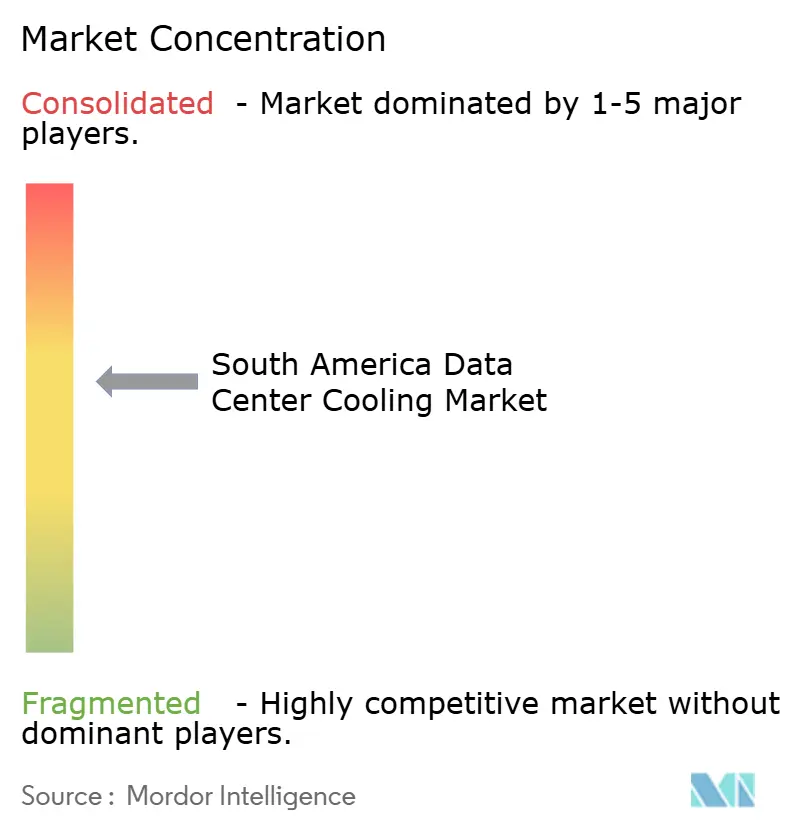
| Market Concentration | Medium |
Major Players *Disclaimer: Major Players sorted in no particular order Image © Mordor Intelligence. Reuse requires attribution under CC BY 4.0. | |
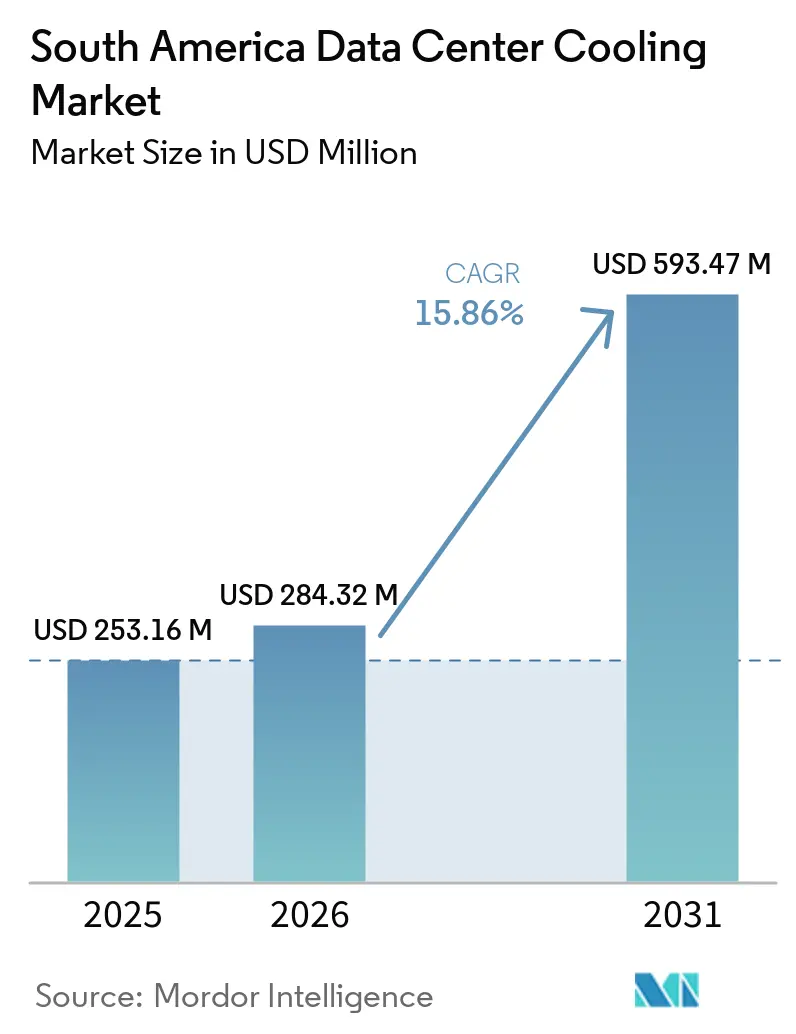
South America Data Center Cooling Market Analysis by Mordor Intelligence
The South America data center cooling market size was valued at USD 253.16 million in 2025 and is estimated to grow from USD 284.32 million in 2026 to reach USD 593.47 million by 2031, at a CAGR of 15.86% during the forecast period (2026-2031). The South America data center cooling market is being shaped by new hyperscale capacity, AI computing requirements, and the need to manage heat from denser racks. New projects are making liquid-ready cooling a more common design requirement, while air-based equipment remains central to the installed base. Regulatory attention to renewable power, water use, and operating efficiency is also moving monitoring and control functions closer to the core cooling system. Suppliers with local inventory, engineering capabilities, and service coverage are positioned to benefit as projects move from planning to construction. The South America data center cooling market also has a clear opportunity in retrofits, where operators need practical ways to raise rack density without replacing an entire operating facility.
Key Report Takeaways
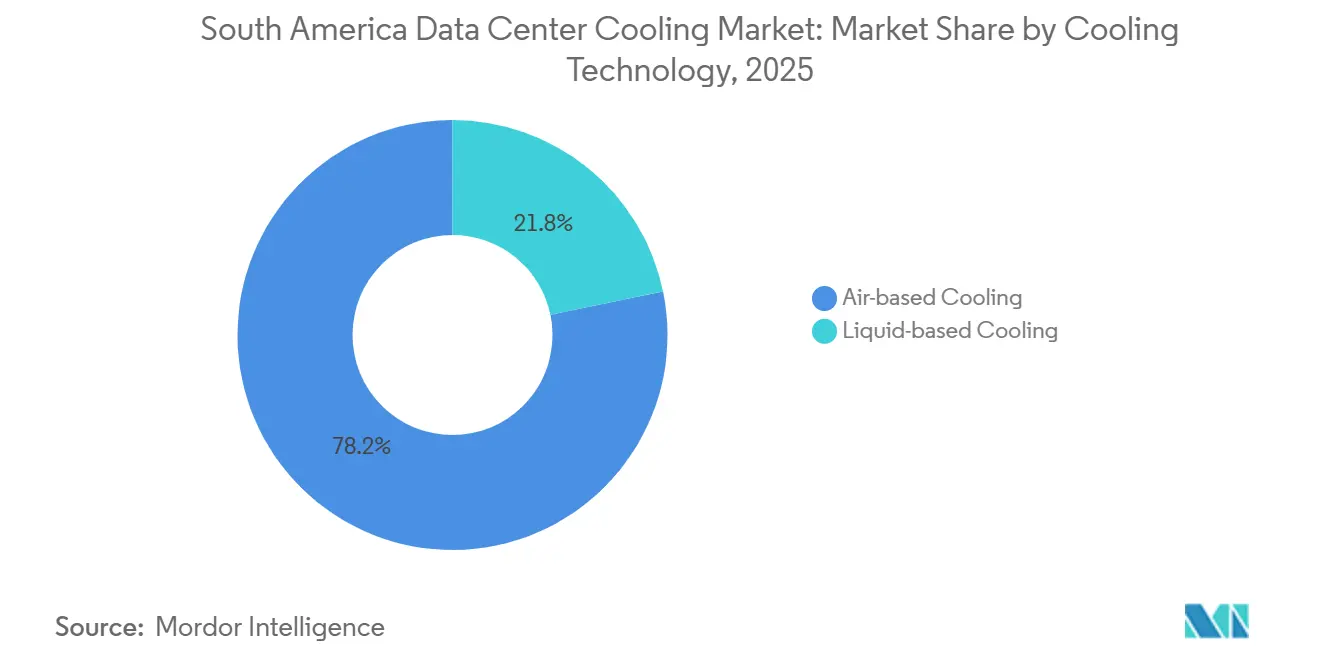
- By cooling technology, air-based cooling held 78.24% of the South America data center cooling market share in 2025, while liquid-based cooling is forecast to grow at a 16.53% CAGR through 2031.
- By cooling component, computer-room air handlers (CRAH/CRAC) units accounted for 33.62% of the South America data center cooling market share in 2025, while control and monitoring software is forecast to expand at a 16.38% CAGR through 2031.
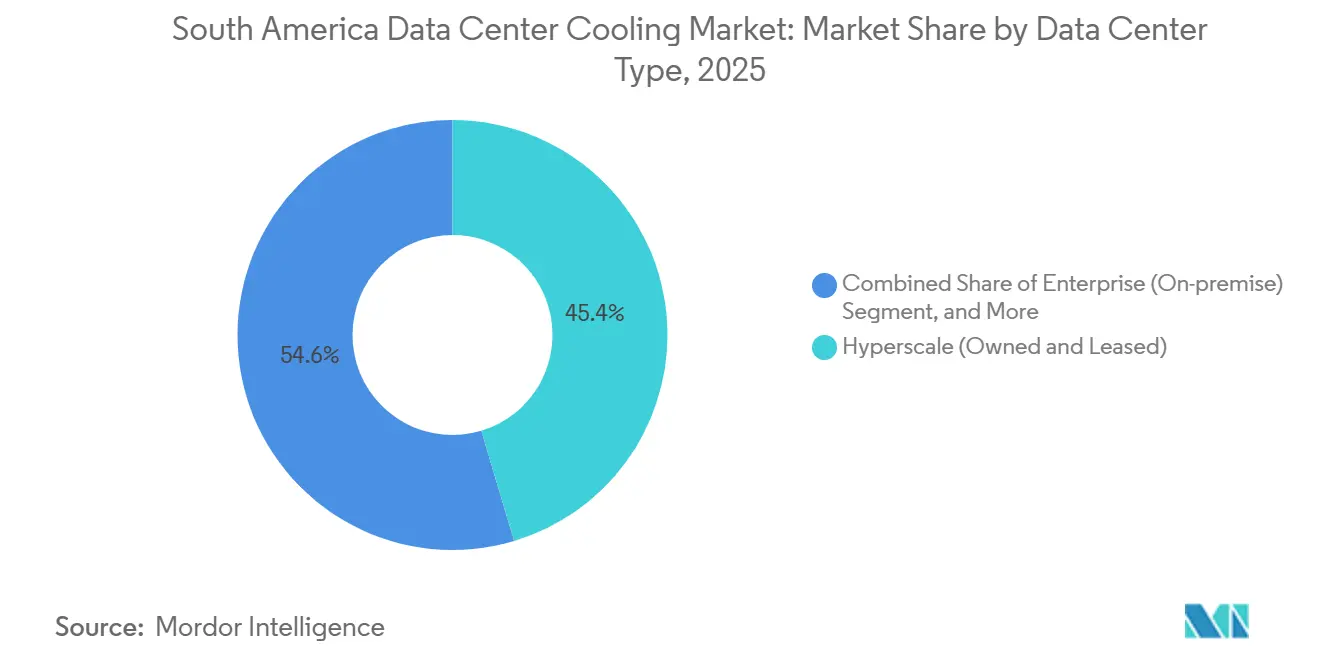
- By data center type, hyperscale facilities held 45.36% of the South America data center cooling market share in 2025 and are forecast to grow at a 16.73% CAGR through 2031.
- By end-user industry, IT and telecom accounted for 34.57% of demand in 2025, while healthcare is forecast to expand at a 16.59% CAGR through 2031.
- By geography, Brazil held 57.34% of the South America data center cooling market share in 2025, while Chile is forecast to grow at a 16.34% CAGR through 2031.
Note: Market size and forecast figures in this report are generated using Mordor Intelligence’s proprietary estimation framework, updated with the latest available data and insights as of January 2026.
Market Trends and Insights
Drivers Impact Analysis of South America Data Center Cooling Market*
| Driver | (~) % Impact on CAGR Forecast | Geographic Relevance | Impact Timeline |
|---|---|---|---|
| Hyperscale and AI Workload Expansion | +4.5% | Brazil and Chile core, spillover to Colombia and Argentina | Short term (≤ 2 years) |
| Cloud, Colocation, and Digital Infrastructure Investment | +3.2% | Brazil, Chile, Colombia | Medium term (2-4 years) |
| Energy-Efficiency and Sustainability Mandates | +2.8% | Brazil national, Chile and Colombia regulatory spillover | Medium term (2-4 years) |
| Digitalization, 5G, and Edge Computing Deployment | +2.1% | Brazil, Colombia, Argentina | Medium term (2-4 years) |
| Brownfield Liquid-Cooling Retrofit Demand | +1.9% | São Paulo and Santiago metro corridors | Short term (≤ 2 years) |
| Local Manufacturing and Service-Capability Expansion | +1.4% | Brazil national, expanding to Chile and Colombia | Long term (≥ 4 years) |
| Source: Mordor Intelligence | |||
Hyperscale and AI Workload Expansion
AI training and inference workloads are changing the cooling requirements of new data centers across the region. GPU clusters place greater demands on thermal management than traditional enterprise systems, which makes liquid-ready infrastructure more relevant in the South America data center cooling market. Ascenty began construction of its Sumaré 3 facility in March 2026, a 90 MW AI-optimized site designed with direct-to-chip liquid cooling and a closed-loop cooling architecture with zero WUE.[1] The facility is scheduled for delivery in Q3 2027, with a further 90 MW expansion phase planned. This type of project makes cooling capability an early design decision rather than a later equipment selection. It also increases the value of suppliers capable of supporting high-density racks, integrating hydraulic systems, and commissioning equipment on a demanding construction schedule. Equipment selection now has to account for piping paths, floor loading, maintenance access, leak detection, controls integration, and the ability to expand capacity without interrupting a customer’s compute environment. These requirements move more of the project discussion toward engineering capability and lifetime service support.
Cloud, Colocation, and Digital Infrastructure Investment
Cloud and colocation projects are driving the growth of large-scale cooling procurement programs in the South America data center cooling market. Amazon announced in May 2025 that it plans to invest more than USD 4 billion to launch the AWS South America Chile Region by the end of 2026. The planned region includes 3 Availability Zones in Santiago, each with independent power and cooling infrastructure. Ascenty also secured 150 MW of new AI contracts and committed USD 1.2 billion to 4 new data centers in Brazil. These investments require cooling decisions well before a facility begins operating, which gives vendors a defined window to qualify designs, establish supply arrangements, and plan field support. The concentration of capacity additions in major hubs also favors providers that can serve several projects from regional inventory and service bases. A supplier with a locally available product can reduce exposure to delivery delays during a narrow construction window. The benefit is especially important when several projects require similar cooling equipment simultaneously.
Energy-Efficiency and Sustainability Mandates
Energy and water requirements are becoming more important in cooling design across the South America data center cooling market. Brazil’s telecommunications regulator, Anatel, opened a public consultation in 2025 on conformity assessment requirements for data centers that integrate with telecommunications networks. The consultation addresses measurements of energy, water, and carbon performance, thereby strengthening the operational case for metering, sensors, and software. Closed-loop systems, dry coolers, and direct-to-chip designs can help operators align cooling choices with tighter water-use expectations. The requirement to monitor performance also makes control software part of the operating model rather than an optional layer. This favors cooling systems that combine thermal equipment with clear reporting, alerts, and operational data. Operators can use those functions to identify temperature changes, compare system performance, and plan maintenance before a condition affects availability. Better visibility also helps facility teams assess whether equipment is performing as intended under changing AI loads.
Digitalization, 5G, and Edge Computing Deployment
Digitalization, 5G, and edge computing are extending cooling needs beyond the largest cloud campuses. Smaller sites have limited space and may operate under conditions less controlled than those in a large data center hall. These environments need compact equipment that can reliably manage heat without occupying excessive floor area. The South America data center cooling market, therefore, includes demand for precision cooling, modular systems, and smaller liquid-cooling modules that can be adapted for edge locations. Distributed deployments can also create more frequent, smaller equipment orders than large hyperscale projects. Suppliers that can customize equipment and service it across secondary locations may be able to compete where scale alone is less decisive. Standardized modules can help operators repeat proven designs across sites while still accommodating different local climates and building constraints. This can reduce design effort for distributed programs that do not justify a fully bespoke cooling plant.
Restraints Impact Analysis of South America Data Center Cooling Market*
| Restraint | (~) % Impact on CAGR Forecast | Geographic Relevance | Impact Timeline |
|---|---|---|---|
| High Upfront Cost of Advanced Cooling Systems | -2.3% | Brazil, Chile, Colombia | Short term (≤ 2 years) |
| Water, Grid, and Site-Specific Infrastructure Constraints | -1.8% | Chile, Brazil, Argentina | Medium term (2-4 years) |
| Cooling-System Energy Consumption | -1.5% | Global, intensified in South America | Medium term (2-4 years) |
| Limited Availability of Skilled Liquid-Cooling Service Personnel | -1.2% | Brazil and Chile primarily | Medium term (2-4 years) |
| Source: Mordor Intelligence | |||
High Upfront Cost of Advanced Cooling Systems
Advanced liquid cooling requires more than a single piece of equipment. Direct-to-chip systems, immersion tanks, pumps, manifolds, coolant distribution units, compatible fluids, and installation services can increase a project's initial cost. This cost profile can delay adoption among operators without hyperscale purchasing power. The result is a divided adoption pattern in the South America data center cooling market, with large AI-oriented projects moving faster toward liquid systems while many enterprise facilities retain air-based equipment. Existing CRAH, CRAC, chiller, and cooling tower installations remain economically viable when rack densities are within their practical operating range. Import dependence and limited local availability of specialist components can further lengthen lead times and increase the capital needed for phased expansions. Operators may need to reserve key equipment earlier in the project cycle to protect commissioning dates. That approach can add planning complexity when capacity is being added in stages, and the final IT load remains uncertain.
Water, Grid, and Site-Specific Infrastructure Constraints
Water availability, grid conditions, and local infrastructure constraints affect cooling design choices across South America. In Santiago, water stress drives greater interest in adiabatic and closed-loop glycol designs than in water-intensive approaches. Brazil’s Chamber of Deputies received House Bill 2601746/2026 in February 2026, proposing national standards for the installation, operation, expansion, and decommissioning of large data centers. The proposal includes restrictions on the use of artesian wells and aquifers for data center cooling. Grid bottlenecks and high energy costs can further strain a project’s design and operating economics. These conditions make site-specific engineering, low-water designs, and dependable power planning important considerations for the South America data center cooling market. A system that performs well in one metropolitan location may need a different heat-rejection method in another. Cooling suppliers must therefore assess local water, power, ambient conditions, and service access before applying a standard configuration.
*Our forecasts treat driver/restraint impacts as directional, not additive. The impact forecasts reflect baseline growth, mix effects, and variable interactions.
South America Data Center Cooling Market Segment Analysis
By Cooling Technology:
Liquid Cooling Changes the Premium Revenue MixAir-based cooling held 78.24% of the South America data center cooling market share in 2025. The segment benefits from a substantial installed base of CRAH and CRAC units, chillers, economizers, and cooling towers across hyperscale, enterprise, and colocation facilities. Air-based systems remain practical for workloads that operate below the rack-density levels that require liquid cooling. Replacement of functional equipment is often difficult to justify before the end of its useful life. Cooling towers, chillers, and economizers continue to support many established campus facilities. Precision cooling equipment also remains relevant for telecom shelters and modular edge deployments. These uses maintain a broad installed base for service, replacement, and incremental upgrades in the South America data center cooling market.
Liquid-based cooling is forecast to grow at a 16.53% CAGR through 2031, which is the highest rate among cooling technologies. Direct-to-chip systems are gaining early use in new AI-oriented hyperscale developments, while immersion cooling is being considered for purpose-built AI environments and selected high-density retrofit zones. Rear-door heat exchangers offer a middle path for facilities that want to increase density without rebuilding every cooling circuit. The South America data center cooling industry is therefore likely to retain air equipment in volume while liquid systems take a larger role in high-value deployments. Liquid cooling can have higher revenue per kilowatt and a larger service requirement than air-based alternatives. Suppliers with both air and liquid portfolios can address existing facilities as well as new AI-ready projects. Their ability to support hybrid designs is important because many sites will adopt liquid cooling in phases rather than through a single full conversion.
By Cooling Component:
Monitoring Software Gains a Larger Role in System ValueCRAH and CRAC units accounted for 33.62% of the cooling component segment in 2025. Their leading position reflects their use across enterprise and colocation facilities, not only their role in new builds. Chillers and heat exchanger units, cooling towers and dry coolers, and pumps and valves form the physical infrastructure that moves heat away from IT loads. These components can serve air-side systems, liquid-side systems, or hybrid designs. Pumps and valves may have a lower unit value but remain essential, as hydraulic circuits require maintenance, replacement parts, and controls. The South America data center cooling market size for components is supported by this combination of installed-base service requirements and new capacity additions.
Control and monitoring software is forecast to expand at a 16.38% CAGR through 2031. Its growth is linked to operator needs for real-time thermal visibility, power planning, and performance reporting. Anatel’s 2025 consultation on data center conformity assessment reinforces the importance of measuring energy, water, and carbon-related performance. Schneider Electric’s Motivair MCDU-70, launched in January 2026, includes EcoStruxure software for digital-twin simulation, adaptive load balancing, and real-time monitoring.[2] This product approach bundles monitoring functions with coolant distribution hardware. It also makes software more directly connected to compliance and cooling performance. The South America data center cooling industry can therefore see controls become a recurring part of cooling procurement rather than a separate discretionary purchase. When hardware and software are selected together, operators can establish a more consistent operating view across the cooling chain.
By Data Center Type:
Hyperscale Facilities Lead in Size and GrowthHyperscale facilities held 45.36% of the South America data center cooling market share in 2025 and are forecast to grow at a 16.73% CAGR through 2031. Their leading role reflects the region’s concentration of cloud, AI, and large colocation investment in major metropolitan corridors. Hyperscale projects require more capacity, higher system availability, and more rigorous cooling design than smaller enterprise facilities. They also often need solutions that can support the increase in rack density over time. Enterprise facilities remain an important part of installed cooling capacity. However, some organizations are moving workloads to public cloud and colocation providers instead of adding on-premise infrastructure. This shift directs a larger portion of new cooling investment toward shared and hyperscale environments in the South America data center cooling market.
Amazon’s planned AWS South America Chile Region and Ascenty’s AI-related expansion illustrate the scale of demand that hyperscale projects can create. These facilities need coordinated cooling, power, controls, and service plans that can operate at a large scale. Hyperscale contracts can be larger and more customized than those associated with smaller sites. They may also require more demanding testing and commissioning processes. This creates a higher bar for suppliers that want to serve the segment. It also gives established vendors with regional engineering resources an advantage. Colocation remains strategically important because it can serve enterprise cloud migration and provide a route for hyperscale capacity where an operator does not own a campus. This makes the segment a bridge between smaller customers that need flexible capacity and large cloud tenants that require dependable regional infrastructure.

By End-User Industry:
Healthcare Adds Faster-Growing DemandIT and telecom held 34.57% of end-user cooling demand in 2025. Content delivery, telecom core networks, cloud services, and AI inference workloads support its continued importance. Media and entertainment, retail, and consumer goods also require capacity for streaming, digital payments, e-commerce, and customer platforms. Government and institutional users continue to add data processing needs as public services become more digital. These users may remain cost-sensitive and continue to rely on air-based precision cooling in many deployments. The South America data center cooling market continues to depend on IT and telecom, as they support much of the region’s digital infrastructure.
Healthcare is forecast to grow at a 16.59% CAGR from 2026 to 2031. Hospital networks, health technology platforms, medical imaging, and connected diagnostics need reliable compute capacity and high availability. Medical imaging AI can create heat-intensive processing needs that exceed those of earlier healthcare data centers. Data protection concerns can also support domestic infrastructure for sensitive workloads. Brazil’s data protection authority provides guidance and enforcement of the country’s personal data protection framework. These conditions support demand for cooling that is reliable, closely monitored, and suited to mission-critical operations. Fintech, agritech, and mining analytics are also emerging demand pools. Their growing use of digital platforms can widen the range of facilities that need dependable thermal control.
Geography Analysis
Brazil Data Center Cooling Market
Brazil held 57.34% of the South America data center cooling market share in 2025. São Paulo remains the region’s main hyperscale hub, supported by the concentration of cloud operators, colocation facilities, and large new data center plans. Ascenty’s USD 1.2 billion commitment to 4 new data centers and 150 MW of new AI contracts creates a meaningful pipeline for cooling procurement. Brazil’s regulatory environment is also placing greater emphasis on water use, energy performance, and environmental licensing. House Bill 2601746/2026 proposes national requirements, including limits on artesian-well and aquifer water withdrawals for cooling. Existing colocation facilities in the São Paulo corridor provide a separate retrofit opportunity as operators add AI-ready cooling zones. This blend of greenfield and brownfield work supports Brazil’s central role in the South America data center cooling market.
Chile and Argentina Data Center Cooling Market
Chile is forecast to grow at a 16.34% CAGR through 2031, the fastest rate among the regional geographies. Amazon plans to invest more than USD 4 billion to establish the AWS South America Chile Region by the end of 2026.[3] The project is planned with 3 Availability Zones in Santiago and independent power and cooling infrastructure. Water stress in Santiago is directing attention toward adiabatic and closed-loop glycol systems. This issue makes water efficiency a core element in cooling technology selection for new projects. Argentina has a smaller share but has continuing demand for edge and colocation infrastructure. Vertiv’s October 2025 alliance with Grupo Datco covers Argentina and Chile, indicating a commercial effort to reach both countries with power and cooling technologies.
South America Data Center Cooling Market
Colombia and the rest of South America accounted for the remaining regional demand in 2025. Bogotá has an established role in Colombia’s data center activity, and new capacity supports demand for cooling equipment and related services. The South America data center cooling market in Peru, Uruguay, and other smaller countries is more closely linked to modular systems that can serve edge sites and smaller deployments. Uruguay’s large data center planning has brought attention to water-use conditions in hyperscale project approvals. This development supports the wider regional focus on lower-water cooling approaches. The planned fiber network connecting Argentina, Chile, and Brazil can help extend data center activity to secondary cities over time. As a result, regional suppliers need product ranges that serve both large metropolitan campuses and smaller distributed facilities.
Competitive Landscape
The South America data center cooling market has a concentrated premium tier and a broader group of regional integrators and specialist suppliers. Vertiv, Schneider Electric, STULZ, and Johnson Controls have established positions in air-based and hybrid cooling through existing service networks and customer relationships. LiquidStack, Submer Technologies, CoolIT Systems, and Asperitas are seeking positions in direct-to-chip and immersion cooling. The South America data center cooling market is more fragmented outside the main hyperscale corridors, where local resellers and HVAC integrators compete for smaller projects. Hyperscale accounts have stricter qualification requirements because cooling solutions must be delivered at scale and supported under multiyear service expectations.
Vertiv expanded its regional reach through a distribution agreement with MAXID in April 2026. The agreement covers modular and scalable power and cooling solutions across Brazil, Peru, Chile, Argentina, Paraguay, Uruguay, and Bolivia. MAXID is expected to consolidate inventory in Brazil and Uruguay to support regional supply. Vertiv also launched the CoolLoop RDHx in March 2025, a chilled-water rear-door heat exchanger rated for up to 80 kW per rack for AI and HPC applications. These moves address a practical need for equipment that can support high-density retrofits and improve product availability. They also show that channel development is an important competitive tool in the South America data center cooling market. Distribution partners can improve access to stock, local technical support, and relationships with installation firms. This can be as important as product specifications when customers need equipment delivered and commissioned within a fixed schedule.
Schneider Electric completed the acquisition of a controlling interest in Motivair in February 2025, adding liquid cooling capabilities across CDUs, rear-door heat exchangers, and direct-to-chip solutions. In January 2026, Motivair by Schneider Electric launched the MCDU-70, a 2.5 MW coolant distribution unit that can scale to 10 MW and includes EcoStruxure software. ICONIC announced in Q2 2026 that it would introduce immersion cooling tanks in Brazil and pursue direct-to-chip cooling partnerships.[4] These examples show competition around liquid cooling products, monitoring capabilities, and localized delivery. The South America data center cooling market is therefore likely to reward vendors that pair advanced thermal products with reliable regional service. Product portfolios need to address new liquid deployments, existing air systems, and hybrid retrofit programs. Suppliers that can provide equipment, controls, technical support, and long-term maintenance have a broader basis on which to compete.
South America Data Center Cooling Industry Leaders
-
Vertiv Holdings Co
-
Schneider Electric SE
-
STULZ GmbH
-
Rittal GmbH & Co. KG
-
Johnson Controls International plc
- *Disclaimer: Major Players sorted in no particular order
South America Data Center Cooling Market Companies Covered in this Report
- Vertiv Holdings Co
- Schneider Electric SE
- STULZ GmbH
- Rittal GmbH & Co. KG
- Johnson Controls International plc
- Munters Group AB
- Daikin Industries, Ltd.
- Mitsubishi Electric Corporation
- Alfa Laval AB
- Carrier Global Corporation
- Trane Technologies plc
- Modine Manufacturing Company
- Motivair Corporation
- CoolIT Systems Inc.
- LiquidStack Inc.
- Submer Technologies S.L.
- Iceotope Technologies Limited
- Green Revolution Cooling, Inc.
- Asperitas B.V.
- Delta Electronics, Inc.
- Huawei Technologies Co., Ltd.
Recent Industry Developments in South America Data Center Cooling Market
- April 2026: Vertiv announced a distribution partnership with MAXID to expand its modular and scalable power and cooling product portfolio across Brazil, Peru, Chile, Argentina, Paraguay, Uruguay, and Bolivia. MAXID will consolidate inventory in Brazil and Uruguay to reduce regional lead times for AI and HPC cooling deployments.
- March 2026: Ascenty began construction on Sumaré 3 in Brazil, a 90 MW AI-optimized hyperscale data center designed for large-scale AI workloads. The project incorporates direct-to-chip liquid cooling and a closed-loop, zero-WUE cooling architecture, with delivery planned for Q3 2027.
- February 2026: Brazil’s Chamber of Deputies introduced PL 414/2026, proposing national standards for large data center installation and operation, including restrictions on water draws from artesian wells and aquifers for cooling and mandatory environmental licensing.
- January 2026: Motivair by Schneider Electric launched the MCDU-70, a 2.5 MW coolant distribution unit that can scale to 10 MW and includes EcoStruxure software for digital-twin simulation, adaptive load balancing, and real-time monitoring.
South America Data Center Cooling Market Report Scope
The South America data center cooling market encompasses cooling solutions and services designed to maintain optimal temperature and humidity levels in data centers across the region. The report covers cooling systems, including air-based and liquid-based cooling technologies, as well as associated components and services used by data center operators, colocation providers, cloud service providers, and enterprises.
The South America Data Center Cooling Market Report is Segmented by Cooling Technology (Air-based Cooling [Chillers and Economizers, Computer Room Air Handlers (CRAHs), Cooling Towers (Direct, Indirect, and Two-Stage), and Other Air-based Cooling Technologies], and Liquid-based Cooling [Immersion Cooling, Direct-to-Chip Cooling, and Rear-Door Heat Exchangers]), Cooling Component (Computer-Room Air Handlers (CRAH/CRAC), Chillers and Heat Exchanger Units, Cooling Towers and Dry Coolers, Pumps and Valves, and Control and Monitoring Software), Data Center Type (Hyperscale (Owned and Leased), Enterprise (On-premise), and Colocation), End-user Industry (IT and Telecom, Retail and Consumer Goods, Healthcare, Media and Entertainment, Federal and Institutional Agencies, and Other End-user Industries), and Geography (Brazil, Argentina, Chile, Colombia, and Rest of South America). The Market Forecasts are Provided in Terms of Value (USD).
Segmentation Overview
By Cooling Technology
| Air-based Cooling | Chillers and Economizers |
| Computer Room Air Handlers (CRAHs) | |
| Cooling Towers (Direct, Indirect, and Two-Stage) | |
| Other Air-based Cooling Technologies | |
| Liquid-based Cooling | Immersion Cooling |
| Direct-to-Chip Cooling | |
| Rear-Door Heat Exchangers |
By Cooling Component
| Computer-Room Air Handlers (CRAH/CRAC) |
| Chillers and Heat Exchanger Units |
| Cooling Towers and Dry Coolers |
| Pumps and Valves |
| Control and Monitoring Software |
By Data Center Type
| Hyperscale (Owned and Leased) |
| Enterprise (On-premise) |
| Colocation |
By End-user Industry
| IT and Telecom |
| Retail and Consumer Goods |
| Healthcare |
| Media and Entertainment |
| Federal and Institutional Agencies |
| Other End-user Industries |
By Geography
| Brazil |
| Argentina |
| Chile |
| Colombia |
| Rest of South America |
| By Cooling Technology | Air-based Cooling | Chillers and Economizers |
| Computer Room Air Handlers (CRAHs) | ||
| Cooling Towers (Direct, Indirect, and Two-Stage) | ||
| Other Air-based Cooling Technologies | ||
| Liquid-based Cooling | Immersion Cooling | |
| Direct-to-Chip Cooling | ||
| Rear-Door Heat Exchangers | ||
| By Cooling Component | Computer-Room Air Handlers (CRAH/CRAC) | |
| Chillers and Heat Exchanger Units | ||
| Cooling Towers and Dry Coolers | ||
| Pumps and Valves | ||
| Control and Monitoring Software | ||
| By Data Center Type | Hyperscale (Owned and Leased) | |
| Enterprise (On-premise) | ||
| Colocation | ||
| By End-user Industry | IT and Telecom | |
| Retail and Consumer Goods | ||
| Healthcare | ||
| Media and Entertainment | ||
| Federal and Institutional Agencies | ||
| Other End-user Industries | ||
| By Geography | Brazil | |
| Argentina | ||
| Chile | ||
| Colombia | ||
| Rest of South America | ||
Key Questions Answered in the Report
How large is the South America data center cooling market?
The South America data center cooling market size is estimated at USD 284.32 million in 2026 and is forecast to reach USD 593.47 million by 2031 at a 15.86% CAGR.
What is driving demand for data center cooling in South America?
AI workloads, cloud capacity, colocation development, and tighter energy and water requirements are increasing demand for advanced thermal management across new facilities and operating campuses.
Which cooling technology is growing fastest in South America?
Liquid-based cooling is forecast to grow at a 16.53% CAGR through 2031 as AI workloads require higher-density thermal management.
Which country leads regional demand for data center cooling?
Brazil held 57.34% of regional demand in 2025, supported by São Paulo’s role as a major cloud and hyperscale hub.
Why is Chile important for cooling suppliers?
Chile is forecast to grow at a 16.34% CAGR through 2031, supported by planned AWS infrastructure investment and cooling designs that address water stress.
What role does monitoring software play in a cooling system?
Control and monitoring software is forecast to grow at a 16.38% CAGR because operators need real-time thermal data, performance reporting, energy and water monitoring, and dependable records for daily operating decisions.