
Market Overview
| Study Period | 2019 - 2031 |
|---|---|
| Forecast Data Period | 2026 - 2031 |
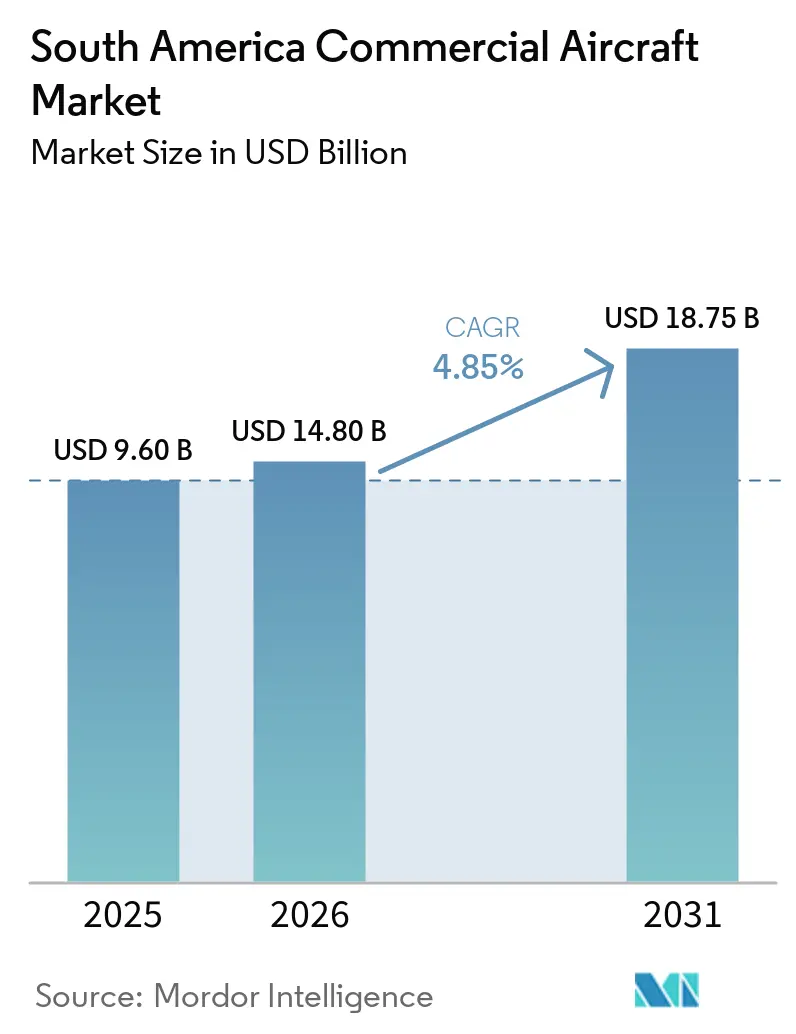
| Base Year Market Size (2025) | USD 9.60 Billion |
| Market Size (2026) | USD 14.80 Billion |
| Market Size (2031) | USD 18.75 Billion |
| Growth Rate (2026 - 2031) | 4.85 % |
| Market Concentration | High |
Major Players *Disclaimer: Major Players sorted in no particular order Image © Mordor Intelligence. Reuse requires attribution under CC BY 4.0. | |
South America Commercial Aircraft Market Analysis by Mordor Intelligence
The South America commercial aircraft market size was valued at USD 9.60 billion in 2025 and is forecast to grow from USD 14.80 billion in 2026 to USD 18.75 billion by 2031, at a 4.85% CAGR during the forecast period (2026-2031). Passenger traffic and airline fleet renewal continue to support aircraft demand across the region. South America and the Caribbean handled 477.3 million passengers in 2025, an increase of 3.8% from the previous year. Regional international traffic also expanded faster than total passenger traffic in 2025, supporting investment in cross-border connectivity. Airline orders are increasingly linked to lower fuel use, network expansion, and replacement of older aircraft. Airport capacity, foreign-currency costs, and workforce availability continue to affect how quickly airlines can place aircraft into service.
Key Report Takeaways
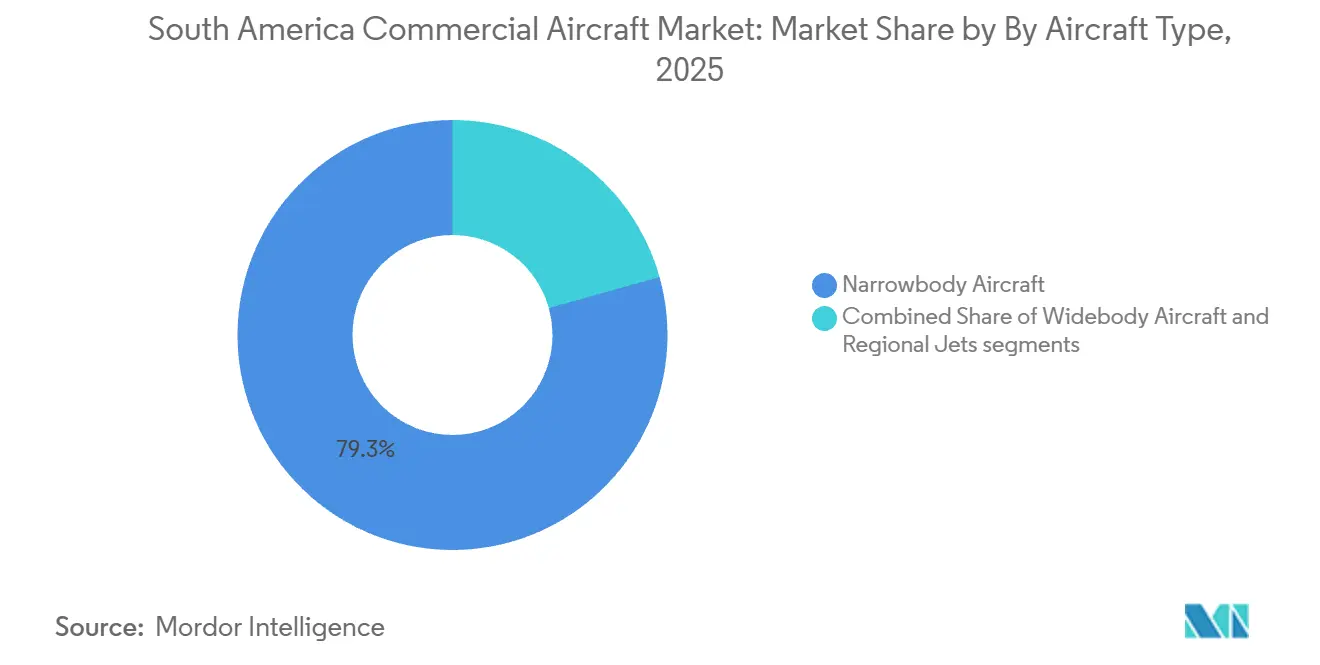
- By aircraft type, narrowbody aircraft accounted for 79.34% of the South America commercial aircraft market share in 2025, while regional jets are forecast to grow at a 5.45% CAGR through 2031.
- By application, passenger aircraft accounted for 96.89% of the South America commercial aircraft market share in 2025 and are forecast to grow at a 6.87% CAGR through 2031.
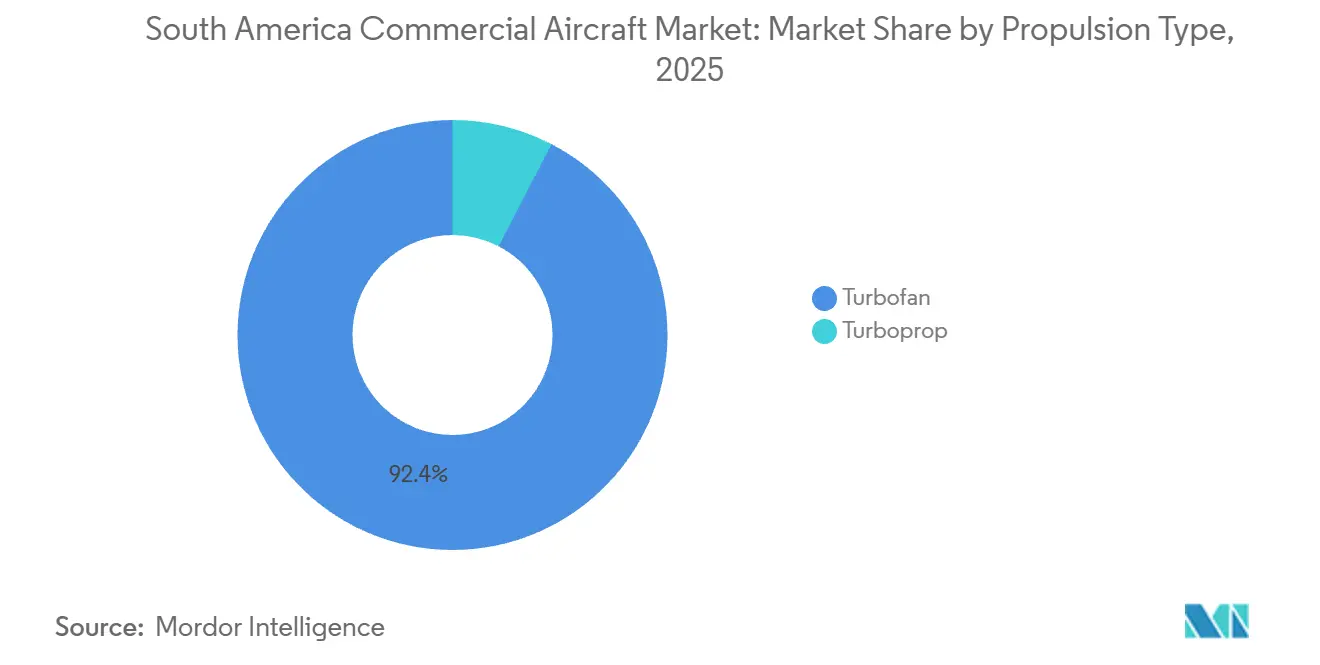
- By propulsion type, turbofan aircraft accounted for 92.38% of the South America commercial aircraft market share in 2025, while turboprop aircraft are forecast to grow at a 6.38% CAGR through 2031.
- By component, airframe structures accounted for 34.81% of the South America commercial aircraft market size in 2025, while avionics and flight-control systems are forecast to grow at a 7.51% CAGR through 2031.
- By geography, Brazil held 35.96% of the South America commercial aircraft market share in 2025, while Chile is forecast to grow at an 8.98% CAGR through 2031.
Note: Market size and forecast figures in this report are generated using Mordor Intelligence’s proprietary estimation framework, updated with the latest available data and insights as of January 2026.
Market Trends and Insights
Drivers Impact Analysis of South America Commercial Aircraft Market*
| Driver | (~) % Impact on CAGR Forecast | Geographic Relevance | Impact Timeline |
|---|---|---|---|
| Fleet replacement and fuel-efficiency economics | +2.30% | Global, with primary concentration in Brazil, Colombia, and Chile | Medium term (2-4 years) |
| Expansion of LCC and ULCC networks | +1.80% | Argentina, Chile, Peru, Colombia, and Brazil secondary markets | Short term (≤ 2 years) |
| Connectivity demand from secondary cities and thin routes | +1.60% | Brazil, Colombia, Peru, and Rest of South America | Medium term (2-4 years) |
| Brazil-led regional aerospace and financing ecosystem | +1.30% | Brazil, with regional export financing effects | Long term (≥ 4 years) |
| Rising middle-class and tourism air-travel demand | +1.10% | Brazil, Colombia, Peru, Argentina; tourism corridors across Ecuador and Chile | Medium term (2-4 years) |
| Air cargo and e-commerce network development | +0.90% | Brazil, Colombia, Chile, and cross-border flows from Argentina | Short term (≤ 2 years) |
| Source: Mordor Intelligence | |||
Fleet Replacement and Fuel-Efficiency Economics
Commercial airline fleets across South America entered a replacement cycle during 2025 and 2026. Airlines are retiring older narrowbody aircraft and adding newer, more fuel-efficient platforms. Abra Group announced a 246-aircraft commitment in October 2025, including A320neo, B737 MAX, A350, and A330neo aircraft.[1] This order supports demand across the South America commercial aircraft market and gives the group greater certainty over future delivery positions. GE Aerospace expanded its Três Rios maintenance operation after completing its 1,000th engine test in December 2025. Faster fleet replacement can reduce operating costs and strengthen airline competition on established domestic routes.
Newer aircraft also change the maintenance needs of regional operators. The growing installed base of LEAP-powered aircraft supports longer-term demand for engine repair capacity. Local maintenance capability can reduce the time and foreign-currency costs of sending engines overseas. Airlines still need sufficient airport slots and trained personnel before they can fully use new aircraft. These operating limits can delay the economic benefit from a new delivery. The South America commercial aircraft market therefore depends on fleet renewal and the supporting maintenance system progressing together.
Expansion of Low-Cost and Ultra-Low-Cost Networks
LCCs and ULCCs are expanding route networks across South America. These carriers use single-aisle fleets to offer lower fares and add service between large and secondary cities. JetSMART operated 56 A320neo and A321neo aircraft across its regional operating certificates in 2026. Its investment plan for Argentina covered 23 additional aircraft, 5 routes, and 300 jobs. Lower fares can attract travelers who previously did not use air transport. This approach broadens the demand base for the South America commercial aircraft market.
LCC networks also increase competition for capacity at major airports. Carriers need reliable access to airports, ground services, and operating slots to maintain high aircraft use. Brazil recorded 37 million departure seats in the first quarter of 2026, while Colombia recorded 16.4 million seats during the same period. These volumes show the importance of the two countries for airline network planning. The model favors aircraft that can serve dense routes with lower unit costs. It also supports further narrowbody deliveries as airlines seek fleet commonality and lower maintenance complexity.
Connectivity Demand from Secondary Cities and Thin Routes
Secondary-city connectivity is creating a separate demand base for regional aircraft. South America has 200 cities with populations between 200,000 and 500,000 that remain underserved by air service. Half of these cities are located in Brazil. These places have much lower trips per capita than major metropolitan areas. Airlines can use smaller aircraft to match capacity with local demand. This supports fleet diversification within the South America commercial aircraft market.
LATAM plans to introduce E195-E2 aircraft on 42 domestic Brazilian routes from November 2026. The plan included 4 previously unserved destinations and linked regional service to a larger domestic network. ATR also described South America as a core area for turboprop fleet growth in 2026. Smaller aircraft can connect thin routes that are not viable with larger jets. The resulting hub traffic can improve feed for longer international services. This creates a practical link between regional connectivity and the utilization of the broader airline network.
Brazil-Led Regional Aerospace and Financing Ecosystem
Brazil remains the region’s main aerospace manufacturing base. Embraer reported a record firm-order backlog of USD 31.6 billion at the end of the fourth quarter of 2025. Its commercial aviation business received support from demand for the E175 and E2. The company guided 80 to 85 commercial aircraft deliveries for 2026. The order book supports production planning and supplier activity. It also gives South American airlines another source of aircraft suited to regional route conditions.
A domestic aerospace base supports more than final aircraft deliveries. It can strengthen relationships across the region in training, maintenance, component support, and financing. Brazil’s scale allows airline groups to operate large domestic networks and connect them to international hubs. The benefits can extend to neighboring markets that use regional aircraft or source maintenance services from Brazil. Access to financing still depends on airline balance sheets and currency conditions. Brazil’s manufacturing base, therefore, supports the South America commercial aircraft industry, but airline financial discipline remains important.
Restraints Impact Analysis of South America Commercial Aircraft Market*
| Restraint | (~) % Impact on CAGR Forecast | Geographic Relevance | Impact Timeline |
|---|---|---|---|
| Dollar-denominated costs versus local-currency revenues | -1.70% | Brazil, Argentina, Colombia, and Peru | Short term (≤ 2 years) |
| Airport and air-traffic-control bottlenecks | -1.20% | Brazil, Colombia, Chile, and Peru | Medium term (2-4 years) |
| Pilot, maintenance technician, and training capacity constraints | -0.80% | Brazil, Colombia, and Argentina | Long term (≥ 4 years) |
| SAF availability and decarbonization compliance costs | -0.50% | Brazil, Chile, and Colombia | Long term (≥ 4 years) |
| Source: Mordor Intelligence | |||
Dollar-Denominated Costs Versus Local-Currency Revenues
Aircraft leases, fuel, and many maintenance contracts are priced in USD. Airline ticket revenue is largely earned in local currencies across South America. This mismatch creates pressure when domestic currencies weaken against the USD. LATAM reported USD 624 million in foreign-exchange hedging derivatives as of June 2026. Hedging can manage some exposure, but it does not remove currency risk. The South America commercial aircraft market can be affected when airlines delay orders or adjust delivery schedules to protect cash flow.
Currency exposure directly affects fleet planning. Airlines with weaker balance sheets may have limited capacity to commit to multiyear aircraft programs. Higher financing and lease costs can reduce the benefit of fuel-efficient aircraft. Carriers must balance lower operating costs from new fleets against the foreign-currency burden of acquiring them. This is particularly relevant in countries with volatile exchange rates. It also creates a competitive advantage for airline groups with stronger liquidity, diversified revenue, or established hedging programs.
Airport and Air-Traffic-Control Bottlenecks
Airport capacity limits are restricting network expansion in parts of South America. IATA reported that 54% of regional flights depart from or arrive at congested or severely congested airports. The constraint applies to major hubs and smaller airports with limited apron capacity. Congestion makes it harder for airlines to add frequencies or schedule newly delivered aircraft. It can also reduce aircraft utilization during peak operating periods. This limits the speed at which the South America commercial aircraft market can convert order activity into active fleet capacity.
São Paulo Congonhas entered a demanding reconstruction phase in 2026, which restricted operations. Lima’s new Jorge Chávez International Airport was designed for up to 40 million passengers annually. Such projects can increase capacity, but the full benefits depend on the availability of supporting access and air traffic systems. Airlines cannot realize planned fuel and network gains if aircraft remain constrained at core hubs. Infrastructure improvements, therefore, need to progress alongside fleet expansion. The timing of airport projects will influence where future aircraft can be deployed most efficiently.
*Our forecasts treat driver/restraint impacts as directional, not additive. The impact forecasts reflect baseline growth, mix effects, and variable interactions.
South America Commercial Aircraft Market Segment Analysis
By Aircraft Type:
Narrowbody Aircraft Lead, Regional Jets Grow FasterNarrowbody aircraft held 79.34% of the South America commercial aircraft market share in 2025. Single-aisle aircraft are central to high-frequency domestic and regional routes. Their capacity suits the route structure of Brazil, Colombia, Chile, and Argentina. The A320 and B737 families remain important fleet platforms for major airline groups. Abra Group’s aircraft commitment included large volumes of A320neo and B737 MAX aircraft. This demand reinforces the narrowbody position in the South America commercial aircraft market.
Regional jets are forecast to grow at a 5.45% CAGR from 2026 to 2031. Their smaller capacity allows airlines to serve underserved cities without relying on large aircraft. LATAM’s planned E195-E2 route deployment illustrates this role in Brazil. Embraer’s commercial aircraft backlog also indicates continuing demand for its regional platforms. Widebodies remain relevant for longer international routes, but they serve a more selective set of network needs. Airlines will continue to match aircraft size with route economics and airport conditions.

By Application:
Passenger Aircraft Dominate, Cargo Adds Strategic DemandPassenger aircraft accounted for 96.89% of the South America commercial aircraft market in 2025. Passenger traffic was supported by rising regional travel and international connectivity. South America and Caribbean passenger traffic reached 477.30 million travelers in 2025. Passenger carriers need additional aircraft when load factors and network demand remain strong. The segment’s 6.87% CAGR forecast through 2031 reflects this sustained central role. Most fleet orders are therefore directed to passenger service requirements.
Freighter aircraft represented a smaller part of the market, but cargo activity remains commercially important. Air cargo grew during 2025, with additional international tonnage concentrated in Brazil and Colombia. E-commerce, pharmaceuticals, and export corridors increase demand for time-sensitive air transport. Passenger aircraft can provide belly capacity on many routes. Dedicated freighters may be needed where cargo demand is concentrated or service timing is critical. Airlines are considering these needs when allocating aircraft across passenger and cargo networks.
By Propulsion Type:
Turbofan Aircraft Remain Predominant, Turboprops Gain RelevanceTurbofan-powered aircraft accounted for 92.38% of the South America commercial aircraft market size in 2025. This reflects the strong position of narrowbody and widebody jets in the region’s airline fleets. CFM LEAP engines are a major part of the next-generation narrowbody fleet. Abra Group agreed to acquire 100 LEAP-1A engines for 50 A320neo aircraft in July 2026. The agreement also included long-term services for Avianca and GOL fleets. Engine support capacity will remain important as these aircraft enter service.
Turboprop aircraft are forecast to grow at a 6.38% CAGR through 2031. Their economics are suited to shorter routes and airports with operating limitations. ATR reported strong 2025 demand and plans for higher production in 2026. Clic and SATENA added ATR 72-600 aircraft in Colombia during May 2026. Turboprops can connect geographically varied domestic markets where jet operations are less suitable. This supports their growing role within the South America commercial aircraft industry.
By Component:
Airframe Structures Hold the Largest Position, Avionics Grow FastestAirframe structures accounted for 34.81% of the South America commercial aircraft market share in 2025. Each aircraft delivery adds structural content to the regional supply base. Therefore, narrowbody and regional jet deliveries directly support the component category. Engine systems are also important because of large LEAP-powered fleet commitments. GE Aerospace expanded engine testing and overhaul activity at Três Rios in Brazil during 2025. Cabin systems grow with fleet deliveries and airline efforts to improve passenger experience.
Avionics and flight-control systems are forecast to grow at a 7.51% CAGR through 2031. New aircraft have higher avionics content than many older fleets they replace. Honeywell was selected to provide cockpit technologies and mechanical systems for 138 Avianca A320neo aircraft in December 2024.[2] These systems support flight management, cockpit displays, and aircraft operations. Other components, including hydraulics, landing gear, and pneumatic systems, continue to rise with fleet deliveries. The component mix will remain linked to the pace and technology level of new aircraft orders.
Geography Analysis
Brazil Commercial Aircraft Market
Brazil held 35.96% of the South America commercial aircraft market share in 2025. It remains the region’s largest aviation base and main source of domestic aircraft demand. ANAC reported 958,900 domestic and international flight operations in 2025, the highest number since 2019.[3] The country also recorded high load factors, which support additional fleet capacity. Brazil’s scale supports narrowbody operations, regional routes, and maintenance activity. Embraer’s domestic manufacturing presence adds a separate supply-chain role. The country’s airport constraints and foreign-currency exposure remain material limitations.
Colombia and Argentina Commercial Aircraft Market
Colombia is expanding through passenger growth, regional connectivity, and fleet additions. Aerocivil reported 15 million passengers in the first quarter of 2026, up 8.7% from the previous year. Its geography creates demand for regional aircraft capable of serving a variety of domestic routes. Avianca and LATAM Colombia continue to support domestic and international network capacity. Argentina also recorded capacity growth in the first quarter of 2026. JetSMART’s investment program supports additional aircraft and route development in Argentina. These countries add diversity to regional aircraft demand beyond Brazil.
South America Commercial Aircraft Market
Chile is forecast to grow at an 8.98% CAGR through 2031, the fastest rate among the listed geographies. Passenger traffic declined 2.1% year over year through July 2026, reflecting fuel and economic pressure. The country’s airport modernization plan is intended to expand future capacity. Peru is also strengthening Lima’s role in cargo and passenger traffic through its new airport facility. Ecuador, Bolivia, Venezuela, Paraguay, Uruguay, and Guyana contribute smaller volumes. Cross-border route expansion and resource-related charter demand add to utilization across these markets.
Competitive Landscape
The South America commercial aircraft market is concentrated among a limited group of aircraft manufacturers and major airline groups. Airbus and Boeing hold major positions in narrowbody and widebody fleet planning. Embraer has a distinct role in the regional jet market through the E175 and E2 programs. Its USD 31.6 billion backlog at the end of 2025 reflected continued demand across its aircraft businesses. Airlines are using large orders to secure delivery positions and standardize fleet operations. Engine suppliers and systems providers compete through equipment and long-term service agreements.
Abra Group made a major strategic move with its 246-aircraft order announced in October 2025. It followed this with the July 2026 agreement for 100 CFM LEAP-1A engines. The agreements support fleet renewal at Avianca and GOL and provide long-term service visibility. Honeywell’s agreement for Avianca’s 138 A320neo aircraft is another example of a broad equipment contract. The deal covers cockpit technologies, auxiliary power units, and mechanical systems. These arrangements favor suppliers that can provide equipment and ongoing support across large fleets.
Competitive opportunities also exist in maintenance, regional connectivity, and the supply of lower-carbon fuels. GE Aerospace’s Três Rios expansion supports local maintenance capability for next-generation engines. ATR and Embraer are positioned for demand from thin routes and secondary cities. Aircraft lessors remain relevant to airlines seeking flexibility rather than direct purchases. Sustainable aviation fuel requirements may affect future operating decisions and service agreements. Market participants must manage airport congestion, financing conditions, and currency risks alongside new fleet activity. The South America commercial aircraft market remains competitive, but large orders give leading airline groups and suppliers meaningful influence.
South America Commercial Aircraft Industry Leaders
-
Airbus SE
-
The Boeing Company
-
Embraer S.A.
-
Avions de Transport Régional GIE (ATR)
-
Empresa Nacional de Aeronáutica de Chile (ENAER)
- *Disclaimer: Major Players sorted in no particular order

South America Commercial Aircraft Market Companies Covered in this Report
- Aircraft OEMs
- Systems Manufacturers and Integrators
Recent Industry Developments in South America Commercial Aircraft Market
- April 2026: Copa Airlines finalized an agreement with Boeing to purchase 40 additional B737 MAX aircraft, with options for up to 20 more. The commitment, valued at USD 13.5 billion at list prices, covers up to 60 aircraft.
- October 2025: CFM International and Abra Group, the parent company of Avianca and GOL, announced that Avianca selected CFM LEAP-1A engines to power 50 previously unallocated aircraft from its remaining order of 134 A320neo family aircraft. The agreement also includes a comprehensive services package to support Abra Group’s long-term operational requirements, including spare engines and long-term services. The long-term services component will also cover GOL’s fleet of B737 MAX aircraft.
South America Commercial Aircraft Market Report Scope
The South America commercial aircraft market includes the design, manufacturing, assembly, delivery, and aftermarket support of fixed-wing aircraft used for passenger and cargo transportation. The study includes narrowbody, widebody, and regional aircraft, covering both jet and turboprop platforms. It evaluates market performance across original equipment manufacturing (OEM) sales, fleet replacement, and capacity expansion driven by airline demand. The analysis encompasses the entire aircraft ecosystem, including airframe and propulsion systems, avionics, cabin interiors, and integrated service offerings, for both linefit and retrofit installations.
The South America commercial aircraft market is segmented by aircraft type, application, propulsion type, component, and geography. By aircraft type, the market is segmented into narrowbody, widebody, and regional jets. By application, the market is segmented into passenger and freighter. By propulsion type, the market is segmented into turbofan and turboprop. By component, the market is segmented into airframe structures, aero-engines, avionics and flight control, cabin interior and IFEC, and other components. The report also covers market sizes and forecasts for the South America commercial aircraft market in five countries across the region. For each segment, the market size is provided in terms of value (USD).
Segmentation Overview
By Aircraft Type
| Narrowbody |
| Widebody |
| Regional Jets |
By Application
| Passenger |
| Freighter |
By Propulsion Type
| Turbofan |
| Turboprop |
By Component
| Airframe Structures |
| Aero-Engines |
| Avionics and Flight Control |
| Cabin Interior and IFEC |
| Other Components |
By Geography
| Brazil |
| Argentina |
| Colombia |
| Chile |
| Peru |
| Rest of South America |
| By Aircraft Type | Narrowbody |
| Widebody | |
| Regional Jets | |
| By Application | Passenger |
| Freighter | |
| By Propulsion Type | Turbofan |
| Turboprop | |
| By Component | Airframe Structures |
| Aero-Engines | |
| Avionics and Flight Control | |
| Cabin Interior and IFEC | |
| Other Components | |
| By Geography | Brazil |
| Argentina | |
| Colombia | |
| Chile | |
| Peru | |
| Rest of South America |
Key Questions Answered in the Report
What is the projected value of the South America commercial aircraft market by 2031?
The South America commercial aircraft market is forecast to grow from USD 14.80 billion in 2026 to USD 18.75 billion by 2031, at a 4.85% CAGR during the forecast period.
Which aircraft type held the largest share in 2025?
Narrowbody aircraft led with 79.34% of the South America commercial aircraft market share in 2025.
Which aircraft category is expected to grow fastest through 2031?
Regional jets are forecast to grow at a 5.45% CAGR between 2026 and 2031.
Why is Brazil important for commercial aircraft demand?
Brazil held 35.96% of the regional total in 2025 and recorded 958,900 flight operations that year.
What is driving demand for regional aircraft?
Secondary cities, thin domestic routes, and airline network expansion support demand for right-sized regional aircraft.
What is the main constraint facing airlines in South America?
USD-denominated lease, fuel, and maintenance costs can create pressure when local currencies weaken.