
Market Overview
| Study Period | 2020 - 2031 |
|---|---|
| Forecast Data Period | 2026 - 2031 |
| Base Year Market Size (2025) | USD 1.85 Billion |
| Market Size (2026) | USD 1.92 Billion |
| Market Size (2031) | USD 2.38 Billion |
| Growth Rate (2026 - 2031) | 4.39 % |
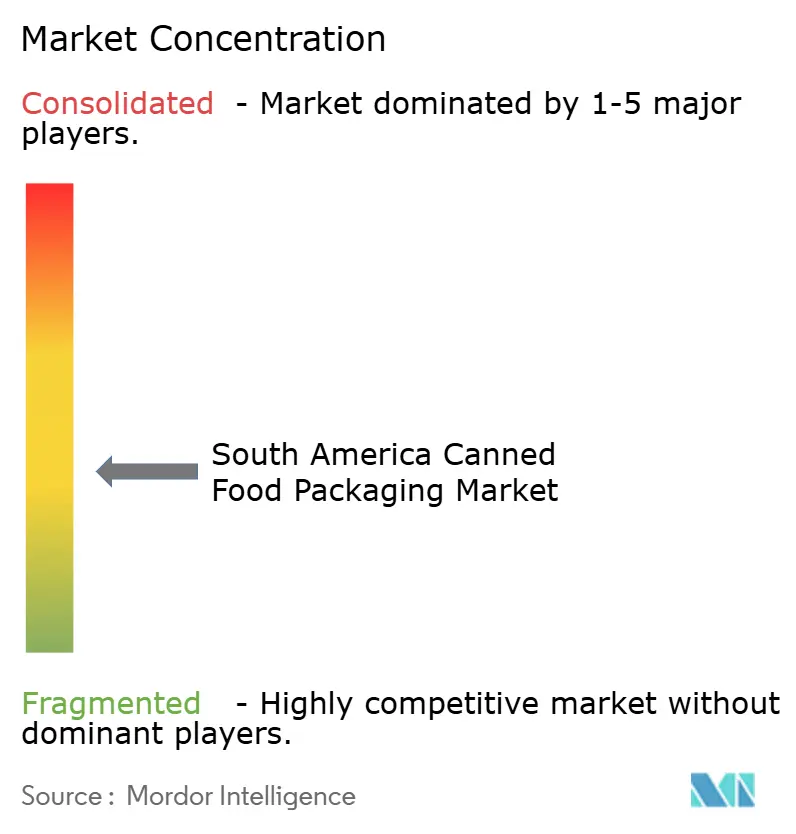
| Market Concentration | Medium |
Major Players *Disclaimer: Major Players sorted in no particular order Image © Mordor Intelligence. Reuse requires attribution under CC BY 4.0. | |
South America Canned Food Packaging Market Analysis by Mordor Intelligence
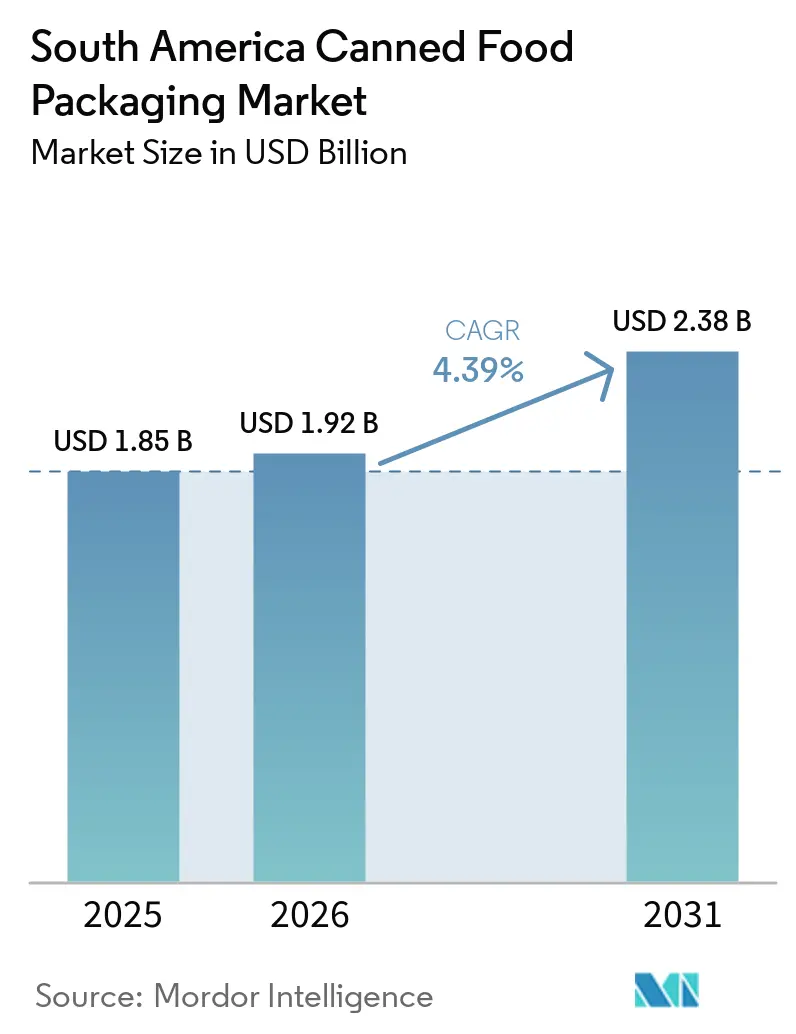
The South America Canned Food Packaging Market size was valued at USD 1.85 billion in 2025 and estimated to grow from USD 1.92 billion in 2026 to reach USD 2.38 billion by 2031, at a CAGR of 4.39% during the forecast period (2026-2031). Metal cans remain important where ambient distribution is more practical than refrigerated transport, because they provide hermetic sealing, food safety, and tamper evidence for processors, retailers, foodservice operators, and households. The South America Canned Food Packaging Market is also changing internally as two-piece cans expand faster than three-piece formats, altering material use, line economics, and the production choices available to manufacturers. Aluminum is gaining ground against steel and tinplate as canmakers pursue lighter formats and stronger recycled-content credentials while maintaining product protection. Brazil remains the principal production base, while Colombia combines faster growth with new capacity and an expanding organized retail sector. Suppliers are responding by investing in capacity, developing coatings, sourcing recycled materials, and adopting digital decoration rather than relying on price competition alone.
Key Report Takeaways
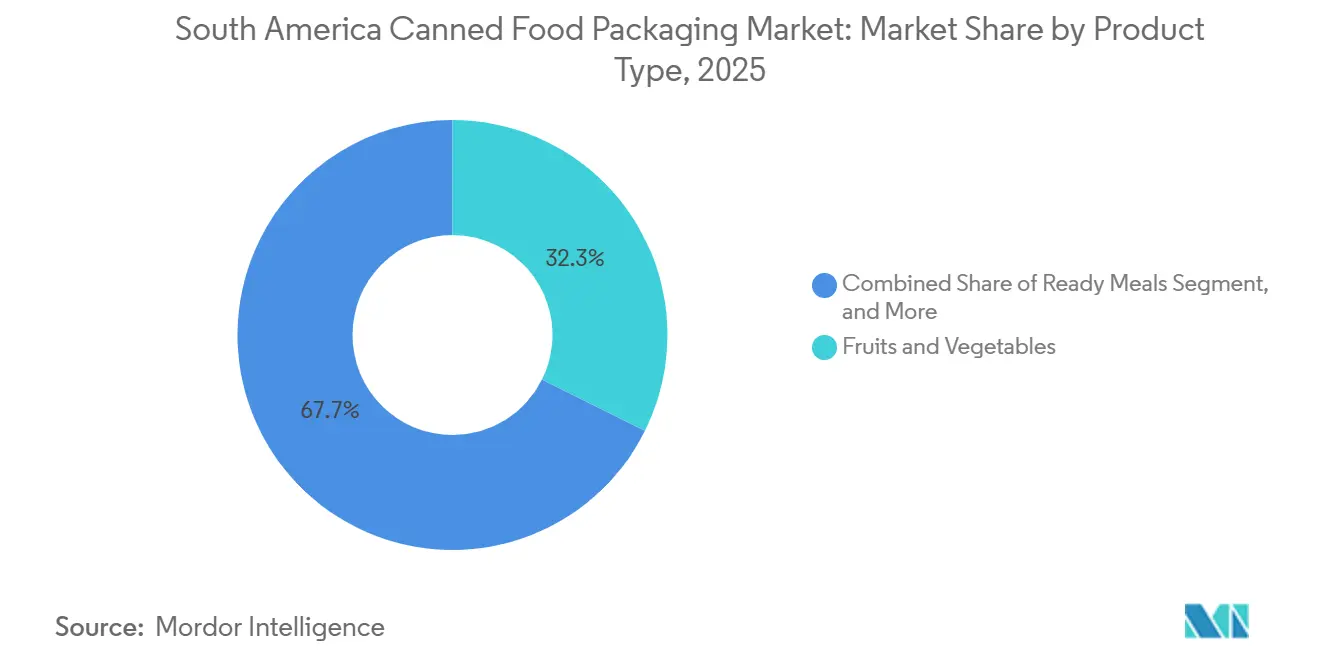
- By product type, fruits and vegetables held 32.34% of the South America Canned Food Packaging Market share in 2025, while ready meals are forecast to grow at a 5.12% CAGR through 2031.
- By material, steel and tinplate accounted for 58.13% of the South America Canned Food Packaging Market share in 2025, while aluminum is forecast to grow at a 5.96% CAGR through 2031.
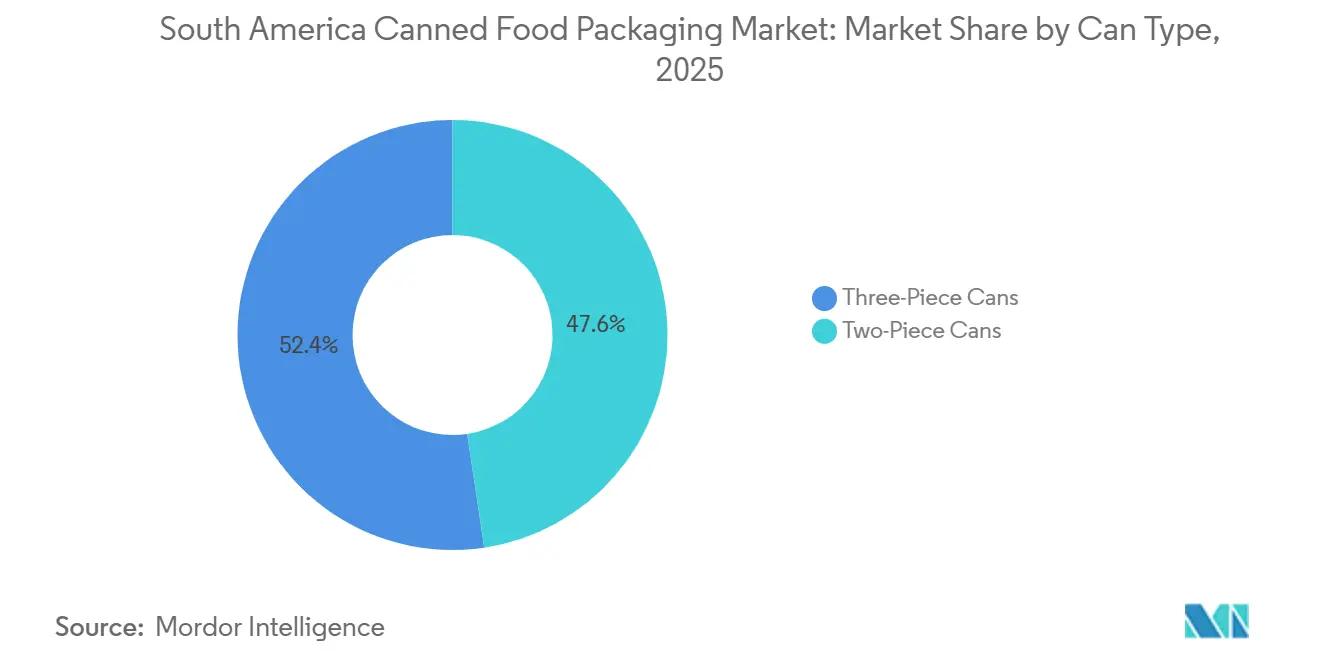
- By can type, three-piece cans held 52.36% of revenue in 2025, while two-piece cans are forecast to expand at a 6.11% CAGR through 2031.
- By geography, Brazil accounted for 52.12% of revenue in 2025, while Colombia is forecast to grow at a 5.87% CAGR through 2031.
Note: Market size and forecast figures in this report are generated using Mordor Intelligence’s proprietary estimation framework, updated with the latest available data and insights as of January 2026.
Market Trends and Insights
Drivers Impact Analysis of South America Canned Food Packaging Market*
| Driver | (~) % Impact on CAGR Forecast | Geographic Relevance | Impact Timeline |
|---|---|---|---|
| Demand for Convenience and Ready-to-Eat Foods | +1.2% | Brazil, Argentina, Colombia | Short term (≤ 2 years) |
| Shelf-Life Extension and Food-Waste Reduction | +0.9% | South America-wide, strongest in Brazil and Rest of South America | Medium term (2-4 years) |
| Expansion of Modern Retail and E-Commerce | +0.7% | Brazil, Colombia | Medium term (2-4 years) |
| Recyclability and Plastic-Reduction Preference | +0.5% | Brazil core, spillover to Argentina and Colombia | Long term (≥ 4 years) |
| Mercosur Local-Sourcing and Import-Substitution of Cans | +0.4% | Brazil, Argentina | Medium term (2-4 years) |
| Small-Batch Retort Meals for Foodservice and Emergency Channels | +0.3% | Colombia, Brazil | Long term (≥ 4 years) |
| Source: Mordor Intelligence | |||
Demand for Convenience and Ready-to-Eat Foods
Urban households and dual-income families continued to favor shelf-stable foods that require limited preparation during 2025, particularly where commuting patterns and time constraints reduce the appeal of cooking from basic ingredients every day. This supports ready meals because cans offer accessible protein-and-carbohydrate combinations at a lower cost than chilled convenience products, while also allowing households to store food for later consumption. The South America Canned Food Packaging Market also benefits from foodservice demand for sauce bases, proteins, and prepared starches used by quick-service restaurants and institutional caterers, which need consistent quality across multiple locations. These customers can hold inventory longer and manage kitchen operations with less dependence on cold storage, helping them plan procurement around availability rather than daily delivery schedules. Foodservice orders can also be steadier than household pantry purchases during periods of regional economic pressure, because institutions and restaurant operators still require basic ingredients to maintain menus. The growing role of this channel gives canmakers a more predictable demand base for ready-meal formats and supports production planning across food categories.
Shelf-Life Extension and Food-Waste Reduction
Food loss remains significant in distribution networks with limited refrigeration capacity, particularly outside major cities and along long routes connecting agricultural areas, processors, wholesalers, and retail outlets.[1] Cans create an oxygen-, moisture-, and microbial-barrier that allows processors to move products at ambient temperatures without relying on refrigerated vehicles or retail cabinets. This function helps food companies serve Brazil’s interior and Colombia’s secondary cities without adding temperature-controlled logistics, which can be difficult for regional processors to fund. The South America Canned Food Packaging Market, therefore, supports regional processors that need to sell harvest output beyond local fresh-food channels and manage supply across seasons. A shelf life of 2 to 5 years can reduce the capital needed for refrigerated distribution and help smaller processors meet supermarket requirements for regular, reliable supply. For brands entering nonmetropolitan areas, this distribution role remains difficult for flexible alternatives to match at a similar cost and with comparable protection.
Expansion of Modern Retail and E-Commerce
Supermarket and hypermarket expansion continued through 2025 in Colombia and in Brazilian secondary cities, bringing more food purchases into organized channels with formal inventory and assortment management. Organized retail favors ambient products because they require no refrigeration equipment and carry a lower risk of inventory loss than chilled goods, reducing operating complexity for stores. Canned products also use shelf space efficiently and can remain available through longer replenishment cycles, allowing retailers to manage a wider range of food items without frequent markdowns. Online grocery sales reinforce these advantages because cans require no cold chain and are simpler to handle in last-mile distribution, including deliveries that combine several ambient products. The South America Canned Food Packaging Market can therefore benefit as retailers widen their formal distribution networks and standardize assortments across city and regional locations. The growth of these channels gives food brands practical reasons to retain cans in categories that require reliable storage, repeatable handling, and transport over variable distances.
Recyclability and Plastic-Reduction Preference
Metal packaging is gaining attention from food brands seeking a recyclable alternative to selected single-use plastic formats, particularly when they need a clear material story for retailers and export customers. Brazil’s aluminum can recycling system recorded a 100% collection rate in 2025, while more than 80% of aluminum sheet used in can production came from post-consumer material.[2] The association reported that this system saved 5,000 GWh of energy during the year, reinforcing the role of recycled content in the country’s can supply chain. Food exporters also face greater interest from overseas customers in documented recycled inputs, particularly in seafood, fruit, and specialty-food categories that may be sold into more tightly specified channels. Ball Beverage Packaging South America held an Aluminum Stewardship Initiative chain-of-custody certificate in 2025. These credentials can influence packaging selection in commercial tenders and brand procurement decisions, even where cost and technical performance remain the first criteria.[3]
Restraints Impact Analysis of South America Canned Food Packaging Market*
| Restraint | (~) % Impact on CAGR Forecast | Geographic Relevance | Impact Timeline |
|---|---|---|---|
| Volatile Steel and Aluminum Costs | -0.8% | South America-wide | Short term (≤ 2 years) |
| Competition from Flexible and Plastic Packaging | -0.5% | Brazil, Colombia | Medium term (2-4 years) |
| Consumer Perceptions of Processed Foods | -0.2% | Brazil, Argentina | Long term (≥ 4 years) |
| BPA-Free Coating Conversion and Qualification Costs | -0.1% | Brazil, Argentina | Short term (≤ 2 years) |
| Source: Mordor Intelligence | |||
Volatile Steel and Aluminum Costs
Steel and aluminum represent a large share of the cost of a finished food can, making commodity movements an immediate operating risk for both large canmakers and smaller regional producers. Local canmakers have limited ability to offset these movements because relevant benchmarks are set in international aluminum, scrap, and tinplate markets rather than by local food-can demand alone. Raw material purchases are commonly priced in USD, while cash sales are typically negotiated in Brazilian real, Argentine peso, or Colombian peso, creating a direct currency mismatch in procurement and revenue. Currency depreciation can therefore widen the gap between input costs and local selling prices, particularly when food brands resist price changes after their budgets have been agreed. The South America Canned Food Packaging Market is especially exposed when annual customer contracts limit rapid price adjustments, and canmakers must continue supplying essential food-packaging volumes. Smaller producers may defer equipment upgrades when they cannot recover sudden cost increases from food brands, slowing investment in lightweighting, coating changes, and other line improvements.
Competition from Flexible and Plastic Packaging
Stand-up pouches, retort pouches, and multilayer laminates are competing with cans in sauces, processed meats, and selected fruit and vegetable products, especially where brands want a different shelf appearance. Flexible packs can offer lower unit costs at moderate volumes and allow for more varied shapes and graphics, making them attractive for promotional or premium product ranges. Trivium reported that a food and specialty customer in the Americas was moving pet food from steel cans to aluminum and outsourcing filling operations in 2025. This illustrates how material and supply chain changes can simultaneously reduce demand for individual can formats without necessarily reducing the broader need for packaged food. Canmakers are responding with lighter two-piece cans, digital decoration, easy-open ends, and reclosable designs that make metal products easier to use and more visually differentiated. These measures seek to reduce the functional and shelf-appeal gap with pouches while retaining the barrier performance of metal and the established distribution benefits of cans.
*Our forecasts treat driver/restraint impacts as directional, not additive. The impact forecasts reflect baseline growth, mix effects, and variable interactions.
South America Canned Food Packaging Market Segment Analysis
By Product Type:
Fruits and Vegetables Lead, While Ready Meals Reshape the Demand MixFruits and vegetables accounted for 32.34% of the South America Canned Food Packaging Market share in 2025, making them the largest product category and a core volume base for food can production. The category aligns with regional agricultural output and with established household demand for tomatoes, corn, peas, hearts of palm, and tropical fruits that can be purchased outside harvest periods. Canning gives processors a way to extend seasonal harvests into year-round supply at stable price points, while reducing their dependence on immediate fresh-market sales. This is useful where fresh-produce supply chains remain uneven across cities and inland locations, and where seasonal abundance can otherwise create short-term price pressure. Meat products and seafood also drive substantial demand, with canned tuna providing an accessible protein option in coastal cities and inland markets where shoppers value shelf stability.
Ready meals are forecast to grow at a 5.12% CAGR through 2031, the fastest rate among product categories in the South America Canned Food Packaging Market. The segment is supported by working households in São Paulo, Bogotá, and Buenos Aires who have less time to cook from scratch and may prefer products that are easy to store. Quick-service restaurants and institutional caterers also use canned components to simplify preparation, manage portion control, and reduce the variability that can arise from handling fresh ingredients. During economic weakness, some consumers may substitute canned meals for restaurant spending or higher-cost fresh proteins, which provides some resilience for value-focused product lines. Beans, soups, pet food, and other canned products provide steady volume across economic cycles, while demand for them helps canmakers maintain line utilization when premium categories soften.

By Material:
Steel and Tinplate Dominate, While Aluminum Gains GroundSteel and tinplate held 58.13% of the South America Canned Food Packaging Market share in 2025, reflecting their central role in established food-can supply chains. Their position reflects long-standing supply relationships with Brazil’s steel sector and established food-can manufacturing infrastructure that has served processors for decades. These materials perform well in high-acid applications such as tomatoes, citrus fruits, and seafood, where oxygen protection and corrosion resistance are critical to product quality throughout the intended shelf life. Brasilata S.A. Embalagens Metálicas has built its position around localized steel can production and tailored solutions for Brazilian food processors with varied product requirements. Proximity to agricultural processing plants can reduce lead times and strengthen customer relationships for regional canmakers that compete on responsiveness as well as standard can supply.
Aluminum is forecast to grow at a 5.96% CAGR through 2031, supported by lighter formats and established recycling infrastructure. Brazil’s 2025 collection performance and recycled sheet use provide a strong material story for food brands seeking documented circularity without changing the core protection offered by a metal container. Capacity investments by Crown, Ball, CANPACK, and Ardagh increase aluminum can availability across Brazil and expand the range of formats offered to brand owners. Crown announced a third production line at Ponta Grossa in May 2025, intended to raise annual capacity from 2.4 billion to 3.6 billion cans when commercial production begins. Tin-free steel and specialty-coated alloys remain relevant in narrower applications, although they occupy a smaller share of demand and serve more specific food-processing needs.[4]
By Can Type:
Three-Piece Cans Lead, While Two-Piece Technology AcceleratesThree-piece cans accounted for 52.36% of revenue in 2025, supported by their flexibility across food categories and can sizes. A separately formed body with welded construction and two ends can accommodate varied diameters and fill heights, giving processors more flexibility when product presentation or filling requirements differ. This makes the format suitable for fruits, premium meats, and products where geometry supports brand presentation or allows a familiar package design to be retained. Many regional producers operate three-piece lines for mid-volume customers with multiple stock-keeping units and a need for production changes across food categories. The installed equipment base creates switching costs and keeps three-piece cans relevant even as production technology changes and high-volume customers consider faster two-piece lines.
Two-piece cans are forecast to expand at a 6.11% CAGR through 2031, the highest rate across the South America Canned Food Packaging Market. The draw-and-iron process removes the side seam, reduces material use, and supports high-speed production for customers who can commit to large volumes. Input material savings of 10% to 15% per can can be significant for lines producing billions of units each year, especially when raw material costs are volatile. Crown’s Ponta Grossa expansion demonstrates the scale at which high-speed two-piece production can be economical and shows why leading suppliers are increasing capacity in Brazil. Wider conversion will depend on multi-year volume commitments that justify capital spending by canmakers and allow food brands to standardize their can requirements.
Geography Analysis
Brazil Canned Food Packaging Market
Brazil held 52.12% of the South America Canned Food Packaging Market share in 2025, based on canmaking scale, raw-material access, and aluminum recycling capacity that supports a broad base of food and beverage production. The Brazilian aluminum can sector sold 34.1 billion units in 2025, its second-highest volume on record, showing the depth of the country’s established can collection and manufacturing system. Canned water grew 24% year over year, while ready-to-drink beverages, energy drinks, and other categories also grew, partially offsetting softer demand in legacy beverage segments. This broader use of aluminum cans supports investment in production infrastructure that can also serve food applications, including products that require an established local supply. Brazil updated food-contact rules through ANVISA RDC 961/2025, effective February 10, 2025, adding TMBPF-DGE to the national positive list for food-contact plastic packaging coatings. Crown disclosed a global capital expenditure plan of USD 550 million for 2026, including Brazilian capacity investment, underscoring the importance of the country in large suppliers’ future production plans.
Colombia Canned Food Packaging Market
Colombia is forecast to grow at a 5.87% CAGR through 2031, making it the fastest-growing geography in the South America Canned Food Packaging Market. CANPACK announced plans for a greenfield aluminum can plant near Barranquilla in August 2025, with a capacity of 1 billion can bodies annually. The facility is backed by a long-term agreement with a strategic customer and strengthens supply for northern Colombian distribution, including routes that can serve domestic and nearby export-oriented demand. A CANPACK and Bavaria project in Malambo, with a total investment of COP 548 billion (equivalent to USD 130 million at 2025 average exchange rates), is expected to begin operations in 2027. Modern retail, rising incomes, and organized food manufacturing support the country’s demand outlook and create a larger base for consistent packaged-food distribution.
Argentina and Neighboring Markets
Argentina remains a meaningful market, although currency volatility and import restrictions complicate raw-material sourcing for canmakers and can complicate local pricing. Domestic aluminum capacity, centered on the Aluar smelter, provides some proximity to material supply, while steel and tinplate remain more exposed to external conditions and potential supply disruption. Seafood, tomato paste, and ready meals continue to use cans because ambient distribution can work across fragmented cold-chain networks and over long distances between production and consumption areas. Argentina adopted Joint Resolution No. 01/2026 in April 2026, incorporating Mercosur GMC Resolution 28/24 into national rules for TMBPF-DGE in food and beverage can linings. Chile, Peru, Ecuador, and smaller Southern Cone markets also rely on metal cans, and in mountainous and interior areas, limited refrigerated distribution makes shelf-stable products important for the local food supply.
Competitive Landscape
The South America Canned Food Packaging Market is moderately fragmented among global canmakers, with Crown Holdings, Ball Corporation, CANPACK, and Trivium Packaging leading the market. Their advantage comes from owned production assets, large customer agreements, material sourcing scale, and investment capacity that allows them to undertake high-cost upgrades in manufacturing, decoration, and food-contact compliance. Competition increasingly centers on two-piece production, recycled-content aluminum, coating compliance, and digital decoration, because food brands want both dependable supply and visible packaging differentiation. Crown’s announced expansion in Ponta Grossa would increase annual capacity from 2.4 billion to 3.6 billion cans. The investment illustrates how large suppliers are preparing for high-volume customer commitments in Brazil and are seeking to lower unit costs through scale. Crown’s 2025 annual report also identified planned 2026 investment, including capacity work in Brazil.
Trivium’s Food and Specialty segment generated USD 2.42 billion in revenue during 2025, representing 75% of group sales and confirming the importance of specialty food and metal packaging to its overall business. The company also noted softer Americas volumes in 2026 after a food customer moved a product from steel to aluminum and outsourced filling. This example shows that supplier performance can be affected by a customer’s material choice and operating model, even when the underlying demand for packaged food remains stable. In February 2026, Trivium Packaging Brazil received a WorldStar award for its Budweiser NFL aluminum bottle for Budweiser Brazil. The product demonstrates the company’s capability in premium aluminum design and decoration, which can be transferred to customers seeking more distinctive food and specialty packaging.
Smaller regional firms can compete where customers require short runs, specialized can shapes, or food-grade coating support that large, standardized lines cannot efficiently provide. Brasilata and Sonoco can pursue customers that need local responsiveness and tailored formats rather than standardized high-volume supply, particularly for varied product ranges or smaller food processors. BPA-free coating migration and testing offer an opportunity for firms that secure approvals early for export-oriented seafood and fruit brands. ANVISA’s 2025 update and Argentina’s 2026 rule increase the importance of verified food-contact compliance. Small retort cans for institutional foodservice and emergency channels also remain underserved compared with mainstream retail formats. Digital printing can further reduce order-size barriers for limited editions and promotional food products, giving regional suppliers a way to support customer launches without the high minimum volumes of conventional decoration.
South America Canned Food Packaging Industry Leaders
-
Crown Holdings, Inc.
-
Trivium Packaging B.V.
-
CANPACK S.A.
-
Brasilata S.A. Embalagens Metálicas
-
Ball Corporation
- *Disclaimer: Major Players sorted in no particular order
South America Canned Food Packaging Market Companies Covered in this Report
- Crown Holdings, Inc.
- Trivium Packaging B.V.
- CANPACK S.A.
- Sonoco Products Company
- Silgan Holdings Inc.
- Ball Corporation
- Brasilata S.A. Embalagens Metálicas
- Envases Universales de México, S.A.P.I. de C.V.
- Grupo Zapata, S.A. de C.V.
- Massilly Holding S.A.S.
- Tecnocap S.p.A.
- Toyo Seikan Group Holdings, Ltd.
- Toyo Seikan Kaisha, Ltd.
- CPMC Holdings Limited
- Kian Joo Can Factory Berhad
- Nampak Limited
- Colep Packaging S.A.
- JFE Container Co., Ltd.
- Daiwa Can Company
- Hokkan Holdings Limited
- Mauser Packaging Solutions
- Ideal Can Canada Inc.
Recent Industry Developments in South America Canned Food Packaging Market
- April 2026: Argentina’s ANMAT and Ministry of Agriculture published Joint Resolution No. 01/2026. The rule incorporated Mercosur GMC Resolution 28/24 and authorized TMBPF-DGE for food and beverage can linings with defined migration limits.
- February 2026: Trivium Packaging Brazil won a 2026 WorldStar Global Packaging Award for the Budweiser NFL Aluminum Bottle developed for Budweiser Brazil.
- December 2025: Abralatas reported 34.1 billion aluminum cans sold in Brazil during 2025 and a 100% recycling rate. More than 80% of aluminum sheet used for cans came from recycled material.
- August 2025: CANPACK announced a greenfield aluminum can plant near Barranquilla, Colombia, with capacity of 1 billion can bodies annually.
South America Canned Food Packaging Market Report Scope
The South America Canned Food Packaging Market refers to the production and supply of metal containers specifically designed to preserve and store food products. This includes two- and three-piece cans manufactured from materials such as steel, tinplate, and aluminum. These packaging solutions provide a robust, airtight barrier against contaminants and extend shelf life, making them essential for packaging ready meals, meat, seafood, and fruits and vegetables across the region.
The South America Canned Food Packaging Market Report is Segmented by Product Type (Ready Meals, Meat Products, Seafood, Fruits and Vegetables, and Other Product Types), Material (Steel and Tinplate, Aluminum, and Other Materials), Can Type (Three-Piece Cans and Two-Piece Cans), and Geography (Brazil, Argentina, Colombia, and Rest of South America). The Market Forecasts are Provided in Terms of Value (USD).
Segmentation Overview
By Product Type
| Ready Meals |
| Meat Products |
| Seafood |
| Fruits and Vegetables |
| Other Product Types |
By Material
| Steel and Tinplate |
| Aluminum |
| Other Materials |
By Can Type
| Three-Piece Cans |
| Two-Piece Cans |
By Geography
| Brazil |
| Argentina |
| Colombia |
| Rest of South America |
| By Product Type | Ready Meals |
| Meat Products | |
| Seafood | |
| Fruits and Vegetables | |
| Other Product Types | |
| By Material | Steel and Tinplate |
| Aluminum | |
| Other Materials | |
| By Can Type | Three-Piece Cans |
| Two-Piece Cans | |
| By Geography | Brazil |
| Argentina | |
| Colombia | |
| Rest of South America |
Key Questions Answered in the Report
What is the South America Canned Food Packaging Market size?
The South America Canned Food Packaging Market is valued at USD 1.92 billion in 2026 and is forecast to reach USD 2.38 billion by 2031 at a 4.39% CAGR, supported by shelf-stable food distribution, convenient packaged meals, and can formats that allow food products to be stored and transported without refrigerated logistics.
Which food category leads demand for canned packaging in South America?
Fruits and vegetables lead with 32.34% of revenue in 2025, supported by regional agricultural output, strong consumer familiarity, and the need to make seasonal produce available throughout the year.
Which material is growing fastest for food cans?
Aluminum is forecast to grow at a 5.96% CAGR through 2031 because of lightweighting and Brazils established recycling system, which recorded a 100% collection rate in 2025.
Why are two-piece cans gaining adoption?
Two-piece cans are forecast to grow at a 6.11% CAGR through 2031 because they use less material, eliminate the side seam, support high-volume output, and can reduce cost when production volumes are large, while manufacturers can also use the format to improve throughput and standardize supply for major food and beverage customers.
Which country has the fastest growth outlook?
Colombia is forecast to grow at a 5.87% CAGR through 2031, supported by modern retail growth, organized food manufacturing, and new canmaking capacity announced near Barranquilla.
What are the main risks for canmakers in the region?
Volatile metal costs, local-currency weakness, competing flexible packs, and food-contact coating qualification requirements remain the main risks, particularly for producers that have limited pricing flexibility, smaller procurement scale, or less ability to absorb regulatory testing and line-conversion costs.