
Market Overview
| Study Period | 2019 - 2031 |
|---|---|
| Forecast Data Period | 2026 - 2031 |
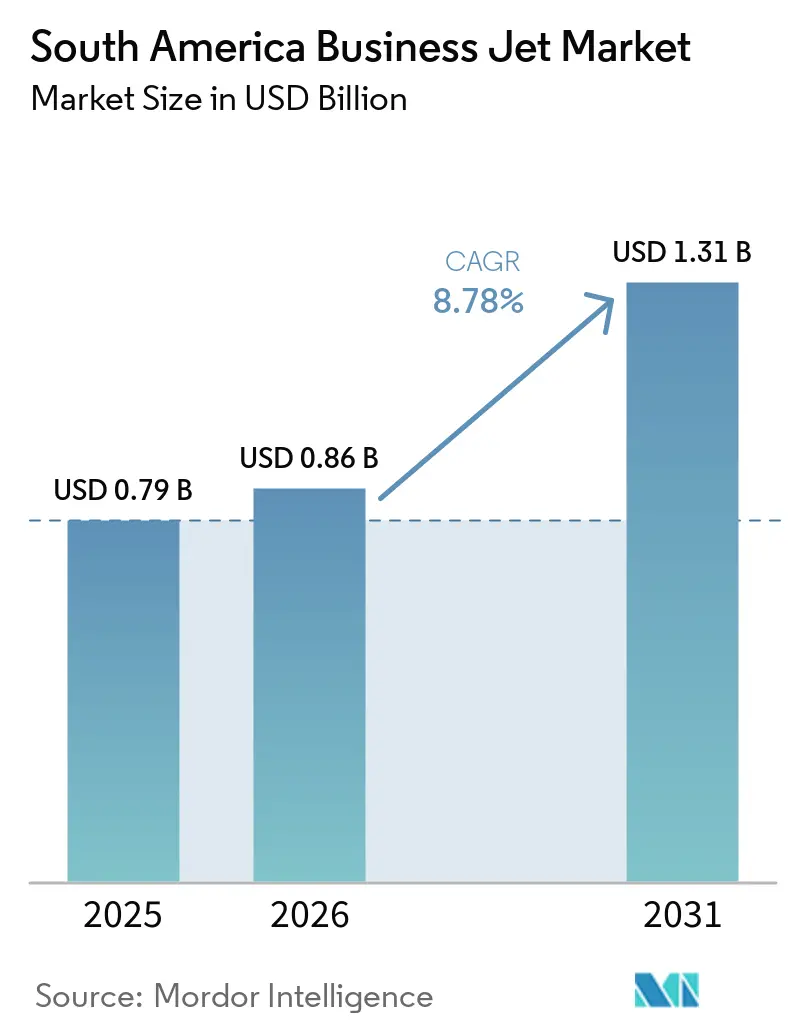
| Base Year Market Size (2025) | USD 0.79 Billion |
| Market Size (2026) | USD 0.86 Billion |
| Market Size (2031) | USD 1.31 Billion |
| Growth Rate (2026 - 2031) | 8.78 % |
| Market Concentration | Medium |
Major Players *Disclaimer: Major Players sorted in no particular order Image © Mordor Intelligence. Reuse requires attribution under CC BY 4.0. | |
South America Business Jet Market Analysis by Mordor Intelligence
The South America business jet market size was valued at USD 0.79 billion in 2025, and is forecast to grow from USD 0.86 billion in 2026 to USD 1.31 billion by 2031, registering an 8.78% CAGR during the forecast period (2026-2031). Limited scheduled airline coverage across Brazil and other dispersed business corridors supports demand for point-to-point aviation. Corporate users increasingly treat aircraft access as a transport and scheduling tool rather than a discretionary travel expense. Higher utilization in secondary cities can support aircraft orders, charter activity, and local handling services. Fleet age also creates a need for replacements that can persist through changing economic conditions. The South America business jet market, therefore, combines demand for access, fleet renewal, and more flexible ownership models.
Key Report Takeaways
- By body type, light/very-light jets accounted for 58.49% of the South America business jet market share in 2025, while large jets are forecast to grow at a 9.59% CAGR through 2031.
- By end user, businesses and corporate entities accounted for 39.28% of the South America business jet market share in 2025, while individual owners are forecast to grow at a 10.71% CAGR through 2031.
- By ownership model, pre-owned purchases accounted for 42.59% of the South America business jet market share in 2025, while jet cards/memberships are forecast to grow at an 11.92% CAGR through 2031.
- By geography, Brazil held 40.55% of the South America business jet market share in 2025, while Chile is forecast to grow at a 12.28% CAGR through 2031.
Note: Market size and forecast figures in this report are generated using Mordor Intelligence’s proprietary estimation framework, updated with the latest available data and insights as of January 2026.
Market Trends and Insights
Drivers Impact Analysis of South America Business Jet Market*
| Driver | (~) % Impact on CAGR Forecast | Geographic Relevance | Impact Timeline |
|---|---|---|---|
| Rising HNWI population and corporate wealth | +2.50% | Brazil, Chile, Colombia primary. Argentina and Peru secondary. | Medium term (2-4 years) |
| Growth of shared ownership and fractional-access models | +2.20% | Brazil leads. Argentina and Chile show early adoption. | Medium term (2-4 years) |
| Gaps in scheduled-airline connectivity across dispersed business centers | +2.00% | Brazil most acute. Argentina, Peru, and Venezuela also affected. | Long term (≥ 4 years) |
| Agribusiness-driven demand for regional and remote-location access | +1.80% | Brazil Center-West and MATOPIBA. Argentina Pampas region. | Long term (≥ 4 years) |
| Airport and air-traffic infrastructure development | +1.50% | Brazil primary. Chile and Colombia receive spillover benefits. | Medium term (2-4 years) |
| Fleet renewal driven by aging aircraft | +1.50% | Venezuela, Argentina, and Chile have the oldest fleets. | Short term (≤ 2 years) |
| Source: Mordor Intelligence | |||
Rising High-Net-Worth Individual and Corporate Wealth
Business aviation demand is broadening beyond traditional corporate travel departments. A June 2025 Airbus Corporate Jets survey of 62 senior professionals found that business aviation represented 55% of business air travel among participating corporate executives. The share reached 69% among private equity and hedge fund managers and 74% among family offices. The survey also found that 63% of participating organizations expected business jet usage to rise by 50% to 75% within 2 years. All participating private equity firms and family offices expected growth in the number of global offices and cross-country family distributions over 3 years. The South America business jet market can therefore see greater demand for aircraft with larger cabins and longer ranges from buyers with higher travel needs and longer planning horizons.
Gaps in Scheduled-Airline Connectivity Across Dispersed Business Centers
Gaps in airline networks create a continuing need for direct access to interior business locations. Airbus Corporate Jets reported that commercial airlines served fewer than 130 of Brazil’s 5,500 municipalities in 2025. The same June 2025 survey found that 82% of participating senior executives lacked a viable commercial-flight alternative for at least 25% of their corporate routes. Mountainous terrain also limits same-day access to mining, energy, and agricultural sites in Chile, Peru, Colombia, and Argentina. Rising flight activity can allow operators to earn more from existing aircraft before adding capacity. Secondary cities that handle substantial business aviation activity can also need more FBO, handling, and maintenance support.
Agribusiness-Driven Demand for Regional and Remote-Location Access
Agribusiness supports business aviation use in Brazil and Argentina because large operations are spread across distant locations. Producers in Brazil’s Center-West states and the MATOPIBA frontier must oversee farms, suppliers, and logistics networks across wide areas. These journeys can be difficult to complete with scheduled flights or road transport. Commodity-linked businesses can also have stronger travel budgets when export earnings rise in USD. The buyer profile for light jets is therefore linked to operating requirements and commodity revenues, not only corporate travel budgets. This makes the South America business jet market relevant to users who need reliable access to remote production areas.
Growth of Shared Ownership and Fractional-Access Models
Shared ownership is bringing aircraft access to users who do not require a dedicated aircraft. Flapper launched a formal fractional ownership program in June 2025. Each aircraft can be shared by 5 shareholders, who pay monthly fees ranging from BRL 25,000 to BRL 45,000 (USD 4,908.40 to USD 8,835.12), plus hourly charges. Prime You Aviation added a Gulfstream G550 to its fractional fleet, investing USD 26 million. Brazil’s RBAC 91 provides a legal framework that separates fractional programs from charter operations. The South America business jet market can gain new users through these models, although repositioning needs and limited hangar space outside major hubs remain constraints.[1]
Restraints Impact Analysis of South America Business Jet Market*
| Restraint | (~) % Impact on CAGR Forecast | Geographic Relevance | Impact Timeline |
|---|---|---|---|
| Import taxes, customs delays, and regulatory bureaucracy | -1.20% | Brazil, Argentina, and Colombia most constrained. Chile moderate. | Short term (≤ 2 years) |
| Uneven MRO, FBO, parts, and ground-support coverage | -0.70% | Secondary markets across South America. Lima and Antofagasta most constrained. | Long term (≥ 4 years) |
| Pilot, technician, and safety-management workforce shortages | -0.60% | Region-wide. Most acute for Large Jet and ultra-long-range operations in Argentina and Chile. | Medium term (2-4 years) |
| Limited availability and high premium for SAF | -0.50% | Brazil most active. Colombia and Chile have early supply chains. | Long term (≥ 4 years) |
| Source: Mordor Intelligence | |||
Import Taxes, Customs Delays, and Regulatory Bureaucracy
Import structures remain a constraint on fleet expansion because aircraft rules differ by country. Argentina’s luxury tax applies to aircraft under the existing statute regardless of operational purpose. Argentina’s ANAC issued Resolution 235/2025 to require automatic import permits for aeronautical products within 4 working days through the Plataforma de Trámites a Distancia. Colombia’s DIAN issued Concept No. 2026006074 in April 2026 on national consumption tax treatment for aircraft imports when the buyer is the final consumer. Brazil provides duty treatment for certain certified air taxi operators, but policy time limits can create planning uncertainty. These requirements add cost and administrative work for aircraft owners, lessors, and operators across the South America business jet market.[2]
Uneven MRO, FBO, Parts, and Ground-Support Coverage
Maintenance and ground-support coverage outside major hubs can increase operating costs and reduce aircraft availability. São Paulo Catarina Executive Airport completed its fifth expansion in October 2025, bringing the total to 16 hangars and 50,000 m² of space. All available space was occupied, and a sixth expansion, with 3 additional hangars and 15,000 m² of apron area, was underway. Antofagasta, Lima, and many secondary cities have limited certified maintenance capacity for large-cabin aircraft. Operators may need to move aircraft to US or Canadian facilities for heavy inspections. The South America business jet market is therefore affected by parts logistics, imported-component costs, and the limited availability of skilled technical support.
*Our forecasts treat driver/restraint impacts as directional, not additive. The impact forecasts reflect baseline growth, mix effects, and variable interactions.
South America Business Jet Market Segment Analysis
By Body Type:
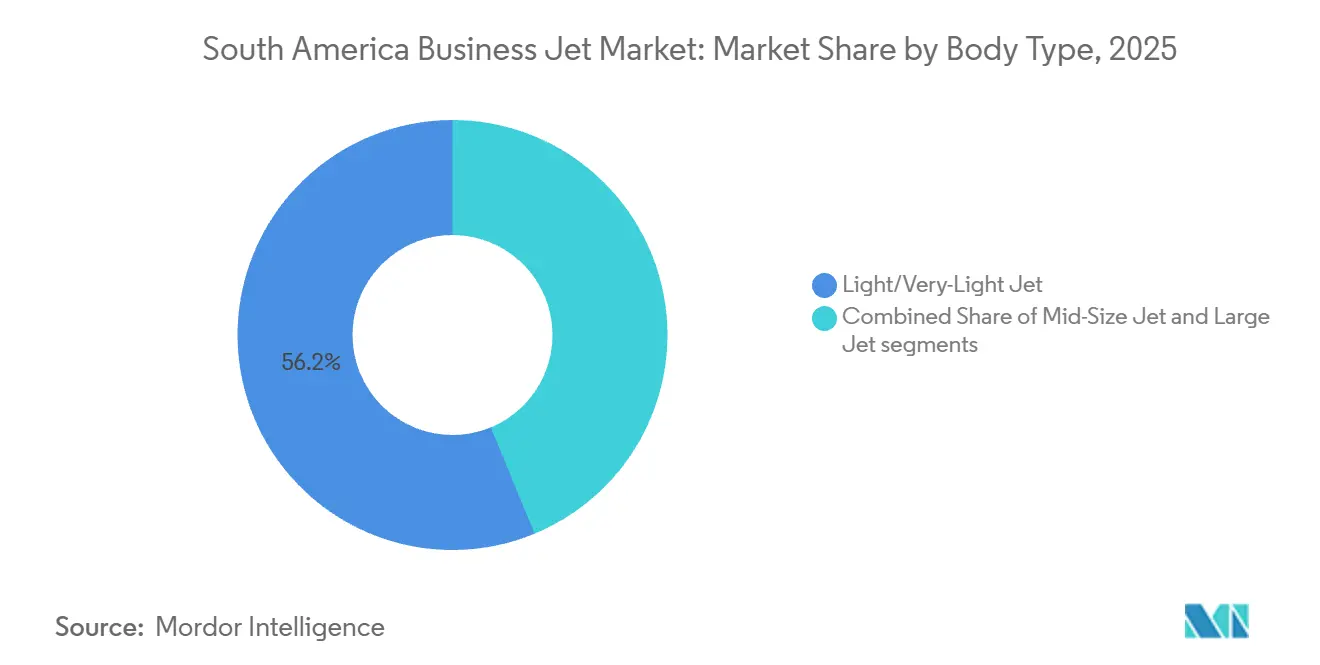
Large Jets Challenge Light Jet DominanceLight/very-light jets commanded 58.49% of the South America business jet market size in 2025. Their position reflects demand for secondary-city routes, short-runway interior airports, and mid-range domestic travel. These aircraft generally have lower acquisition costs and simpler operating requirements than larger models. Mid-size jets serve users who need more capability than light aircraft but do not require a large cabin. They also support a material share of pre-owned replacement activity. Embraer’s Praetor series benefits from regional manufacturing and established support coverage. Embraer entered 2026 with a record backlog after executive aviation revenue increased by 64% year over year in the second quarter of 2025.[3]
Large jets are forecast to grow at a 9.59% CAGR through 2031. The South America business jet industry is seeing more demand from corporate and high-net-worth buyers traveling to Asia and Europe. These trips require a nonstop or limited-stop range that light aircraft cannot provide. Brazil’s ANAC issued a type certificate for the Gulfstream G700 in June 2025. Brazil became the first South American country to authorize the operation of that model. The certification can support deliveries of ultra-long-range aircraft to regional clients. The South America business jet market may therefore shift toward large and mid-size aircraft even when unit growth is slower.

By End User:
Corporate Buyers Anchor Volume as Individual Demand AcceleratesBusinesses and corporate entities held 39.28% of the South America business jet market size in 2025. Airbus Corporate Jets found that 97% of participating South American organizations were flying more employees, not only senior executives, through business aviation in June 2025. This broader use supports demand for corporate fleets and charter contracts. Corporate users value direct access to locations not served by scheduled airlines. They also use aircraft to coordinate activity across large national territories. Charter and air taxi operators represent a separate layer of demand. Government and special-mission operators, including medevac and law enforcement users, depend on procurement and modernization cycles.
Individual owners are forecast to grow at a 10.71% CAGR through 2031. The South America business jet industry is attracting buyers from retail, technology, financial services, and agribusiness. Flapper’s June 2025 program provides this group with a structured, lower-cost access model. Individual users can prioritize availability and total operating cost over a specific aircraft category. Fractional ownership and Jet cards can meet those priorities without a full ownership commitment. These models can capture demand that previously defaulted to charter. The South America business jet market can also benefit when growing usage later supports a move to full ownership.
By Ownership Model:
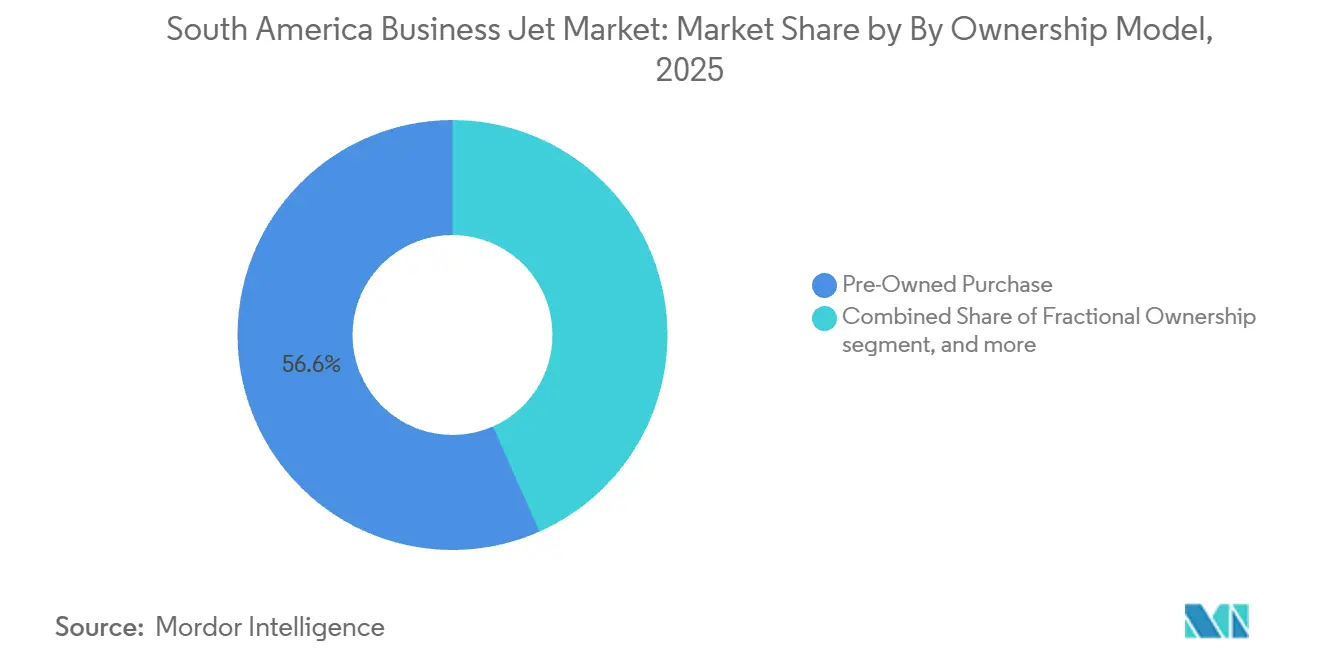
Pre-Owned Market Faces Fractional DisruptionPre-owned purchases accounted for 42.59% of the South American business jet market in 2025. Buyers use this route when affordability, faster delivery, and familiarity with the type matter more than a new-aircraft purchase. Available-for-sale inventory in South America stood at 5.70% in 2025. This was below the 10% level associated with buyer’s market conditions. Lower inventory can support residual values for in-demand aircraft such as the Phenom 300 and Hawker 400 series. Pre-owned aircraft also offer a practical entry route for first-time owners. The South America business jet market can retain this structure while buyers assess their long-term utilization requirements.
Jet cards/membership is forecast to grow at an 11.92% CAGR through 2031. The South America business jet industry is expanding access for users seeking travel flexibility without ownership management. Flapper, Prime You, Solojet, and Aliar have launched or expanded structured programs. New aircraft purchases also benefit from an aging regional fleet. South America and the Caribbean had an average registered business jet age of 24.5 years in February 2025, compared with a global average of 18.1 years. Venezuela, Argentina, and Chile had average fleet ages of 39.1, 27.3, and 27.9 years, respectively. The South America business jet market can see access-model users move into outright ownership as their flight needs rise.
Geography Analysis
Brazil Business Jet Market
Brazil held 40.55% of the South America business jet market share in 2025. It had 1,193 registered business jets in May 2026, based on ABAG data compiled from ANAC records. Brazil also hosts the world’s second-largest business jet fleet. Demand extends beyond São Paulo into the Center-West agribusiness corridor, Amazon infrastructure activity, and manufacturing centers in the Northeast. Airport modernization and investment in regional airports can support this broader demand base. The South America business jet market has a strong base in Brazil because commercial networks do not provide direct access to many business locations.
Chile and Colombia Business Jet Market
Chile is forecast to grow at a 12.28% CAGR through 2031. Copper mining in the Atacama and lithium extraction in Andean salt flats drive demand for fast links between Santiago and remote sites. Chile extends more than 4,000 km from north to south, which makes direct aviation access valuable for mining and corporate users. Its business jet fleet had an average age of 27.9 years in February 2025. This supports a sizable replacement opportunity. The South America business jet market also includes Colombia, where business activity is concentrated in the Bogotá-Medellín-Barranquilla corridor.
South America Business Jet Market
Argentina, Venezuela, Peru, and smaller countries present both demand for renewal and operational constraints. Argentina had approximately 205 registered business jets in early 2025 and an average fleet age of 27.3 years. Venezuela had 248 registered jets and the region’s oldest average fleet at 39.1 years. Peru depends on aviation links to Andean mining sites and Amazon basin projects, while Lima has limited hangar space. Uruguay, Paraguay, and Ecuador generate demand through agricultural exports, financial services, and travel between secondary cities. The South America business jet market can grow in these countries when investment conditions improve and infrastructure constraints ease.
Competitive Landscape
The South America business jet market is moderately concentrated among original equipment manufacturers and fragmented among operators. Bombardier, Embraer, Textron, and Gulfstream are the leading aircraft manufacturers in active-fleet deliveries. Embraer has a regional position through local manufacturing and its support network. Its February 2025 Flexjet agreement covered up to 212 executive jets, including 182 firm aircraft and 30 options. The agreement was valued at up to USD 7 billion at list prices. This order supported Embraer’s backlog entering 2026 and strengthened its executive aviation presence.
Textron Aviation reported a 40% share of competitive turbine aircraft deliveries in South America in 2024. The company announced the first Brazilian order for a Cessna Citation Longitude in August 2025. It also announced the first Cessna Citation Latitude order in Argentina, scheduled for October 2025. These orders reflect demand for aircraft with greater range and cabin capacity. Dassault Aviation caters to ultra-high-net-worth buyers with its Falcon jets. Pilatus addresses short-runway missions with the PC-24. The South America business jet market remains a seller’s environment, with 5.7% available-for-sale inventory in 2025.
Competition among operators focuses on network coverage, transparent pricing, and aircraft availability. Prime You, Flapper, Solojet, and Aliar share ownership and manage fleets to offer structured access. Operators with maintenance capacity can have lower service risk than those reliant on external heavy-maintenance facilities. Líder Aviação completed Brazil’s first general aviation flight using sustainable aviation fuel in May 2025. The flight used a 10% sustainable aviation fuel blend supplied by Vibra at Galeão Airport. This action placed the operator early in the development of a client and regulatory priority. The South America business jet market can create opportunities in secondary-city FBO, handling, maintenance, and parts support.
South America Business Jet Industry Leaders
-
Bombardier Inc.
-
Embraer S.A.
-
Airbus SE
-
Textron Aviation Inc.
-
Dassault Aviation SA
- *Disclaimer: Major Players sorted in no particular order

South America Business Jet Market Companies Covered in this Report
- Bombardier Inc.
- Embraer S.A.
- Textron Aviation Inc.
- Gulfstream Aerospace Corporation (General Dynamics Corporation)
- Dassault Aviation SA
- Airbus SE
- Honda Aircraft Company (Honda Motor Co., Ltd.)
- The Boeing Company
- Pilatus Aircraft Ltd.
- Voar Aviation
- Líder Aviação
- TAM Aviação Executiva
- Avantto
Recent Industry Developments in South America Business Jet Market
- August 2026: Bombardier showcased its Challenger 3500 business jet at LABACE 2026 in São Paulo from August 4–6, highlighting its reliability, range, performance, and design capabilities for operators across South America. The company's participation formed part of a 10-city South American tour for the Challenger 3500, reinforcing Bombardier's commitment to expanding its presence and customer engagement across the region, particularly in Brazil.
- May 2026: Bombardier showcased the Global 8000 at the Catarina Aviation Show in São Paulo, marking the aircraft's trade show debut. The company also displayed the Global 6500 and Challenger 3500 business jets at the event.
- June 2025: Brazil's ANAC certified Gulfstream Aerospace's G700 large-cabin business jet, expanding its regulatory approval for operations in the Brazilian market amid growing demand for long-range business aviation in South America. The certification was announced during the Catarina Aviation Show in São Paulo, where Gulfstream highlighted the G700's Mach 0.935 maximum operating speed, long-range capability, and premium cabin configuration.
South America Business Jet Market Report Scope
The South American business jet market focuses on the acquisition, delivery, operation, and aftermarket support of fixed-wing aircraft used for corporate, private, charter, and other business aviation applications. The study covers light, midsize, super-midsize, and large-cabin business jets, including new and pre-owned aircraft. It evaluates market performance based on OEM deliveries, fleet expansion and replacement, and demand from corporate travelers, high-net-worth individuals, charter operators, and fractional ownership providers. The analysis also examines the broader business jet ecosystem, including airframes, aero-engines, avionics, cabin interiors, connectivity systems, MRO services, and other integrated services.
The South America business jet market is segmented by body type, end user, and ownership model. By body type, the market is segmented into large jets, mid-size jets, and light/very light jets. By end user, the market is segmented into individual owners, businesses and corporate entities, charter/air-taxi operators, training and academic institutions, and government and special-mission operators. By ownership model, the market is segmented into new aircraft purchases, pre-owned purchases, fractional ownership, and jet cards/memberships. The report also covers market sizes and forecasts for the South America business jet market across six countries in the region. For each segment, the market size is provided in terms of value (USD).
Segmentation Overview
By Body Type
| Large Jets |
| Mid-Size Jets |
| Light/Very-Light Jets |
By End User
| Individual Owners |
| Businesses and Corporate Entities |
| Charter/Air-Taxi Operators |
| Training and Academic Institutions |
| Government and Special-Mission Operators |
By Ownership Model
| New Aircraft Purchases |
| Pre-Owned Purchases |
| Fractional Ownership |
| Jet Cards/Membership |
By Geography
| Brazil |
| Argentina |
| Chile |
| Colombia |
| Venezuela |
| Peru |
| Rest of South America |
| By Body Type | Large Jets |
| Mid-Size Jets | |
| Light/Very-Light Jets | |
| By End User | Individual Owners |
| Businesses and Corporate Entities | |
| Charter/Air-Taxi Operators | |
| Training and Academic Institutions | |
| Government and Special-Mission Operators | |
| By Ownership Model | New Aircraft Purchases |
| Pre-Owned Purchases | |
| Fractional Ownership | |
| Jet Cards/Membership | |
| By Geography | Brazil |
| Argentina | |
| Chile | |
| Colombia | |
| Venezuela | |
| Peru | |
| Rest of South America |
Key Questions Answered in the Report
What is the forecast growth rate for South America business jets?
The South America business jet marke is forecast to grow at a 8.78% CAGR from 2026 to 2031, reaching USD 1.31 billion by 2031.
Which aircraft category leads regional demand?
Light/very-light jets led with a 58.49% share in 2025 because they suit short-runway airports and domestic routes.
Why are Large Jets growing faster in South America?
Large jets are forecast to grow at a 9.59% CAGR as buyers need longer-range travel to Europe and Asia.
Which end users are expanding fastest?
Individual owners are forecast to grow at a 10.71% CAGR through 2031, supported by flexible ownership programs.
Why is Brazil important for executive aviation?
Brazil held 40.55% of regional value in 2025 and has major demand across corporate, agribusiness, and air taxi activity.
How do Jet cards and fractional ownership affect aircraft access?
Jet cards/membership is forecast to grow at a 11.92% CAGR because these structures reduce capital and management requirements.