
South America Built To Rent Residential Market Size and Share
Market Overview
| Study Period | 2020 - 2031 |
|---|---|
| Forecast Data Period | 2026 - 2031 |
| Base Year Market Size (2025) | USD 1.33 Billion |
| Market Size (2026) | USD 1.45 Billion |
| Market Size (2031) | USD 2.28 Billion |
| Growth Rate (2026 - 2031) | 9.47 % |
| Market Concentration | Low |
Major Players *Disclaimer: Major Players sorted in no particular order Image © Mordor Intelligence. Reuse requires attribution under CC BY 4.0. | |
South America Built To Rent Residential Market Analysis by Mordor Intelligence
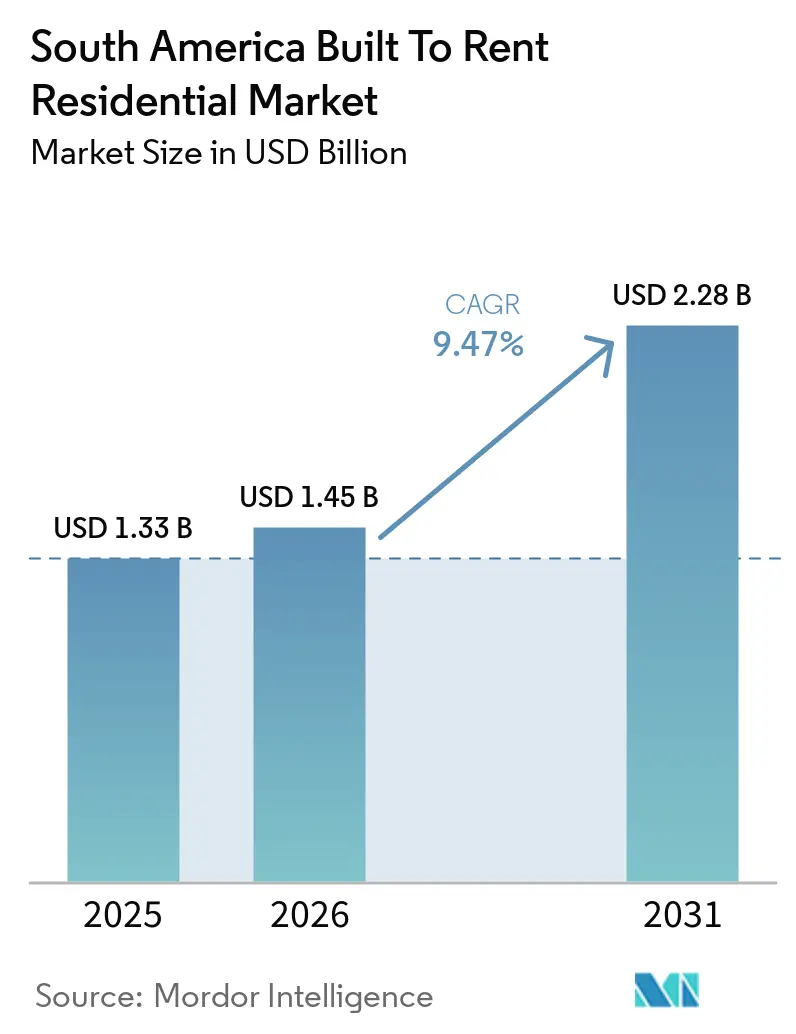
The South America Built To Rent Residential Market size is projected to expand from USD 1.33 billion in 2025 and USD 1.45 billion in 2026 to USD 2.28 billion by 2031, registering a CAGR of 9.47% between 2026 and 2031.
The South America built to rent residential market is expanding as renting becomes a longer-term housing choice for households that cannot readily finance a home purchase. Brazil remains the center of existing institutional activity, while Colombia offers the strongest country growth outlook because renting has overtaken owner occupancy. High borrowing costs create a difficult development environment, but they also extend the pool of households that remain in rental housing. Investors are concentrating on professionally operated assets because standardized leasing, tenant service, and performance reporting support portfolio ownership. The South America built to rent residential market also has room to expand outside the region’s core cities as operating capacity, local teams, and financing channels develop.
Key Report Takeaways
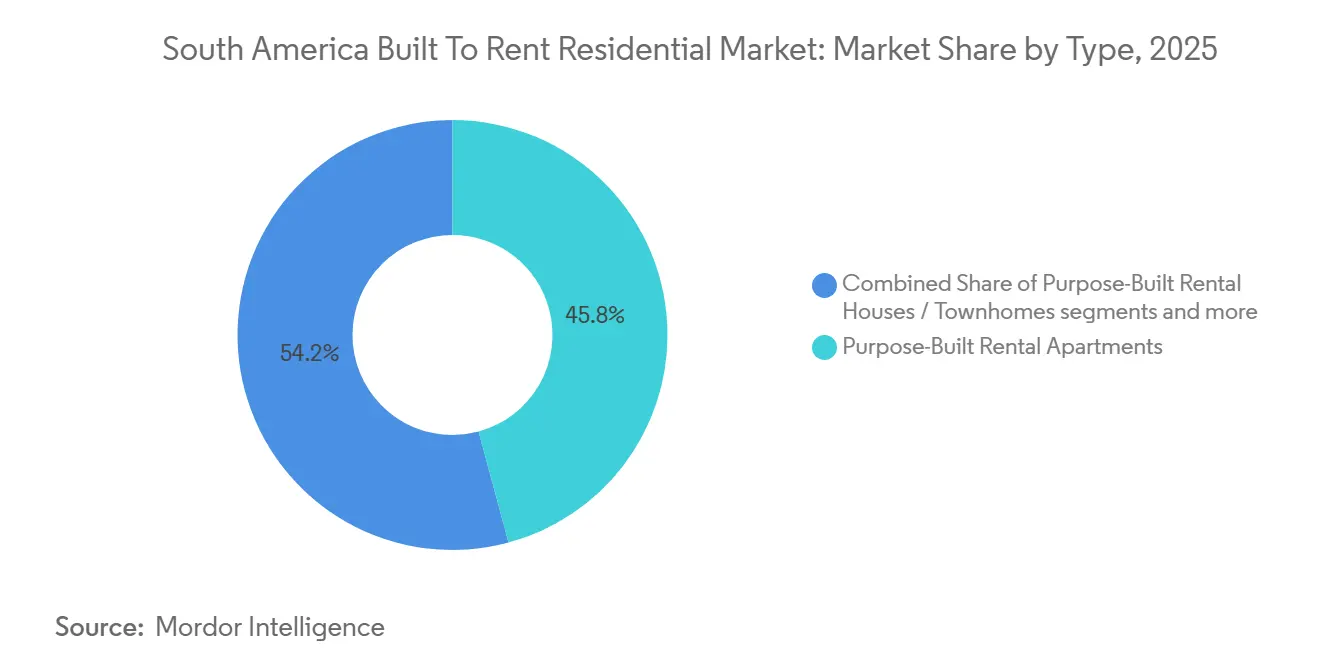
- By type, purpose-built rental apartments held 45.8% of the South America built to rent residential market in 2025, while single-family built to rent / built to rent communities are forecast to grow at an 11.2% CAGR through 2031.
- By management model, third-party operators accounted for 54.6% of the South America built to rent residential market share in 2025, while hybrid management is projected to expand at a 10.7% CAGR through 2031.
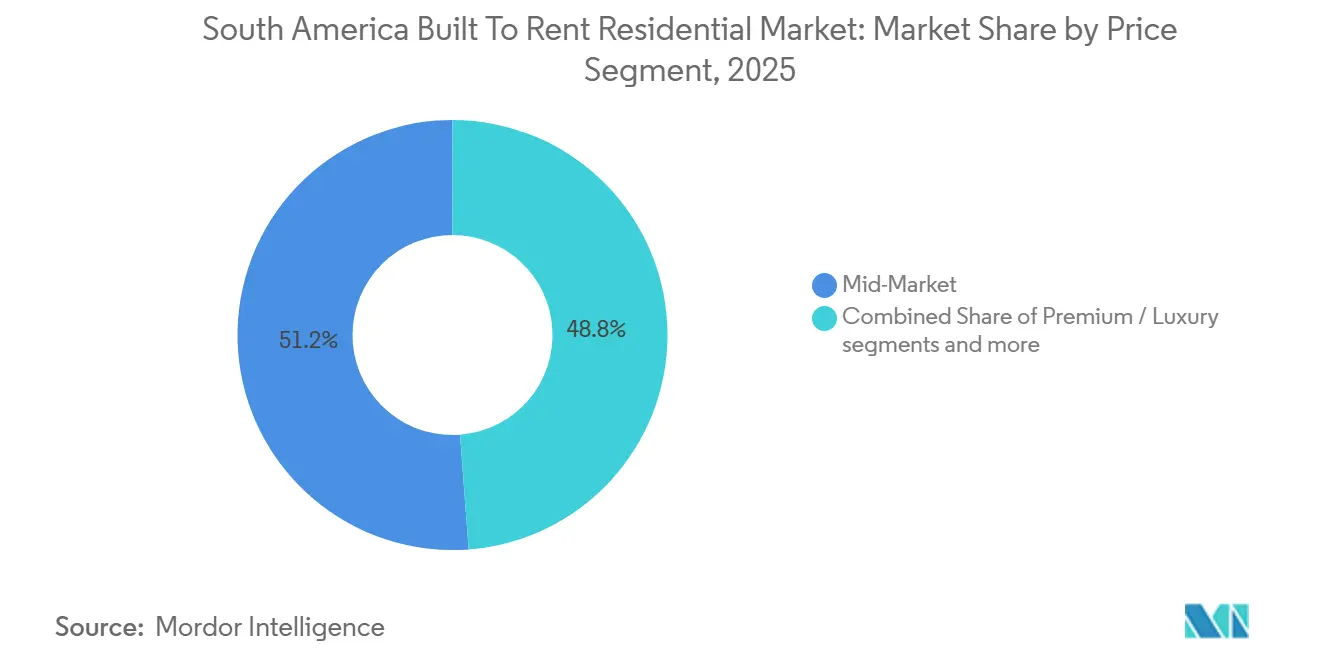
- By price segment, mid-market products accounted for 51.2% of the South America built to rent residential market size in 2025, while affordable & workforce housing are forecast to grow at an 11.0% CAGR through 2031.
- By country, Brazil accounted for 67.5% of the South America built to rent residential market size in 2025, while Colombia is forecast to grow at an 11.8% CAGR through 2031.
Note: Market size and forecast figures in this report are generated using Mordor Intelligence’s proprietary estimation framework, updated with the latest available data and insights as of January 2026.
South America Built To Rent Residential Market Trends and Insights
Drivers Impact Analysis*
| Drivers | (~) % Impact on CAGR Forecast | Geographic Relevance | Impact Timeline |
|---|---|---|---|
| Delayed Homeownership From Mortgage Affordability Pressure Extends Rental Demand | +3.2% | Brazil, Colombia, Chile | Short term (≤ 2 years) |
| Institutional Demand for Recurring Residential Income Supports BTR Investment | +2.1% | Brazil, Colombia, Chile | Medium term (2-4 years) |
| Rental-Majority Housing Tenure Strengthens BTR Adoption | +1.4% | Colombia, Brazil, Argentina | Medium term (2-4 years) |
| Professionalization of Rental Operations Supports Institutional BTR Growth | +0.9% | Brazil, Chile, Colombia | Medium term (2-4 years) |
| Digital Leasing and Flexible-Stay Models Improve Rental Accessibility | +0.7% | Brazil, Colombia, Rest of South America | Short term (≤ 2 years) |
| Adaptive Reuse of Underutilized Urban Buildings Expands BTR Supply | +0.5% | Brazil, Argentina | Long term (≥ 4 years) |
| Source: Mordor Intelligence | |||
Delayed Homeownership from Mortgage Affordability Pressure Extends Rental Demand
Access to homeownership has weakened in Brazil, giving the South America built to rent residential market a wider base of long-term renters. Fully paid homeownership fell from 66.8% of Brazilian households in 2016 to 60.2% in 2025, while rented housing rose from 18.4% to 23.8% over the same period[1]Instituto Brasileiro de Geografia e Estatística, “Rented Housing Units Grew More Than 50% Since 2016,” IBGE Agência de Notícias, nada.ibge.gov.br. Brazil had 18.9 million rented households in 2025, and rented units had increased 54.1% since 2016. Higher mortgage payments have made renting more practical for many urban households, especially those seeking mid-priced homes near employment centers. A 2025 QuintoAndar survey found that 41% of respondents identified a lack of down-payment funds as their main purchase barrier, while 21% pointed to interest rates[2]QuintoAndar, “Gen Z Leads the Dream of Homeownership in Brazil,” QuintoAndar Newsroom, quintoandar.com.br. This tenant group can support demand for professionally managed homes because it includes households with income and credit capacity but limited access to ownership.
Institutional Demand for Recurring Residential Income Supports BTR Investment
Institutional capital is becoming more important to the South America built to rent residential market because rental homes can provide recurring income across economic cycles. Brazil’s securities regulator provides governance rules for real estate investment funds through Resolution 175, which supports clearer structures for institutional property investment[3]Comissão de Valores Mobiliários, “Resolution 175,” Comissão de Valores Mobiliários, conteudo.cvm.gov.br. These funds can give developers an exit route after a rental portfolio reaches operating scale. High interest rates limit development feasibility, but they also sustain rental demand by keeping homeownership costly for a larger pool of households. This relationship makes stable occupancy and tenant retention important to investors evaluating long holding periods. The opportunity remains strongest where operators can pair investment capital with reliable leasing, maintenance, and resident-service capabilities.
Rental-Majority Housing Tenure Strengthens BTR Adoption
Colombia has become a central growth area for the South America built to rent residential market because renting now exceeds homeownership in the country. Colombia counted 7.3 million renting households and 7.1 million owner-occupied homes in 2025. The country’s rental share reached 40.8% of households in 2025, extending a multi-year increase in rental reliance. Bogotá and Medellín are the main locations for institutional rental pipelines because they combine large populations with established urban services. Smaller household sizes and limits on mortgage access also support the need for professionally managed rental stock. Developers entering this setting must match unit design and rents to household budgets rather than rely only on premium apartments.
Professionalization of Rental Operations Supports Institutional BTR Growth
Professional management supports the South America built to rent residential market by giving investors a more consistent operating model than fragmented landlord ownership. Standardized leases, rent collection, maintenance programs, and resident services can reduce operational variation across buildings. Greater Santiago ended 2025 with 183 operating multifamily buildings, 44,020 units, and a 95.2% occupancy rate in the fourth quarter. Chile’s operating base shows how a mature management model can support occupancy across a large rental portfolio. Operators still need more consistent reporting on costs, net operating income, and vacancies to make comparisons easier for new investors. The next stage of market development depends on extending these operating standards beyond a small number of leading cities.
Restraints Impact Analysis*
| Restraints | (~) % Impact on CAGR Forecast | Geographic Relevance | Impact Timeline |
|---|---|---|---|
| High Local Interest Rates and Development Costs Reduce Project Feasibility | -2.8% | Brazil, Argentina, Colombia | Short term (≤ 2 years) |
| Limited Institutional Operating Capacity Restricts Expansion Beyond Core Cities | -1.6% | Brazil, Colombia, Chile | Medium term (2-4 years) |
| Construction Cost Inflation and Urban Land Scarcity Constrain New Supply | -1.3% | Brazil, Colombia, Chile | Long term (≥ 4 years) |
| Tenant Affordability and Credit Volatility Limit Rental Pricing Potential | -1% | Brazil, Colombia, Argentina | Medium term (2-4 years) |
| Source: Mordor Intelligence | |||
High Local Interest Rates and Development Costs Reduce Project Feasibility
High interest rates remain a direct constraint on the South America built to rent residential market because they raise development and financing costs. Brazil’s Selic rate was reduced from 15% to 14.3% in June 2026, but it remains elevated for developers using market-rate credit. Higher funding costs narrow the difference between expected rental income and the returns investors require. Projects with long construction periods are more exposed because financing expenses continue before homes generate rent. Larger operators can often handle this pressure more effectively because they have deeper capital relationships and established portfolios. Affordable programs can reduce some exposure, although market-rate built to rent projects do not receive the same support.
Limited Institutional Operating Capacity Restricts Expansion Beyond Core Cities
The limited depth of local operating teams slows the South America built to rent residential market outside its main cities. Brazil’s professionally managed multifamily stock is concentrated in São Paulo, which leaves many regional cities at an earlier stage of development. New entrants in secondary locations must recruit leasing and property-management teams, establish maintenance networks, and build awareness among local renters. These steps can raise initial vacancy risk and delay full operating scale. Greater Santiago also has a heavily concentrated multifamily base, despite Chile’s more mature rental model. Expansion will depend on building institutional capacity before capital is committed to new city-level pipelines.
*Our forecasts treat driver/restraint impacts as directional, not additive. The impact forecasts reflect baseline growth, mix effects, and variable interactions.
Segment Analysis
By Type: Purpose-Built Rental Apartments Lead Market Share, While Single-Family Built to Rent / Built to Rent Communities Grow Faster
Purpose-built rental apartments held 45.8% of the South America built to rent residential market share in 2025. Their leading position reflects the need for dense housing formats in major urban centers, particularly where land parcels are limited and employment is concentrated. São Paulo is well-suited to vertical rental development because its urban form supports higher-density projects. Chile also provides an established multifamily setting, with 183 operating buildings in Greater Santiago at the end of 2025. Purpose-built apartments can be managed with common leasing, maintenance, and service systems across many units. This structure gives institutional owners a practical way to standardize daily operations.
Single-family built to rent / built to rent communities are forecast to grow at an 11.2% CAGR through 2031. These formats can serve family renters who need more living space or private outdoor areas than many urban apartment projects provide. They may be more feasible in suburban corridors and secondary cities where land costs are lower. The format gives investors access to demand that is not fully addressed by apartment-focused portfolios. Transport investment can improve the attractiveness of suburban locations by maintaining links to jobs and services. Growth will depend on whether local infrastructure, land supply, and property management systems develop together.



By Management Model: Third-Party Operators Lead Market Share, While Hybrid Management Grows Faster
Third-party operators held 54.6% of the management model in 2025. The model separates the ownership of a property from its day-to-day operation, which can help investors assess performance through a dedicated operating partner. It also supports standardized leasing and resident services across a portfolio. A specialist manager may provide systems and experience that a new asset owner does not yet have. This arrangement is especially relevant while many regional portfolios are still small and operational benchmarks are developing. Better disclosure and consistent reporting will remain necessary for this model to gain wider institutional acceptance.
Hybrid management is forecast to grow at a 10.7% CAGR through 2031. It combines in-house leasing and tenant relationships with outsourced maintenance, technology, or community services. This approach can help owners retain control over pricing and resident data while using outside specialists for selected functions. Housi operates with partners in 17 Brazilian states while keeping technology and operating standards within its platform. The structure can help a platform enter more locations without replicating every local support function. Its success depends on clear responsibility between the owner, leasing team, and outsourced providers.
By Price Segment: Mid-Market Leads Market Share, While Affordable & Workforce Housing Grows Faster
Mid-market rental products accounted for 51.2% of the South America built to rent residential market share in 2025. This position reflects the large group of urban households that do not qualify for social housing but face barriers to homeownership. These renters need homes that remain accessible while offering predictable service and maintenance. Brookfield has focused much of its Brazilian multifamily portfolio on class B and class C renters, with monthly rents between USD 350 and USD 525 in 2026. Mid-market demand gives operators a broad tenant pool, although rental pricing must remain aligned with local incomes. Premium products have a smaller addressable base, but they can support corporate leasing and higher revenue per unit.
Affordable & workforce housing is forecast to grow at an 11% CAGR through 2031. Public-private partnerships can improve project feasibility when public bodies contribute land, rental support, or financing structures. The United Nations Office for Project Services is working with Brazil’s federal government and Caixa Econômica Federal on 5 public-private partnership models for affordable rental housing. São Paulo’s Tô em Casa program provides eligible families with rental vouchers covering up to 75% of rent. These tools can reduce tenant payment pressure and make lower-rent projects more viable for private operators. The segment will require close coordination between developers, municipalities, and housing finance institutions.
Geography Analysis
Brazil held 67.5% of the South America built to rent residential market share in 2025. The country has the region’s largest rental household base, with 18.9 million rented households in 2025. Its strong position reflects institutional capital depth and the concentration of purpose-built multifamily stock in São Paulo. Brookfield planned to operate more than 4,000 built to rent units across 33 projects in 8 Brazilian cities by the end of 2026. São Paulo remains the core market, while Belo Horizonte, Curitiba, and Rio de Janeiro offer the next locations for portfolio expansion.
Colombia is forecast to record an 11.8% CAGR through 2031, the fastest country growth rate in the region. Its housing tenure shift is central to that outlook, with 7.3 million renting households exceeding the 7.1 million owner-occupied homes recorded in 2025. Bogotá and Medellín are the leading cities for built to rent activity because of their large rental populations and established urban demand. Barranquilla may offer a lower-cost entry point as the South America built to rent residential market broadens beyond the main metro areas. Local policy and financing conditions will influence how quickly the pipeline becomes operational.
Chile has the region’s most developed operating base, with 183 multifamily buildings and 44,020 units in Greater Santiago at the end of 2025. The South America built to rent residential market recorded 95.2% occupancy in Chile during the fourth quarter of 2025, supporting the case for managed rental housing. Argentina remains smaller because currency and financing conditions limit institutional investment. Peru, Ecuador, Uruguay, and other countries are still early-stage markets because institutional infrastructure and capital-market depth are less developed.
Competitive Landscape
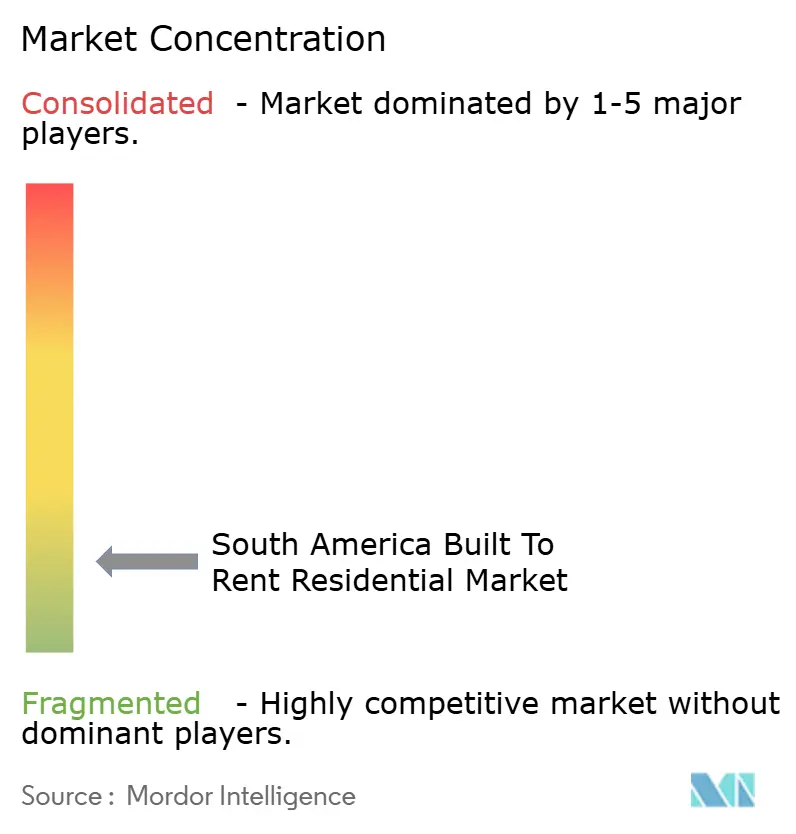
The South America built to rent residential market remains fragmented, although a limited group of institutional operators is building scale in professionally managed housing. Brookfield Properties and Greystar Real Estate Partners, LLC are among the most visible international platforms in Brazil. The informal rental sector remains dominated by individual landlords. Larger platforms seek scale through development, acquisitions, retrofits, and professional operating systems. Market concentration remains limited because institutional rental inventory is still small compared with the region’s total rental housing stock.
Brookfield has expanded its operating model by acquiring Tabas, a rental technology company that supports flexible stays and tenant management. In June 2026, Brookfield Properties and Kinea Investimentos closed the Kinea Plataforma Residencial fund, targeting USD 328 million for 22 projects and more than 4,500 units in Brazil. Greystar, Cyrela Brazil Realty S.A. Empreendimentos e Participações, and Canada Pension Plan Investment Board committed USD 862 million to develop 40 multifamily buildings by 2029. These moves show that larger operators are using joint ventures and dedicated investment vehicles to fund expansion. The South America built to rent residential market is likely to favor platforms that combine capital access with established local operating teams.
Domestic platforms use distinct approaches to address different renter groups. Vila 11 focuses on middle-income renters, while JFL Living serves premium tenants and corporate leasing demand. Yuca is moving from marketplace operations into purpose-built development to capture development-stage returns. QuintoAndar announced a USD 345 million technology investment in June 2026, focused on artificial intelligence and related rental systems.
South America Built To Rent Residential Industry Leaders
Greystar Real Estate Partners, LLC
Brookfield Properties
Cyrela Brazil Realty S.A. Empreendimentos e Participações
MRV&CO
Vila 11
- *Disclaimer: Major Players sorted in no particular order

Recent Industry Developments
- July 2026: MRV&CO signed a memorandum of understanding with JiveMauá Real Estate to structure the sale of 3 Luggo multifamily assets, Luggo Pampulha, Luggo Mauá, and Luggo Samambaia, with a combined potential value of USD 29 million.
- June 2026: Brookfield Properties and Kinea Investimentos closed a joint fund structure, Kinea Plataforma Residencial, targeting USD 328 million to acquire 22 Brookfield multifamily projects encompassing over 4,500 residential units across Brazil.
- June 2026: QuintoAndar announced a USD 345 million investment in technology infrastructure focused on artificial intelligence over 2 years, alongside the opening of its new São Paulo headquarters.


South America Built To Rent Residential Market Report Scope
| Multifamily Built to Rent |
| Single-Family Built to Rent / Built to Rent Communities |
| Purpose-Built Rental Apartments |
| Purpose-Built Rental Houses / Townhomes |
| In-house Operator |
| Third-party Operator |
| Hybrid Management |
| Premium / Luxury |
| Mid-Market |
| Affordable & Workforce Housing |
| Brazil |
| Argentina |
| Colombia |
| Chile |
| Rest of South America |
| By Type | Multifamily Built to Rent |
| Single-Family Built to Rent / Built to Rent Communities | |
| Purpose-Built Rental Apartments | |
| Purpose-Built Rental Houses / Townhomes | |
| By Management Model | In-house Operator |
| Third-party Operator | |
| Hybrid Management | |
| By Price Segment | Premium / Luxury |
| Mid-Market | |
| Affordable & Workforce Housing | |
| By Country | Brazil |
| Argentina | |
| Colombia | |
| Chile | |
| Rest of South America |


Key Questions Answered in the Report
What is driving demand for built to rent homes in South America?
Higher barriers to homeownership and a growing renter population support demand. Brazil had 18.9 million rented households in 2025, while Colombia had more renters than owner-occupiers.
How large is the South America built to rent residential market?
The sector was valued at USD 1.33 billion in 2025 and is estimated at USD 1.45 billion in 2026. It is forecast to reach USD 2.28 billion by 2031.
Which South American country has the strongest built to rent growth outlook?
Colombia has the strongest forecast country growth, with an 11.8% CAGR through 2031. Its rental household count exceeded its owner-occupied household count in 2025.
Which built to rent property type is the largest in South America?
Purpose-built rental apartments are the largest type, with 45.8% share in 2025. They fit the dense urban form of leading rental cities.
What management model leads the sector?
Third-party operators led with 54.6% share in 2025. Hybrid management is the fastest-growing model, with a projected 10.7% CAGR through 2031.
What is holding back built to rent development in South America?
High interest rates, development costs, limited operating capacity outside core cities, land scarcity, and tenant affordability remain the key constraints.
Page last updated on:


 Your data is secure and never sold or shared.


