
Market Overview
| Study Period | 2020 - 2031 |
|---|---|
| Forecast Data Period | 2026 - 2031 |
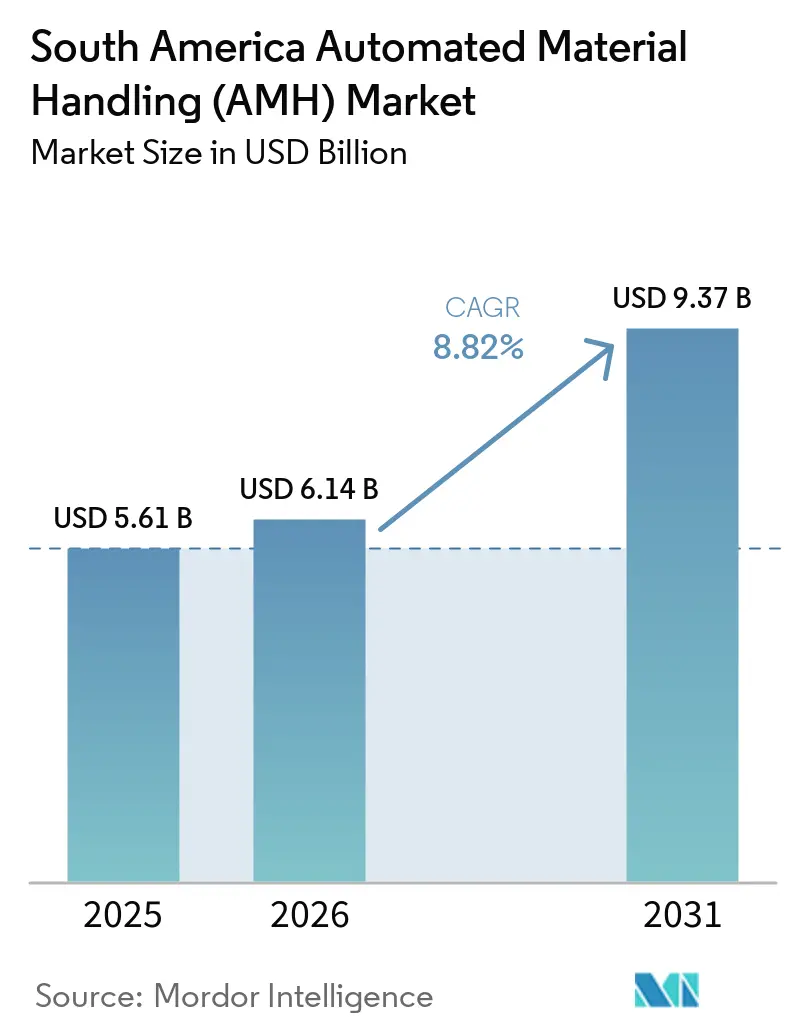
| Base Year Market Size (2025) | USD 5.61 Billion |
| Market Size (2026) | USD 6.14 Billion |
| Market Size (2031) | USD 9.37 Billion |
| Growth Rate (2026 - 2031) | 8.82 % |
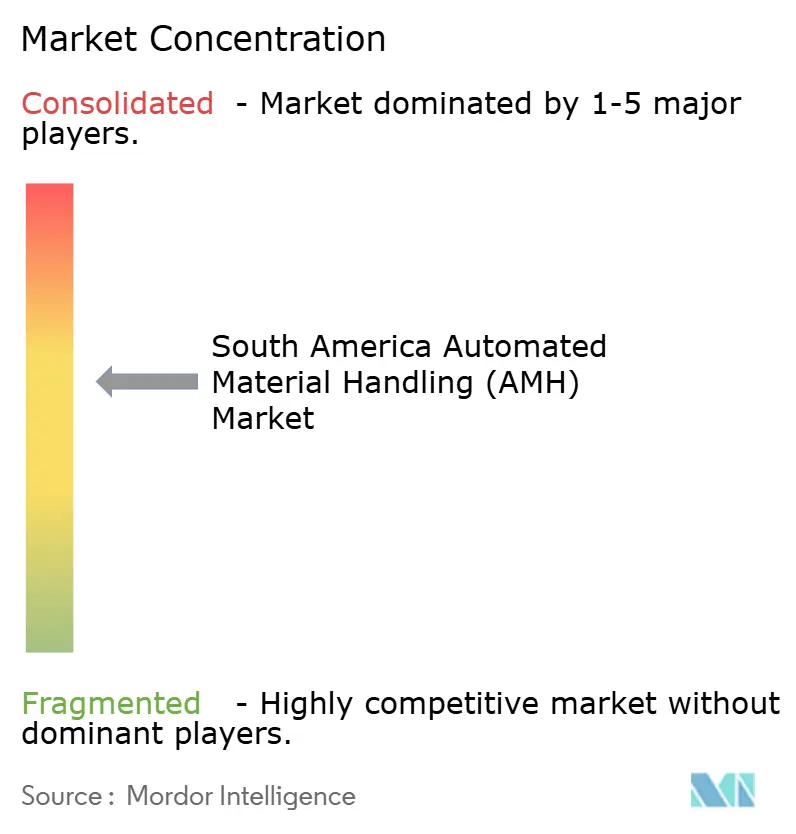
| Market Concentration | Medium |
Major Players *Disclaimer: Major Players sorted in no particular order Image © Mordor Intelligence. Reuse requires attribution under CC BY 4.0. | |
South America Automated Material Handling (AMH) Market Analysis by Mordor Intelligence
The South America Automated Material Handling (AMH) Market size was valued at USD 5.61 billion in 2025 and estimated to grow from USD 6.14 billion in 2026 to reach USD 9.37 billion by 2031, at a CAGR of 8.82% during the forecast period (2026-2031). E-commerce expansion is increasing order volumes and delivery expectations across the region's largest urban corridors. Public financing for industrial modernization is improving access to automation investments in Brazil, Colombia, Argentina, and Chile. Cold-chain expansion supports demand for dense storage and dependable product movement across food export routes. Labor availability and operating costs are also encouraging operators to consider automation as a way to stabilize fulfillment performance. Competition centers on service coverage, software capability, financing options, and the ability to support complex installations after deployment.
Key Report Takeaways
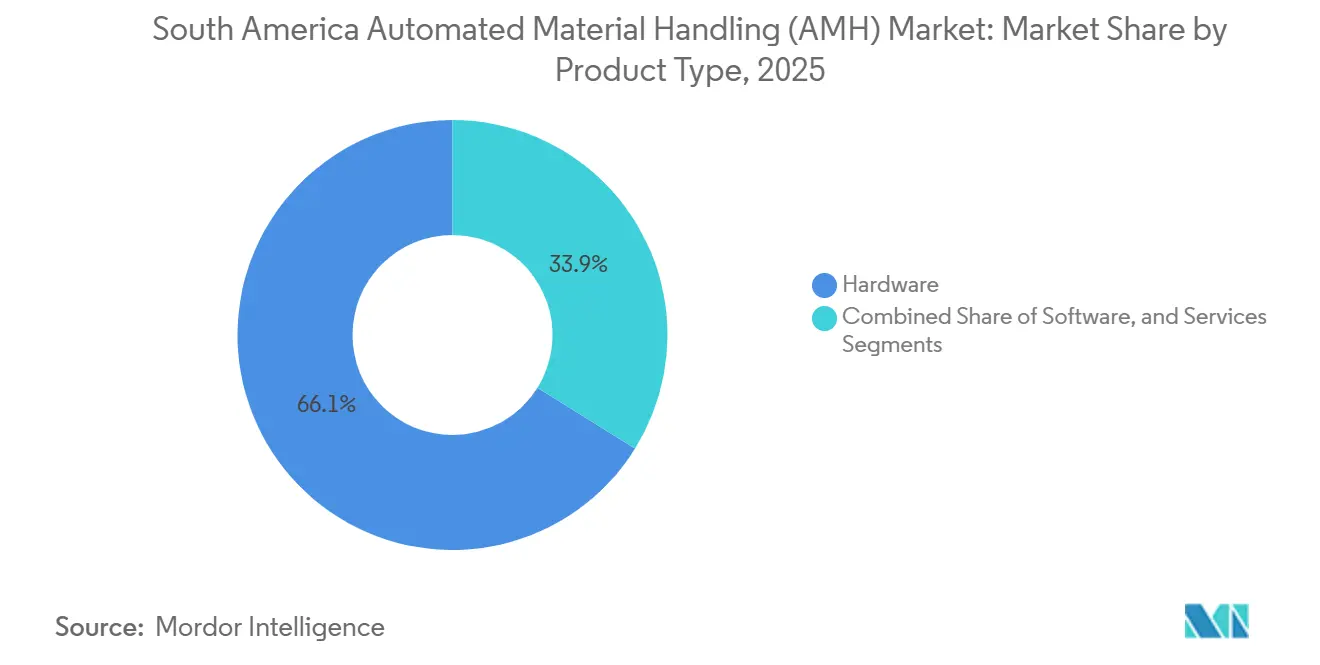
- By product type, hardware held 66.14% of the South America Automated Material Handling (AMH) Market in 2025, while software is projected to expand at a 9.42% CAGR through 2031.
- By equipment type, Automated Storage and Retrieval Systems held 34.82% of the South America Automated Material Handling (AMH) Market in 2025, while Mobile Robots are projected to grow at a 9.78% CAGR through 2031.
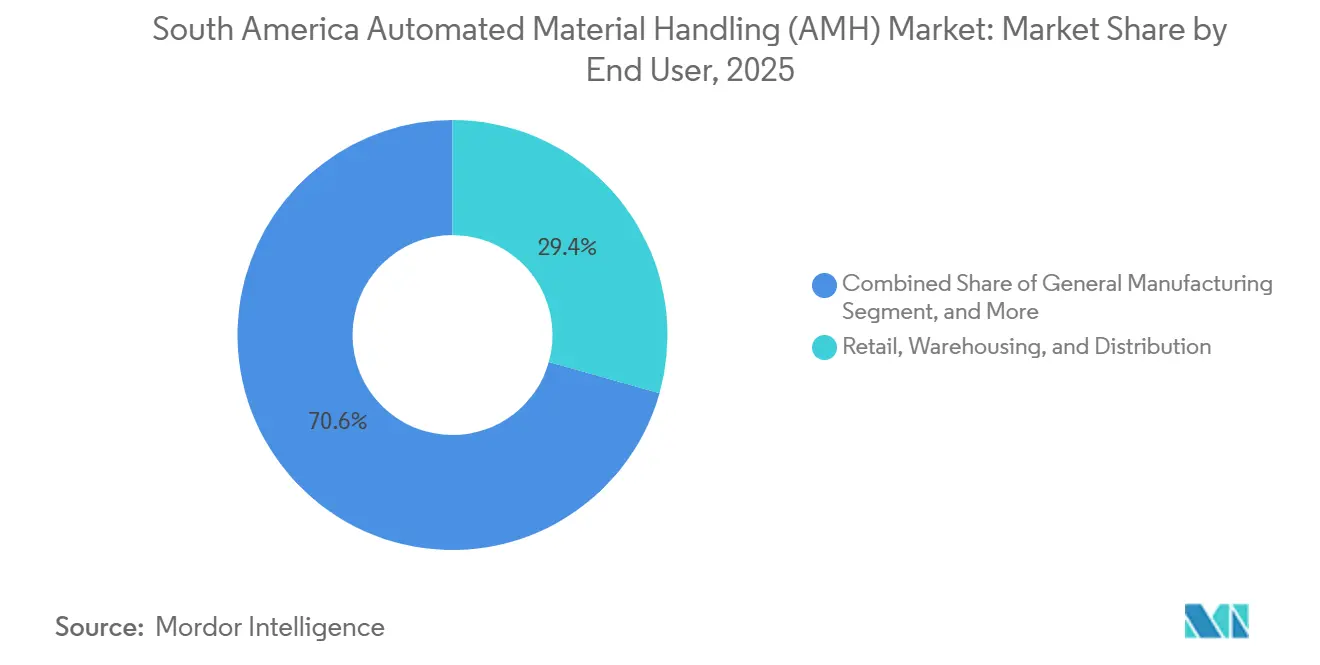
- By end user, Retail, Warehousing, and Distribution held 29.36% of the South America Automated Material Handling (AMH) Market in 2025, while Pharmaceuticals is projected to grow at a 9.71% CAGR through 2031.
- By function, Storage held 35.74% of the South America Automated Material Handling (AMH) Market in 2025, while Picking and Placing is projected to grow at a 9.14% CAGR through 2031.
- By geography, Brazil held 56.12% of revenue in 2025, while Colombia is projected to expand at a 9.31% CAGR through 2031.
Note: Market size and forecast figures in this report are generated using Mordor Intelligence’s proprietary estimation framework, updated with the latest available data and insights as of January 2026.
South America Automated Material Handling (AMH) Market Trends and Insights
Drivers Impact Analysis*
| Driver | (~) % Impact on CAGR Forecast | Geographic Relevance | Impact Timeline |
|---|---|---|---|
| Rising E-Commerce Fulfillment Requirements | +2.4% | Brazil, Colombia, Argentina | Short term (≤ 2 years) |
| Industry 4.0 Investment in Manufacturing and Distribution | +1.7% | Brazil, Colombia, Argentina, Chile | Medium term (2-4 years) |
| Food and Beverage Export and Cold-Chain Expansion | +1.2% | Brazil, Chile, Argentina, Colombia | Medium term (2-4 years) |
| Labor Availability and Operating-Cost Pressures | +0.9% | Brazil, Colombia, Rest of South America | Short term (≤ 2 years) |
| Brownfield Automation Demand in Urban Distribution Centers | +0.6% | Brazil, Colombia | Medium term (2-4 years) |
| Localized Software Orchestration for Mixed-Fleet Automation | +0.4% | Brazil, Colombia, Chile | Long term (≥ 4 years) |
| Source: Mordor Intelligence | |||
Rising E-Commerce Fulfillment Requirements
Brazil generated USD 36.3 billion in e-commerce revenue during 2025, with 94 million active online shoppers placing growing pressure on fulfillment networks. Existing distribution centers were often designed for lower-volume replenishment rather than frequent, small online orders. This gap is raising interest in automated storage, sorting, and goods-to-person systems across the South America Automated Material Handling (AMH) Market. Colombia's online sales increased 11.1% in 2025, with 684 million transactions processed during the year.[1]Colombian Chamber of Electronic Commerce, “Online Sales Grew 11.1% in 2025,” Colombian Chamber of Electronic Commerce, ccce.org.co. Dense metropolitan demand concentrates a large share of order activity within a limited number of logistics corridors. High-bay storage and goods-to-person layouts can help operators raise throughput where additional floor space is limited.
Industry 4.0 Investment in Manufacturing and Distribution
Brazil's Nova Indústria Brasil program allocated BRL 300 billion (USD 55 billion) through 2026 to support industrial investment. The program includes a BRL 12 billion (USD 2.2 billion) credit line for machinery and technology purchases. By June 2025, BNDES had approved BRL 205 billion (USD 37.6 billion) in industrial credit under the program. This funding supports warehouse projects that integrate physical equipment with systems for inventory visibility and throughput control. Colombia's Industry 4.0 credit facilities and Argentina's depreciation incentives also supported automation purchases in 2025. The South America Automated Material Handling (AMH) Market benefits as financing improves project feasibility for manufacturers and logistics operators.
Food and Beverage Export and Cold-Chain Expansion
Food and beverage export activity is expanding the need for reliable cold-chain storage and movement systems across South America. Emergent Cold LatAm opened its expanded Olivo facility in Maipú, Santiago, in March 2026. The facility has a capacity for up to 33,000 pallet positions and formed part of a USD 35 million investment. The company also brought 2 blast-freezing tunnels into service in San Antonio during June 2026. These tunnels can process more than 10,500 tons of frozen food annually. Similar export needs among Brazilian protein suppliers, Argentine grain handlers, and Colombian produce exporters support the South America Automated Material Handling (AMH) Market.
Labor Availability and Operating-Cost Pressures
Distribution operations in Brazil and Colombia faced high worker turnover and difficulty securing skilled labor during 2025. The issue raises training needs and makes picking accuracy and daily throughput less predictable. CNI reported that 43% of Brazilian firms surveyed identified a lack of skilled labor as a barrier to automation investment decisions in 2025. This finding shows that labor constraints affect both the need for automation and the capacity to deploy it. Automated systems can provide steadier performance in high-SKU pharmaceutical and retail facilities, where errors create direct operating or compliance costs. The South America Automated Material Handling (AMH) Market, therefore, gains support from the value placed on reliable handling, not only from wage considerations.
Restraints Impact Analysis*
| Restraint | (~) % Impact on CAGR Forecast | Geographic Relevance | Impact Timeline |
|---|---|---|---|
| High Initial Investment and Extended Payback Requirements | -1.6% | Global, concentrated in Rest of South America | Short term (≤ 2 years) |
| Shortage of Automation Engineering and Maintenance Skills | -1.2% | Brazil, Colombia, Peru, Rest of South America | Medium term (2-4 years) |
| Uneven Transport Infrastructure and Facility Readiness | -0.8% | Argentina, Rest of South America, inland Brazil | Long term (≥ 4 years) |
| Interruption Risk in Highly Automated Production Flows | -0.5% | Brazil, Argentina, Chile | Medium term (2-4 years) |
| Source: Mordor Intelligence | |||
High Initial Investment and Extended Payback Requirements
High equipment costs remain a material barrier for brownfield distribution center projects across the South America Automated Material Handling (AMH) Market. Brazil's multi-layered tax structure can increase the landed cost of imported systems and raise capital requirements. A 10,000 m² retrofit can require investment levels beyond the reach of many domestic credit programs. This leaves large multinational businesses and third-party logistics providers better able to fund major installations. Mid-sized operators may face payback periods exceeding 5 years with conventional hardware configurations. BNDES approval and project documentation requirements can also extend implementation schedules by 6-10 months, delaying vendor revenue recognition.
Shortage of Automation Engineering and Maintenance Skills
Automation adoption requires robotics maintenance engineers, integration specialists, and fleet managers with practical operating experience. Demand for these roles is outpacing regional technical training pipelines. SENAI CIMATEC has supported more than 500 manufacturers through Industry 4.0 applied research centers. Its trial model allows companies to test digital and robotic production lines before committing to equipment purchases. The gap between instruction and field-ready maintenance skills remains narrow, particularly outside major markets. Vendors increasingly need to offer remote diagnostics and extended maintenance support, which increases lifecycle costs for buyers.
*Our forecasts treat driver/restraint impacts as directional, not additive. The impact forecasts reflect baseline growth, mix effects, and variable interactions.
Segment Analysis
By Product Type: Software Is Changing Hardware-Led Revenue Mix
Hardware accounted for 66.14% of the South America Automated Material Handling (AMH) Market share in 2025, reflecting the region's capital-intensive build-out phase. Conveyors, stacker cranes, and palletizing equipment represented much of the initial investment as manual sites moved toward automation. Hardware remains essential because physical flow, storage density, and line-end output depend on installed equipment that must match each facility's load profile, available space, safety practices, and service expectations. Its lead also reflects the number of warehouses still developing their first large-scale automated capacity. The South America Automated Material Handling (AMH) industry is gradually placing greater value on systems that work across equipment brands. Operators need better visibility into inventory, labor, equipment status, and order progress. This requirement is encouraging suppliers to improve the software layer around installed equipment. It also makes the hardware decision more dependent on future integration needs. The product mix should continue to reflect large equipment purchases while software plays a larger operational role. Suppliers that connect equipment decisions with clear operating outcomes can better address changing buyer expectations.
Software is projected to grow at a 9.42% CAGR from 2026 to 2031 within the South America Automated Material Handling (AMH) Market. Warehouse execution systems can coordinate AGVs, AMRs, and fixed conveyors through a shared operational layer, allowing managers to address exceptions and prioritize orders with a more consistent view of daily operations. Mecalux's Easy WMS has been used in Brazilian fragrance manufacturing and pharmaceutical distribution settings.[2]Mecalux, “Easy WMS - Case Studies and Deployments,” Mecalux, mecalux.com. These deployments show that warehouse software can support both smaller businesses and larger facilities. Pharmaceutical users also need software capable of meeting validated-system requirements under ANVISA RDC 658/2022. This raises the importance of system capability in a segment with stringent handling needs. Hardware suppliers that depend on closed software platforms face greater pressure from independent software providers. Services also benefit as multi-vendor sites need integration, maintenance, and ongoing system support.



By Equipment Type: AS/RS Leads While Mobile Robots Expand Access
Automated Storage and Retrieval Systems held 34.82% of the South America Automated Material Handling (AMH) Market share in 2025. Their position reflects demand for dense storage in urban distribution centers and pharmaceutical warehouses. High-bay storage can help operators increase usable capacity where land and expansion options are restricted, especially in dense urban areas where operational changes are less disruptive than acquiring or building additional space. HAI Robotics installed 85 robots at RD Saúde's Viana distribution center in Espírito Santo during 2025. The installation provides more than 62,000 storage locations and was designed for 1,140 totes per hour. It supports pharmacy replenishment with traceability designed to meet ANVISA requirements. Automated conveyors, palletizers, and sorters remain important supporting systems for high-throughput facilities.
Mobile Robots are projected to grow at a 9.78% CAGR in the South America Automated Material Handling (AMH) Market through 2031. AGVs and AMRs can be introduced with less permanent infrastructure than fixed material movement systems, helping operators adapt layouts as order profiles change without committing every material flow to a fixed route. This is useful for brownfield facilities that cannot accept lengthy shutdowns for structural changes. Dalca deployed 4 FlexNav AMR robots at Suzano's Ribas do Rio Pardo pulp mill during 2025. The robots moved cellulose bales and were intended to support eventual coverage of all internal production movement. Mobile systems are therefore extending beyond e-commerce and consumer goods storage into heavy industrial environments.
By End User: Retail Provides Scale While Pharmaceutical Rules Support Growth
Retail, Warehousing, and Distribution accounted for 29.36% of the regional share of automated material handling in 2025. Platform operators and third-party logistics providers invest in automation to protect service levels and retain marketplace volumes. Mercado Livre opened a large cross-docking center in Franco da Rocha, São Paulo, in 2025. The facility raised the throughput benchmark for regional e-commerce distribution operations. Smaller fulfillment providers face pressure to improve capacity as platforms raise delivery expectations, particularly when faster service becomes necessary to protect volume, customer retention, and operating relationships with larger marketplace partners. Automotive and food and beverage users also create recurring demand for conveyors and palletizing systems.
Pharmaceuticals are projected to advance at a 9.71% CAGR in the South America Automated Material Handling (AMH) Market through 2031. ANVISA issued RDC 938/2024 and RDC 939/2024 in November 2024, strengthening storage and operational requirements in Brazil. GS1 DataMatrix barcodes became mandatory for medicines from 2026 under Brazil's SNCM framework. Distributors need reliable scanning and traceable handling across custody transfers. Automated systems with vision verification and validated warehouse management software can address these requirements. Manual processes are less suited to maintaining the required scan accuracy and audit records when products pass through multiple handling points, storage zones, and distribution routes before reaching pharmacies or other healthcare customers. The segment's demand is less focused on lowest-cost equipment and more focused on documented compliance capability.
By Function: Storage Leads as Picking Requirements Increase
Storage held 35.74% of the regional automated material handling share in 2025. The share reflects continued investment in racking and automated storage capacity across expanding warehouse networks. Many facilities are still completing the first stage of capacity development before adding more advanced automation. Storage systems provide the base for later investments in retrieval, picking, and internal movement. Their role is particularly relevant for cold-chain, pharmaceutical, retail, and export-oriented operations. The share is expected to decline gradually as other functions capture a larger share of new spending. Transport and towing applications are increasing as AGVs and AMRs are used within plants and distribution centers. Sorting applications are gaining attention in parcel and postal operations as package volumes grow.
Picking and Placing is projected to grow at a 9.14% CAGR through 2031 in the South America Automated Material Handling (AMH) Market. High-SKU fulfillment centers require speed and accuracy in the picking process. Goods-to-person and robotic picking systems can reduce the operational constraints created by manual travel and handling. Geekplus and Mindugar announced a partnership during May 2026 for shelf-to-person and tote-to-person systems in Chile and Brazil. The partnership targeted mid-sized logistics operators with integrated robotics and racking configurations. Such systems can raise capacity without requiring a physical warehouse expansion. They also respond to the rising complexity of e-commerce orders and labor pressures. Sorting functions are progressing through robotic systems for parcel and postal applications. Picking automation is becoming a more important design choice for facilities handling many orders and stock keeping units.
Geography Analysis
Brazil accounted for 56.12% of the regional automated material handling market share in 2025. Logistics investments by platform operators and third-party logistics providers along the São Paulo–Rio de Janeiro corridor supported the country’s leading position. By June 2025, BNDES had approved BRL 205 billion (USD 37.3 billion) in industrial credit under the Nova Indústria Brasil program. The program’s BRL 12 billion (USD 2.2 billion) machinery and technology line, combined with capability development through SENAI CIMATEC, supports the adoption of automation across Brazil’s manufacturing and distribution sectors. Pharmaceutical traceability requirements provide an additional incentive for investment in integrated material handling systems.
Colombia is projected to grow at a 9.31% CAGR through 2031. Its position in the Pacific Alliance and e-commerce activity support investment in fulfillment. DHL Supply Chain launched a fulfillment network in Bogotá and Medellín during June 2026, using an AI-powered warehouse management system and reaching more than 1,000 domestic delivery destinations. Argentina's depreciation incentives for control hardware supported automation purchases during 2025. Chile's expanded Maipú facility demonstrates the scale of demand for cold-chain automation, while its sustainability certification indicates that environmental requirements can influence project selection.
The Rest of South America is a smaller but growing demand base as marketplaces and agricultural export routes develop. Maersk opened an integrated Olmos packing and cold-storage hub in 2025, supporting an automated route from collection to port dispatch. Uneven facility readiness and transport links limit large projects outside primary logistics corridors. AMRs can provide a practical entry point because they need fewer facility upgrades than fixed systems.
Competitive Landscape
The South America Automated Material Handling (AMH) Market is moderately concentrated among systems integrators and fragmented among component suppliers. Daifuku, Dematic, Vanderlande, and SSI Schäfer compete for larger projects through regional service networks and established software platforms. These capabilities support complex installation work and continued maintenance after commissioning. Pharmaceutical customers also favor suppliers that can demonstrate validated software and reliable audit trails in accordance with ANVISA requirements. Chinese AMR vendors are entering through partnerships with regional racking and service companies.
Independent software suppliers are offering warehouse execution systems without hardware dependencies. In fiscal year 2025/26, KNAPP reported revenue of EUR 2.135 billion (USD 2.31 billion) and new orders worth EUR 2.51 billion (USD 2.71 billion). The company invested EUR 106 million (USD 114.5 million) in robotics and AI research and development, including AeroBot and Knapp Brain.[3]KNAPP AG, “Knapp Cresce 7,6% no Ano Fiscal e Amplia Investimentos em Automação e Inteligência Artificial,” Tecnologística, tecnologistica.com.br. HAI Robotics expanded its regional presence by deploying at RD Saúde in Brazil. Emergent Cold LatAm expanded its Maipú facility to address frozen-food storage requirements.
Mid-sized logistics companies, pharmaceutical cold-chain operators, and post and parcel businesses remain under-served areas. Large original equipment manufacturers can prioritize projects above their minimum scale thresholds. Grid-based storage is also moving into uses such as agricultural spare-parts distribution. Suppliers that combine flexible equipment, financing, and local maintenance can address buyers' needs for practical deployment, uptime, and rapid service response.
South America Automated Material Handling (AMH) Industry Leaders
Daifuku Co., Ltd.
Dematic S.à r.l.
Vanderlande Industries B.V.
SSI Schäfer Group
Mecalux, S.A.
- *Disclaimer: Major Players sorted in no particular order

Recent Industry Developments
- August 2026: Reeman Robotics deployed its Rhino Autonomous Forklift at a major logistics company in Brazil, adding 1,500 kg payload autonomous pallet handling with SLAM navigation to a large-scale distribution operation, and separately deployed 2 Ironhide unmanned forklifts at a Brazilian label manufacturing plant.
- June 2026: Emergent Cold LatAm brought 2 new blast-freezing tunnels into operation at its San Antonio, Chile facility, adding annual processing capacity of more than 10,500 tons of frozen food to support the country's protein and fresh-produce export season.
- March 2026: Emergent Cold LatAm inaugurated the expansion of its Olivo facility in Maipú, Santiago, reaching 33,000 pallet positions and creating the largest automated frozen-food cold-storage facility in South America as part of a USD 35 million investment, with EDGE Advanced sustainability certification covering the expansion.
- July 2025: Maersk launched an integrated packing and cold storage hub in Olmos, Peru, to support avocado, blueberry, and mango exports through an automated post-harvest journey from field collection to port dispatch.


South America Automated Material Handling (AMH) Market Report Scope
The South America automated material handling market comprises systems, equipment, and software that automate the movement, storage, control, and protection of materials within warehouses, distribution centers, manufacturing facilities, and other logistics operations. The report analyzes market trends, growth drivers, restraints, competitive dynamics, and opportunities across key South American countries during the study and forecasts periods.
The South America Automated Material Handling Market Report is Segmented by Product Type (Hardware, Software, and Services), Equipment Type (Mobile Robots [Automated Guided Vehicles, and Autonomous Mobile Robots], Automated Storage and Retrieval Systems [Fixed-Aisle Systems, Carousel Systems, and Vertical Lift Modules], Automated Conveyors [Belt Conveyors, Roller Conveyors, Pallet Conveyors, and Overhead Conveyors], Palletizers [Conventional Palletizers, and Robotic Palletizers], and Sortation Systems), End User (Airports, Automotive, Food and Beverages, Retail, Warehousing, and Distribution, General Manufacturing, Pharmaceuticals, Post and Parcel, and Other End Users), Function (Storage, Transport and Towing, Picking and Placing, Sorting, and Packaging and Palletizing), and Geography (Brazil, Argentina, Chile, Colombia, and Rest of South America). The Market Forecasts are Provided in Terms of Value (USD).
By Product Type
| Hardware |
| Software |
| Services |
By Equipment Type
| Mobile Robots | Automated Guided Vehicles (AGVs) |
| Autonomous Mobile Robots (AMRs) | |
| Automated Storage and Retrieval Systems | Fixed-Aisle Systems |
| Carousel Systems | |
| Vertical Lift Modules | |
| Automated Conveyors | Belt Conveyors |
| Roller Conveyors | |
| Pallet Conveyors | |
| Overhead Conveyors | |
| Palletizers | Conventional Palletizers |
| Robotic Palletizers | |
| Sortation Systems |
By End User
| Airports |
| Automotive |
| Food and Beverages |
| Retail, Warehousing, and Distribution |
| General Manufacturing |
| Pharmaceuticals |
| Post and Parcel |
| Other End Users |
By Function
| Storage |
| Transport and Towing |
| Picking and Placing |
| Sorting |
| Packaging and Palletizing |
By Geography
| Brazil |
| Argentina |
| Chile |
| Colombia |
| Rest of South America |
| By Product Type | Hardware | |
| Software | ||
| Services | ||
| By Equipment Type | Mobile Robots | Automated Guided Vehicles (AGVs) |
| Autonomous Mobile Robots (AMRs) | ||
| Automated Storage and Retrieval Systems | Fixed-Aisle Systems | |
| Carousel Systems | ||
| Vertical Lift Modules | ||
| Automated Conveyors | Belt Conveyors | |
| Roller Conveyors | ||
| Pallet Conveyors | ||
| Overhead Conveyors | ||
| Palletizers | Conventional Palletizers | |
| Robotic Palletizers | ||
| Sortation Systems | ||
| By End User | Airports | |
| Automotive | ||
| Food and Beverages | ||
| Retail, Warehousing, and Distribution | ||
| General Manufacturing | ||
| Pharmaceuticals | ||
| Post and Parcel | ||
| Other End Users | ||
| By Function | Storage | |
| Transport and Towing | ||
| Picking and Placing | ||
| Sorting | ||
| Packaging and Palletizing | ||
| By Geography | Brazil | |
| Argentina | ||
| Chile | ||
| Colombia | ||
| Rest of South America | ||


Key Questions Answered in the Report
What is the South America Automated Material Handling market size?
The South America Automated Material Handling (AMH) Market is estimated at USD 6.14 billion in 2026 and is forecast to reach USD 9.37 billion by 2031, at an 8.82% CAGR. The forecast reflects continued demand for warehouse, production, and cold-chain automation.
What is driving adoption of automated material handling in South America?
E-commerce fulfillment needs, industrial financing, cold-chain expansion, and labor constraints are supporting adoption across logistics and manufacturing sites. These factors are relevant to both established regional hubs and developing export corridors.
Which equipment type is expanding fastest in South America?
Mobile Robots are projected to grow at a 9.78% CAGR through 2031 because they can be deployed with limited fixed infrastructure. Their modular format is suitable for facilities that cannot accept long construction shutdowns.
Which end user is projected to grow fastest?
Pharmaceuticals is projected to grow at a 9.71% CAGR through 2031, supported by traceability and storage requirements in Brazil. Validated software and accurate scanning are important capabilities for these facilities.
Which country leads automated material handling demand in South America?
Brazil held 56.12% of regional demand in 2025, supported by e-commerce scale, industrial financing, and pharmaceutical compliance requirements. The São Paulo-Rio de Janeiro corridor remains important for larger logistics projects.
Page last updated on:





