
Market Overview
| Study Period | 2020 - 2031 |
|---|---|
| Forecast Data Period | 2026 - 2031 |
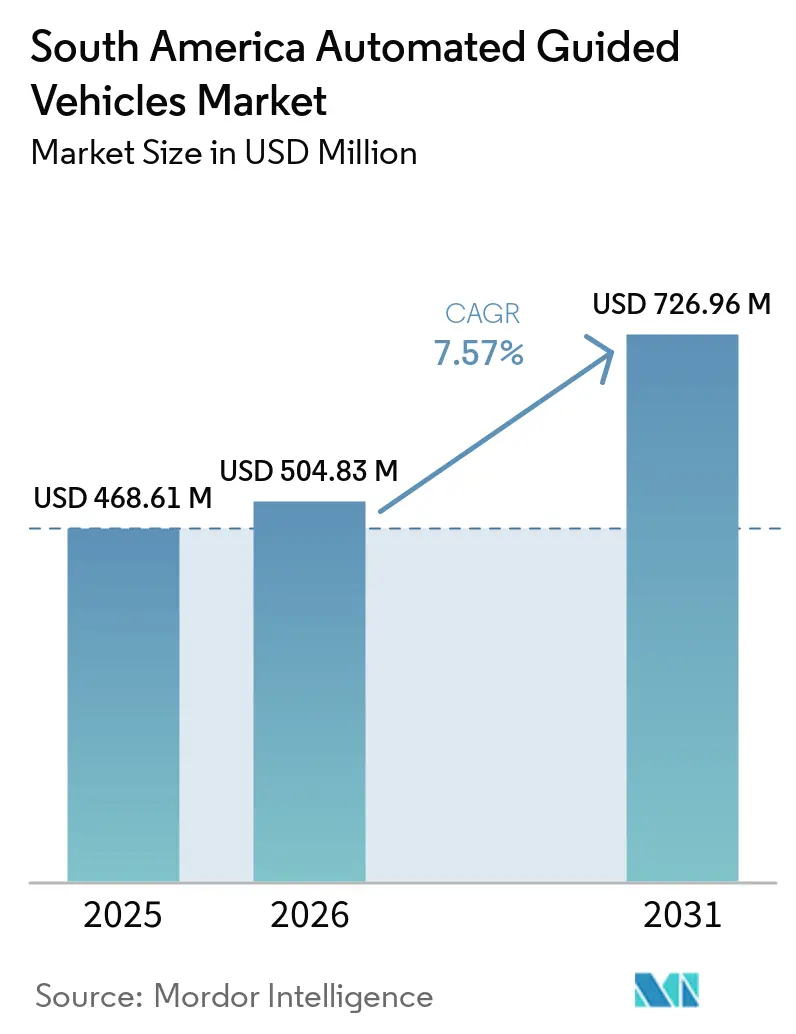
| Base Year Market Size (2025) | USD 468.61 Million |
| Market Size (2026) | USD 504.83 Million |
| Market Size (2031) | USD 726.96 Million |
| Growth Rate (2026 - 2031) | 7.57 % |
| Market Concentration | Medium |
Major Players *Disclaimer: Major Players sorted in no particular order Image © Mordor Intelligence. Reuse requires attribution under CC BY 4.0. | |
South America Automated Guided Vehicles Market Analysis by Mordor Intelligence
The South America automated guided vehicles market size was valued at USD 468.61 million in 2025 and estimated to grow from USD 504.1 million in 2026 to reach USD 726.96 million by 2031, at a CAGR of 7.57% during the forecast period (2026-2031). E-commerce fulfillment networks are placing greater emphasis on rapid replenishment, dense storage, and reliable sorting, which supports demand for mobile automation across the region. Labor shortages in warehouse operations are also making automated transport a practical option for firms seeking steadier throughput across shifts. Manufacturing modernization is widening the use of digital production systems, particularly where automotive plants need coordinated movement of components and subassemblies. Port investment and export-oriented cold-chain logistics extend the addressable use of AGVs beyond factories and conventional distribution centers. The South America automated guided vehicles market therefore favors suppliers that can combine equipment, integration support, financing, and local maintenance services.
Key Report Takeaways
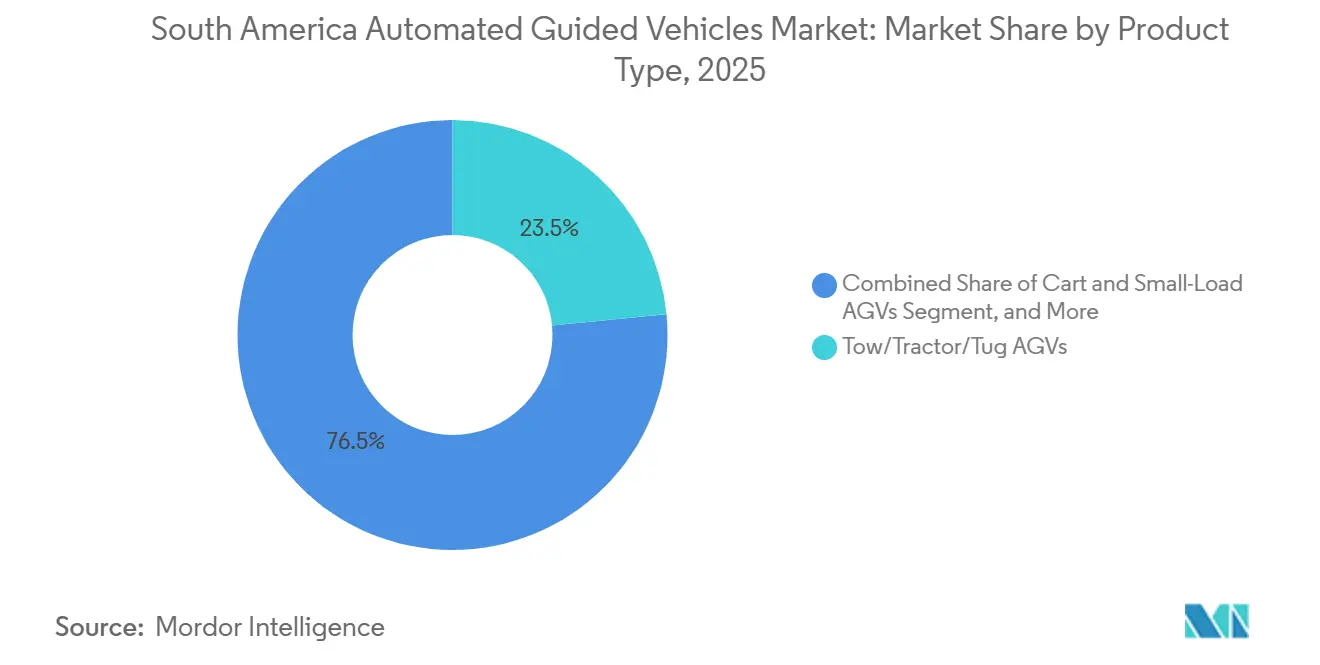
- By product type, Tow/Tractor/Tug AGVs held 23.47% of the South America automated guided vehicles market share in 2025, while Cart and Small-Load AGVs are projected to expand at a 8.13% CAGR through 2031.
- By end-user industry, Automotive held 26.94% of the South America automated guided vehicles market share in 2025, while Retail and E-Commerce are expected to grow at a CAGR of 7.89% through 2031.
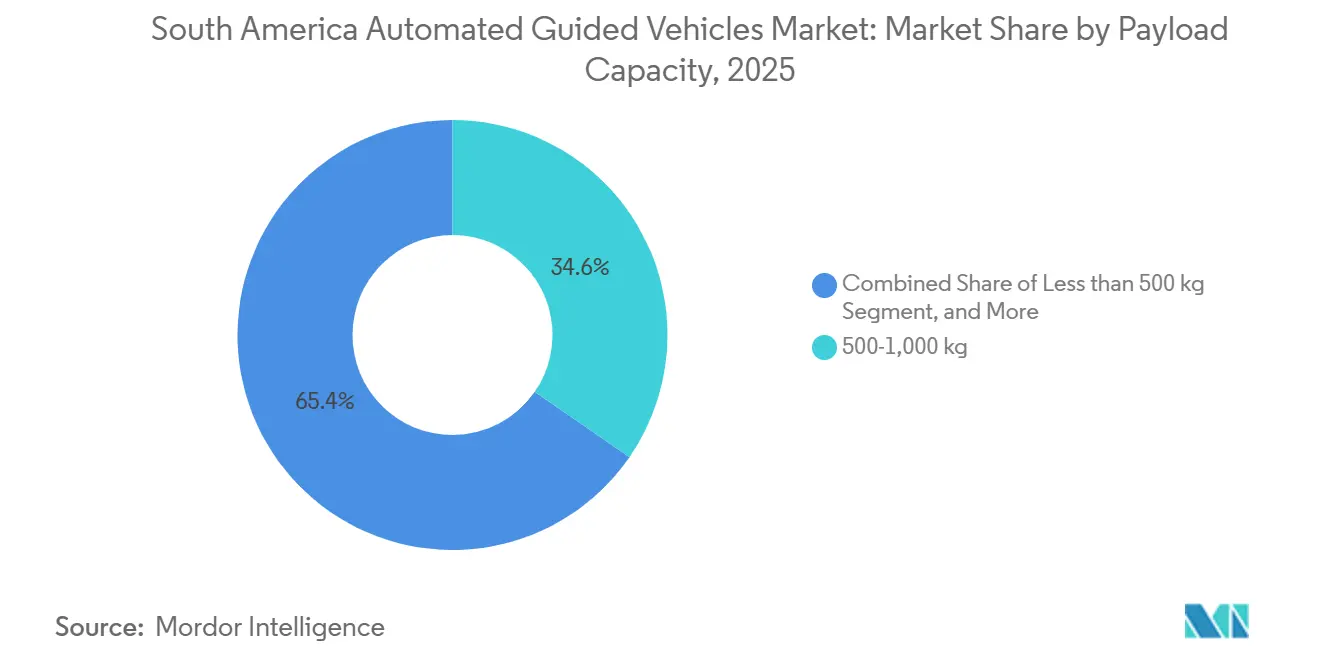
- By payload capacity, the 500-1,000 kg category accounted for 34.62% of the South America automated guided vehicles market size in 2025, while the less than 500 kg category is projected to grow at a 7.74% CAGR through 2031.
- By application, Material Handling and Transportation accounted for 38.21% of the South America automated guided vehicles market share in 2025, while Order Picking and Sortation is projected to grow at a 8.06% CAGR through 2031.
- By geography, Brazil accounted for 44.83% of the South America automated guided vehicles market size in 2025, while Colombia is expected to expand at a 8.34% CAGR through 2031.
Note: Market size and forecast figures in this report are generated using Mordor Intelligence’s proprietary estimation framework, updated with the latest available data and insights as of January 2026.
South America Automated Guided Vehicles Market Trends and Insights
Drivers Impact Analysis*
| Driver | (~) % Impact on CAGR Forecast | Geographic Relevance | Impact Timeline |
|---|---|---|---|
| E-Commerce and Omnichannel Fulfillment Expansion | +2.1% | Brazil, Colombia, Chile | Short term (≤ 2 years) |
| Warehouse Labor Availability and Productivity Pressure | +1.8% | Brazil, Argentina, Colombia | Short term (≤ 2 years) |
| Manufacturing Modernization and Industry 4.0 Adoption | +1.5% | Brazil, Argentina, Chile | Medium term (2-4 years) |
| Safety Requirements for Repetitive Material Movement | +0.9% | Brazil, Colombia, Chile | Medium term (2-4 years) |
| Port and Intermodal Terminal Automation in Chile, Peru, and Brazil | +0.7% | Chile, Peru, Brazil | Long term (≥ 4 years) |
| Export-Oriented Food and Beverage Logistics Modernization | +0.5% | Brazil, Colombia, Argentina | Medium term (2-4 years) |
| Source: Mordor Intelligence | |||
E-Commerce and Omnichannel Fulfillment Expansion
Rapid fulfillment requirements are changing how logistics operators plan warehouse capacity across South America. Amazon Brazil has quick-commerce operations in 8 major Brazilian cities in 2026 and is targeting a 3x increase in volume by year-end, with 15-minute delivery commitments in São Paulo and Rio de Janeiro. Such service standards increase the need for frequent, accurate movement between storage, sorting, and dispatch areas. The South America automated guided vehicles market benefits where operators cannot sustain those flows through manual processes alone. Constrained warehouse space also makes higher throughput within existing facilities more attractive than expanding the building footprint. Cart-style vehicles and under-rider systems are well-suited to repeated, low-weight movements in busy fulfillment operations.
Warehouse Labor Availability and Productivity Pressure
Warehouse operators are expanding capacity in locations where skilled picking, checking, and forklift labor is limited. This constraint affects daily service reliability because demand volumes and work schedules vary considerably across regional logistics networks. Maersk identified Brazil's logistics corridors as a setting where nearshoring and e-commerce activity support greater use of AGVs and AMRs for internal transport.[1]Maersk, “Latin America Market Update, April 2026,” Maersk, maersk.com. The South America automated guided vehicles market is consequently supported by projects that stabilize material movement rather than replace every human task. Tow tractors, cart vehicles, and pallet systems offer practical options for mid-sized operators with recurring transport work. This operating-continuity rationale can make automation approvals easier when management is seeking to protect service levels during labor shortages.
Manufacturing Modernization and Industry 4.0 Adoption
Manufacturing investment is increasing demand for digitalized assembly lines and connected material flows. Changan and CAOA inaugurated a highly automated production line in Anápolis in March 2026, supported by a total investment of BRL 8 billion (USD 1.52 billion) and an annual capacity of 90,000 vehicles. These facilities require predictable movement of parts between receiving, storage, and assembly stations. Brazil and Colombia have both highlighted Industry 4.0 applications through national policy frameworks, although small and medium-sized firms still face practical barriers to adoption. The South America automated guided vehicles market can benefit when financing and implementation support make these projects accessible to smaller manufacturers. Connected maintenance and production systems also strengthen the case for AGV fleets capable of following changing assembly schedules.
Safety Requirements for Repetitive Material Movement
Heavy pallets, automotive components, chemical inputs, and repeated horizontal transport create safety concerns in manufacturing environments. AGV deployment can reduce exposure to repetitive movement tasks while maintaining defined transport routes. This matters in sectors where guarded interfaces and safety-distance practices shape equipment decisions. Automated handling can also support more consistent transport routines across automotive, food and beverage, and chemical facilities. The South America automated guided vehicles market benefits when safety compliance and productivity objectives are aligned within the same capital project. Equipment with documented safety features and clear operating procedures is likely to have an advantage over less supported alternatives.
Restraints Impact Analysis*
| Restraint | (~) % Impact on CAGR Forecast | Geographic Relevance | Impact Timeline |
|---|---|---|---|
| High Initial Investment and Extended Payback Periods | -1.8% | Argentina, Brazil, Rest of South America | Short term (≤ 2 years) |
| Integration Complexity Across WMS, ERP, MES, and Fleet-Control Systems | -1.2% | Brazil, Colombia, Chile | Medium term (2-4 years) |
| Shortage of Local AGV Engineering and Maintenance Specialists | -0.8% | All South American markets | Long term (≥ 4 years) |
| Infrastructure Variability Across South American Facilities | -0.6% | Rest of South America, Argentina | Long term (≥ 4 years) |
| Source: Mordor Intelligence | |||
High Initial Investment and Extended Payback Periods
AGV systems require spending on vehicles, site preparation, software, integration, and ongoing service. These costs are particularly difficult for buyers in Argentina, where exchange-rate conditions and financing risks can raise the effective cost of imported equipment. Mid-sized manufacturers and third-party logistics providers may face extended internal approval processes when projected returns are uncertain. Financing conditions also differ across the region, which can give Brazilian buyers with subsidized credit better access to automation than buyers in smaller markets. The South America automated guided vehicles market remains more accessible to suppliers that can provide local financing structures or managed-service options. This difference can favor domestic providers and internationally established firms with regional legal and service capabilities.
Integration Complexity Across WMS, ERP, MES, and Fleet-Control Systems
Many facilities operate warehouse, enterprise, manufacturing, and fleet systems implemented at different times by different vendors. Linking AGVs to these systems can require substantial middleware, process redesign, and testing. Maersk described digital twins in Latin America as still developing, while automation modernization continues at a gradual and hybrid pace because infrastructure and technology conditions vary. The South America automated guided vehicles market faces added project risk when legacy software does not easily exchange operational data. Policy support for advanced manufacturing has not yet created a common integration pathway for many smaller firms. Vendors that offer implementation services and clear system interfaces can reduce the risk of projects stalling after equipment procurement.
*Our forecasts treat driver/restraint impacts as directional, not additive. The impact forecasts reflect baseline growth, mix effects, and variable interactions.
Segment Analysis
By Product Type: Tow and Tractor Configurations Lead, Light-Load Formats Gain Momentum
Tow/Tractor/Tug AGVs held 23.47% of the South America automated guided vehicles market in 2025. Their role in automotive assembly feeding and distribution-center transport supports continued demand in Brazil, Argentina, and Chile. Automotive clusters require regular movement of components along defined routes, which suits tugger configurations. The Anápolis production line demonstrates the type of digitalized manufacturing investment that can require coordinated intralogistics support. Stellantis also began series production of the Jeep Avenger at Porto Real in July 2026, alongside modernization and the addition of a second production shift. These settings favor vehicles that can align material delivery with production schedules.
Cart and Small-Load AGVs are projected to grow at an 8.13% CAGR between 2026 and 2031. Frequent low-weight movements in e-commerce and micro-fulfillment sites provide the main use case for this format. The South America automated guided vehicles market size for smaller formats is supported by facilities that operate with narrow aisles and mixed traffic. Continental introduced the NXS 300 automated small-load carrier in July 2025, designed for cart compatibility, omnidirectional movement, and 360-degree obstacle detection.[2]Continental AG, “Ultracompact and Cost-Efficient: NXS 300 Drives the Next Generation of Automated Small Load Carriers,” Continental AG, continental.com. Automated Forklift, Unit-Load, Assembly Line, and Pallet Truck AGVs serve larger industrial material flows. Reeman Robotics reported autonomous forklift deployment at a major Brazilian logistics company, showing adoption beyond automotive plants.



By End-User Industry: Automotive Anchors Demand, Retail and E-Commerce Accelerates
Automotive is projected to account for 26.94% of the South America automated guided vehicles market share in 2025. Vehicle and component manufacturers require reliable parts handling that meets specific weight, timing, and quality requirements. Changan designed its Anápolis facility around a highly automated production line and localized supply chain integration. Stellantis is expected to begin a BRL 3 billion (USD 555 million) modernization and expansion cycle at its Porto Real facility in 2026. These investments are expected to support demand for automated line feeding and component transport. The automotive industry remains a stable buyer group, as its intralogistics requirements are closely linked to production continuity.
Retail and E-Commerce is projected to expand at a 7.89% CAGR from 2026 to 2031. Fast delivery models require more frequent picking, sorting, and dispatch activity across fulfillment locations. The South America automated guided vehicles market serves this need through flexible vehicles that can operate alongside workers in changing layouts. Food and Beverage, Logistics and 3PL, Pharmaceutical and Healthcare, Electronics and Electrical, Aerospace and Defense, and General Manufacturing make up the remaining end-user base. Food and beverage exporters are increasing cold-chain automation where traceability and temperature-controlled flows are important. HAI Robotics reported that RD Saúde plans an automated distribution center in Londrina, Paraná, with more than 200 robots and planned operation in 2027.
By Payload Capacity: Mid-Range Capacity Leads, Smaller Formats Rise with E-Commerce
The 500-1,000 kg category captured 34.62% of the South America automated guided vehicles market in 2025. This range aligns with standard pallet and unit-load movement across automotive, food and beverage, and general manufacturing operations. Counterbalanced forklifts and pallet trucks commonly address those transport requirements. The segment is therefore suited to the regional distribution networks that depend on repeated movement of standard loads. Buyers can use mid-range capacity vehicles for receiving, storage, line supply, and dispatch routes. These broad use cases help the category retain its leading position across varied facility types.
The less than 500 kg category is projected to grow at a 7.74% CAGR during 2026-2031. Goods-to-person fulfillment systems and parcel sorting are increasing the need for compact vehicles capable of repeatedly moving smaller items. The South America automated guided vehicles market has room for these formats as e-commerce distribution and pharmaceutical pack-and-pick operations expand. The segment also aligns with the need to work within constrained fulfillment footprints. The 1,000-2,000 kg category supports heavy manufacturing, including engine transport, structural components, and steel coils. Above 2,000 kg systems remain specialized for ports, mining, and aerospace facilities where heavy loads and operating conditions exceed ordinary warehouse requirements.
By Application: Material Handling Leads, Order Picking and Sortation Gains Ground
Material Handling and Transportation held 38.21% of the South America automated guided vehicles market in 2025. Automotive plants, food processors, and large distribution centers use these systems for repetitive movement between work areas. Standard tow-and-deliver routes generally require less complex integration than advanced picking architectures. This makes material handling a practical first AGV application for firms beginning their automation programs. The South America automated guided vehicles market benefits from this accessible entry point across manufacturing and warehousing. It also supports gradual expansion from single routes to broader fleets once users have established operational confidence.
Order Picking and Sortation is projected to record an 8.06% CAGR from 2026 to 2031. Parcel sorting and e-commerce fulfillment are creating more demand for high-frequency, accurate movement near the final dispatch stage. These applications require closer coordination with inventory and warehouse systems than basic transport tasks. Trailer Loading and Unloading, Packaging and Palletizing, Assembly Operations, Cold Chain and Refrigerated Storage, and Hazardous Materials Handling represent the remaining applications. Cold-chain operations can limit manual exposure to difficult working environments while supporting temperature-controlled distribution. Hazardous-materials handling can also benefit from documented routes and reduced human involvement in sensitive transport tasks.
Geography Analysis
Brazil held 44.83% of the South America automated guided vehicles market share in 2025. Its scale in manufacturing and e-commerce gives suppliers a broad base of potential automotive, logistics, and food-processing customers. The Anápolis production investment supports demand for digitalized assembly and component transport. Stellantis' Porto Real modernization provides another example of expanding production activity that can require automated material movement. Brazil's emphasis on industrial policy and manufacturing digitalization initiatives also supports a pipeline of smaller automation projects. Local financing and service access can make the country more favorable for deployment than several smaller regional markets.
Colombia is projected to expand at a 8.34% CAGR from 2026 to 2031. Manufacturing modernization is spreading beyond Bogotá into the Medellín-Rionegro axis and Barranquilla's logistics cluster. The country offers an opportunity for suppliers to provide integration, training, and field support as industrial investment increases. Chile has a separate demand pattern tied to port modernization and future intermodal requirements. Peru's Port of Chancay commenced commercial operations in 2025 and has used autonomous AGVs guided by LiDAR sensors and 5G-supported predictive models.[3]Agencia Peruana de Noticias Andina, “Puerto de Chancay Acelera la Era 5G: Más Vehículos Autónomos y Gemelos Digitales con IA,” Agencia Peruana de Noticias Andina, andina.pe. These port developments broaden regional interest in automated vehicle use beyond indoor warehouses.
Argentina and the Rest of South America form a smaller combined part of the South America automated guided vehicles market. Argentina maintains demand from automotive modernization and food-processing export upgrades. Currency volatility and credit risk, however, can make procurement less predictable for firms importing equipment. Paraguay and Uruguay have developing logistics and food-processing clusters where smaller automation projects are becoming more feasible. Improving cold-chain infrastructure and international traceability requirements support interest in these applications. Bolivia and Ecuador remain earlier-stage markets because modern warehouse infrastructure is less developed.
Competitive Landscape
The South America automated guided vehicles market is moderately fragmented. BALYO SA, Elettric 80 S.p.A., and Seegrid Corporation hold established positions in automotive and food-and-beverage applications. Their product portfolios and integration experience are relevant where buyers follow formal qualification processes. VisionNav Robotics, AGILOX Services GmbH, and inVia Robotics target warehouse and e-commerce applications with flexible navigation and fleet concepts. These approaches can reduce reliance on fixed infrastructure in older or mixed-use facilities.
Local service coverage is a central basis of competition because buyers need maintenance, engineering support, and dependable response times. The South America automated guided vehicles market rewards vendors that build regional technician networks or work with capable local integrators. Domestic Brazilian developers are gaining attention where customers seek long-term service commitments. AGVs S.A. has partnered with Toyota Material Handling to commercialize automated forklifts, strengthening access to a recognized handling ecosystem. International suppliers also need to show that technical documentation, training, and replacement support are available locally. These capabilities may matter as much as vehicle specifications for buyers with limited in-house automation resources.
Locus Robotics acquired Nexera Robotics in May 2026 and integrated NeuraGrasp end-effector technology into its Locus Array platform, expanding its autonomous manipulation capabilities. Continental's NXS 300 launch in 2025 illustrates product development toward compact, adaptable carriers. Changan's automated Anápolis line also shows how customer investments create new opportunities for suppliers of material movement systems. The principal opportunity lies in mid-sized manufacturers and 3PL providers that need more scalable solutions than semi-manual operations. Managed-service financing, technician certification, and warehouse-system support can help suppliers serve this buyer group.
South America Automated Guided Vehicles Industry Leaders
AGVE Group AB
MAXAGV AB
Elettric 80 S.p.A.
BALYO SA
Seegrid Corporation
- *Disclaimer: Major Players sorted in no particular order


Recent Industry Developments
- August 2026: Libiao Robotics deployed 240 autonomous sorting robots at Correo Argentino's Monte Grande facility near Buenos Aires, implementing South America's first fully robotic postal sorting hub across 1,180 m², tripling parcel throughput to 9,000 items per hour. A second modernization phase planned for the remainder of 2026 includes RFID tracking, automatic weighing, and robotic container handling, signaling a multi-year automation commitment by Argentina's national postal operator.
- July 2026: Stellantis commenced series production of the new Jeep Avenger at its Porto Real, Rio de Janeiro, plant, launching a BRL 3 billion investment cycle for plant modernization and expansion through 2030. A second production shift was activated alongside new supplier contract awards, reinforcing demand for automated assembly-line feeding and component transport at the facility.
- June 2026: APM Terminals inaugurated South America's first fully electrified container terminal at the Suape Industrial Port Complex in Pernambuco, Brazil, with an investment exceeding USD 350 million. The facility features remote-operated ship-to-shore and rubber-tired gantry cranes, with initial capacity of 400,000 TEUs per year, establishing a regional benchmark for electrified automated port equipment.
- June 2026: Gestamp opened its seventh manufacturing facility in Brazil in Piracicaba, São Paulo, with an investment of BRL 200 million (USD 40 million) focused on metal body and chassis parts for the EV segment, introducing new intralogistics automation requirements aligned with precision component handling.


South America Automated Guided Vehicles Market Report Scope
The South America automated guided vehicles market covers the development, production, distribution, and deployment of automated guided vehicles (AGVs) across industries such as manufacturing, warehousing, logistics, healthcare, and retail. The report analyzes market size, growth trends, key drivers, restraints, opportunities, competitive landscape, and technological advancements across South American countries during the study period.
The South America Automated Guided Vehicles Market Report is Segmented by Product Type (Automated Forklift AGVs, Tow/Tractor/Tug AGVs, Unit-Load AGVs, Assembly Line AGVs, Pallet Truck AGVs, Cart and Small-Load AGVs, Special-Purpose AGVs, and Other Product Types), End-User Industry (Automotive, Food and Beverage, Retail and E-Commerce, Electronics and Electrical, Pharmaceutical and Healthcare, Logistics and Third-Party Logistics (3PL), Aerospace and Defense, General Manufacturing, and Other End-User Industries), Payload Capacity (Less than 500 kg, 500-1,000 kg, 1,000-2,000 kg, and Above 2,000 kg), Application (Material Handling and Transportation, Order Picking and Sortation, Trailer Loading and Unloading, Packaging and Palletizing, Assembly Operations, Cold Chain and Refrigerated Storage, and Hazardous Materials Handling), and Geography (Brazil, Argentina, Chile, Colombia, and Rest of South America). The Market Forecasts are Provided in Terms of Value (USD).
By Product Type
| Automated Forklift AGVs |
| Tow/Tractor/Tug AGVs |
| Unit-Load AGVs |
| Assembly Line AGVs |
| Pallet Truck AGVs |
| Cart and Small-Load AGVs |
| Special-Purpose AGVs |
| Other Product Types |
By End-User Industry
| Automotive |
| Food and Beverage |
| Retail and E-Commerce |
| Electronics and Electrical |
| Pharmaceutical and Healthcare |
| Logistics and Third-Party Logistics (3PL) |
| Aerospace and Defense |
| General Manufacturing |
| Other End-User Industries |
By Payload Capacity
| Less than 500 kg |
| 500-1,000 kg |
| 1,000-2,000 kg |
| Above 2,000 kg |
By Application
| Material Handling and Transportation |
| Order Picking and Sortation |
| Trailer Loading and Unloading |
| Packaging and Palletizing |
| Assembly Operations |
| Cold Chain and Refrigerated Storage |
| Hazardous Materials Handling |
By Geography
| Brazil |
| Argentina |
| Chile |
| Colombia |
| Rest of South America |
| By Product Type | Automated Forklift AGVs |
| Tow/Tractor/Tug AGVs | |
| Unit-Load AGVs | |
| Assembly Line AGVs | |
| Pallet Truck AGVs | |
| Cart and Small-Load AGVs | |
| Special-Purpose AGVs | |
| Other Product Types | |
| By End-User Industry | Automotive |
| Food and Beverage | |
| Retail and E-Commerce | |
| Electronics and Electrical | |
| Pharmaceutical and Healthcare | |
| Logistics and Third-Party Logistics (3PL) | |
| Aerospace and Defense | |
| General Manufacturing | |
| Other End-User Industries | |
| By Payload Capacity | Less than 500 kg |
| 500-1,000 kg | |
| 1,000-2,000 kg | |
| Above 2,000 kg | |
| By Application | Material Handling and Transportation |
| Order Picking and Sortation | |
| Trailer Loading and Unloading | |
| Packaging and Palletizing | |
| Assembly Operations | |
| Cold Chain and Refrigerated Storage | |
| Hazardous Materials Handling | |
| By Geography | Brazil |
| Argentina | |
| Chile | |
| Colombia | |
| Rest of South America |


Key Questions Answered in the Report
What is the size of the South America automated guided vehicles market?
The South America automated guided vehicles market is estimated at USD 504.1 million in 2026 and is forecast to reach USD 726.96 million by 2031, growing at a 7.57% CAGR.
What is driving demand for automated guided vehicles in South America?
E-commerce fulfillment, warehouse labor constraints, manufacturing modernization, and repetitive handling safety requirements are supporting demand.
Which product type leads automated guided vehicle adoption in South America?
Tow/Tractor/Tug AGVs led product demand with a 23.47% share in 2025, supported by assembly-line feeding and distribution-center transport.
Which end-user sector has the largest demand for AGVs?
Automotive held the largest end-user share at 26.94% in 2025, driven by digitalized production lines and component-handling requirements. Retail and E-Commerce is expected to post the highest growth rate, with a projected CAGR of 7.89% through 2031, as quick fulfillment operations need frequent movement, order handling, and sortation within constrained facilities.
Which country is growing fastest for AGV deployment in South America?
Colombia is projected to grow at an 8.34% CAGR through 2031, supported by manufacturing modernization and developing logistics clusters. Brazil remained the largest geography in 2025 with a 44.83% share, supported by its large manufacturing and e-commerce base, stronger service access, and an established set of automotive, food-processing, and distribution customers.
What limits wider AGV adoption across South America?
High initial investment, complex software integration, limited engineering talent, and uneven facility infrastructure remain the main constraints. These factors can delay deployment, especially where buyers operate legacy software systems or lack access to local technical support, financing options, documented integration processes, and trained maintenance personnel.
Page last updated on:





