
Market Overview
| Study Period | 2019 - 2031 |
|---|---|
| Forecast Data Period | 2026 - 2031 |
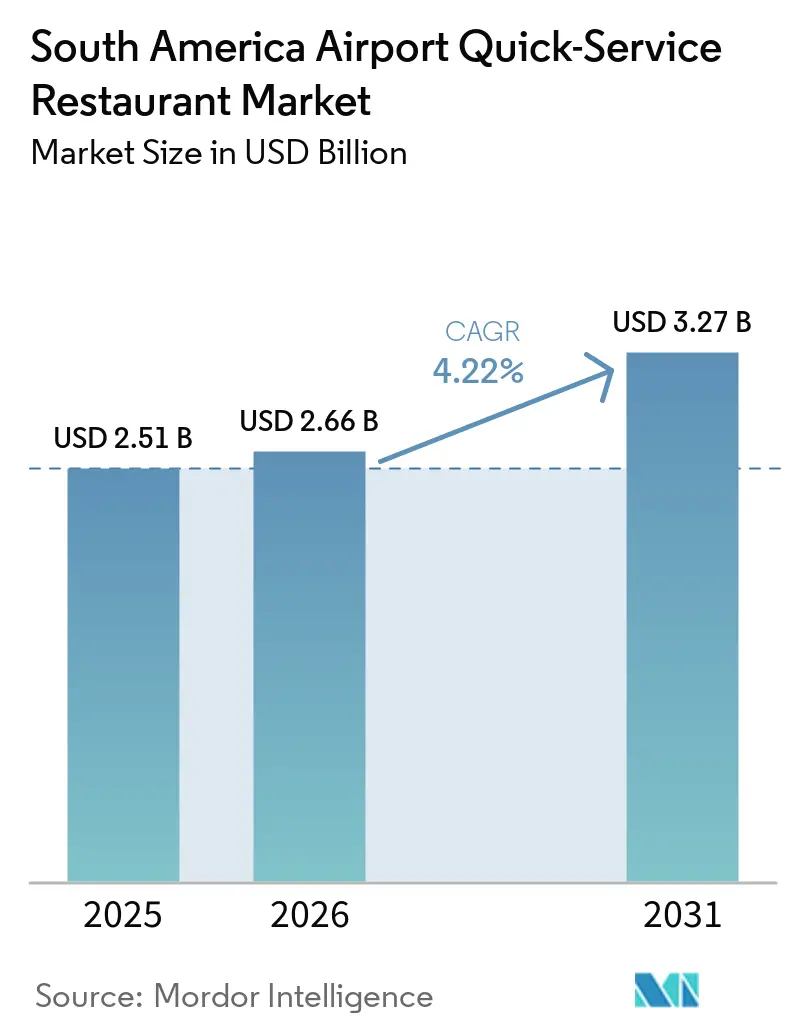
| Base Year Market Size (2025) | USD 2.51 Billion |
| Market Size (2026) | USD 2.66 Billion |
| Market Size (2031) | USD 3.27 Billion |
| Growth Rate (2026 - 2031) | 4.22 % |
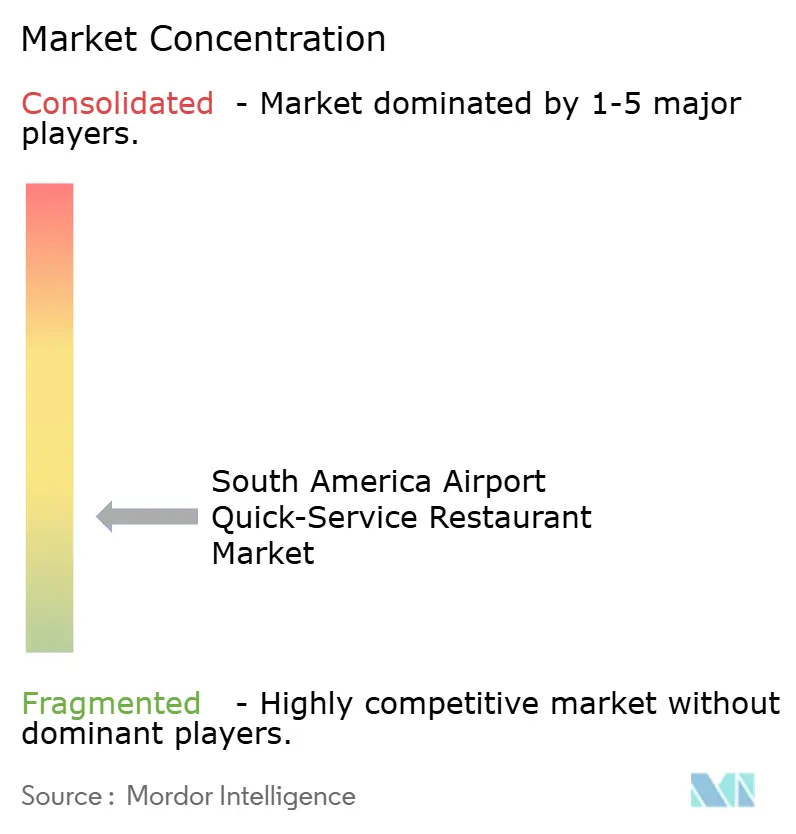
| Market Concentration | Low |
Major Players *Disclaimer: Major Players sorted in no particular order Image © Mordor Intelligence. Reuse requires attribution under CC BY 4.0. | |
South America Airport Quick-Service Restaurant Market Analysis by Mordor Intelligence
The South America airport quick-service restaurant market size was valued at USD 2.51 billion in 2025 and is forecast to grow from USD 2.66 billion in 2026 to USD 3.27 billion by 2031, at a 4.22% CAGR during the forecast period (2026-2031). Passenger traffic across major South American airports remained strong in 2025. São Paulo/Guarulhos handled 47.1 million passengers, up 8.3% year over year, while Bogotá El Dorado handled 45.4 million passengers and Lima Jorge Chávez reached 25.5 million, up 4.1%. High passenger volumes at these major hubs expand the customer base for quick-service restaurants, particularly for travelers seeking convenient food and beverage options within terminals. Airport infrastructure development is also increasing commercial opportunities. Lima's new terminal, opened in 2025, is three times larger than the previous terminal and includes an expanded retail and dining offering. These developments support the South America airport quick-service restaurant market by driving higher passenger traffic and increasing terminal commercial capacity.
Key Report Takeaways
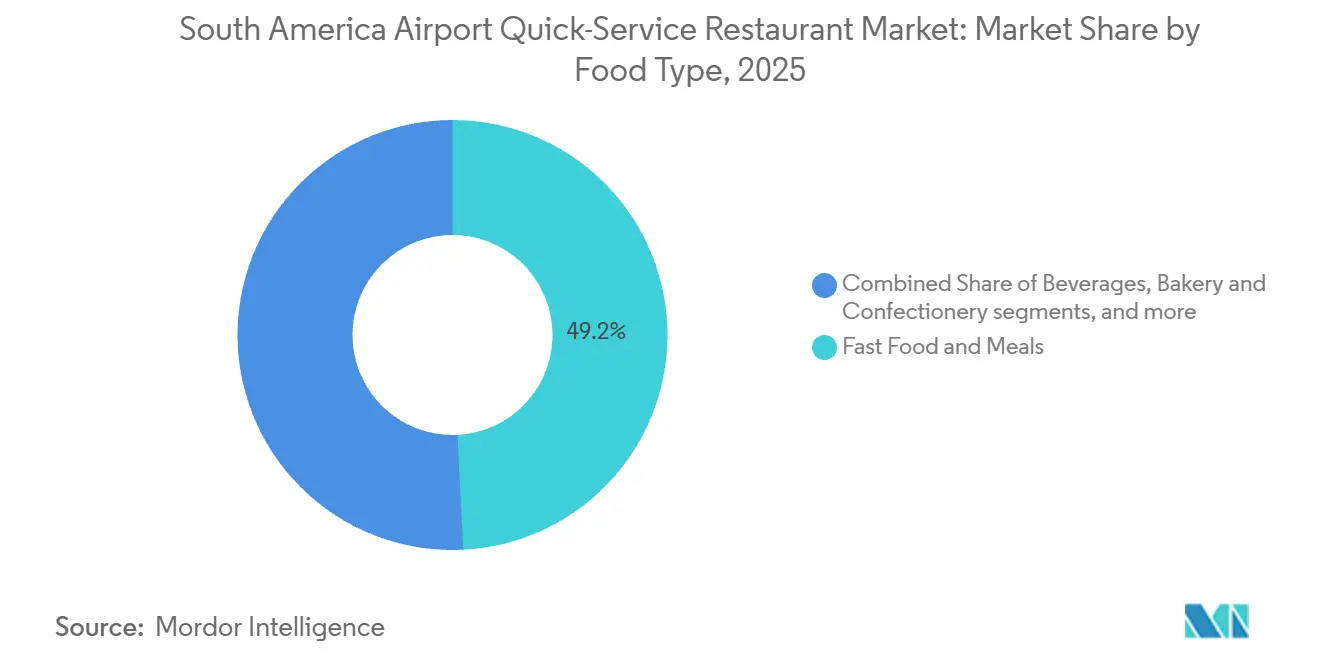
- By food type, fast foods and meals accounted for 49.20% of revenue in 2025, while beverages are forecast to grow at a 5.65% CAGR through 2031.
- By location, food courts held 51.55% revenue share in 2025, while airport lounges are forecast to grow at a 5.10% CAGR through 2031.
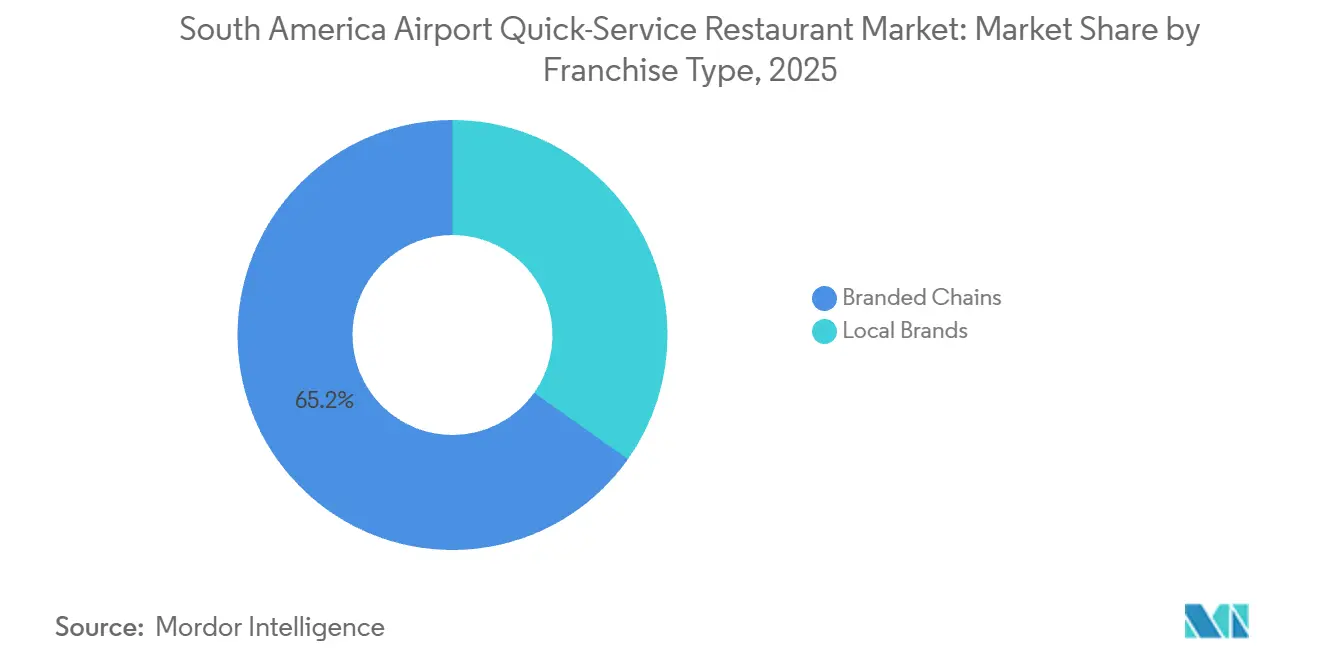
- By franchise type, branded chains held 65.20% of the South America airport quick-service restaurant market share in 2025, while local brands are forecast to grow at a 5.65% CAGR through 2031.
- By application, domestic airports held 61.25% of South America airport quick-service restaurant market share in 2025, while international airports are forecast to grow at a 5.35% CAGR through 2031.
- By geography, Brazil accounted for 35.55% of the South America airport quick-service restaurant market in 2025, while Peru is forecast to grow at a 5.21% CAGR through 2031.
Note: Market size and forecast figures in this report are generated using Mordor Intelligence’s proprietary estimation framework, updated with the latest available data and insights as of January 2026.
Market Trends and Insights
Drivers Impact Analysis of South America Airport Quick-Service Restaurant Market*
| Driver | (~) % Impact on CAGR Forecast | Geographic Relevance | Impact Timeline |
|---|---|---|---|
| Air passenger traffic and flight frequency recovery | +1.2% | Global, Brazil, Argentina, Colombia, and Peru | Medium term (2-4 years) |
| Narrowbody fleet expansion and network development | +0.8% | Brazil, Colombia, Chile, and Peru | Long term (≥ 4 years) |
| Premium, branded, and local food offerings | +0.7% | Brazil, Peru, and Colombia | Medium term (2-4 years) |
| Regional, dietary-specific, and sustainable food demand | +0.6% | Peru, Brazil, and Chile | Medium term (2-4 years) |
| Inflight catering outsourcing | +0.5% | Brazil and Peru | Medium term (2-4 years) |
| Pre-order, personalization, and waste-optimized meals | +0.5% | Brazil, Chile, and Colombia | Long term (≥ 4 years) |
| Source: Mordor Intelligence | |||
Air Passenger Traffic and Flight Frequency Recovery
Air passenger traffic continued to expand across major South American aviation markets in 2025. Brazil transported 129.6 million domestic and international passengers, up 9.4% year over year, while Argentina's airports handled 50.65 million passengers, up 12% from 2024. Argentina also recorded 405,434 aircraft movements, up 9%, indicating higher overall flight activity. Colombia reached a record 57.52 million passengers during the year, with the Bogotá–Medellín corridor alone carrying approximately 3.5 million passengers, reflecting strong domestic inter-city demand. Growing passenger volumes and flight activity broaden the potential customer base for terminal food and beverage outlets, supporting demand for quick-service restaurants across major hubs and regional airports in South America.
Narrowbody Fleet Expansion and Network Development
LCCs are adding narrowbody capacity and expanding domestic and regional networks across South America. JetSMART increased its fleet from 40 aircraft in 2024 to 50 in 2025 and expanded routes in markets including Argentina and Colombia, while SKY Airline added four A320neo aircraft in late 2024. Brazil recorded 101.2 million domestic passengers in 2025, up 8.4% year over year. Airport commercial capacity is expanding alongside traffic growth: Santiago Airport announced 41 new commercial outlets for 2025, including 16 food and beverage locations, supported by more than USD 11 million in tenant investment, with another 13 outlets planned for 2026. These developments expand quick-service restaurant opportunities across both major hubs and growing regional airports.
Premium, Branded, and Local Food Offerings
Airport redevelopment is broadening food and beverage offerings beyond traditional terminal concessions. In June 2025, Lagardère Travel Retail opened a 3,300 m² dining area under the Nación Sazón concept at Lima's new Jorge Chávez terminal. The offer includes 13 food-and-beverage concepts, 9 Peruvian brands, chef-developed restaurants such as SAKAI and CALLAO, and the Puku Puku coffee brand. Congonhas Airport is moving in a similar direction. Aena Brasil states its expanded commercial area will include full-service restaurants, fast-casual formats, flagship cafés, premium bars, and healthy food options as part of the airport's redevelopment. The broader mix of branded, local, and convenient dining formats expands opportunities for quick-service restaurants and fast-casual operators at airports in South America.
Regional, Dietary-specific, And Sustainable Food Demand
Regional cuisine, healthier food choices, and sustainability are becoming more prominent in South American airport commercial strategies. At Lima's Jorge Chávez International Airport, Lagardère Travel Retail and Lima Airport Partners built the Nación Sazón offer around Peruvian gastronomy, with nine of its 13 food and beverage concepts representing local brands and culinary formats. In Brazil, 3tentos invested USD 326 million in 2025 expansion, strengthening Brazil's agricultural processing capacity and supporting more reliable food-input supply for quick-service restaurant operators. Sustainability requirements are also becoming more relevant to concession operations. Aena Brasil's 2025 sustainability framework includes agreements with concessionaires to reduce packaging, optimize inventory, and improve waste management. Together, these trends support quick-service restaurant operators that combine convenience with local, healthier, and more sustainable offerings.
Restraints Impact Analysis of South America Airport Quick-Service Restaurant Market*
| Restraint | (~) % Impact on CAGR Forecast | Geographic Relevance | Impact Timeline |
|---|---|---|---|
| Food, labor, logistics, and cold-chain costs | -0.80% | Global, Argentina, Brazil, and Venezuela | Short term (≤ 2 years) |
| Airline margin pressure and passenger demand volatility | -0.60% | Argentina, Venezuela, and Brazil | Short term (≤ 2 years) |
| Catering capacity concentration at aviation hubs | -0.40% | Brazil, Colombia, and Chile | Medium term (2-4 years) |
| Food safety, customs, and traceability requirements | -0.30% | All South American markets | Long term (≥ 4 years) |
| Source: Mordor Intelligence | |||
Food, Labor, Logistics, and Cold-chain Costs
Food, labor, and occupancy costs continue to pressure quick-service restaurant operations across South America. Arcos Dorados reported that food and paper costs increased 7.2% in 2025, reaching 36.0% of company-operated restaurant sales. In Brazil, food and paper costs increased 5.4% and reached 36.5% of restaurant sales. Currency movements add further uncertainty, as a portion of restaurant input costs remains exposed to foreign-exchange fluctuations. Labor costs are also affected by wage revisions, including Brazil's increase in the national minimum wage from USD 252 to USD 271 in January 2025. Airport concession structures can add another fixed-cost element: Aena Brasil states that commercial concession payments vary with sales but remain subject to a Minimum Guaranteed Annual amount. These cost pressures can limit margin flexibility for airport quick-service restaurant operators, particularly when passenger traffic or sales soften.
Airline Margin Pressure and Passenger Demand Volatility
Airport quick-service restaurant revenues remain sensitive to changes in passenger throughput, while concession operators may retain minimum contractual payment obligations even when sales weaken. Aena Brasil, for example, applies sales-linked commercial concession fees subject to a Minimum Guaranteed Annual amount. Airline capacity can also grow faster than passenger demand. Latin American airlines increased international capacity by 10.2% in 2025, compared with 8.6% growth in passenger traffic, resulting in a 1.2-percentage-point decline in load factor. Localized disruptions can create additional volatility. Venezuela experienced significant changes in international connectivity during 2025, with Panama services resuming in May after a nine-month suspension before several international airlines suspended Venezuela operations later in the year. Such fluctuations in traffic and connectivity can make sales forecasting and concession planning more difficult for airport quick-service restaurant operators in South America.
*Our forecasts treat driver/restraint impacts as directional, not additive. The impact forecasts reflect baseline growth, mix effects, and variable interactions.
South America Airport Quick-Service Restaurant Market Segment Analysis
By Food Type:
Beverages Gain Ground While Meals Retain the Largest BaseFast food and meals accounted for an estimated 49.20% of South America airport quick-service restaurant revenue in 2025, driven by demand for convenient meal options within terminals. This segment remains the largest revenue stream, as passengers continue to rely on quick, familiar meal formats during airport stays. Bakery and confectionery also maintains an established presence, particularly through compact formats suited to quick purchases. Nanica Brasil entered São Paulo Guarulhos International Airport in early 2025 with a Terminal 2 kiosk and two mobile Naniquinha carts serving Terminal 2 departures and Terminal 3 arrivals.
Beverages are forecast to be the fastest-growing food category, expanding at a 5.65% CAGR from 2026 to 2031, outpacing the overall market rate. Coffee and specialty beverage concepts are increasing their airport presence across South America. Starbucks Brasil ended 2025 with 112 coffeehouses after opening a kiosk at Curitiba International Airport in December and planned approximately 30 additional stores across Brazil in 2026.[1] In Peru, Starbucks opened its third outlet at Jorge Chávez International Airport in September 2025. It announced a fourth location at the Peru Plaza mezzanine, highlighting the growing role of branded beverage concepts at high-traffic airports.

By Location:
Food Courts Retain Scale While Lounges Raise Spending Per PassengerFood courts accounted for an estimated 51.55% of South America airport quick-service restaurant revenue in 2025, supported by their ability to concentrate multiple food options in high-passenger-flow areas. New airport developments are combining centralized dining areas with more distributed formats. Lima's new Jorge Chávez terminal includes the 3,300 m² Nación Sazón dining hub, while Congonhas is expanding its food and beverage area from 4,720 m² to 7,050 m² by 2028, incorporating restaurants, fast-casual concepts, flagship cafés, and premium bars. Avolta also opened its 334 m² Vista Corona concept at Congonhas in March 2025, combining a full-service restaurant with a Grab & Go section. These developments indicate that traditional food courts are increasingly being complemented by flexible quick-service and hybrid formats.
Airport lounges are forecast to grow at a 5.10% CAGR from 2026 to 2031 as access expands beyond traditional airline lounge memberships. Visa reported a 50% increase in airport lounge benefit usage among Brazilian cardholders in 2025, while Aeropuertos Argentina's VIPCLUB offers memberships, corporate plans, and individual paid passes. At Ezeiza International Airport, Aeropuertos Argentina opened a new 780 m² VIPCLUB lounge in 2025, featuring an à la carte menu developed by chef Agustín Brañas, along with a buffet, premium wine, and cocktail offerings. Aena Brasil is also nearly doubling lounge space at Congonhas, from 3,420 m² to 6,500 m² by 2028. These developments support differentiated food service formats across food courts, lounges, and smaller service locations within the South America airport quick-service restaurant market.
By Franchise Type:
Branded Chains Lead While Local Operators Gain RelevanceBranded chains accounted for an estimated 65.20% of South America airport quick-service restaurant revenue in 2025, supported by established operating systems, supply networks, and standardized food-safety processes. Airport concessionaires must comply with country-specific food service requirements. In Brazil, ANVISA regulations establish good-practice standards for restaurants and other food service establishments, while in Colombia, territorial health authorities oversee gastronomic establishments and INVIMA conducts additional controls on imported and exported foods at major airports. These operating and compliance requirements can favor established chains with the systems and resources to maintain consistent service across airport locations.
Local brands are forecast to grow at a 5.65% CAGR from 2026 to 2031 as airports give greater prominence to regional food concepts. At Jorge Chávez International Airport, Lagardère Travel Retail's Nación Sazón includes 13 food and beverage units, nine of which are Peruvian brands selected to represent the country's culinary heritage.[2] In Colombia, Frisby ended 2025 with 290 restaurants across 61 municipalities, demonstrating the operating scale that established domestic chains can achieve. These developments indicate that while large branded chains retain the largest revenue base, mature local and regional brands are gaining stronger opportunities within South American airport food service.
By Application:
Domestic Airports Lead Volume While International Terminals Grow FasterDomestic airports accounted for an estimated 61.25% of South America airport quick-service restaurant revenue in 2025, supported by the scale of domestic air travel in major markets. Brazil recorded 101.2 million domestic passengers during the year, up 8.4% from 2024. Investment is also increasing commercial capacity at domestic-focused airports. At São Paulo Congonhas, Aena Brasil is investing around USD 357.6 million in redevelopment and plans to increase food and beverage space from 4,720 m² to 7,050 m² by 2028. The expansion will include fast-casual restaurants, flagship cafés, premium bars, and other food service formats, increasing opportunities for quick-service restaurant operators serving high-volume domestic passenger flows.
International airports are forecast to grow at a 5.35% CAGR from 2026 to 2031, supported by expanding international traffic and commercial investment. SSP entered the Brazilian market through a joint venture with Duty Free Americas, securing nine-year food and beverage contracts at São Paulo Guarulhos and RIOgaleão, reflecting the long-term commercial value of major international airport concessions. New terminal designs are also integrating domestic and international passenger operations more closely. The new Jorge Chávez terminal in Lima consolidates domestic and international operations within a single terminal while maintaining dedicated commercial areas for different passenger flows. These developments create opportunities for operators to serve both domestic and international travelers through a broader mix of quick-service restaurant and food service formats.
Geography Analysis
Brazil and Colombia Airport Quick-Service Restaurant Market
Brazil accounted for an estimated 35.55% of South America airport quick-service restaurant revenue in 2025, making it the largest national market. ACI-LAC reported 234.8 million airport passengers in Brazil during the year, up 9.1%, while international traffic increased 14%. Airport investment is expanding the addressable commercial base. Aena Brasil is redeveloping São Paulo Congonhas, where the passenger terminal will more than double in size, providing around 20,000 m² of commercial space. Avolta also opened its 334 m² Vista Corona food service concept at Congonhas in March 2025. Colombia provides another large domestic traffic base, with Bogotá–Medellín carrying 3.5 million passengers in 2025 and ranking as South America's busiest airport pair.
Peru and Argentina Airport Quick-Service Restaurant Market
Peru is forecast to be the fastest-growing named geography, expanding at a 5.21% CAGR from 2026 to 2031, supported by the expansion of Jorge Chávez International Airport. The airport handled 25.5 million passengers in 2025 and is projected by Lima Airport Partners to reach 26.5 million in 2026.[3] Lagardère Travel Retail opened 7,300 m² of retail and dining space at the new terminal in June 2025, including the 3,300 m² Nación Sazón dining area with 13 food and beverage concepts. Lagardère Travel Retail Peru also expanded its workforce to more than 750 employees by mid-2025. In January 2026, Arcos Dorados opened renewed McDonald's facilities at Jorge Chávez, including a new restaurant and Dessert Center with a McCafé station. Argentina also recorded strong passenger growth, with final ANAC data showing traffic increased 12% to 50.65 million passengers in 2025.
South America Airport Quick-Service Restaurant Market
Chile continues to expand airport commercial capacity, with Santiago Airport ending 2025 with 128 operating commercial outlets and planning to reach 144 during 2026. Commercial openings across 2024 and 2025 represented more than USD 30 million in tenant investment, alongside the redevelopment of the domestic terminal. Smaller South American markets are also seeing selective investment in airport food service. Carrasco International Airport in Uruguay has expanded its boarding-area dining offerings with Starbucks, La Pasiva, Be Juice, and other concepts. At the same time, Bolivia continues to modernize its major airports and offer commercial space in both domestic and international passenger areas. In Ecuador, Starbucks opened its first airport coffeehouse at Quito's Mariscal Sucre International Airport in April 2026, reflecting further expansion of branded food service beyond the region's largest aviation markets.
Competitive Landscape
The South America airport quick-service restaurant market remains fragmented across individual countries, while a limited number of multi-year concession contracts shape competition at major hubs. Contract duration varies by airport and operator: Avolta secured a three-year food and beverage agreement at São Paulo Congonhas, while SSP entered Brazil through a joint venture with Duty Free Americas under nine-year contracts at São Paulo Guarulhos and RIOgaleão. Avolta opened its first F&B outlet in Brazil, the 334 m² Vista Corona concept, at Congonhas in March 2025. Lagardère Travel Retail's 3,300 m² dining development at Jorge Chávez International Airport, including 13 F&B concepts, further illustrates the operating scale and localized-format capability required for large terminal projects. Competition, therefore, centers on concession access, operating capability, investment capacity, and the ability to manage different food service formats.
Scale and customer data are becoming additional competitive tools. Club Avolta had more than 10 million members at the end of 2024, added over one million in the first quarter of 2025, and exceeded 16 million members by the end of 2025. Avolta states that customer and transactional data are used to adjust assortments, store layouts, and promotions based on passenger profiles and travel patterns. Arcos Dorados also continued to expand and modernize its network, opening 102 restaurants across South America and the Caribbean in 2025. Its renewed 20-year McDonald's master franchise agreement became effective in January 2025, while its renovated Jorge Chávez facilities opened in January 2026, featuring a new restaurant and a Dessert Center with McCafé. These investments reinforce competition around standardized operations, convenience, technology, and format modernization.
Opportunities also extend beyond the largest hubs as airport networks undergo investment. Aena Brasil manages 17 airports and secured USD 1.02 billion in financing in December 2025 to expand and modernize 11 of them, broadening the potential commercial base beyond Congonhas. Local operators are also establishing a presence at airports. G&N Brands opened its Lovdo concept at Santiago Airport in January 2025 in partnership with Lagardère Travel Retail, demonstrating that established domestic brands can participate alongside international operators. Frisby ended 2025 with 290 restaurants across Colombia and targeted 300 locations in 2026, although no airport concession has been independently confirmed. Food-safety requirements in markets such as Brazil and Colombia further increase the importance of documented processes and operational consistency, making major hub concessions more demanding for smaller entrants without established airport-service capabilities.
South America Airport Quick-Service Restaurant Industry Leaders
-
Avolta AG
-
SSP Group plc
-
Lagardère Travel Retail SAS
-
Arcos Dorados Holdings Inc.
-
Starbucks Corporation
- *Disclaimer: Major Players sorted in no particular order
South America Airport Quick-Service Restaurant Market Companies Covered in this Report
- Restaurant Brands International, Inc.
- Churromania International Holding LLC
- Domino's Pizza, Inc.
- Frisby S.A. BIC
- G&N Brands SpA
- Arcos Dorados Holdings Inc.
- Starbucks Corporation
- Subway IP LLC
- KFC Corporation
- Avolta AG
- Lagardère Travel Retail SAS
- SSP Group plc
- Duty Free Americas, Inc.
- Global Group Corporation (GGCorp)
- Retail Services S.A.C.
Recent Industry Developments in South America Airport Quick-Service Restaurant Market
- January 2026: Arcos Dorados opened a renovated McDonald’s restaurant and Dessert Center with McCafé at Lima’s Jorge Chávez International Airport. The development strengthens McDonald’s airport presence in Peru, improves passenger accessibility across arrivals and departures, and reflects continued investment in digitalization, energy efficiency, and modern airport food service infrastructure.
- December 2025: Starbucks Brazil, operated by ZAMP, announced two new coffeehouses, including a location at Curitiba International Airport, and plans for approximately 30 additional stores in 2026. The expansion highlights growing investment in high-traffic travel locations and strengthens competition across Brazil’s airport food service and branded beverage retail market.
South America Airport Quick-Service Restaurant Market Report Scope
Airport quick-service restaurants are food and beverage outlets located within airport terminals that provide passengers, visitors, and airport staff with fast, convenient, and standardized meal, snack, and beverage options. These outlets typically operate through food courts, standalone counters, kiosks, service centers, and other high-throughput formats designed around limited passenger dwell times.
The South America airport quick-service restaurant market is segmented by product type, service location, franchise type, airport type, and geography. By product type, the market is segmented into fast food and meals, beverages, bakery and confectionery, and other product types. By service location, the market is segmented into airport lounges, food courts, and service centers. By franchise type, the market is segmented into branded chains and local brands. By airport type, the market is segmented into domestic airports and international airports. The report also covers the market sizes and forecasts for the South America airport quick-service restaurant market in seven countries across the region. For each segment, the market size is provided in terms of value (USD).
Segmentation Overview
By Food Type
| Fast Food and Meals |
| Beverages |
| Bakery and Confectionery |
| Other Food Types |
By Location
| Airport Lounges |
| Food Courts |
| Service Centers |
By Franchise Type
| Branded Chains |
| Local Brands |
By Application
| Domestic Airports |
| International Airports |
By Geography
| Brazil |
| Colombia |
| Argentina |
| Chile |
| Peru |
| Venezuela |
| Bolivia |
| Uruguay |
| Rest of South America |
| By Food Type | Fast Food and Meals |
| Beverages | |
| Bakery and Confectionery | |
| Other Food Types | |
| By Location | Airport Lounges |
| Food Courts | |
| Service Centers | |
| By Franchise Type | Branded Chains |
| Local Brands | |
| By Application | Domestic Airports |
| International Airports | |
| By Geography | Brazil |
| Colombia | |
| Argentina | |
| Chile | |
| Peru | |
| Venezuela | |
| Bolivia | |
| Uruguay | |
| Rest of South America |
Key Questions Answered in the Report
What is the forecast value for airport quick-service restaurants in South America?
The sector is forecast to reach USD 3.27 billion by 2031, rising from USD 2.66 billion in 2026 at a 4.22% CAGR through 2031.
Which food category is growing fastest at South American airports?
Beverages are forecast to grow at a 5.65% CAGR through 2031, supported by premium coffee and specialty drink concepts.
Why do food courts remain important in regional terminals?
Food courts held 51.55% revenue share in 2025 because terminal layouts commonly direct passengers through centralized dining areas.
Which country has the strongest growth outlook through 2031?
Peru has the fastest forecast growth at a 5.21% CAGR, supported by the expanded Jorge Chávez International Airport terminal.
What makes branded chains important in airport food service?
Branded chains held 65.20% revenue share in 2025 because standardized supply and food-safety processes reduce concession operating risk.
What operating issues can affect airport restaurant performance?
Food inflation, labor requirements, cold-chain costs, fixed concession payments, and traffic volatility can place pressure on operator margins.