
Market Overview
| Study Period | 2021 - 2031 |
|---|---|
| Forecast Data Period | 2026 - 2031 |
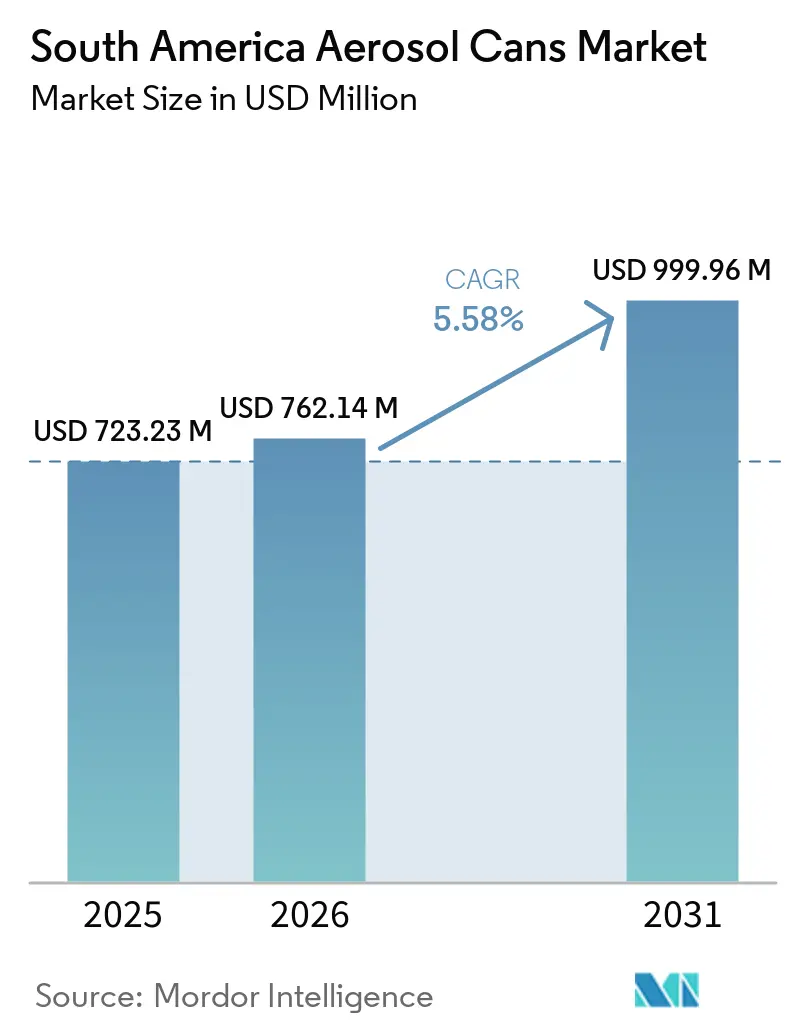
| Base Year Market Size (2025) | USD 723.23 Million |
| Market Size (2026) | USD 762.14 Million |
| Market Size (2031) | USD 999.96 Million |
| Growth Rate (2026 - 2031) | 5.58 % |
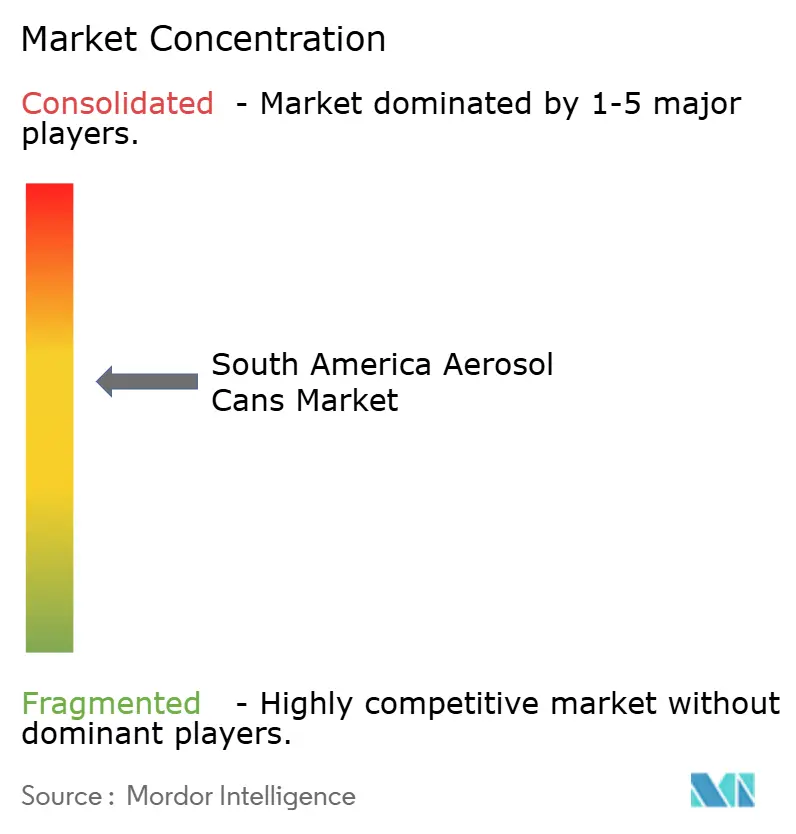
| Market Concentration | Medium |
Major Players *Disclaimer: Major Players sorted in no particular order Image © Mordor Intelligence. Reuse requires attribution under CC BY 4.0. | |
South America Aerosol Cans Market Analysis by Mordor Intelligence
The South America Aerosol Cans Market size is projected to expand from USD 723.23 million in 2025 and USD 762.14 million in 2026 to USD 999.96 million by 2031, registering a CAGR of 5.58% between 2026 and 2031.
Demand is supported by personal care, automotive maintenance, household care, and healthcare applications that require convenient and hygienic dispensing. Brazil’s aluminum recovery system gives can makers access to recycled material and supports brand packaging commitments. Higher use of bag-on-valve formats is directing suppliers toward certified healthcare packaging and more specialized filling capabilities. Manufacturers are also using lightweighting, decoration, and product customization to distinguish their offerings. Raw-material volatility, incomplete post-consumer collection systems, and substitution from pump, trigger, and refillable packs remain material constraints for the South America aerosol cans market.
Key Report Takeaways
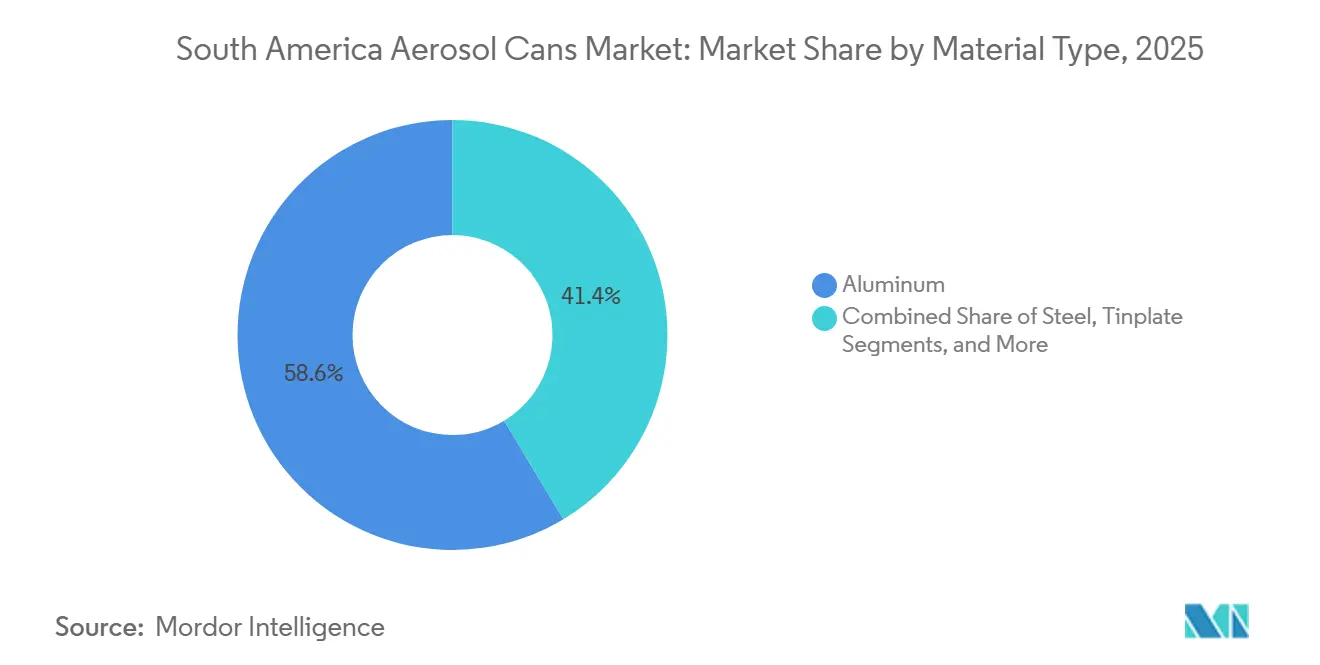
- By material type, aluminum held 58.63% of the South America aerosol cans market share in 2025 and is projected to expand at a 6.12% CAGR through 2031.
- By can type, one-piece cans accounted for 57.62% of the South America aerosol cans market share in 20255 and are expected to expand at a 6.43% CAGR through 2031.
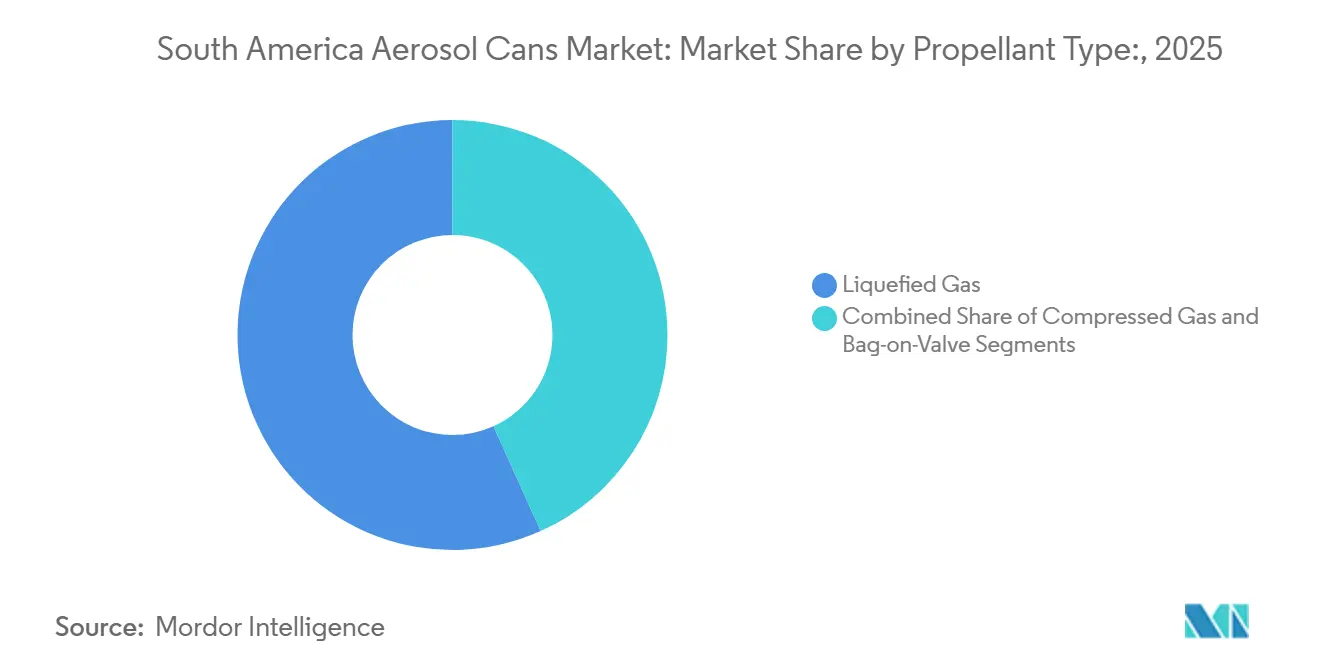
- By propellant type, liquefied gas held 56.72% of the South America aerosol cans market share in 2025, while bag-on-valve is projected to expand at a 6.66% CAGR through 2031.
- By capacity, 101ml-300ml cans accounted for 49.72% of the South America aerosol cans market share in 2025, while less-than-100ml cans are expected to expand at a 6.52% CAGR through 2031.
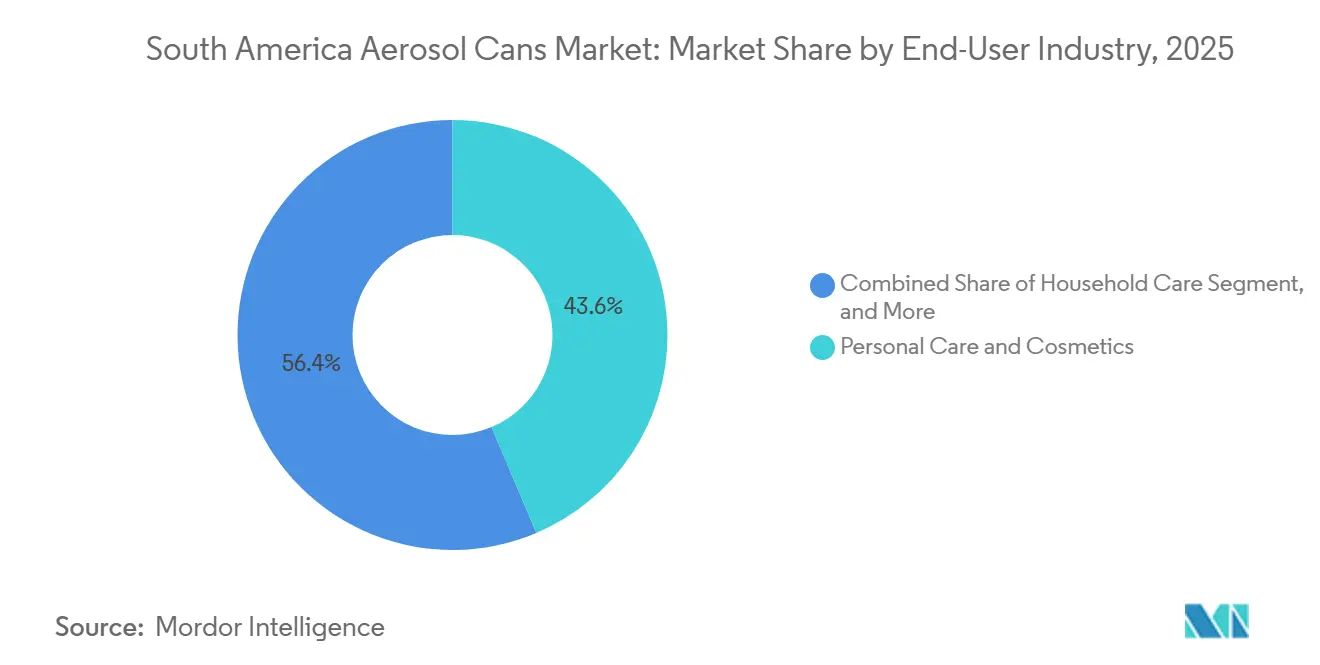
- By end-user industry, personal care and cosmetics held 43.62% of the South America aerosol cans market share in 2025, while healthcare and pharmaceutical is projected to expand at a 6.78% CAGR through 2031.
- By geography, Brazil accounted for 43.82% of the South America aerosol cans market share in 2025 and is expected to expand at a 7.03% CAGR through 2031.
Note: Market size and forecast figures in this report are generated using Mordor Intelligence’s proprietary estimation framework, updated with the latest available data and insights as of January 2026.
South America Aerosol Cans Market Trends and Insights
Drivers Impact Analysis*
| Driver | (~) % Impact on CAGR Forecast | Geographic Relevance | Impact Timeline |
|---|---|---|---|
| Expansion of Personal Care and Cosmetics Aerosols | +2.0% | Brazil, Argentina, Chile, Colombia | Medium term (2-4 years) |
| Recyclability Advantage of Aluminum and Steel Packaging | +1.0% | Brazil, Rest of South America | Long term (≥ 4 years) |
| Growth of Automotive Maintenance and Spray Paint Applications | +0.7% | Brazil, Argentina, Chile | Medium term (2-4 years) |
| Demand for Convenient and Hygienic Dispensing Formats | +0.6% | Brazil, Colombia, Peru | Short term (≤ 2 years) |
| Localized Aerosol Filling and Contract Manufacturing Capacity | +0.4% | Brazil, Argentina | Medium term (2-4 years) |
| Premiumization Through High-Definition Decoration and Shaped Cans | +0.3% | Brazil, Chile | Long term (≥ 4 years) |
| Source: Mordor Intelligence | |||
Expansion of Personal Care and Cosmetics Aerosols
Brazil’s personal care base provides the largest demand pool for the South America aerosol cans market. Aerosol deodorants, body sprays, and hairsprays remain important formats because they provide controlled, contact-free application. The category benefits from established use of aerosol deodorants in Brazil and from broad retail distribution. Grupo Boticário introduced post-consumer recycled aluminum packaging for deodorant and dry-shampoo lines in 2024, reporting that the move avoided more than 240 tonnes of CO₂ emissions and over 100 tonnes of aluminum waste. This action links personal care demand with requirements for recycled material and a traceable supply. ANVISA requirements for cosmetic formulations and labeling also make regulatory knowledge important for suppliers serving this category.
Recyclability Advantage of Aluminum and Steel Packaging
Aluminum recovery strengthens the material case for the South America aerosol cans market, particularly in Brazil. The International Aluminum Institute reported that South America and the Caribbean achieved a 94.0% aluminum can collection rate in 2023.[1]International Aluminium Institute, “Global Aluminium Can Recycling Reaches 75%, Marking Major Step Toward Circular Economy,” International Aluminium Institute, international-aluminium.org. This collection performance supports recycled-content sourcing and gives brand owners an established circularity narrative. Brazil’s packaging sector consumed 451,500 tonnes of aluminum between January and September 2025, with recycled content accounting for 60% of the aluminum used.The 2024 classification of empty aerosol packs as non-hazardous waste reduced a handling barrier for recycling channels. Collection systems still need safe depressurization and consumer return points before this advantage can extend evenly across the region.
Growth of Automotive Maintenance and Spray Paint Applications
Automotive maintenance and spray paint uses provide a second demand base beyond consumer personal care. Aerosol paint, lubricants, cleaners, and corrosion-control products depend on durable cans and established filling lines. Brazil’s industrial base concentrates much of this demand in the south and southeast. Demand also extends to Chile and Colombia as vehicle ownership and repair activity increase. The South America aerosol cans market benefits when maintenance products are purchased in smaller, ready-to-use formats. Tightening limits on volatile organic compounds require reformulation work, which can raise costs for smaller converters. Suppliers with technical resources can use compliance support as a service advantage in automotive and industrial accounts.
Demand for Convenient and Hygienic Dispensing Formats
Demand for hygienic dispensing supports household disinfectants, personal care sprays, and healthcare products in the South America aerosol cans market. Bag-on-valve technology separates the product from the propellant and can provide controlled dispensing across different use positions. Aptar Pharma states that its bag-on-valve platform supports nasal saline and dermal drug products and is certified to ISO 15378 and ISO 13485. This design is relevant to wound care, first-aid sprays, and premium dermatological products. Brazil’s medical-device requirements for nasal saline increased the need for compliant manufacturing systems from May 2026. The result is a higher entry threshold for suppliers that lack good manufacturing practice capabilities. Healthcare demand therefore favors technically certified operators rather than commodity aerosol capacity.
Restraints Impact Analysis*
| Restraint | (~) % Impact on CAGR Forecast | Geographic Relevance | Impact Timeline |
|---|---|---|---|
| Environmental Compliance and Reverse-Logistics Costs | -0.8% | Brazil, Colombia, Argentina | Long term (≥ 4 years) |
| Volatility in Aluminum, Steel, Tinplate, and Propellant Costs | -0.7% | Brazil, Argentina, Chile | Short term (≤ 2 years) |
| Competition from Pump Sprays, Trigger Sprays, and Refillable Formats | -0.5% | Brazil, Argentina | Medium term (2-4 years) |
| Limited Collection Infrastructure for Post-Consumer Aerosol Containers | -0.4% | Colombia, Peru, Chile, Argentina | Long term (≥ 4 years) |
| Source: Mordor Intelligence | |||
Environmental Compliance and Reverse-Logistics Costs
Environmental compliance is becoming more demanding for aerosol packaging suppliers. Reverse logistics is more complex for aerosol packs because residual propellant can create safety risks during collection and processing. Standard metal recycling facilities may need depressurizing equipment and trained operators. Brazil’s empty-can reclassification removed one barrier, but it did not create a complete consumer collection network. Extended producer responsibility requirements can shift collection and reporting costs to brand owners and packaging suppliers. The South America aerosol cans market faces greater pressure in countries that lack accessible municipal return systems. Suppliers that can support safe collection programs and clear packaging instructions are better placed to manage this requirement.
Volatility in Aluminum, Steel, Tinplate, and Propellant Costs
Material and propellant costs can change quickly for regional can producers in the South America aerosol cans market. Aluminum coil, steel, tinplate, and hydrocarbon propellants are affected by global commodity prices, trade policy, import dependence, and currency movement. Smaller economies such as Argentina and Chile have limited ability to absorb higher imported-input costs. Currency depreciation can make these costs more difficult to manage for import-dependent fillers. Smaller converters also have less capacity to manage price swings through long-term procurement arrangements. This exposure can delay investment in new capacity and compress margins when cost increases cannot be passed through.
*Our forecasts treat driver/restraint impacts as directional, not additive. The impact forecasts reflect baseline growth, mix effects, and variable interactions.
Segment Analysis
By Material Type: Aluminum Leads Both Scale and Expansion
Aluminum commanded 58.63% of the market in 2025, making it the largest material used in the South America aerosol cans market. It is projected to expand at a 6.12% CAGR through 2031, making it the fastest-growing material. Aluminum supports lightweight packaging for deodorants, hairsprays, and body sprays. Its established recovery system in Brazil supports recycled-content claims for consumer brands. Brand procurement programs increasingly place value on traceable, lower-carbon metal sourcing. This adds demand support that is less available to alternative materials. The South America aerosol cans industry also uses aluminum in premium shapes and decorated formats.
Trivium Packaging Brasil received recognition in 2026 for an adidas prototype using an advanced aluminum alloy. The company said the design can reduce weight by 25% and carbon emissions by more than 50% while maintaining strength and coating quality.[2]Trivium Packaging, “World Aluminium Aerosol Can Award for Trivium,” Trivium Packaging, triviumpackaging.com. Steel and tinplate remain relevant for household insecticides, paints, and industrial aerosols. These materials fit three-piece designs and established technical filling lines. Plastic and other materials are used in smaller specialty applications, including non-pressurized packs. Steel demand remains connected to paint and varnish activity, which is more exposed to industrial cycles. Aluminum’s combination of recycling performance and personal care use supports its leading position.



By Can Type: One-Piece Cans Combine Volume and Technical Fit
One-piece cans held 57.62% of the market in 2025, the largest share by can type. The format is expected to expand at a 6.43% CAGR through 2031. A seamless interior suits coating-sensitive personal care formulations and reduces contamination concerns. High-speed filling operations in Brazil also support its use. One-piece aluminum can production is well-suited to the high volumes associated with deodorants and body sprays. This structure aligns with the demand for premium decoration and recycled aluminum content. These features give one-piece cans a leading role in the South America aerosol cans market.
Ball Corporation launched ASI-certified aerosol cans with Brazilian brands Soffie and Aeroflex in September 2025. The launch covered deodorant, hairspray, dry shampoo, and body spray products, with certification information shown on the pack.[3]Ball Corporation, “Ball Launches World’s First ASI-Certified Aerosol Cans With Soffie and Aeroflex,” Ball Corporation, ball.com. Two-piece cans remain common for food and beverage aerosol uses. Three-piece welded cans continue to be used for industrial paints, solvents, and technical aerosols. Those formats offer material and production advantages for their specific pressure and coating requirements. One-piece cans, nevertheless, align more closely with the largest personal care uses. Their growth is also supported by healthcare fillers that require clean and consistent interior surfaces.
By Propellant Type: Liquefied Gas Retains Volume While Bag-on-Valve Gains Use
Liquefied gas propellants accounted for 56.72% of the market in 2025. Hydrocarbon systems, including butane, propane, and isobutane, support high-volume applications in deodorants, hairspray, and insecticides. Their low cost and compatibility with existing filling equipment sustain this position. Dimethyl ether is also used for selected personal care and pharmaceutical formulations. Bag-on-valve is expected to expand at a 6.66% CAGR through 2031. The system separates product from propellant and supports sterile, controlled delivery. This makes it relevant to pharmaceutical and consumer healthcare products in the South America aerosol cans market.
Coster introduced a bag-on-valve system with integrated metering for cosmetics and pharmaceutical applications in 2024. Metered delivery can support applications that require consistent dosing. Bag-on-valve formats also enable 360-degree dispensing and can reduce direct exposure of the product to propellant. Compressed gas systems using nitrogen or compressed air occupy a smaller space. They are used in selected household cleaning and first-aid products where nonflammability is important. Hydrocarbons will retain structural volume because of the installed filling capacity. Healthcare regulation and premium product requirements will continue to favor bag-on-valve adoption.
By Capacity: Mid-Range Formats Hold Volume as Smaller Packs Advance
The 101ml-300ml range captured 49.72% of the market in 2025. Standard 150ml-200ml deodorant and hairspray products account for a large share of this capacity band. Retail shelf planning and consumer familiarity reinforce these formats. Filling-line standardization also reduces unit costs at scale. The band is widely used in Brazil, Argentina, and Colombia. It therefore provides the central volume base for the South America aerosol cans market. Its position reflects established personal care purchasing patterns rather than a short-term product shift.
Less-than-100ml cans are projected to expand at a 6.52% CAGR through 2031. Compact formats fit travel retail, e-commerce delivery, and direct-to-consumer subscription models. Smaller packs also reduce shipping weight and can suit trial or convenience purchases. The 301ml-500ml category serves household cleaning and automotive maintenance applications. Cans above 500ml are mainly used for industrial paints, adhesives, and technical products. These larger formats meet professional users’ need for higher product volume per unit. Capacity demand will remain linked to distinct product categories rather than a single format trend.
By End-User Industry: Personal Care Leads as Healthcare Adds Momentum
Personal care and cosmetics accounted for 43.62% of the market in 2025, representing the largest end-user segment in the South America aerosol cans market. Deodorants, hairsprays, and body sprays provide its core demand. Retail distribution and established consumer use support recurring purchases. The category also encourages lightweighting, recycled content, and visual differentiation. These requirements make it a central customer base for the South America aerosol cans industry. Healthcare and pharmaceutical applications are projected to expand at a 6.78% CAGR through 2031. Their higher rate reflects the adoption of bag-on-valve formats for wound care, nasal irrigation, and dermal delivery.
Household care provides stable demand across the South America aerosol cans market through insecticides, air fresheners, and surface disinfectants. Automotive and industrial products benefit from paint and coatings activity in Brazil. Food and beverage aerosols remain the smallest end-user category, with cooking sprays and specialty uses. Paints and varnishes add demand that tracks construction and infrastructure activity. The breadth of end-user demand limits dependence on a single application. Softness in one category can be partly balanced by demand from other uses. Certified healthcare filling capacity is a notable opportunity because medical applications require more specialized systems.
Geography Analysis
Brazil held 43.82% of the market in 2025, representing the largest geographic position in the South America aerosol cans market. It is projected to expand at a 7.03% CAGR through 2031, making it the fastest-growing country. The country combines a large personal care base with established aerosol filling and aluminum recovery systems. Brazil’s production capabilities are concentrated around São Paulo, where filling plants and consumer brands can operate near each other. This proximity supports procurement, logistics, and product development efficiency. The International Aluminium Institute’s reported 94.0% collection rate for South America and the Caribbean reinforces Brazil’s position as a regional reference for aluminum circularity.
Argentina has a sizable consumer base for deodorants, household cleaners, and insecticides within the South America aerosol cans market. Its macroeconomic volatility since 2024 has reduced purchasing power and limited near-term capacity investment. Import exposure for aluminum coil and propellants creates additional cost pressure for domestic fillers. Chile has an organized environmental framework and a certified aerosol valorization model from Hidronor that targets recovery of 500 tonnes of aerosol containers. Colombia offers room for wider use as organized retail and e-commerce extend product distribution. Its aerosol production was 36.2 million units in 2024, indicating a smaller base than the more mature Southern Cone countries.
Peru produced 44 million aerosol units in 2024 and remains at an earlier adoption stage than Brazil. Personal care and household insecticides provide the main entry categories in these smaller markets. Healthcare and industrial aerosol use is less developed outside the region’s larger economies. Urbanization and wider distribution support future demand in Lima and secondary cities. The South America aerosol cans market therefore has different country profiles, ranging from Brazil’s integrated value chain to emerging distribution-led opportunities. Product suppliers need country-specific planning for regulations, input availability, and collection systems. These differences favor flexible regional supply networks and targeted product portfolios.
Competitive Landscape
The South America aerosol cans market is moderately fragmented. Ball Corporation, Crown Holdings, Trivium Packaging, Ardagh Metal Packaging, and Can-Pack compete with Brasilata, Aeroflex, Grupo Comeca, and regional specialists. Global producers use wider aluminum procurement, research capacity, and multi-country supply chains. Domestic producers can compete through smaller batches, local service, and product customization. Competition is increasingly based on sustainability credentials, efficient use of metal, and advanced decoration. Suppliers also compete for healthcare applications that require compliant bag-on-valve and filling systems. These factors allow technically capable firms to create positions beyond basic supply.
Ball partnered with Soffie and Aeroflex in September 2025 to introduce ASI-certified aluminum aerosol cans in Brazil for the South America aerosol cans market. The move showed how independently verified sourcing can become a consumer-facing packaging feature. Trivium Packaging Brasil demonstrated lightweighting potential through its award-recognized adidas can prototype in 2026. Brasilata developed the INNOCAN platform with HP Indigo and ACTEGA for digital decoration and supply-chain tracking in steel aerosol formats. These examples show that leading companies are combining material innovation with differentiated design and traceability. The strategy is relevant to personal care brands seeking stronger shelf distinction.
Healthcare-grade filling capacity remains a competitive opening in the South America aerosol cans market because it requires certification and specialized equipment. Sustainable can supply outside Brazil is another opening because regional collection and recycled-material systems are uneven. Large multinational suppliers have scale advantages, but their investment footprints do not cover every smaller South American market equally. Local specialists can therefore serve niche geographies and smaller customer programs. Price remains important where industrial and household applications use established steel formats. The market’s structure supports continued rivalry among global and domestic suppliers. No company share data is available to demonstrate high concentration among the leading firms.
South America Aerosol Cans Industry Leaders
Ball Corporation
Trivium Packaging B.V.
Crown Holdings, Inc.
Brasilata Comércio e Indústria Ltda.
Cerviflan Embalagens Metálicas Ltda.
- *Disclaimer: Major Players sorted in no particular order

Recent Industry Developments
- March 2026: ZEMPACK and Termomecanica received silver recognition in the Sustainability category at the ABAS Awards 2026 for reducing the diameter of copper wire used in steel aerosol can welding from 1.38mm to 1.24mm, lowering copper consumption without compromising structural integrity.
- February 2026: Trivium Packaging Brasil received the prototype award for its adidas aluminum aerosol can, which achieved a 25% weight reduction and more than 50% lower carbon emissions through an advanced aluminum alloy process.
- September 2025: Ball Corporation partnered with Brazilian personal care brands Soffie and Aeroflex to launch aluminum aerosol cans certified by the Aluminium Stewardship Initiative. Soffie’s RUN Live and RUN Ultra deodorant lines became the first ASI-certified aerosol products commercially available on retail shelves globally.


South America Aerosol Cans Market Report Scope
The South America Aerosol Cans Report is Segmented by Material Type (Aluminum, Steel, Tinplate, Plastic, and Other Material Types), Can Type (One-Piece, Two-Piece, and Three-Piece), Propellant Type (Compressed Gas, Liquefied Gas, and Bag-on-Valve), Capacity (Less Than 100ml, 101ml-300ml, 301ml-500ml, and More Than 500ml), End-User Industry (Personal Care and Cosmetics, Household Care, Automotive and Industrial, Healthcare and Pharmaceutical, Food and Beverage, Paints and Varnishes, and Other End-User Industries), and Country (Brazil, Argentina, Chile, Colombia, Peru, and Rest of South America). The Market Forecasts are Provided in Terms of Value (USD).
By Material Type
| Aluminum |
| Steel |
| Tinplate |
| Plastic |
| Other Material Types |
By Can Type
| One-Piece |
| Two-Piece |
| Three-Piece |
By Propellant Type
| Compressed Gas | |
| Liquefied Gas | Hydrocarbon |
| DME | |
| Other Liquefied Gas | |
| Bag-on-Valve |
By Capacity
| Less Than 100ml |
| 101ml-300ml |
| 301ml-500ml |
| More Than 500ml |
By End-User Industry
| Personal Care and Cosmetics |
| Household Care |
| Automotive and Industrial |
| Healthcare and Pharmaceutical |
| Food and Beverage |
| Paints and Varnishes |
| Other End-User Industries |
By Country
| Brazil |
| Argentina |
| Chile |
| Colombia |
| Peru |
| Rest of South America |
| By Material Type | Aluminum | |
| Steel | ||
| Tinplate | ||
| Plastic | ||
| Other Material Types | ||
| By Can Type | One-Piece | |
| Two-Piece | ||
| Three-Piece | ||
| By Propellant Type | Compressed Gas | |
| Liquefied Gas | Hydrocarbon | |
| DME | ||
| Other Liquefied Gas | ||
| Bag-on-Valve | ||
| By Capacity | Less Than 100ml | |
| 101ml-300ml | ||
| 301ml-500ml | ||
| More Than 500ml | ||
| By End-User Industry | Personal Care and Cosmetics | |
| Household Care | ||
| Automotive and Industrial | ||
| Healthcare and Pharmaceutical | ||
| Food and Beverage | ||
| Paints and Varnishes | ||
| Other End-User Industries | ||
| By Country | Brazil | |
| Argentina | ||
| Chile | ||
| Colombia | ||
| Peru | ||
| Rest of South America | ||


Key Questions Answered in the Report
What is the South America aerosol cans market size?
The South America aerosol cans market size is projected to expand from USD 762.14 million in 2026 to USD 999.9628561 million by 2031 at a 5.58% CAGR.
Which material leads aerosol can demand in South America?
Aluminum led with 58.63% of the market in 2025 and is projected to expand at a 6.12% CAGR through 2031.
Why are bag-on-valve aerosol systems gaining adoption?
Bag-on-valve systems separate the product from the propellant and support sterile, controlled delivery for healthcare and premium personal care uses.
Which country has the strongest aerosol can outlook in South America?
Brazil held 43.82% of the market in 2025 and is expected to expand at a 7.03% CAGR through 2031.
Which end-user application is expanding most quickly?
Healthcare and pharmaceutical applications are projected to expand at a 6.78% CAGR through 2031, supported by wound care, nasal irrigation, and dermal delivery.
Page last updated on:





