
South America Advertising Video-on-Demand (AVOD) Market Size and Share
Market Overview
| Study Period | 2020 - 2031 |
|---|---|
| Forecast Data Period | 2026 - 2031 |
| Base Year Market Size (2025) | USD 5.80 Billion |
| Market Size (2026) | USD 6.21 Billion |
| Market Size (2031) | USD 10.25 Billion |
| Growth Rate (2026 - 2031) | 10.54 % |
| Market Concentration | Medium |
Major Players *Disclaimer: Major Players sorted in no particular order Image © Mordor Intelligence. Reuse requires attribution under CC BY 4.0. | |
South America Advertising Video-on-Demand (AVOD) Market Analysis by Mordor Intelligence
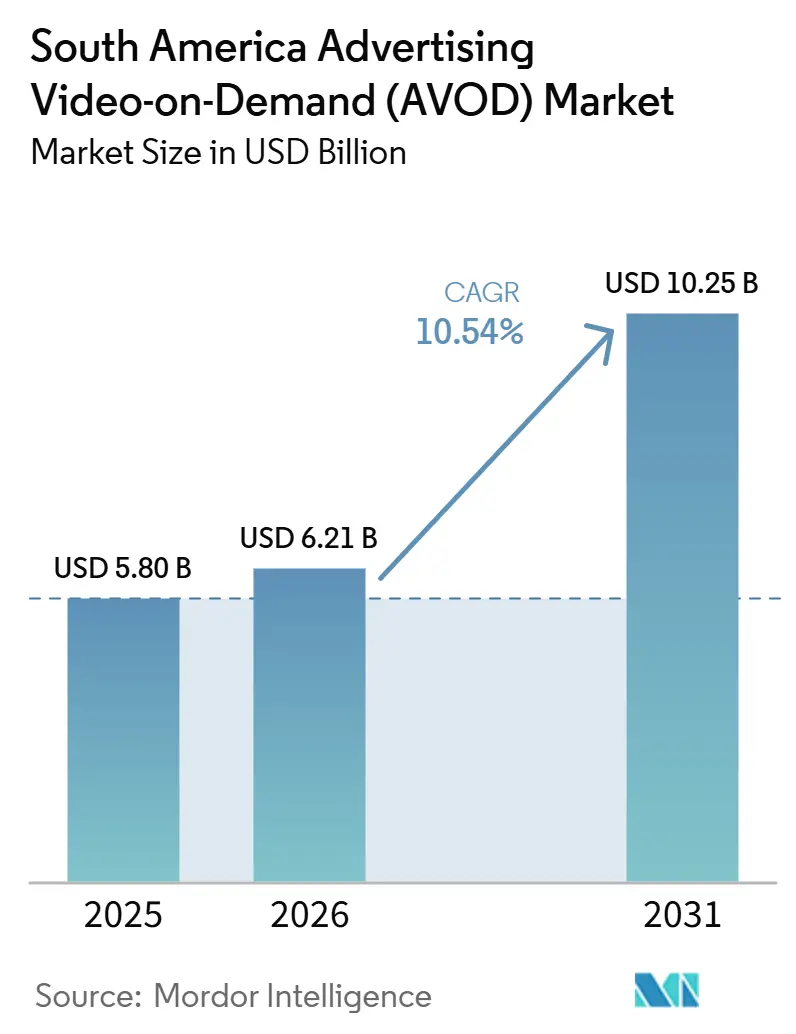
The South America advertising video-on-demand (AVOD) market size was valued at USD 5.80 billion in 2025 and estimated to grow from USD 6.21 billion in 2026 to reach USD 10.25 billion by 2031, at a CAGR of 10.54% during the forecast period (2026-2031). The South America AVOD market is benefiting from a shift in viewing away from pay television and toward ad-funded streaming services. Lower-priced plans are expanding access for price-sensitive households, while advertisers are gaining more places to reach viewers through streaming video. Connected television is becoming more important because it combines large-screen viewing with audience targeting that traditional television cannot provide. Platforms are also using local content, retail media partnerships, and direct ad sales to enhance the value of their inventory. Lower advertising yield, currency volatility, inconsistent measurement, and piracy remain limits on the South America AVOD market, but they do not change the underlying demand for free video services.
Key Report Takeaways
- By content type, movies and films held 39.41% of the South America advertising video-on-demand (AVOD) market share in 2025, while documentaries are projected to expand at a 10.94% CAGR through 2031.
- By device type, smartphones and tablets accounted for 31.73% of the South America advertising video-on-demand (AVOD) market share in 2025, while smart TVs are expected to grow at a 11.15% CAGR through 2031.
- By end user, media and entertainment accounted for 35.75% of revenue in 2025, while education is projected to grow at a 11.06% CAGR through 2031.
- By ad format, pre-roll ads captured 42.85% of the South America advertising video-on-demand (AVOD) market size in 2025, while mid-roll ads are expected to expand at a 11.25% CAGR through 2031.
- By geography, Brazil held 49.71% of South America advertising video-on-demand (AVOD) market size in 2025, while Colombia is projected to grow at a 11.21% CAGR through 2031.
Note: Market size and forecast figures in this report are generated using Mordor Intelligence’s proprietary estimation framework, updated with the latest available data and insights as of January 2026.
South America Advertising Video-on-Demand (AVOD) Market Trends and Insights
Drivers Impact Analysis*
| Driver | (~) % Impact on CAGR Forecast | Geographic Relevance | Impact Timeline |
|---|---|---|---|
| Expansion of Low-Cost Ad-Supported Streaming Tiers | +2.4% | Global, with the strongest gains in Brazil and Colombia | Short term (≤ 2 years) |
| Migration of Linear Television Budgets to CTV Inventory | +2.0% | Brazil, with early adoption in Argentina and Chile | Medium term (2-4 years) |
| Growth of Smart TV and Connected TV Reach | +1.8% | Brazil, Colombia, Argentina, and Chile | Medium term (2-4 years) |
| Mobile-First Viewing and Affordable Data Packages | +1.5% | Peru, Colombia, and Brazil | Short term (≤ 2 years) |
| Retail Media and Streaming Commerce Convergence | +1.2% | Brazil, Argentina, and Colombia within MercadoLibre’s footprint | Medium term (2-4 years) |
| Local-Language and Regional Content Monetization | +1.0% | Brazil and Spanish-speaking South America | Long term (≥ 4 years) |
| Source: Mordor Intelligence | |||
Expansion of Low-Cost Ad-Supported Streaming Tiers
Lower-priced plans have broadened the audience for the South America advertising video-on-demand (AVOD) market more quickly than content spending alone could have. Netflix’s ad-supported plan reached 40% of active accounts across tracked markets in Q3 2025, compared with 26% in Q4 2024, while Disney+ ad-tier use rose from 35% to 44% over the same period.[1]Digital i, “Netflix Drives Global Growth in Ad-Supported Streaming,” Digital i, digital-i.com In 2026, 5 of Brazil's 7 major streaming platforms offered lower-cost, ad-funded access. The growing role of these plans means advertisers are reaching newer and more price-sensitive subscribers rather than a limited secondary audience. Platforms are also selling sponsorships alongside programmatic placements, helping position ad-supported inventory as a more deliberate advertising product. Brazil’s pending audiovisual framework, including a proposed Condecine levy and a 10% local-content requirement, may increase local production spending and strengthen catalog depth over time
Migration of Linear Television Budgets to CTV Inventory
Advertising budgets are moving toward connected TV as brands seek video audiences beyond linear broadcast. Connected TV spending in Brazil reached USD 170 million in 2026, and the country’s connected TV advertising spend is projected to grow by 23.7% this year. Connected TV offers audience-level targeting and viewer profiles, while linear television primarily relies on broader reach metrics. This change requires platforms in the South America advertising video-on-demand (AVOD) market to provide credible, consistent measurement for advertisers. It also encourages broadcasters such as Globo to expand connected TV inventory alongside their broadcast rights. Online video was projected to generate USD 34 billion in South America in 2026, surpassing traditional television revenue for the first time. The change is likely to remain durable because buyers increasingly expect targeting and verification in their video campaigns.
Growth of Smart TV and Connected TV Reach
Connected TV use has moved beyond early adopters and is bringing a broader household audience to the South America advertising video-on-demand (AVOD) market. A Comscore survey conducted across 6 South American countries in September and October 2025 found that 60% of digital users consumed content through connected TV. The region’s smart TV installed base was approaching 193 million units, which expands the possible reach for large-screen advertising. Different operating systems, including Tizen, webOS, and Android TV, make it harder for advertisers to manage reach across screens. A service that secures preinstallation on a major smart TV platform gains a valuable position on the first screen viewers see. This advantage can favor established services over new entrants, particularly in a market where viewers often choose from preloaded apps. The 2026 FIFA World Cup has also encouraged investment in large-screen viewing in Brazil and Colombia, supporting connected TV use in urban households.
Mobile-First Viewing and Affordable Data Packages
Mobile devices remain the main streaming access point for many consumers in Peru, Colombia, and lower-income urban areas of Brazil. Claro Brazil’s Prezão plan offered 12 GB of unrestricted data at BRL 2.50 per GB (USD 0.47 per GB) in Q4 2025. Nubank’s NuCel service offered 30 GB per month for BRL 70 (USD 13.30) on Claro’s 5G network, with 93% national coverage. More affordable data allows viewers to stream away from home rather than restricting use to Wi-Fi sessions. This supports more frequent viewing and greater total viewing time for mobile-focused services such as YouTube and Tubi. Mobile inventory generally earns lower rates than connected TV inventory, so high mobile use can favor audience volume over yield. Mid-roll formats are therefore becoming more useful because they can hold attention better than skippable pre-roll ads during mobile viewing.
Restraints Impact Analysis*
| Restraint | (~) % Impact on CAGR Forecast | Geographic Relevance | Impact Timeline |
|---|---|---|---|
| Low Advertising Yield and Currency Volatility | -1.8% | Argentina, Brazil, Chile, and Peru | Medium term (2-4 years) |
| Fragmented Measurement and Limited Cross-Platform Attribution | -1.4% | Regional, most acute in smaller markets | Medium term (2-4 years) |
| Ad-Load Fatigue and Viewer Churn | -1.0% | Brazil and Argentina | Short term (≤ 2 years) |
| Piracy, Content Leakage, and Weak Copyright Enforcement | -0.8% | Argentina, Brazil, Colombia, and Peru | Long term (≥ 4 years) |
| Source: Mordor Intelligence | |||
Low Advertising Yield and Currency Volatility
Advertising rates in South America are lower than in North America and Western Europe, creating a difficult revenue model for platforms investing in content. Currency depreciation, especially in Argentina, can reduce the USD value of advertising commitments when contracts are renewed in local currencies. The gap is not only a pricing issue, as fewer domestic advertisers can afford the rates charged in larger advertising economies. Lower revenue per viewer-hour can constrain the funds available for content, limiting a platform’s ability to attract premium audiences. Some platforms are responding through retail-media partnerships that link advertising exposure to commerce data and measurable outcomes. This approach may support higher-value placements without relying solely on audience size. Mercado Libre reported that advertising revenue rose 73% year over year in USD terms in Q1 2026, showing the appeal of commerce-linked advertising tools in the region.
Fragmented Measurement and Limited Cross-Platform Attribution
Inconsistent measurement across video platforms can make advertisers cautious about expanding budgets in the South America advertising video-on-demand (AVOD) market. A 2025 survey of 166 commerce media buyers in Mexico, Argentina, Chile, Colombia, and Peru found that marketers lacked consistent standards, unified campaign management, and complete digital-to-physical attribution. CENP published its Cross-Media Measurement Guide in Brazil in June 2026 to establish metrics for linear television, YouTube, streaming services, and social media. The guide responds to the risk of counting the same viewer more than once across screens. Netflix’s 2025 partnership with Kantar Ibope Media in Brazil validated the campaign audience for its own inventory, but it did not resolve regional cross-platform attribution. MiQ introduced its Sigma programmatic platform in South America in June 2026 to address fragmented consumer signals across streaming, social media, e-commerce, and connected TV. Wider adoption of common standards remains necessary before many advertisers are likely to place larger multi-market video budgets.
*Our forecasts treat driver/restraint impacts as directional, not additive. The impact forecasts reflect baseline growth, mix effects, and variable interactions.
Segment Analysis
By Content Type: Film Libraries Support Revenue While Documentaries Lead Growth
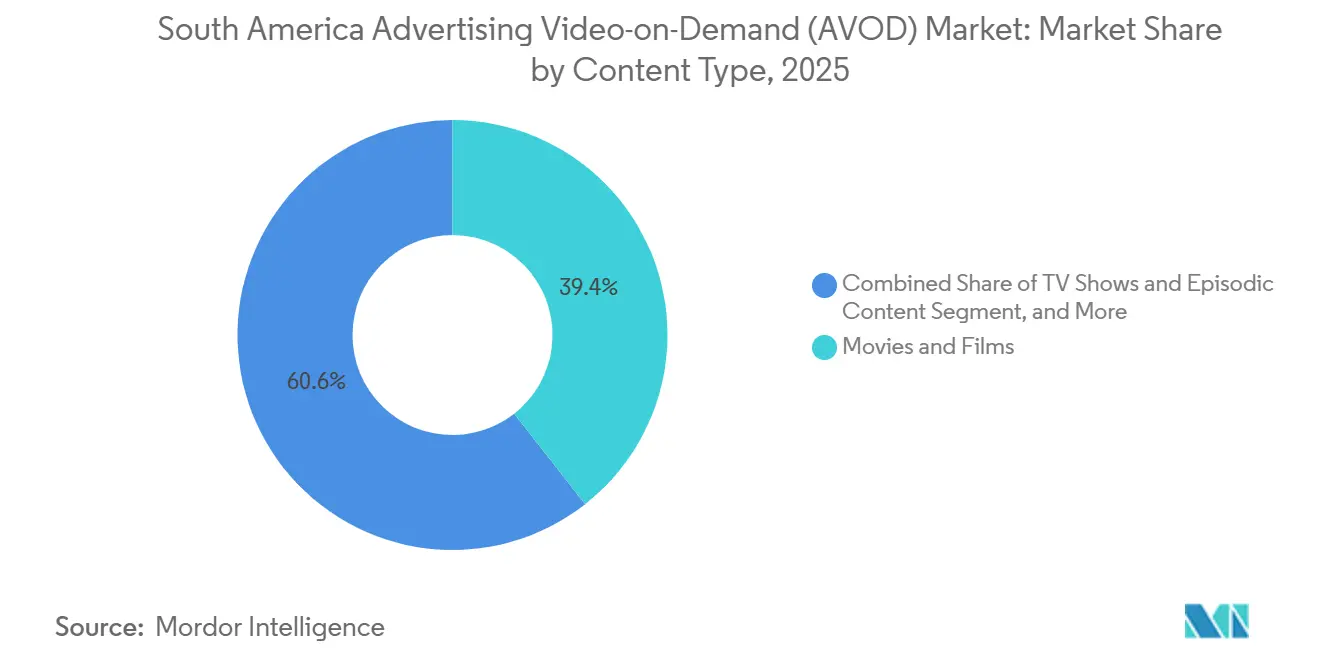
Movies and films held 39.41% of the South America advertising video-on-demand (AVOD) market share in 2025, making them the largest content type in the region. Film libraries help services start viewing sessions and maintain viewing time. YouTube, Amazon, and Tubi use extensive film catalogs to attract audiences without requiring large original production budgets. Encripta S/A’s free film distribution activity on YouTube reached 77.2 million unique monthly users and generated BRL 20 million (USD 3.8 million) in the 12 months ending July 2026. Advertising accounted for 30% of the company’s revenue during that period. The company was targeting BRL 30 million (USD 5.7 million) for the full year of 2026 and was testing vertical video formats.
Documentaries are projected to record the fastest content-type growth at a 10.94% CAGR from 2026 to 2031. Brazilian true-crime and social documentaries have become useful formats for services seeking content that works locally and can travel to other markets. Netflix added 55 Brazilian titles in 2025, while viewing of national content on the platform increased 39% in hours watched globally during the preceding 12 months. Television shows and episodic content do not have the largest share, but they can create the longest viewing sessions. Longer sessions increase the number of available advertising impressions per viewer. They also create more suitable places for mid-roll advertising. Licensing Brazilian theatrical titles can cost less per viewing hour than commissioning original content, which supports catalog depth and the economics of the South America advertising video-on-demand (AVOD) market.



By Device Type: Mobile Viewing Remains Large While Smart TVs Improve Advertising Value
Smartphones and tablets accounted for 31.73% of the South America advertising video-on-demand (AVOD) market in 2025. This position reflects mobile-first viewing across large parts of the region. Affordable data and high smartphone use in Brazil and Colombia have supported video consumption on smaller screens. Television shows, sports, and short-form vertical video are particularly suited to mobile use. YouTube and related video services have benefited from their long-standing mobile design and distribution. Laptops, desktops, and other devices accounted for the remaining share, though their share is weakening as mobile and smart TV viewing become more common.
Smart TVs are expected to grow at an 11.15% CAGR from 2026 to 2031, the fastest rate among device types. A 2025 Comscore survey across 6 South American markets found that 97% of connected TV viewers owned a smart TV. Large-screen viewing can bring higher advertising rates than mobile placements because it supports household viewing and brand-oriented campaigns. Household-level audience measurement is improving the case for shifting television budgets to connected TV. MercadoLibre launched Mercado Play on more than 70 million smart TVs in Q1 2025 across Samsung Tizen, LG webOS, Android TV, and Google TV.[2]Mercado Libre, “Mercado Play Available for Free on Smart TVs Across Latin America,” Mercado Libre News, mercadolibre.com The service reached 4 million monthly viewers and offered more than 15,900 hours of free ad-supported content.
By End User: Media and Entertainment Holds the Largest Position While Education Expands Fastest
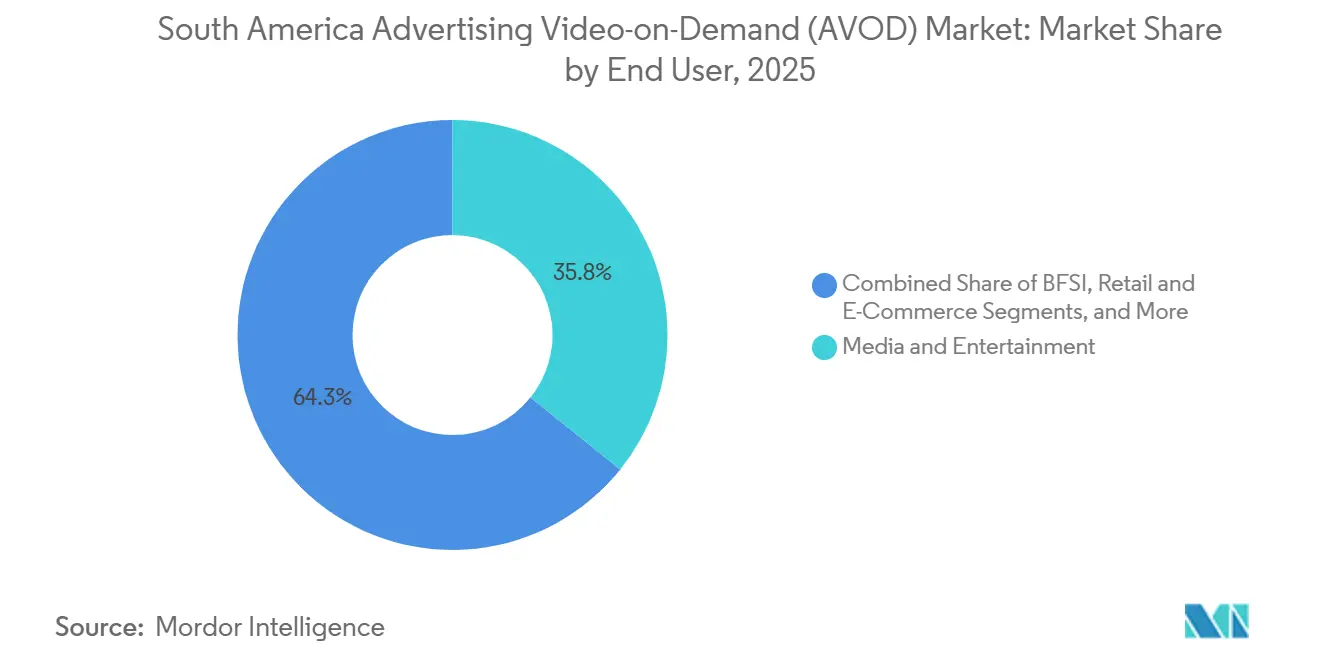
Media and entertainment accounted for 35.75% of the South America advertising video-on-demand (AVOD) market in 2025. Entertainment advertisers fit naturally into video environments because they can promote films, television, music, games, and streaming releases to engaged viewers. Studio campaigns and cross-promotion also benefit from the context that many other advertising categories cannot match. Retail and e-commerce are another important user group because platforms can use purchase-intent data for performance-based placements. Mercado Ads reported 73% year-over-year growth in advertising revenue in Q1 2026, reflecting the value of commerce data alongside video inventory. Financial services brands in Brazil and Colombia are also expanding video advertising to reach consumers considering digital financial products.
Education is projected to grow at an 11.06% CAGR from 2026 to 2031, the fastest rate among end-user groups. E-learning platforms in Brazil and Colombia are using ad-supported models to offer free course material. Universities and certification bodies are also placing educational videos within ad-funded distribution channels. IT, telecommunications, healthcare, and other end users contribute additional spending across the South America advertising video-on-demand (AVOD) market. Telefónica and América Móvil can use video placements to promote mobile-data bundles. This creates a link between the advertising product and the connectivity needed to watch content. The arrangement can support both streaming use and subscriber acquisition for telecommunications brands.
By Ad Format: Pre-Roll Is Largest While Mid-Roll Gains Momentum
Pre-roll ads captured 42.85% of the South America advertising video-on-demand (AVOD) market in 2025, making them the largest advertising format by revenue. Most AVOD services built their early advertising systems around pre-roll inventory. The format fits brand awareness campaigns because it can provide a clear impression before viewers start the content. Pre-roll placements are familiar to advertisers and easy to package into existing video-buying plans. Post-roll represented the smallest of the 3 formats because many viewers leave once their selected content ends. This behavior limits the practical audience for a post-roll message.
Mid-roll ads are projected to advance at an 11.25% CAGR from 2026 to 2031. Growth in documentaries, television series, and longer films is creating more natural breaks within content. Viewers already engaged in a program are more likely to complete a mid-roll placement than those deciding whether to begin a piece of content after a pre-roll. The original material indicates mid-roll completion rates of 70%-85%, compared with 60%-70% for pre-roll ads. Longer viewing sessions can also increase advertising revenue per session and partially offset the lower regional advertising yield. The shift toward mid-roll suggests that viewers are becoming more familiar with advertising as an exchange for no-cost content. It also gives the South America advertising video-on-demand (AVOD) market more ways to manage ad load without relying on a single placement format.
Geography Analysis
Brazil held 49.71% of the South America advertising video-on-demand (AVOD) market in 2025 and remains the region’s largest national market. AVOD accounted for 37% of Brazil’s total streaming revenue, which indicates that advertising already plays a substantial role in funding streaming services. Brazil was the world’s 3rd-largest FAST market by revenue, with USD 152 million in FAST revenue. Connected TV advertising investment in Brazil reached USD 170 million in 2026. Connected TV advertising spending in the country is projected to increase 23.7% in 2026. The Brazilian government launched Tela Brasil in May 2026 as a free AVOD service with 555 locally produced films and series.
The service added publicly funded local content without requiring subscriber acquisition. Brazil’s proposed audiovisual framework includes a Condecine streaming levy and a minimum 10% Brazilian-content quota. Those measures could direct more platform spending toward domestic production. Colombia is projected to achieve the highest national growth rate, with a 11.21% CAGR from 2026 to 2031. The country is expected to add 1.6 million fixed broadband lines during the forecast period, while SVOD subscriptions are projected to increase 26% over 5 years.
IAB Colombia described 2026 as a period of change in digital video consumption, with faster adoption of AVOD and FAST services and more advertising moving to digital video.[3]Interactive Advertising Bureau Colombia, “Colombia Impulsa una Nueva Etapa del Video Digital,” IAB Colombia, iabcolombia.com Colombia requires video-on-demand providers to show a visible section for Colombian content, which can support local licensing and viewer engagement. Argentina has high streaming density but currency and economic volatility that limits advertising rates. Chile has mature subscription streaming use, with Netflix reaching more than 40% of television households, which shifts competition toward monetization. Peru has lower household broadband coverage but strong mobile streaming in Lima and coastal cities. Ecuador, Bolivia, Uruguay, and Paraguay remain earlier-stage markets where infrastructure limits current scale, but early platform distribution can support later growth.
Competitive Landscape
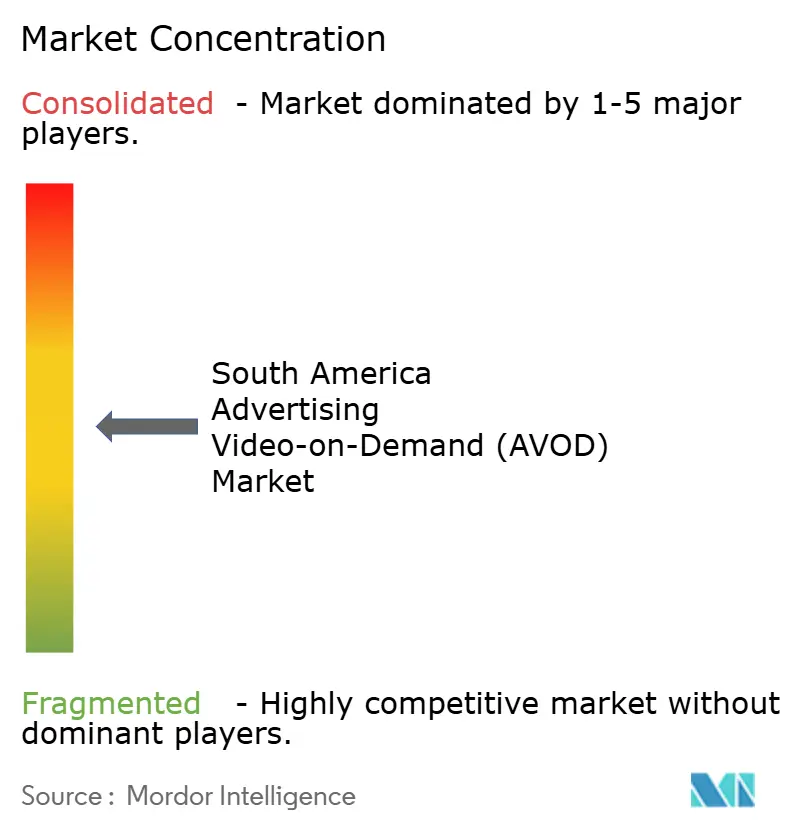
The South America advertising video-on-demand (AVOD) market is moderately consolidated. The Walt Disney Company, Netflix, and Amazon hold strong positions through content libraries, technology, and advertising infrastructure. Netflix accounted for nearly 50% of streaming revenue in South America. Its global advertising revenue nearly doubled in 2025, and the company targeted USD 3 billion from advertising in 2026. ViX and Globoplay compete by offering Spanish- and Portuguese-language programming that global platforms cannot always produce with the same local depth.
MercadoLibre is a distinctive entrant because it combines Mercado Play with first-party commerce data through Mercado Ads. Mercado Ads grew 4 times faster than the regional advertising market in 2025. In June 2026, the company announced TikTok advertising integration and shoppable video across social, streaming, and connected TV environments. These formats connect video exposure to purchase completion inside the Mercado Libre ecosystem. Its ML_ID identity system is intended to link audience journeys across devices and platforms to commerce outcomes. This capability can appeal to advertisers seeking measurable results rather than reach alone.
Anti-piracy activity in 2025 and 2026 removed hundreds of illegal streaming applications and reduced counterfeit inventory competing with legitimate services.[4]Brazil Ministry of Justice and Public Security, “Operation 404.8,” Brazil Ministry of Justice and Public Security, gov.br Such action can improve the environment for compliant AVOD platforms, even though piracy has not been eliminated. Opportunities remain in retail video for financial services and healthcare advertisers using performance-focused mid-roll placements. Opportunities also exist in smaller South American countries where no platform has a commanding local position. Canela Media and Plex are building niche audiences with culturally specific programming. The South America advertising video-on-demand (AVOD) market, therefore, combines powerful global services with regional specialists and commerce-based competitors.
South America Advertising Video-on-Demand (AVOD) Industry Leaders
Alphabet Inc.
The Walt Disney Company
Paramount, a Skydance Corporation
Roku, Inc.
Amazon.com, Inc.
- *Disclaimer: Major Players sorted in no particular order

Recent Industry Developments
- July 2026: Globo Comunicação e Participações S.A. signed broadcast agreements to expand its telenovela remake "Anything Goes" (Vale Tudo) to Chile via Canal 13 and to Peru via Panamericana TV, marking Globo's return to Chilean first-run telenovela programming and extending its South America content distribution footprint.
- June 2026: Mercado Ads (MercadoLibre Inc.) announced at Cannes Lions 2026 the integration of TikTok's ad inventory into the Mercado Ads platform and the launch of shoppable video formats across social, streaming, and CTV environments, enabling brands to link video ad impressions to verified in-platform purchase completion without redirecting users away from content.
- May 2026: Netflix Inc. unveiled 5 new Brazilian productions at Rio2C 2026, extending its active South American development pipeline to 17 titles across 2026 and 2027. The announcement reinforced Netflix's commitment to local-language originals as both a subscriber-retention and an AVOD ad-inventory enrichment strategy.
- May 2026: Mercado Libre reported Q1 2026 advertising revenue growth of 73% YoY in USD, with Mercado Ads described as the fastest-growing advertising player in South America, having grown 4x the regional market rate in 2025. AI-powered ad setup, targeting, and measurement tools drove higher seller activation and per-seller ad spend.


South America Advertising Video-on-Demand (AVOD) Market Report Scope
The South America Advertising Video-on-Demand (AVOD) Market refers to streaming video services that offer users free or low-cost access to content supported by advertising. The scope of the report covers AVOD platforms and services across South America, analyzing market trends, growth drivers, challenges, competitive landscape, and key developments influencing the market.
The South America Advertising Video-on-Demand (AVOD) Market Report is Segmented by Content Type (Movies and Films, TV Shows and Episodic Content, Documentaries, and Other Content Types), Device Type (Smartphones and Tablets, Smart TVs, Laptops and Desktops, and Other Device Types), End User (Media and Entertainment, Retail and E-Commerce, BFSI, Education, Information Technology and Telecommunications, Healthcare, and Other End Users), Ad Format (Pre-Roll, Mid-Roll, and Post-Roll), and Geography (Brazil, Argentina, Colombia, Chile, Peru, and Rest of South America). The Market Forecasts are Provided in Terms of Value (USD).
| Movies and Films |
| TV Shows and Episodic Content |
| Documentaries |
| Other Content Types |
| Smartphones and Tablets |
| Smart TVs |
| Laptops and Desktops |
| Other Device Types |
| Media and Entertainment |
| Retail and E-Commerce |
| BFSI |
| Education |
| Information Technology and Telecommunications |
| Healthcare |
| Other End Users |
| Pre-Roll |
| Mid-Roll |
| Post-Roll |
| Brazil |
| Argentina |
| Colombia |
| Chile |
| Peru |
| Rest of South America |
| By Content Type | Movies and Films |
| TV Shows and Episodic Content | |
| Documentaries | |
| Other Content Types | |
| By Device Type | Smartphones and Tablets |
| Smart TVs | |
| Laptops and Desktops | |
| Other Device Types | |
| By End User | Media and Entertainment |
| Retail and E-Commerce | |
| BFSI | |
| Education | |
| Information Technology and Telecommunications | |
| Healthcare | |
| Other End Users | |
| By Ad Format | Pre-Roll |
| Mid-Roll | |
| Post-Roll | |
| By Geography | Brazil |
| Argentina | |
| Colombia | |
| Chile | |
| Peru | |
| Rest of South America |


Key Questions Answered in the Report
What is the South America advertising video-on-demand (AVOD) market size?
The South America advertising video-on-demand (AVOD) market size is estimated at USD 6.21 billion in 2026 and is projected to reach USD 10.25 billion by 2031, at a 10.54% CAGR.
What is driving ad-supported video growth in South America?
Lower-priced streaming plans, growing connected TV use, mobile viewing, and advertising budget migration from linear television are supporting expansion.
Which content type has the largest position in South America AVOD?
Movies and films held a 39.41% share in 2025, supported by extensive film libraries and strong viewer demand for free content.
Which device type is growing fastest for AVOD viewing?
Smart TVs are projected to grow at an 11.15% CAGR through 2031 because large-screen viewing supports higher-value advertising.
Which country leads South American AVOD revenue?
Brazil led with 49.71% of regional revenue in 2025, supported by its large streaming base and connected TV advertising activity.
What limits AVOD growth in South America?
Lower advertising rates, currency volatility, fragmented measurement, ad-load fatigue, and piracy can restrict revenue growth and advertiser confidence.
Page last updated on:





