
South America 5G Technology Market Size and Share
Market Overview
| Study Period | 2020 - 2031 |
|---|---|
| Forecast Data Period | 2026 - 2031 |
| Base Year Market Size (2025) | USD 6.35 Billion |
| Market Size (2026) | USD 7.45 Billion |
| Market Size (2031) | USD 15.99 Billion |
| Growth Rate (2026 - 2031) | 16.50 % |
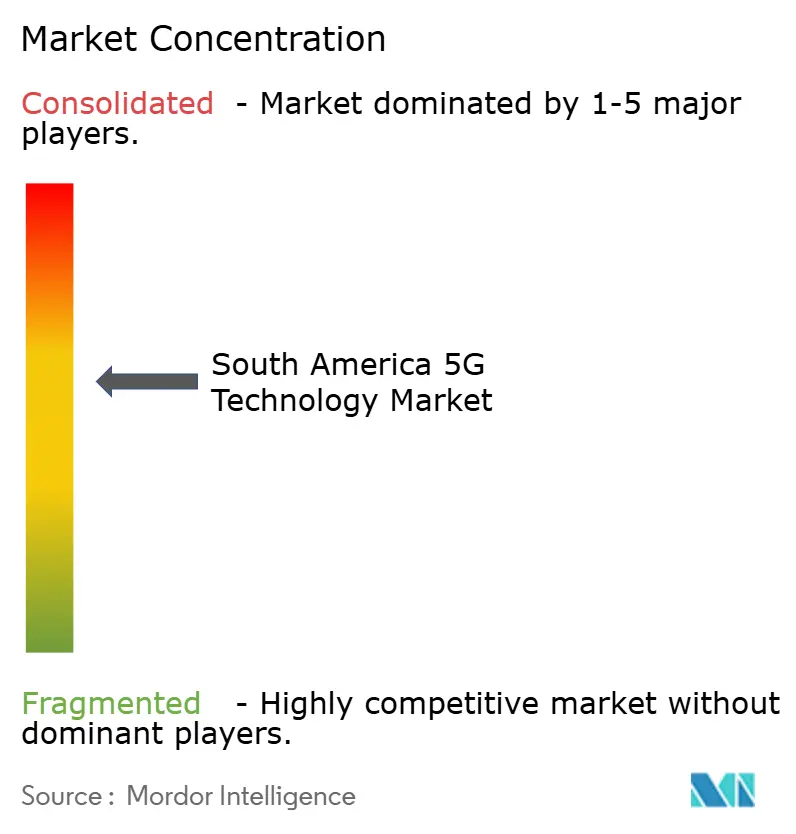
| Market Concentration | Medium |
Major Players *Disclaimer: Major Players sorted in no particular order Image © Mordor Intelligence. Reuse requires attribution under CC BY 4.0. | |
South America 5G Technology Market Analysis by Mordor Intelligence
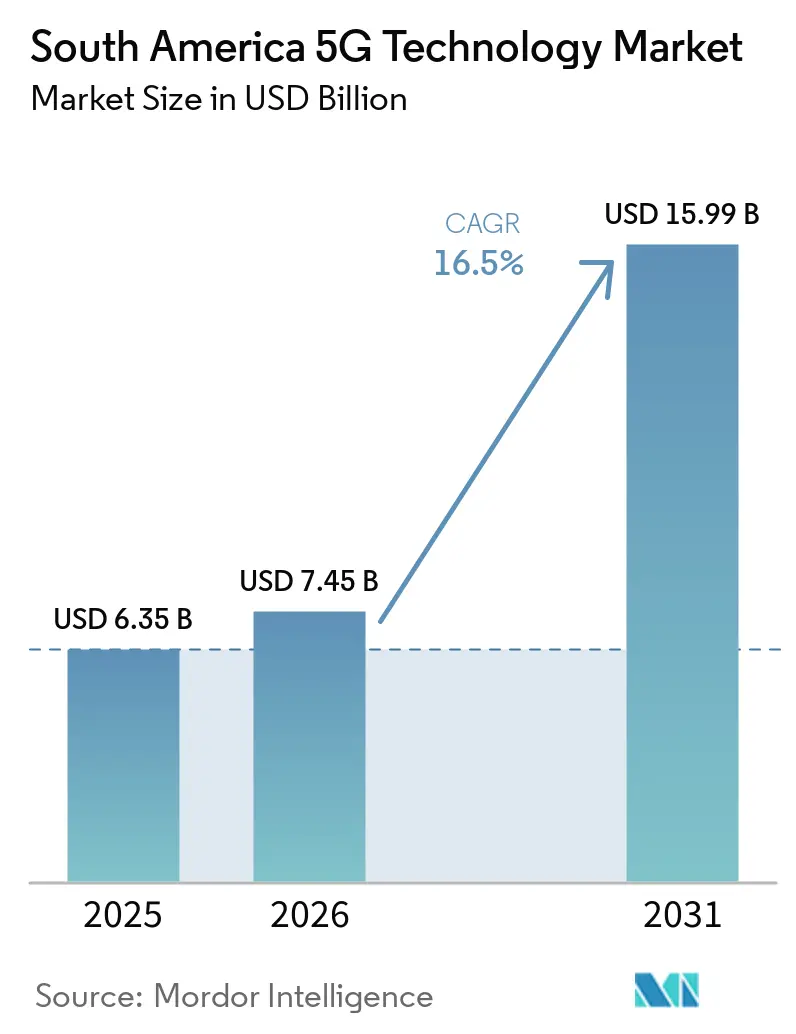
The South America 5G Technology Market size is projected to be USD 6.35 billion in 2025, USD 7.45 billion in 2026, and reach USD 15.99 billion by 2031, growing at a CAGR of 16.50% from 2026 to 2031. Mandatory coverage obligations are moving network deployment beyond a purely commercial decision in Brazil. This creates a steadier equipment and service pipeline than voluntary rollout programs, because site construction follows publicly defined coverage milestones and does not depend solely on immediate consumer returns. Operators are also shifting toward cloud-native cores and software-based network operations. That shift supports enterprise services and reduces reliance on consumer mobile data alone, particularly where customers need dedicated connectivity, network management, or low-latency operational support. Private networks, fixed wireless access, and stand-alone architecture are widening the South America 5G technology market opportunity across the region, with each area creating demand that goes beyond traditional consumer mobile broadband.
Key Report Takeaways
- By component, hardware held 50.35% of the South America 5G Technology Market share in 2025, while services are projected to expand at an 18.35% CAGR through 2031.
- By spectrum band, sub-6 GHz held 68.90% of the South America 5G technology market share in 2025, while hybrid configurations are projected to expand at an 18.80% CAGR through 2031.
- By application, enhanced mobile broadband (eMBB) accounted for 41.21% of the South America 5G technology market size in 2025, while fixed wireless access (FWA) is projected to expand at an 18.69% CAGR through 2031.
- By end-user industry, the consumer segment held 45.88% of the South America 5G technology market share in 2025, while manufacturing is projected to expand at an 18.85% CAGR through 2031.
- By network architecture, non-stand-alone (NSA) architecture accounted for 73.12% of the South America 5G technology market in 2025, while stand-alone (SA) architecture is projected to expand at a 19.25% CAGR through 2031.
- By country, Brazil held 61.89% of South America's 5G technology market share in 2025, while Argentina is projected to expand at an 18.59% CAGR through 2031, reflecting its later rollout position and the prospect of further investment following spectrum allocation, despite immediate pressure on capital budgets and consumer purchasing power.
Note: Market size and forecast figures in this report are generated using Mordor Intelligence’s proprietary estimation framework, updated with the latest available data and insights as of January 2026.
South America 5G Technology Market Trends and Insights
Drivers Impact Analysis*
| Driver | (~) % Impact on CAGR Forecast | Geographic Relevance | Impact Timeline |
|---|---|---|---|
| Rising 5G Network Rollout Across Major South American Economies | +5.0% | Brazil, Argentina, Chile, Colombia, Peru | Short term (≤ 2 years) |
| Expanding Enterprise Demand for Low-Latency Connectivity | +2.9% | Brazil, Chile, Peru | Medium term (2-4 years) |
| Growth in Fixed Wireless Access for Broadband Underserved Areas | +2.4% | Brazil, Argentina, Rest of South America | Short term (≤ 2 years) |
| Telecom Virtualization and Cloud-Native Core Modernization | +1.8% | Brazil, Argentina | Medium term (2-4 years) |
| Private 5G Adoption in Mining, Ports, and Industrial Corridors | +1.4% | Brazil, Chile, Peru | Long term (≥ 4 years) |
| Spectrum Refarming and New Auction Programs Supporting Capacity Expansion | +1.1% | Brazil, Chile, Argentina | Medium term (2-4 years) |
| Source: Mordor Intelligence | |||
Rising 5G Rollout Across Major South American Economies
Brazil’s spectrum obligations have made 5G rollout a phased statutory requirement for operators, connecting license conditions to deployment deadlines and making network extension a formal part of the operating environment. Anatel requires service in 30% of municipalities below 30,000 residents by December 2026. The requirement rises to universal coverage by 2029. 5G had reached 1,966 municipalities by early 2026. The Ministry of Communications expects service to be available in more than 2,220 cities by the end of 2026. TIM Brasil approved Huawei and Nokia supply contracts for more than 6,500 4G and 5G sites during January 2026.[1]TIM S.A., “Current Report Form 6-K, Board of Directors Decisions, January 21, 2026,” SEC, stocktitan.net These obligations support demand for radio access networks and fixed wireless access in locations with limited commercial appeal, while giving suppliers clearer timing for equipment deliveries, installation work, and service contracts.
Expanding Enterprise Demand for Low-Latency Connectivity
Enterprise deployment is moving from trials toward operational networks in mining, ports, energy, and manufacturing, where the commercial case rests on better monitoring, more dependable communications, automation, and site-specific network control. Nokia expanded its TIM Brasil partnership across 14 additional states in March 2026.[2]Nokia, “Nokia Expands Partnership with TIM Brasil to Deliver Next-Generation AI-Ready 5G Network with NVIDIA,” Nokia Newsroom, nokia.com The coverage reaches 42% of Brazil’s population. The program supports network slicing, image analysis, voice recognition, and autonomous operations. Nokia uses Habrok Massive MIMO radios and NVIDIA AI-RAN computing in the deployment. Vale, Petrobras, Gerdau, AXIA Energia, and Flex have commissioned private networks in Brazil. Their activity makes private wireless connectivity a planned capital investment rather than an experimental technology. This demand gives the South America 5G technology market a path to recurring enterprise revenue, since industrial customers require deployment support, ongoing optimization, secure operations, and connectivity tailored to specific sites.
Growth in Fixed Wireless Access for Broadband-Underserved Areas
Fixed wireless access is becoming a practical fiber alternative in rural and peri-urban locations, because it can use new mobile coverage without requiring every household or school to receive a dedicated fiber connection. A 2025 trial involved Brazil’s Ministry of Communications, CPQD, Qualcomm, Brisanet, Intelbras, and Beenoculus. The trial covered 3 rural schools in Rio Grande do Norte. Outdoor 5G equipment delivered internet speeds comparable to fiber-optic speeds.[3]Brazil Ministry of Communications and CPQD, “Brazil Tests Find 5G FWA Viable Alternative to Fibre for Rural Schools,” Telecompaper, telecompaper.com Claro Argentina introduced commercial 5G fixed wireless access in Buenos Aires, Cordoba, and provincial capitals. Its 100 Mbps plan costs ARS 17,000 (USD 12) per month. New radio sites can serve mobile users and fixed wireless customers through shared transport infrastructure. That dual use improves deployment economics in areas where fixed networks remain difficult to justify, because operators can use coverage investments for household connectivity as well as for mobile service provision.
Telecom Virtualization and Cloud-Native Core Modernization
Cloud-native core migration is shifting network spending from hardware-led programs to software and operations programs, as operators seek more flexible core functions and need partners to manage integration across cloud environments. Vivo moved its IT production environment to Red Hat OpenShift in 2025. It also validated AWS Outposts for a 5G stand-alone core with Mavenir, Nokia, and Oracle. The validation showed that a distributed, multivendor design could meet stand-alone performance needs. Claro Brasil launched the Claro uStore hybrid cloud platform in March 2026. The platform uses AWS Outposts and Claro’s cloud management layer. It provides unified multicloud governance and data management for enterprise clients. These designs increase demand for integration, automation, and managed network services across the South America 5G technology market, as operators coordinate applications and network functions across distributed infrastructure.
Restraints Impact Analysis*
| Restraint | (~) % Impact on CAGR Forecast | Geographic Relevance | Impact Timeline |
|---|---|---|---|
| Uneven Spectrum Availability and High Auction Complexity | -2.8% | Argentina, Chile, Peru, Bolivia, Ecuador | Medium term (2-4 years) |
| Elevated Rural Backhaul and Fiber Deployment Costs | -2.2% | Brazil interior, Andean countries, Amazon Basin | Long term (≥ 4 years) |
| Macroeconomic Pressure on Operator Capex and Device Affordability | -1.6% | Argentina, Brazil, Colombia | Short term (≤ 2 years) |
| Slow Monetization Beyond Consumer Mobile Broadband | -1.0% | South America-wide | Medium term (2-4 years) |
| Source: Mordor Intelligence | |||
Uneven Spectrum Availability and Auction Complexity
South American spectrum rules create different rollout conditions across national markets, so equipment suppliers and operators face different auction schedules, licensing terms, spectrum availability, and technical conditions from one country to another. Brazil and Chile have moved earlier, while other countries remain at earlier stages. Chile was conducting a consultation on the remaining 3.5 GHz allocations in early 2026. Brazil also opened a public consultation on the 6 GHz band. These processes extend the period between spectrum planning and physical deployment. Each delay can postpone the availability of devices and enterprise service launches. Argentina, Peru, Ecuador, and Bolivia also apply different technical and procedural requirements. Vendors, therefore, need country-specific compliance work instead of standardized regional designs, which can slow procurement, complicate project planning, and limit the immediate benefits of a region-wide equipment approach.
Elevated Rural Backhaul and Fiber Deployment Costs
Rural 5G extension faces limited fiber availability, difficult terrain, and dispersed populations, creating a gap between national coverage objectives and the practical costs of backhaul, construction, power, maintenance, and transport infrastructure. These conditions raise transport costs beyond standard investment-return thresholds. The Amazon Basin and the Andean countries face especially difficult fiber deployment conditions. Fixed wireless access can help, but it still needs reliable mid-haul connectivity. Neoenergia is using private LTE in the 450 MHz band across Brasilia. The program targets concession-wide coverage by 2028 and digitization of 90% of high- and medium-voltage networks by 2030. A 2026 study found that Open RAN can reduce total ownership costs in rural Brazilian eHealth settings. The study also found that integration costs remain a material upfront requirement.[4]Rodrigo Figueiredo et al., “Integrated Technical and Economic Analysis of Open RAN for Remote eHealth in Brazil,” Journal of Internet Services and Applications, doi.org Neutral-host and network-as-a-service models remain at an early commercial stage across the region, leaving many operators responsible for the initial financing and technical coordination of coverage extensions.
*Our forecasts treat driver/restraint impacts as directional, not additive. The impact forecasts reflect baseline growth, mix effects, and variable interactions.
Segment Analysis
By Component: Hardware Leads Initial Deployment, While Services Expand Fastest
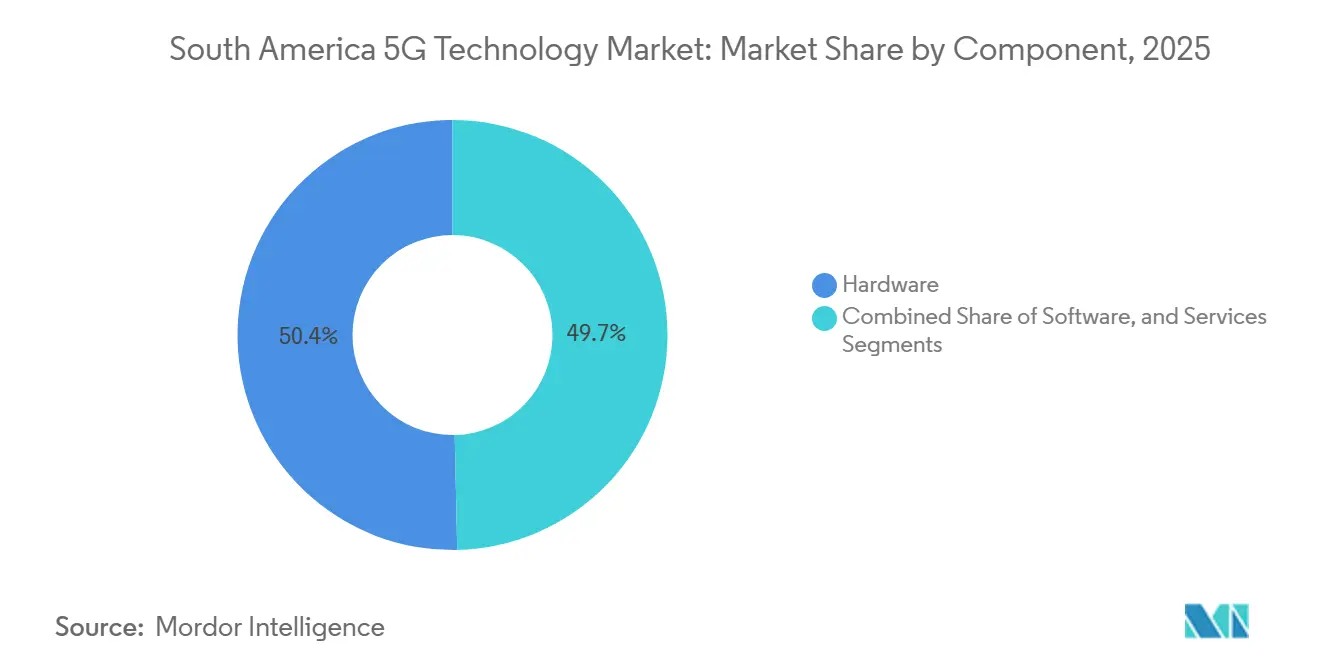
Hardware accounted for 50.35% of the South America 5G technology market in 2025, reflecting the early rollout stage, when operators needed large volumes of radio equipment before service and software revenues could become more prominent. The first deployment phase required base stations, antennas, and radio units at scale, with coverage programs demanding physical infrastructure before operators can offer more advanced service capabilities. Brazilian coverage obligations sustained this equipment requirement. Argentina’s early deployment program also supported demand for hardware. Software is becoming increasingly important as operators modernize OSS/BSS systems, because newer networks require coordinated provisioning, customer support, billing processes, and service assurance across multiple technology layers. Cloud-native network functions also require software investment. Nokia’s MantaRay SON supports automated network management. The component mix is therefore moving beyond radio equipment alone, as operators need systems that coordinate provisioning, service assurance, automation, and core-network functions alongside physical infrastructure.
Services are projected to expand at an 18.35% CAGR from 2026 to 2031. Operators need specialist support for deployment, optimization, and managed operations. Nokia’s TIM Brasil agreement includes AirScale installation and MantaRay SON automation services. It also includes enterprise solution development across 14 Brazilian states. Stand-alone networks require SIM migration and core configuration work. They also require radio-to-core latency optimization. Open RAN can make hardware interfaces more interchangeable. Service delivery and software integration, therefore, become more important to contract value, since customers need compatible systems, operational continuity, and technical support after the initial network installation is completed.



By Spectrum Band: Sub-6 GHz Supports Coverage, While Hybrid Networks Add Capacity
Sub-6 GHz accounted for 68.90% of the South America 5G technology market in 2025, underscoring the priority given to coverage and usable propagation across a region where commercial and geographic conditions vary widely. The band provides useful coverage in dense cities and rural areas. This suits South America’s varied geography, which includes dense metropolitan areas, distant municipalities, rural communities, mountainous territory, and industrial locations with very different coverage needs. Brazil assigned 3.5 GHz spectrum nationally in its 2021 auction. Claro, Vivo, and TIM received national allocations. Anatel also awarded 700 MHz lots during May 2026. The awards included investment obligations for underserved locations and federal highways. This layered spectrum approach supports coverage before higher-capacity overlays become widespread, allowing operators to extend service beyond central urban areas while planning additional capacity for dense locations.
Hybrid configurations are projected to expand at an 18.80% CAGR from 2026 to 2031. Operators combine sub-6 GHz macro coverage with mmWave capacity in dense settings. Stadiums and enterprise locations are early use cases for mmWave, where large numbers of users or data-intensive industrial functions can justify focused capacity investment and specialized network design. More than 150 commercial mmWave-capable devices were available by June 2025. The total was 21 at the end of 2019. The GSMA estimates that each market will need 2 GHz of mid-band spectrum by 2030. Chile, Argentina, and Peru therefore face longer-term capacity constraints. Hybrid networks provide a practical way to match coverage and concentrated traffic demand, because each spectrum layer can be used where its propagation and capacity characteristics are most useful.
By Application: Enhanced Mobile Broadband Leads, While Fixed Wireless Access Gains Ground
Enhanced mobile broadband accounted for 41.21% of the South America 5G technology market in 2025, confirming that consumer smartphone use remained the most developed application, while specialized enterprise uses continued to grow from a smaller base. Smartphone data consumption remains the primary near-term driver of 5G use, as consumer mobile services have the broadest existing subscriber base and can leverage the expanding macro coverage layer. Brazil, Argentina, and Chile have invested heavily in urban macro coverage. These investments support mobile broadband in major population centers. Massive machine-type communications are expanding through industrial IoT. Mining, precision agriculture, and logistics require wide-area sensor coverage, as their operations depend on data from dispersed equipment, vehicles, monitoring systems, and connected assets across large sites. Anatel’s industrial spectrum allocation supports private deployments in the energy and mining sectors. Ultra-reliable low-latency communications remain concentrated in selected industrial locations, where remote control, autonomous operations, and time-sensitive processes can support the additional network engineering requirements.
Fixed wireless access is projected to expand at an 18.69% CAGR from 2026 to 2031. Remote and mountainous communities have limited economic access to fiber. The rural school trial in Rio Grande do Norte supported the technical case for 5G fixed wireless access. Regulators can use the results when considering broadband delivery approaches. Claro Argentina’s 100 Mbps service established a mass-market price point. The service was offered in Buenos Aires, Cordoba, and other provincial capitals. The monthly price was ARS 17,000 (USD 12) at prevailing rates. This pricing places 5G fixed wireless access alongside entry-level fixed broadband options, giving operators a way to offer household connectivity without extending fiber to every low-density customer location.
By End-User Industry: Consumer Use Leads, While Manufacturing Builds Private Network Demand
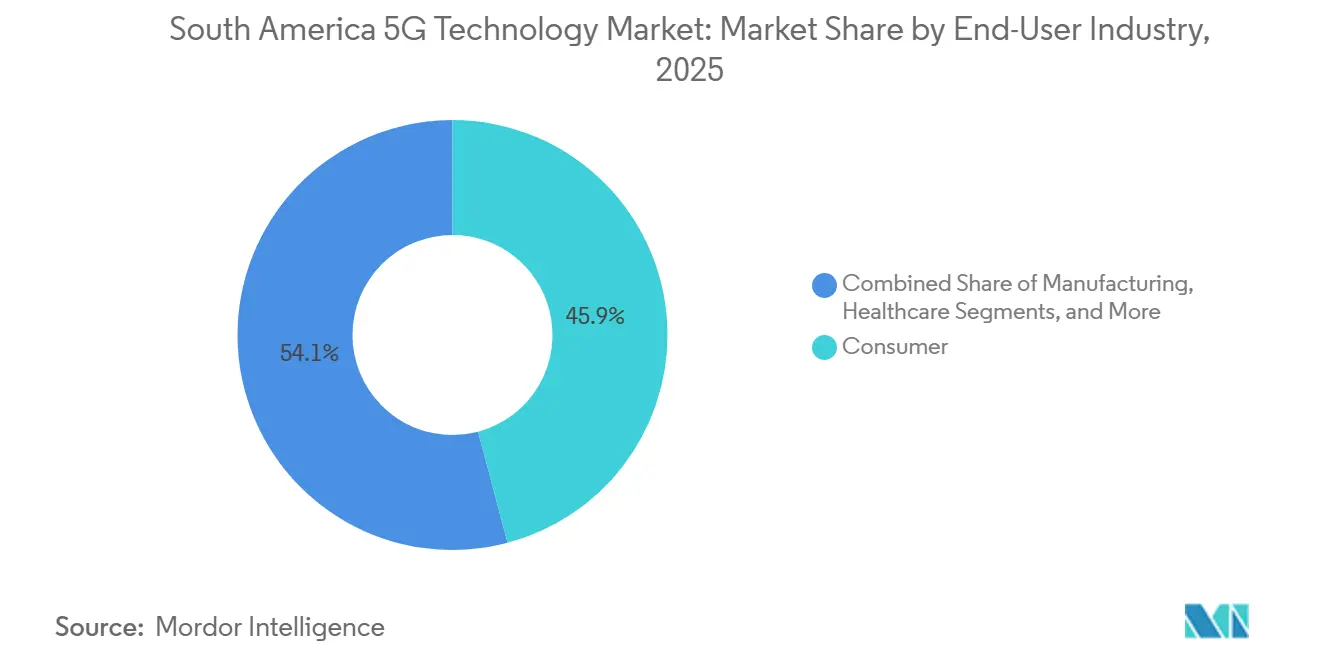
Consumer users accounted for 45.88% of the South America 5G technology market in 2025, as existing mobile subscriptions and demand for faster urban data services continued to provide the main immediate volume for operators. Brazil and Argentina provide much of this base through smartphone subscriptions. Consumer mobile broadband still anchors near-term operator revenue, while the broader service mix gradually evolves through operational applications requiring managed connectivity and higher network performance. Healthcare is building a separate use-case pipeline through diagnostics and connected clinical devices. OpenCare5G at Hospital das Clinicas in Sao Paulo illustrates this activity. Utilities are creating private LTE-to-5G upgrade paths for smart-grid operations, where reliable connections can support equipment monitoring, field communications, maintenance coordination, and wider network visibility. Automotive projects are linked to Sao Paulo’s original equipment manufacturer cluster. Media use is concentrated around live events and stadium connectivity, while public safety and defense agencies remain at an earlier stage of evaluating dedicated command-and-control applications.
Manufacturing is projected to expand at an 18.85% CAGR from 2026 to 2031. Flex installed a private 5G network at its electronics plant in Sorocaba, Sao Paulo. The deployment reduced factory cabling needs and line-reconfiguration downtime. It also accelerated firmware and software downloads. Nokia’s trial at Bio-Manguinhos connected programmable logic controllers at a vaccine plant. The trial team expected the system to prevent interruptions that would affect more than 2 million immunizer doses. Energy, automotive, and healthcare settings show similar operational needs. Public safety and defense projects remain in the early stages. Governments in several countries are considering 5G-based command-and-control systems, though those projects remain less mature than commercial deployments in manufacturing, mining, logistics, and consumer services.
By Network Architecture: Non-Stand-Alone Leads Today, While Stand-Alone Enables Enterprise Services
Non-stand-alone architecture accounted for 73.12% of the South America 5G technology market in 2025, reflecting the practical preference for using established 4G cores as operators extend coverage and manage the cost of a full network transformation. Operators used existing 4G LTE cores to limit early investment, allowing them to add 5G radio coverage while relying on established core systems during the first rollout period. This model supported rapid geographic rollout, especially when operators had to meet coverage obligations and prioritize broader service availability over advanced stand-alone network functions. It also matched regulatory deadlines in Brazil and other countries. Non-stand-alone networks depend on 4G fallback. This limits network slicing and some low-latency functions. The design remains useful while operators widen coverage. It also enables a gradual transition for consumer services, as operators can improve coverage and handset access before committing to the broad availability of a stand-alone service.
Stand-alone architecture is projected to expand at a 19.25% CAGR from 2026 to 2031. Brazil’s 2021 spectrum auction required stand-alone deployment from the start. Vivo and Claro, therefore, gained an earlier basis for core deployment. Vivo used stand-alone and non-stand-alone designs in parallel. Its stand-alone priority remained business-to-business services in 2025. Network slicing and low-latency support stronger service guarantees for enterprise users. Multivendor core designs are also becoming more common. Vivo validated a design with Mavenir, Nokia, Oracle, and AWS. This creates integration opportunities that were less relevant during the non-stand-alone phase, since operators must connect several suppliers, test core functions, and maintain service quality throughout migration.
Geography Analysis
Brazil held 61.89% of the South America 5G technology market share in 2025, reflecting earlier spectrum availability, national coverage requirements, extensive operator activity, and the country’s larger telecom base relative to neighboring markets. Its lead began with the 2021 Anatel auction, which gave operators a broader set of spectrum resources and a clearer regulatory basis for national deployment planning. The auction assigned spectrum in the 3.5 GHz, 2.3 GHz, 700 MHz, and 26 GHz bands. These allocations created coverage layers across national and regional operators. By early 2026, 5G had reached 1,966 municipalities. The Ministry of Communications expects 80% population coverage by the end of 2026. The 700 MHz auction added investment obligations for 864 underserved localities. It also covered 6,500 kilometers of federal highways. Brisanet, Unifique, Amazonia Digital Services, and IEZ received the lots.
TIM Brasil and Nokia expanded 5G modernization across 14 states in March 2026. The area covers 42% of Brazil’s population. The program shows that quality and capacity upgrades are underway before rollout is complete, indicating that leading operators are improving network performance and enterprise readiness while continuing to meet geographic coverage obligations. Brazil also leads in regional private network activity, with large industrial users deploying dedicated connectivity for operations that require reliable coverage, monitoring, automation, and secure local communications. Vale, Petrobras, Gerdau, AXIA Energia, and Flex operate networks in mining, steel, energy, and electronics. These sectors create demand that extends beyond consumer device upgrades, as their operations require site coverage, industrial communications, systems integration, and ongoing network support regardless of household handset replacement cycles. Argentina is projected to expand at an 18.59% CAGR through 2031, reflecting its later rollout position and the prospect of further investment after spectrum allocation, despite immediate pressure on capital budgets and consumer purchasing power. Its later rollout is supported by 3.5 GHz spectrum allocated to Claro, Telecom Personal, and Movistar, giving the country’s major mobile operators a formal spectrum base for broader 5G investment and service planning. Device affordability remains a near-term barrier to consumer adoption, even as enterprise and fixed wireless access use cases face fewer handset-related barriers.
Claro Argentina introduced 5G fixed wireless access in major cities, showing the mobile network investment can also serve household broadband demand where fiber expansion has economic limitations. Nokia also signed a mobile core evolution agreement with Telecom Personal in January 2026. Inflation and currency depreciation constrain operator capital expenditure in Argentina. Enterprise and fixed wireless access services face lower device-cost barriers. The Rest of South America includes Chile, Colombia, Peru, Ecuador, Bolivia, Uruguay, Paraguay, and other countries. Chile has advanced private mining deployments involving Codelco, BHP, and Antofagasta Minerals. Peru assigned the 3.5 GHz band through Resolution 199-2025-MTC/03 in 2025. Claro Peru deployed private networks for Minera Chinalco and the Port of Chancay. Harmonized 3.5 GHz and 6 GHz allocations remain necessary for regional economies of scale. Common allocations would support device availability, equipment planning, and more consistent network investment across national markets.
Competitive Landscape
The South America 5G technology market has moderate concentration in radio access equipment, where a small group of global suppliers competes for large national contracts that require equipment scale, technical support, and established relationships with operators. Huawei, Nokia, and Ericsson hold many large operator contracts. Software and services remain more fragmented because cloud-native platforms, automation tools, systems integration, private network delivery, and managed operations allow smaller specialists to compete alongside major radio access suppliers. Huawei expanded regional activity through TIM Brasil contracts in January 2026. It also supports private networks in Brazilian and Andean mining areas. Its unified network offer combines Wi-Fi 6/7, local area network switching, dense wavelength division multiplexing optical systems, and 5G, giving industrial customers a single supplier for several important connectivity layers. This lowers procurement complexity for industrial customers across complex industrial deployments today. The approach can also increase switching costs once several network layers are combined within a single operating environment. Nokia focuses on AI-RAN modernization and managed services, offering operators a model that links network upgrades with automation and enterprise-focused service delivery.
Nokia’s agreement with TIM Brasil uses AI-RAN-ready AirScale equipment and NVIDIA computing. It also uses MantaRay SON automation. Nokia has also worked on private 5G at Bio-Manguinhos and resource projects. This presence spans consumer, healthcare, and mining needs, giving Nokia exposure to several demand patterns, ranging from national operator modernization to highly specialized private networks serving specific operational environments. Ericsson lost the TIM Brasil radio access renewal in 2026. It secured 2 private network contracts for Brazilian ports in 2025, focusing on logistics environments that require consistent communications for cargo handling, operational monitoring, and mission-critical activities.
Mavenir participated in Vivo’s multivendor stand-alone core validation, demonstrating the role independent core software providers can play when operators choose architectures that use multiple suppliers rather than a single integrated vendor. The arrangement included Nokia and Oracle. Claro and Vivo leverage their multi-country scale to pursue architecture-neutral contracts, enabling them to compare suppliers across markets and maintain greater flexibility in choosing equipment, software, and service partners. This can reduce dependence on a single vendor while allowing operators to select specialized suppliers as their needs change across radio networks, core platforms, automation tools, and enterprise service delivery. Qualcomm, MediaTek, Skyworks, and Analog Devices compete in the chipset layer. More capable devices enable consumer adoption without relying solely on handset subsidies, as operators can expand access to compatible services by offering a wider range of devices and equipment types. Network-as-a-service providers can lower the barriers to private-network investment for mid-sized enterprises that may not have the capital or internal technical resources for a fully owned private network.
South America 5G Technology Industry Leaders
Huawei Technologies Co., Ltd.
Telefonaktiebolaget LM Ericsson (Ericsson)
Nokia Corporation
Mavenir plc
Qualcomm Incorporated
- *Disclaimer: Major Players sorted in no particular order

Recent Industry Developments
- May 2026: Brazil's National Telecommunications Agency, Anatel, awarded all lots in a 700 MHz spectrum auction to regional operators Brisanet, Unifique, Amazônia Digital Services, and IEZ, committing BRL 2 billion (USD 400 million) in network investment obligations. The auction extends 5G and mobile broadband coverage to 864 underserved localities and 6,500 kilometers of federal highways, with phased implementation running through 2030.
- March 2026: Nokia expanded its partnership with TIM Brasil at MWC 2026 to modernize the operator's 5G network across 14 additional states, covering 42% of Brazil's population. The deployment includes AI-RAN-ready AirScale solutions, Habrok Massive MIMO radios, Pandion Remote Radio Heads, and NVIDIA AI-RAN compute integration, targeting enterprise AI-driven connectivity across mining, agribusiness, manufacturing, logistics, and transport verticals.
- March 2026: Claro Brasil launched the Claro uStore hybrid cloud platform at MWC 2026, built on AWS Outposts and the operator's proprietary cloud management layer. The platform delivers unified multicloud governance, sovereign data management, and reduced operational expenditure for enterprise clients in Brazil, positioning Claro as an infrastructure-as-a-service provider alongside its role as a mobile operator.
- March 2026: Ericsson closed 2 operator-partnered contracts for private 4G and 5G networks at Brazilian ports, targeting mission-critical connectivity for port logistics, autonomous cargo handling, and real-time operational monitoring.


South America 5G Technology Market Report Scope
The South America 5G technology market revenue is generated through the sale of 5G network hardware, software licenses and subscriptions, network deployment and integration, managed and professional services, maintenance, and other 5G connectivity solutions supporting eMBB, FWA, mMTC, and URLLC applications across consumer, manufacturing, healthcare, automotive, energy and utilities, media and entertainment, and public safety and defense sectors.
The South America 5G technology market report is segmented by component (hardware, software, and services), spectrum band (sub-6 GHz, mmWave, and hybrid (sub-6GHz and mmWave)), application (enhanced mobile broadband (eMBB), fixed wireless access (FWA), massive machine-type communications (mMTC), and ultra-reliable low-latency communications (URLLC)), end-user industry (consumer, manufacturing, healthcare, automotive, energy and utilities, media and entertainment, and public safety and defense), network architecture (stand-alone (SA) and non-stand-alone (NSA)), and country (Brazil, Argentina, and rest of South America). The market forecasts are provided in terms of value (USD).
| Hardware |
| Software |
| Services |
| Sub-6 GHz |
| mmWave |
| Hybrid (Sub-6 GHz and mmWave) |
| Enhanced Mobile Broadband (eMBB) |
| Fixed Wireless Access (FWA) |
| Massive Machine-Type Communications (mMTC) |
| Ultra-Reliable Low-Latency Communications (URLLC) |
| Consumer |
| Manufacturing |
| Healthcare |
| Automotive |
| Energy and Utilities |
| Media and Entertainment |
| Public Safety and Defense |
| Stand-Alone (SA) |
| Non-Stand-Alone (NSA) |
| Brazil |
| Argentina |
| Rest of South America |
| By Component | Hardware |
| Software | |
| Services | |
| By Spectrum Band | Sub-6 GHz |
| mmWave | |
| Hybrid (Sub-6 GHz and mmWave) | |
| By Application | Enhanced Mobile Broadband (eMBB) |
| Fixed Wireless Access (FWA) | |
| Massive Machine-Type Communications (mMTC) | |
| Ultra-Reliable Low-Latency Communications (URLLC) | |
| By End-User Industry | Consumer |
| Manufacturing | |
| Healthcare | |
| Automotive | |
| Energy and Utilities | |
| Media and Entertainment | |
| Public Safety and Defense | |
| By Network Architecture | Stand-Alone (SA) |
| Non-Stand-Alone (NSA) | |
| By Country | Brazil |
| Argentina | |
| Rest of South America |


Key Questions Answered in the Report
What is the South America 5G technology market size?
The South America 5G technology market size is estimated at USD 7.45 billion in 2026 and is forecast to reach USD 15.99 billion by 2031.
What is driving 5G deployment in South America?
Brazil's coverage obligations, enterprise connectivity needs, fixed wireless access, and cloud-native modernization are supporting deployment.
Which country leads 5G adoption in South America?
Brazil held 61.89% of regional revenue in 2025, supported by spectrum availability and mandatory coverage obligations.
Which 5G application is expanding fastest in South America?
Fixed wireless access is projected to expand at an 18.69% CAGR through 2031, supported by demand in areas with limited fiber coverage.
Why are manufacturers adopting private 5G networks?
Manufacturing is projected to expand at an 18.85% CAGR as plants use private networks to improve production monitoring and reduce downtime.
What network architecture is gaining momentum in South America?
Stand-alone architecture is projected to expand at a 19.25% CAGR because it supports network slicing, low latency, and enterprise service guarantees.
Page last updated on:





