
South America 5G Services Market Size and Share
Market Overview
| Study Period | 2020 - 2031 |
|---|---|
| Forecast Data Period | 2026 - 2031 |
| Base Year Market Size (2025) | USD 4.33 Billion |
| Market Size (2026) | USD 5.13 Billion |
| Market Size (2031) | USD 11.34 Billion |
| Growth Rate (2026 - 2031) | 17.19 % |
| Market Concentration | Medium |
Major Players *Disclaimer: Major Players sorted in no particular order Image © Mordor Intelligence. Reuse requires attribution under CC BY 4.0. | |
South America 5G Services Market Analysis by Mordor Intelligence
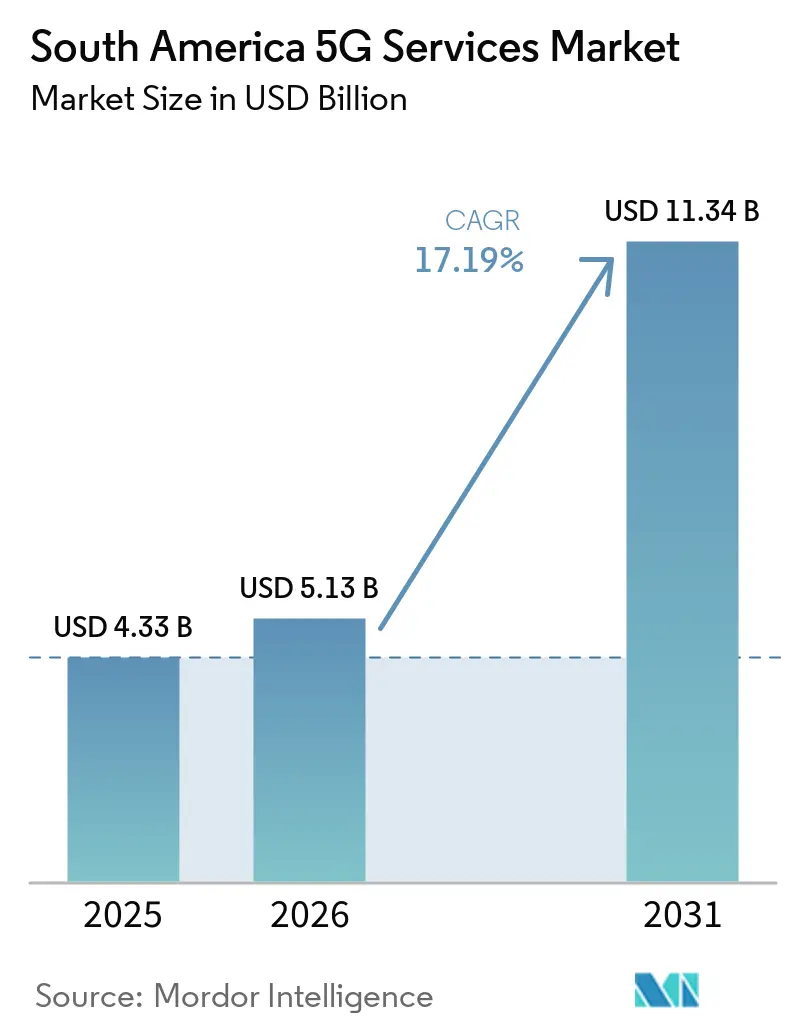
The South America 5G Services Market size was valued at USD 4.33 billion in 2025 and is estimated to grow from USD 5.13 billion in 2026 to reach USD 11.34 billion by 2031, at a CAGR of 17.19% during the forecast period (2026-2031).
Brazil entered this period with the region's broadest 5G footprint after its 2021 spectrum process supported simultaneous use of low, mid, and high frequency bands. Rising smartphone data use makes new network capacity essential, rather than an optional premium upgrade. Enterprise buyers are also creating longer service contracts for private networks, industrial automation, and secure operations. Operators are concentrating capital on locations and services where returns are clearer, including fixed wireless access, standalone capabilities, and business connectivity. The South America 5G services market, therefore, has room to expand, although rural economics, uneven spectrum policy, and limits on premium service monetization will continue to shape deployment choices.
Key Report Takeaways
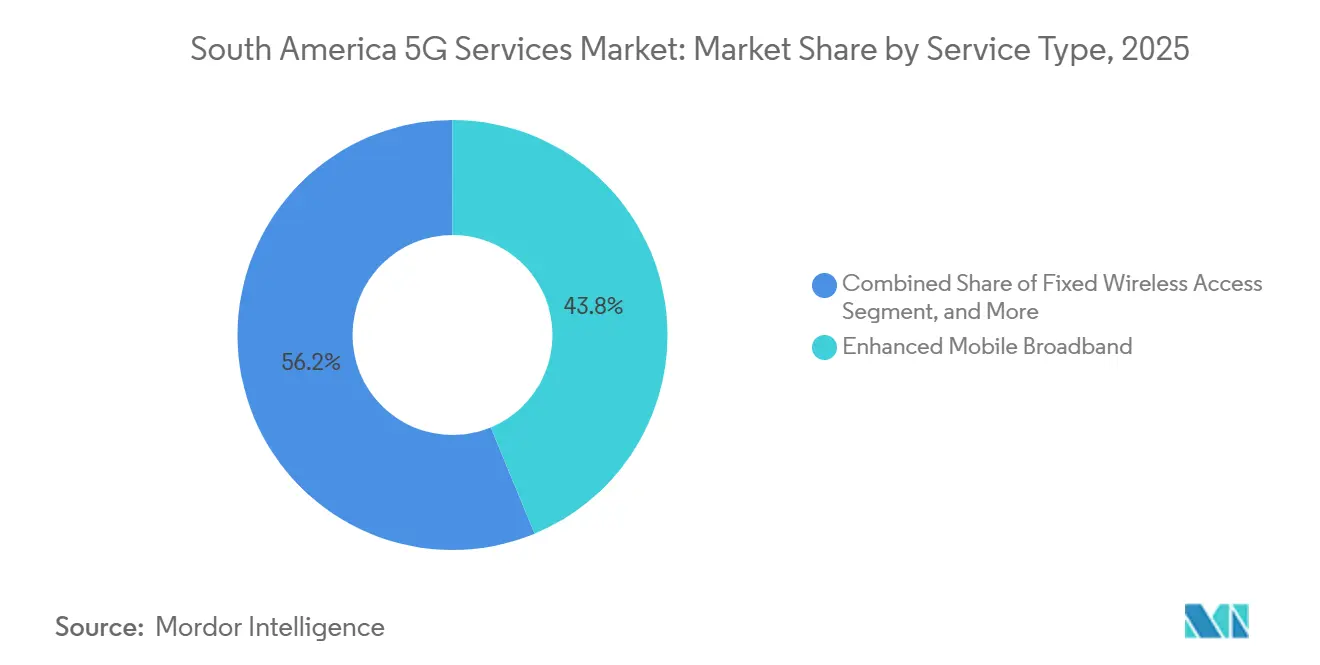
- By service type, enhanced mobile broadband held 43.76% of South America 5G services market revenue in 2025, while fixed wireless access is projected to expand at a 17.93% CAGR through 2031.
- By network architecture, non-standalone 5G accounted for 55.72% of South America 5G services market revenue in 2025, while standalone 5G is projected to expand at an 18.16% CAGR through 2031.
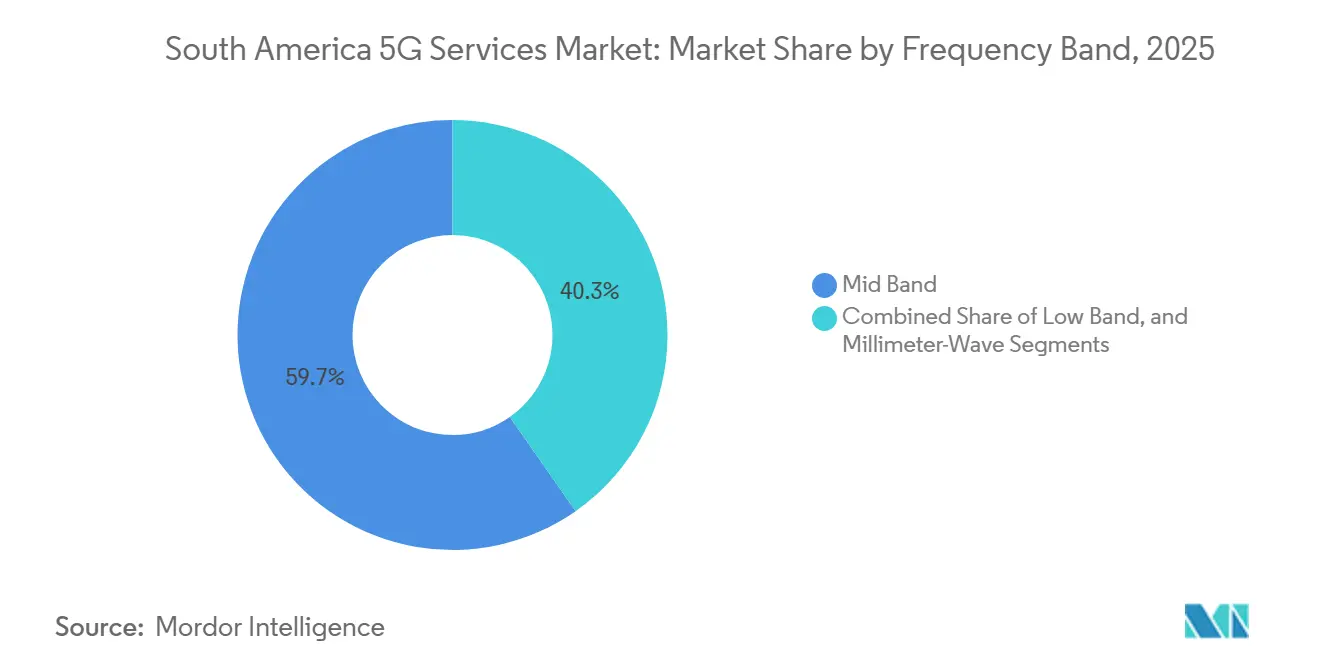
- By frequency band, mid band held 59.71% of 2025 revenue, while millimeter-wave is projected to expand at an 18.43% CAGR through 2031.
- By end-user industry, IT and telecom accounted for 28.23% of 2025 revenue, while manufacturing, energy, and utilities is projected to expand at a 19.04% CAGR through 2031.
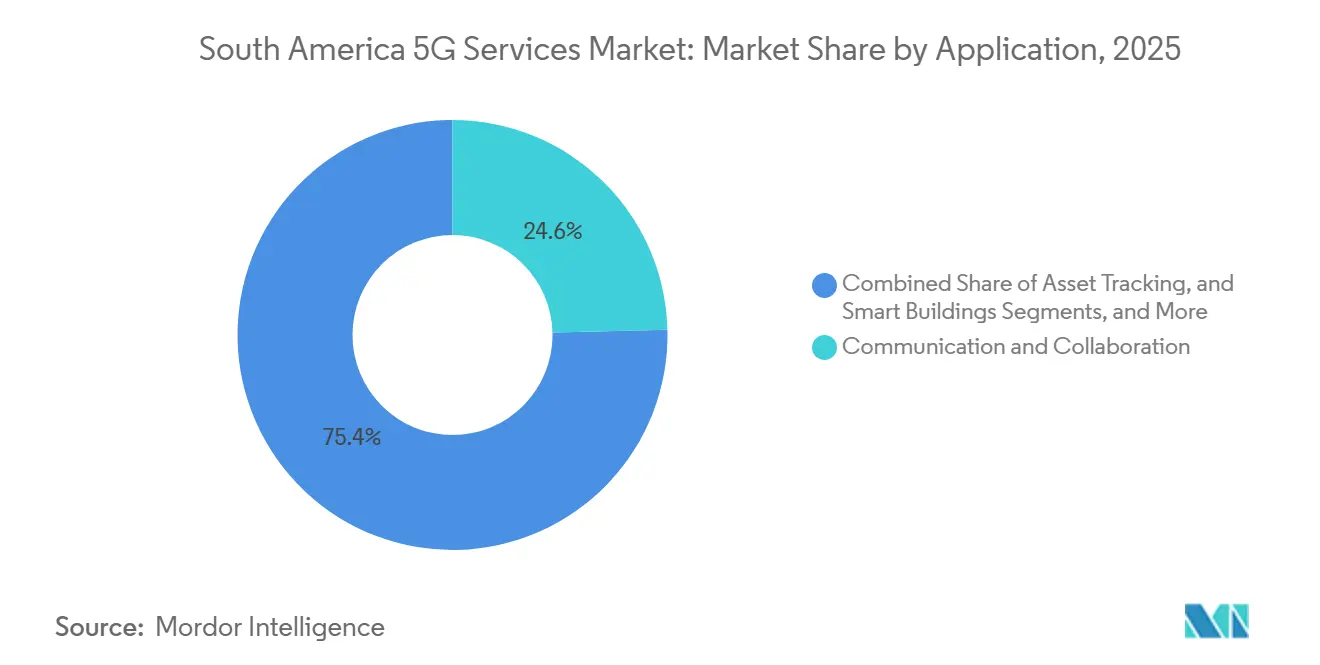
- By application, communication and collaboration held 24.61% of 2025 revenue, while Industry 4.0 is projected to expand at a 17.69% CAGR through 2031.
- By geography, Brazil held 59.97% of the South America 5G services market share in 2025, while Chile is projected to expand at an 18.83% CAGR through 2031.
Note: Market size and forecast figures in this report are generated using Mordor Intelligence’s proprietary estimation framework, updated with the latest available data and insights as of January 2026.
South America 5G Services Market Trends and Insights
Drivers Impact Analysis*
| Driver | (~) % Impact on CAGR Forecast | Geographic Relevance | Impact Timeline |
|---|---|---|---|
| Exploding Mobile Data Traffic | +4.8% | Brazil, Chile, Colombia, Argentina, Peru | Short term (≤ 2 years) |
| Rising Demand for Enhanced Mobile Broadband Services | +3.2% | Brazil, Chile, Colombia | Short term (≤ 2 years) |
| Enterprise Digital Transformation Use Cases | +2.9% | Brazil, Chile, Colombia, Peru | Medium term (2-4 years) |
| Government Spectrum Release and Coverage Initiatives | +2.4% | Brazil, Chile, Peru, Colombia, Argentina | Medium term (2-4 years) |
| Private 5G Adoption in Industrial and Local License Bands | +2.0% | Brazil, Chile | Medium term (2-4 years) |
| Network Slicing and Service-Level Agreement Monetization | +1.4% | Brazil | Long term (≥ 4 years) |
| Source: Mordor Intelligence | |||
Exploding Mobile Data Traffic
South America's 5G investment cycle is being pulled by data use that is exceeding the capacity available on older networks. Ericsson projected average monthly traffic per active smartphone in Latin America would rise from 15 GB in 2025 to 32 GB by 2031, at a 14% CAGR, driven by video, cloud gaming, and short-form content.[1]Ericsson, “Mobile Traffic Forecast,” Ericsson, ericsson.com Brazil showed the immediate pressure, as every state recorded double-digit 5G subscriber expansion in 2025. Even so, 5G represented only 21.5% of Brazilian mobile lines at year-end, while population coverage reached 64.94%, leaving substantial traffic on 4G networks. This difference between coverage and adoption means capacity spending can precede full subscriber monetization. The South America 5G services market benefits when operators sell reliable low-latency capacity to business customers whose operations are sensitive to network performance.
Rising Demand for Enhanced Mobile Broadband Services
Enhanced mobile broadband held the leading position because it serves the widest installed base of compatible devices. Its 43.76% share of 2025 service revenue reflects a continuing transition from 4G, rather than a fully mature 5G consumer base. Telefónica Brasil reported 21.4 million 5G subscribers in the third quarter of 2025, while mobile average revenue per user rose 3.9% to BRL 31.5, or USD 5.5. This performance supported a value-focused approach rather than a strategy based only on adding connections. Claro's 10.4 Gbps 5G Advanced millimeter-wave trial in Brazil showed how faster service tiers could support future premium offers. Chile, Colombia, and Peru remain earlier in the consumer adoption cycle, which gives operators an incentive to secure spectrum and prepare commercial offers before demand increases.
Enterprise Digital Transformation Use Cases
Enterprise deployment is creating service agreements with longer durations than conventional mobile plans. Gerdau's Ouro Branco steel plant hosted South America's largest dedicated private industrial 5G network, covering more than 8.3 million m² with 4.8 Gbps capacity. The network supports autonomous vehicles, digital twins, connected equipment, and artificial intelligence applications that are linked to plant operations. These uses make latency, reliability, and security commercial requirements rather than technical features. Brazil's MetaIndústria program targets the digital transformation of 90% of digitized industrial companies, providing public support for this demand pipeline. The South America 5G services market can capture more durable revenue where carriers develop specialized sales channels for manufacturers, mining companies, and logistics providers.
Government Spectrum Release and Coverage Initiatives
Regulatory decisions have a direct effect on the pace and location of 5G network investment. Resolution 785, signed in December 2025, set Brazil's spectrum auction roadmap for the 850 MHz, 2.3 GHz, 2.5 GHz, and 3.5 GHz bands. In Peru, Bitel, Claro, Entel, and Integratel signed 3.5 GHz concession contracts in December 2024 with infrastructure commitments for schools, universities, and hospitals. Chile also consulted on a third 3.5 GHz auction in late 2025 and proposed a 105 MHz per-operator limit. Brazil's earlier auction obligations helped extend 5G to 2,019 municipalities by the end of 2025. This record shows that clear coverage obligations can support the South America 5G services market across large areas where commercial demand alone may not justify early deployment.
Restraints Impact Analysis*
| Restraint | (~) % Impact on CAGR Forecast | Geographic Relevance | Impact Timeline |
|---|---|---|---|
| High Deployment Cost and Long Return-on-Investment Horizons | -1.8% | Brazil, Chile, Colombia, Argentina | Short term (≤ 2 years) |
| Fragmented and Delayed Spectrum Policy | -1.2% | Argentina, Colombia, Peru, Rest of South America | Medium term (2-4 years) |
| Rural Site Economics and Unreliable Power Availability | -0.9% | Brazil, Peru, Colombia, Rest of South America | Long term (≥ 4 years) |
| Limited Monetization of Standalone 5G Beyond Premium Connectivity | -0.7% | Region-wide, most acute in Brazil | Medium term (2-4 years) |
| Source: Mordor Intelligence | |||
High Deployment Cost and Long Return-on-Investment Horizons
5G deployment remains capital intensive, so operators are selecting projects more carefully. TIM Brasil planned BRL 4.4 billion to BRL 4.6 billion, or USD 835 million to USD 875 million, in 2026 capital expenditure for 5G modernization and business-to-business and Internet of Things services. Claro Brazil stated in February 2026 that it would not install 5G antennas in every city solely to claim national coverage. This position reflects a focus on returns from each deployment location. Winity Telecom's return of its spectrum concession also removed a neutral-host mechanism that could have supported rural cost sharing. ANATEL's August 2026 sanction decision reinforced the compliance risk facing future infrastructure-sharing arrangements.[2]Agência Nacional de Telecomunicações, “Notícias,” Agência Nacional de Telecomunicações, anatel.gov.br
Fragmented and Delayed Spectrum Policy
Argentina and Colombia show how delayed spectrum awards can hold back service availability. In the third quarter of 2025, 5G availability reached 3.0% among active users in Argentina and 1.6% in Colombia, compared with 38.5% in Brazil. Argentina's regulator was still considering more dynamic spectrum allocation methods in late 2025, without confirming an auction date. This uncertainty limits the ability of operators to plan network investment and device marketing. Millicom completed the consolidation of Coltel in April 2026 after identifying that standalone operators could not independently fund 5G deployment. Consolidation may improve the investment case, but delayed policy and limited financial capacity can still slow the South America 5G services market in countries with significant unmet demand.
*Our forecasts treat driver/restraint impacts as directional, not additive. The impact forecasts reflect baseline growth, mix effects, and variable interactions.
Segment Analysis
By Service Type: Fixed Wireless Access Broadens the Role of 5G
Enhanced mobile broadband accounted for 43.76% of 2025 service revenue in the South America 5G services market, supported by its wide device base and longer commercial history. It remains the main service through which mobile users shift from 4G connectivity to 5G plans. Ultra-reliable low-latency communications and massive machine-type communications remain at earlier stages of development. Their demand is tied more closely to private networks and connected sensors in mining, agriculture, manufacturing, and logistics. Fixed wireless access is projected to expand at a 17.93% CAGR from 2026 to 2031. Its growth is supported by a July 2025 Brazilian government proof of concept that found 5G fixed wireless access could provide fiber-equivalent speeds to rural schools.[3]Fundação CPQD, “Tecnologia 5G FWA Leva Conectividade de Alta Velocidade a Escolas em Áreas Rurais do Rio Grande do Norte,” CPQD, cpqd.com.br Claro Argentina also activated commercial 5G fixed wireless access in Buenos Aires, Córdoba, and provincial capitals in November 2025.
Coverage obligations embedded in spectrum licenses create a base level of demand for fixed wireless access services. This makes the offering less dependent on short-term consumer upgrades than enhanced mobile broadband. It can also connect locations where fiber deployment remains difficult or costly. Rural schools and communities are important early use cases because they align public connectivity targets with operator rollout plans. The South America 5G services market size for enhanced mobile broadband remained the largest in 2025, but fixed wireless access has a clearer route to new fixed connectivity revenue. Providers will need local distribution, installation capability, and suitable customer equipment to scale these services. The distinction is important because 5G can serve both mobile capacity needs and fixed broadband gaps. That wider role can improve the value of networks built beyond dense urban areas.



By Network Architecture: Standalone Networks Support Differentiated Services
Non-standalone 5G held 55.72% of network architecture revenue in 2025 because operators could use existing 4G cores during early network rollout. This approach reduced near-term costs and allowed faster commercial launches. Standalone 5G is projected to expand at an 18.16% CAGR from 2026 to 2031. It enables network slicing, lower latency, and service-level commitments that non-standalone architecture cannot support at the same level. Brazil's 2021 auction included standalone coverage milestones that drove deployment across the municipalities originally targeted by the program. Claro activated quality-on-demand network slicing for a major Brazilian bank in 2026. This example shows how standalone functionality can be sold as a defined business service.
TIM and Nokia expanded their AI-RAN program to 14 Brazilian states in March 2026. The project covered 42% of the national population and targeted 40% improvements in network coverage and capacity, while preparing for 5G Advanced. These investments combine network modernization with preparation for enterprise offers. The South America 5G services market share for non-standalone systems remained higher in 2025, reflecting their practical role during the first rollout phase. Standalone deployment becomes more valuable when customers pay for reliability, security, and application-specific network performance. Banks, factories, and public services are likely to be important early buyers of these capabilities. Operators will need to link technical upgrades to customer outcomes if they are to convert standalone networks into sustained revenue. The architecture choice will therefore remain a commercial as well as an infrastructure decision.
By Frequency Band: Mid Band Provides the Regional Network Base
Mid band held 59.71% of frequency band revenue in 2025, giving it the leading South America 5G services market share among available spectrum ranges. It offers a practical balance between coverage range and network capacity. This balance has made 3.5 GHz the central band for many regional deployments. Low band extends coverage into rural areas and improves indoor connectivity. Its lower throughput limits its suitability for some high-performance 5G applications. Millimeter-wave is projected to expand at an 18.43% CAGR from 2026 to 2031. Claro demonstrated a 10.4 Gbps downlink using millimeter-wave and mid-band aggregation in Brazil during a 2024 trial.
Chile allocated four 400 MHz blocks in the 26 GHz band during its 2021 auction. These holdings can support industrial networks as private deployments develop in mining and port logistics. Millimeter-wave remains concentrated in dense areas such as São Paulo, Santiago, and Bogotá. Its short range requires closer network spacing, which limits broad-area deployment. However, its high capacity supports premium services in locations with intensive data needs. The South America 5G services market size for mid band remains larger because the band can support national coverage and mainstream mobile capacity. Millimeter-wave has a narrower role, but it can be commercially important for operators with dedicated business channels. The long-term opportunity rests on identifying sites where extreme capacity has a measurable operational value.
By End-User Industry: Manufacturing Adds Long-Term Contract Demand
IT and telecom accounted for 28.23% of end-user industry revenue in 2025, supported by wholesale infrastructure purchases and enterprise connectivity upgrades. This customer group provides a direct route for network services and supporting equipment. Manufacturing, energy, and utilities is projected to expand at a 19.04% CAGR from 2026 to 2031. Private network contracts in steel, food processing, oil and gas, and mining support longer service relationships. Gerdau's private 5G deployment shows how industrial users can apply the technology to production systems and vehicle operations. Healthcare is also developing as a relevant use case. Nokia's proof of concept at Bio-Manguinhos indicated that private 5G could prevent waste of more than 2 million immunizer doses in a production cycle.
Banking, financial services, insurance, and regulatory technology have already adopted more advanced connectivity services. Claro's network-sliced quality-on-demand service for a Brazilian financial institution illustrates this demand. Government, defense, education, and other public users have a different demand base that is linked to security and coverage requirements. Brazil's federal private 5G security network supports this public-sector role. Automotive and retail users are earlier in their adoption cycle. Warehouse management and logistics are likely to be entry points for these sectors. The South America 5G services market can benefit as industrial users move beyond pilots and link network spending to measurable operational results. This makes the end-user mix more diverse than a consumer mobile model alone.
By Application: Industry 4.0 Turns Connectivity Into an Operating Tool
Communication and collaboration held 24.61% of 2025 application revenue, supported by unified communications, video conferencing, and mission-critical push-to-talk services. These uses address immediate enterprise communication needs and rely on a relatively established device base. Industry 4.0 is projected to expand at a 17.69% CAGR from 2026 to 2031. Its demand comes from the connection of robotics, digital twins, and autonomous guided vehicles to private 5G networks. SENAI-SP installed an Ericsson private network at 2 industrial units in August 2025 to validate digital twin applications.[4]Serviço Nacional de Aprendizagem Industrial de São Paulo, “SENAI-SP,” SENAI-SP, senai.br This work supported the use of 5G in industrial training and production environments. Smart cities and public safety applications are also moving from pilots toward broader deployment.
Claro, Vivo, and TIM installed a shared 5G tower on Ilha do Combu in October 2025 before COP30. The project extended connectivity to a riverine Amazon community and demonstrated an infrastructure-sharing option for remote coverage. Asset tracking and smart healthcare are gaining use in agriculture, mining, and cross-border logistics. Immersive media, gaming, autonomous vehicles, and vehicle-to-everything services have a longer path to commercial scale. Their contribution depends on broader device availability and stronger road infrastructure after 2028 in most countries outside Brazil and Chile. Communication applications still provide the largest South America 5G services market size in this group. Industrial applications may gradually offer more specialized revenue where customers can justify private network investment.
Geography Analysis
Brazil held 59.97% of the South America 5G services market share in 2025, supported by a substantial lead in deployment and spectrum execution. The country ended 2025 with 64.94% 5G population coverage across 2,019 municipalities. Vivo had 21.4 million 5G subscribers, while TIM covered 1,089 cities and became the first operator in Brazil to exceed 1,000 cities.[5]TIM S.A., “Investor Relations,” TIM, tim.com.br Brazil's three-operator structure has supported more balanced spectrum allocation and continuing network investment. Network performance remained strong, with 5G download speeds ranging from 201.9 Mbps to 306.8 Mbps in a January 2026 benchmark. Resolution 785 also provided clearer visibility for future spectrum planning. This policy setting gives carriers a stronger basis for multi-year modernization decisions.
Chile is projected to expand at an 18.83% CAGR through 2031, the fastest rate among the covered countries. WOM completed its restructuring in March 2025 with USD 500 million in new investment and a debt reduction of more than USD 650 million. Millicom and NJJ completed the acquisition of Telefónica Chile in February 2026. Entel committed USD 640 million to Chile and Peru in 2025, including USD 280.2 million for mobile network strengthening and 5G expansion. These changes brought new capital and ownership to a country with a meaningful 5G site base. Colombia also gained a stronger investment platform after Millicom fully consolidated Coltel in April 2026. The company guided for 1,000 new sites over 12-18 months, although its 1.6% 5G availability in the third quarter of 2025 showed the distance still remaining to broad commercial coverage.
Peru, Argentina, and the rest of South America form the next deployment frontier. Peru's 4 holders of 3.5 GHz concessions have commitments to connect schools, universities, and hospitals. Entel invested USD 208.4 million in Peru during 2025, including USD 173.1 million for 4G and 5G expansion across 9 regions. Argentina's 3.0% 5G availability in the third quarter of 2025 reflected delayed spectrum awards. The retirement of 2G and 3G networks can release sub-GHz spectrum for future reuse. Ecuador began commercial 5G in December 2024, Paraguay followed in December 2025 with an initial USD 35 million investment, and Bolivia started its spectrum award process in 2026. These developments extend the addressable South America 5G services market and create earlier entry opportunities for infrastructure and managed-service providers.
Competitive Landscape
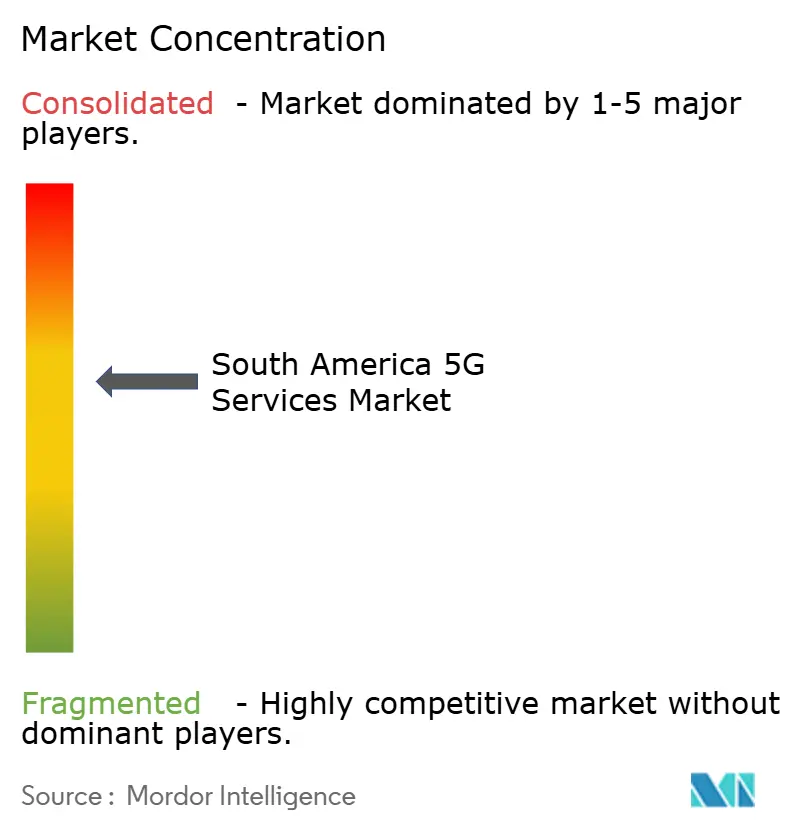
The South America 5G services market is moderately concentrated among Telefónica, América Móvil, TIM, Millicom, and Entel, which hold many of the region's spectrum and subscriber positions. Their strategies differ because each operator faces distinct market structures, coverage needs, and capital constraints. TIM Brasil expanded its AI-RAN partnership with Nokia across 14 states in March 2026 to improve coverage and capacity while preparing for 5G Advanced. Claro Brazil took a more selective approach by prioritizing investment returns over blanket national coverage. América Móvil maintained USD 7 billion in global capital expenditure in 2025 and indicated that this level would continue in 2026. Brazil, Colombia, and Argentina were important destinations for its 5G investment plans. These choices show that regional competition is driven by network quality, financial discipline, and the ability to develop business services.
Millicom's acquisitions of Telefónica Colombia and Telefónica Chile during 2026 were a major competitive change. The transactions strengthened the company's presence in 2 markets where more limited investment capacity had delayed network expansion.[6]Millicom International Cellular S.A., “Press Releases,” Millicom, millicom.com Vendor relationships also matter because they shape the speed of technology deployment across multiple countries. Nokia has positions with TIM and Vivo in Brazil, Entel in Chile, Claro in Colombia, and Claro in Paraguay. These relationships can support consistent deployment methods as operators expand or integrate acquired networks. However, operators still must adapt each network plan to local spectrum conditions and coverage obligations. The competitive environment is becoming more concentrated in selected countries, but it retains several established regional providers.
Private network work is creating a separate competitive layer beyond public network investment. Ericsson deployments at SENAI-SP and Nestlé's Caçapava plant demonstrate opportunities in industrial connectivity. Winity Telecom's exit from the 700 MHz neutral-host model reduced a possible cost-sharing route for rural coverage. Future wholesale entrants will need to meet spectrum obligations closely after ANATEL's 2026 enforcement action. Chile's industrial millimeter-wave spectrum, Peru's coverage-obligation areas, and Brazil's rural fixed wireless access programs remain areas with lower competitive intensity. Brisanet and other regional providers can compete in northeastern Brazil through local distribution and lower-cost operations. The South America 5G services industry will continue to reward operators that match network investment to specific customer and geographic needs.
South America 5G Services Industry Leaders
Telefónica, S.A.
América Móvil, S.A.B. de C.V.
TIM S.A.
Millicom International Cellular S.A.
Entel S.A.
- *Disclaimer: Major Players sorted in no particular order

Recent Industry Developments
- August 2026: Anatel continued regulatory enforcement activity in Brazil; the specific claim of a finalized sanction against Winity Telecom for its 700 MHz obligations could not be independently verified and should be removed pending a primary Anatel decision.
- May 2026: Millicom outlined its Colombia network expansion plan, targeting a fourfold increase in 5G coverage during 2026 and deployment of more than 1,000 new sites over the following 18-24 months.
- April 2026: Millicom acquired the remaining 32.5% stake in Colombia Telecomunicaciones (Coltel) formerly held by La Nación, completing its acquisition and consolidation of Coltel.
- March 2026: Nokia expanded its AI-ready 5G partnership with TIM Brasil to 14 additional Brazilian states, covering approximately 42% of the country's population.


South America 5G Services Market Report Scope
The South America 5G Services Market Report is Segmented by Service Type (Enhanced Mobile Broadband, Ultra-Reliable Low-Latency Communications, Massive Machine-Type Communications, Fixed Wireless Access), Network Architecture (Non-Standalone 5G, Standalone 5G), Frequency Band (Low Band, Mid Band, Millimeter-Wave), End-User Industry (IT and Telecom, Automotive, Mobility and Transportation, Manufacturing, Energy and Utilities, Healthcare and Life Sciences, Banking, Financial Services, Insurance and RegTech, Retail, Media and E-Commerce, Government, Defense, Education and Public Sector, Other Industries), Application (Communication and Collaboration, Asset Tracking, Smart Cities, Smart Buildings, Autonomous Vehicles and Vehicle-to-Everything, Smart Healthcare, Industry 4.0, Smart Utilities, Immersive Media and Gaming, Public Safety and Mission-Critical Communications), and Geography (Brazil, Argentina, Chile, Colombia, Peru, and Rest of South America). The Market Forecasts are provided in Terms of Value (USD).
| Enhanced Mobile Broadband |
| Ultra-Reliable Low-Latency Communications |
| Massive Machine-Type Communications |
| Fixed Wireless Access |
| Non-Standalone 5G |
| Standalone 5G |
| Low Band |
| Mid Band |
| Millimeter-Wave |
| IT and Telecom |
| Automotive, Mobility and Transportation |
| Manufacturing, Energy and Utilities |
| Healthcare and Life Sciences |
| Banking, Financial Services, Insurance and RegTech |
| Retail, Media and E-Commerce |
| Government, Defense, Education and Public Sector |
| Other End-User Industries |
| Communication and Collaboration |
| Asset Tracking |
| Smart Cities |
| Smart Buildings |
| Autonomous Vehicles and Vehicle-to-Everything |
| Smart Healthcare |
| Industry 4.0 |
| Smart Utilities |
| Immersive Media and Gaming |
| Public Safety and Mission-Critical Communications |
| Brazil |
| Argentina |
| Chile |
| Colombia |
| Peru |
| Rest of South America |
| By Service Type | Enhanced Mobile Broadband |
| Ultra-Reliable Low-Latency Communications | |
| Massive Machine-Type Communications | |
| Fixed Wireless Access | |
| By Network Architecture | Non-Standalone 5G |
| Standalone 5G | |
| By Frequency Band | Low Band |
| Mid Band | |
| Millimeter-Wave | |
| By End-User Industry | IT and Telecom |
| Automotive, Mobility and Transportation | |
| Manufacturing, Energy and Utilities | |
| Healthcare and Life Sciences | |
| Banking, Financial Services, Insurance and RegTech | |
| Retail, Media and E-Commerce | |
| Government, Defense, Education and Public Sector | |
| Other End-User Industries | |
| By Application | Communication and Collaboration |
| Asset Tracking | |
| Smart Cities | |
| Smart Buildings | |
| Autonomous Vehicles and Vehicle-to-Everything | |
| Smart Healthcare | |
| Industry 4.0 | |
| Smart Utilities | |
| Immersive Media and Gaming | |
| Public Safety and Mission-Critical Communications | |
| South America | Brazil |
| Argentina | |
| Chile | |
| Colombia | |
| Peru | |
| Rest of South America |


Key Questions Answered in the Report
What is the South America 5G services market size?
The South America 5G services market is estimated at USD 5.13 billion in 2026 and is forecast to reach USD 11.34 billion by 2031, at a 17.19% CAGR. The outlook reflects rising mobile data demand and wider enterprise adoption of private network services across the region.
Which South American country leads 5G services?
Brazil led the region with 59.97% revenue share in 2025, supported by its earlier spectrum awards and wide network deployment. It reached 64.94% population coverage across 2,019 municipalities by the end of that year.
Which 5G service is expanding fastest in South America?
Fixed wireless access is projected to expand at a 17.93% CAGR through 2031, supported by rural connectivity needs and license obligations. It gives operators a practical option where fiber construction is difficult, slow, or uneconomic.
Why are businesses adopting private 5G networks?
Manufacturers, mining companies, and logistics providers use private 5G for automation, digital twins, connected equipment, and reliable low-latency communications. These applications are most valuable when connectivity supports a defined production, safety, or operating requirement.
What is slowing 5G deployment in South America?
High capital requirements, delayed spectrum allocation, rural site economics, and limited standalone 5G monetization can slow network investment. Operators are responding by prioritizing higher-return locations and business cases with clearer customer demand.
Which business users are expected to adopt 5G fastest?
Manufacturing, energy, and utilities is projected to expand at a 19.04% CAGR through 2031, driven by industrial private network contracts. Steel, food processing, mining, and energy operations are among the sectors linking 5G services to automation and connected equipment.
Page last updated on:





