
Market Overview
| Study Period | 2020 - 2031 |
|---|---|
| Forecast Data Period | 2026 - 2031 |
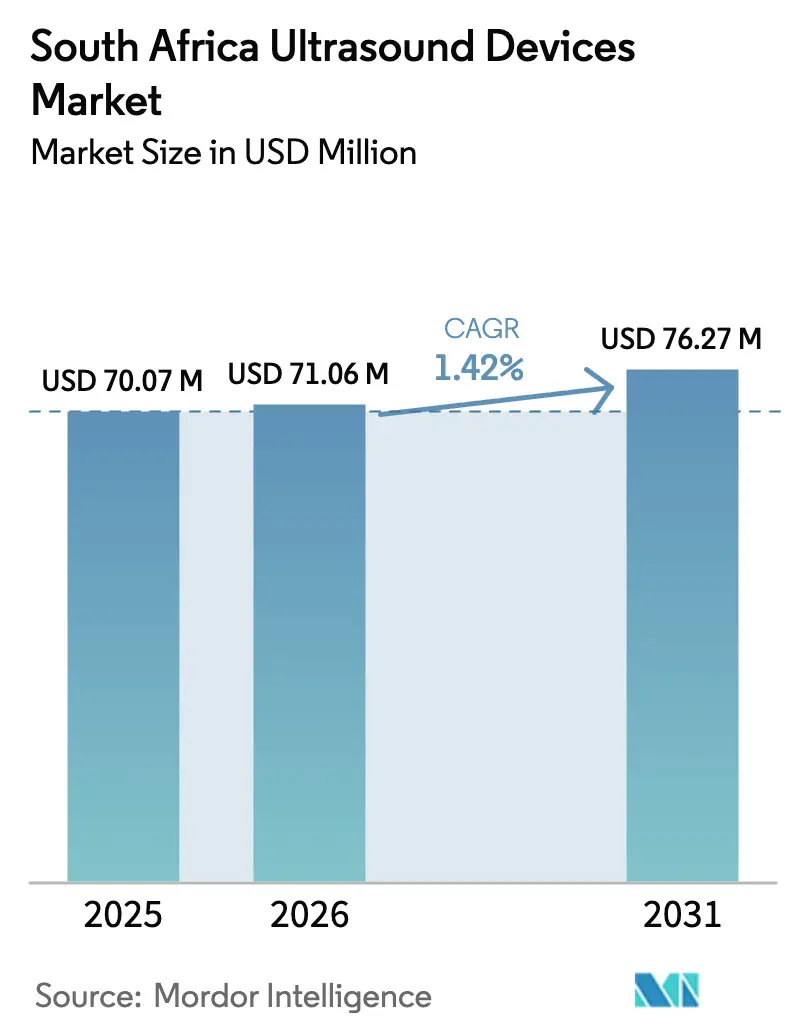
| Base Year Market Size (2025) | USD 70.07 Million |
| Market Size (2026) | USD 71.06 Million |
| Market Size (2031) | USD 76.27 Million |
| Growth Rate (2026 - 2031) | 1.42 % |
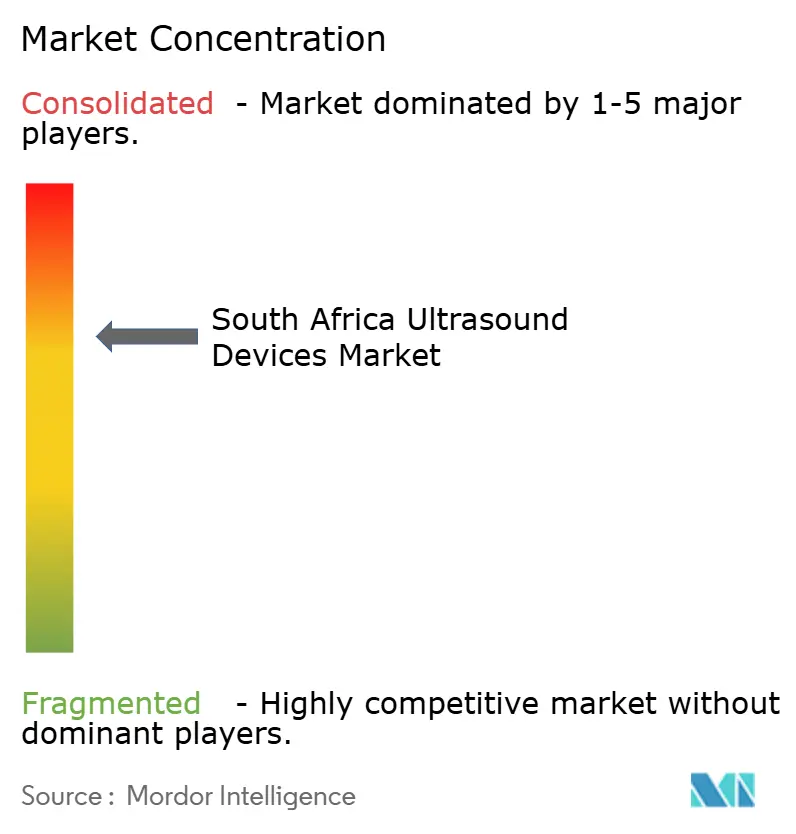
| Market Concentration | Medium |
Major Players *Disclaimer: Major Players sorted in no particular order Image © Mordor Intelligence. Reuse requires attribution under CC BY 4.0. | |
South Africa Ultrasound Devices Market Analysis by Mordor Intelligence
South Africa Ultrasound Devices Market size in 2026 is estimated at USD 71.06 million, growing from 2025 value of USD 70.07 million with 2031 projections showing USD 76.27 million, growing at 1.42% CAGR over 2026-2031.
This measured trajectory reflects constrained hospital budgets, volatile currency movements, and the gradual rollout of the National Health Insurance (NHI) program, yet the underlying demand for real-time imaging in maternal care, cardiology, and perioperative monitoring continues to expand. Portable and handheld scanners post the fastest volume gains as rural outreach programs embrace point-of-care models, while advanced 3D and 4D platforms maintain revenue leadership due to their higher selling price and superior diagnostic performance. Strategic investments by private hospital groups, combined with foreign grant funding for maternal health, sustain equipment refresh cycles even as public-sector tenders slow. Regulatory reforms under SAHPRA preserve clinical safety standards and favor brands with proven after-sales support, subtly raising the competitive bar for new entrants.
Key Report Takeaways
- By application, obstetrics and gynecology led with 21.41% share of the South Africa ultrasound devices market in 2025, while anesthesiology recorded the fastest CAGR at 3.71% through 2031.
- By technology, 3D and 4D imaging held 41.89% of the South Africa ultrasound devices market share in 2025; high-intensity focused ultrasound is projected to expand at a 3.44% CAGR to 2031.
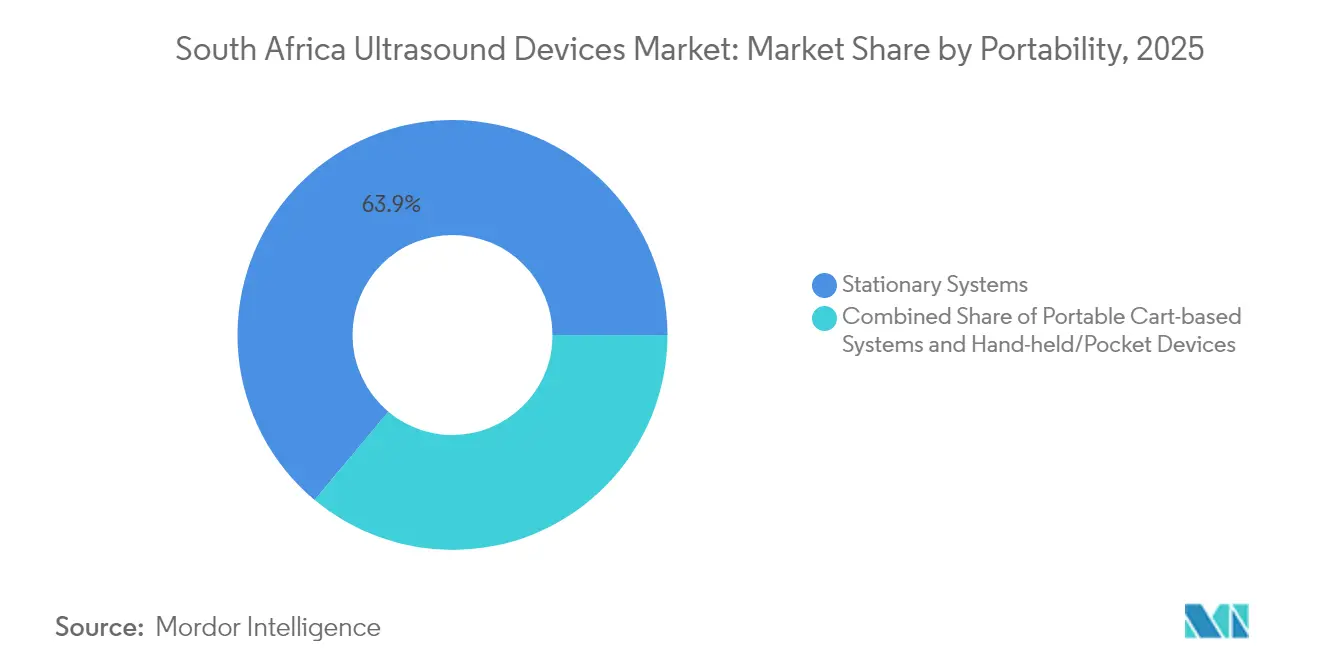
- By portability, stationary systems accounted for 63.92% of the South Africa ultrasound devices market size in 2025 and handheld devices are advancing at a 4.56% CAGR through 2031.
- By end user, hospitals captured 50.62% revenue share in 2025, whereas diagnostic imaging centers are set to post the quickest growth at 4.27% CAGR to 2031.
Note: Market size and forecast figures in this report are generated using Mordor Intelligence’s proprietary estimation framework, updated with the latest available data and insights as of 2026.
South Africa Ultrasound Devices Market Trends and Insights
Drivers Impact Analysis*
| Driver | (~) % Impact on CAGR Forecast | Geographic Relevance | Impact Timeline |
|---|---|---|---|
| Rising Burden of Non-Communicable Diseases | +0.4% | National, concentrated in urban centers | Medium term (2-4 years) |
| National Health Insurance (NHI) Rollout | +0.3% | National, phased implementation | Long term (≥ 4 years) |
| Point-of-Care & Handheld Ultrasound Adoption | +0.5% | National, rural emphasis | Short term (≤ 2 years) |
| Private Sector Investment Surge | +0.2% | Western Cape, Gauteng primary | Medium term (2-4 years) |
| Tele-Ultrasound & AI-Driven Remote Mentoring | +0.3% | National, rural connectivity focus | Medium term (2-4 years) |
| Adoption of 3D/4D Imaging and Wavefront-Guided Systems | +0.2% | Urban centers, private facilities | Short term (≤ 2 years) |
| Source: Mordor Intelligence | |||
Rising Burden of Non-Communicable Diseases
Non-communicable diseases cause 57% of deaths in South Africa, creating sustained imaging demand across cardiology and vascular care.[1] Cardiac ultrasound enables early detection of hypertensive heart disease while Doppler studies support diabetes management protocols. The NHI preventive-care focus pushes public clinics to screen high-risk adults, encouraging bulk procurement of entry-level scanners. Private primary-care networks deploy mobile units for workplace screenings, broadening the South Africa ultrasound devices market. AI-supported cardiac packages reduce operator dependency, allowing nurses to capture diagnostic views that specialists later review remotely.
National Health Insurance Rollout
The NHI Act centralizes equipment purchasing under a single fund, promising uniform technology standards across provinces. A three-year budget of ZAR 1.4 billion (USD 74 million) concentrates on primary-care clinics where compact ultrasound aligns with point-of-care workflows. Yet the 15-year implementation horizon introduces spending uncertainty, prompting hospitals to defer high-end system upgrades until reimbursement rules clarify. Portable platforms with integrated tele-consult features position well for upcoming tenders that prioritize rural outreach.
Point-of-Care & Handheld Ultrasound Adoption
Bedside imaging shortens diagnosis-to-treatment time in trauma, obstetrics, and perioperative care. Devices such as Butterfly iQ+ deliver whole-body scanning with a single probe, supporting the Siyakubona program that equips 1,000 midwives across five provinces.[2] Emergency responders report 79.5% correlation between pre-hospital and in-hospital findings, validating the clinical utility of handhelds. Battery life of six hours, smartphone connectivity, and pay-per-scan cloud storage lower entry barriers for small practices and contribute materially to the South Africa ultrasound devices market growth.
Private Sector Investment Surge
Life Healthcare earmarked ZAR 2.1 billion (USD 114 million) for domestic projects in 2024, including AI-enabled imaging suites. Netcare’s ZAR 6.6 billion (USD 370 million) annual supplier spend, with 52% to black-owned firms, anchors vendor relationships and supports transformation targets. Western Cape’s USD 400 million med-tech hub attracts start-ups focusing on advanced visualization, raising competitive intensity inside the South Africa ultrasound devices market.
Restraints Impact Analysis*
| Restraint | (~) % Impact on CAGR Forecast | Geographic Relevance | Impact Timeline |
|---|---|---|---|
| Shortage of Skilled Personnel | -0.3% | National, rural areas most affected | Long term (≥ 4 years) |
| High Import Tariffs & Currency Volatility | -0.2% | National, import-dependent market | Short term (≤ 2 years) |
| SAHPRA Registration Delays | -0.2% | National, regulatory bottlenecks | Medium term (2-4 years) |
| Cybersecurity Risks & Legacy Systems | -0.1% | National, healthcare facilities | Medium term (2-4 years) |
| Source: Mordor Intelligence | |||
Shortage of Skilled Personnel
Vacancies exceed 27,000 critical posts and the radiologist attrition rate tops 13% annually, leaving scanners idle in many district hospitals.[3] The first accredited sonography degree began only in 2024, so near-term staffing relief is limited. AI workflow tools that label anatomy and suggest measurements do help, yet they still require minimum operator competence. Delays in processing foreign critical-skills visas further tighten the talent pool and restrain the South Africa ultrasound devices market.
High Import Tariffs & Currency Volatility
More than 76% of ultrasound equipment is imported, exposing buyers to rand swings that reached ZAR 18.43 per USD (USD 1.0) in May 2025. Import duties and logistics surcharges raise landed costs by up to 12%. Large corporates hedge currency risk, whereas small clinics shift to multiyear leasing that ultimately inflates lifetime ownership costs.
*Our forecasts treat driver/restraint impacts as directional, not additive. The impact forecasts reflect baseline growth, mix effects, and variable interactions.
Segment Analysis
By Application: Maternal Health Drives Core Demand
Obstetrics and gynecology generated 21.41% of the South Africa ultrasound devices market share in 2025, buoyed by national targets to cut maternal mortality. The Siyakubona roll-out shows that handheld scanners can shorten first-trimester booking delays in rural clinics, underpinning recurring probe purchases and consumables. Cardiology remains a steady revenue pillar as non-communicable diseases rise, while anesthesiology posts a 3.71% CAGR by embedding real-time nerve-block guidance into perioperative protocols.
Point-of-care lung and abdominal scans gained visibility during COVID-19 and remain in routine use for sepsis and trauma triage. Community nursing programs add basic obstetric scanning to extend reach into low-resource districts. Continuous expansion of these mid-level services broadens the South Africa ultrasound devices market beyond tertiary hospitals.


By Technology: Advanced Imaging Leads Innovation
3D and 4D platforms captured 41.89% of the South Africa ultrasound devices market in 2025, reflecting clinician preference for volumetric fetal and cardiac data. High-intensity focused ultrasound grows at a 3.44% CAGR as non-invasive fibroid therapy pilots receive favorable patient feedback. Doppler packages stay relevant for vascular mapping, while 2D remains the affordable baseline across public facilities.
AI echo-workflow modules trim exam time by automating chamber segmentation, aiding overworked staff. GE Healthcare’s USD 51 million AI acquisition adds real-time guidance that appeals to training hospitals. Integration with cloud PACS makes advanced packages more appealing, despite higher capital outlay.
By Portability: Mobility Transforms Access
Stationary rooms still dominate with 63.92% of the South Africa ultrasound devices market size in 2025, especially in large hospitals that require full cardiac, vascular, and interventional capabilities. Yet handheld units clock the fastest 4.56% CAGR as grant-funded community programs equip ambulances and outreach teams. Cart-based systems remain popular for emergency departments wanting mobility without sacrificing power.
Handheld buyers value dual-probe architecture, six-hour battery life, and smartphone connectivity. SAHPRA’s classification ensures safety, yet importers must show electromagnetic compliance, lengthening time-to-market for the latest models.
By End User: Hospitals Anchor Market Demand
Hospitals absorbed 50.62% of 2025 revenue thanks to broad procedure mixes and stronger maintenance budgets. Diagnostic imaging centers, advancing at 4.27% CAGR, tap rising demand for same-day appointments and short report turnaround. Primary-care clinics use basic handheld sets under NHI outreach, while private practices prefer pocket devices that fit cash-flow constraints.
Emergency medical services integrate portable scans for on-scene triage, driving annual fleet demand from ambulance providers. Training institutes purchase simulation-ready systems that combine phantom modules with AI coaching, contributing incremental volume to the South Africa ultrasound devices market.
Geography Analysis
Western Cape enjoys the highest equipment density given a decade-long USD 400 million med-tech investment that nurtures device start-ups and specialist clusters. Provincial health authorities still face bed shortages and aging scanners at Groote Schuur and Tygerberg, prompting fresh tenders favoring portable units that can fill service gaps.
Gauteng hosts most private hospitals and posts the strongest premium-system sales, yet public facilities struggle with limited radiotherapy and ultrasound capacity for a populous catchment. Private insurance penetration fuels demand for 3D cardiac and obstetric studies, sustaining value growth inside the South Africa ultrasound devices market.
KwaZulu-Natal leverages a digital patient registry across 3,215 public clinics, creating an IT backbone for networked ultrasound storage. Eastern Cape serves as the pilot site for mid-level practitioner training under Siyakubona, illustrating how skill development can lift utilization in low-income areas. Rural provinces still lag in specialist availability, yet expanded fiber coverage and tele-ultrasound mentoring programs offer a path to closing the diagnostic gap.
Regulatory Landscape
Medical devices in South Africa are regulated by the South African Health Products Regulatory Authority (SAHPRA) under the Medicines and Related Substances Control Act No. 101 of 1965 and the medical device regulations published in Government Gazette 40480. Diagnostic ultrasound systems fall under SAHPRA medical-device controls as active devices for diagnosis, requiring compliance with essential principles and applicable device classification. This places documentation and quality-system readiness at the center of market access.
In practice, OEMs and local distributors must operate through a licensed establishment (manufacture, import, export, or distribution as applicable) and maintain an in-country authorized representative. SAHPRA guidance links ongoing licensing controls to quality management expectations, and evidence such as ISO 13485 is used in renewal workflows. Reliance pathways that recognize prior registration in major reference jurisdictions can also streamline certain reviews for global ultrasound portfolios.
Competitive Landscape
Global brands dominate procurement due to proven quality records and compliance infrastructure. GE Healthcare leverages its Vscan Air line and recent AI acquisitions to address point-of-care and workflow automation segments, keeping its global share above 30%. Siemens Healthineers pushes premium 4D obstetric and cardiology suites while integrating nuclear-diagnostics capabilities from its USD 223 million takeover of a Novartis unit, creating a broader imaging portfolio.
Philips emphasizes value-tier cart systems with built-in cardiac strain and tissue-specific presets that appeal to mid-range hospitals. Canon Medical gains traction by bundling extended warranties and zero-interest financing, helping it penetrate cost-sensitive public tenders. Local distributors such as Grobir Medical and AiM Medical negotiate exclusive import rights, yet their bargaining power remains limited given manufacturer-direct relationships with large hospital chains.
Barriers to entry stem from SAHPRA documentation, cybersecurity requirements, and a service-network mandate that compels all vendors to maintain local technical teams. Emerging niche players focus on specialized software, for example, AI auto-scoring of lung images for tuberculosis screening, aiming to partner with hardware leaders rather than compete head-on.
South Africa Ultrasound Devices Industry Leaders
-
Siemens Healthineers AG
-
GE Healthcare
-
Canon Medical Systems Corporation
-
Fujifilm Holdings Corporation
-
Koninklijke Philips N.V.
- *Disclaimer: Major Players sorted in no particular order
Market Opportunities and Future Outlook
The clearest white space is scalable point-of-care imaging models that combine handheld or cart-based ultrasound with structured training and remote mentoring. This approach aligns with the National Health Insurance (NHI) shift toward primary-care delivery and rural outreach described in the market context. Programs such as Siyakubona (equipping midwives across provinces) show how grant-backed deployments can translate into repeat demand for probes, service coverage, and refresh cycles, especially when vendors package uptime, cloud connectivity, and straightforward workflow tools to sustain utilization in low-resource clinics.
Procurement design also creates a practical opportunity area for vendors. SAMED has advocated value-based procurement approaches, and public-sector buying follows thresholds and preferential procurement rules (including 80/20 or 90/10 principles). Vendors that can document outcomes, training, and lifecycle cost, and support both local service-network requirements and centralized purchasing patterns under the NHI Act, have clearer routes into larger tenders, while private hospital groups continue investing in AI-enabled imaging suites and advanced 3D/4D platforms.
Recent Industry Developments
- March 2026: Fujifilm introduced the ARIETTA DeepInsight ultrasound platform family (850, 750, and 650) and the L52H 25 MHz transducer at ECR 2026. The update reinforced competition around AI-enabled workflow and high-frequency imaging, which factors into upgrade decisions at premium private facilities and specialist imaging centers.
- September 2025: Siemens Healthineers collaborated with the Gauteng Provincial Government to enhance heart care through deployment of advanced imaging technology alongside professional training. Pairing equipment with capability-building supports utilization in the public system and supports vendor positioning for province-level procurement and service contracts.
- August 2024: GE HealthCare launched the Versana Premier ultrasound system in South Africa, with deployments referenced across Johannesburg, Pretoria, and Cape Town. Wider availability of a value-oriented platform supports replacement demand among budget-constrained facilities and extends OEM reach through standardized configurations and local rollout support.
Research Methodology Framework and Report Scope
Market Definition and Coverage
This market covers the value of ultrasound imaging systems sold and installed in South Africa across care settings, including new system purchases and replacements. The sizing is tracked in USD and tied to clinical imaging use where ultrasound equipment is procured and utilized.
Scope exclusions: We exclude ultrasound consumables and procedure-only accessories, routine service contracts, and non-medical ultrasonic equipment used in industrial testing or cleaning.
Segmentation Overview
- By Application
- Anesthesiology
- Cardiology
- Gynecology / Obstetrics
- Musculoskeletal
- Radiology
- Critical Care
- Urology
- Vascular
- Other Applications
- By Technology
- 2D Ultrasound Imaging
- 3D & 4D Ultrasound Imaging
- Doppler Imaging
- High-Intensity Focused Ultrasound
- Other Technologies
- By Portability
- Stationary Systems
- Portable Cart-based Systems
- Hand-held / Pocket Devices
- By End User
- Hospitals
- Diagnostic Imaging Centers
- Other End Users
Data Sources, Market Sizing, and Validation
Desk Research
Desk work starts by anchoring the healthcare context in South Africa, then narrowing it to diagnostic imaging demand and purchasing channels. We typically refer to public sources such as Statistics South Africa, the National Department of Health, the South African Health Products Regulatory Authority, and World Bank health indicators to understand facility mix, spending capacity, and policy direction.
To translate those signals into market inputs, we also review sources such as UN Comtrade trade statistics for relevant equipment categories, peer reviewed clinical publications on imaging utilization, and industry association or hospital network updates where available. Company filings and investor presentations are used to confirm country priorities and product launch timing, while paid subscriptions for company financials and intelligence and a patent database are used selectively to cross-check positioning and innovation activity. This list is not exhaustive, and several other sources were used for data collection, validation, and research clarification.
Primary Interviews and Surveys
Primary work is used to pressure test the desk assumptions and fill gaps where public data is not granular enough, especially around replacement cycles, price bands, and tender-driven buying. We spoke with a mix of hospital procurement stakeholders, radiology and obstetric imaging users, independent diagnostic center administrators, and local channel participants to validate volumes and pricing logic across key provinces and care settings.
Distribution of primary research fieldwork respondents
| Company type | Respondent position |
|---|---|
| Top tier: 26% | CXOs: 12% |
| Mid tier: 54% | Functional/Unit leaders: 38% |
| Smaller Players: 20% | Managers: 50% |
Market-Sizing & Forecasting
Our core build uses a top-down approach where national diagnostic imaging and care delivery signals are translated into an addressable ultrasound demand pool, then allocated across settings and converted into value using realistic price ladders. The output is corroborated with selective bottom-up approximations, such as sampled system shipments through channels, a check on installed base replacement volumes, and ASP times unit calculations for common system classes.
Key inputs that shaped the model include imaging procedure intensity by care level, public versus private facility mix, procurement timing influenced by tenders and budget cycles, the split of portable versus cart-based demand, and typical replacement and upgrade periods for systems. Where direct unit clues were thin for certain end users, we used proxy indicators like bed capacity, maternity service loads, and diagnostic center footprint, followed by interview based calibration.
For forecasting, we used scenario analysis supported by a light multivariate regression check, where demand is linked to healthcare utilization indicators and capital equipment spend direction, then adjusted for expected ASP progression. Because market movement can be modest year to year, the forecast also accounts for step changes caused by delayed tenders or large hospital refresh programs.
Data Validation & Update Cycle
Validation is completed by comparing model totals against independent signals, such as import trends for relevant equipment categories, public procurement announcements where visible, and the implied installed base replacement requirement. Outliers are reviewed in a second pass, and when a variance cannot be logically explained, respondents are re-contacted to confirm whether it is driven by pricing, delayed orders, or mix shifts.
Before sign-off, the dataset and calculations move through multi-step analyst reviews, where assumptions are checked for internal consistency across units, value, and implied ASP. The report is refreshed annually, and interim updates are made when material events occur that can change demand or pricing. Before delivery, a final review pass is done so clients receive the latest updated view.
Mordor Intelligence's South Africa Ultrasound Devices Market Size Compared Against Other Published Estimates
Published market values for ultrasound devices in South Africa can look different across sources, even when they appear to describe the same topic. This mainly happens because studies do not align on what is counted as an ultrasound system sale, which buyer groups are included, and how pricing is normalized when products span wide price bands.
The largest gap drivers usually come from whether refurbished systems are added into the total, how public-sector tender timing is smoothed across years, and how ASPs are updated when the portable mix rises. Differences can also show up when one estimate leans on import values without adjusting for distributor margins and re-exports, or when currency conversion is taken at a different average rate and update month, before the scope is tightly filtered to clinical imaging devices as done here, including the refresh and variance checks applied by Mordor Intelligence.
Benchmark comparison
| Source | Market Size | Gaps in Research Methodology |
|---|---|---|
| Mordor Intelligence | USD 70.07 M (2025) | |
| Industry Association A | USD 82.40 M (2025) | Often includes refurbished and donated systems and may treat full installation and multi-year service bundles as part of equipment value, which lifts totals versus a new-system-only equipment view. |
| Trade Journal B | USD 61.90 M (2026) | Tends to rely on import and shipment value proxies and may not normalize for tender timing, distributor markups, and local inventory swings, which can understate demand in years with delayed deliveries. |
The spread in the table is mostly explained by scope choices around refurbished units and bundled service value, along with how procurement timing and pricing are smoothed across years. By keeping the model tied to clear demand indicators, checking implied replacement needs, and updating ASP ladders through repeated interviews, we aim to provide a balanced number that can be re-created and stress-tested with practical inputs.
Key Questions Answered in the Report
How large is the South Africa ultrasound devices market in 2026?
The market is valued at USD 71.06 million in 2026 and is on track to reach USD 76.27 million by 2031.
What CAGR is expected for ultrasound equipment sales in South Africa?
Sales are projected to grow at a 1.42% CAGR between 2026 and 2031.
Which application holds the largest share of ultrasound spending?
Obstetrics and gynecology leads with 21.41% of 2025 revenue due to national maternal health targets.
Why are handheld scanners gaining popularity?
Handheld devices support point-of-care workflows in rural areas, reduce capital outlay, and integrate tele-consult features that suit NHI outreach goals.
Which province offers the greatest growth opportunity for vendors?
The Western Cape combines strong private investment with public-sector modernization plans, making it the primary growth engine for new installations.