
Market Overview
| Study Period | 2020 - 2031 |
|---|---|
| Forecast Data Period | 2026 - 2031 |
| Base Year Market Size (2025) | USD 442.76 Million |
| Market Size (2026) | USD 468.89 Million |
| Market Size (2031) | USD 624.49 Million |
| Growth Rate (2026 - 2031) | 5.90 % |
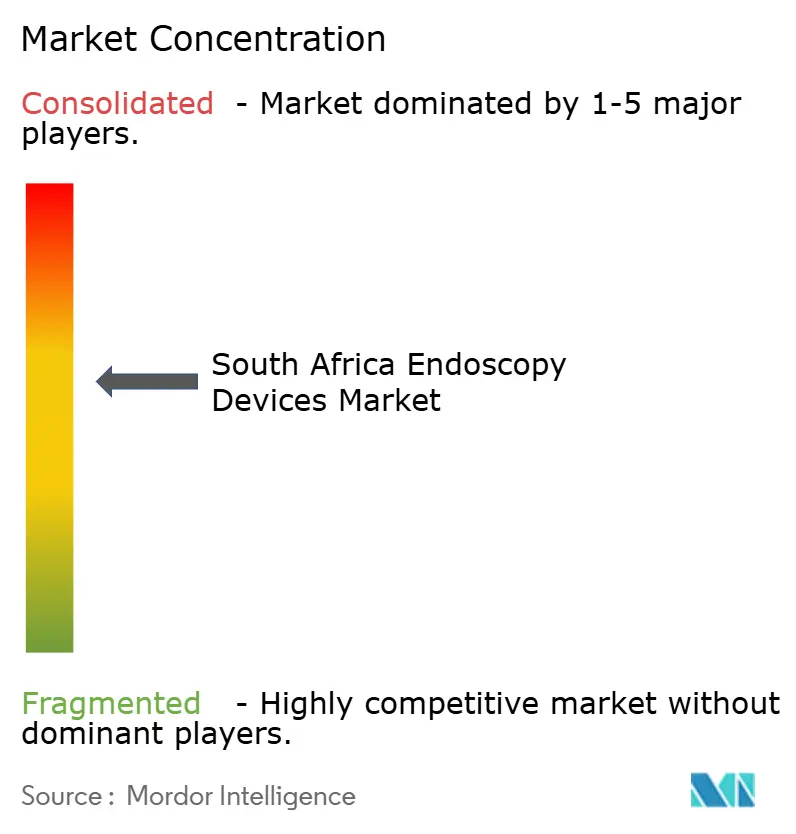
| Market Concentration | Medium |
Major Players *Disclaimer: Major Players sorted in no particular order Image © Mordor Intelligence. Reuse requires attribution under CC BY 4.0. | |
South Africa Endoscopy Devices Market Analysis by Mordor Intelligence
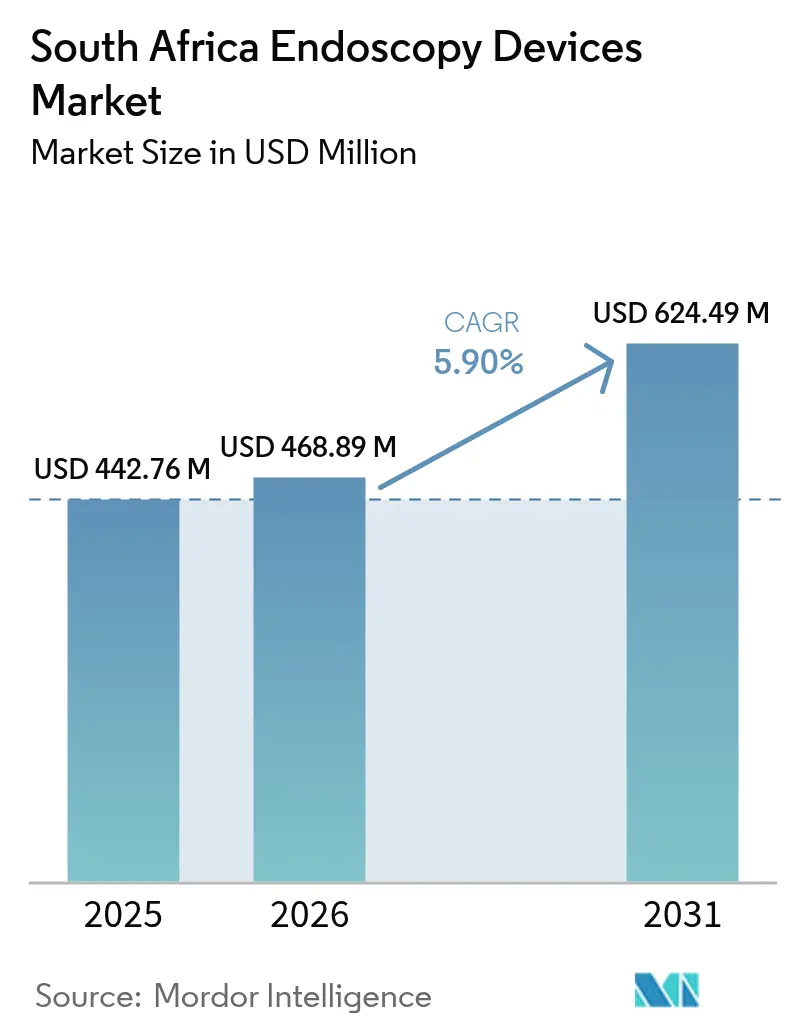
The South Africa endoscopy devices market size is expected to grow from USD 442.76 million in 2025 to USD 468.89 million in 2026 and is forecast to reach USD 624.49 million by 2031 at 5.90% CAGR over 2026-2031. Intensifying healthcare infrastructure upgrades under the National Health Insurance (NHI), rising gastrointestinal disease prevalence, and sustained private-sector capital expenditure are jointly reshaping demand for flexible and rigid scopes. Life Healthcare’s USD 115 million capital plan, together with city-center hospital expansions, boosts equipment procurement pipelines while creating headroom for premium visualization systems. Infection-control imperatives following reusable-scope contamination incidents have elevated single-use options, and artificial-intelligence-enabled imaging continues to raise diagnostic accuracy thresholds, especially in colorectal cancer screening. Regulatory clarity from SAHPRA’s September 2024 medical-device schedules now shortens product-registration lead times, encouraging multinational technology roll-outs. However, escalating compliance expenses for scope reprocessing, a nationwide shortage of 27,000 healthcare workers, and public-sector budget ceilings temper the near-term adoption curve.
Key Report Takeaways
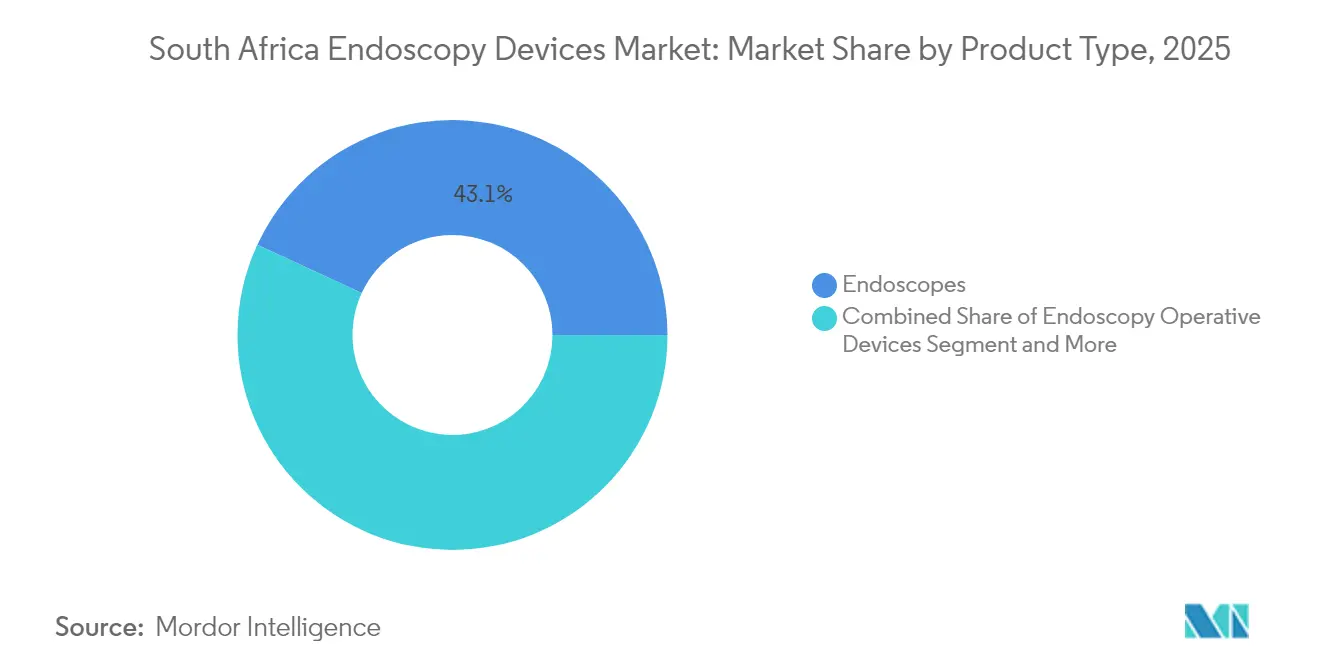
- By product type, endoscopes led with a 43.11% South Africa endoscopy devices market share in 2025; visualization systems are forecast to post an 8.42% CAGR through 2031.
- By application, gastroenterology accounted for 52.05% of the South Africa endoscopy devices market size in 2025, while ENT surgery is advancing at an 8.63% CAGR to 2031.
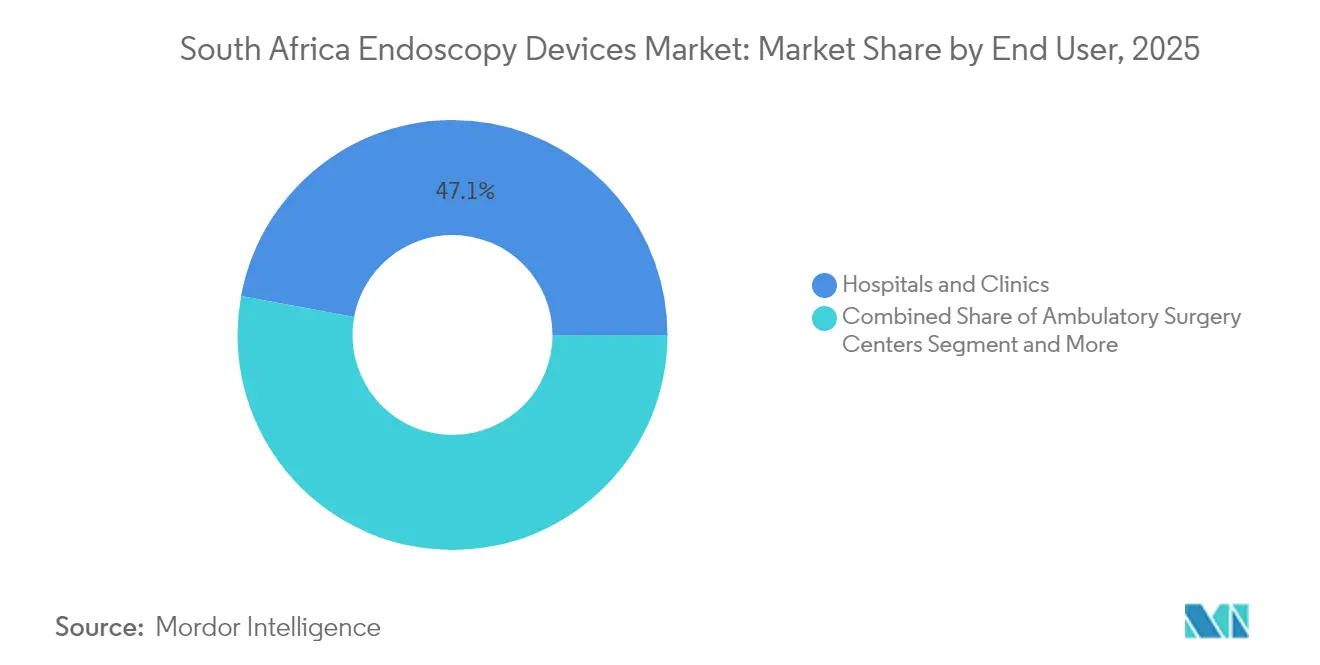
- By end user, hospitals & clinics held 47.10% share of the South Africa endoscopy devices market size in 2025, yet ambulatory surgery centers record the highest projected 8.99% CAGR through 2031.
- By hygiene, reusable scopes dominated with 83.60% South Africa endoscopy devices market share in 2025; single-use scopes are rising at a 9.21% CAGR through 2031.
Note: Market size and forecast figures in this report are generated using Mordor Intelligence’s proprietary estimation framework, updated with the latest available data and insights as of 2026.
South Africa Endoscopy Devices Market Trends and Insights
Drivers Impact Analysis*
| Driver | (~) % Impact on CAGR Forecast | Geographic Relevance | Impact Timeline |
|---|---|---|---|
| Rising incidence of GI diseases & aging population | +1.8% | Urban hubs (Cape Town, Johannesburg) | Medium term (2-4 years) |
| Advancements in endoscopic technologies | +1.5% | Private tertiary hospitals nationwide | Long term (≥ 4 years) |
| Expansion of day-surgery centers | +1.2% | Metro areas, secondary cities | Medium term (2-4 years) |
| Growing awareness of minimally invasive care | +0.9% | National, led by private insurers | Short term (≤ 2 years) |
| Improved NHI reimbursement for therapeutic scopes | +0.6% | Nationwide | Long term (≥ 4 years) |
| Source: Mordor Intelligence | |||
Rising Incidence of Gastrointestinal Diseases Coupled with Growing Aging Population
Dyspepsia drives 52.4% of upper-GI endoscopy indications in Africa, and gastritis is the most frequent finding at 33.3%, underscoring persistent procedural demand. South Africa’s demographic shift toward an older population amplifies colonoscopy screening requirements, as colorectal-cancer cases are projected to rise sharply by 2050. Early detection via endoscopy improves survival odds, embedding the modality within routine chronic-disease management pathways. Urban lifestyles linked to Helicobacter pylori infection and gastroesophageal reflux disease escalate case volumes in major metros. Consequently, the South Africa endoscopy devices market benefits from a consistent flow of diagnostic and interventional procedures despite macroeconomic headwinds.
Advancements in Endoscopic Technologies
Artificial-intelligence-assisted detection now elevates adenoma-detection rates and reduces inter-observer variability during colonoscopy sessions, narrowing diagnostic gaps between public and private facilities[1]. Robotic-assisted platforms extend minimally invasive access to complex GI and bariatric procedures, with flagship programs operational in Johannesburg’s teaching hospitals. Olympus’ EVIS X1 launch integrates machine-learning-based texture and color-pattern recognition, supporting early neoplasia identification. Video-processing upgrades and high-definition chip-on-tip optics stimulate replacement cycles across tertiary centers. While high acquisition costs slow penetration in smaller facilities, leasing models and vendor-backed training accelerate broader technology diffusion within the South Africa endoscopy devices market.
Expansion of Day-Surgery Centers Accelerates Flexible Endoscope Adoption
Ambulatory surgery centers (ASCs) deliver shorter turnaround times and 20%–25% lower procedure costs compared with inpatient settings, a value proposition attractive to payers and patients alike. High-volume colonoscopy and upper-GI lists improve scope utilization rates, justifying investment in premium visualization towers and automated reprocessors. Cape Town and Johannesburg ASCs report the region’s highest surgical-capacity indices, driven by streamlined scheduling protocols and reduced cancellation rates. As NHI benefit schedules broaden, secondary cities such as Bloemfontein and Polokwane are planning ASC build-outs, further enlarging the addressable base for flexible scopes and related consumables.
Growing Awareness and Patient Preference for Minimally Invasive Procedures
Predictive-analytics tools like Discovery Health’s Personal Health Pathways deliver tailored screening prompts to 2.1 million members, boosting preventive colonoscopy uptake rates. Patient education campaigns emphasize faster recovery, reduced scarring, and lower infection risk relative to open surgery, tilting decision matrices toward endoscopic solutions. In facilities where waiting lists strain capacity, minimally invasive techniques free inpatient beds more quickly, aligning clinical efficiencies with administrative imperatives. Social-media amplification of celebrity endoscopy experiences further normalizes procedures, encouraging earlier physician consultations. This demand-side momentum underpins robust volume growth within the South Africa endoscopy devices market.
Restraints Impact Analysis*
| Restraint | (~) % Impact on CAGR Forecast | Geographic Relevance | Impact Timeline |
|---|---|---|---|
| High cost of advanced equipment | -1.1% | Public-sector hospitals countrywide | Short term (≤ 2 years) |
| Shortage of trained endoscopy staff | -0.8% | Rural & secondary urban facilities | Medium term (2-4 years) |
| Economic constraints & budget limitations | -0.6% | Public healthcare system | Long term (≥ 4 years) |
| Source: Mordor Intelligence | |||
High Cost of Advanced Endoscopy Equipment
Premium visualization stacks and robotic platforms can exceed USD 1 million per installation, stretching procurement budgets even in leading private groups. Updated AAMI reprocessing standards add USD 52–67 to every reusable-scope procedure, increasing total cost of ownership. Public hospitals frequently postpone upgrades or rely on donations, creating a two-tier technology landscape. While single-use scopes address contamination risk, their per-unit pricing remains higher than amortized reusable alternatives, challenging adoption in price-sensitive settings.
Shortage of Trained Endoscopy Support Staff in Hospitals
Vacancies across endoscopy technicians, GI nurses, and sterile-processing specialists limit procedural volumes, even where equipment capacity is adequate. Competition from the private sector accelerates workforce migration away from rural facilities, lengthening waiting lists and undermining NHI equity goals[2]. Advanced platforms such as AI-guided colonoscopy require additional training, which intensifies the skills deficit and delays roll-outs in resource-constrained provinces.
*Our forecasts treat driver/restraint impacts as directional, not additive. The impact forecasts reflect baseline growth, mix effects, and variable interactions.
Segment Analysis
By Product Type: Endoscopes Lead Despite Visualization Growth
Endoscopes accounted for 43.11% of the South Africa endoscopy devices market share in 2025, underlining their central role in diagnostic and therapeutic pathways. High prevalence of GI indications ensures stable baseline demand for flexible gastroscopes and colonoscopes, while rigid arthroscopes and laparo-endoscopes support surgical volumes in orthopedics and bariatrics. Visualization systems are projected to log an 8.42% CAGR through 2031, reflecting rapid replacement of standard-definition camera heads with 4K and 3D modules. The South Africa endoscopy devices market benefits from vendor-provided managed-service contracts that bundle towers, light sources, and processors into predictable monthly fees, easing capital-budget pressures.
Disposable single-use scopes gain momentum where contamination concerns outweigh cost differentials; FDA-backed designs are now applied in ERCP and bronchoscopy with comparable technical success. Operative accessories—from electrocautery snares to fluid-management pumps—experience rising throughput as therapeutic endoscopy expands. Robot-assisted flexible platforms remain nascent but attract early adopters in academic centers aiming to deliver incisionless NOTES (natural-orifice transluminal endoscopic surgery). These dynamics collectively tilt the product mix toward higher-value categories, sustaining revenue expansion beyond pure volume growth.

By Application: Gastroenterology Dominance Challenged by ENT Growth
Gastroenterology held 52.05% of the South Africa endoscopy devices market size in 2025, supported by established colorectal-cancer screening guidelines and high peptic-ulcer prevalence. Routine surveillance for Barrett’s esophagus and inflammatory bowel disease further entrenches GI demand. ENT surgery, however, is set to outpace at an 8.63% CAGR through 2031, driven by endoscopic sinus-surgery adoption and the popularity of office-based laryngoscopy.
Pulmonology volumes rise amid persistent tuberculosis caseloads; therapeutic bronchoscopy now incorporates cryo-biopsy and airway-stenting kits that enlarge accessory revenues. Urology leans toward single-use ureteroscopes that mitigate cross-infection in renal-stone management. Arthroscopy and cardiology remain specialized niches characterized by high reimbursement values, while bariatric-endoscopy services such as intragastric-balloon placement reflect burgeoning obesity prevalence. Cross-disciplinary growth diversifies revenue streams, ensuring that the South Africa endoscopy devices market is not overly reliant on any single therapeutic area.
By End User: Hospitals Dominate While Ambulatory Centers Surge
Hospitals & clinics commanded 47.10% of the South Africa endoscopy devices market size in 2025, leveraging integrated care pathways and intensive-care back-up essential for advanced therapeutic cases. Their in-house sterile-processing departments enable large reusable-scope fleets, spreading reprocessing costs over high daily volumes. Yet ambulatory surgery centers will post the fastest 8.99% CAGR to 2031 as payers push lower-acuity procedures into outpatient settings.
The ASC business model aligns with bundled payments and capitation schemes under NHI, encouraging investors to green-light new builds in growing peri-urban markets. Specialized endoscopy centers focusing on GI or ENT lines exploit high-throughput efficiencies and shorter patient turnover to achieve superior economics. Such diversification of care venues reshapes procurement patterns, favoring portable towers and slim-line scopes optimized for fast case-mix changes.
By Hygiene: Reusable Dominance Faces Single-Use Disruption
Reusable scopes still controlled 83.60% of the South Africa endoscopy devices market share in 2025, reflecting entrenched reprocessing infrastructure and lower per-procedure costs at high volumes. Automated endoscope reprocessors with integrated drying cabinets reduce microbial risk, yet outbreaks linked to Pseudomonas and multidrug-resistant organisms continue to surface globally. Single-use scopes, growing at 9.21% CAGR, bypass cleaning entirely and simplify logistics for remote outreach programs.
Cost-benefit models now factor in AAMI-mandated micro-inspection borescope checks and detergent upgrades, narrowing the lifetime expense gap between reusable and disposable options. Sustainability debates ruminate over medical-plastic waste, yet clinical-governance committees increasingly prioritize patient safety over environmental trade-offs. As procurement authorities consolidate under NHI, volume-discount negotiations may tip the balance in favor of single-use platforms for high-risk ERCP and bronchoscopy procedures.
Geography Analysis
Metropolitan hubs—Johannesburg, Pretoria, and Cape Town—absorb a majority share of procedural volumes, buoyed by tertiary hospitals, private-sector capital flows, and proximity to import logistics corridors. These provinces adopt AI-enhanced towers earlier, accelerating replacement cycles. NHI legislation, enacted in 2024, aims to equalize service availability by centralizing procurement and funding nationwide. Yet roll-out complexities and fiscal constraints may delay uniform equipment distribution until beyond 2027, preserving short-term geographic disparities.
Coastal provinces benefit from medical-tourism inflows; private hospitals in Durban and Port Elizabeth advertise package colonoscopy screenings with same-day histology reporting, attracting regional travelers. Inland provinces face greater staff shortages, with vacancy rates for GI technicians surpassing 35% in Limpopo and the Northern Cape. Infrastructure commitments totaling ZAR 943.8 billion (USD 53.28 billion) for 2024-2026 allocate funds for rural clinic refurbishments, including modular endoscopy suites and tele-mentoring platforms that extend urban expertise to remote sites.
Mobile endoscopy units equipped with generator-powered towers are piloting cross-district colorectal-screening drives, demonstrating 40% higher participant compliance versus centralized referral models. Provincial health departments evaluate cloud-based image-archiving systems to enable real-time consults with university gastroenterologists, mitigating specialist scarcity. Over the forecast horizon, incremental infrastructure build-outs and technology transfer schemes are expected to lift penetration rates outside the top three metro areas, broadening the revenue canvas for the South Africa endoscopy devices market.
Regulatory Landscape
South Africa regulates medical devices, including endoscopy equipment, under the Medicines and Related Substances Act, 1965 (Act 101 of 1965), as amended, with oversight by the South African Health Products Regulatory Authority (SAHPRA). The framework is implemented through the Regulations relating to Medical Devices and In Vitro Diagnostic Medical Devices (Government Gazette No. 40480, 09 December 2016) and uses a risk-based classification system (Class A to Class D), which determines evidence requirements and controls based on intended use and invasiveness.
Market entry and ongoing supply depend on establishment-level compliance. Manufacturers, importers, exporters, and distributors must hold a valid SAHPRA Medical Device Establishment License, with quality-system expectations such as ISO 13485 evidence referenced in licensing and renewals. Alongside classification guidance updates (including SAHPRA medical-device classification guideline updates issued in 2025), importation and distribution controls reinforce post-market accountability, which increases the value of local authorized representation and compliant channel partners for multinational endoscopy OEMs operating in South Africa.
Competitive Landscape
International manufacturers dominate through long-standing distributor alliances that navigate SAHPRA registration and tender prerequisites. Olympus, Karl Storz, and Boston Scientific collectively account for significant unit shipments, leveraging bundled service contracts and on-site engineer coverage. Local firms concentrate on reprocessing detergents and low-cost accessory ranges, supplying public hospitals under price-sensitive bids.
Technological differentiation around AI-embedded detection algorithms, 4K/3D imaging, and robotic steerable tips sets leading brands apart, enabling premium pricing. Strategic moves include Olympus’ FY 2024 launch of the EVIS X1 system, which has secured early adoption at two Johannesburg teaching hospitals. Boston Scientific expanded its distribution partnership in 2025 to cover single-use duodenoscopes, anticipating NHI-linked infection-control mandates. Meanwhile, Karl Storz introduced a managed-service lease model, bundling towers, scopes, and consumables under fixed monthly fees, appealing to ASC operators seeking predictable cash-flows.
Training remains a decisive competitive lever; vendors sponsor fellowships and simulation labs to address the critical technician shortage. Digital platforms offering augmented-reality troubleshooting guide on-site staff through scope maintenance, reducing downtime. Such wrap-around services elevate switching costs and entrench incumbent positions, maintaining a moderate concentration score within the South Africa endoscopy devices industry.
South Africa Endoscopy Devices Industry Leaders
-
Olympus Corporation
-
KARL STORZ SE & Co. KG
-
Boston Scientific Corporation
-
Fujifilm Holdings Corporation
-
Pentax Medical (HOYA Corporation)
- *Disclaimer: Major Players sorted in no particular order
Market Opportunities and Future Outlook
Demand for procurement and service expansion is closely tied to health-system infrastructure programs, as National Health Insurance (NHI) drives more centralized buying. In June 2026, the National Department of Health reported that 11 infrastructure bids were submitted to the Budget Facility for Infrastructure (BIF) covering hospitals across multiple provinces (including Gauteng, KwaZulu-Natal, Eastern Cape, Mpumalanga, and Limpopo). These submissions create concrete near-term installation and upgrade touchpoints for visualization towers, reprocessing equipment, and scope fleets aligned to higher case volumes.
Access expansion outside major metros is also being supported through decentralized delivery models that favor portable endoscopy setups and service-supported deployments. A mobile endoscopy-on-wheels model based at George Regional Hospital in the Western Cape has been documented delivering gastrointestinal endoscopy across multiple rural hospitals, reflecting a scalable route to extend diagnostic capacity where fixed-suite constraints and staffing gaps persist. On the market-access side, suppliers that align to SAHPRA licensing and quality expectations (including ISO 13485-linked requirements for licensed establishments) and plan for NHI-linked structures such as the proposed Office of Health Products Procurement (OHPP) can position themselves for both provincial tenders and future centralized procurement pathways.
Recent Industry Developments
- April 2026: Olympus Corporation entered into a strategic distribution partnership with Adcock Ingram Critical Care to supply advanced endoscopy and surgical technologies across South Africa and the Southern African region. The partnership improves local logistics, service coverage, and clinical support capacity, which can reduce downtime and support retention for premium visualization and scope platforms.
- April 2026: South Africa issued an urgent recall notice for certain Boston Scientific products through the National Consumer Commission, citing potential deployment and mechanical malfunctions and referencing 128 affected units in the local market. The action increases post-market surveillance attention and may push hospitals and distributors handling advanced endoscopy-adjacent devices toward tighter supplier quality, traceability, and field-service responsiveness.
- September 2024: SAHPRA released updated medical-device schedules that clarified classification and licensing rules affecting medical devices, including endoscopy equipment. Clearer categorization and establishment obligations support more predictable registration and compliance planning for importers and OEMs selling endoscopes, visualization systems, and related operative devices into South Africa.
Research Methodology Framework and Report Scope
Market Definition and Coverage
For this study, the market covers revenues earned from endoscopy devices used in South Africa for diagnostic and therapeutic procedures, counted at the point of sale into hospitals, clinics, and other care settings.
Scope exclusions: We exclude procedure fees, physician services, and general hospital equipment that is not specific to endoscopy.
Segmentation Overview
- By Product Type
- Endoscopes
- Flexible Endoscopes
- Rigid Endoscopes
- Capsule Endoscopes
- Robot-Assisted Endoscopes
- Disposable (Single-Use) Endoscopes
- Visualization Systems
- Camera Heads
- Light Sources
- Video Processors
- Monitors & Displays
- Data Recorders & Storage
- Endoscopy Operative Devices
- Energy Systems
- Insufflators & Suction Pumps
- Endoscopic Staplers & Suturing Devices
- Retrieval Devices
- Fluid Management Systems
- Accessories & Consumables
- Endoscopes
- By Application
- Gastroenterology
- Pulmonology
- Urology
- Gynecology
- Orthopedic Surgery (Arthroscopy)
- Cardiology
- ENT Surgery
- Neurology
- Bariatric & Metabolic Surgery
- Other Applications
- By End User
- Hospitals & Clinics
- Ambulatory Surgery Centers
- Other End Users
- By Hygiene
- Reusable Endoscopes
- Single-Use Endoscopes
Data Sources, Market Sizing, and Validation
Desk Research
Desk work starts with grounding variables that can be checked publicly, before assumptions get carried into the model. We refer to sources such as the World Health Organization, the World Bank, OECD health statistics (where available), and South Africa health and procurement publications that describe care capacity and service delivery.
We also review regulator and standards content (such as medical device oversight guidance), peer-reviewed clinical literature on endoscopy utilization trends, and hospital group publications where procedure mix is discussed. Company annual reports, investor decks, and reputable press are then used to understand portfolio exposure (endoscopes, operative devices, and visualization systems) and expected pricing direction. For cross-checks, we use paid subscriptions for company financials and intelligence, news and financials coverage, and patent databases to confirm product cycles and adoption timing. The sources listed here are illustrative, and many additional public documents were also used for collection, checks, and clarification.
Primary Interviews and Surveys
Primary inputs are gathered through expert interviews and structured surveys with distributors, procurement stakeholders, clinicians, and service teams that support endoscopy suites, which helps us pin down what is actually being bought and replaced. Since this is a South Africa country market, the fieldwork is spread across major care hubs and then balanced with views from smaller provinces so the pricing and adoption story is not overfit to one metro area. What we hear is used to validate desk signals, fill gaps on reusable versus single-use mixes, and pressure test assumptions on replacement cycles and tender timing.
Distribution of primary research fieldwork respondents
| Company type | Respondent position |
|---|---|
| Top tier: 34% | CXOs: 18% |
| Mid tier: 47% | Functional/Unit leaders: 23% |
| Smaller Players: 19% | Managers: 59% |
Market-Sizing & Forecasting
Sizing begins with a top-down build that reconstructs the demand pool from procedure-linked need and care capacity in South Africa, and then converts that into device spending using realistic pricing and replacement assumptions. The totals are corroborated with selective bottom-up approximations, such as sampled average selling price times unit volumes for key device groups, and distributor channel checks to adjust where the first pass looks too high or too low.
Inputs that matter in this market include estimated endoscopy procedure volumes by major applications, installed base and replacement cycles for endoscopes and visualization systems, reusable versus single-use adoption, public tender cadence versus private buying patterns, and imported device price movement (including currency timing). Where a segment lacks a clean public series, gaps are handled by using proxy indicators like hospital capacity expansion, utilization ranges confirmed by interviews, and conservative carry-forward assumptions that are later re-tested.
Forecasts are built using scenario analysis, because demand can shift with budgets, tender timing, and adoption of single-use products. Growth cases are shaped around procedure growth and replacement need, and then moderated using expert consensus on near-term procurement constraints and expected product upgrade cycles.
Data Validation & Update Cycle
Outputs are checked against independent signals, and large variances are investigated before numbers are finalized. We compare the implied spending per procedure and per facility against realistic ranges, and then review any sudden jumps that are not explained by tenders, currency moves, or replacement waves.
A multi-step analyst review is followed, where assumptions, intermediate worksheets, and final totals are cross-checked for internal consistency across device groups and applications. If a key driver changes materially, such as tender delays, import pricing shifts, or a change in single-use uptake, respondents are re-contacted to confirm direction and magnitude. Reports are refreshed annually, with interim updates for material events, and a final pre-delivery review is completed so clients receive the latest updated view.
Mordor Intelligence's South Africa Endoscopy Devices Market Sizing Compared With Other Published Estimates
Published estimates for this market can look different even when they use the same country label, because the counted device basket and timing choices are not always the same. Differences also show up when one study reports a value for a base year while another highlights a forecast year, which can make gaps look larger than they actually are.
The main gap comes from whether the model counts only device revenues tied to endoscopy procedures inside South Africa, or whether it blends in broader surgical tool spend and wider visualization or accessory buckets without clear allocation rules. Some estimates also apply different currency timing for imported devices and assume faster price progression, and those choices can move the total when volumes are similar. By explicitly separating reusable and single-use endoscopes and then validating replacement cycles through fieldwork, Mordor Intelligence keeps the estimate linked to a repeatable demand pool instead of a wide equipment roll-up.
Benchmark comparison
| Source | Market Size | Gaps in Research Methodology |
|---|---|---|
| Mordor Intelligence | USD 468.89 M (2026) | |
| Industry Publisher A | USD 417.78 M (2024) | Uses an earlier base year, and the reported total may reflect a different inclusion mix across endoscopes, operative devices, and visualization systems, which shifts the starting value before forecasting. |
| Global Advisory B | USD 393.80 M (2028) | States an absolute market increase over the period rather than a single-year market value, which can be misread as a size number and makes comparisons sensitive to the chosen start year and growth window. |
The spread across published figures is largely explained by year selection and what gets counted as endoscopy device revenue versus adjacent equipment spend. When scope rules are clear and pricing, replacement, and procedure linkages are checked with practitioners, the result is easier to replicate and interpret for planning and budgeting.
Key Questions Answered in the Report
What is the current value of the South Africa endoscopy devices market?
It stands at USD 468.89 million in 2026 and is projected to reach USD 624.49 million by 2031.
How fast is single-use endoscope adoption growing?
Single-use scopes are expanding at a 9.21% CAGR through 2031, driven by infection-control priorities.
Which product category is growing fastest?
Visualization systems are slated to grow at an 8.42% CAGR, propelled by AI-enabled imaging.
Why are ambulatory surgery centers important in this space?
ASCs offer 20%-25% lower procedure costs and are expected to grow at a 8.99% CAGR, absorbing routine GI volumes.
What key restraint could slow market growth?
High capital costs and increased reprocessing-compliance expenses raise barriers for public hospitals.