
Software As A Medical Device (SaMD) For Mental Health Market Size and Share
Market Overview
| Study Period | 2020 - 2031 |
|---|---|
| Market Size (2026) | USD 12.44 Billion |
| Market Size (2031) | USD 27.40 Billion |
| Growth Rate (2026 - 2031) | 17.45 % |
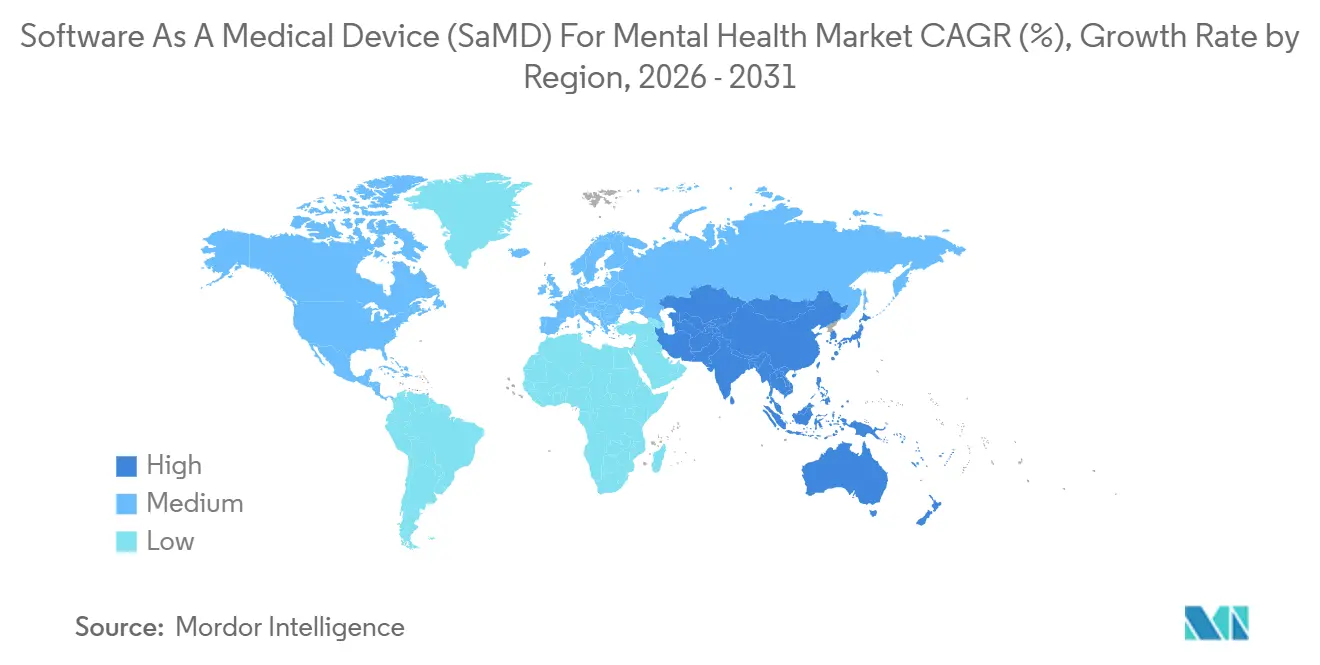
| Fastest Growing Market | Asia-Pacific |
| Largest Market | North America |
| Market Concentration | Medium |
Major Players *Disclaimer: Major Players sorted in no particular order Image © Mordor Intelligence. Reuse requires attribution under CC BY 4.0. | |
Software As A Medical Device (SaMD) For Mental Health Market Analysis by Mordor Intelligence
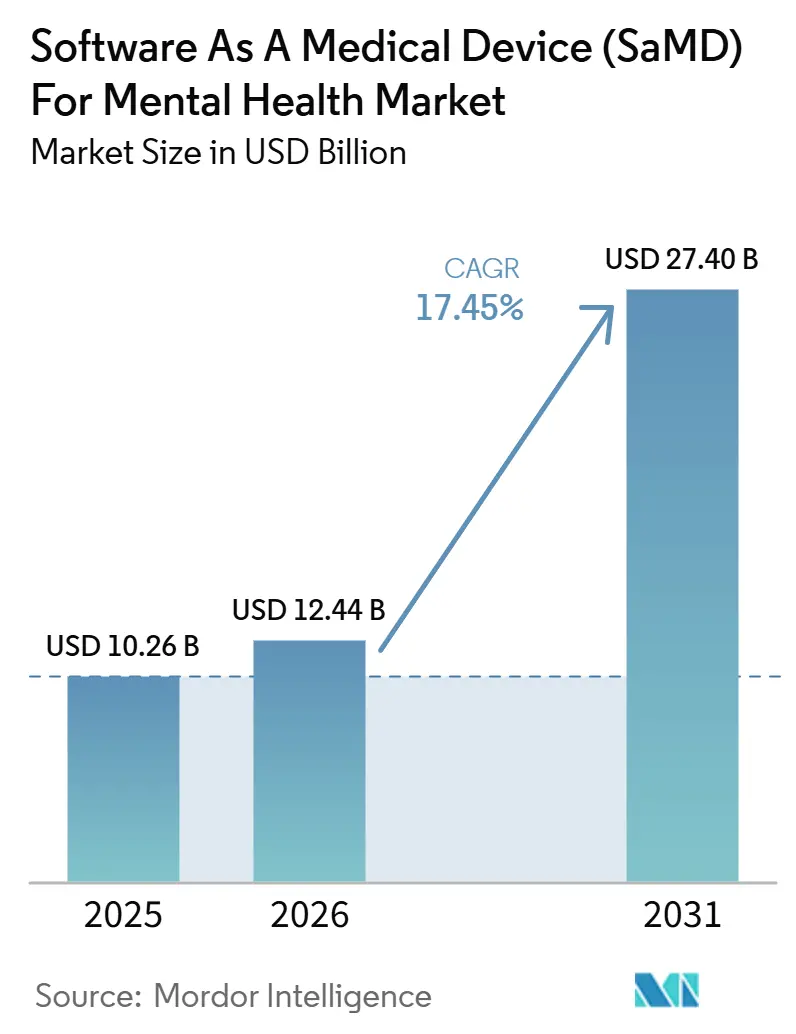
The Software As A Medical Device For Mental Health Market size was valued at USD 10.26 billion in 2025 and is estimated to grow from USD 12.44 billion in 2026 to reach USD 27.40 billion by 2031, at a CAGR of 17.45% during the forecast period (2026-2031).
The software as a medical device for mental health market moved into broader clinical use as mental health systems faced treatment gaps, limited specialist capacity, and rising demand for structured remote care. In 2025, the Centers for Medicare & Medicaid Services activated billing codes G0552, G0553, and G0554, creating a federal reimbursement route for eligible digital mental health treatments and improving commercial adoption for providers and developers.[1]Centers for Medicare & Medicaid Services, “Medicare & Mental Health Coverage – MLN1986542,” CMS, cms.gov Prescription digital therapeutics, mobile applications, and healthcare providers led by type, delivery mode, and end-user group, while growth through 2031 was set to come from Asia-Pacific, web-based platforms, and payer and employer channels.
Key Report Takeaways
- By type, prescription digital therapeutics held 38.55% of revenue in 2025, while remote patient monitoring and digital biomarker software is projected to grow at an 18.93% CAGR through 2031.
- By therapeutic area, depression accounted for 34.22% of revenue in 2025, while ADHD is projected to grow at a 19.67% CAGR through 2031.
- By delivery mode, mobile applications held 52.66% of revenue in 2025, while web-based platforms are projected to grow at a 20.35% CAGR through 2031.
- By end user, healthcare providers held 41.56% of revenue in 2025, while payers and employers are projected to grow at an 18.78% CAGR through 2031.
- By geography, North America held 40.56% of revenue in 2025, while Asia-Pacific is projected to grow at a 19.56% CAGR through 2031.
Note: Market size and forecast figures in this report are generated using Mordor Intelligence’s proprietary estimation framework, updated with the latest available data and insights as of January 2026.
Market Trends and Insights
Drivers Impact Analysis of Software As A Medical Device (SaMD) For Mental Health Market*
| DRIVER | (~) % IMPACT ON CAGR FORECAST | GEOGRAPHIC RELEVANCE | IMPACT TIMELINE |
|---|---|---|---|
| Rising FDA and regulator-backed clinical validation | +3.2% | North America primary, Europe and Japan expanding | Medium term (2-4 years) |
| Expansion of reimbursement pathways for prescription digital therapeutics | +2.9% | North America core, Europe with DiGA spillover | Short term (≤ 2 years) |
| Employer and payer demand for scalable mental health solutions | +2.6% | Global, with early gains in North America, the UK, and Australia | Short term (≤ 2 years) |
| Ai-enabled personalization and measurement-based care | +2.2% | Global | Medium term (2-4 years) |
| Under-served psychiatric comorbidities with limited therapeutic alternatives | +1.8% | Asia-Pacific core, with spillover to Middle East and Africa | Long term (≥ 4 years) |
| Post-acute and relapse-prevention use cases are expanding total addressable market | +1.4% | North America and Europe | Medium term (2-4 years) |
| Source: Mordor Intelligence | |||
Rising FDA and Regulator-Backed Clinical Validation
The software as a medical device for mental health market is benefiting from a clearer regulatory pathway than it had a few years ago. A 2025 peer-reviewed review identified 19 FDA-authorized mental health SaMD products across digital therapeutics, biofeedback tools, remote monitoring systems, and software-based care support applications. This expanding base provides developers with visible product precedents and gives providers greater confidence in clinical adoption.[2]Johanna Herpertz, “FDA-Authorized Software as a Medical Device in Mental Health, A Perspective on Evidence, Device Lineage, and Regulatory Challenges,” npj Mental Health Research, nature.com
The same review noted that many later products relied on substantial equivalence to earlier De Novo predicates, giving established players an advantage as product lineages deepened. This trend is reshaping competition, as newer entrants must meet a higher evidence and compliance threshold to build trust. Over time, it should support higher-quality products, stronger clinical acceptance, and more durable commercial positions for companies with cleared assets.
Expansion of Reimbursement Pathways for Prescription Digital Therapeutics
Reimbursement remains one of the strongest growth levers in the software as a medical device for mental health market. CMS activated the G0552 to G0554 billing codes on January 1, 2025, allowing Medicare providers to bill for eligible digital mental health treatment devices and related clinical services. This policy shift turns clinical validation into a more viable revenue pathway, especially for products that require prescription oversight.
The Access to Prescription Digital Therapeutics Act of 2025 also indicated that federal policy was moving toward a more formal benefit structure for these tools, including manufacturer reporting obligations and pricing transparency. In Europe, Germany continued to serve as an important reference point through DiGA, and the 2026 update linked at least 20% of reimbursed pricing to outcomes performance. Together, these reimbursement changes improve buyer visibility and make the market more investable.
Employer and Payer Demand for Scalable Mental Health Solutions
Employer and payer demand is expanding the commercial base of the software as a medical device for mental health market beyond traditional prescription channels. EBRI reported in 2025 that 97% of large US employers offered mental health coverage, yet fewer than half measured whether those benefits delivered timely and effective care. This gap favors digital treatment models that generate structured usage data and clearer outcome tracking.
A 2025 published analysis covering 19 employer cohorts found that enhanced behavioral health services produced strong results for depression and anxiety outcomes, supporting continued interest in measurable, digital-first mental health programs. As employers focus more on value, the market benefits from products that are easier to monitor than traditional fragmented care pathways. This trend also gives vendors more real-world evidence to strengthen payer discussions and product positioning.
AI-Enabled Personalization and Measurement-Based Care
AI-supported personalization is shaping the next phase of the software as a medical device for mental health market. A 2025 JMIR study that reviewed 42 peer-reviewed papers found that passive sensing from smartphones and wearables, when paired with machine learning, can reliably monitor mental health conditions in clinically diagnosed populations. This capability shifts software from fixed treatment modules toward adaptive care based on behavior, sleep, voice, movement, or device use.[3]S. Y. Shen, “Passive Sensing for Mental Health Monitoring Using Machine Learning,” Journal of Medical Internet Research, jmir.org
It also gives providers and payers a pathway toward measurement-based care without relying only on traditional visit-based assessments. In practical terms, this approach can reduce dependence on long and repeated user sessions by generating useful signals from short and frequent interactions. As these systems mature, the market is likely to reward companies that combine clinical rigor with simple user experiences.
Restraints Impact Analysis of Software As A Medical Device (SaMD) For Mental Health Market*
| RESTRAINT | (~) % IMPACT ON CAGR FORECAST | GEOGRAPHIC RELEVANCE | IMPACT TIMELINE |
|---|---|---|---|
| Slow and uneven payer coverage for novel digital therapeutics | -2.8% | North America and Europe outside DiGA-style systems | Short term (≤ 2 years) |
| High clinical evidence burden and long reimbursement timelines | -2.1% | Global | Medium term (2-4 years) |
| Patient retention and engagement decay after initial use | -1.6% | Global | Short term (≤ 2 years) |
| Data privacy, cybersecurity, and algorithm transparency | -1.2% | Global, with added sensitivity in Europe and the United States | Medium term (2-4 years) |
| Source: Mordor Intelligence | |||
Slow and Uneven Payer Coverage for Novel Digital Therapeutics
The software as a medical device for mental health market continued to face uneven coverage even after the 2025 Medicare milestone. CMS opened an important route for eligible digital mental health treatments, but broader payer adoption across plans and care settings remained in progress. Provider willingness to prescribe and operationalize these tools varied widely depending on reimbursement clarity. This created a split commercial picture, with some employer-backed or provider-led programs moving ahead quickly while other parts of the care system remained cautious. This uneven pace slowed scale-up for products that required prescription support, workflow integration, and repeat provider engagement. Until coverage becomes more consistent, the market is expected to show stronger adoption in channels where payment visibility is better.
High Clinical Evidence Burden and Long Reimbursement Timelines
High evidence standards remained a meaningful restraint for the software as a medical device for mental health market. The 2025 Nature review found that 4 of the 19 FDA-authorized mental health SaMD products had pivotal randomized trials conducted on prototypes that differed from the final marketed version. This finding raised questions about how evidence continuity was judged and increased pressure for stronger post-clearance validation. Developers may need to spend more time and capital on trial design, software updates, and regulatory documentation before revenue can scale. Smaller companies may find this difficult, especially when payer adoption trails regulatory clearance by a wide margin. Over time, this can favor companies with deeper balance sheets, stronger clinical partnerships, and the capacity to absorb a longer path to reimbursement.
*Our forecasts treat driver/restraint impacts as directional, not additive. The impact forecasts reflect baseline growth, mix effects, and variable interactions.
Software As A Medical Device (SaMD) For Mental Health Market Segment Analysis
By Type:
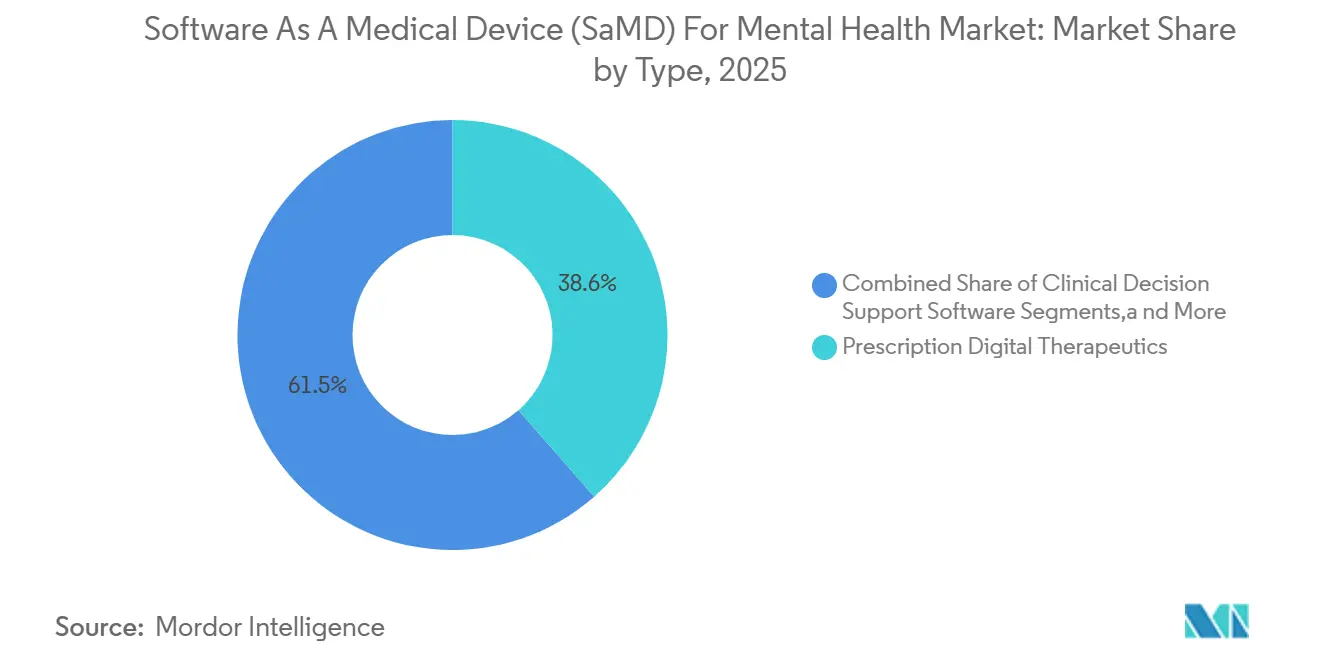
Prescription Therapeutics Anchor Revenue as Biomarker Monitoring AcceleratesPrescription digital therapeutics held 38.55% of the type segment in 2025, making them the largest revenue contributor in the software as a medical device for mental health market. Their lead reflected a stronger clinical identity, higher physician relevance, and better alignment with formal reimbursement pathways than lower-acuity companion applications. Rejoyn, cleared in 2024 as the first prescription digital therapeutic authorized for adjunctive treatment of major depressive disorder symptoms in adults, showed that smartphone-based interventions could meet FDA standards for clinical use. This milestone strengthened the business case for products that providers could prescribe, monitor, and bill within established workflows.
Remote patient monitoring and digital biomarker software is projected to grow at an 18.93% CAGR from 2026 to 2031, making it the fastest-moving type in the software as a medical device for mental health market. A 2025 review in JMIR found consistent support for passive sensing across 42 peer-reviewed studies, covering mobility, sleep, social activity, and voice-related patterns. This evidence base expanded mental health software from treatment delivery to continuous measurement and tracking. As products shift from symptom support to longitudinal monitoring, biomarker-driven tools are likely to play a larger role in relapse prevention, therapy adjustment, and clinical oversight.



By Therapeutic Area:
Depression Anchors the Market as ADHD Builds Fastest Growth MomentumDepression accounted for 34.22% of therapeutic area revenue in 2025, giving it the largest position in the software as a medical device for mental health market. The segment benefited from a large diagnosed population, a more established cognitive behavioral therapy evidence base, and clearer regulatory familiarity for digital treatment models. Product proof points, including Rejoyn for major depressive disorder and SleepioRx and DaylightRx in related reimbursable behavioral treatment pathways, supported commercial confidence. Anxiety, insomnia, and sleep disorders also remained attractive due to strong payer and employer demand and alignment with digital behavior-change models.
ADHD is projected to grow at a 19.67% CAGR from 2026 to 2031, making it the fastest-growing therapeutic area in the software as a medical device for mental health market. APA Services noted in 2025 that the 2026 Medicare Physician Fee Schedule proposal extended digital mental health treatment billing to ADHD devices under CFR § 882.5803, creating an important reimbursement signal. This policy direction built on the regulatory foundation established by EndeavorRx and supported follow-on products for structured attention-related interventions. Substance use disorder and PTSD remained active middle-tier categories, while severe mental illness presented white space due to limited cleared products and complex clinical measurement.
By Delivery Mode:
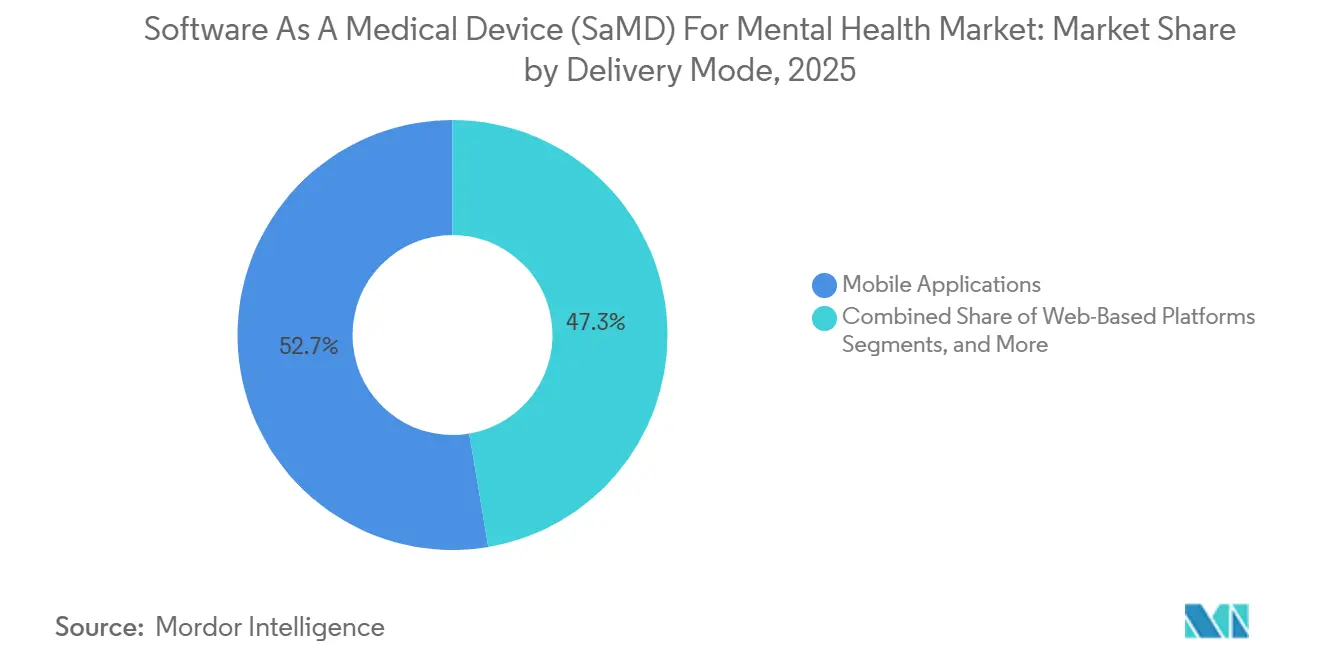
Mobile Platforms Dominant, Web-Based Closes the Gap on Enterprise DemandMobile applications accounted for 52.66% of the software as a medical device for mental health market size in 2025, making them the dominant delivery mode. Their lead reflected smartphone familiarity, easier onboarding, and repeated patient engagement during structured therapy programs. Mobile-first delivery also supported cleared products that relied on direct patient interaction while enabling clinical oversight when needed. Products such as SleepioRx and DaylightRx showed that mobile delivery could support reimbursable treatment models beyond consumer wellness.
Web-based platforms are projected to grow at a 20.35% CAGR from 2026 to 2031, making them the fastest-growing delivery model in the software as a medical device for mental health market. This growth reflects rising demand from health systems, employers, and payers for browser-based access across mixed device environments and stronger IT control. APA Services noted that employer-contracted digital mental health deployments increasingly used web-based formats to reduce app-store dependence and improve workforce access. Hybrid platforms with provider dashboards are also gaining relevance where prescription management, documentation, and EHR connectivity matter.
By End User:
Providers Anchor Prescriptions While Payers and Employers AccelerateHealthcare providers held 41.56% of end-user revenue in 2025 and remained the largest buyer group in the software as a medical device for mental health market. This position reflected the role of physicians, therapists, and behavioral health teams in prescribing, supervising, and billing for regulated digital interventions. The provider channel was critical for prescription digital therapeutics because adoption depended on clinical workflow fit, not only consumer interest. CMS billing support for digital mental health treatment devices strengthened this model by placing eligible products within recognized care and reimbursement structures.
Payers and employers are projected to grow at an 18.78% CAGR from 2026 to 2031, making them the fastest-growing end-user segment in the software as a medical device for mental health market. EBRI found in 2025 that mental health benefits were nearly universal among large employers, but outcome measurement remained limited, creating demand for trackable solutions. A published 2025 cohort analysis showed that enhanced behavioral health services delivered strong results across 19 employer sites, reinforcing demand for measurable and scalable digital care models. Patients and consumers remain direct-access users for companion applications, but payer and employer adoption is likely to remain a key growth engine over the forecast period.
Geography Analysis
North America Software As a Medical Device (SaMD) for Mental Health Market
North America held 40.56% of the software as a medical device for mental health market share in 2025 and remained the leading commercial region. The United States supported this position through strong FDA authorization pathways, improving reimbursement, and provider familiarity with digital mental health treatment categories. CMS billing codes for eligible devices created a clearer route for prescription-linked products, strengthening revenue conversion and product validation. The region also benefited from a deeper installed base of cleared products and strong employer interest in measurable mental health benefits.
Europe Software As a Medical Device (SaMD) for Mental Health Market
Europe remained the second major regional pillar in the software as a medical device for mental health market. Germany stood out as its DiGA pathway remained one of the most developed national prescription routes for digital health applications. A 2024 review found that mental health applications formed the largest category in Germany’s DiGA directory, with 25 listed applications. The 2026 DiGA update required outcomes monitoring and linked at least 20% of reimbursed pricing to performance, raising the standard for evidence-backed adoption.
APAC, MEA and South America Software As a Medical Device (SaMD) for Mental Health Market
Asia-Pacific is projected to grow at a CAGR of 19.56% from 2026 to 2031, making it the fastest-growing regional segment in the software as a medical device for mental health market. The region offers strong demand potential as care access gaps remain wider, and digital delivery can expand support without requiring every user to consult an in-person specialist. Japan remains strategically important as its PMDA framework provides a defined path for SaMD review and supports interest in reimbursable digital therapeutic use. South Korea and Australia have more structured digital health environments, while the Middle East and Africa remains early-stage and South America is building a stronger regulatory base.

Competitive Landscape
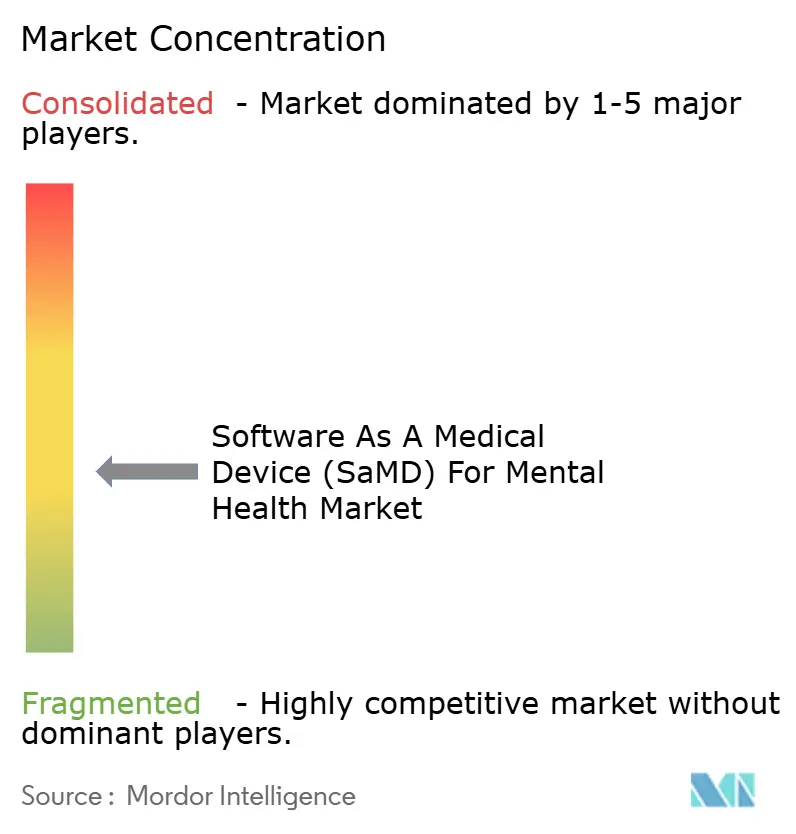
The software as a medical device for mental health market remains moderately fragmented, with competition spanning prescription digital therapeutic developers, behavioral health platforms, and healthcare incumbents adding software capabilities. No single business model controls the market, while clinical evidence requirements, reimbursement dependence, and platform integration needs create opportunities for multiple competitors. Scale advantages are becoming more visible as larger companies gain better access to provider channels, employer contracts, and regulatory resources, making the market more competitive while still far from consolidated.
Strategic deals in 2026 showed how the market was changing. Universal Health Services announced its plan to acquire Talkspace for approximately USD 835 million, linking a major behavioral health provider with a large virtual mental health network and strengthening distribution capacity. Spring Health completed its combination with Alma in May 2026, creating a platform that reached 120 million insured lives and more than 120,000 independent clinicians. Big Health secured USD 23.7 million in February 2026 to accelerate provider adoption of SleepioRx and DaylightRx, indicating that commercial focus was shifting toward reimbursement penetration rather than consumer scale alone. These moves suggested that companies were building stronger positions through network access, payer relevance, workflow fit, and product design.
Competition within the software as a medical device for mental health market is separating into two broad groups. One group focuses on evidence-backed prescription products that depend on FDA clearance and reimbursement support, while the other focuses on broader behavioral health platforms that use software, AI tools, and benefit integration to support large employer and payer relationships. White space remains most visible in severe mental illness, where cleared software options remain limited and clinical measurement is more difficult than in depression, anxiety, or sleep-related conditions. Companies that combine rigorous evidence, practical reimbursement pathways, and scalable delivery models are likely to build the strongest positions over the next few years.
Software As A Medical Device (SaMD) For Mental Health Industry Leaders
Akili Interactive Labs, Inc.
Big Health, Inc.
Koa Health, S.L.
Teladoc Health, Inc.
Headspace, Inc.
- *Disclaimer: Major Players sorted in no particular order
Software As A Medical Device (SaMD) For Mental Health Market Companies Covered in this Report
- AbleTo, Inc.
- Akili Interactive Labs, Inc.
- Behavioral Health Tech, LLC
- BetterHelp, Inc.
- Big Health, Inc.
- Calm.com, Inc.
- Curio Digital Therapeutics, Inc.
- Headspace, Inc.
- Headway, Inc.
- Koa Health, S.L.
- Limbix Health, Inc.
- Lyra Health, Inc.
- Otsuka
- Qualifacts Systems, LLC
- Quartet Health, Inc.
- Rejoyn, Inc.
- Spring Health, Inc.
- Talkspace, Inc.
- Teladoc Health
- Wysa Ltd.

Recent Industry Developments in Software As A Medical Device (SaMD) For Mental Health Market
- May 2026: Spring Health acquired Alma, creating a lifelong mental health platform that combines AI-native employer benefits with Alma’s payer-contracted network covering 120 million insured lives and over 120,000 independent clinicians.
- March 2026: Universal Health Services signed a definitive agreement to acquire Talkspace for approximately USD 835 million, combining a major behavioral health provider with a 6,000-clinician virtual network.
- February 2026: Big Health raised USD 23.7 million in strategic funding to accelerate Medicare provider adoption of SleepioRx and DaylightRx after CMS activated DMHT billing codes G0552 to G0554.


Global Software As A Medical Device (SaMD) For Mental Health Market Report Scope
As per the scope of the report, Software as a Medical Device (SaMD) for mental health refers to standalone software used to diagnose, treat, or monitor psychiatric conditions like depression, anxiety, or insomnia. Because it is entirely software, it functions independently of any physical hardware device, usually operating through a smartphone app, tablet, or web browser.
The Software as a Medical Device (SaMD) for mental health market is segmented by type, therapeutic area, delivery mode, end user, and geography. By type, the market includes prescription digital therapeutics, clinical decision support software, remote patient monitoring and digital biomarker software, and companion and adjunct therapeutic software. By therapeutic area, the market is segmented into depression, anxiety disorders, insomnia and sleep disorders, substance use disorders, attention-deficit/hyperactivity disorder, post-traumatic stress disorder, schizophrenia and psychosis, and other mental health indications. By delivery mode, the market is categorized into mobile applications, web-based platforms, hybrid app and provider workflow platforms, and wearable-integrated software. By end user, the market is segmented into patients and consumers, healthcare providers, payers and employers, and behavioral health clinics and telepsychiatry networks. By geography, the market is analyzed across North America, Europe, Asia-Pacific, the Middle East and Africa, and South America. The report also covers the estimated market sizes and trends for 17 countries across major regions globally. The report offers the market sizes and forecasts in terms of value (USD) for the above segments.
| Prescription Digital Therapeutics |
| Clinical Decision Support Software |
| Remote Patient Monitoring and Digital Biomarker Software |
| Companion and Adjunct Therapeutic Software |
| Depression |
| Anxiety Disorders |
| Insomnia and Sleep Disorders |
| Substance Use Disorders |
| Attention-Deficit/Hyperactivity Disorder |
| Post-Traumatic Stress Disorder |
| Schizophrenia and Psychosis |
| Other Mental Health Indications |
| Mobile Applications |
| Web-Based Platforms |
| Hybrid App and Provider Workflow Platforms |
| Wearable-Integrated Software |
| Patients and Consumers |
| Healthcare Providers |
| Payers and Employers |
| Behavioral Health Clinics and Telepsychiatry Networks |
| North America | United States |
| Canada | |
| Mexico | |
| Europe | Germany |
| United Kingdom | |
| France | |
| Italy | |
| Spain | |
| Rest of Europe | |
| Asia-Pacific | China |
| India | |
| Japan | |
| Australia | |
| South Korea | |
| Rest of Asia-Pacific | |
| Middle East and Africa | GCC |
| South Africa | |
| Rest of Middle East and Africa | |
| South America | Brazil |
| Argentina | |
| Rest of South America |
| By Type | Prescription Digital Therapeutics | |
| Clinical Decision Support Software | ||
| Remote Patient Monitoring and Digital Biomarker Software | ||
| Companion and Adjunct Therapeutic Software | ||
| By Therapeutic Area | Depression | |
| Anxiety Disorders | ||
| Insomnia and Sleep Disorders | ||
| Substance Use Disorders | ||
| Attention-Deficit/Hyperactivity Disorder | ||
| Post-Traumatic Stress Disorder | ||
| Schizophrenia and Psychosis | ||
| Other Mental Health Indications | ||
| By Delivery Mode | Mobile Applications | |
| Web-Based Platforms | ||
| Hybrid App and Provider Workflow Platforms | ||
| Wearable-Integrated Software | ||
| By End User | Patients and Consumers | |
| Healthcare Providers | ||
| Payers and Employers | ||
| Behavioral Health Clinics and Telepsychiatry Networks | ||
| By Geography | North America | United States |
| Canada | ||
| Mexico | ||
| Europe | Germany | |
| United Kingdom | ||
| France | ||
| Italy | ||
| Spain | ||
| Rest of Europe | ||
| Asia-Pacific | China | |
| India | ||
| Japan | ||
| Australia | ||
| South Korea | ||
| Rest of Asia-Pacific | ||
| Middle East and Africa | GCC | |
| South Africa | ||
| Rest of Middle East and Africa | ||
| South America | Brazil | |
| Argentina | ||
| Rest of South America | ||


Key Questions Answered in the Report
What is the 2026 size of the software as a medical device for mental health space?
The software as a medical device for mental health market size stands at USD 12.26 billion in 2026 and is forecast to reach USD 27.40 billion by 2031 at a 17.45% CAGR.
Which region currently leads revenue generation?
North America led in 2025 with a 40.56% share, supported by stronger FDA pathways and clearer reimbursement progress for eligible digital mental health treatments.
Which product type contributes the most revenue today?
Prescription digital therapeutics led the type segment with a 38.55% share in 2025 because they fit more directly into prescribing, reimbursement, and supervised care workflows.
Which therapeutic area is growing the fastest through 2031?
ADHD is forecast to expand at a 19.67% CAGR through 2031, supported by a stronger reimbursement direction and an expanding regulatory base for digital therapeutic use.
Why are employers and payers becoming more important buyers?
Large employers already offer mental health benefits widely, but many still do not measure outcomes well, which increases interest in software that can show usage, adherence, and treatment results.
What is the main barrier to faster adoption?
Reimbursement consistency remains the biggest barrier because even with new Medicare billing support, broader payer coverage and operational uptake still vary across care settings.
Page last updated on:





