
Software As A Medical Device (SaMD) For Chronic Disease Management Market Size and Share
Market Overview
| Study Period | 2020 - 2031 |
|---|---|
| Market Size (2026) | USD 32.91 Billion |
| Market Size (2031) | USD 83.03 Billion |
| Growth Rate (2026 - 2031) | 19.45 % |
| Fastest Growing Market | Asia-Pacific |
| Largest Market | North America |
| Market Concentration | Low |
Major Players *Disclaimer: Major Players sorted in no particular order Image © Mordor Intelligence. Reuse requires attribution under CC BY 4.0. | |
Software As A Medical Device (SaMD) For Chronic Disease Management Market Analysis by Mordor Intelligence
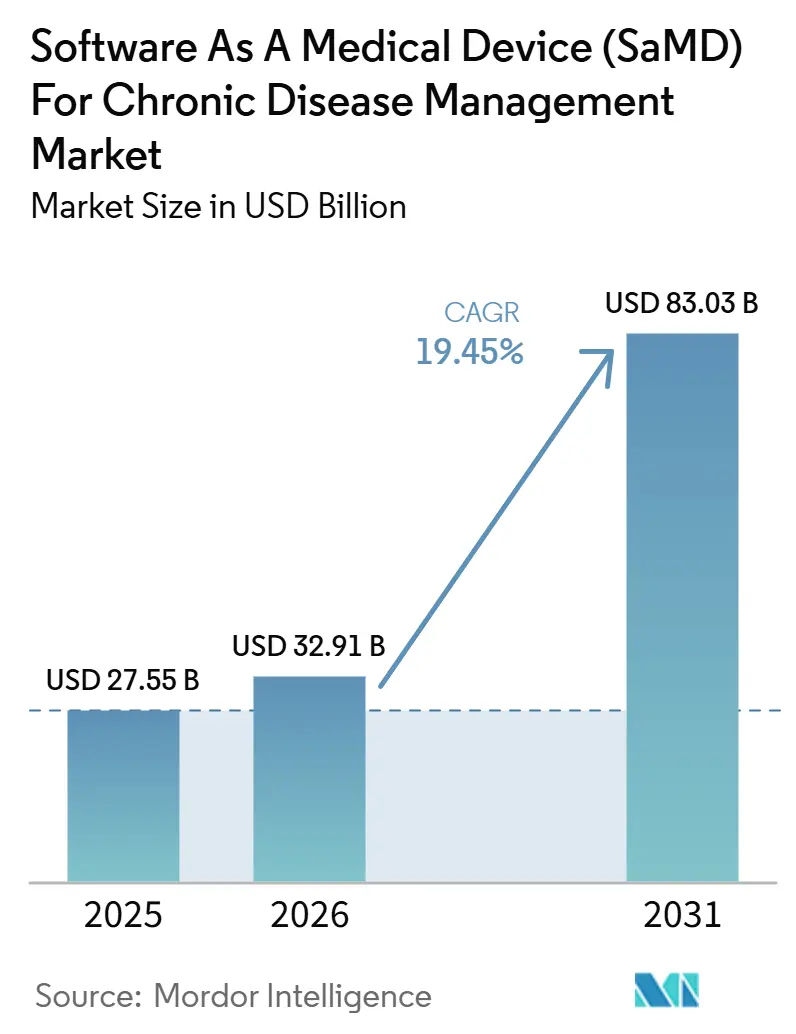
The Software As A Medical Device For Chronic Disease Management Market size is expected to grow from USD 27.55 billion in 2025 to USD 32.91 billion in 2026 and is forecast to reach USD 83.03 billion by 2031 at 19.45% CAGR over 2026-2031.
The demand base remains durable, as chronic and mental health conditions account for 90% of the United States’ USD 5.3 trillion in annual healthcare spending. More than 40.1 million Americans live with diabetes, while cardiovascular disease and stroke caused more than 850,000 deaths in 2024. Globally, noncommunicable diseases cause more than 40 million deaths each year, keeping health systems focused on continuous care rather than episodic intervention. Advances in machine learning tools, connected sensors, and scalable cloud infrastructure now enable clinically relevant monitoring and decision support to extend beyond hospitals into daily disease management. The July 2026 CMS ACCESS launch added a direct payment route tied to measurable chronic care outcomes.
Key Report Takeaways
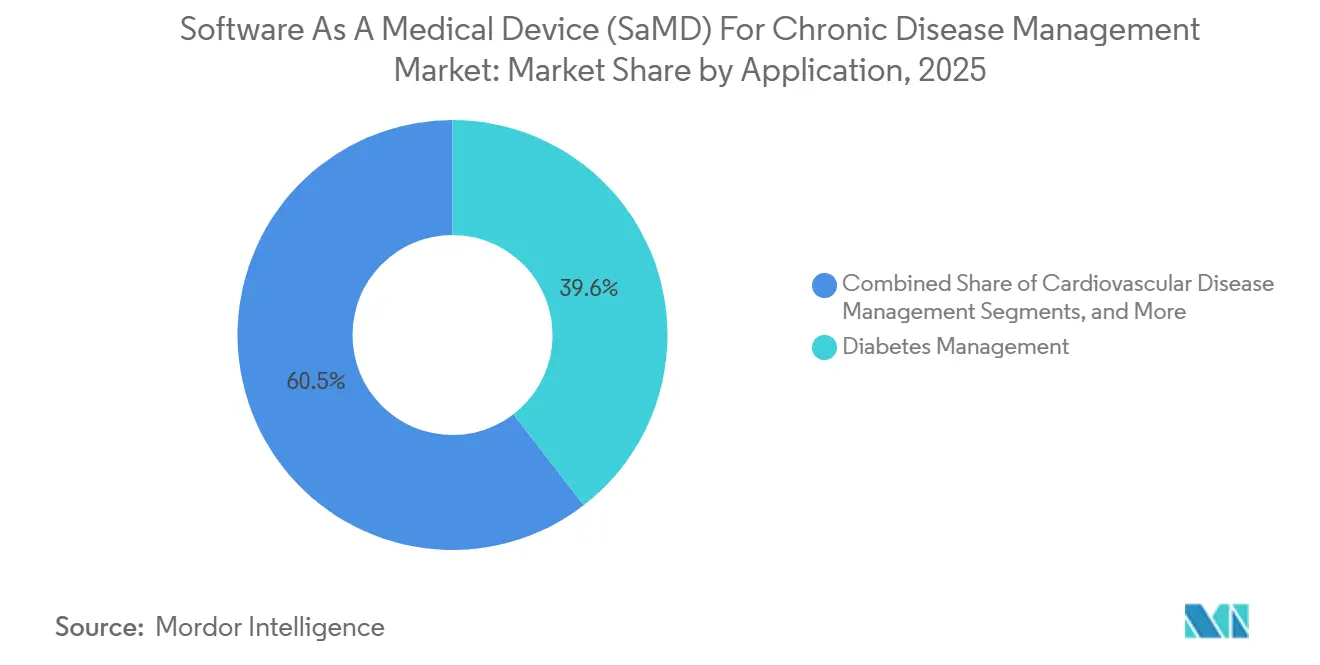
- By application, diabetes management held 39.55% share in 2025, while cardiovascular disease management is projected to expand at a 21.93% CAGR through 2031.
- By deployment, cloud-based solutions accounted for 64.22% share in 2025, while hybrid deployment is projected to grow at a 22.67% CAGR through 2031.
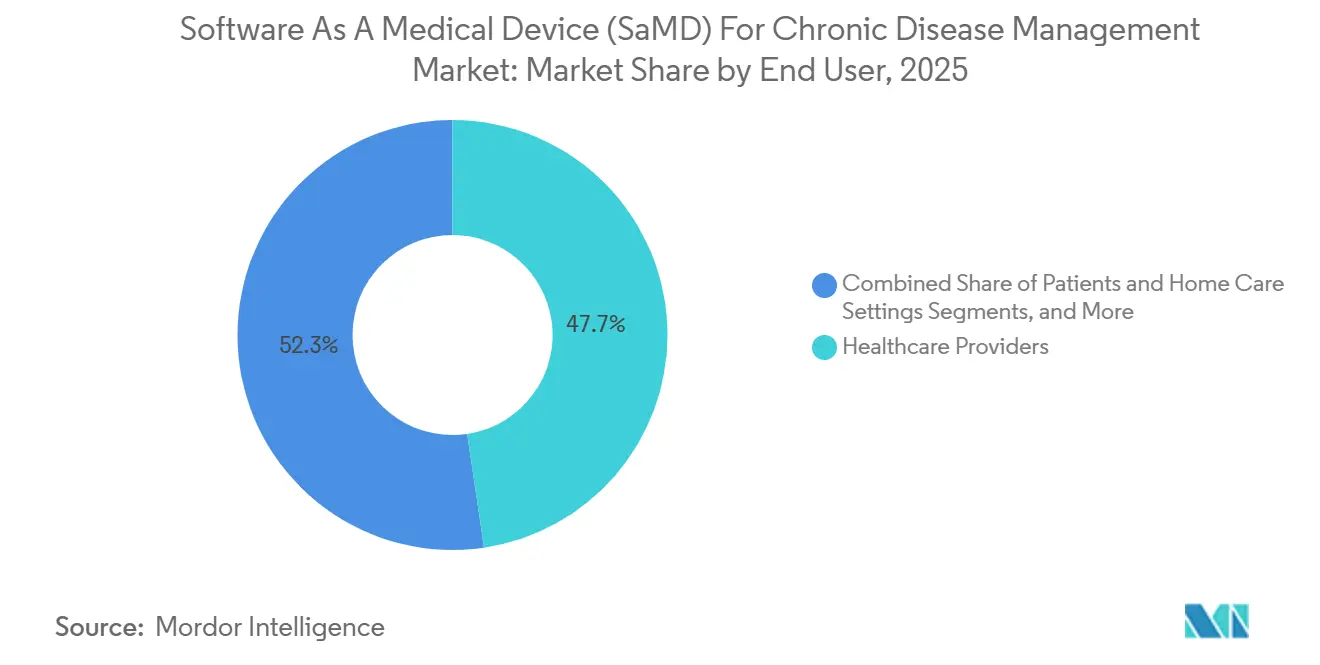
- By end user, healthcare providers held 47.66% share in 2025, while patients and home care settings is expected to record the fastest CAGR of 23.35% through 2031.
- By risk class, Class II devices represented 52.33% share in 2025, while Class III devices are projected to expand at a 22.33% CAGR through 2031.
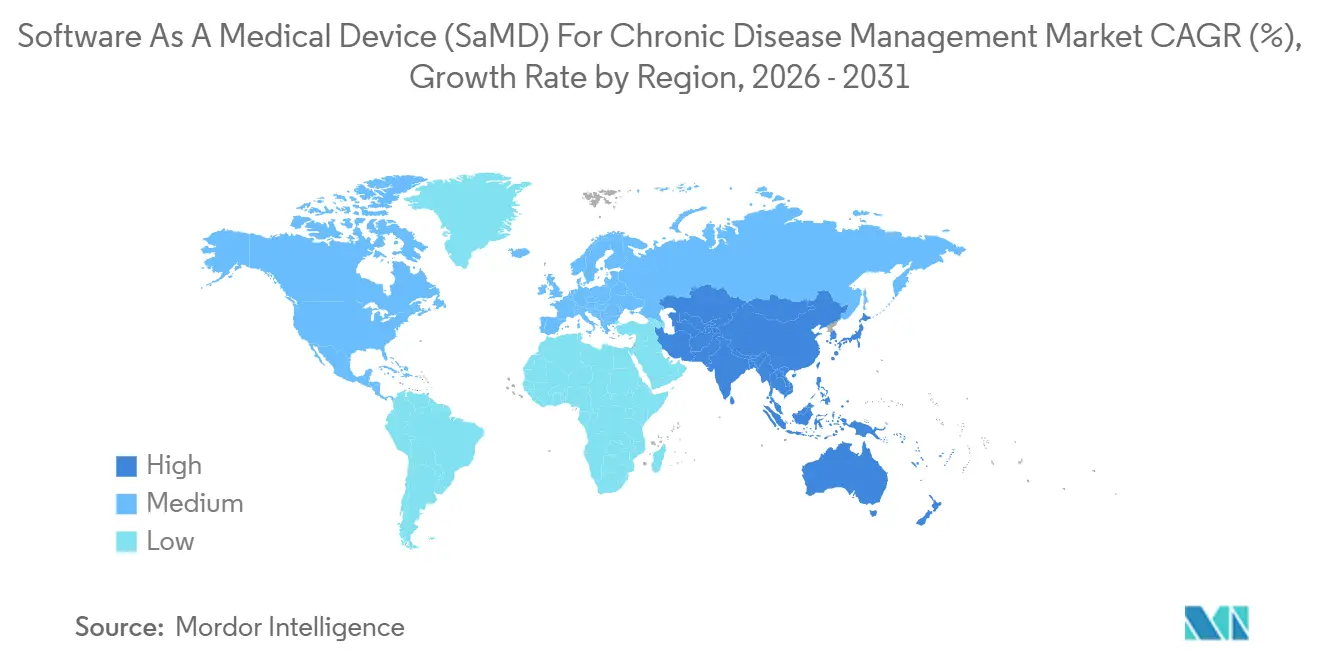
- By geography, North America held 42.25% share in 2025, while Asia-Pacific is projected to grow at a 23.95% CAGR through 2031.
Note: Market size and forecast figures in this report are generated using Mordor Intelligence’s proprietary estimation framework, updated with the latest available data and insights as of January 2026.
Global Software As A Medical Device (SaMD) For Chronic Disease Management Market Trends and Insights
Drivers Impact Analysis*
| DRIVER | (~) % IMPACT ON CAGR FORECAST | GEOGRAPHIC RELEVANCE | IMPACT TIMELINE |
|---|---|---|---|
| Rising burden of diabetes, cardiovascular disease, and other chronic conditions | +5.5% | Global, with concentration in North America, Asia-Pacific, and Europe | Long term (≥ 4 years) |
| Ai-enabled continuous risk stratification and personalization | +4.1% | North America and Europe, with rapid Asia-Pacific adoption | Medium term (2-4 years) |
| Expansion of value-based care and outcome-linked reimbursement | +3.2% | North America primary, with spillover into Europe | Medium term (2-4 years) |
| Remote patient monitoring integration with connected devices | +3.5% | Global, with fastest penetration in North America and East Asia | Short term (≤ 2 years) |
| Regulatory clarification for ai-enabled medical software | +2.4% | North America and Europe core, with secondary effect in Asia-Pacific | Medium term (2-4 years) |
| Employer and payer demand for lower total cost of care | +2.0% | North America, with gradual spillover into employer-led markets elsewhere | Short term (≤ 2 years) |
| Source: Mordor Intelligence | |||
Rising Chronic Disease Burden Amplified by Multi-Morbidity
Chronic disease remains the core demand driver for the Software as a Medical Device (SaMD) for Chronic Disease Management Market, as treatment increasingly requires long-duration monitoring, repeated intervention, and stronger patient follow-up. In the United States, chronic and mental health conditions account for 90% of annual healthcare spending, while more than 40.1 million Americans live with diabetes. Cardiovascular disease and stroke caused more than 850,000 deaths in 2024, and noncommunicable diseases cause more than 40 million deaths globally each year.[1]U.S. Food and Drug Administration, “Artificial Intelligence in Software as a Medical Device,” U.S. Food and Drug Administration, fda.gov This demand favors software that tracks linked conditions across care settings, as patients often move across diabetes, cardiovascular, and metabolic pathways simultaneously.
AI-Enabled Continuous Risk Stratification and Personalization
AI is changing how the Software as a Medical Device (SaMD) for Chronic Disease Management Market creates value, as care teams can monitor risk continuously instead of relying on periodic readings. The FDA’s 2025 guidance work for AI and machine learning in medical software centered attention on life cycle management, post-clearance change control, and safer algorithm updates.[2]Centers for Disease Control and Prevention, “Fast Facts: Health and Economic Costs of Chronic Conditions,” Centers for Disease Control and Prevention, cdc.gov Vendors with stronger change management plans can improve software faster without disrupting the regulatory pathway each time they refine a model. As a result, the market is moving toward platforms that combine algorithm performance with disciplined governance, larger data pools, stronger quality systems, and continuous validation.
Expansion of Value-Based Care and Outcome-Linked Reimbursement
Reimbursement change became one of the clearest commercial supports for the Software as a Medical Device (SaMD) for Chronic Disease Management Market in 2026. The CMS ACCESS model went live on July 5, 2026, and paid participating organizations based on measurable improvement in chronic conditions rather than service volume alone. This shift made SaMD tools more relevant because they can track outcomes, follow patients between visits, and document whether care teams meet defined care goals. The FDA TEMPO pilot, announced in December 2025, added another pathway for digital health devices tied to meaningful patient outcomes in chronic conditions.
Remote Patient Monitoring Integration With Connected Devices
Remote monitoring is becoming a routine part of chronic care delivery, giving the Software as a Medical Device (SaMD) for Chronic Disease Management Market a broader operating base. Dexcom presented results from the CONNECT randomized controlled trial in June 2026, showing statistically significant A1C reduction in people with Type 2 diabetes not using insulin who used Dexcom G7 compared with standard care. ResMed received FDA clearance in November 2025 for its AI-enabled Personalized Therapy Comfort Settings software, extending adaptive treatment support into the home setting. iRhythm reported that patients can self-apply home-based monitoring devices with strong compliance and data quality, supporting the shift away from clinic-only workflows.
Restraints Impact Analysis*
| RESTRAINT | (~) % IMPACT ON CAGR FORECAST | GEOGRAPHIC RELEVANCE | IMPACT TIMELINE |
|---|---|---|---|
| Clinical validation and evidence generation bottlenecks | -2.3% | Global, with greater pressure in cardiovascular and respiratory applications | Long term (≥ 4 years) |
| Reimbursement variability across therapies and geographies | -1.8% | Asia-Pacific, Middle East and Africa, and South America most affected | Medium term (2-4 years) |
| Interoperability gaps with EHr and device ecosystems | -1.5% | Global, concentrated in fragmented hospital systems | Medium term (2-4 years) |
| Data privacy, cybersecurity, and AI liability exposure | -1.2% | Europe and North America most exposed | Short term (≤ 2 years) |
| Source: Mordor Intelligence | |||
Clinical Validation and Evidence Generation Bottlenecks
Clinical validation remains a significant restraint in the Software as a Medical Device (SaMD) for Chronic Disease Management Market, as evidence generation is slower and more expensive than standard software release cycles. The FDA’s AI-related SaMD work shows that developers must support safe change management and ongoing validation, not just initial clearance. Review timelines vary by device complexity, while quality systems, documentation controls, and software life cycle processes add fixed costs before companies can scale revenue. A 2026 framework called for good digital medicine practices and more consistent validation standards; however, until harmonization improves, evidence requirements will continue to favor better-funded companies.
Reimbursement Variability Across Therapies and Geographies
Reimbursement remains uneven across the Software as a Medical Device (SaMD) for Chronic Disease Management Market, although policy momentum has improved in the United States. CMS ACCESS has created a stronger route for outcome-linked adoption, but payment clarity remains inconsistent across regions and disease categories. As a result, developers must manage multiple commercial models, including provider contracting, employer sales, payer partnerships, and patient-paid use cases. This mismatch slows sales cycles, complicates product planning, and limits market scaling in lower-coverage regions, pushing vendors to prioritize applications with clearer reimbursement first.
*Our forecasts treat driver/restraint impacts as directional, not additive. The impact forecasts reflect baseline growth, mix effects, and variable interactions.
Segment Analysis
By Application: Diabetes SaMD Anchors Share While Cardiovascular Reshapes Growth
Diabetes Management held 39.55% of the application base in 2025, giving it the largest position within the Software as a Medical Device (SaMD) for Chronic Disease Management market share. The segment benefited from a mature connected care stack covering continuous glucose monitoring, dose support, and automated insulin delivery. Dexcom’s G7 15-Day Continuous Glucose Monitoring System received FDA clearance on February 3, 2026, underscoring continued product refinement.
The diabetes application continued to expand as developers targeted more complex user groups beyond the broad insulin-treated population. WellDoc registered its Rx App for Diabetes in Pregnancy and Insulin Pump Users with the FDA in March 2026, indicating deeper specialization within the segment. Cardiovascular Disease Management is projected to record the fastest CAGR of 21.93% from 2026 to 2031, increasing the Software as a Medical Device (SaMD) for Chronic Disease Management market size as care models become more continuous and data-driven.



By Deployment: Cloud Dominance Persists While Hybrid Models Gain Enterprise Preference
Cloud-Based deployment accounted for a 64.22% share in 2025, keeping it at the center of the Software as a Medical Device (SaMD) for Chronic Disease Management market size by deployment. The model supports broad patient access, large data storage requirements, and regular software improvements without site-by-site updates. Cloud architecture also aligns with longitudinal monitoring, where repeated data capture and ongoing clinical review create value.
The Hybrid model is forecast to expand at a 22.67% CAGR through 2031 as buyers seek cloud analytics with local control over sensitive health data. Hospitals and health systems want scalability, but they also need stronger control over patient data storage and movement. On-Premise setups remain relevant in high-security environments, public health systems, and facilities with slower cloud migration timelines. As a result, deployment strategy is becoming part of the clinical and operational buying decision, not only an IT choice.
By End User: Provider Workflows Hold Scale While Home Care Expands Fastest
Healthcare Providers held a 47.66% share in 2025, making them the largest end-user group across the Software as a Medical Device (SaMD) for Chronic Disease Management market. This position reflected the continued importance of hospital and clinic workflows, where clinicians rely on dashboards, alerts, and software-supported care planning. Provider adoption remains strongest when monitoring tools fit into existing decision routines and support follow-up for high-risk chronic patients.
Patients and Home Care Settings are projected to grow at a 23.35% CAGR through 2031, making this the fastest-moving end-user segment. iRhythm’s AVALON study showed that commercially insured patients who self-applied the Zio LTCM device at home had the highest diagnostic yield and the lowest likelihood of cardiovascular events compared with other ambulatory cardiac monitoring modalities. Employers are also using chronic disease software to manage absenteeism, productivity loss, and downstream claims costs. As more care moves into the home, the market gains a larger role in adherence, therapy adjustment, and patient engagement.
By Risk Class: Class II Leads the Current Base While Class III Lifts Future Complexity
Class II devices held a 52.33% share in 2025, placing them at the center of the Software as a Medical Device (SaMD) for Chronic Disease Management market share by risk class. This category has been commercially productive because it supports clinically meaningful monitoring and decision support without the heavier burden of the most complex approvals. The 510(k) pathway has enabled companies such as Dexcom, iRhythm, and ResMed to build product families with recurring improvements and new clinical use cases.
Class III devices are projected to grow at a 22.33% CAGR through 2031, indicating stronger demand for software that can influence higher-acuity treatment decisions. As developers move further into therapy adaptation and complex decision support, evidence requirements and surveillance needs increase. Class I software still supports engagement, symptom tracking, and self-management across the broader care journey. The mix across Class I, Class II, and Class III shows that the industry is moving from basic monitoring toward deeper clinical involvement.
Geography Analysis
North America is expected to hold 42.25% of the Software as a Medical Device (SaMD) for Chronic Disease Management market share in 2025, maintaining its lead among regional markets. The region benefits from stronger reimbursement channels, deeper insurance penetration, and a larger base of digital health developers than most other geographies. The CMS ACCESS model, scheduled to launch on July 5, 2026, is expected to create a direct policy signal that measurable improvements in chronic care can support payment. The FDA’s TEMPO pilot also adds momentum by outlining a pathway for technology-enabled patient outcomes in chronic conditions. Canada is also gaining relevance, as Huma Therapeutics received a Health Canada Class II Medical Device Licence for its cloud-based digital health platform in April 2025.
Europe remains the second-largest region in the user-supplied draft, supported by a regulated healthcare base and growing interest in reimbursable digital therapeutics. Germany stands out because it offers a clearer route for digital health reimbursement than most other European markets. This framework gives developers a more practical entry point for software commercialization in chronic care. However, the region continues to progress unevenly because payment conditions and adoption rates vary widely across national healthcare systems.
Asia-Pacific is projected to grow at a CAGR of 23.95% through 2031, making it the fastest-expanding regional opportunity and increasing the Software as a Medical Device (SaMD) for Chronic Disease Management market size during the forecast period. Large chronic disease populations, rising healthcare expenditure, and increasing digital health adoption across major economies support this growth. China and India offer the largest patient pools, especially across diabetes, cardiovascular disease, and respiratory conditions. Japan serves as an important near-term commercial marker, as iRhythm launched its Zio ECG Recording and Analysis System in the country in May 2025 through Senko Medical Instrument.

Competitive Landscape
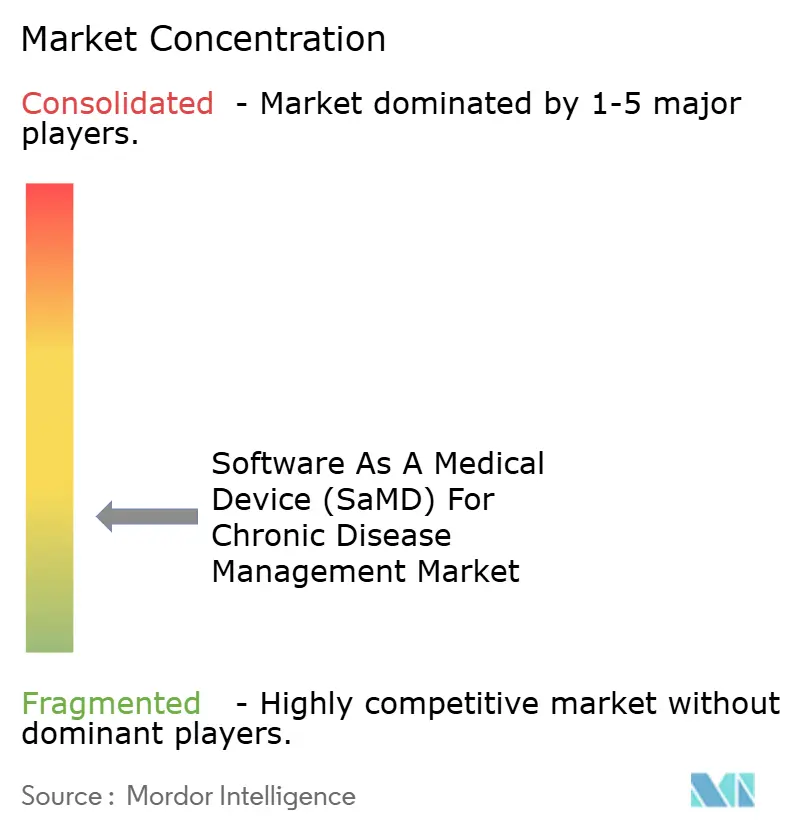
The competitive structure of the Software as a Medical Device (SaMD) for Chronic Disease Management Market remains fragmented, with device-software hybrids, digital therapeutics firms, and broader virtual care platforms competing across clinical pathways. Larger companies gain an advantage when they combine hardware, algorithms, patient monitoring, and commercial access within one ecosystem. Medtronic completed its acquisition of CathWorks for USD 585 million in April 2026, adding AI-enabled fractional flow reserve angiography software to its cardiovascular portfolio. Dexcom also announced in June 2026 that it had agreed to acquire Nutrisense, expanding from glucose data into personalized nutrition guidance and dietitian support.
Platform-led companies are pursuing a strategy focused on outcomes, member growth, and payer or employer access. Omada Health reported 42% year-over-year revenue growth in Q1 2026 and surpassed 1 million total members, strengthening its scale in obesity, diabetes, and related metabolic management. The company also stated that its GLP-1 Care Track is available through all three major US pharmacy benefit managers, improving reach without relying on proprietary hardware. This model keeps pressure on larger companies as software-led chronic care scales through benefit design, employer channels, and digital coaching rather than device placement alone.
Product development remains a key route to differentiation in the Software as a Medical Device (SaMD) for Chronic Disease Management Market. Insulet’s 2026 EVOLVE pivotal trial for a fully closed-loop system showed how software automation is moving deeper into treatment support and reducing patient effort. Diabeloop’s July 2026 launch of DBLG2 in Germany, integrated with Kaleido and Dexcom G7, highlighted software, device, and reimbursement alignment within one offering. Huma Therapeutics also strengthened its regulatory footprint with a Health Canada Class II Medical Device Licence in 2025, supporting cross-market platform credibility.
Software As A Medical Device (SaMD) For Chronic Disease Management Industry Leaders
AliveCor, Inc.
Koninklijke Philips N.V.
GE HealthCare Technologies Inc.
Siemens Healthineers AG
Medtronic plc
- *Disclaimer: Major Players sorted in no particular order

Recent Industry Developments
- July 2026: Diabeloop launched the DBLG2 Automated Insulin Delivery system in Germany, integrating ViCentra's Kaleido insulin patch pump and Dexcom G7 CGM as a fully reimbursable, physician-prescribed diabetes SaMD.
- June 2026: Dexcom presented CONNECT trial results showing significant A1C reduction in non-insulin Type 2 diabetes patients using Dexcom G7 and agreed to acquire Nutrisense to expand CGM-based nutrition support.
- April 2026: Medtronic acquired CathWorks for USD 585 million, adding the AI-enabled FFRangio System to its cardiovascular SaMD portfolio for coronary artery disease management.
- May 2025: iRhythm launched its Zio ECG Recording and Analysis System in Japan through Senko Medical Instrument, with PMDA-cleared deep-learning detection for 13 arrhythmia types.


Global Software As A Medical Device (SaMD) For Chronic Disease Management Market Report Scope
As per the scope of the report, Software as a Medical Device (SaMD) is standalone software intended to be used for medical purposes (like diagnosis, treatment, or monitoring) without being part of physical hardware. In chronic disease management, it uses algorithms, smartphones, or cloud platforms to actively analyze patient data and provide actionable treatment recommendations.
The software as a medical device (SaMD) for chronic disease management market is segmented by application, deployment, end user, risk class, and geography. By application, the market includes diabetes management, cardiovascular disease management, respiratory disease management, obesity and metabolic disease management, and other chronic disease management. By deployment, the market is segmented into cloud-based, on-premise, and hybrid. By end user, the market is segmented into healthcare providers, payers, patients and home care settings, and employers. By risk class, the market is segmented into Class I, Class II, and Class III. By geography, the market is analyzed across North America, Europe, Asia-Pacific, the Middle East and Africa, and South America. The report also covers the estimated market sizes and trends for 17 countries across major regions globally. The report offers the market sizes and forecasts in terms of value (USD) for the above segments.
| Diabetes Management |
| Cardiovascular Disease Management |
| Respiratory Disease Management |
| Obesity and Metabolic Disease Management |
| Other Chronic Disease Management |
| Cloud-Based |
| On-Premise |
| Hybrid |
| Healthcare Providers |
| Payers |
| Patients and Home Care Settings |
| Employers |
| Class I |
| Class II |
| Class III |
| North America | United States |
| Canada | |
| Mexico | |
| Europe | Germany |
| United Kingdom | |
| France | |
| Italy | |
| Spain | |
| Rest of Europe | |
| Asia-Pacific | China |
| India | |
| Japan | |
| Australia | |
| South Korea | |
| Rest of Asia-Pacific | |
| Middle East and Africa | GCC |
| South Africa | |
| Rest of Middle East and Africa | |
| South America | Brazil |
| Argentina | |
| Rest of South America |
| By Application | Diabetes Management | |
| Cardiovascular Disease Management | ||
| Respiratory Disease Management | ||
| Obesity and Metabolic Disease Management | ||
| Other Chronic Disease Management | ||
| By Deployment | Cloud-Based | |
| On-Premise | ||
| Hybrid | ||
| By End User | Healthcare Providers | |
| Payers | ||
| Patients and Home Care Settings | ||
| Employers | ||
| By Risk Class | Class I | |
| Class II | ||
| Class III | ||
| By Geography | North America | United States |
| Canada | ||
| Mexico | ||
| Europe | Germany | |
| United Kingdom | ||
| France | ||
| Italy | ||
| Spain | ||
| Rest of Europe | ||
| Asia-Pacific | China | |
| India | ||
| Japan | ||
| Australia | ||
| South Korea | ||
| Rest of Asia-Pacific | ||
| Middle East and Africa | GCC | |
| South Africa | ||
| Rest of Middle East and Africa | ||
| South America | Brazil | |
| Argentina | ||
| Rest of South America | ||


Key Questions Answered in the Report
How large is software as a medical device for chronic disease management in 2026?
The sector stands at USD 32.91 billion in 2026 and is projected to reach USD 83.03 billion by 2031 at a 19.45% CAGR.
Which application area leads current demand?
Diabetes Management leads with 39.55% share in 2025, supported by mature CGM, dose support, and automated insulin delivery software.
Which application is growing the fastest through 2031?
Cardiovascular Disease Management is the fastest-growing application, with a projected 21.93% CAGR through 2031.
Why is North America ahead of other regions?
North America held 42.25% share in 2025 because reimbursement, regulation, and digital health infrastructure are more established, and CMS ACCESS now supports outcome-linked adoption.
What is driving home-based chronic care software adoption?
Remote monitoring is gaining ground because connected devices and SaMD now support reliable at-home use, with examples from Dexcom, ResMed, and iRhythm showing stronger clinical utility outside the clinic.
Which deployment model is expanding the fastest?
Hybrid deployment is projected to grow at 22.67% CAGR because health systems want cloud scalability while keeping tighter control over sensitive health data.
What makes competition intense in this space?
Competition is rising because companies are widening their scope through acquisitions, broader care programs, and integrated software-device ecosystems, as seen with Medtronic, Dexcom, Omada, Insulet, and Diabeloop.
Page last updated on:





