
Sodium Dichromate Market Size and Share
Market Overview
| Study Period | 2021 - 2031 |
|---|---|
| Market Size (2026) | USD 1.60 Billion |
| Market Size (2031) | USD 2.05 Billion |
| Growth Rate (2026 - 2031) | 5.11 % |
| Fastest Growing Market | Asia-Pacific |
| Largest Market | Asia-Pacific |
| Market Concentration | Low |
Major Players *Disclaimer: Major Players sorted in no particular order Image © Mordor Intelligence. Reuse requires attribution under CC BY 4.0. | |
Sodium Dichromate Market Analysis by Mordor Intelligence
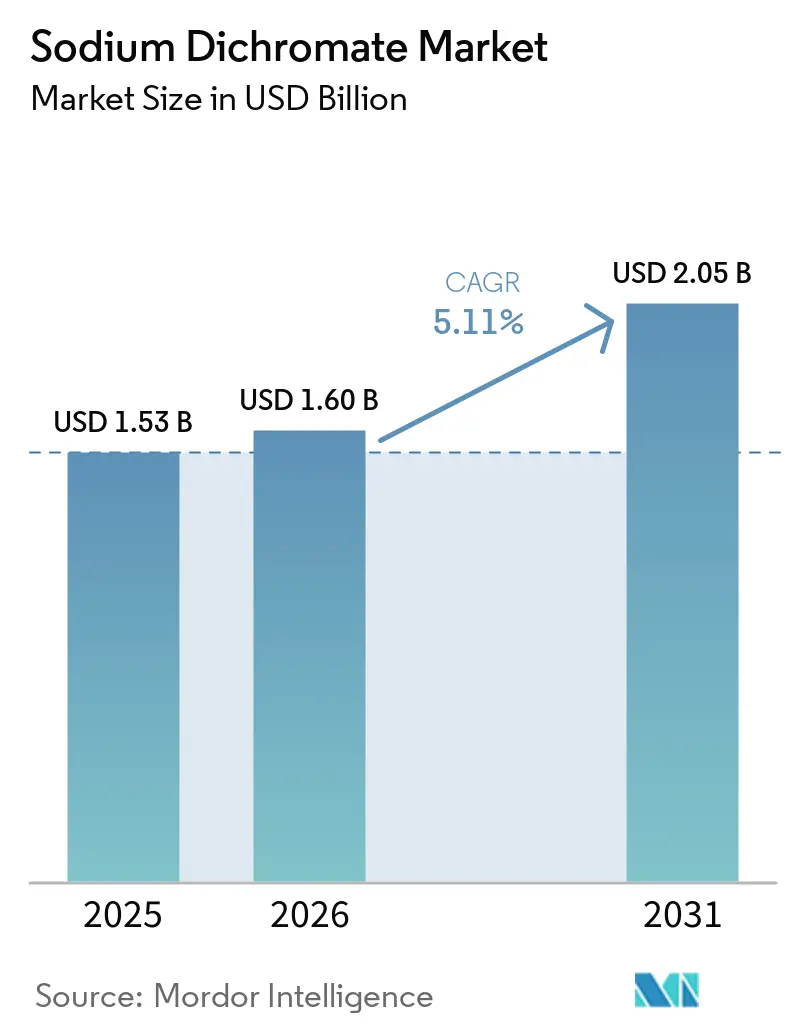
The sodium dichromate market size was valued at USD 1.53 billion in 2025 and is estimated to grow from USD 1.60 billion in 2026 to reach USD 2.05 billion by 2031, at a CAGR of 5.11% during the forecast period from 2026 to 2031. The sodium dichromate market remains closely tied to the production of chromic acid, chromium trioxide, and chromium oxide green, where commercial substitutes have not gained broad acceptance at scale within the established chromium chemicals value chain. Demand from metal finishing, pigments, coatings, and leather tanning supports sales across established industrial supply chains, including aerospace surface treatment, construction-related colorants, and cost-sensitive tanning operations. Asia-Pacific combines large downstream chemical activity with cost-competitive leather processing and expanding automotive and electronics production. Regulatory controls limit certain uses of hexavalent chromium, but they also favor suppliers that retain authorizations and operate modern treatment systems, narrowing the group of producers with stronger pricing and customer retention positions. Calcium-free roasting offers these producers a lower-risk production route by avoiding calcium chromate by-products, reducing remediation exposure, and supporting longer operating license durability as environmental controls become more stringent.
Key Report Takeaways
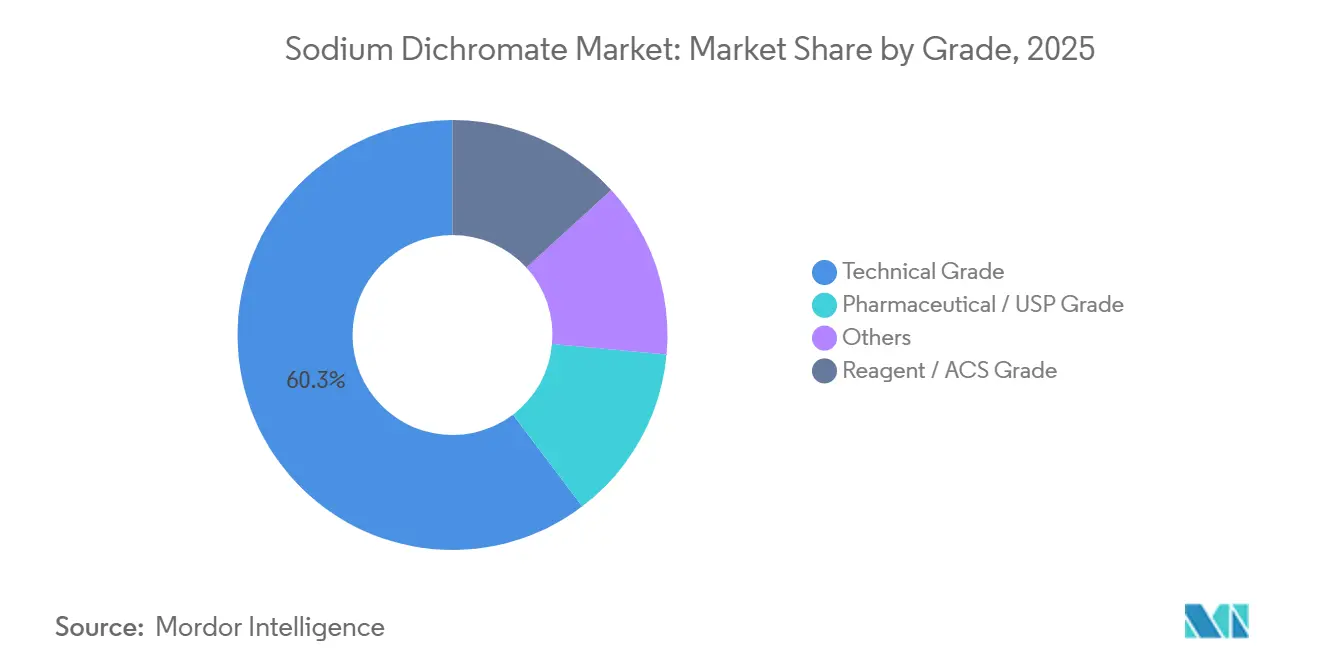
- By grade, technical grade held 60.32% revenue share in 2025 and was forecast to grow at a 5.65% CAGR through 2031.
- By production process, calcium roasting held 44.56% revenue share in 2025, while calcium-free roasting is forecast to grow at a CAGR of 5.87% through 2031.
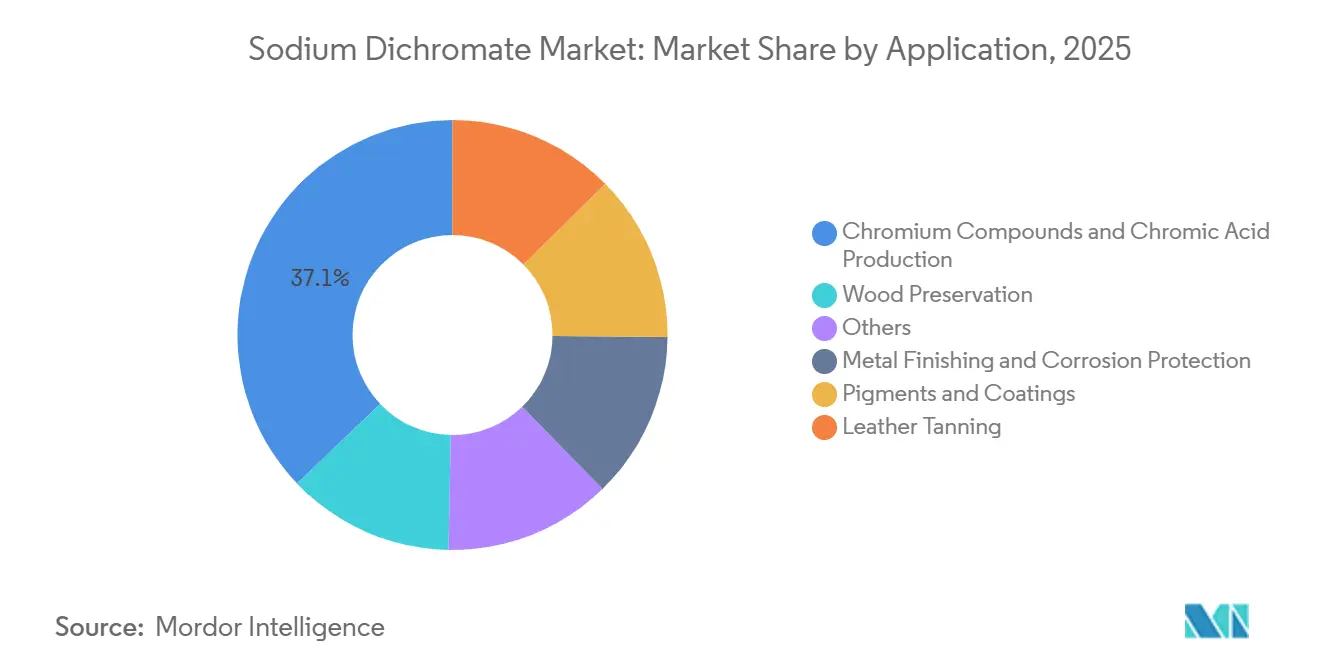
- By application, chromium compounds and chromic acid production accounted for 37.13% of the sodium dichromate market size in 2025, while metal finishing and corrosion protection are forecast to grow at a CAGR of 6.12% through 2031.
- By geography, Asia-Pacific held 42.45% regional revenue share in 2025 and was forecast to expand at a 5.98% CAGR through 2031.
Note: Market size and forecast figures in this report are generated using Mordor Intelligence’s proprietary estimation framework, updated with the latest available data and insights as of January 2026.
Global Sodium Dichromate Market Trends and Insights
Drivers Impact Analysis*
| Drivers | (~) % Impact on CAGR Forecast | Geographic Relevance | Impact Timeline |
|---|---|---|---|
| Expansion of Metal Finishing and Corrosion-Protection Applications | +1.2% | Global, concentrated in Asia-Pacific and North America | Medium term (2-4 years) |
| Growth of Leather Tanning and Chromium Replenishment Demand | +0.9% | Asia-Pacific core, with South America | Medium term (2-4 years) |
| Rising Demand for Chromium-Based Pigments, Coatings, and Dyes | +0.8% | Global, with Asia-Pacific and Europe as key demand centers | Medium term (2-4 years) |
| Ongoing Dependence on Sodium Dichromate as a Chromium-Chemicals Intermediate | +1.1% | Global | Long term (≥ 4 years) |
| Closed-Loop Chromium Recovery Creating Replenishment Demand | +0.5% | Asia-Pacific core, with spillover to South America | Medium term (2-4 years) |
| Source: Mordor Intelligence | |||
Expansion of Metal Finishing and Corrosion-Protection Applications
Metal finishing and corrosion protection are the fastest-growing applications in the sodium dichromate market. Aerospace and defense programs continue to use hexavalent chromium where qualified alternatives have not met functional specifications. The ADCR Consortium received 12-year REACH authorizations for sodium dichromate for use in conversion coating and passivation in 2024. UK REACH adopted Tranche 2 authorization decisions for the consortium in January 2026, supporting continued use in defined aerospace operations. Aircraft component qualifications require long validation cycles, which makes immediate chemical replacement difficult. Facilities can retain dual chemistry lines during conversion programs, thereby maintaining replenishment demand as surface treatment standards evolve. This is especially relevant to aircraft components because program-specific surface treatment approvals can require 12 to 24 months, preventing an immediate change in the chemistry used across qualified parts and repair operations.
Growth of Leather Tanning and Chromium Replenishment Demand
Leather tanning continues to support the sodium dichromate market as chrome-based processes remain established across Asian production hubs. The industry values processing speed, consistent leather properties, and the economics of existing equipment, particularly in cost-competitive tanning hubs that already use chrome-based chemistry and support wastewater systems. Closed-loop recovery systems can reduce chromium losses, yet recovered material still requires fresh input to maintain bath quality. This creates a replenishment cycle for chromium chemicals rather than eliminating demand for primary material, as recovered chromium must be supplemented to maintain the efficacy and consistency of process baths during repeated operating cycles and changing production conditions. Brazil adds demand outside Asia-Pacific through tannery capacity and footwear exports, while India's wastewater requirements favor dependable chromium input quality, capital-intensive treatment lines, and stable procurement from established suppliers. Tighter wastewater controls also increase the importance of integrated process systems and make smaller, poorly equipped operators less competitive. The resulting cost burden does not remove the need for chromium inputs, but it favors tanneries and suppliers that can maintain recovery systems, meet discharge requirements, and source consistent material for established processing lines.
Rising Demand for Chromium-Based Pigments, Coatings, and Dyes
Chromium oxide green, derived from sodium dichromate, is used in architectural coatings, industrial paints, ceramics, and glass coloration. The sodium dichromate market benefits from construction-linked demand for durable colorants and coating materials. Chromium oxide green offers thermal stability and ultraviolet resistance in several industrial formulations, making it relevant across these end-use applications. Restrictions on lead chromate pigments can shift some formulation demand toward trivalent chromium oxide green, which does not undergo the same authorization process as hexavalent chromium compounds in the cited use cases. Jinghai Bohong Technology Co., Ltd. announced a first-phase CNY 290 million (~USD 43.13 million) investment in a 50,000-ton-per-year sodium dichromate facility, followed by chromium oxide green capacity[1]Sichuan YHCC, “Xining, Qinghai: Construction of Chromium Oxide Green and Metallic Chromium Projects Started,” Sichuan YHCC. This alignment between upstream capacity and pigment output can preserve demand for sodium dichromate as construction and industrial coating needs develop. Producers can therefore participate in a downstream product chain where the value of the intermediate depends on durable pigment performance rather than on a single end-use application.
Ongoing Dependence on Sodium Dichromate as a Chromium-Chemicals Intermediate
Sodium dichromate remains a starting material for chromic acid, chromium trioxide, chromium oxide green, basic chromium sulfate, and metallic chromium. This central role supports the sodium dichromate market across several downstream product generations. Replacing it requires changes across the value chain rather than a simple reagent substitution, as chromic acid, chromium trioxide, basic chromium sulfate, chromium oxide green, and metallic chromium all depend on this intermediate. Vishnu Chemicals has pursued vertical integration and planned additional sodium dichromate capacity to strengthen raw material security and downstream production. Its planned chrome metal production uses chromium oxide green derived from sodium dichromate, linking the intermediate to defense, aerospace, and medical alloy applications. The sodium dichromate market remains dependent on the economic viability of chromic acid and chromium oxide green production. As long as these downstream products remain economically viable, sodium dichromate retains an upstream role that alternative trivalent inputs do not replicate across the same range of commercial products. This dependency connects the material to defense, aerospace, medical alloy, pigment, plating, and leather-related value chains.
Restraints Impact Analysis*
| Restraints | (~) % Impact on CAGR Forecast | Geographic Relevance | Impact Timeline |
|---|---|---|---|
| Hexavalent Chromium Toxicity and Carcinogenicity | -0.7% | Global, with immediate relevance in Europe and North America | Short term (≤ 2 years) |
| REACH, Occupational Safety, and Wastewater-Compliance Requirements | -0.5% | Europe and North America, with spillover to export markets | Medium term (2-4 years) |
| Substitution by Trivalent Chromium, Chromium-Free Coatings, and Alternative Tanning Chemistries | -0.6% | Europe and North America, emerging in the Asia-Pacific | Long term (≥ 4 years) |
| Source: Mordor Intelligence | |||
Hexavalent Chromium Toxicity and Carcinogenicity
Hexavalent chromium toxicity constrains the sodium dichromate market because the material requires strict handling and exposure controls. Its International Agency for Research on Cancer (IARC) Group 1 classification has increased pressure on users to reduce exposure and evaluate alternative chemistries, particularly in applications where trivalent chromium or chromium-free options can meet functional requirements. The European Union occupational exposure limit for Cr(VI) is 0.005 mg/m³, which requires costly engineering controls at finishing sites. General Motors stated that interior chrome-plated components from model year 2027 would use trivalent chromium. Airbus qualified a REACH-compliant trivalent alternative for black chromium on tungsten alloys in March 2025. Hard chrome plating for hydraulic and aeronautical components remains difficult to replace in applications where performance qualifications are demanding, leaving a defined group of functional uses dependent on existing derogations and authorization windows.
Compliance Requirements and Alternative Chemistries
REACH authorization, occupational safety rules, and wastewater compliance add cost throughout the sodium dichromate market. These requirements shift demand toward authorized suppliers rather than eliminating demand for regulated applications. Gentrochema BV allowed its European sodium and potassium dichromate authorizations for formulation and aerospace surface treatment to expire in September 2024[2]Gentrochema BV, “Sodium & Potassium Dichromates REACH Authorizations: Important Notice,” Gentrochema BV. This decision illustrates how compliance demands can reduce the intermediary distribution layer. Authorized producers can gain a stronger commercial position when downstream users require documented access to regulated substances, while unauthorized intermediaries risk losing customers as procurement teams seek supply routes with clearer authorization status. India's zero liquid discharge requirements and U.S. chromate effluent controls favor larger producers that can fund treatment equipment, maintain monitoring systems, and secure consistent input quality for regulated downstream operations. Trivalent chromium, chromium-free coatings, and alternative tanning agents can replace hexavalent chemistry in selected uses, although qualification, performance, and capital constraints slow adoption in functional applications, particularly where surface treatment specifications have long approval cycles.
*Our forecasts treat driver/restraint impacts as directional, not additive. The impact forecasts reflect baseline growth, mix effects, and variable interactions.
Segment Analysis
By Grade: Technical Grade Leads Industrial Demand
Technical grade captured 60.32% of the sodium dichromate market share in 2025 and was projected to grow at a 5.65% CAGR through 2031. It serves chromic acid production, metal finishing, leather tanning, wood preservation, and pigment production. These large-scale applications have not shifted to higher-purity specifications at the material scale. Industrial expansion in Asia-Pacific supports technical-grade demand across established chemical supply chains. Authorized industrial users also have a clearer procurement pathway for this grade because their applications are defined at scale and supported by existing handling systems. This position reduces the appeal of a rapid shift toward smaller high-purity segments, where compliance costs are harder to spread across limited output.
Reagent and American Chemical Society (ACS) grades are for laboratory and analytical uses, while pharmaceutical and United States Pharmacopeia (USP) grades are for limited drug synthesis and medical device applications. These grades remain smaller than technical grades because their end-use output is narrower. Other grades include specialty and nonstandard industrial formulations. Some producers are examining specifications for iron-chromium flow battery electrolytes, which could broaden demand beyond standard technical-grade requirements. Technical grade is expected to retain its leading position because it has the broadest downstream industrial base in the sodium dichromate market. Iron-chromium flow battery development could introduce demand for more specialized specifications if applications reach commercial scale. Even then, those products would complement rather than displace the larger technical-grade requirement from established industrial users.



By Production Process: Calcium-Free Roasting Builds Compliance Advantages
Calcium roasting accounted for 44.56% of the sodium dichromate market in 2025 because legacy facilities in China and Kazakhstan remained operational. Calcium-free roasting was the fastest-growing process, with a projected 5.87% CAGR from 2026 to 2031. Calcium roasting produces calcium chromate, which creates an additional carcinogenic by-product management issue. Calcium-free systems offer a route to reduce this liability as environmental standards tighten. Their capital requirement can be material, yet the investment can lower future remediation exposure and improve the durability of operating permits. This creates a different cost profile from legacy plants, which may continue to operate but carry a more demanding compliance burden. The production process, therefore, affects market access, cost exposure, and the ability to retain customers that require evidence of controlled production conditions. It can also influence which capacity remains viable as authorities raise expectations for environmental performance and worker protection.
Research published in Minerals found that optimized calcium-free sodium carbonate roasting at 1,000°C can support efficient Cr₂O₃ recovery from chromite ore beneficiation tailings. Other processes include oxidative roasting approaches using sodium hydroxide and sodium chloride, developed through Chinese academic and industrial work. Chongqing Changyuan Group's clean-technology roasting process illustrates how newer production methods can support capacity plans under tighter environmental controls. Producers that adopt calcium-free technology can reduce remediation exposure and strengthen the durability of operating licenses. Legacy calcium plants face rising compliance costs, which can accelerate shifts in production processes within the sodium dichromate industry. These process differences can reshape competition independently of end-use demand because they affect which producers can maintain output under tighter environmental conditions. Undercapitalized plants have less capacity to absorb this transition and may lose customers who require consistent compliance documentation.
By Application: Chemical Intermediates Lead While Metal Finishing Grows Fastest
Chromium compounds and chromic acid production held 37.13% of application revenue in 2025. These chemical intermediates supply chromium oxide green, chromic acid, hard chrome plating, and specialty catalyst applications. Metal finishing and corrosion protection were projected to grow at the highest CAGR, 6.12%, through 2031. Aerospace conversion coating, automotive hard chrome plating, and defense procurement support this application. These uses involve functional performance requirements, unlike decorative applications, where trivalent systems can be adopted more readily. In functional coating systems, operators must validate corrosion resistance, adhesion, durability, and process compatibility before substituting established chemistry on active equipment. Continued authorization windows, therefore, protect a defined output of demand during the period in which alternatives are being qualified.
Pigments and coatings benefit from the use of chromium oxide green in architectural and industrial formulations. Leather tanning demand reflects pricing and compliance conditions for chromium chemicals and wastewater treatment. Wood preservation remains relevant in tropical markets, where chromated copper arsenate products are well established for outdoor structural timber. European biocidal rules limit this application in Europe, shifting demand toward non-European markets. Other uses include iron-chromium flow battery electrolytes and high-temperature refractories, which remain small but represent potential areas of diversification in the sodium dichromate market. These applications are relevant because integrated chromium
Geography Analysis
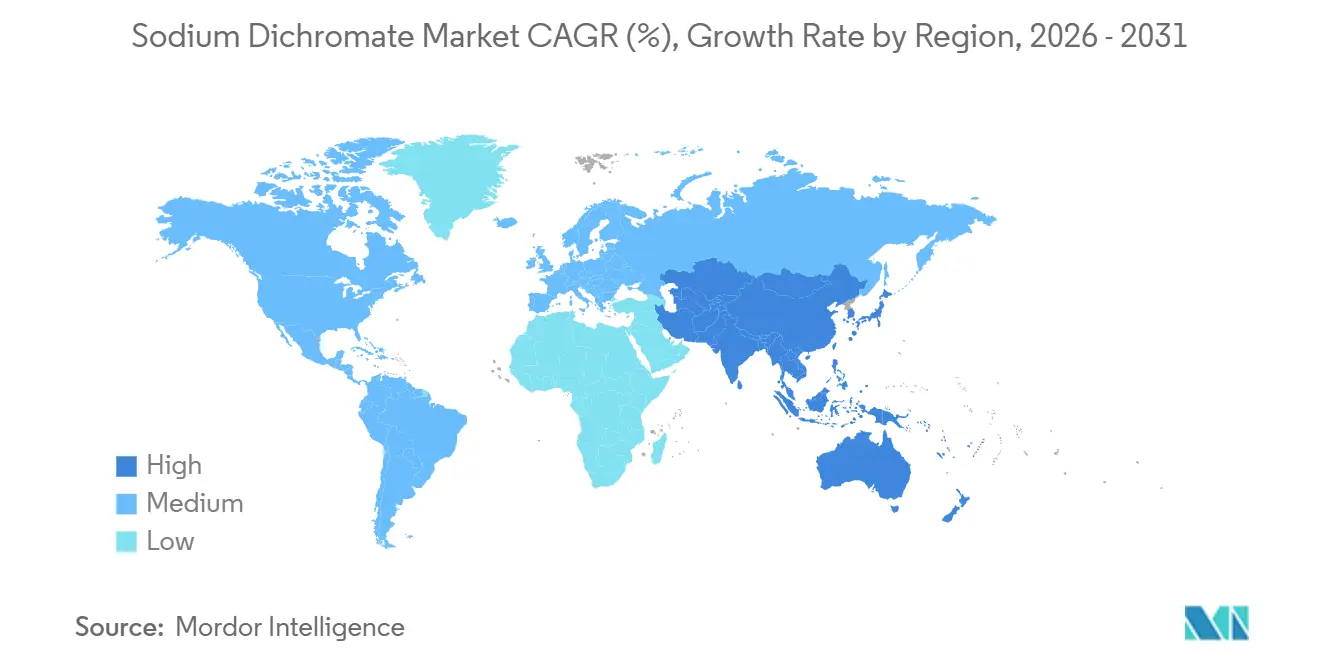
Asia-Pacific held 42.45% of the sodium dichromate market share in 2025 and was forecast to grow at a 5.98% CAGR through 2031. China's facilities in Hubei, Sichuan, Chongqing, Gansu, and Shaanxi supply a large portion of global technical-grade output. The region benefits from downstream activity in automotive, electronics, leather, pigments, and chemical processing. Environmental tightening in China is supporting output consolidation among larger compliant producers, which is creating greater price discipline among surviving suppliers and providing a firmer base for export pricing. The regional structure also gives producers access to nearby users of pigments, coatings, leather chemicals, and surface treatment products. This proximity helps maintain the region's position across both supply and demand, as the same industrial clusters consume chromium chemicals and provide supporting logistics, processing, and technical services. Leather tanning in cost-competitive Asian hubs remains important, as chrome-based chemistry continues to offer established process performance and economics, even as wastewater and recovery requirements become more stringent.
India is expanding its position through domestic production of chromium chemicals and upstream integration of chromite ore. Vishnu Chemicals operated at nearly 80% utilization of its chromium segment in mid-2026 and targeted a sodium dichromate capacity of 100,000 metric tons per annum (MTPA) during FY26. Vietnam contributes indirect demand through leather production and chrome tanning chemical use. These Asian supply chains combine local consumption with export capacity, supporting the region's position in the sodium dichromate market. India's backward integration demonstrates how non-Chinese producers can reduce exposure to chromite supply risks while expanding into downstream chromium products. Vietnam's role is primarily demand-led, with its leather production adding an indirect consumption channel for chrome tanning chemicals. Both India and China illustrate how upstream integration can influence competitiveness, as access to chromite ore reduces exposure to feedstock disruptions and supports planning for downstream products such as chromic acid, green chromium oxide, and metallic chromium. These linked production chains make the regional position more durable than a model based solely on merchant imports of intermediate chemicals.
North America and Europe are mature sodium dichromate markets, driven by demand from metal finishing, aerospace treatment, and specialty chemicals. Distributor-level authorization expirations in Europe narrowed procurement options for some downstream customers during 2024. ADCR authorizations support defined conversion coating uses across the European Union and the United Kingdom through the mid-2030s. North American environmental and wastewater rules add ongoing compliance costs. South America draws on Brazil's leather tanning and footwear exports, while Argentina contributes to chemical demand. Middle East and Africa demand remains dependent on imports from the Asia-Pacific region, with South Africa serving primarily as a chromite ore export hub. Saudi Arabia's industrial diversification plans are creating early demand for surface-treatment chemicals in emerging manufacturing clusters. The region remains sensitive to freight costs and disruptions at major logistics nodes, as local sodium dichromate production is limited. North America and Europe face a different supply position, where regulatory requirements, authorization expirations, and long procurement lead times shape consumption as much as the underlying end-use activity. Defined aerospace authorizations can protect demand for specific surface-treatment uses, while decorative applications face greater exposure to substitution by trivalent chromium systems.

Competitive Landscape
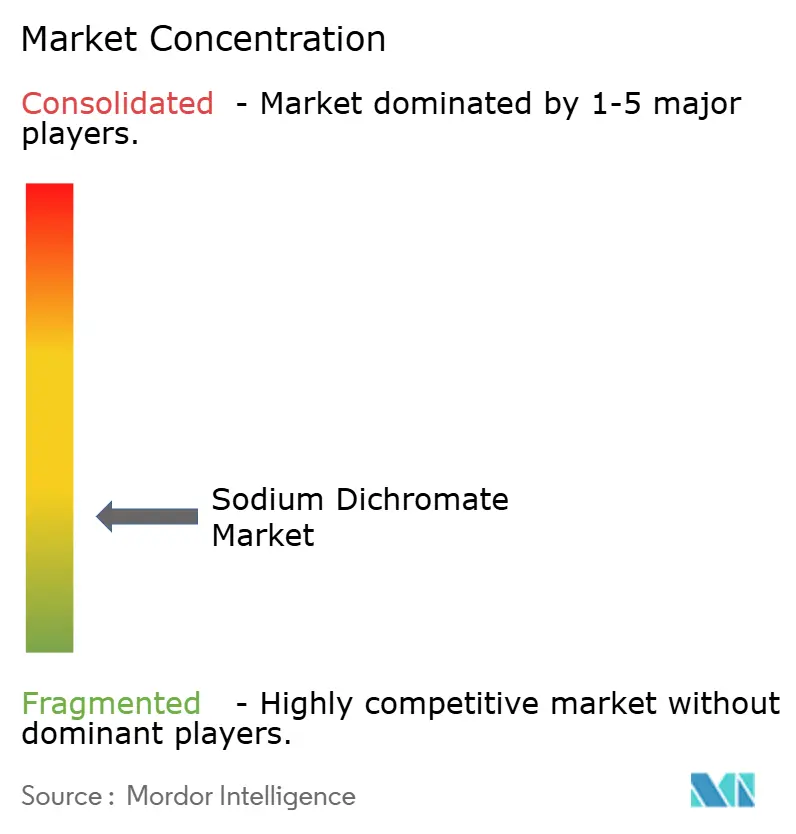
The sodium dichromate market is fragmented. Brother Enterprises, Hubei Zhenhua Chemical, Sichuan Yinhe Chemical, Chongqing Changyuan, and Chongqing Minfeng are Chinese suppliers. Vishnu Chemicals in India and Aktyubinsk Chromium Chemicals Plant in Kazakhstan are non-Chinese producers. JSC Novotroitsk Plant of Chromium Compounds and CHROMPIK provide European production, although compliance obligations limit their operational flexibility. The competitive structure is shaped by the concentration of technical-grade capacity in China and the need for authorization coverage in regulated export destinations. Buyers evaluate supplier capability through quality consistency, compliance documentation, logistics reliability, and raw material security rather than price alone. The concentration of output in China reflects large technical-grade facilities in Hubei, Sichuan, Chongqing, Gansu, and Shaanxi, access to domestic sodium carbonate, and established chromium chemical supply chains. Non-Chinese producers remain relevant as customers seek alternatives that meet regulatory, quality, and delivery requirements in markets with limited authorized supply routes.
Vertical integration is a central competitive strategy in the sodium dichromate market. Vishnu Chemicals acquired a 74% stake in a South African chromite ore mining entity in 2025, improving feedstock security and supply chain resilience. Brother Enterprises has pursued closed-loop chromium recycling technology, which reduces resource use and creates a technical barrier for new entrants. Chongqing Changyuan has developed a calcium-free clean-technology roasting process that links environmental performance with market access. Qinghai Bohong Technology Co., Ltd.'s capacity investment links sodium dichromate production to future green chromium oxide output. Closed-loop chromium recovery lowers waste liabilities and creates an operational capability that is difficult for a commodity-focused entrant to replicate. High-purity chromium compounds for iron-chromium flow battery electrolytes remain relevant for producers seeking application-specific certifications beyond established industrial grades.
Compliance separates producers with modern plants from operators that cannot fund authorizations, emission systems, or wastewater controls. Aktyubinsk Chromium Chemicals Plant completed emission-control reconstruction in 2024, including 15 new electrostatic precipitators. Smaller operators face higher risk as authorization and safety requirements intensify. Environmental investments are a commercial issue, not simply a regulatory one, as customers require suppliers that can provide stable output while meeting requirements across processing, transport, and end-use operations. Regulatory requirements act as a consolidation mechanism because the costs of maintaining emissions controls, wastewater systems, occupational protection, and use authorizations are more readily borne by large integrated operators. Aerospace and functional surface treatment applications remain active under defined authorization pathways, but the addressable supplier base is narrow.
Sodium Dichromate Industry Leaders
American Chrome & Chemicals
CHROMPIK
SICHUAN YINHE CHEMICAL CO.,LTD
Nippon Chemical Industrial CO., LTD.
Vishnu Chemicals
- *Disclaimer: Major Players sorted in no particular order

Recent Industry Developments
- January 2026: UK REACH adopted the first Tranche 2 authorization decisions for the ADCR Consortium, covering sodium dichromate use in aerospace conversion coating and passivation. This provided a medium-term demand anchor for British and European surface treatment operations and reduced procurement uncertainty for downstream aerospace contractors.
- May 2025: The European Chemicals Agency (ECHA) submitted its Annex XV restriction dossier covering 13 hexavalent chromium compounds, including sodium dichromate, under REACH Annex XVII. This initiated a formal six-month public consultation that shaped derogation windows and permitted end-use categories for authorized industrial operators across the EU.


Global Sodium Dichromate Market Report Scope
Sodium dichromate is an inorganic, bright orange-red crystalline compound known primarily as a powerful oxidizing agent. It serves as a key industrial raw material for manufacturing chromium chemicals, pigments, and leather tanning agents.
The sodium dichromate market is segmented by grade, production process, application, and geography. By grade, the market is segmented into technical grade, reagent/ACS grade, pharmaceutical/USP grade, and others. By production process, the market is segmented into calcium roasting, calcium-free roasting, and others. By application, the market is segmented into chromium compounds and chromic acid production, metal finishing and corrosion protection, pigments and coatings, leather tanning, wood preservation, and others. The report also covers market size and forecasts for the sodium dichromate across 15 countries in major regions. The market sizes and forecasts are provided in terms of value (USD).
| Technical Grade |
| Reagent/ACS Grade |
| Pharmaceutical/USP Grade |
| Others |
| Calcium Roasting |
| Calcium-Free Roasting |
| Others |
| Chromium Compounds and Chromic Acid Production |
| Metal Finishing and Corrosion Protection |
| Pigments and Coatings |
| Leather Tanning |
| Wood Preservation |
| Others |
| Asia-Pacific | China |
| India | |
| Japan | |
| South Korea | |
| ASEAN Countries | |
| Rest of Asia-Pacific | |
| North America | United States |
| Canada | |
| Mexico | |
| Europe | Germany |
| United Kingdom | |
| France | |
| Italy | |
| NORDIC Countries | |
| Rest of Europe | |
| South America | Brazil |
| Argentina | |
| Rest of South America | |
| Middle East and Africa | Saudi Arabia |
| South Africa | |
| Rest of Middle East and Africa |
| By Grade | Technical Grade | |
| Reagent/ACS Grade | ||
| Pharmaceutical/USP Grade | ||
| Others | ||
| By Production Process | Calcium Roasting | |
| Calcium-Free Roasting | ||
| Others | ||
| By Application | Chromium Compounds and Chromic Acid Production | |
| Metal Finishing and Corrosion Protection | ||
| Pigments and Coatings | ||
| Leather Tanning | ||
| Wood Preservation | ||
| Others | ||
| By Geography | Asia-Pacific | China |
| India | ||
| Japan | ||
| South Korea | ||
| ASEAN Countries | ||
| Rest of Asia-Pacific | ||
| North America | United States | |
| Canada | ||
| Mexico | ||
| Europe | Germany | |
| United Kingdom | ||
| France | ||
| Italy | ||
| NORDIC Countries | ||
| Rest of Europe | ||
| South America | Brazil | |
| Argentina | ||
| Rest of South America | ||
| Middle East and Africa | Saudi Arabia | |
| South Africa | ||
| Rest of Middle East and Africa | ||


Key Questions Answered in the Report
What is current market size of Sodium Dichromate Market?
The sodium dichromate market size was valued at USD 1.53 billion in 2025 and is estimated to grow from USD 1.60 billion in 2026 to reach USD 2.05 billion by 2031, at a CAGR of 5.11% during the forecast period from 2026 to 2031.
Which production process is growing fastest?
Calcium-free roasting was the fastest-growing process, with a forecast of 5.87% CAGR from 2026 to 2031. It is gaining relevance because it avoids calcium chromate by-products and can reduce future compliance and remediation exposure.
What application is expected to grow fastest?
Metal finishing and corrosion protection were projected to expand at a 6.12% CAGR through 2031. Aerospace, defense, and functional plating programs support demand where long qualification cycles make rapid material substitution difficult.
Which region leads to demand for sodium dichromate?
Asia-Pacific led with 42.45% revenue share in 2025 and was forecast to grow at a 5.98% CAGR through 2031. China, India, and other regional manufacturing locations combine downstream consumption, technical-grade production, and export capacity.
Page last updated on:





