
SMS Firewall Market Size and Share
Market Overview
| Study Period | 2020 - 2031 |
|---|---|
| Market Size (2026) | USD 3.41 Billion |
| Market Size (2031) | USD 4.97 Billion |
| Growth Rate (2026 - 2031) | 7.84 % |
| Fastest Growing Market | Asia Pacific |
| Largest Market | North America |
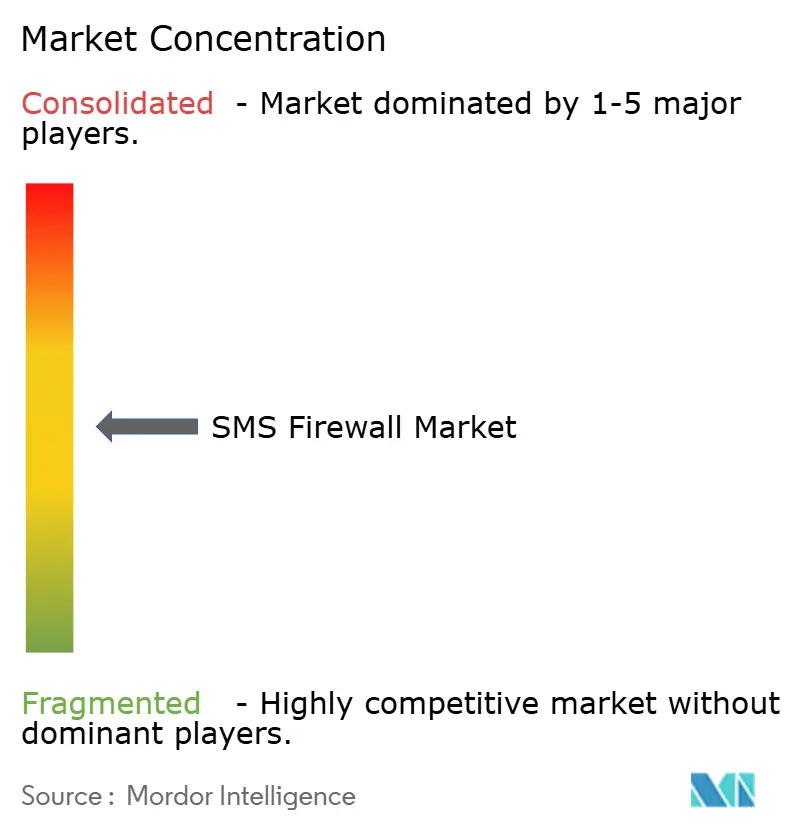
| Market Concentration | Medium |
Major Players *Disclaimer: Major Players sorted in no particular order Image © Mordor Intelligence. Reuse requires attribution under CC BY 4.0. | |
SMS Firewall Market Analysis by Mordor Intelligence
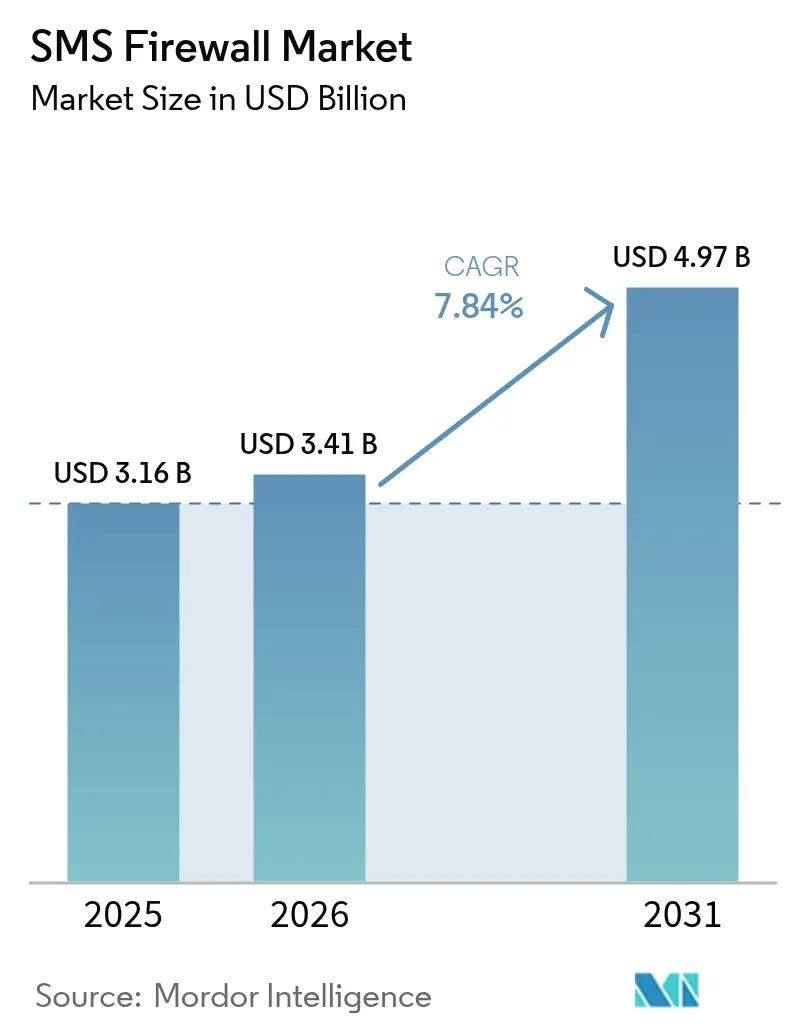
The SMS Firewall Market size is expected to grow from USD 3.16 billion in 2025 to USD 3.41 billion in 2026 and is forecast to reach USD 4.97 billion by 2031 at 7.84% CAGR over 2026-2031.
Operators are investing in next-generation firewalls to secure A2P revenues, comply with new traceability mandates, and guard 5G network slices from signaling threats. Migration from SS7 to Diameter firewalls, accelerated 5G rollouts in early-adopter countries, and national data-sovereignty rules that force on-shore filtering keep capital spending elevated. At the same time, CPaaS consolidation is compressing vendor margins, prompting suppliers to differentiate with AI-driven analytics and managed services offers. Moderate fragmentation among suppliers leaves space for niche specialists that target tier-3 and tier-4 mobile network operators with cloud-native, subscription-based tools.
Key Report Takeaways
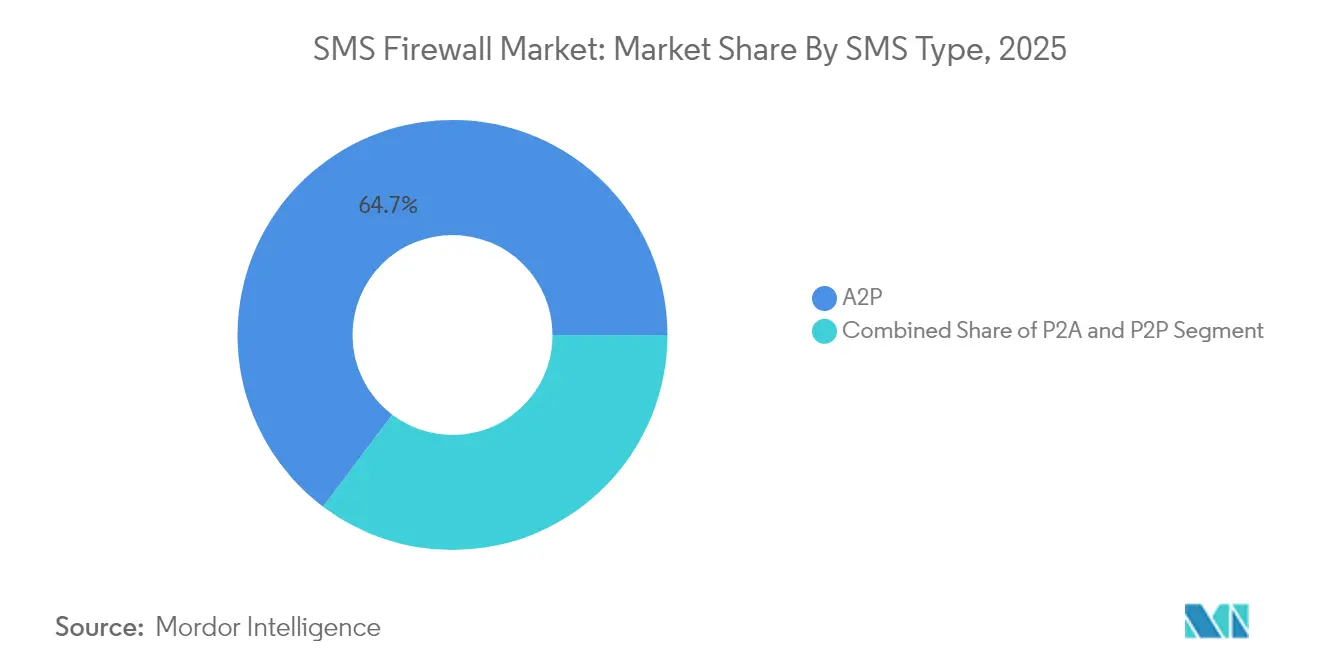
- By SMS type, A2P traffic commanded 64.72% of SMS firewall market share in 2025, while P2P enterprise messaging is projected to expand at a 9.74% CAGR through 2031.
- By deployment mode, on-premise implementations held 52.71% of the SMS firewall market in 2025; cloud deployments are forecast to post a 12.62% CAGR to 2031.
- By service type, professional services captured 55.62% revenue share in 2025; managed services are the fastest-growing, rising at an 10.83% CAGR to 2031.
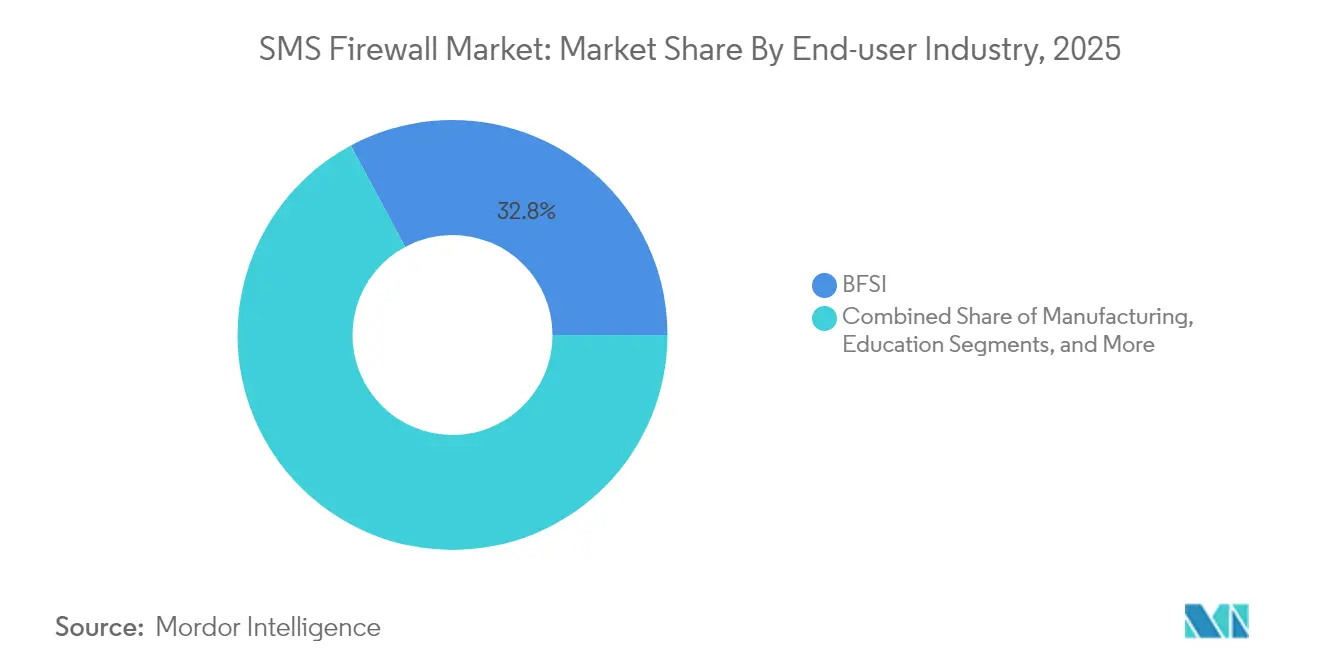
- By end-user industry, BFSI accounted for 32.84% of revenue in 2025, whereas retail and e-commerce is set to grow at a 10.36% CAGR until 2031.
- By network generation, 4G/LTE accounted for 46.65% revenue in 2025; 5G segments will accelerate at a 12.31% CAGR to 2031.
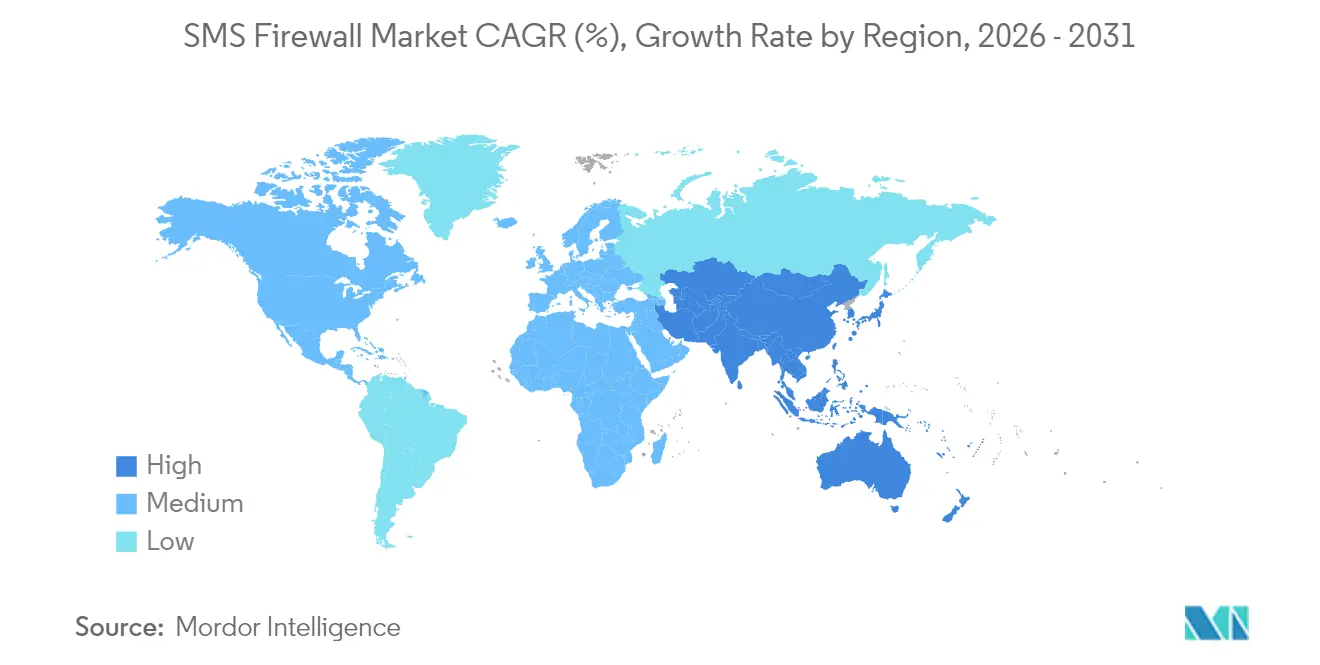
- By geography, North America led with 37.25% revenue share in 2025, while Asia-Pacific is predicted to register a 12.07% CAGR through 2031.
Note: Market size and forecast figures in this report are generated using Mordor Intelligence’s proprietary estimation framework, updated with the latest available data and insights as of 2026.
Market Trends and Insights
Drivers Impact Analysis of SMS Firewall Market*
| Driver | (~)% Impact on CAGR Forecast | Geographic Relevance | Impact Timeline |
|---|---|---|---|
| Surge in A2P traffic monetisation | +2.1% | Global, led by APAC and MEA | Medium term (2-4 years) |
| Intensifying mobile fraud and grey-route losses | +1.8% | North America and Europe | Short term (≤ 2 years) |
| SS7 → Diameter firewall upgrade cycle | +1.5% | Europe and North America, expanding to APAC | Long term (≥ 4 years) |
| National data-sovereignty clauses forcing on-shore filtering | +1.2% | EU, India, Brazil | Medium term (2-4 years) |
| Operator focus on subscriber QoE and brand trust | +0.9% | Global premium operators | Short term (≤ 2 years) |
| 5G slicing opening new attack surfaces | +0.8% | North America, South Korea | Long term (≥ 4 years) |
| Source: Mordor Intelligence | |||
Surge in A2P Traffic Monetisation
Operators face declining voice income, so authenticated A2P messaging has become pivotal for revenue recovery. India’s distributed ledger framework showed a 40% cut in leakage and a 98% spam drop for Airtel customers. [1]Airtel, “Spam Protection,” airtel.in Similar monetisation programs in Brazil and Nigeria rely on advanced traffic analytics that separate legitimate enterprise messages from grey routes. The model also lets carriers resell premium delivery services with embedded security. Although profitable, rollout demands machine-learning inspection tools that smaller carriers cannot host on legacy infrastructure.
Intensifying Mobile Fraud and Grey-Route Losses
SIM-box fraud causes USD 3.11 billion in yearly losses and represents 7.8% of total telecom fraud. [2]Infosys Limited, “Understanding SIM Box Fraud And Its Implications,” infosysbpm.com Artificially inflated traffic and phishing campaigns now combine voice, SMS, and social apps, pressuring regulators to act. India’s AI-based anti-spoofing platform cut fraudulent calls by 90% in three months. Such successes push other regulators to demand integrated SMS firewall capability within wider fraud-prevention stacks, expanding the SMS firewall market.
SS7 to Diameter Firewall Upgrade Cycle
SS7 vulnerabilities enable location tracking and message hijacking, incidents documented at large US carriers. [3]Hackers Arise, “Chinese State-Sponsored Hackers Inside the US Mobile Telecom System,” hackers-arise.com Diameter improves authentication but introduces complexity that requires dual-protocol firewalls. Deutsche Telekom’s Magenta Security Roaming service now protects 2G through 5G traffic on one platform. The multiyear upgrade cycle sustains capital spending and fuels managed service demand for carriers with limited in-house expertise.
5G Slicing Opening New Attack Surfaces
Network slicing segments traffic for bespoke applications, yet slice isolation failures expose SMS channels. Singtel’s consumer-grade 5G slices serve 1.5 million users and highlight the need for slice-aware firewalls. [4]World Teleport, “Singtel Extends 5G Network Slicing Capabilities,” worldteleport.org T-Mobile’s event-specific slices confirmed that dynamic policies and AI analytics are essential when slice configurations change frequently. Vendors that embed slice context into threat detection gain a competitive edge.
Restraints Impact Analysis of SMS Firewall Market*
| Restraint | (~) % Impact on CAGR Forecast | Geographic Relevance | Impact Timeline |
|---|---|---|---|
| Low technical awareness among Tier-3/4 MNOs | -1.4% | APAC, Africa, Latin America | Medium term (2-4 years) |
| Pricing pressure from CPaaS consolidations | -1.1% | Global, affecting North America and Europe | Short term (≤ 2 years) |
| Delayed RCS roll-outs blurring capex timing | -0.8% | Global, varied by region | Long term (≥ 4 years) |
| Regulatory ambiguity on cross-border message inspection | -0.6% | EU-US, APAC corridors | Medium term (2-4 years) |
| Source: Mordor Intelligence | |||
Low Technical Awareness Among Tier-3/4 MNOs
Thousands of smaller operators grapple with DLT registration and rule optimization, as seen when 27,000 entities in India sought compliance assistance. Continuous tuning of machine-learning rules and integration of live threat feeds push these operators toward managed services, yet budget limits slow adoption.
Pricing Pressure from CPaaS Consolidations
Proximus paid EUR 2 billion to buy Route Mobile, using scale to bundle firewall functions into global CPaaS suites. Rival acquisitions by Infobip and others let them undercut stand-alone vendors, trimming margins 15–20%. Mid-tier firewall suppliers respond with AI patents and sector-specific packages to justify premium pricing.
*Our forecasts treat driver/restraint impacts as directional, not additive. The impact forecasts reflect baseline growth, mix effects, and variable interactions.
SMS Firewall Market Segment Analysis
By SMS Type:
A2P Dominance Drives Revenue GrowthA2P messaging held 64.72% of the SMS firewall market share in 2025, underpinned by mandatory authentication rules across finance, healthcare, and public services. The SMS firewall market size for A2P segments is set to expand at a 7.79% CAGR as enterprises pay for guaranteed delivery and spam control. Enterprises also invest in secure P2P alerts, pushing the P2P enterprise category to a 9.74% CAGR. Jack Henry already moves 12–15 million secured alerts each month through Twilio and plans a fifty-fold volume growth.
A2P growth accelerates firewall upgrades that filter grey routes, while P2A use cases such as inbound customer queries hinge on authentication that shields enterprises from impersonation attacks. Competing channels like RCS slow P2A momentum, yet regulated sectors still rely on SMS for universal reach. The rising volume of one-time passwords and service notifications keeps security-rich A2P traffic central to operator revenue strategies, fortifying the SMS firewall market.



By Deployment Mode:
Cloud Migration AcceleratesOn-premise deployments retained 52.71% revenue share in 2025 because tier-1 carriers favor local data control. Even so, cloud options are projected to record a 12.62% CAGR, reflecting strong demand from smaller operators. The SMS firewall market size for cloud deployments is forecast to rise sharply as regulators in regions that allow cross-border processing endorse shared-threat feeds.
Hybrid architectures gain traction where data localization laws exist, letting operators analyze metadata in the cloud while storing message content on shore. Edge nodes positioned inside carrier facilities provide near-real-time analytics without moving sensitive data off-site. This flexibility spurs additional investment, ensuring that the SMS firewall market continues to grow in both traditional and emerging deployment models.
By Service Type:
Professional Services Lead ImplementationProfessional services delivered 55.62% of 2025 revenue because complex integrations demand signaling expertise and compliance validation. Service providers guarantee deployment timelines and post-launch tuning, making outcome-based contracts common. Managed offerings will climb at an 10.83% CAGR, boosted by carriers that outsource 24×7 monitoring.
AI-enhanced managed detection and response reduces time to block new fraud patterns, attracting tier-3 operators that lack security analysts. Meanwhile, consulting teams expand into regulatory certifications, turning compliance risk into an upsell. These dynamics keep the SMS firewall industry focused on services that wrap technology deployments with measurable performance guarantees.
By End-user Industry:
BFSI Leads Security InvestmentBFSI accounted for 32.84% of 2025 revenue, as two-factor authentication and fraud alerts demand uncompromised delivery. The SMS firewall market size within banking benefits from punitive fines that follow breaches. Retail and e-commerce sites grow fastest at a 10.36% CAGR, illustrated by Her Fantasy Box adding USD 20.86 million in six months through secure SMS campaigns.
Healthcare adoption rises because HIPAA rules require encrypted transport and audit logs; Telnyx demonstrates HIPAA-compliant SMS services adopted by providers who value universal reach. Government agencies expand authenticated citizen services, and manufacturers add secured notifications for supply chain updates, broadening the SMS firewall market.
By Network Generation:
4G Dominance With 5G Growth4G/LTE contributed 46.65% revenue in 2025, reflecting large installed bases. The SMS firewall market size for 4G networks stays large because text delivery defaults to the most stable layer. Meanwhile, 5G firewalls will grow at a 12.31% CAGR by 2031, driven by slice-specific security policies.
GSMA sunset guidelines for 2G/3G push carriers to invest in multi-generation firewalls that protect legacy and next-gen networks simultaneously. Vendors that provide AI threat detection optimized for 5G latency gain advantage as standalone 5G cores roll out, enhancing the overall SMS firewall market.
Geography Analysis
North America SMS Firewall Market
North America led with a 37.25% revenue share in 2025, thanks to stringent privacy rules, early 5G adoption, and large CPaaS ecosystems that embed firewalls into enterprise communication stacks. Carrier spending stays strong in 2025 as cross-border messaging with Canada and Mexico triggers new audit trail mandates. Federal attention on robocalls and smishing scams further boosts demand, anchoring North American leadership within the SMS firewall market.
APAC SMS Firewall Market
Asia-Pacific is the fastest-growing region at a 12.07% CAGR to 2031. India’s DLT framework enforces end-to-end message traceability and functions as a regional blueprint, while China’s aggressive 5G slicing deployment accelerates next-generation firewall uptake. Southeast Asian operators follow with spam-reduction drives that mirror India’s performance gains, collectively enlarging the SMS firewall market.
EMEA and South America SMS Firewall Market
Europe balances GDPR compliance with pan-EU cross-border traffic rules that require granular consent logs. Data-sovereignty clauses push operators toward on-shore filtering, yet shared threat feeds encourage cloud adoption in low-risk categories. In the Middle East and Africa, mobile-first economies adopt cloud-native firewalls to reduce capital expenses, though awareness gaps among smaller MNOs slow penetration. South America mirrors India by mandating KYC verification on messages, fueling demand for low-cost, regulation-ready solutions.

Regulatory Landscape
The regulatory environment for SMS firewalls reflects a combination of national anti-spam and anti-fraud requirements and voluntary technical guidance from industry bodies. In the United States, the FCC has adopted requirements that place responsibility on terminating providers to block texts from specific numbers when notified of illegal activity by the Enforcement Bureau, reinforcing the need for carrier-grade filtering and rapid rule updates.
Across Europe, initiatives such as Ireland's ComReg SMS Sender ID Registry implementation and communications plan (December 2024) formalize sender identification and anti-spoofing controls that map to SMS firewall capabilities. These obligations are complemented by association and standards-body publications, including CTIA's Messaging Security Best Practices (October 2025) and ITU-T Recommendations such as X.1237 (in force from 2024) for PII protection and X.1238 (December 2025) for counter-spam guidance for RCS, which expands compliance expectations beyond legacy SMS toward multi-channel messaging security controls.
Value Chain Analysis
The SMS firewall value chain starts with standards and interconnect requirements that determine how traffic is identified, routed, and inspected across networks. GSMA industry specifications (including interworking and security-related PRDs) shape core engineering for SS7/SIGTRAN and Diameter environments, while numbering intelligence and reputation data (including validation registries and threat feeds) support policy decisions for blocking, rerouting, or monetizing A2P traffic.
Technology delivery typically moves from firewall vendors and signaling specialists into operator environments through professional services (integration, testing, and compliance validation) and, increasingly, through managed services for 24x7 monitoring and continuous policy tuning. Commercial distribution also involves CPaaS and hubbing ecosystems where firewall capability is bundled with international SMS routing, supported by multi-year operator agreements such as Globe Teleservices' three-year exclusive contract with CelcomDigi (March 2025) and Tanla Platforms' multi-year deployment with Indosat Ooredoo Hutchison for AI-native anti-spam and anti-scam protection (August 2025). This structure creates operational dependency on continuous threat-intelligence updates, interconnect partners, and scalable analytics infrastructure as operators migrate from SS7 to Diameter and deploy 5G cores.
Competitive Landscape
The market remains moderately fragmented. Tata Communications, Syniverse, and Sinch maintain leadership through global signaling hubs and multicloud delivery platforms. Sinch processed 800 billion interactions in the last 12 months and invests heavily in RCS to complement SMS defenses. Syniverse leverages carrier interconnects to bundle firewall and roaming security, while Tata Communications deploys multi-protocol firewalls across its global IP backbone.
Consolidation among CPaaS firms raises competitive pressure. Proximus’ acquisition of Route Mobile and Infobip’s purchase of Anam and OpenMarket enable bundled pricing that squeezes stand-alone firewall vendors. In response, niche specialists patent AI impersonation-detection models and partner with validation registries, such as Netnumber and WMC Global, to enhance threat feeds.
Operators also source from regional security vendors that tailor deployments to local protocols and regulations. Spark New Zealand adopted Mobileum’s multi-protocol firewall for national fraud reduction. SecurityGen and Smart Axiata launched a next-generation signaling firewall in Cambodia, proving demand for turnkey deployments in emerging markets. Such moves illustrate how regional champions can thrive by offering fast rollouts and localized support, reinforcing the diverse supplier mix across the SMS firewall market.
SMS Firewall Industry Leaders
Cellusys Telecommunications
Tyntec GmbH
Tata Communications Ltd.
Syniverse Technologies LLC
Sinch AB
- *Disclaimer: Major Players sorted in no particular order
SMS Firewall Market Companies Covered in this Report
- Cellusys Telecommunications
- Tyntec GmbH
- Tata Communications Ltd.
- Syniverse Technologies LLC
- Sinch AB
- Omobio (Pvt) Ltd.
- Route Mobile Ltd.
- AMD Telecom S.A.
- BICS SA/NV
- SAP SE
- Monty Mobile
- NewNet Communication Technologies
- Mahindra Comviva
- Infobip Ltd.
- Twilio Inc.
- Anam Technologies
- Mobileum Inc.
- Mavenir Systems Inc.
- Proofpoint Inc.
- AdaptiveMobile Security (Enea)
- NetNumber Global Data Services
- Openmind Networks
- HORISEN AG
- Sparkle (Telecom Italia)
- Orange Wholesale International
- VOX Solutions
- Global Message Services AG

Market Opportunities and Future Outlook
One primary opportunity lies in operator programs that pair A2P revenue protection with measurable reductions in scams and unwanted messaging, which drives demand for policy automation, analytics, and managed operations. In Malaysia, Maxis operationalized an AI-powered firewall to screen international voice and SMS traffic (January 2026), underscoring active investment in AI-assisted filtering at the operator level and creating space for vendors that can provide explainable, audit-ready decisioning and faster rule iteration.
Another opportunity is the bundling of roaming interworking with messaging security as networks transition from legacy signaling to 5G standalone roaming. Syniverse's launch of Evolved Mobility for Messaging (June 2024) to mediate between Diameter and SS7 for legacy SMS roaming continuity, followed by the Syniverse and Cellusys partnership (September 2024) to integrate signaling, messaging, and voice firewall security with Syniverse's IPX network, reflects buyer demand for unified platforms that reduce operational complexity. This pull-through supports solutions spanning multi-protocol inspection (SS7, Diameter) alongside SMS firewall controls, with service-led offerings helping keep policies aligned to changing sender ID registries and anti-smishing enforcement requirements.
Recent Industry Developments in SMS Firewall Market
- January 2026: Maxis operationalized an AI-powered firewall to screen international voice and SMS traffic in Malaysia. The move takes AI-assisted inspection from a pilot concept to an operator run-state capability, tightening control over grey routes and scam traffic at the international gateway layer.
- March 2025: Globe Teleservices signed a three-year exclusive contract with CelcomDigi to deploy advanced A2P SMS firewall solutions for its Malaysian network. An exclusive, multi-year structure points to longer-term monetization and protection programs where the firewall provider becomes embedded in international SMS traffic management.
- September 2024: Syniverse and Cellusys announced a partnership to integrate Cellusys signaling, messaging, and voice firewall security solutions with the Syniverse IPX network for unified 5G roaming and security. The integration approach connects roaming interconnect services with firewall controls, supporting operators that need consolidated security and compatibility as they migrate from SS7 to Diameter in 5G environments.


SMS Firewall Market Report Scope and Research Methodology
Market Definition and Coverage
For this study, the SMS firewall market covers platforms, licenses, subscriptions, and managed services that inspect and control SMS traffic so mobile operators and messaging providers can reduce spam, smishing, spoofing, and gray routes.
Scope exclusions: It excludes pure signaling firewalls, device-level SMS filtering apps, and fraud analytics tools sold without an SMS inspection or routing module.
Segments Covered in This Report
- By SMS Type
- A2P
- P2A
- P2P (Enterprise Flash/Alert)
- By Deployment Mode
- On-Premise
- Cloud
- By Service Type
- Professional Services (Consulting, Integration)
- Managed Services (24×7 Monitoring, SOC)
- By End-user Industry
- BFSI
- Government and Public Safety
- IT and Telecom
- Healthcare and Life Sciences
- Retail and E-Commerce
- Media and Entertainment
- Education
- Manufacturing
- Other End-user Industries
- By Network Generation
- 2G / 3G
- 4G / LTE
- 5G
- By Geography
- North America
- United States
- Canada
- Mexico
- South America
- Brazil
- Argentina
- Chile
- Rest of South America
- Europe
- Germany
- United Kingdom
- France
- Italy
- Spain
- Russia
- Rest of Europe
- Asia-Pacific
- China
- India
- Japan
- South Korea
- Malaysia
- Singapore
- Australia
- Rest of Asia-Pacific
- Middle East and Africa
- Middle East
- United Arab Emirates
- Saudi Arabia
- Turkey
- Rest of Middle East
- Africa
- South Africa
- Nigeria
- Rest of Africa
- Middle East
- North America
Data Sources, Market Sizing, and Validation
Desk Research
Desk research set the outside boundaries of the model, mainly by grounding messaging usage and telecom economics before market math was applied. We referred to public sources such as ITU indicators for mobile subscriptions, GSMA publications for messaging and network trends, FCC and similar telecom regulator releases for market structure signals, and OECD digital statistics for country comparability.
To translate these signals into an addressable pool, supporting inputs were also taken from sources such as operator annual reports, investor decks, and reputable press coverage on messaging fraud and A2P monetization. When needed, paid database subscriptions were used in a limited way for company financials and news screening, patent lookups, and shipment-level trade cues tied to telecom security appliances. The examples above are illustrative, and many other public and paid sources were also used for data collection, cross-checking, and clarification.
Primary Interviews and Surveys
Primary work clarified what actually gets paid for in deployments and how pricing moves over time, since list prices and public disclosures are often incomplete. We spoke with a mix of mobile operators, messaging aggregators, and firewall solution teams, then followed up with industry advisors across APAC, EMEA, and the Americas to stress-test adoption timing, renewal patterns, and managed-service attachment assumptions.
Distribution of primary research fieldwork respondents
| Company type | Respondent position | Region |
|---|---|---|
| Top tier: 28% | CXOs: 21% | APAC: 39% |
| Mid tier: 51% | Functional/Unit leaders: 25% | EMEA: 37% |
| Smaller Players: 21% | Managers: 54% | Americas: 24% |
Market-Sizing & Forecasting
The model starts with a top-down demand pool built from operator and messaging ecosystem signals, then narrows it using realistic adoption and spending rates for SMS traffic control. In practice, estimated addressable SMS traffic, the share of A2P versus other message types, the observed intensity of spam and gray-route exposure, and the degree of filtering mandated by operator policies were used to shape what portion of the ecosystem purchases firewall capability.
Once the demand pool was framed, totals were corroborated with selective bottom-up approximations, such as sampled price ranges for platform subscriptions, managed-service retainers, and ruleset updates, combined with deployment counts and renewal behavior shared in interviews. Where vendor revenue splits were not publicly clear, gaps were handled by using operator-side spend estimates and typical contract lengths, and then rechecking the implied spend per active message route for reasonableness.
For forecasting, scenario analysis was applied, since growth is sensitive to changes in A2P monetization, messaging fraud pressure, and regulatory push for stronger filtering. The forward view was adjusted using interview-led consensus on how quickly cloud-based deployments replace appliance-led setups and how pricing changes with expanding rule libraries and automation features.
Data Validation & Update Cycle
Outputs were checked against independent signals, including operator messaging revenue commentary, major fraud-event timelines, and the implied spend per operator relative to subscriber scale. If a country or region showed a jump that did not align with these signals, assumptions were revisited and, when needed, respondents were re-contacted to confirm whether the shift came from pricing, adoption, or reporting timing.
Before sign-off, the dataset and calculations go through multiple analyst review steps, and variances are documented so the final number can be traced back to clear inputs. Reports are refreshed annually, with interim updates when material changes occur in regulation, operator monetization models, or messaging fraud patterns. Right before delivery, a fresh review pass is completed so clients receive the latest updated view.
Mordor Intelligence's Sms Firewall Market Estimate Compared With Other Published Estimates
Published market sizes for SMS firewalls often differ because authors do not always count the same revenue streams, and they also anchor models to different base years and growth paths. Differences appear quickly when one estimate blends adjacent security tools into the total, or when another applies a high growth rate without matching it to operator buying cycles.
Pure signaling firewalls are kept outside Mordor Intelligence's scope. This is one reason its 2026 value looks higher than a 2024 anchored estimate, but it remains below some aggressive forecasts that pull in wider telecom security spending.
Benchmark comparison
| Source | Market Size | Gaps in Research Methodology |
|---|---|---|
| Mordor Intelligence | USD 3.41 B (2026) | |
| Global Consultancy A | USD 2.59 B (2024) | Uses an earlier base year and can understate later-year expansion if adoption and price uplift are not rechecked against operator renewal cycles and A2P volume growth. The scope description is broad, so some deployments may be counted differently across on-premise, cloud, and managed services. |
| Industry Research Group B | USD 3.26 B (2025) | Reports a 2025 estimate with a growth curve that can vary depending on how it treats managed services and whether international traffic filtering is priced at a higher share than national traffic. In some cases, component splits can lead to double counting if platform and services revenues are not reconciled at contract level. |
The spread across sources mainly comes from timing and what is bundled into the market total, rather than a disagreement that demand exists. By keeping inputs tied to observable messaging traffic signals and operator purchasing patterns, the estimate remains repeatable, and the adjustments are easier to trace when new evidence shifts the outlook.


Key Questions Answered in the Report
What is driving revenue growth in the SMS firewall market?
Rising A2P monetisation, migration to Diameter and 5G slicing security requirements are the primary catalysts accelerating an 7.84% CAGR through 2031.
Which region offers the fastest expansion opportunity?
Asia-Pacific is forecast to grow at a 12.07% CAGR as India’s DLT framework and China’s 5G investments expand firewall deployments.
Why are cloud deployments gaining traction among mobile operators?
Cloud-native firewalls provide cost efficiency, scalability and shared threat intelligence, allowing smaller operators to adopt advanced security without heavy capex.
How does CPaaS consolidation affect firewall vendors?
Bundled offerings from large CPaaS providers exert pricing pressure, reducing margins by 15–20% and compelling stand-alone vendors to innovate with AI analytics and vertical solutions.
Which industry segment spends the most on SMS firewalls?
BFSI leads with 32.84% revenue share in 2025 due to strict authentication and fraud-alert needs that require premium security features.
What role does 5G network slicing play in firewall adoption?
5G slices introduce new attack vectors, so operators deploy slice-aware firewalls that enforce dynamic, application-specific policies to maintain service integrity.
Page last updated on:


 Your data is secure and never sold or shared.


