
Singapore Personal Accident Insurance Market Size and Share
Market Overview
| Study Period | 2020 - 2031 |
|---|---|
| Forecast Data Period | 2026 - 2031 |
| Base Year Market Size (2025) | USD 139.5 Million |
| Market Size (2026) | USD 143 Million |
| Market Size (2031) | USD 169 Million |
| Growth Rate (2026 - 2031) | 3.40 % |
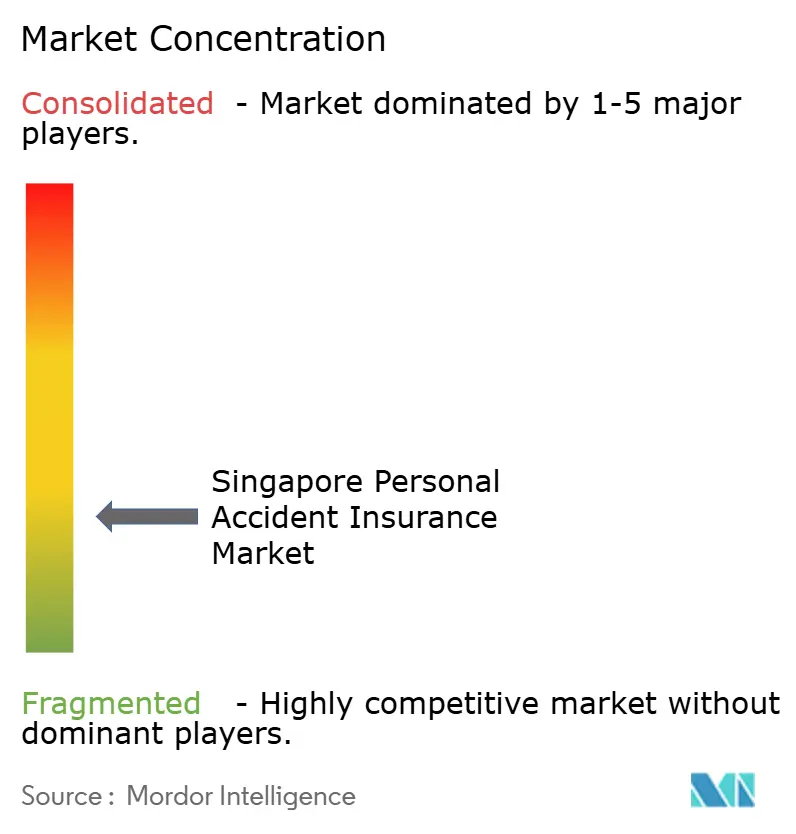
| Market Concentration | Low |
Major Players *Disclaimer: Major Players sorted in no particular order Image © Mordor Intelligence. Reuse requires attribution under CC BY 4.0. | |
Singapore Personal Accident Insurance Market Analysis by Mordor Intelligence
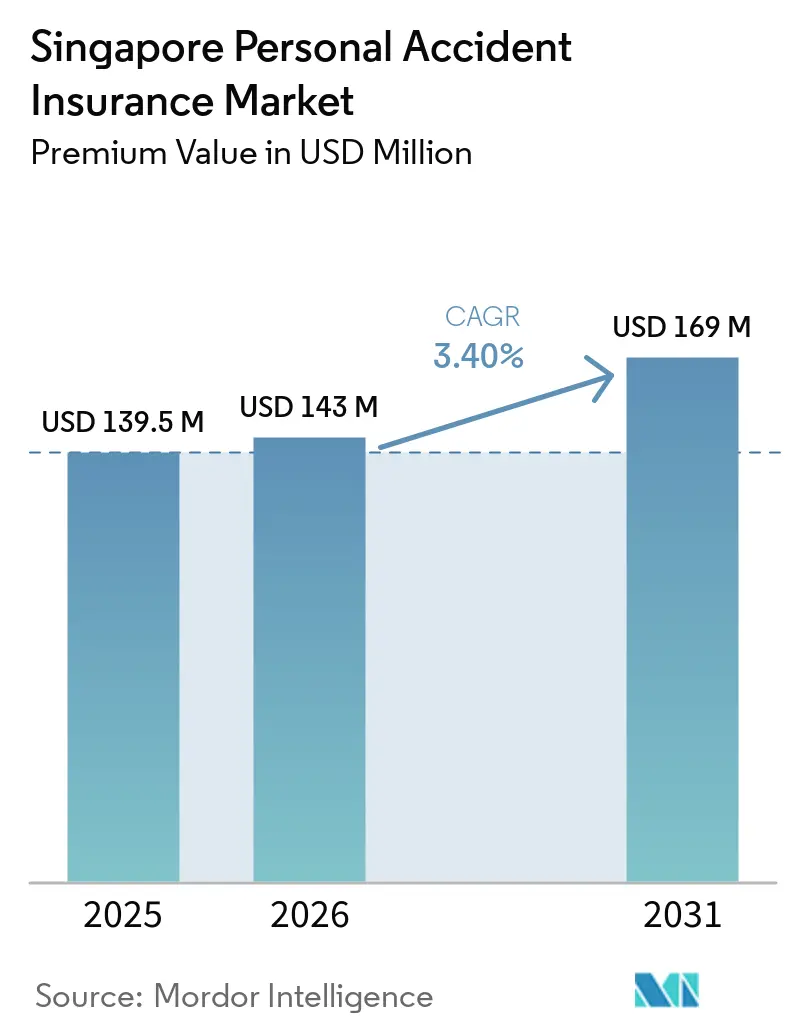
The Singapore personal accident insurance market size was valued at USD 139.5 million in 2025 and is estimated to grow from USD 143.0 million in 2026 to reach USD 169.0 million by 2031, at a CAGR of 3.4% during the forecast period (2026-2031). The Singapore personal accident insurance market operates in a mature insurance environment with broad health, long-term care, and employer benefit coverage. Personal accident policies therefore compete through the scope of recovery support, the clarity of benefits, and ease of enrollment. Higher rehabilitation costs and accident exposure during travel, commuting, and work support demand for more complete cover. Digital partnerships are widening access at points where consumers face mobility and work-related risks. The Singapore personal accident insurance market also faces spending pressure as households review broader health coverage and assess whether standalone protection duplicates existing benefits.
Key Report Takeaways
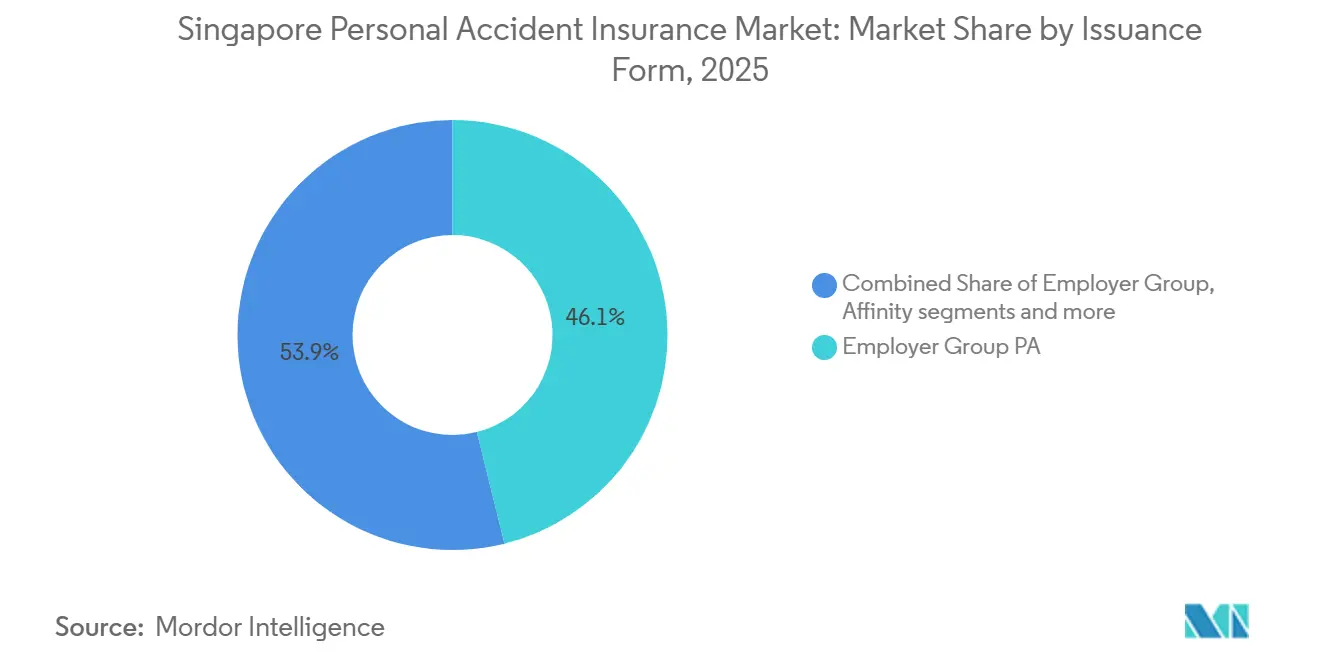
- By issuance form, employer group personal accident held 46.1% of the Singapore personal accident insurance market share in 2025, while affinity, association, and scheme PA is projected to grow at a 5.1% CAGR through 2031.
- By distribution channel, tied agents and financial advisers held 37.9% of the Singapore personal accident insurance market share in 2025, while embedded and partner enrolment is projected to grow at a 5.6% CAGR through 2031.
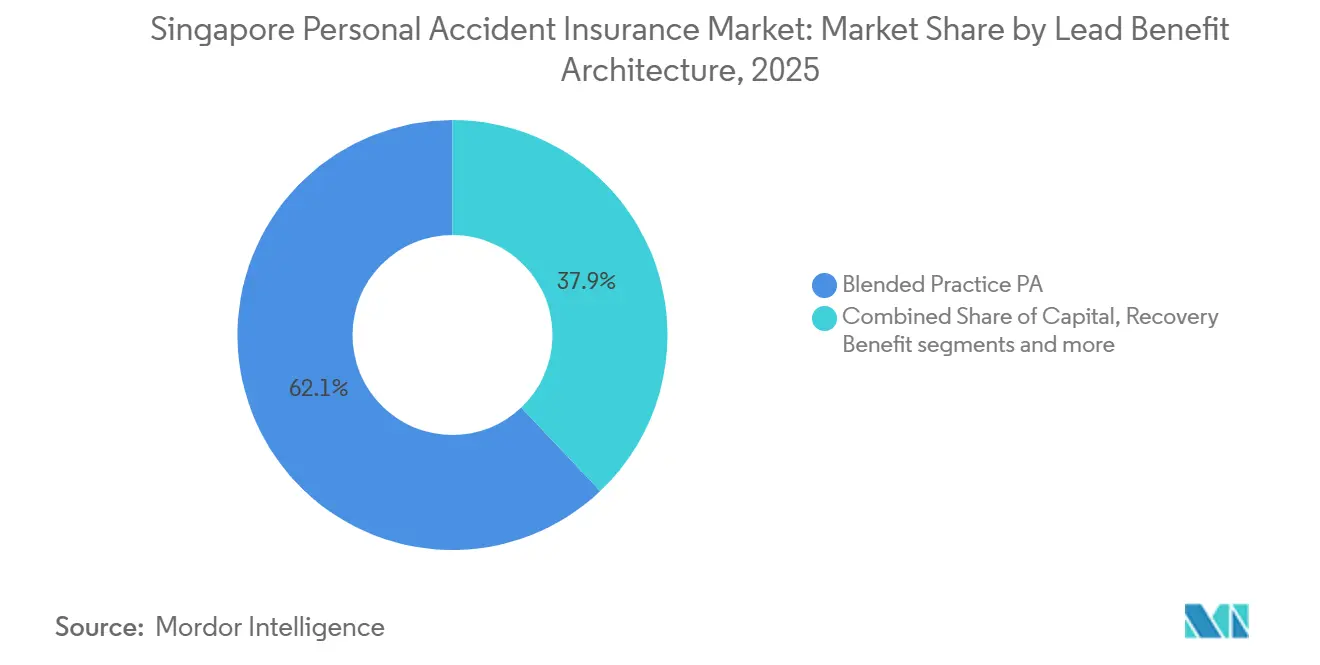
- By lead benefit architecture, blended practice PA held 62.1% of the Singapore personal accident insurance market share in 2025, while recovery-benefit PA is projected to grow at a 4.9% CAGR through 2031.
Note: Market size and forecast figures in this report are generated using Mordor Intelligence’s proprietary estimation framework, updated with the latest available data and insights as of January 2026.
Singapore Personal Accident Insurance Market Trends and Insights
Drivers Impact Analysis*
| Driver | (~) % Impact on CAGR Forecast | Geographic Relevance | Impact Timeline |
|---|---|---|---|
| Rising Healthcare and Post-Accident Rehabilitation Costs | +0.7% | National | Medium term (2-4 years) |
| Growing Protection Needs Among Singapore's Ageing but Active Population | +0.6% | National | Long term (≥ 4 years) |
| High Travel, Commuting and Everyday Mobility Exposure | +0.4% | National | Short term (≤ 2 years) |
| Digital-First Distribution and Embedded Insurance Expansion | +0.8% | National, with ASEAN spillover | Medium term (2-4 years) |
| Growth in Gig Economy and Non-Traditional Employment | +0.5% | National | Medium term (2-4 years) |
| Increasing Demand for Flexible and Lifestyle-Oriented Accident Protection | +0.4% | National | Long term (≥ 4 years) |
| Source: Mordor Intelligence | |||
Rising Healthcare and Post-Accident Rehabilitation Costs
Rehabilitation costs widen the gap between a medical event and a household’s full recovery needs. Ministry of Health benchmarks showed subsidized Ward C rehabilitation bills ranging from USD 1,551 to USD 6,882 in Singapore. Private ward rehabilitation bills ranged from USD 19,497 to USD 26,010 before insurance payouts[1]Source: Ministry of Health, Singapore, “SB702S, Shoulder Fracture/Dislocation, Open Reduction and Internal Fixation,” Ministry of Health Singapore Surgical Procedure Fee Benchmark, moh.gov.sg.. Serious injuries also create inpatient, surgical, and follow-up expenses that can exceed the immediate hospital stay. The Singapore personal accident insurance market benefits when policies reimburse rehabilitation and support income during recovery. Products that combine a capital payment with practical recovery support can address costs that public schemes do not fully cover.
Growing Protection Needs Among Singapore's Ageing but Active Population
Singapore reached super-aged status in 2025, with 20.7% of its population aged 65 or older. The share had risen from 13.1% in 2005, which increased attention to disability and recovery needs. Senior pedestrians represented 75% of pedestrian fatalities in 2025, according to the Singapore Police Force[2]Singapore Police Force, “Traffic Accidents Rose in 2025,” SPF Police Life, February 2026, police.gov.sg.. Accidents involving elderly pedestrians rose 21.7% year over year to 247 cases during the same year. These patterns support policies with recovery benefits for older adults who remain active outside their homes. The Singapore personal accident insurance market can also serve working adults who want clearer financial protection for disability and care needs.
High Travel, Commuting and Everyday Mobility Exposure
Road traffic injury cases reached 7,560 in 2025, a 7.2% increase from the previous year. Red-light running accidents increased 27.1% during the year, while motorcyclists accounted for more than half of traffic deaths. Singapore residents made 10.6 million outbound trips in 2025, compared with 10.3 million trips in 2024. Daily travel, international trips, and recreational activity create recurring occasions for accident protection. SimplyGo and Embed Financial Group Holdings entered a May 2026 partnership to explore embedded micro-insurance in the SimplyGo transit app. This model connects product availability with a mobility setting rather than a separate insurance purchase journey.
Digital-First Distribution and Embedded Insurance Expansion
Digital partnerships are changing how consumers encounter accident cover and how insurers reach new groups. Income Insurance announced the sale of its HIVE digital insurance platform to Embed Financial Group Holdings in June 2026. The transfer expands the technology base available for embedded insurance partnerships in Singapore and other markets. Singapore’s digital advertising standards also set conduct expectations for financial institutions using online distribution channels. The Singapore personal accident insurance market may gain from partner enrollment where the product is offered within a relevant service experience. Insurers still need clear explanations because digital availability does not remove questions about exclusions, eligibility, and benefit limits.
Restraints Impact Analysis*
| Restraint | (~) % Impact on CAGR Forecast | Geographic Relevance | Impact Timeline |
|---|---|---|---|
| High Existing Insurance Coverage and Perceived Product Duplication | -0.5% | National | Medium term (2-4 years) |
| Consumer Preference for Comprehensive Health and Integrated Protection Products | -0.4% | National | Medium term (2-4 years) |
| Limited Consumer Understanding of Personal Accident Policy Coverage and Exclusions | -0.3% | National | Short term (≤ 2 years) |
| Premium Sensitivity and Increasing Consumer Scrutiny of Insurance Value | -0.3% | National | Medium term (2-4 years) |
| Source: Mordor Intelligence | |||
High Existing Insurance Coverage and Perceived Product Duplication
High insurance ownership narrows the pool of consumers seeking an additional standalone policy. Employer Group PA represented 46.1% of the Singapore personal accident insurance market size in 2025, so many workers received accident coverage through their employment. This arrangement can limit active consideration of additional personal protection. The Singapore personal accident insurance market must show where a policy supplements, rather than repeats, health or employer benefits. Consumers may view accident cover as a standard workplace benefit unless they understand recovery costs and income disruption. Clear differences in rehabilitation reimbursement, household support, and benefit portability can make standalone coverage easier to assess.
Consumer Preference for Comprehensive Health and Integrated Protection Products
Households often prioritize broad health protection when reviewing their insurance spending. Changes to Integrated Shield Plan rider arrangements in 2026 increased attention to deductibles, co-payments, and medical expenses. This review can reduce the immediate budget available for specialized personal accident policies. Consumers may also expect government programs and broader medical plans to address disability-related needs. The Singapore personal accident insurance market has to explain the role of accident protection in income continuity and rehabilitation. Products that define this role clearly are better placed to avoid being treated as a duplicate purchase.
*Our forecasts treat driver/restraint impacts as directional, not additive. The impact forecasts reflect baseline growth, mix effects, and variable interactions.
Segment Analysis
By Issuance Form: Employer Coverage Holds the Largest Position While Affinity Schemes Expand
Employer Group PA held 46.1% of the Singapore personal accident insurance market share in 2025. Workplace procurement gives employers a practical way to provide employees with consistent accident benefits. Standardized policy terms can also simplify administration across large employee groups. Employer obligations and group purchasing practices keep this form central to the Singapore personal accident insurance market. Affinity, Association and Scheme PA is forecast to grow at a 5.1% CAGR from 2026 to 2031. The Platform Workers Act took effect on January 1, 2025, and made work injury compensation insurance mandatory for covered platform operators[3]Ministry of Manpower, Singapore, “Platform Workers Act, What It Covers,” Ministry of Manpower Singapore, mom.gov.sg..
CPF contribution rates for platform operators increased from 3.5% to 7% on January 1, 2026. This change reinforces the importance of compliant protection arrangements for riders and drivers. Individual and Family PA remains a route for households seeking protection across several family members. Its progress is limited by existing health and employer coverage. Singlife’s GigConnect program combines Group Personal Accident and Group Prolonged Medical Leave benefits through gig-platform partnerships. Such arrangements allow consumers to enroll through the platform relationship while receiving group-style benefits. This shifts attention toward affinity schemes for self-employed and nontraditional workers. The Singapore personal accident insurance industry is therefore balancing established employer contracts with newer partner-led coverage models.



By Distribution Channel: Tied Advice Remains Important as Partner Enrollment Grows
Tied Agents and Financial Advisers held 37.9% of the Singapore personal accident insurance market share in 2025. Advice-led sales remain relevant for group benefit negotiations and policies requiring detailed benefit explanations. Agents can address questions involving eligibility, benefit combinations, and recovery support. Brokers and bancassurance channels also remain relevant for structured employer arrangements and broader financial relationships. Direct insurer channels provide a faster route from quote to policy issue for some consumers. Embedded and Partner Enrolment is forecast to expand at a 5.6% CAGR from 2026 to 2031.
The June 2026 HIVE transfer reflected continued investment in technology for embedded distribution. Partner enrollment can place a policy within a service that already has a clear connection to commuting, travel, or platform work. The SimplyGo partnership illustrates this approach in a public transit setting. This channel may be more suitable for high-volume and lower-premium individual policies. It does not replace the need for advice where a customer needs help comparing cover. The Singapore personal accident insurance market is likely to retain several channel models because their roles differ by customer and policy complexity. Distribution competition will depend on convenience, trust, and the ability to explain benefits at the point of enrollment.
By Lead Benefit Architecture: Blended Plans Lead While Recovery Benefits Advance
Blended Practice PA accounted for 62.1% of the Singapore personal accident insurance market size in 2025. These plans combine capital payouts with hospital income and medical expense reimbursement. This structure responds to employer and retail demand for more complete protection after an accident. It also reflects the need to manage both immediate costs and ongoing recovery needs. Recovery-Benefit PA is forecast to grow at a 4.9% CAGR from 2026 to 2031. This format addresses the limits of a single lump-sum payment when recovery requires continuing support.
Private hospital orthopedic and trauma procedures can exceed USD 15,794 when surgeon, implant, and ward fees are included. MSIG PA RecoveryPlus includes home nursing support of up to USD 2,369 and home or car modification expenses of up to USD 7,895[4]MSIG Singapore, “MSIG Unveils Latest Personal Accident Plan Offering 360-Degree Protection, PA RecoveryPlus,” MSIG Singapore, msig.com.sg.. It also reimburses unused fitness membership fees during recuperation under the stated product terms. FWD updated its Life PA policy contract in July 2026 with an optional Income Support Rider. Capital-Benefit PA faces a weaker fit where customers expect support for rehabilitation and lost income. The Singapore personal accident insurance industry is moving toward benefits that cover more of the recovery period. Insurers that retain simple capital-only products will need to explain their role more clearly alongside blended plans.
Competitive Landscape
The Singapore personal accident insurance market is moderately fragmented across more than 20 licensed carriers. Competition centers on benefit depth and the ability to reach customers through appropriate distribution channels. Recovery-Benefit and Blended PA plans compete with simpler Capital-Benefit products by offering a wider range of support. MSIG, AIG, Chubb, Sompo, Tokio Marine, and QBE are active in employer group and retail direct channels. AIA, Prudential, FWD, Singlife, and Income Insurance compete where accident protection overlaps with income and health-related benefits.
MSIG uses underwriting relationships with digital intermediaries rather than relying only on proprietary distribution. It serves as the underwriter for the SimplyGo micro-insurance partnership. MSIG personal accident products are also available through Shopee’s marketplace via MoneeInsure Agency. A 2025 consortium involving AIA, Income Insurance, MSIG, and Sompo distributed insurance products through Lazada across 6 Southeast Asian markets. These arrangements show that insurers can share distribution infrastructure while remaining separate underwriting competitors. The Singapore personal accident insurance market is therefore becoming more dependent on the strength and relevance of partner relationships.
Singapore had 310,000 self-employed and platform workers, and Singlife reported that only 12% had enough liquidity for unexpected situations. Singlife provided embedded protection to more than 16,000 platform workers through partnerships with Ryde, HungryPanda, GoGoX, Rida, and Meili. The MAS consultation on a Protected Cell Company framework could reduce the cost of creating specialized insurance vehicles if it is enacted. This could encourage coverage models tailored to defined risk pools. The Singapore personal accident insurance industry remains competitive but lacks disclosed player shares that would support a precise ranking of leading carriers.
Singapore Personal Accident Insurance Industry Leaders
MSIG Insurance (Singapore) Pte. Ltd.
Income Insurance Limited
AIG Asia Pacific Insurance Pte. Ltd.
Chubb Insurance Singapore Limited
AIA Singapore Private Limited
- *Disclaimer: Major Players sorted in no particular order

Recent Industry Developments
- July 2026: FWD Singapore updated the FWD Life PA policy contract, effective July 2, 2026, extending coverage to age 100 with an optional Income Support Rider and Catch-All Rider. The change reinforced the move toward hybrid capital-plus-recovery benefit architectures in individual personal accident products.
- June 2026: Income Insurance announced the sale of its HIVE API-first digital insurance platform to Embed Financial Group Holdings for an undisclosed consideration, with closing expected in Q3 2026. HIVE’s migration repositioned it as the insurance technology backbone for EFGH’s embedded distribution strategy across Singapore, Asia, and 9 African markets.
- May 2026: SimplyGo Pte. Ltd. and Embed Financial Group Holdings entered a Strategic Partnership Agreement to co-develop an embedded micro-insurance platform within the SimplyGo transit app, with MSIG Insurance as the underwriter. The partnership explores contextual micro-insurance for Singapore’s public transport commuter base.
- March 2026: Etiqa Insurance Singapore and AIA Singapore announced a strategic distribution partnership to offer Etiqa’s Shariah-compliant Family Takaful products through AIA’s distribution network of more than 6,300 financial advisers. The partnership expanded access to values-aligned accident and protection products.
- March 2026: GrabInsure launched a motor insurance product for private-hire vehicle drivers in Singapore, applying performance-linked premiums derived from historical Grab platform driving data. The product’s data-driven underwriting approach can inform accident premium personalization for gig-economy and platform-worker groups.


Singapore Personal Accident Insurance Market Report Scope
The Singapore personal accident insurance market comprises insurers providing accident-specific financial protection to individuals, families, employees, and other groups, covering risks such as accidental death, permanent or temporary disability, accidental medical expenses, hospitalization, fractures and burns, and income loss during recovery. Products range from basic individual policies to broader plans with family, lifestyle, overseas, and recovery-related benefits, complementing traditional health and life insurance by addressing accident-related costs and financial consequences.
The Singapore Personal Accident Insurance Market is Segmented by Issuance Form (Individual and Family PA, Employer Group PA, Affinity, and More), Distribution Channel (Tied Agents and Financial Advisers, Insurance Brokers, Bancassurance, and More), and Lead Benefit Architecture (Capital-Benefit PA, Recovery-Benefit PA, Blended Practice PA). The Market Forecasts are Provided in Terms of Value (USD).
| Individual and Family PA |
| Employer Group PA |
| Affinity, Association and Scheme PA |
| Tied Agents and Financial Advisers |
| Insurance Brokers |
| Bancassurance |
| Direct Insurer Channels |
| Embedded and Partner Enrolment |
| Capital-Benefit PA |
| Recovery-Benefit PA |
| Blended Practice PA |
| By Issuance Form | Individual and Family PA |
| Employer Group PA | |
| Affinity, Association and Scheme PA | |
| By Distribution Channel | Tied Agents and Financial Advisers |
| Insurance Brokers | |
| Bancassurance | |
| Direct Insurer Channels | |
| Embedded and Partner Enrolment | |
| By Lead Benefit Architecture | Capital-Benefit PA |
| Recovery-Benefit PA | |
| Blended Practice PA |


Key Questions Answered in the Report
What is the forecast growth rate for personal accident insurance in Singapore?
The Singapore personal accident insurance market is forecast to grow at a 3.4% CAGR from 2026 to 2031, increasing from USD 143 million to USD 169 million. The projection reflects a mature insurance setting where recovery benefits, clear policy value, and convenient enrollment shape demand. It also reflects continued pressure from established health and employer coverage. Insurers must make the additional value of accident benefits understandable at each relevant customer decision point during policy selection.
Which issuance form leads personal accident cover in Singapore?
Employer Group PA led with 46.1% share in 2025, supported by workplace procurement and employer benefit structures. Affinity, Association and Scheme PA is growing faster as platform-worker arrangements become more formal, while Individual and Family PA remains relevant for household protection. Employer plans are still the most established way to provide accident cover.
Which distribution channel is growing fastest for accident protection?
Embedded and Partner Enrolment is forecast to grow at a 5.6% CAGR through 2031, supported by digital and platform partnerships. The model can make coverage available during relevant commuting, travel, or work activities, but it still needs clear benefit explanations. Tied advisers remain important for policies with more complex needs.
Why are recovery benefits becoming more important in accident policies?
Recovery-Benefit PA is forecast to grow at a 4.9% CAGR because post-accident costs can include rehabilitation, nursing support, and income disruption. Blended plans remain the largest benefit architecture because they combine several types of financial support for both immediate treatment and recovery. This combination better reflects the financial needs that can arise after serious accidents.
How does the Platform Workers Act affect accident coverage?
The Act requires covered platform operators to provide work injury compensation insurance, which supports affinity and group protection arrangements. The requirement applies to ride-hailing and food-delivery work and increases attention to compliant cover as platform employment becomes more structured. It also provides a clearer basis for platform-linked insurance offerings.
Which groups have notable accident-related protection needs in Singapore?
Older pedestrians, motorcyclists, logistics workers, delivery workers, and platform workers have distinct mobility or workplace risk exposure. Their different needs create demand for targeted benefits, practical recovery support, and enrollment methods that are easier to access. These groups are not served by the same coverage approach in every setting.
Page last updated on:





