
Size and Share of Singapore Marine Hull Insurance
Market Overview
| Study Period | 2020 - 2031 |
|---|---|
| Forecast Data Period | 2026 - 2031 |
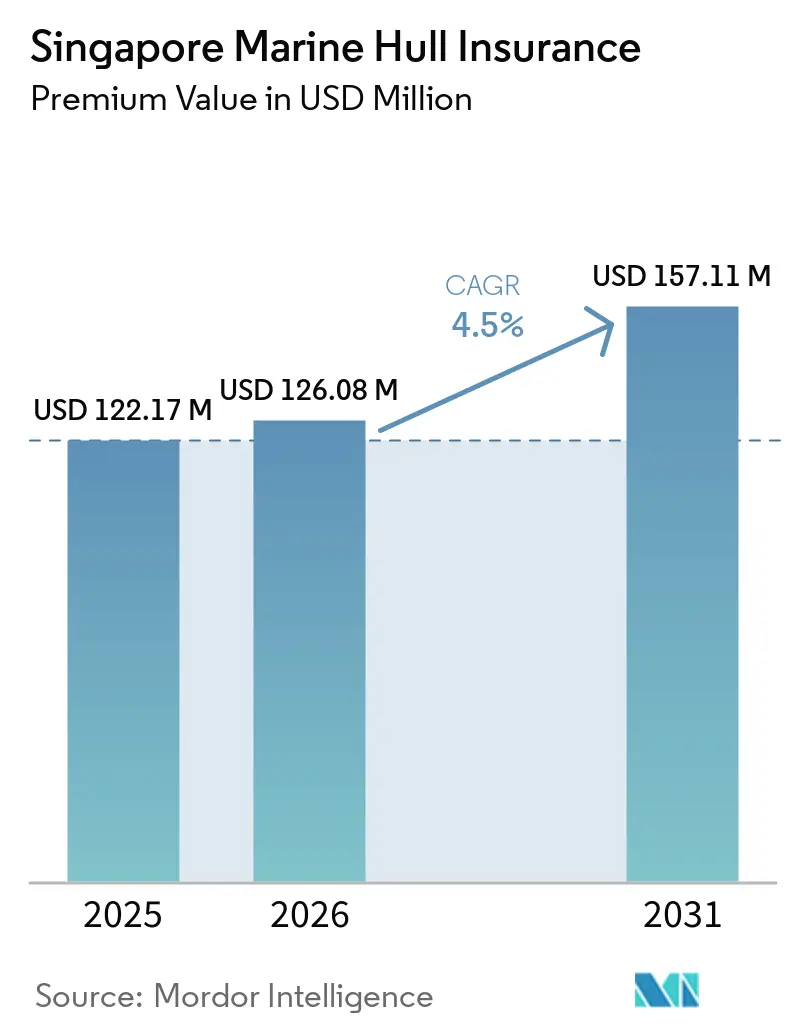
| Base Year Market Size (2025) | USD 122.17 Million |
| Market Size (2026) | USD 126.08 Million |
| Market Size (2031) | USD 157.11 Million |
| Growth Rate (2026 - 2031) | 4.50 % |
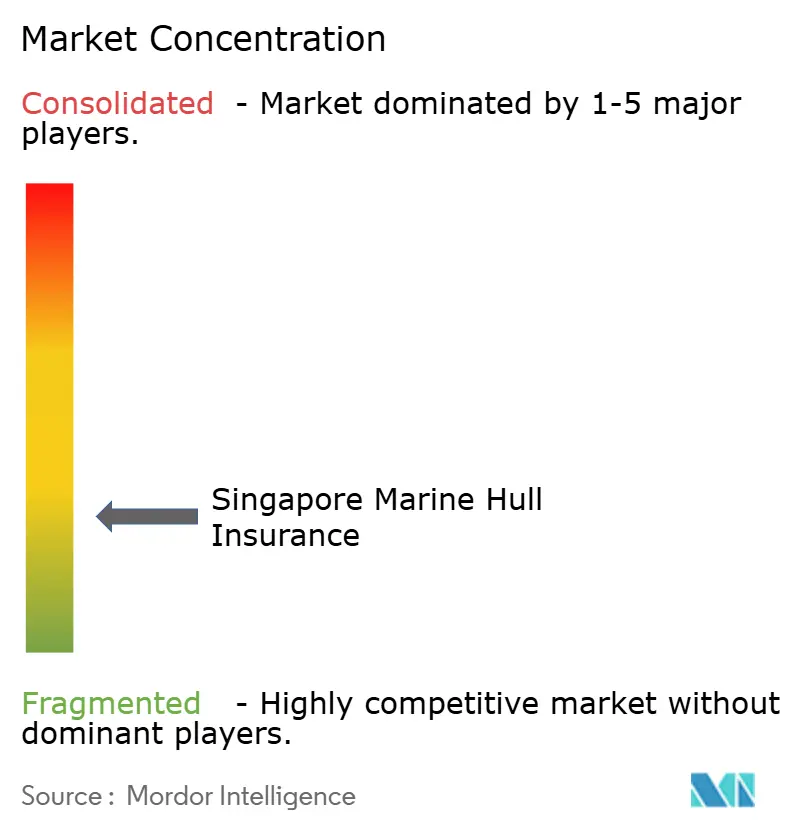
| Market Concentration | Low |
Major Players *Disclaimer: Major Players sorted in no particular order Image © Mordor Intelligence. Reuse requires attribution under CC BY 4.0. | |
Analysis of Singapore Marine Hull Insurance by Mordor Intelligence
The Singapore Marine Hull Insurance Market size in terms of premium value was valued at USD 122.17 million in 2025 and is estimated to grow from USD 126.08 million in 2026 to reach USD 157.11 million by 2031, at a CAGR of 4.5% during the forecast period (2026-2031).
Singapore enters 2026 with a larger registered fleet base, higher vessel values, and a deeper specialist underwriting presence. The Singapore Registry of Ships reached 137.46 million gross tons in 2025, a 27% increase from 2024, and ranked as the world’s fourth-largest registry. This expansion supports premium demand as more Singapore-registered tonnage requires hull coverage and related specialist protection. Competition remains active as underwriting capacity grows, but fleet expansion and product development continue to support the Singapore marine hull insurance market even when international pricing is softer. The opportunity lies in serving complex vessel, terminal, cyber, and alternative-fuel risks through stronger underwriting discipline, faster risk assessment, clear policy wordings, appropriate reinsurance support, and claims processes that help policyholders manage operational disruption, restore vessels efficiently, and address the practical needs of brokers, owners, terminal operators, and lenders.
Key Report Takeaways
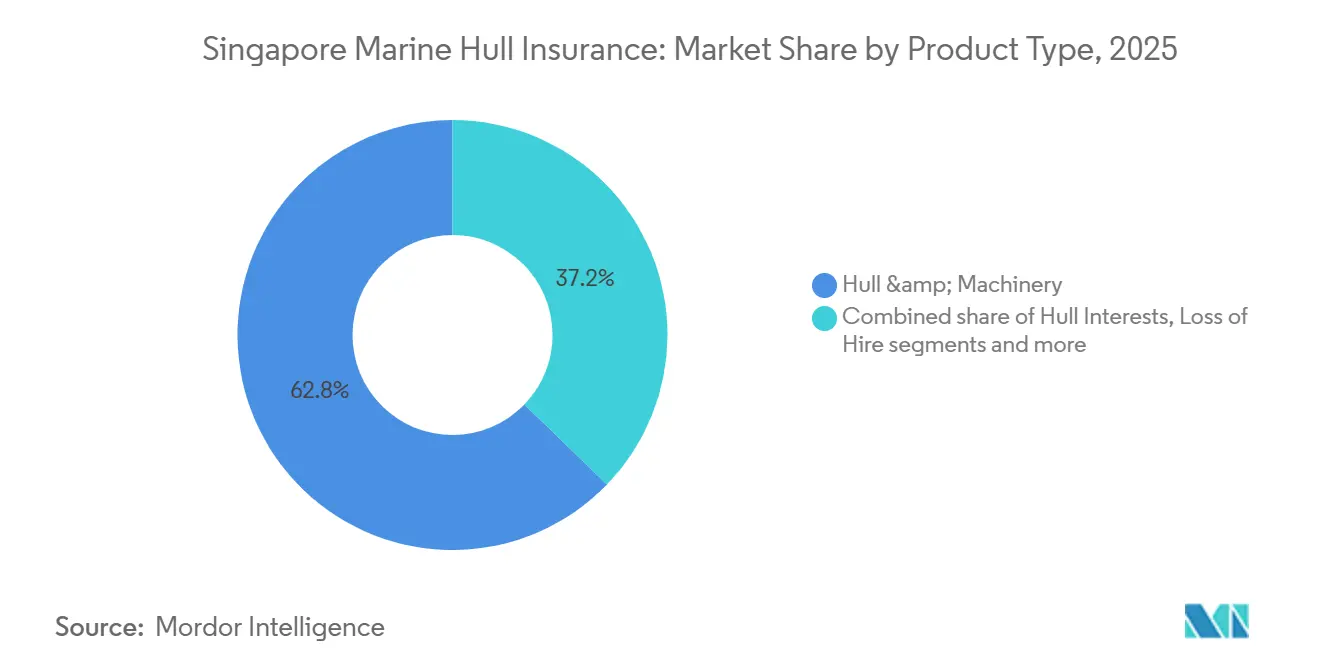
- By product type, hull & machinery held 62.77% of the Singapore marine hull insurance market share in 2025, while marine terminal operators and vessel-operation liability, non-P&I, is projected to grow at a 6.13% CAGR through 2031.
- By vessel type, port, coastal, and local vessels accounted for 63.09% of the Singapore marine hull insurance market share in 2025, while other commercial hull is forecast to expand at a 5.71% CAGR through 2031.
- By coverage type, named-perils operational H&M accounted for 74.12% of the Singapore marine hull insurance market share in 2025, while all-risks are forecast to grow at a 6.32% CAGR through 2031.
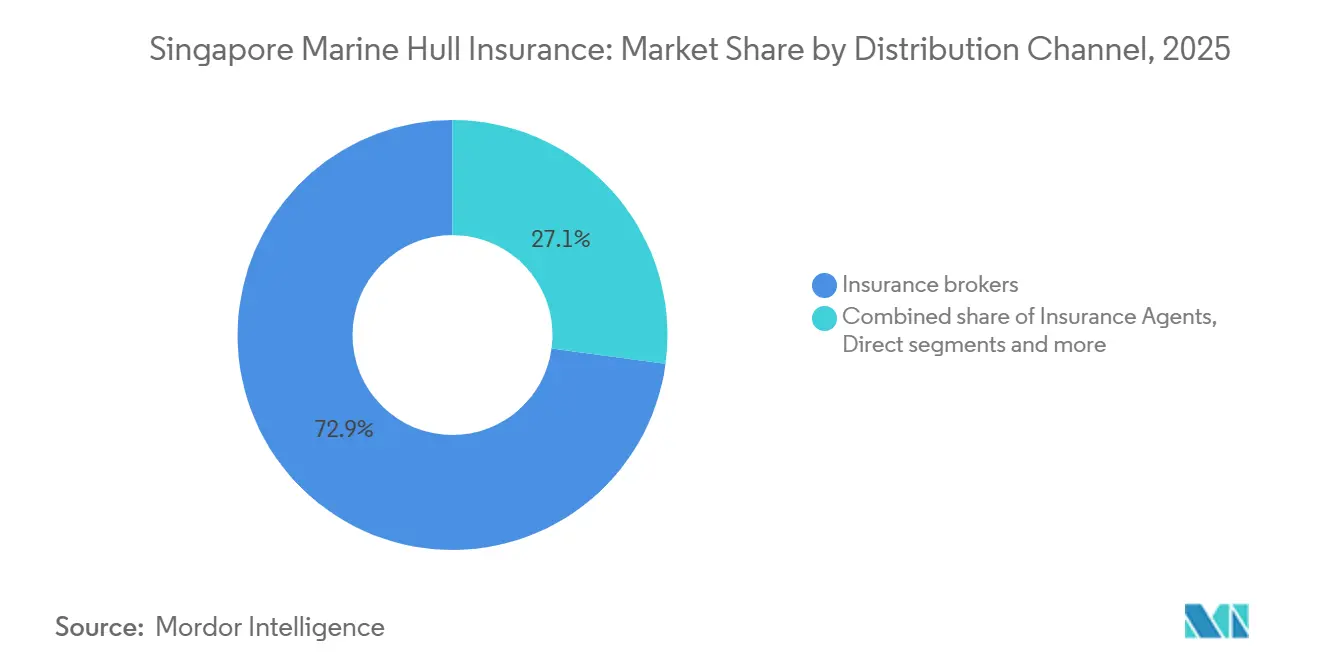
- By distribution channel, insurance brokers held 72.86% of the Singapore marine hull insurance market share in 2025, while MGAs and coverholders are projected to expand at a 6.82% CAGR through 2031.
- By insured type, vessel owners and operators held 79.23% of the Singapore marine hull insurance market share in 2025, while marine terminal and port operators are forecast to grow at a 6.44% CAGR through 2031.
Note: Market size and forecast figures in this report are generated using Mordor Intelligence’s proprietary estimation framework, updated with the latest available data and insights as of January 2026.
Insights and Trends of Singapore Marine Hull Insurance
Drivers Impact Analysis*
| Driver | (~) % Impact on CAGR Forecast | Geographic Relevance | Impact Timeline |
|---|---|---|---|
| Singapore as a Maritime and Marine Insurance Hub | +1.2% | Singapore, with spillover across ASEAN | Long term (≥ 4 years) |
| Growth in Vessel Values and Insurable Fleet Exposure | +0.8% | Singapore, ASEAN, and global reflagging markets | Medium term (2-4 years) |
| Fleet Renewal and Higher-Value Vessel Technology | +0.6% | Singapore, South Korea, Japan, China order-book markets | Long term (≥ 4 years) |
| Specialist Cover Demand from Trade-Route Disruption | +0.7% | Global, with strong relevance for Singapore | Short term (≤ 2 years) |
| Alternative-Fuel Vessels and Emerging Maritime Risks | +0.5% | Singapore, Northern Europe, and major bunkering hubs | Medium term (2-4 years) |
| Digital Vessel Operations and Data-Enabled Underwriting | +0.4% | Singapore, London, and Nordic markets | Medium term (2-4 years) |
| Source: Mordor Intelligence | |||
Singapore's Position as a Regional Maritime and Marine Insurance Hub
Singapore’s role as a port, registry, and underwriting center supports the local premium pool across vessel ownership, management, financing, broking, and claims services. More than 5,000 maritime establishments and 200,000 maritime-sector jobs support a broad commercial base for marine insurance services, technical expertise, and regional risk placement[1]Tokio Marine Kiln, “IUMI 2025: How the Global Maritime Insurance Industry Can Learn from Singapore’s Culture of Innovation,” Tokio Marine Kiln, tmkiln.com. The Singapore Registry of Ships reached a record 137.46 million gross tons in 2025, giving insurers a larger base of Singapore-connected vessels to assess and serve. Its position as the fourth-largest global registry expands the pool of vessels connected to Singapore-based ownership, management, financing, insurance decisions, port calls, repair requirements, and professional services. Reflagging activity added momentum to this expansion and brought more tonnage into the Singapore marine hull insurance market, where local teams can offer specialist underwriting and access to international capacity. Registry decisions also tend to remain in place because they are linked with administrative processes, compliance arrangements, lender requirements, operational planning, and multiyear financing arrangements.
Growth in Vessel Values and Expansion of Insurable Fleet Exposure
The larger registry increases the number of vessels that may require hull protection, liability cover, loss-of-hire extensions, war-risk terms, or other specialist insurance solutions. Vessel values also increase the insured exposure that underwriters must assess for each policy, particularly where the placement involves a high-value commercial vessel or a layered reinsurance program. The record 2025 registry volume shows that the available exposure base expanded sharply from the prior year, supporting a larger pipeline of renewal, new-business, and specialty-placement activity. Higher asset values can raise premium potential, but they also increase the cost of a major loss and the capital needed to support a prudent underwriting position. The Singapore marine hull insurance market therefore needs risk selection that keeps pace with changing vessel values, operating routes, repair options, and the differing risk profiles of coastal and ocean-going fleets. Underwriters also need appropriate reinsurance structures for larger and more complex placements, because exposure growth alone does not ensure an improvement in underwriting margins.
Fleet Renewal and Transition Toward Higher-Value, Technologically Advanced Vessels
Newer vessels bring more advanced machinery, fuel systems, automated controls, and operating requirements into the insurance portfolio, changing the technical information that underwriters need before they offer terms. These features can raise insured values and create demand for more tailored policy wordings that recognize the interaction between physical damage, machinery failure, fuel systems, and operational responsibilities. Alternative propulsion and complex onboard systems require a closer review of repair capability, crew preparedness, spare-part availability, loss scenarios, and the practical limits of established claims experience. The International Maritime Organization approved interim ammonia-fuel safety guidelines in December 2024, creating an international reference point for the safe use of this emerging marine fuel[2]Source: International Maritime Organization, “Ammonia Marine Fuel Interim Guidelines,” International Maritime Organization, imo.org. The framework makes ammonia-related safety and liability questions more relevant for new vessel designs, even though insurance wordings and claims data are still developing. Singapore’s registry had flagged 5 methanol-fueled vessels and expected its first ammonia dual-fuel vessel within 2 years, placing the transition within the local risk portfolio. This transition supports specialized underwriting while raising the need for disciplined pricing, technical review, and realistic loss assumptions.
Rising Demand for Specialist Hull Cover Amid Geopolitical and Trade-Route Disruptions
Trade-route disruption has increased the relevance of war-risk, voyage-extension, and loss-of-hire protection for vessel owners who must reassess routes, voyage duration, and operating conditions. Longer routes can expose vessels to more weather, machinery, fuel, scheduling, and operational risks, while delays can affect a vessel’s earnings and a counterparty’s contractual obligations. Singapore remains important to these flows because it is a major maritime routing, bunkering, service, and insurance center for Asian and international operators. The Singapore marine hull insurance market can support Asian operators seeking specialist capacity for complex voyages, particularly where conventional policy terms do not fully address conflict exposure or extended transit risk. Broader coverage needs may also make standard hull wordings less suitable for some risks, leading owners and brokers to seek clearer terms on exclusions, deductibles, duration, and claims procedures. Underwriters must still distinguish between higher demand for cover and risk that can be priced sustainably, since war-related exposure can change quickly with the route, vessel, cargo, and security environment.
Restraints Impact Analysis*
| Restraint | (~) % Impact on CAGR Forecast | Geographic Relevance | Impact Timeline |
|---|---|---|---|
| Soft Pricing and Capacity Competition | -0.6% | Global, especially London and Scandinavian markets, with relevance to Singapore | Short term (≤ 2 years) |
| Rising Repair Costs and Machinery Claim Severity | -0.5% | Global, with direct exposure for Singapore-flagged and managed fleets | Medium term (2-4 years) |
| Limited Claims History for Emerging Vessel Technology | -0.3% | Singapore, Northern Europe, and East Asian shipbuilding centers | Long term (≥ 4 years) |
| Aging Fleet and High-Severity Hull Loss Exposure | -0.4% | Global, concentrated in older tanker and bulk carrier fleets | Medium term (2-4 years) |
| Source: Mordor Intelligence | |||
Soft Pricing Environment and Intense Underwriting Capacity Competition
Capacity growth can reduce premium rates when several insurers pursue the same risks, particularly where policy terms are broadly comparable, and brokers can access multiple sources of specialist capacity. This pressure is relevant to Singapore because local placement is linked to international specialist capacity, global reinsurance markets, and underwriting decisions made through regional platforms. New MGAs and delegated underwriting arrangements can improve access to regional risks by bringing product knowledge and underwriting authority closer to shipowners and brokers. They can also reduce barriers to entry in competitive classes, increasing the number of providers willing to quote on risks that were once difficult to place. The Singapore marine hull insurance market must balance greater product availability with the need to preserve underwriting margins, claims service standards, and capital discipline. Local prudential requirements continue to set expectations for licensed insurers’ risk management, reinsurance management, and capital practices.
Rising Repair Costs and Increasing Machinery-Claim Severity
Repair cost inflation can increase loss ratios even when written premiums rise, because the cost of restoring a damaged vessel can advance faster than the rate achieved at policy renewal. IUMI’s Hull Inflation Index considers steel prices, shipbuilding wages, and shipyard capacity when assessing hull claim-cost development and provides a common reference for the factors affecting repairs[3]Source: International Union of Marine Insurance, “IUMI Hull Inflation Index,” International Union of Marine Insurance, iumi.com. Machinery claims are especially relevant for harbor tugs, barges, and other working vessels with intensive operating cycles, frequent maneuvering requirements, and limited tolerance for downtime. Higher repair costs also make insured values more sensitive to a midrange loss event, especially when the vessel requires specialist components or an extended period in a shipyard. The Singapore marine hull insurance market must consider repair access, labor availability, material costs, vessel age, and the availability of suitable facilities when setting terms. These factors can restrict profitability if rates do not reflect loss severity, policy limits, deductibles, and the full cost of managing a claim.
*Our forecasts treat driver/restraint impacts as directional, not additive. The impact forecasts reflect baseline growth, mix effects, and variable interactions.
Segment Analysis
By Product Type: Hull & Machinery Anchors, Terminal Liability Accelerates
Hull & machinery accounted for 62.77% of the Singapore marine hull insurance market share in 2025 and remained the largest product category. This core coverage serves operational fleets that are owned or managed from Singapore, supporting the overall Singapore marine hull insurance market size. Hull interests address exposures connected with financiers and other parties that have an interest in the vessel. Builders’ risks, conversion, and ship-repairers coverage address risks during construction, conversion, and repair activity. Loss of hire or earnings cover remains relevant when an insured vessel cannot trade after physical damage. Hull war and strikes coverage serves owners facing route-specific conflict and political violence exposure. Marine terminal operators and vessel-operation liability, non-P&I, have the highest forecast growth at a 6.13% CAGR through 2031. This reflects the growing need to separate port-side liability from traditional vessel-specific protection.
Singapore’s 2025 container throughput reached 44.66 million TEUs, supporting a large operating environment for terminals and vessel services and contributing to the Singapore marine hull insurance market size. Terminal activity can create exposures involving fixed assets, vessel movements, delays, and third-party liabilities. These exposures require policy design that accounts for port operations rather than only vessel navigation. The Income Tax regulations provide a concessionary 5% rate on qualifying underwriting income for approved marine hull and liability insurers. This framework supports insurers that build dedicated hull and liability books in Singapore. The Singapore marine hull insurance industry also benefits when product wordings keep pace with increasingly complex operational relationships. The fastest-growing terminal liability category shows that coverage demand is extending beyond conventional physical vessel damage.



By Vessel Type: Coastal Fleet Commands Volume, Diverse Commercial Hull Grows Fastest
Port, coastal, and local vessels held 63.09% of the Singapore marine hull insurance market share in 2025 and formed the largest vessel category. This group includes harbor tugs, barges, workboats, pilot craft, patrol craft, fishing vessels, and yachts. Their importance reflects Singapore’s dense concentration of commercial activity on and around its waterways. Vessel arrivals at the Port of Singapore reached 3.22 billion gross tons in 2025. These arrivals require tug, bunkering, service, and support operations that create a broad base of smaller insured vessels. Coastal craft can have high machinery use because of frequent maneuvering and operating cycles. Their underwriting needs often depend on condition, maintenance practices, and the operating area.
Ocean-going commercial vessels remain important because insured values are usually higher for container ships, tankers, bulk carriers, LNG or LPG carriers, general cargo vessels, ro-ro vessels, passenger vessels, and offshore support vessels. These vessels may require a layered hull and war-risk coverage supported by reinsurance arrangements. Route disruption and higher asset values can increase the importance of specialist terms for this group. Other commercial hull is projected to grow at a 5.71% CAGR through 2031. This category includes specialized craft and vessel designs outside traditional classifications. It reflects a broader insured universe as commercial operators develop more tailored uses for vessels. The Singapore marine hull insurance industry needs differentiated underwriting rather than one approach for both port craft and ocean-going fleets.
By Coverage Type: Named-Perils Dominates, All-Risks Wordings Gain Ground
Named-perils operational H&M accounted for 74.12% of the Singapore marine hull insurance market share in 2025 and remained the principal coverage form. Defined-peril terms provide a clear scope for insurers and policyholders and are particularly relevant for high-frequency coastal and harbor operations. Total loss only/constructive total loss only coverage serves owners seeking narrower protection for severe loss events. Port risks, laid-up, and inactive coverage serve vessels undergoing maintenance, awaiting charter, or remaining at anchorage. These operating states are relevant in a major port with substantial repair and service activity.
Alternative-fuel vessels are an important reason why broader terms can become more attractive. Novel propulsion systems may not align easily with traditional named-peril lists. The legal and compensation issues surrounding alternative-fuel spills show why policy scope requires careful attention. All-risks wording can help address complex risks, but it also requires more detailed vessel information. Insurers may need data on fuel systems, maintenance, crew preparation, and access to specialist repair facilities. This increases the value of digital risk assessment and technical underwriting. The Singapore marine hull insurance market size for all-risks is forecast to expand at a 6.32% CAGR through 2031. The shift does not replace named-peril cover, which remains the established basis for most operational H&M placements.
By Distribution Channel: Brokers Hold the Market, MGAs Reshape the Supply Side
Insurance brokers controlled 72.86% of the Singapore marine hull insurance market share in 2025 and remained the leading channel. Hull placements often involve large vessel values, layered policy wordings, and international reinsurance requirements. Brokers can coordinate access to domestic and international capacity for these risks. Insurance agents and direct insurer distribution serve smaller or more standardized policies. These routes are often relevant for coastal and harbor craft, where risk profiles are more familiar. MGAs and coverholders are projected to grow at a 6.82% CAGR through 2031, representing the fastest distribution growth rate in the Singapore marine hull insurance market. Delegated underwriting enables specialist insurers to access regional risks through locally informed underwriting teams.
MSIG Specialty Marine began writing protection and indemnity risks from Singapore in September 2025 as an underwriting agent supported by 30 risk carriers. Such arrangements can widen available capacity and bring product expertise closer to Asian fleet operators. They may also increase pressure on pricing when multiple new participants target the same risks. The channel mix, therefore, affects both distribution efficiency and underwriting conditions. Brokers remain central where a policy requires complex structuring and market negotiation. MGAs and coverholders can complement brokers by creating more specialized access points for delegated authority. The Singapore marine hull insurance industry must maintain oversight of underwriting quality as this channel expands. Growth in delegated authority does not remove the need for strong capital, claims, and governance practices.
By Insured Type: Vessel Owners Dominate, Port Operators Emerge as the Growth Segment
Vessel owners and operators represented 79.23% of the Singapore marine hull insurance market share in 2025 and were the dominant insured group. This position reflects the concentration of registered owners and fleet-management companies in Singapore. Owners require cover for vessels that range from local working craft to international commercial fleets. Shipyards and repairers form another important insured group because the market supports active construction, conversion, and repair activity. Builders’ risk and ship-repairers’ liability are relevant when physical work changes the vessel’s risk profile. Mortgagees and other financiers create a stable demand base because lenders and leasing providers have security interests in insured vessels. These parties require protection that recognizes their financial exposure to physical damage. The Singapore marine hull insurance market continues to rely on this owner-led premium base.
Marine terminal and port operators are projected to grow at a 6.44% CAGR through 2031. The record 44.66 million TEUs handled in 2025 indicates the scale of port activity that these operators manage. Port operators can face damage to fixed infrastructure, vessel collision claims, business interruption, and third-party delay exposures. These exposures are different from risks covered by a vessel owner’s ordinary policy. Dedicated non-P&I liability products can therefore address a coverage gap in port operations. The segment’s growth is consistent with greater attention to terminal risk management and standalone liability protection.
Competitive Landscape
The Singapore marine hull insurance market includes specialist Lloyd’s syndicates, MGAs, and licensed direct insurers. Tokio Marine Kiln Singapore, AXA XL Singapore, Beazley Singapore, Markel International Singapore, and Canopius Asia are among the specialist participants named in the supplied scope. QBE Insurance Singapore, MSIG Insurance Singapore, Tokio Marine Insurance Singapore, Sompo Insurance Singapore, and Chubb Insurance Singapore are among the direct insurers active in the broader marine insurance setting. The presence of many participants makes the market fragmented in aggregate despite strong specialist platforms. Competition is shaped by underwriting capability, claims responsiveness, delegated authority, and access to reinsurance. This structure requires providers to differentiate their product and service capabilities rather than rely only on price.
Digital underwriting is becoming a practical, competitive tool for insurers serving complex risks. QBE currently uses Workbench analytics and eClaims to support pricing, tailored solutions, and faster claims decisions. The Singapore Shipping Association’s SCISSOR platform offers integrated marine cyber cover and addresses business interruption and financial loss as well as physical damage. These moves show that coverage design is extending beyond standard H&M products. Insurers that can process vessel information quickly can improve responsiveness for fleet operators and brokers. IUMI has also emphasized the role of data and artificial intelligence in marine insurance operations. The Singapore marine hull insurance market is therefore becoming more dependent on specialist risk data and policy flexibility.
Alternative-fuel vessels, cyber exposure, and terminal operations remain areas where product capability can differentiate providers. The MPA’s alternative-fuel work provides a clear local context for underwriters assessing methanol and ammonia vessels. MSIG’s 2025 launch of direct Singapore-based P&I underwriting through its specialty marine agent showed continuing interest in specialized regional capacity. Insurers must balance product expansion with clear risk selection as capacity remains competitive. Larger international providers can use regional platforms and specialist teams, while smaller MGAs can provide local underwriting focus. This combination creates room for innovation but also makes rate discipline important.
Leaders of Singapore Marine Hull Insurance
QBE International
AXA XL
Canopius Asia
Markel
Beazley
- *Disclaimer: Major Players sorted in no particular order

Recent Industry Developments
- April 2026: QBE Singapore published the Marine Insurance Risk Outlook for Asia 2026, identifying five priority risk themes: environment, manpower, technology, economics and geopolitics, and cargo and supply chain, and confirming that the global fleet faces a shortfall of 90,000 officers in 2026. This signals underwriting scrutiny on manning adequacy as a claims driver for Singapore-managed fleet risks.
- January 2026: The Maritime and Port Authority of Singapore (MPA) has operationalized methanol bunkering through published technical standards and licensing arrangements, with methanol bunkering licences taking effect from January 2026. MPA is also developing Singapore’s first Technical Reference for ammonia bunkering to support safe operations, trials, and early adoption of ammonia as a marine fuel.
- September 2025: MSIG Singapore appointed MSIG Specialty Marine as its underwriting agent to begin writing Protection and Indemnity risks directly from Singapore, backed by 30 risk carriers.
- September 2025: Singapore hosted the IUMI 2025 Annual Conference, where marine insurance discussions addressed digitalization, artificial intelligence, and underwriting challenges.


Scope of Report on Singapore Marine Hull Insurance
Singapore Marine Hull Insurance Market refers to the market for insurance that protects ships and vessels, including their hull, machinery, and equipment, against physical loss or damage from maritime risks such as collision, grounding, fire, storms, and other marine perils.
The Singapore Marine Hull Insurance Market Report is Segmented by Product Type (Hull & Machinery, Hull Interests, Builders' Risks/Conversion/Ship-Repairers, Loss of Hire/Earnings, Hull War and Strikes, Marine Terminal Operators and Vessel-Operation Liability (Non-P&I)), Vessel Type (Ocean-Going Commercial, Port/Coastal/Local, Other Commercial Hull), Coverage Type (Named-Perils Operational H&M, All-Risks Hull Wordings, Total Loss Only, Port Risks/Laid-Up), Distribution Channel (Insurance Brokers, Insurance Agents, Direct, MGAs and Coverholders), and Insured Type (Vessel Owners and Operators, Shipyards and Repairers, Marine Terminal and Port Operators, Mortgagees and Other Financiers). The Market Forecasts are Provided in Terms of Value (USD Million).
| Hull & Machinery |
| Hull Interests |
| Builders' Risks, Conversion and Ship-Repairers |
| Loss of Hire / Earnings |
| Hull War and Strikes |
| Marine Terminal Operators and Vessel-Operation Liability (Non-P&I) |
| Ocean-Going Commercial | Container Ships |
| Bulk Carriers | |
| Oil, Product and Chemical Tankers | |
| LNG and LPG Carriers | |
| General Cargo, Multi-Purpose and Ro-Ro / Vehicle Carriers | |
| Passenger Vessels and Ferries | |
| Offshore Support Vessels | |
| Port, Coastal, and Local | Harbour Tugs, Barges, Workboats, Pilot and Patrol Craft |
| Fishing Vessels | |
| Yachts and Pleasure Craft | |
| Other Commercial Hull |
| Named-Perils Operational H&M |
| All-Risks |
| Total Loss Only/Constructive Total Loss Only |
| Port Risks / Laid-Up / Inactive |
| Insurance Brokers |
| Insurance Agents |
| Direct Insurer Distribution |
| MGAs and Coverholders |
| Vessel Owners and Operators |
| Shipyards and Repairers |
| Marine Terminal and Port Operators |
| Mortgagees and Other Financiers |
| By Product Type | Hull & Machinery | |
| Hull Interests | ||
| Builders' Risks, Conversion and Ship-Repairers | ||
| Loss of Hire / Earnings | ||
| Hull War and Strikes | ||
| Marine Terminal Operators and Vessel-Operation Liability (Non-P&I) | ||
| By Vessel Type | Ocean-Going Commercial | Container Ships |
| Bulk Carriers | ||
| Oil, Product and Chemical Tankers | ||
| LNG and LPG Carriers | ||
| General Cargo, Multi-Purpose and Ro-Ro / Vehicle Carriers | ||
| Passenger Vessels and Ferries | ||
| Offshore Support Vessels | ||
| Port, Coastal, and Local | Harbour Tugs, Barges, Workboats, Pilot and Patrol Craft | |
| Fishing Vessels | ||
| Yachts and Pleasure Craft | ||
| Other Commercial Hull | ||
| By Coverage Type | Named-Perils Operational H&M | |
| All-Risks | ||
| Total Loss Only/Constructive Total Loss Only | ||
| Port Risks / Laid-Up / Inactive | ||
| By Distribution Channel | Insurance Brokers | |
| Insurance Agents | ||
| Direct Insurer Distribution | ||
| MGAs and Coverholders | ||
| By Insured Type | Vessel Owners and Operators | |
| Shipyards and Repairers | ||
| Marine Terminal and Port Operators | ||
| Mortgagees and Other Financiers | ||


Key Questions Answered in the Report
What is the projected value of Singapore marine hull insurance in 2031?
The Singapore marine hull insurance market size is projected to reach USD 157.11 million by 2031, from USD 126.08 million in 2026, at a CAGR of 4.5%.
Which product category leads Singapore marine hull insurance?
Hull & machinery accounted for 62.77% of the Singapore marine hull insurance market share in 2025.
Which vessel category has the largest premium base in Singapore?
Port, Coastal, and Local vessels accounted for 63.09% of premiums in 2025, reflecting demand from harbor and coastal operations.
What is driving demand for specialist marine hull cover in Singapore?
Fleet growth, higher vessel values, trade-route disruption, alternative fuels, and greater use of vessel data are supporting demand for specialist cover.
Why are alternative-fuel vessels important for Singapore insurers?
Methanol and ammonia vessels create unfamiliar technical and liability exposures, which require more detailed underwriting and policy wording.
Which distribution channel is growing fastest in Singapore?
MGAs and Cover holders are forecast to grow at a 6.82% CAGR through 2031, while brokers remain the largest channel in 2025.
Page last updated on:





