
Singapore Health Insurance Market Size and Share
Market Overview
| Study Period | 2020 - 2031 |
|---|---|
| Forecast Data Period | 2026 - 2031 |
| Base Year Market Size (2025) | USD 4.96 Billion |
| Market Size (2026) | USD 5.59 Billion |
| Market Size (2031) | USD 7.75 Billion |
| Growth Rate (2026 - 2031) | 6.75 % |
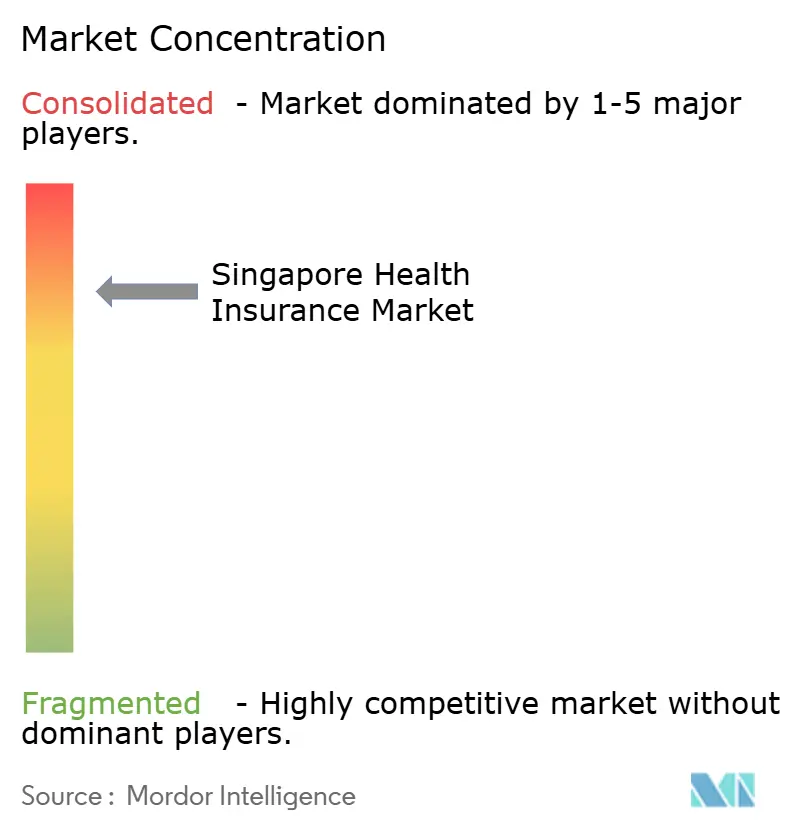
| Market Concentration | High |
Major Players *Disclaimer: Major Players sorted in no particular order Image © Mordor Intelligence. Reuse requires attribution under CC BY 4.0. | |
Singapore Health Insurance Market Analysis by Mordor Intelligence
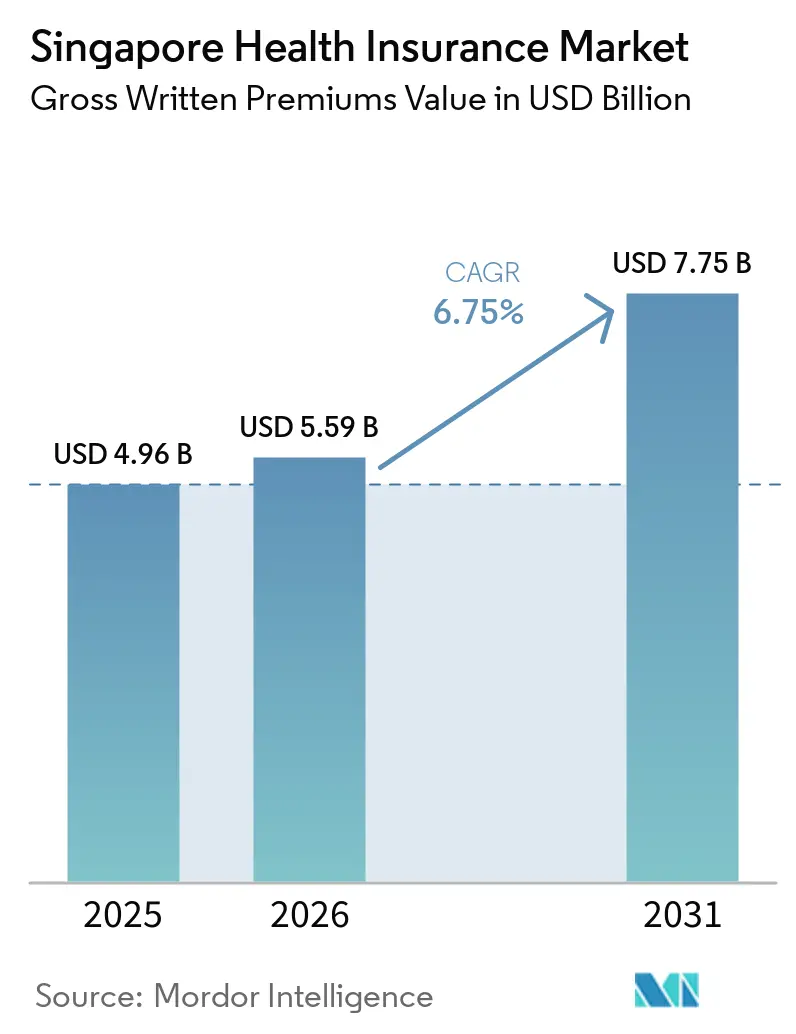
The Singapore Health Insurance Market size in terms of gross written premiums value was valued at USD 4.96 billion in 2025 and is estimated to grow from USD 5.59 billion in 2026 to reach USD 7.75 billion by 2031, at a CAGR of 6.75% during the forecast period (2026-2031).
Medical cost inflation reached 16.9% in 2026, which increases claims pressure and reinforces the need for health coverage. The government healthcare budget is projected to rise from SGD 21 billion (USD 15.6 billion) in 2025 to SGD 30 billion (USD 22.3 billion) by 2030, supporting demand for supplementary private protection. Weighted new-business premiums rose by more than 10% year on year during the first 9 months of 2025, showing continued policy demand before the forecast period. Singapore’s aging population and the growing use of employer benefits are expected to support premium growth, while affordability will remain an important constraint. The Singapore health insurance market is also being reshaped by rider rules, digital service models, and closer management of healthcare claims.
Key Report Takeaways
- By primary benefit, medical expense/hospitalization & surgical accounted for 87.8% of the Singapore health insurance market share in 2025, while long-term care is projected to grow at a 9% CAGR through 2031.
- By customer, individual policyholders accounted for 52.8% of the Singapore health insurance market share in 2025, while employer group - SME, is projected to grow at an 8.1% CAGR through 2031.
- By distribution channel, tied/exclusive agents accounted for 34.4% of the Singapore health insurance market share in 2025, while direct & digital insurer channels are projected to grow at a 9.6% CAGR through 2031.
- By geography, the central region accounted for 25.5% of the Singapore health insurance market share in 2025, while the north region is projected to grow at a 7.2% CAGR through 2031.
Note: Market size and forecast figures in this report are generated using Mordor Intelligence’s proprietary estimation framework, updated with the latest available data and insights as of January 2026.
Singapore Health Insurance Market Trends and Insights
Drivers Impact Analysis*
| Driver | (~) % Impact on CAGR Forecast | Geographic Relevance | Impact Timeline |
|---|---|---|---|
| Rising Healthcare Costs and Private Hospital Treatment Expenses | +1.5% | Global, most acute in Central Region | Short term (≤ 2 years) |
| Demand for Integrated Shield Plans and Supplementary Coverage Beyond MediShield Life | +1.8% | National, concentrated in Central and East Regions | Medium term (2-4 years) |
| Aging Population and Growing Chronic Disease Burden | +1.4% | National, with North Region as a growth corridor | Long term (≥ 4 years) |
| Demand for Comprehensive Employer-Sponsored Health Benefits | +0.9% | National, including small and medium-sized enterprise clusters in North and West industrial areas | Medium term (2-4 years) |
| Mandatory Medical Insurance Requirements for Foreign Workers | +0.5% | National, especially construction and marine activity in West and North | Short term (≤ 2 years) |
| Demand for Digital and Convenient Healthcare Access | +0.6% | National, across all regions | Medium term (2-4 years) |
| Source: Mordor Intelligence | |||
Rising Healthcare Costs and Private Hospital Treatment Expenses
Medical cost inflation reached 16.9% in Singapore in 2026, putting direct pressure on insurers’ claims costs and pricing decisions. SingHealth expenditure increased from SGD 4.4 billion (USD 3.26 billion) in 2019 to SGD 6.1 billion (USD 4.51 billion) in 2024, while inpatient care accounted for 63.8% of spending[1] “Trends in Healthcare Costs and Utilisation in SingHealth 2019-2024, The Effects of an Aging Population,” Annals of Singapore, annals.edu.sg. This pattern makes hospital cover a continuing priority for households, even when premiums rise. Higher treatment bills can reduce insurer margins and lead to narrower coverage designs. They also make supplementary protection more relevant because the financial exposure from hospitalization becomes larger. The Singapore health insurance market must therefore balance affordability with the need to maintain meaningful private hospital protection.
Demand for Integrated Shield Plan and Supplementary Coverage Beyond MediShield Life
The Integrated Shield Plan combines compulsory MediShield Life coverage with private insurance that allows policyholders to select higher ward classes. Around 72% of Singapore’s population held an Integrated Shield Plan in the first half of 2025. The revised rider framework took effect in April 2026 and removed coverage of the required deductible for newly sold riders. The annual co-payment cap increased from SGD 3,000 (USD 2,220) to SGD 6,000 (USD 4,440) under the new requirements[2]Ministry of Health, Singapore, “New Requirements for Integrated Shield Plan Riders to Strengthen Sustainability of Private Health Insurance and Address Rising Healthcare Costs,” Ministry of Health, Singapore, moh.gov.sg. These rules limit differentiation based on extensive rider coverage and place greater emphasis on service, provider relationships, and clear plan design. The Singapore health insurance market can gain policyholders when lower-cost riders improve the entry point for buyers who previously reduced coverage.
Aging Population and Growing Chronic Disease Burden
Singapore citizens aged 65 and above represented 20.7% of citizens in June 2025, and Singapore became Southeast Asia’s first super-aged country in 2026 under the United Nations threshold[3]https://www.researchgate.net/publication/369733194_Population_Ageing_in_Singapore. Adults aged 80 and above reached 145,000 in 2025, after increasing by 60% over the preceding decade. Chronic conditions raise both healthcare use and the value of insurance coverage across older age groups. Older adults with multimorbidity incurred annual healthcare expenditure of SGD 15,148 (USD 11,210), compared with SGD 2,806 (USD 2,076) for those without chronic conditions. This cost difference strengthens demand for coverage that addresses chronic illness, hospitalization, and care after discharge. The Singapore health insurance market is likely to place greater weight on disease management because pricing alone cannot address the higher claims risk associated with multiple conditions.
Demand for Comprehensive Employer-Sponsored Health Benefits
Group medical cover has become more important for employers seeking to recruit and retain workers. The Ministry of Manpower’s Stage 2 requirements took effect on July 1, 2025, increasing the mandatory annual claim limit for Work Permit and S Pass holders from SGD 15,000 (USD 11,100) to SGD 60,000 (USD 44,400). The rules also require direct hospital reimbursement by insurers and standardize key exclusion clauses. These changes raise minimum insurance spending for employers with foreign workers in construction, marine, manufacturing, and services. They also make plan design and age-based pricing more relevant for employers with older worker groups. Digital human resources portals, modular benefits, and compliance support can help insurers serve this part of the Singapore health insurance market.
Restraints Impact Analysis*
| Restraint | (~) % Impact on CAGR Forecast | Geographic Relevance | Impact Timeline |
|---|---|---|---|
| Rising Premiums and Affordability Pressures for Private Hospital Coverage | -0.8% | National, most acute among older individual policyholders | Short term (≤ 2 years) |
| Escalating Claims Costs and Pressure on Integrated Shield Plans Sustainability | -0.9% | National, concentrated in private hospital Integrated Shield Plans | Medium term (2-4 years) |
| Regulatory Changes Increasing Cost-Sharing and Limiting Extensive Rider Coverage | -0.5% | National | Short term (≤ 2 years) |
| Dependence on Public Healthcare Coverage Limiting Additional Private Insurance Need | -0.4% | National, most pronounced among lower-income households | Long term (≥ 4 years) |
| Source: Mordor Intelligence | |||
Rising Premiums and Affordability Pressures for Private Hospital Coverage
Premium affordability continues to limit the breadth of private hospital coverage, despite lower premiums for some new riders. Six of seven Integrated Shield Plan insurers increased rider premiums in 2025 after net claims rose by 9% to 27% in 2024. Five of seven insurers also increased base-plan premiums in 2026, in some cases by double-digit rates. The combined cost of a base plan and rider can still rise for middle-aged and older households. Price-sensitive buyers may move toward restructured hospital plans rather than private hospital coverage. This movement can constrain premium growth at the higher end of the Singapore health insurance market.
Escalating Claims Costs and Pressure on Integrated Shield Plan Sustainability
Integrated Shield Plan's profitability remains under pressure because claims frequency and average claim values have both increased. Policyholders with riders were 1.4 times more likely to make a claim than policyholders without riders, and their average claim size was also 1.4 times higher. This difference informed the April 2026 deductible and co-payment reforms. Cancer, diabetes, and obesity continue to increase the cost of healthcare claims. Insurers need stronger provider networks, claims review, and underwriting practices to manage these pressures. The Singapore health insurance market will remain sensitive to the ability of insurers to reduce avoidable claims costs without weakening useful cover.
*Our forecasts treat driver/restraint impacts as directional, not additive. The impact forecasts reflect baseline growth, mix effects, and variable interactions.
Segment Analysis
By Primary Benefit: Medical Expense Anchors Coverage, Long-Term Care Supports Growth
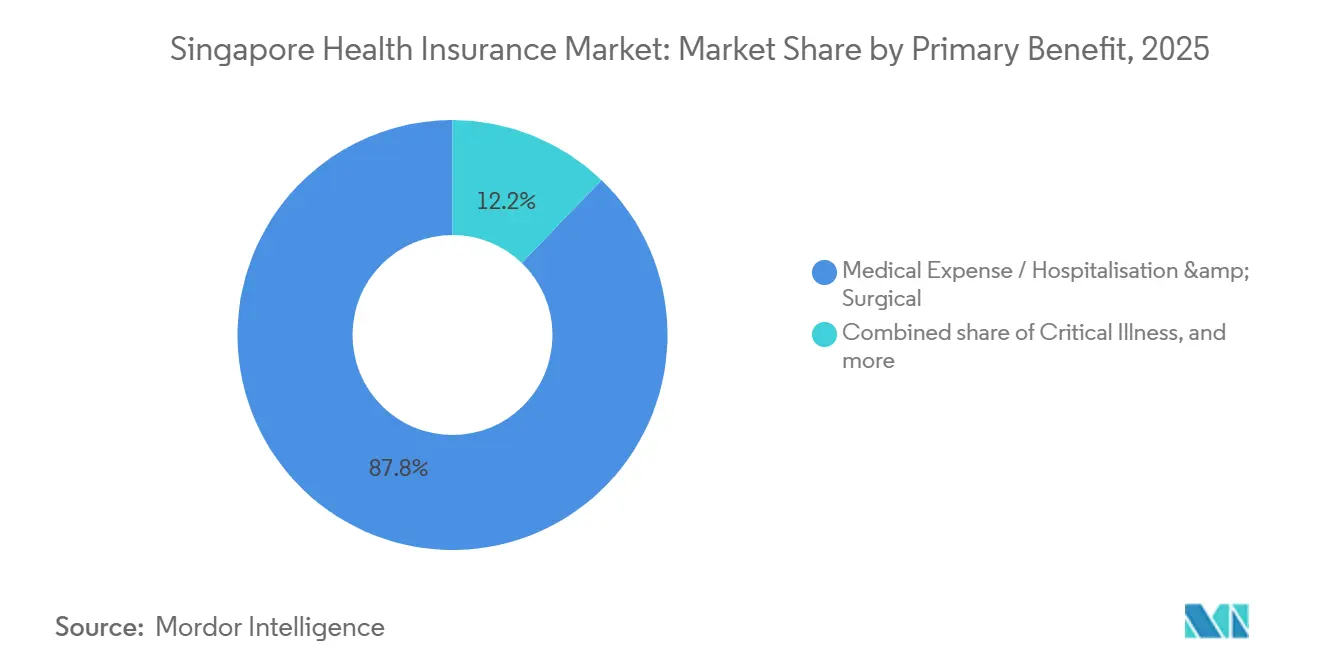
Medical expense/hospitalization & surgical held 87.8% of Singapore health insurance market share in 2025, confirming the central role of inpatient cover in the country’s insurance system. MediShield Life provides the compulsory foundation, while the Integrated Shield Plan adds private cover for policyholders seeking higher ward options. Around 72% of residents had an Integrated Shield Plan in the first half of 2025, showing the broad reach of hospital protection. Critical illness plans remain a material secondary category because they provide financial support around serious conditions. Hospital cash and disability income products serve income-replacement needs for self-employed people and employees whose group cover does not replace lost earnings.
Long-term care is projected to expand at a 9% CAGR from 2026 to 2031, making it the fastest-growing primary benefit category in the Singapore health insurance market, and according to the Ministry of Health (MOH), Singapore, CareShield Life payout growth doubled from 2% to 4% annually from January 2026. Monthly payouts started at SGD 689 (USD 510) in 2026 and are projected to reach SGD 806 (USD 596) by 2030. A government premium support package exceeding SGD 570 million (USD 422 million) for 2026–2030 is intended to limit premium increases to an average of SGD 38 (USD 28) annually. Supplementary products can address home nursing, rehabilitation, and post-hospital care as the population aged 80 and above expands, supporting growth in the Singapore health insurance market size.


By Customer: Individual Policyholders Lead, Small and Medium-Sized Enterprises Grow Faster
Individual policyholders accounted for 52.8% of the Singapore health insurance market share in 2025. Broad ownership of personal Integrated Shield Plan and demand for stand-alone critical illness and disability products support the segment. High Integrated Shield Plan penetration indicates that new individual demand will likely arise from plan upgrades and supplementary protection products. In 2025, only 38% of Singaporeans had critical illness coverage, highlighting a protection gap beyond hospital insurance. Individual policyholders will continue to evaluate affordability as base-plan and rider premiums change.
Employer group - SME is projected to grow at a CAGR of 8.1% through 2031. The segment benefits from foreign worker insurance requirements and intensifying employer competition for talent. The Stage 2 requirements, implemented in July 2025, increased the annual claim limit for covered Work Permit and S Pass holders to SGD 60,000 (USD 44,400). Insurers can lower plan-acquisition barriers by offering modular benefits, digital enrollment, and bundled compliance services. Employer group - large corporate/MNC, customers also generate significant premiums through group medical insurance and international private medical insurance programs. Platform-based distribution can expand access for smaller businesses that previously relied on broker-led purchasing, supporting the Singapore health insurance market size.
By Distribution Channel: Agents Retain Advisory Value, Digital Channels Expand Faster
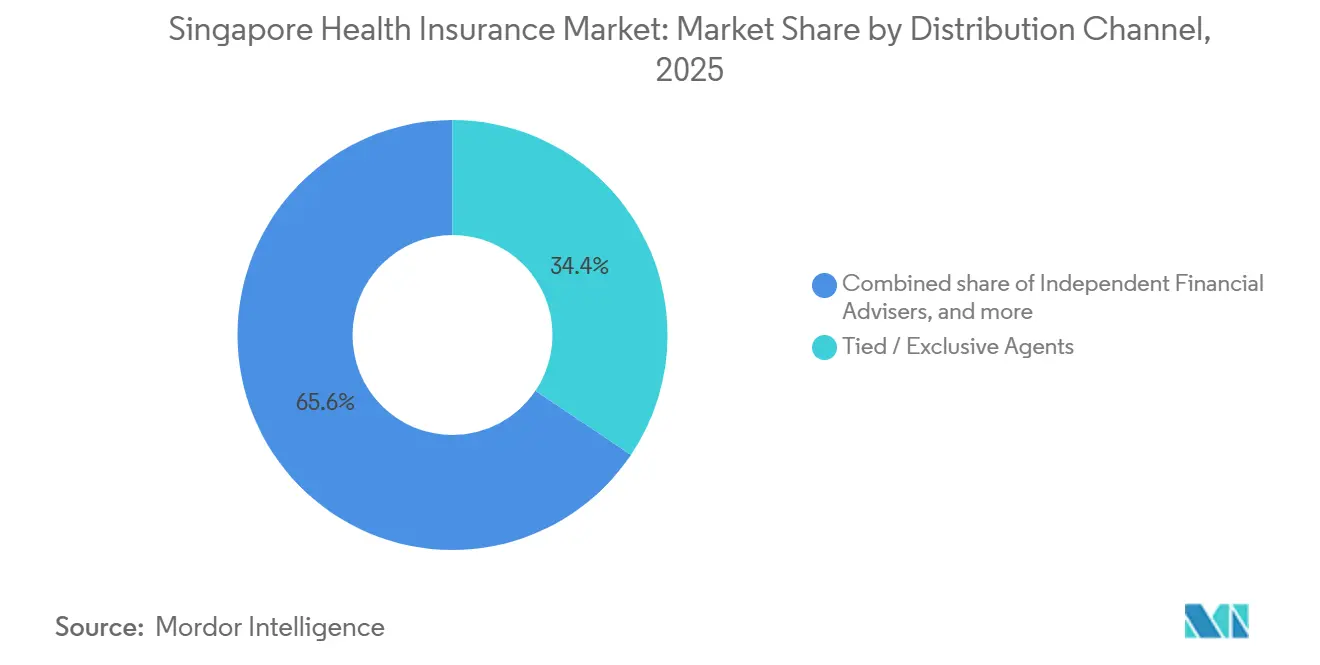
Tied/exclusive agents represented 34.4% of the Singapore health insurance market share in 2025. Their position reflects the importance of guidance for Integrated Shield Plan changes, critical illness reviews, and long-term care decisions. Independent financial advisers remain active in comparing the Integrated Shield Plan for individual clients. Insurance brokers are important for corporate and multinational group medical mandates. Bancassurance provides another route to customers who value access through an established financial institution. These channels remain relevant where benefit choices, exclusions, and personal needs require detailed explanation.
Direct and digital insurer channels are forecast to grow at a 9.6% CAGR from 2026 to 2031. Digital platforms simplify issuance and claims submission for products with less complex underwriting. AIA+ had 1.3 million registered users and a 4.7-star app-store rating by December 2025. Singlife processed 22,930 applications through EzSub between February and April 2025, an 8% increase from the same period in 2024. Digital channels can also combine insurance administration, teleconsultation, wellness support, and financial services in one customer interface. The Singapore health insurance market is likely to use a mixed channel model because simple products can move online. At the same time, complex decisions retain an advisory role, supporting growth in the Singapore health insurance market.
Geography Analysis
The Central Region is expected to account for 25.5% of the Singapore health insurance market share in 2025, representing the largest share among the country’s planning regions. Its role as Singapore’s financial center and its concentration of high-income professional households support demand for private hospital Integrated Shield Plan, higher-sum critical illness coverage, and international private medical insurance. Multinational offices also contribute to group health insurance premium volumes in the region - the East Region benefits from established residential areas, including Tampines, Bedok, and Pasir Ris. Many households in these areas purchase an Integrated Shield Plan that aligns with Class A and B1 wards in restructured hospitals.
The North Region is forecast to grow at a CAGR of 7.2% during 2026–2031, the fastest rate among the geographic segments. Expanding residential areas in Woodlands, Sembawang, and Yishun are increasing the potential customer base. Clusters of small and medium-sized enterprises, along with manufacturing and construction workers, also support demand for employer-sponsored medical coverage. Singapore’s population is projected to reach 6.1 million in June 2025, up 1.2% from 2024, with non-resident growth concentrated in construction and domestic work. The Singapore health insurance market in the North Region also benefits from demand for CareShield Life top-ups and coverage for restructured hospital wards.
The West Region is emerging as a corporate growth area as organizations expand around the Jurong Lake District. This development is expected to support demand for group medical insurance among multinational and mid-market businesses located outside the Central Business District. Construction and marine activities in the West also create sustained demand for Ministry of Manpower-compliant foreign worker insurance. Regulatory requirements apply consistently across Singapore, as the Monetary Authority of Singapore’s framework does not vary by planning region. Therefore, regional growth differences reflect household profiles, employment patterns, and healthcare preferences rather than variations in insurance regulations. While the Singapore health insurance market operates under a national regulatory structure, regional development influences the mix of policyholders and insurance products, supporting the overall Singapore health insurance market size.
Competitive Landscape
The Singapore health insurance market is divided between a regulated Integrated Shield Plan segment and a broader field for critical illness, group medical, international private medical insurance, and accident and health cover. Only seven insurers are approved by the Ministry of Health to offer the Integrated Shield Plan. Required deductibles and co-payments limit the scope for competition based only on coverage depth. The April 2026 rider framework shifted competition toward rider design, provider networks, service quality, and wellness benefits. Larger insurers have an advantage in this environment because they can invest in claims controls, distribution, and customer support.
Allianz announced the acquisition of HSBC Life Singapore in July 2024 and entered a 15-year exclusive distribution partnership with HSBC Singapore. This move strengthened Allianz’s bancassurance position in protection, health, retirement, and wealth solutions. Great Eastern brought medical claims management in-house and used an artificial intelligence-enabled system to support claims administration. Singlife introduced new Integrated Shield Plan riders and a Care Collab Recovery Support Benefit that provides SGD 20,000 (USD 14,900) over two years for home nursing and rehabilitation. These actions show that insurers are linking coverage with care support, distribution reach, and claims management.
Digital platforms, wellness programs, and claims analytics are central competitive priorities. Insurers use these tools to reduce administrative friction and encourage healthier behavior among policyholders. AIA Singapore introduced a chronic disease management program for diabetes, hypertension, and hyperlipidemia in October 2025 for its first 1,500 eligible policyholders. The program was available at no additional cost through the Amped mobile application. Affordable senior-care products, modular small and medium-sized enterprise benefits, and integrated care after hospitalization remain areas of opportunity. The Singapore health insurance market is concentrated in personal hospitalization cover, while adjacent product categories allow more participants to compete.
Singapore Health Insurance Industry Leaders
AIA Singapore Private Limited
The Great Eastern Life Assurance Company Limited
Prudential Assurance Company Singapore (Pte) Limited
Income Insurance Limited
Singapore Life Limited
- *Disclaimer: Major Players sorted in no particular order

Recent Industry Developments
- May 2026: AIA Singapore launched AIA Protect 3, a critical illness plan targeting Singapore’s 74% critical illness protection gap, with premiums from SGD 0.6 (USD 0.45) per day covering cancer, heart attack, and stroke. The plan uses simplified 4-question underwriting and integrates with AIA Vitality for wellness rewards.
- April 2026: All 7 Ministry of Health-approved Integrated Shield Plan insurers launched new rider suites in compliance with the revised framework. The Ministry of Health stated that new private-hospital riders were 35-40% cheaper on average than legacy maximum-coverage riders.
- April 2026: Great Eastern introduced GREAT SupremeHealth P Prime, with an SGD 2.3 million (USD 1.7 million) annual coverage limit and an SGD 6,500 (USD 4,800) out-of-pocket cap. The product was paired with a GREAT TotalCare 2 Prime rider.
- October 2025: AIA Singapore and Amplify Health launched a Chronic Disease Management Program for diabetes, hypertension, and hyperlipidemia. The program was available at no additional cost to the first 1,500 eligible policyholders through the Amped mobile application.


Singapore Health Insurance Market Report Scope
| Medical Expense/Hospitalization & Surgical |
| Critical Illness |
| Hospital Cash |
| Disability Income |
| Long-Term Care |
| Individuals |
| Employer Group - SME |
| Employer Group - large corporate/MNC |
| Tied/Exclusive Agents |
| Independent Financial Advisers |
| Insurance Brokers |
| Bancassurance |
| Direct & Digital Insurer Channels |
| Central Region |
| East Region |
| North Region |
| West Region |
| By Primary Benefit | Medical Expense/Hospitalization & Surgical |
| Critical Illness | |
| Hospital Cash | |
| Disability Income | |
| Long-Term Care | |
| By Customer | Individuals |
| Employer Group - SME | |
| Employer Group - large corporate/MNC | |
| By Distribution Channel | Tied/Exclusive Agents |
| Independent Financial Advisers | |
| Insurance Brokers | |
| Bancassurance | |
| Direct & Digital Insurer Channels | |
| By Geography | Central Region |
| East Region | |
| North Region | |
| West Region |


Key Questions Answered in the Report
What is the forecast growth rate for health insurance in Singapore?
The sector is projected to grow at a 6.8% CAGR from 2026 to 2031, reaching USD 7.8 billion by 2031. This growth reflects demand for private protection alongside rising healthcare costs.
Which primary benefit has the largest share in Singapore?
Medical Expense / Hospitalisation & Surgical led with 87.8% share in 2025. Its position reflects the central role of inpatient protection in the Integrated Shield Plan structure.
Which customer group is growing fastest?
Employer Group - SME is expected to expand at an 8.1% CAGR through 2031. Foreign worker coverage rules and talent competition support this growth.
Why are Integrated Shield Plans riders changing in Singapore?
New rider rules effective in April 2026 require deductibles and raise the annual co-payment cap to SGD 6,000. The requirements are intended to strengthen sustainability and address rising healthcare costs.
Which distribution channel is expected to grow fastest?
Direct & Digital Insurer Channels are forecast to grow at a 9.6% CAGR through 2031. Digital tools can simplify applications, policy management, teleconsultation access, and claims submission.
Which region is expected to grow fastest?
The North Region is forecast to grow at a 7.2% CAGR through 2031. Residential development, industrial activity, and demand for employer medical cover support its expansion.
Page last updated on:





