
Asia-Pacific Rice Market Analysis by Mordor Intelligence
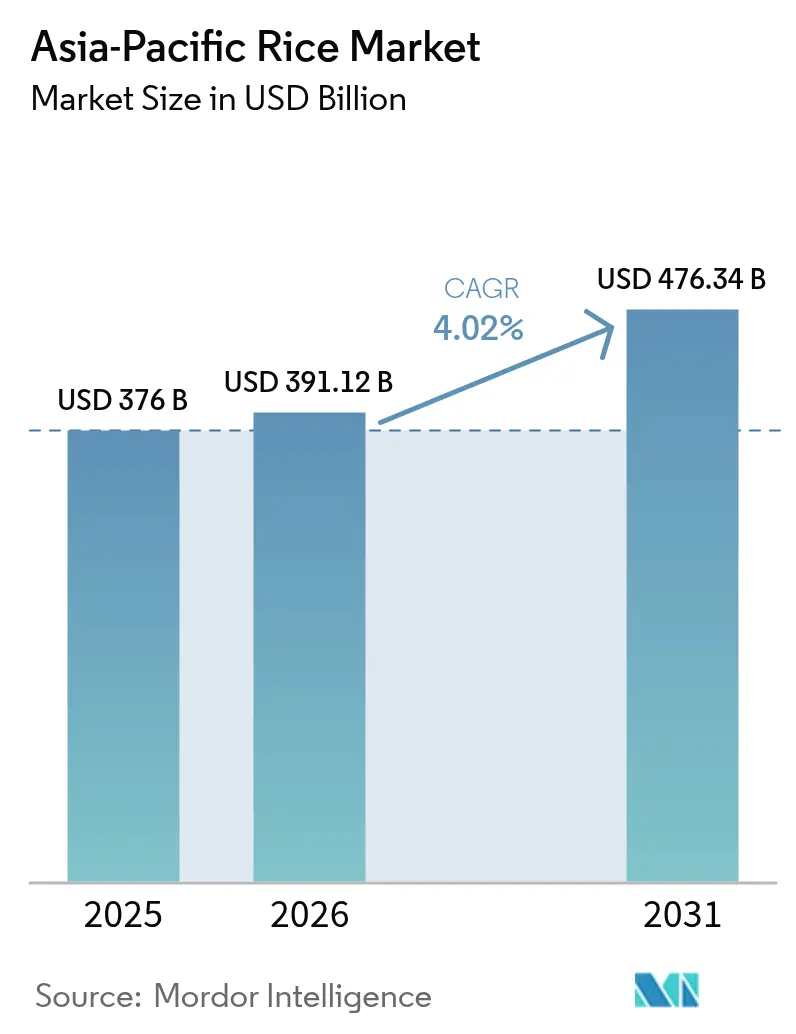
The Asia-Pacific rice market size is expected to grow from USD 376 billion in 2025 to USD 391.12 billion in 2026 and is forecast to reach USD 476.34 billion by 2031 at 4.02% CAGR over 2026-2031. The region accounts for more than 80% of global rice production and consumption, playing a crucial role in global food security through a combination of subsistence farming and modernizing commercial value chains. The market growth is driven by urbanization, changing dietary preferences, and increasing disposable incomes, which have increased demand for premium, organic, and processed rice varieties, even as per-capita consumption stabilizes in mature markets. Supply stability is strengthened by stockpiling programs in China and India, increased mechanization in South and Southeast Asia, and the development of drought-tolerant rice varieties. The market faces challenges from climate variability, logistics inefficiencies, and land ownership uncertainties, which influence investment decisions, pricing dynamics, and market competition in the Asia-Pacific region.
Key Report Takeaways
- By geography, China held 28.42% of the Asia-Pacific rice market share in 2025, while the Philippines is projected to record the fastest 5.05% CAGR through 2031.
Note: Market size and forecast figures in this report are generated using Mordor Intelligence’s proprietary estimation framework, updated with the latest available data and insights as of 2026.
Asia-Pacific Rice Market Trends and Insights
Drivers Impact Analysis*
| Driver | (~) % Impact on CAGR Forecast | Geographic Relevance | Impact Timeline |
|---|---|---|---|
| Surging Intra-regional Demand from the Middle-income Cohort | +0.8% | China, India, Indonesia, and Thailand | Medium term (2-4 years) |
| Rapid Mechanization Narrowing the Yield Gap | +0.6% | Vietnam, Philippines, Bangladesh, and Indonesia | Long term (≥ 4 years) |
| Gene-edited Drought-tolerant Varieties Moving from Trials to Scale | +0.4% | India, China, Australia, and Philippines | Long term (≥ 4 years) |
| Public Stockpiling Programs Cushioning Price Volatility | +0.3% | China, India, Thailand, and Japan | Short term (≤ 2 years) |
| Expansion of Cross-border E-procurement Platforms | +0.2% | Global, with early adoption in Vietnam, and Thailand | Medium term (2-4 years) |
| Carbon-credit Premiums for Low-methane Paddy Practices | +0.2% | Vietnam, Thailand, Indonesia, and Philippines | Long term (≥ 4 years) |
| Source: Mordor Intelligence | |||
Surging Intra-regional Demand from the Middle-income Cohort
Rising incomes among middle-class consumers in China, Indonesia, and India are reshaping rice consumption patterns. There is increasing demand for specialty, organic, and fortified rice varieties that provide enhanced nutritional value.[1]Tan Shi Hui, “Wilmar Results News Release,” Wilmar International, WILMAR-INTERNATIONAL.COM Urban consumers prioritize grain uniformity, aroma, and branded packaging, leading processors to enhance quality control, traceability, and marketing. While overall consumption stabilizes in some regions, the transition toward premium products maintains market growth. Consumer preferences for health-conscious options and sustainable products drive demand for organic jasmine, low glycemic index varieties, and fortified grains. These consumption trends are transforming the rice value chain and promoting innovation across production, processing, and retail segments in the Asia-Pacific region.
Rapid Mechanization Narrowing the Yield Gap
Mechanization is increasing across the Asia-Pacific, particularly in regions with labor shortages and small landholdings. Farmers are adopting mini tillers, combine harvesters, and transplanting machines for small plots, which improves efficiency and reduces post-harvest losses. Increasing labor costs and rural migration have reduced manual farming viability, encouraging farmers to use machinery through rental cooperatives and government programs. This equipment helps reduce the gap between potential and actual yields, decreases production costs, and improves supply chain stability. Mechanization enables crop diversification and timely field operations, essential for climate resilience. As equipment becomes more accessible, productivity increases and the region progresses toward sustainable agricultural growth.
Gene-edited Drought-tolerant Varieties Moving from Trials to Scale
Gene-edited rice varieties developed for drought resistance are moving from research trials to commercial production across the Asia-Pacific. These crops maintain yield and quality during water stress, addressing climate-related volatility. Regulatory systems are adapting to differentiate gene editing from genetic modification, facilitating faster approvals and wider acceptance. Advanced breeding methods combine drought resistance, disease tolerance, and nutritional improvements, making these varieties suitable for rain-fed areas. Increased adoption helps farmers achieve more consistent harvests and lower input costs. This development enhances food security and supports sustainability objectives, establishing gene-edited rice as an important component of agricultural strategy.
Public Stockpiling Programs Cushioning Price Volatility
Strategic rice reserves in Asia-Pacific producing countries help stabilize prices and ensure food security. Governments utilize these stockpiles to manage supply variations caused by weather events, trade disruptions, or market speculation. Reserve releases help control domestic prices and prevent panic buying, while supporting farmers during surplus periods. Digital technology and data analytics improve intervention accuracy, minimizing market distortions and increasing transparency. Public stockpiling protects against global disruptions, enabling consistent exports and safeguarding vulnerable populations. These programs are becoming essential components of agricultural policy and market stability as climate risks increase.
Restraints Impact Analysis*
| Restraint | (~) % Impact on CAGR Forecast | Geographic Relevance | Impact Timeline |
|---|---|---|---|
| Land Tenure Insecurity Limiting Long-term On-farm Investment | -0.4% | Philippines, Indonesia, Vietnam, and Cambodia | Long term (≥ 4 years) |
| Invasive Disease and Pest Outbreaks Disrupting Regional Yields | -0.3% | Global, with severe impact in Philippines, and China | Short term (≤ 2 years) |
| Diesel-price Volatility Squeezing Milling Margins | -0.2% | Indonesia, Thailand, Vietnam, and Bangladesh | Medium term (2-4 years) |
| Fragmented Supply Chains and Poor Infrastructure | -0.3% | Indonesia, Philippines, Bangladesh, and Pakistan | Long term (≥ 4 years) |
| Source: Mordor Intelligence | |||
Land Tenure Insecurity Limiting Long-term On-farm Investment
In many parts of the Asia-Pacific region, farmers face significant challenges due to insecure land tenure. Without formal ownership or long-term rights, they are reluctant to invest in improvements such as irrigation systems, soil restoration, or perennial crops that require multi-season commitment. This uncertainty prevents capital investment and reduces productivity. In regions where governments have implemented land-use rights or formal titles, farmers have demonstrated increased adoption of sustainable practices and investment in organic inputs. Women farmers experience higher rates of tenure insecurity, which restricts their access to credit and resources. This gender disparity hampers agricultural development and impedes equitable growth. Addressing land rights remains fundamental for enabling long-term investment and building resilience in the regional rice sector.
Invasive Disease and Pest Outbreaks Disrupting Regional Yields
The Asia-Pacific rice market faces increasing challenges from invasive diseases and pests that affect yields and disrupt supply chains. Rice blast, bacterial blight, and other pathogens are expanding into new areas due to climate change, trade flows, and pesticide resistance.[2]International Rice Research Institute, “New Initiative Equips BPI-NSQCS Officials with Bacterial Panicle Blight Detection,” IRRI.ORG These outbreaks can reduce harvests significantly, requiring farmers to implement costly detection methods and emergency measures. The rising frequency and geographic spread of infestations create systemic risks, particularly in regions with limited access to diagnostics and crop protection. As conventional pesticides become less effective, integrated pest management and early-warning systems gain importance. Regional cooperation and investment in resistant crop varieties are essential for managing these threats and maintaining stable rice production across vulnerable farming communities.
*Our forecasts treat driver/restraint impacts as directional, not additive. The impact forecasts reflect baseline growth, mix effects, and variable interactions.
Geography Analysis
China holds 28.42% of the Asia-Pacific rice market share in 2025. The country maintains its market position through organized farming systems, strategic stockpiling, and efficient use of agricultural by-products, which improve profitability and environmental performance. Climate challenges, particularly heavy rainfall and heat-induced sterility, affect production stability. In response, China is implementing advanced breeding techniques and adaptive agronomy to maintain consistent yields. The country's integrated production and sustainability approach influences domestic consumption and international trade patterns across the rice value chain.
The Philippines shows the highest growth rate at 5.05% CAGR through 2031. The market expansion stems from increased imports and modernization initiatives. Large-scale investments in farming infrastructure, including a USD 1.5 billion commitment from Charoen Pokphand Group to develop a 10,000-hectare modern farm, reflect the country’s push toward productivity and self-sufficiency. The country is investing in farming infrastructure, including high-tech agricultural zones, to improve productivity and self-sufficiency. Rice yellowing syndrome remains a production challenge, necessitating integrated pest management and robust seed systems. The government focuses on expanding technology access for farmers and improving supply chains. This growth pattern is transforming the Philippines' position in the regional rice market and drawing international agribusiness interest.
India's surplus rice stocks enable price control in global markets, while its implementation of gene-edited rice and mechanization strengthens production stability and farmer earnings. Vietnam has enhanced its export standing through premium fragrant rice and improved traceability systems. Thailand maintains strong exports despite fuel cost challenges. Indonesia's investments focus on mechanization and post-harvest systems to reduce import dependency. Japan's recent supply constraints revealed logistics system weaknesses, leading to reserve distribution. Australia's export marketing deregulation creates opportunities for growers in East Asian and Middle Eastern premium markets, strengthening regional market competition.
Regulatory Landscape
Rice regulation across Asia-Pacific remains focused on food-security objectives, price stabilization, and tighter oversight of physical grain flows through warehouses and borders. In the Philippines, a quarterly, price-indexed rice import tariff adjustment mechanism began in January 2026 under Executive Order No. 105 (2025), with tariff bands shifting within a 15% to 35% range based on international price triggers. This adds more frequent reset points for importers and downstream traders.
In Northeast Asia, Japan enacted a revision to its staple food framework in July 2026 that moves the system toward demand-driven production and introduces a private-sector rice stockpiling mechanism managed by major buyers and cooperatives. In Southeast Asia, Malaysia passed the Control of Padi and Rice (Amendment) Bill 2026 in July 2026, strengthening enforcement against smuggling and hoarding, and enabling the rice director-general to act on minimum and maximum price settings. The bill also raises compliance and reporting requirements for millers, wholesalers, and retailers.
Value Chain Analysis
The Asia-Pacific rice value chain covers input supply (seed, fertilizers, crop protection, and machinery), farm production dominated by smallholders, aggregation and drying, milling and polishing, and distribution through wholesale, modern retail, and food service. Cross-border trade connects surplus producers, including India, Thailand, and Vietnam, to deficit markets.
Policy interventions increasingly shape paddy and milled rice flows across the chain. In the Philippines, retail-price measures, including a maximum suggested retail price for imported rice implemented in January 2025, were paired with stock releases after a food security emergency was declared in February 2025, pulling buffer stocks and public distribution into downstream pricing and availability. Traceability, storage, and facility oversight are also becoming more operationally important for moving rice from farm to market, supported by the Philippines amending its Rice Tariffication Law via R.A. 12078 (signed in December 2024). This expanded the Department of Agriculture role in registering and inspecting grain warehouses, which increases formalization at the storage and trading layer. Similar efforts to adjust procurement incentives and production systems, including Taiwan increasing guided rice purchase prices under its grains industry upgrade plan and Japan pivoting away from acreage-reduction policies, reinforce the influence of public procurement, regulated storage, and modernized milling on quality differentiation, loss reduction, and the availability of premium and export-grade rice.
Market Opportunities and Future Outlook
In 2026, investment and program activity points to near-term gaps in post-harvest infrastructure and in processing capacity that can support premium rice segments across key Southeast Asian hubs. In Vietnam, ThaiBinh Seed Group JSC started building a VND 1 trillion high-quality rice processing complex (April 2026) designed for 50,000 tons per year. SunRice also announced an expansion of its Dong Thap processing facility (May 2026) to 120,000 tonnes per year, supporting demand for consistent, traceable paddy supply and higher-throughput milling, sorting, and packaging for fragrant and higher-value segments.
Logistics and resilience remain another focus area. In April 2026, Indonesia allocated Rp 5 trillion (about USD 290 million) for Bulog to construct 100 new rice warehouses (around 900,000 tonnes of added storage capacity), aiming to address storage bottlenecks that contribute to quality loss and price volatility. Opportunities also extend to climate-resilient and low-emission production systems that can be linked to verification and differentiated procurement. Japan MAFF and IRRI launched the CoolRice project in June 2026 to develop heat-resilient breeding and low-emission practices, while the Philippines RCEF reported completion of high wet-season seed distribution in Central Luzon in June 2026, expanding the base for improved seed, mechanization services, and structured offtake models that reward uniformity and quality.
Recent Industry Developments
- July 2026: Malaysia passed the Control of Padi and Rice (Amendment) Bill 2026, strengthening enforcement against smuggling, illegal hoarding, and market manipulation. The changes empower the rice director-general to act on minimum and maximum price settings, raising compliance expectations for wholesalers, millers, and retailers.
- September 2025: The Philippines imposed a 60-day suspension on rice imports to stabilize domestic pricing and clear warehouse inventories. The suspension tightened near-term supply availability for traders and shifted more demand toward domestic procurement and the release of existing stocks.
- August 2024: ICAR-National Rice Research Institute introduced the climate-resilient rice variety CR Dhan 416 (IET 30201) in India. Its disease and pest resistance profile supports production stability in climate-stressed areas and expands the pipeline of improved varieties available for commercialization and seed multiplication.


Research Methodology Framework and Report Scope
Market Definition and Coverage
For this study, the market is defined as the value of rice consumed across Asia-Pacific, expressed in USD, where volumes are translated into value using country-level price trends and trade-adjusted consumption balances.
Scope exclusions: It excludes downstream retail markups and non-rice staple substitutes, and it does not count value created from processed foods where rice is only a minor ingredient.
Segmentation Overview
- By Geography (Production Analysis (Volume), Consumption Analysis (Volume and Value), Import Analysis (Volume and Value), Export Analysis (Volume and Value), and Price Trend Analysis)
- China
- India
- Indonesia
- Bangladesh
- Thailand
- Vietnam
- Philippines
- Pakistan
- Japan
- Australia
Data Sources, Market Sizing, and Validation
Desk Research
Desk work started with building the supply and demand backbone for rice in Asia-Pacific, because production, consumption, and trade are tracked more consistently than brand level revenues in many countries. We relied on public datasets such as FAOSTAT for crop area, yield, production, and food balance sheets, and UN Comtrade for import and export quantities and values to understand trade direction and unit value signals.
Price and policy context was then added using sources such as national agriculture ministries and statistics agencies, customs or port authority releases where available, and international references like the World Bank commodity price series and OECD-FAO agricultural outlooks. Company annual reports, investor presentations, and credible association or exchange websites were also used to sanity check milling activity, procurement patterns, and packaged versus bulk dynamics. In a few cases, paid subscriptions for company financials, news and financials, and shipment-level import and export records were used to confirm major trade corridors and timing. These desk research sources are illustrative only, and many other public and paid references were also consulted for data collection, validation, and clarification.
Primary Interviews and Surveys
We conduct expert interviews and surveys with growers' organizations, millers, traders, importers, distributors, retailers, and public procurement specialists across Asia-Pacific. Their input helps us test consumption patterns, price pass-through, procurement cycles, and trade restrictions, while differences are checked against desk evidence before sign-off.
Distribution of primary research fieldwork respondents
| Company type | Respondent position |
|---|---|
| Top tier: 25% | CXOs: 14% |
| Mid tier: 55% | Functional/Unit leaders: 32% |
| Smaller Players: 20% | Managers: 54% |
Market-Sizing & Forecasting
Sizing was built using a top-down reconstruction where production and trade data are combined to estimate apparent consumption by country, and then translated into value using observed price series and unit values from trade. When the main demand pool was established, we added selective bottom-up checks using sampled price per ton multiplied by country volumes, along with channel checks on milling throughput and traded rice mix to adjust for obvious mismatches.
A few inputs were treated as the key fingerprints for this market, which included planted area and yield movements, net trade position by country, export and import unit values, domestic wholesale price trends, and seasonality effects tied to harvest cycles and stock releases. Where country price series had gaps, proxy logic was applied using nearby market prices and trade unit values, followed by a re-check with interview feedback so the imputation stayed realistic.
For forecasting, scenario analysis was used with a base case anchored on expected acreage and yield direction, policy-driven stock management, and trade flow stability, and then stress cases were run around weather shocks and export restrictions. The final outlook was kept consistent with what industry participants expected for price progression and demand resilience, before totals were locked at the regional roll-up level.
Data Validation & Update Cycle
Outputs were validated by checking whether modeled consumption and value moved in line with independent signals like production swings, net exports, and price inflation, and then by running variance checks at the country level so one market could not distort the regional picture. When an anomaly appeared, we re-checked the source series, confirmed units and currency timing, and then revisited the assumption with an additional expert touchpoint before sign-off.
Each report is refreshed annually, and interim updates are made when material events occur, such as major policy shifts, sharp price spikes, or disruptions to trade corridors. Before delivery, a final analyst review pass is completed so clients receive the most current view that matches the latest available public data and field feedback.
Mordor Intelligence's Asia Pacific Rice Market Size Compared With Other Published Estimates
Published estimates for rice in Asia-Pacific often differ because the value basis is not always the same, and because some models lean more on retail pricing while others stay closer to farm gate or wholesale levels. The year used, the currency conversion date, and whether trade unit values are used as a pricing anchor can also move the total noticeably.
The table shows a wide spread largely because of scope and price logic differences, and in Mordor Intelligence's model the market value is built from trade-adjusted consumption in metric tons and then priced using country-level price trends and unit values, instead of applying a packaged or retail price layer across all volumes.
Benchmark comparison
| Source | Market Size | Gaps in Research Methodology |
|---|---|---|
| Mordor Intelligence | USD 391.12 B (2026) | |
| Global Consultancy A | USD 292.39 B (2023) | Uses a different base year and applies a segmented revenue construct (type, application, and channels), which can miss bulk trade volumes that are not captured as consumer-channel revenues in several APAC countries. |
| Industry Publisher B | USD 57.35 B (2024) | Uses a narrower value capture that appears closer to packaged or formal-channel revenue, and it likely excludes large parts of domestically traded bulk rice, which keeps the total much lower than consumption-linked models. |
Taken together, the comparison suggests that the tightest way to interpret the market is to first lock the regional demand pool using production plus net trade, and then apply transparent price series that can be reviewed country by country. That sequence makes the total easier to reproduce and easier to update when policy, harvest, or trade conditions change.


Key Questions Answered in the Report
How large is the Asia-Pacific rice market in 2026?
The Asia-Pacific rice market size is USD 391.12 billion in 2026 and is projected to grow to USD 476.34 billion by 2031.
Which country holds the biggest share of regional rice value?
China leads with 28.42% Asia-Pacific rice market share in 2025.
What is the forecast growth rate for rice demand in the Philippines?
The Philippines is projected to post a 5.05% CAGR for rice value through 2031.
How are carbon credits being integrated into rice cultivation?
Farmers using sustainable rice practices like Alternate Wetting and Drying or Direct Seeding can earn carbon credits, creating new income opportunities.
Which technology is considered a breakthrough for drought resilience in rice?
Gene-edited rice varieties developed with CRISPR technology offer improved drought resilience and higher yields under water stress.
Page last updated on:





