
SIM Swap Fraud Detection Software Market Size and Share
Market Overview
| Study Period | 2020 - 2031 |
|---|---|
| Market Size (2026) | USD 19.39 Billion |
| Market Size (2031) | USD 55.37 Billion |
| Growth Rate (2026 - 2031) | 23.25 % |
| Fastest Growing Market | Asia-Pacific |
| Largest Market | North America |
| Market Concentration | Medium |
Major Players *Disclaimer: Major Players sorted in no particular order Image © Mordor Intelligence. Reuse requires attribution under CC BY 4.0. | |
SIM Swap Fraud Detection Software Market Analysis by Mordor Intelligence
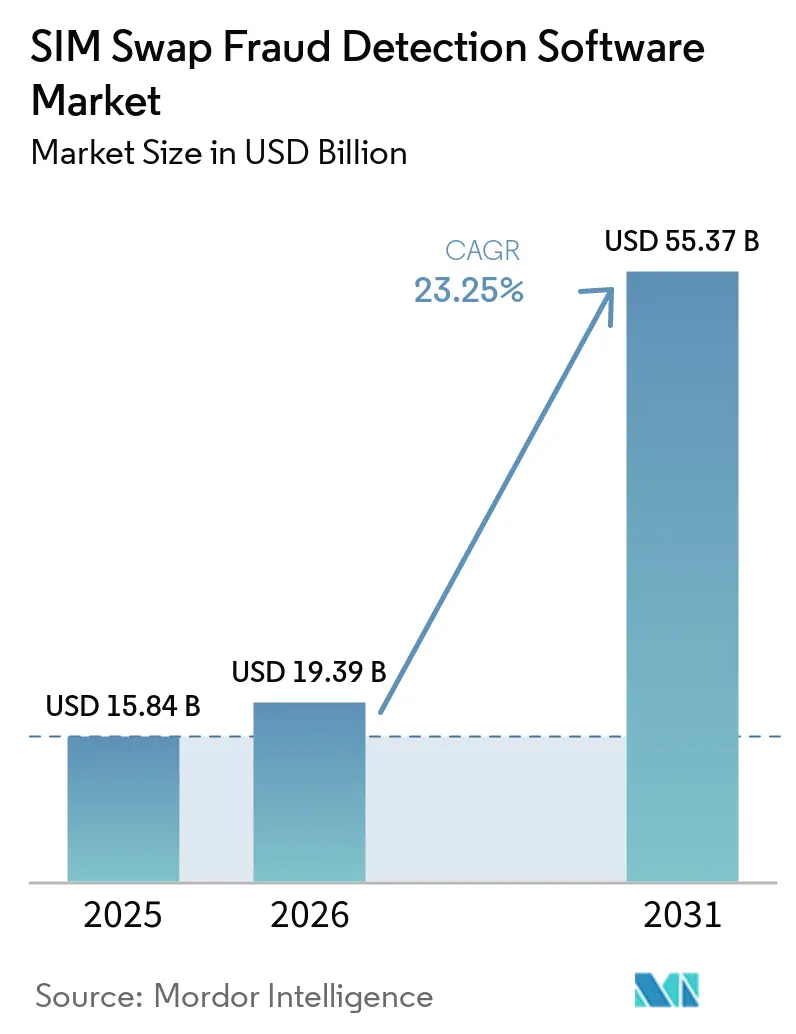
The SIM swap fraud detection software market size was valued at USD 15.84 billion in 2025 and estimated to expand from USD 19.39 billion in 2026 to reach USD 55.37 billion by 2031, at a CAGR of 23.35% during the forecast period (2026-2031). The SIM swap fraud detection software market is being shaped by the shift from isolated application checks toward real-time carrier data that can identify recent SIM changes before a transaction is approved. Financial institutions, mobile network operators, and digital platforms increasingly need this information because a compromised number can expose one-time passwords and reset credentials. Standardized network APIs are reducing the effort required to connect these checks across multiple operators, which favors platforms that can combine carrier signals with device and behavioral data while supporting consistent decisions across onboarding, recovery, authentication, and payment workflows. Regulatory requirements are also moving secure SIM changes from an internal operating practice to a formal control that carriers must evidence. The main commercial challenge remains uneven operator readiness, which can leave providers with incomplete coverage, increase integration work, and cause legitimate customers to face extra verification steps at key account moments.
Key Report Takeaways
- By component, software held 62.13% of the SIM swap fraud detection software market share in 2025, while services are projected to expand at a 24.13% CAGR through 2031.
- By deployment mode, cloud held 61.43% of revenue in 2025 and is projected to expand at a 25.11% CAGR through 2031.
- By organization size, large enterprises held 51.14% of revenue in 2025, while small and medium enterprises are projected to expand at a 24.87% CAGR through 2031.
- By application, fraud detection and prevention held 23.31% of revenue in 2025, while authentication and transaction risk assessment is projected to expand at a 25.51% CAGR through 2031.
- By end user, banks and financial institutions held 25.41% of revenue in 2025, while fintech and digital payment providers are projected to expand at a 25.61% CAGR through 2031.
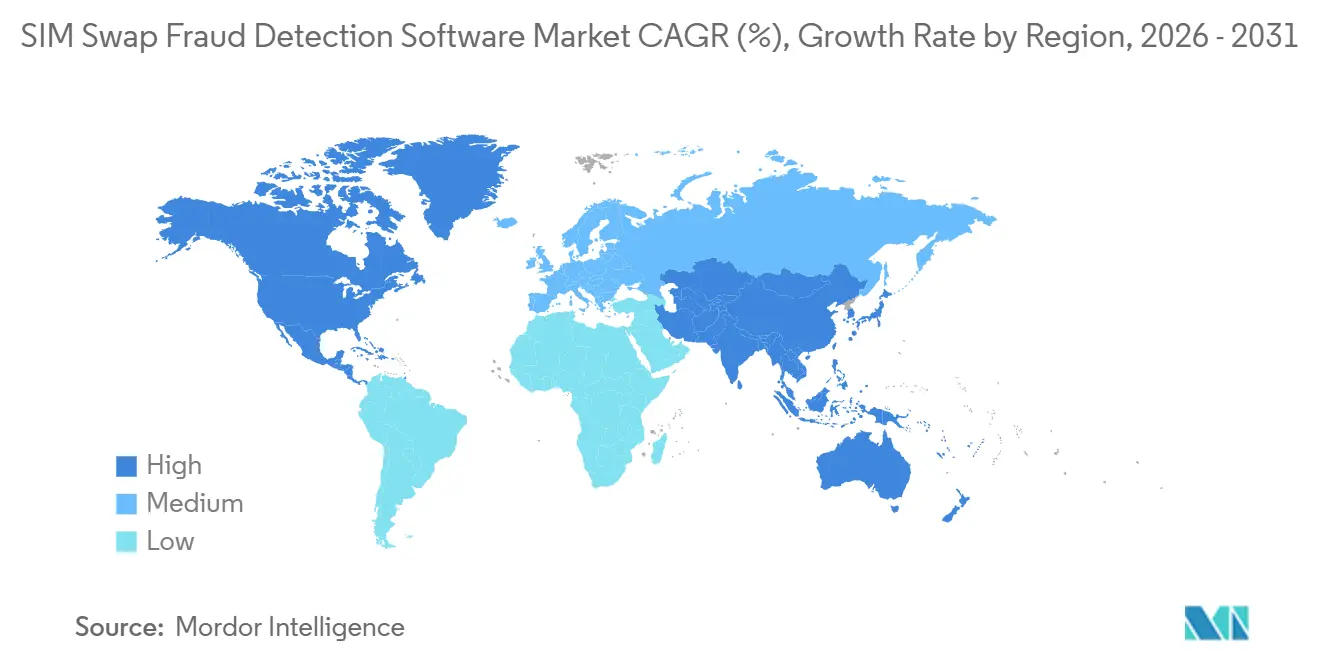
- By geography, North America held 32.12% of revenue in 2025, while Asia-Pacific is projected to expand at a 25.21% CAGR through 2031.
Note: Market size and forecast figures in this report are generated using Mordor Intelligence’s proprietary estimation framework, updated with the latest available data and insights as of January 2026.
Global SIM Swap Fraud Detection Software Market Trends and Insights
Drivers Impact Analysis*
| DRIVER | (~) % IMPACT ON CAGR FORECAST | GEOGRAPHIC RELEVANCE | IMPACT TIMELINE |
|---|---|---|---|
| Rising SIM Swap, Port-Out, and Account Takeover Attacks | +5.2% | Global | Short term (≤ 2 years) |
| Expansion of Mobile Network Fraud-Prevention APIs | +4.8% | Global, with accelerated uptake in Europe and Asia-Pacific | Medium term (2-4 years) |
| Regulatory Requirements for Secure SIM Changes and Strong Authentication | +4.3% | North America and the Europe core, spill-over to the Asia-Pacific and Middle East, and Africa | Medium term (2-4 years) |
| Growth of Mobile Banking, Instant Payments, and Digital Identity Services | +3.7% | Global, led by Asia-Pacific and South America | Long term (≥ 4 years) |
| Carrier Data Monetization Through Standardized Network Signals | +2.9% | Global, with commercial traction concentrated in Europe and North America | Medium term (2-4 years) |
| Real-Time Risk Scoring for Low-Friction Authentication | +2.1% | Global, particularly financial services hubs | Long term (≥ 4 years) |
| Source: Mordor Intelligence | |||
Rising SIM Swap, Port-Out, and Account Takeover Attacks
The increasing volume and cost of SIM swaps establish a lasting demand base for the SIM swap fraud-detection software market, even as technology spending becomes more selective. The FBI reported that SIM swap incidents increased by 48% in 2025 and caused global losses exceeding USD 2.7 billion, although direct reports do not capture every subsequent account-drain event enabled by a hijacked number.[1]Federal Bureau of Investigation Internet Crime Complaint Center, “2025 IC3 Annual Report,” Internet Crime Complaint Center, ic3.gov. Cifas recorded a 1,055% increase in UK SIM swap cases in 2024, highlighting how fraudsters used retail SIM-change channels to access protected accounts.[2]Cifas, “SIM Swap Fraud Cases, 2024 Reported Surge,” Cifas, cifas.org.uk. A number takeover can provide access to password resets, transaction confirmations, and recovery flows that depend on SMS messages. Fraud teams may record the eventual payment loss without identifying the earlier SIM change that enabled the attack. That reporting gap can delay procurement decisions, but it also creates a clear case for enterprises that want SIM-level checks before high-risk transactions, account recovery, and payment approvals.
Expansion of Mobile Network Fraud-Prevention APIs
Standardized carrier APIs are turning data that was once isolated within operator systems into an input that application developers can use to make risk decisions across the SIM swap fraud detection software market. The GSMA Open Gateway program covers more than 80 operator groups, 292 networks, and over 80% of global mobile connections, creating a common route to carrier capabilities.[3]GSMA, “Mobile Money Accounted for USD 2 Trillion in Transactions in 2025,” GSMA, gsma.com. Poland’s 4 major operators launched SIM Swap and Number Verification APIs in February 2026, and Greece’s COSMOTE TELEKOM and Vodafone followed with comparable services in March 2026. Itaú Unibanco used the CAMARA SIM Swap API more than 36.5 million times through April 2025, with a monthly run rate of 5 million calls. The same interface can reduce integration work for banks operating across multiple mobile networks. As these interfaces become more widely available, vendors will compete more on risk orchestration, workflow design, model performance, and deployment support than on exclusive access to one operator’s data.
Regulatory Requirements for Secure SIM Changes and Strong Authentication
Regulatory rules are making secure SIM-change procedures a formal operating requirement for carriers and a related control for institutions that rely on mobile authentication. FCC 23-95 required U.S. wireless providers to use secure authentication before a SIM change or port-out and to send prompt customer notifications from July 8, 2024.[4]Federal Communications Commission, “FCC Adopts Rules to Protect Consumers from Cell Phone Account Fraud,” Federal Communications Commission, fcc.gov. Mexico published mobile-line know-your-customer rules in December 2025 that require identity verification against the RENAPO national biometric database. Nigeria’s central bank and communications regulator signed an April 2026 agreement for a portal that will let banks query SIM swap, recycling, and blacklisting status before a transaction is authorized. These measures link mobile-number ownership more closely to identity records and transaction controls, creating a clearer audit trail across carriers and financial institutions. The SIM swap fraud detection software market can therefore benefit when compliance teams need auditable controls that work consistently across carrier and financial-service workflows.
Growth of Mobile Banking, Instant Payments, and Digital Identity Services
Mobile-first financial services expand the number of account events that can be targeted after a phone number has been compromised. Mobile money services processed more than USD 2 trillion in 2025, supported by 2.3 billion registered accounts, while the 30-day activity rate reached 25.7%. UK Finance found that 75% of UK adults used mobile banking in 2025, and 91% used remote banking.[5]UK Finance, “UK Payment Markets Report 2026 Summary,” UK Finance, ukfinance.org.uk. Each login, password reset, beneficiary addition, and high-value payment can require a decision on whether the number still belongs to the intended customer. A SIM change made minutes before a payment has a different risk profile than one recorded several days earlier. Providers that evaluate SIM tenure, porting activity, device context, and behavioral evidence can support lower-friction decisions across the SIM swap fraud detection software market than systems that return only a recent-change flag.
Restraints Impact Analysis*
| RESTRAINT | (~) % IMPACT ON CAGR FORECAST | GEOGRAPHIC RELEVANCE | IMPACT TIMELINE |
|---|---|---|---|
| Fragmented Access to Mobile Network Data | -2.8% | Global, most acute in South Asia, ASEAN, and Sub-Saharan Africa | Medium term (2-4 years) |
| False Positives and Customer Friction | -2.1% | Global, concentrated in high-volume digital banking markets | Short term (≤ 2 years) |
| Privacy, Consent, and Cross-Border Data Restrictions | -1.6% | European Union, Canada, and Asia-Pacific markets with national data-sovereignty frameworks | Medium term (2-4 years) |
| Uneven Operator API Readiness Across Developing Markets | -1.1% | Sub-Saharan Africa, parts of South Asia, and ASEAN | Long term (≥ 4 years) |
| Source: Mordor Intelligence | |||
Fragmented Access to Mobile Network Data
Fragmented carrier data remains a central limitation because a check can return no useful signal when the relevant operator is outside a provider’s integration network. The GSMA reported in 2026 that API availability in mature markets had improved, but the conversion of available APIs into enterprise revenue remained uneven. Platform-mediated distribution models are gaining preference in the SIM swap fraud detection software market because they reduce the need for direct commercial agreements with every operator. Yet providers still need to maintain operator relationships and CAMARA integrations where coverage is incomplete. This increases operating cost, complicates product maintenance, and delays expansion into markets where mobile data access is less standardized or commercial agreements are still developing. Smaller fintechs may apply checks only to their largest operator relationships, leaving gaps that fraudsters can exploit by moving a victim’s number to an uncovered network.
False Positives and Customer Friction
False positives can discourage broad deployment because legitimate phone replacements, device upgrades, and eSIM migrations may appear similar to a fraudulent SIM change. A bank that blocks each recent SIM change can create difficulties during onboarding, account recovery, password resets, or high-value payments. The SIM swap fraud detection software market must therefore support a balance between detecting harmful events and limiting unnecessary customer challenges. Lowering the alert threshold can identify more suspicious activity, but may also increase abandonment in important user journeys. Combining SIM signals with device fingerprinting, behavioral biometrics, and session data can improve decision-making, but it adds integration work and licensing costs. Many organizations consequently use these checks only at high-risk moments, which supports strong value in selected workflows but can restrict license revenue per customer and delay broader platform adoption.
*Our forecasts treat driver/restraint impacts as directional, not additive. The impact forecasts reflect baseline growth, mix effects, and variable interactions.
Segment Analysis
By Component: Software Holds the Revenue Base While Services Support Deployment
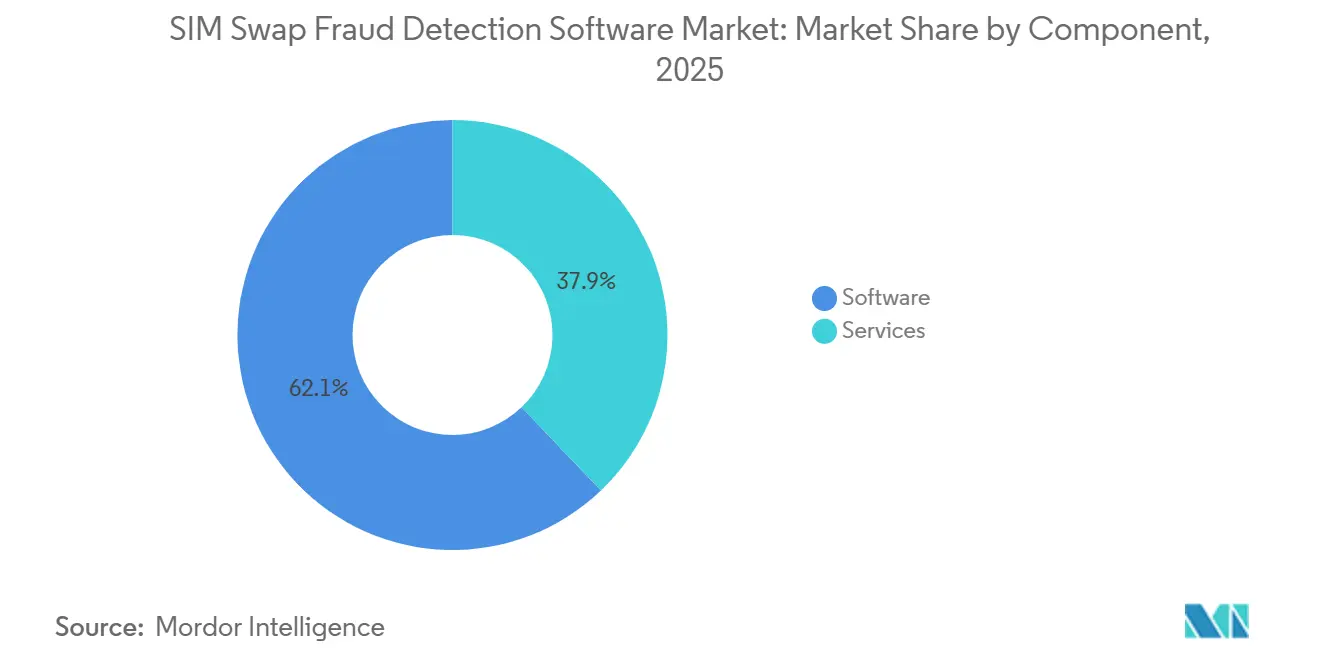
Software accounted for 62.13% of the SIM swap fraud detection software market revenue in 2025, reflecting demand for platforms capable of processing high volumes of carrier and transaction signals. The segment benefits from the low incremental cost of processing additional API calls once providers have trained and deployed a model. Banks can use a single platform to integrate SIM-change events, device data, behavioral patterns, and consortium intelligence into a single decision workflow. This approach reduces the need to manage separate providers for each fraud signal, while software vendors continuously update rules and models as fraudsters change their methods. This position gives software providers a large installed base from which to offer related identity, authentication, and transaction-monitoring tools. It also enables them to retain customers through product updates and address changing security priorities without requiring customers to replace the underlying decision platform across their portfolios.
Services are projected to expand at a 24.13% CAGR through 2031 as regional carriers and fintech firms seek support for model tuning, threshold management, and compliance reporting. These buyers may lack the internal teams required to operate a complex fraud technology stack. The CAMARA Fall25 release provided stable APIs and certification for managed services. Bharti Airtel, Reliance Jio, and Vodafone Idea launched federated SIM Swap API access at India Mobile Congress 2025, providing service providers with a route to offer multi-operator checks through a single arrangement. Services can accelerate adoption among smaller buyers and help them operate controls that would otherwise be difficult to maintain. Consequently, the SIM swap fraud detection software industry provides opportunities for both scalable platforms and specialized operational support.


By Deployment Mode: Cloud Extends Its Lead Through Shared API Access
Cloud deployment accounted for 61.43% of revenue in 2025 and is projected to expand at a 25.11% CAGR through 2031 in the SIM swap fraud detection software market. Its leading position reflects mobile operators’ transition toward cloud-native network functions and the need for low-latency access to common APIs in the SIM-swap fraud-detection software market. Cloud environments can position fraud decisions closer to policy, identity, and transaction services while enabling enterprises to use a single connection across multiple operators. This model can reduce development efforts when banks, payment providers, or marketplaces expand into new territories. Cloud platforms can also distribute model updates without requiring separate software upgrades across each customer environment.
On-premises deployments remain relevant among large operators and regulated organizations that require tighter control over subscriber data. Data residency requirements in European Union jurisdictions and selected Gulf Cooperation Council markets can restrict the locations where organizations process identity-related information. These requirements can make direct control over local infrastructure essential. However, the GSMA stated in its first-quarter 2026 update that the ecosystem was moving toward platform-mediated distribution. This transition supports cloud aggregation among enterprises that prioritize ease of integration and cross-operator access. The SIM swap fraud detection software market remains open to both deployment models, as the choice depends on regulatory obligations, existing infrastructure, and required levels of data control.
By Organization Size: Large Enterprises Lead While Smaller Buyers Gain Access
Large enterprises accounted for 51.14% of revenue in 2025 because they can fund multi-operator integration initiatives and negotiate volume-based pricing. Major banks and global operators were early adopters because their transaction volumes justified incorporating carrier checks into broader systems that also consider device intelligence, identity records, and behavioral data. These capabilities provide teams with a more comprehensive view of risk before they approve account actions, particularly payments, password resets, and beneficiary changes. Enterprise procurement processes also support longer implementation projects involving multiple internal security, privacy, and technology stakeholders. The scale of these organizations makes them an important source of recurring platform demand for providers in the SIM swap fraud detection software market.
Small and medium enterprises are projected to expand at a 24.87% CAGR through 2031 as cloud APIs reduce access costs. Infobip’s GSMA Open Gateway certification enabled clients to use SIM Swap, Number Verification, and know-your-customer APIs through a single cloud integration. This model benefits digital lenders and fintech firms in the SIM swap fraud detection software market, which cannot maintain separate contracts with each carrier. Smaller buyers typically favor usage-based pricing, which lowers entry barriers but generates lower revenue per transaction for vendors. Nevertheless, a broader small-business customer base can create a significant opportunity as more organizations seek to protect mobile-led customer journeys.
By Application: Fraud Detection Leads Revenue While Risk Assessment Accelerates
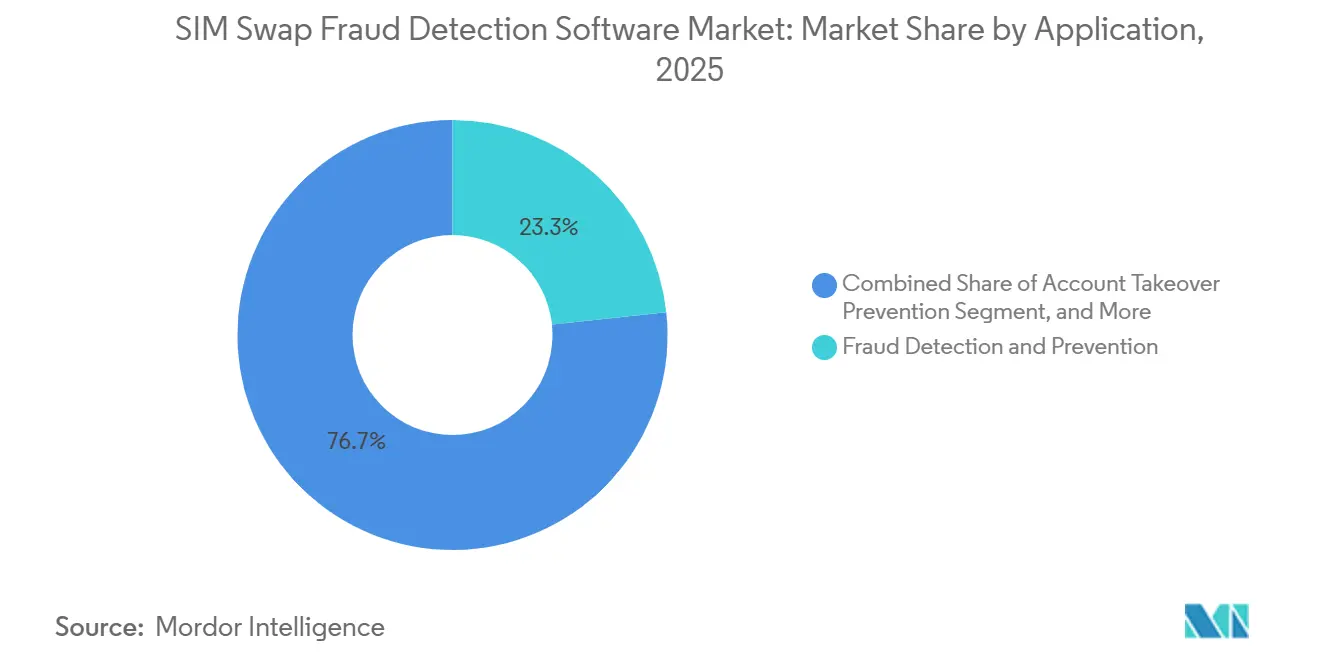
Fraud detection and prevention accounted for 23.31% of application revenue in the SIM swap fraud detection software market in 2025, making it the largest application segment. This use case includes transaction blocks, alerts triggered by SIM changes, controls to prevent port-out attempts, and review workflows for events requiring human investigation. Banks, e-commerce platforms, and government portals use these controls when a compromised number could enable account takeover or a payment request. The application also provides fraud teams with an operational process to review activity that exceeds an organization’s risk threshold. The SIM swap fraud detection software market size for this application is supported by the need to protect high-value actions without adding unnecessary steps to routine interactions.
Authentication and transaction risk assessment are projected to expand at a 25.51% CAGR through 2031, supported by risk-proportionate authentication. A SIM check can confirm whether a phone number remains associated with the original SIM before an institution sends a one-time password. Orange described a 2026 implementation in which a SIM Swap API, connected to an AI banking agent, blocked high-value payment confirmations following a recent SIM swap. Identity verification and account takeover prevention are becoming increasingly interconnected use cases, while European digital identity rules require stronger authentication evidence. Compliance monitoring remains a smaller application, but its role may expand as fraud-reporting rules require organizations to demonstrate that they applied checks at specified transaction thresholds.

By End User: Banks Provide the Revenue Base While Fintech Sets the Pace
Banks and financial institutions accounted for 25.41% of end-user revenue in the SIM swap fraud detection software market in 2025, the largest share among end users. Their use of SMS one-time passwords exposes the customer’s number when it is transferred to another SIM. Account-to-account transfers, credit disbursements, and wealth management events can make attacks costly, while established fraud teams can act on real-time signals before funds are released. Their procurement decisions often favor platforms that integrate SIM events with customer behavior, device intelligence, and existing case-management processes used by fraud operations. This demand base provides the SIM swap fraud detection software market with stable use cases tied to high-value financial actions.
Fintech and digital payment providers are projected to expand at a 25.61% CAGR through 2031 because their mobile-led services often combine rapid customer acquisition with significant exposure to account takeover. Mobile network operators serve as both users of fraud tools and suppliers of network data used by providers of SIM swap fraud detection software. Subex offers FraudZap, which provides controls for eSIM and SIM-swap risk across subscriber journeys, demonstrating the operator-focused need for monitoring. E-commerce platforms apply checks during login and payment-method changes, while government entities incorporate related controls into digital identity programs to enable secure citizen access. Healthcare providers, insurers, and other regulated organizations also apply these signals to know-your-customer and claims-fraud workflows, as number hijacking can result in unauthorized account changes beyond banking.
Geography Analysis
North America accounted for 32.12% of the SIM swap fraud detection software market share in 2025, supported by formal regulations, widespread adoption of digital banking, and established enterprise security procurement practices. Since July 2024, FCC 23-95 has required secure authentication before SIM changes and port-out requests, creating a clear compliance requirement for operators. In March 2026, ATIS described how standardized CAMARA APIs can enable North American operators to package fraud prevention as an intelligence service rather than solely as a network feature. In March 2026, Infobip and T-Mobile formed a partnership that provides enterprise clients with access to SIM Swap and Number Verification APIs through a certified platform. In November 2025, EnStream, a joint venture between Bell Canada, Rogers, and TELUS, partnered with Proximus Global to provide phone number fraud prevention services to Canada’s banking ecosystem.
Europe was the second-largest geography in 2025, with demand supported by PSD2 authentication requirements and eIDAS 2.0 provisions. GDPR consent and personal data requirements also influence delivery practices in the SIM swap fraud detection software market. In September 2025, the United Kingdom’s four largest operators launched KYC Match APIs, enabling businesses to compare identity details against verified operator records without receiving personal information. Poland and Greece introduced standardized SIM Swap and Number Verification services in early 2026, extending the rollout across Central, Eastern, and Southern Europe. Germany and France remain important country markets due to their high digital banking volumes and large numbers of regulated financial institutions.
Asia-Pacific is projected to expand at a CAGR of 25.21% through 2031, the fastest growth rate among all regions. The region combines a large mobile subscriber base with rising digital payment activity and increasing operator standardization across India, Indonesia, China, and Taiwan. India’s three leading operators introduced federated SIM Swap and Number Verification APIs in 2025. By late 2025, the Department of Telecommunications had blocked between 300,000 and 400,000 SIMs for suspected fraud. China Mobile deployed CAMARA-standardized SIM Swap and Device Swap APIs into its fraud-prevention architecture.

Competitive Landscape
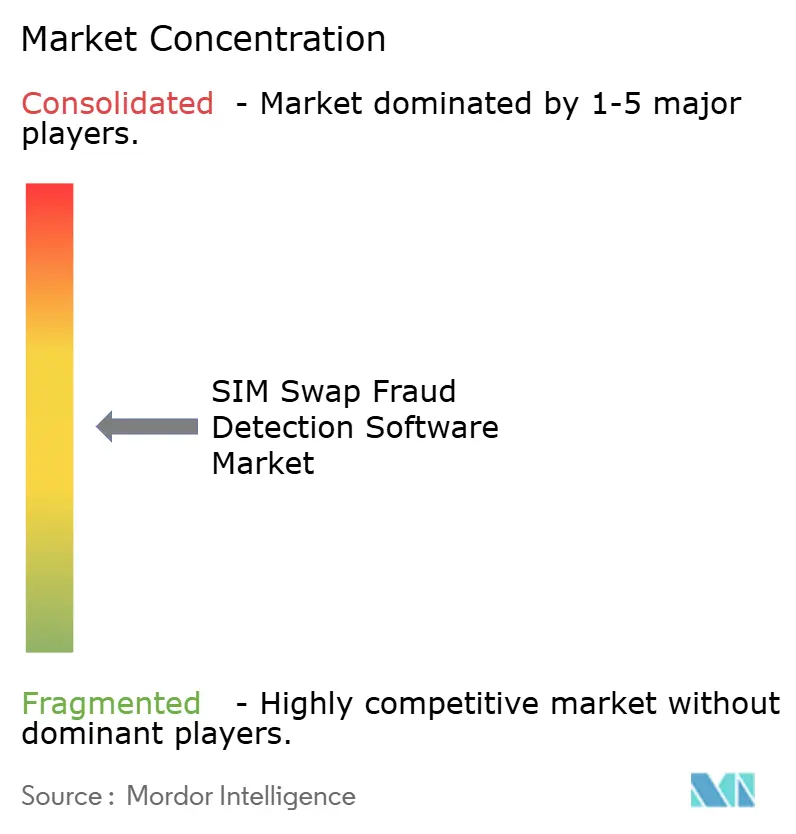
The SIM swap fraud detection software market is moderately concentrated among communications providers, data analytics providers, and specialized telecom security providers. Proximus Global, LexisNexis Risk Solutions, Experian, TransUnion, and Equifax hold competitive advantages through extensive data resources and established enterprise relationships. Proximus Global combines BICS, Telesign, and Route Mobile under a single commercial structure. These providers can integrate carrier information with identity, device, and behavioral data within a single fraud decisioning process. This breadth is important for buyers seeking to avoid the need to integrate multiple specialized tools. Specialized vendors and API aggregators also remain important because they can address regional coverage requirements or specific use cases more quickly.
Competition is increasingly centered on the ability to provide consistent operator coverage and an accessible integration layer. Infobip obtained the GSMA Open Gateway CAMARA certification and partnered with T-Mobile in March 2026, positioning its platform as a hub that connects enterprise customers to network APIs. In July 2026, Shush Inc. added Infobip as a global demand partner, enabling access to silent authentication, SIM swap detection, and device-status verification across six continents. In March 2026, TransUnion introduced expanded machine-learning capabilities for Device Risk and reported fraud-capture improvements of up to 50% through pre-built adaptive models. During its May 2026 investor seminar, LexisNexis Risk Solutions described neural-network enhancements for liveness checks. These developments indicate that providers increasingly offer SIM signals as part of broader identity and fraud-control platforms.
Smaller buyers represent an opportunity for providers that offer usage-based access without substantial minimum commitments. eSIM adoption creates a distinct risk area, as embedded-SIM changes may require controls that older platforms did not originally address. Subex has targeted this need through its FraudZap tools for MVNOs and regional carriers. Operator readiness continues to limit competitive reach across parts of South Asia, ASEAN, and Sub-Saharan Africa. However, combining behavioral signals with SIM checks can reduce false positives during sensitive customer interactions. The SIM swap fraud detection software market, therefore, rewards both broad network access and accurate decisioning capabilities. The competitive landscape remains active as standardized APIs improve data access while increasing the importance of execution quality, reliable customer support, regional coverage, and timely implementation for enterprise buyers operating in regulated customer journeys.
SIM Swap Fraud Detection Software Industry Leaders
LexisNexis Risk Solutions Inc.
Equifax Inc.
Experian plc
TransUnion
Telesign Corporation
- *Disclaimer: Major Players sorted in no particular order

Recent Industry Developments
- August 2026: TIM Brazil announced it had surpassed 80 million consultations to its GSMA Open Gateway APIs through June 2026, with SIM Swap detection among 7 commercially active services. The milestone signals that carrier-level fraud APIs in South America are transitioning from pilot-scale to production-scale commercial deployments, with TIM also formalizing a partnership with Aduna to accelerate global API commercialization.
- July 2026: Shush Inc., a U.S.-based carrier-grade authentication and fraud prevention innovator, welcomed Infobip as a global demand partner. Under the agreement, Infobip integrates the Shush Sherlock platform into its communications stack, providing enterprise customers across 6 continents with access to silent authentication, SIM swap detection, and device status verification via GSMA Open Gateway-compliant APIs.
- April 2026: Nigeria's Central Bank (CBN) and the Nigerian Communications Commission (NCC) signed a memorandum of understanding to deploy the Telecom Identity Risk Management System (TIRMS), a real-time data-sharing portal enabling banks to query SIM swap, number recycling, and blacklisting status before authorizing transactions. The agreement directly addresses an estimated NGN 320 billion (USD 195 million) in financial fraud losses over the preceding 2 years.
- March 2026: Infobip and T-Mobile announced a go-to-market partnership to deliver T-Mobile network APIs, including SIM Swap and Number Verification, to enterprise clients through Infobip's GSMA Open Gateway-certified platform, extending carrier-grade fraud intelligence to enterprise buyers across North America under a certified, standardized integration layer.


Global SIM Swap Fraud Detection Software Market Report Scope
The SIM Swap Fraud Detection Software Market Report is Segmented by Component (Software, and Services), Deployment Mode (Cloud, and On-Premises), Organization Size (Large Enterprises, and Small and Medium Enterprises), Application (Fraud Detection and Prevention, Identity Verification, Account Takeover Prevention, Authentication and Transaction Risk Assessment, and Compliance Monitoring), End User (MNOs, Banks and Financial Institutions, Fintech and Digital Payment Providers, E-Commerce and Marketplaces, Government and Public Sector, and Healthcare, Insurance and Other Regulated Enterprises), and Geography (North America, Europe, South America, Asia-Pacific, and the Middle East and Africa). The Market Forecasts are Provided in Terms of Value (USD).
| Software |
| Services |
| Cloud |
| On-Premises |
| Large Enterprises |
| Small and Medium Enterprises |
| Fraud Detection and Prevention |
| Identity Verification |
| Account Takeover Prevention |
| Authentication and Transaction Risk Assessment |
| Compliance Monitoring |
| Mobile Network Operators |
| Banks and Financial Institutions |
| Fintech and Digital Payment Providers |
| E-Commerce and Marketplaces |
| Government and Public Sector |
| Healthcare, Insurance and Other Regulated Enterprises |
| North America | United States |
| Canada | |
| Mexico | |
| South America | Brazil |
| Argentina | |
| Rest of South America | |
| Europe | United Kingdom |
| Germany | |
| France | |
| Rest of Europe | |
| Asia-Pacific | China |
| India | |
| Japan | |
| Rest of Asia-Pacific | |
| Middle East | United Arab Emirates |
| Saudi Arabia | |
| Rest of Middle East | |
| Africa | South Africa |
| Nigeria | |
| Rest of Africa |
| By Component | Software | |
| Services | ||
| By Deployment Mode | Cloud | |
| On-Premises | ||
| By Organization Size | Large Enterprises | |
| Small and Medium Enterprises | ||
| By Application | Fraud Detection and Prevention | |
| Identity Verification | ||
| Account Takeover Prevention | ||
| Authentication and Transaction Risk Assessment | ||
| Compliance Monitoring | ||
| By End User | Mobile Network Operators | |
| Banks and Financial Institutions | ||
| Fintech and Digital Payment Providers | ||
| E-Commerce and Marketplaces | ||
| Government and Public Sector | ||
| Healthcare, Insurance and Other Regulated Enterprises | ||
| By Geography | North America | United States |
| Canada | ||
| Mexico | ||
| South America | Brazil | |
| Argentina | ||
| Rest of South America | ||
| Europe | United Kingdom | |
| Germany | ||
| France | ||
| Rest of Europe | ||
| Asia-Pacific | China | |
| India | ||
| Japan | ||
| Rest of Asia-Pacific | ||
| Middle East | United Arab Emirates | |
| Saudi Arabia | ||
| Rest of Middle East | ||
| Africa | South Africa | |
| Nigeria | ||
| Rest of Africa | ||


Key Questions Answered in the Report
What is the size of the SIM swap fraud detection software market?
The SIM swap fraud detection software market was valued at USD 15.84 billion in 2025 and is estimated at USD 19.39 billion in 2026. It is forecast to reach USD 55.37 billion by 2031.
What is driving demand for SIM swap detection software?
Increased SIM swaps, mobile banking activity, standardized carrier APIs, and rules for secure SIM changes are expanding demand for real-time mobile risk checks.
Which component holds the largest share?
Software held 62.13% of revenue in 2025 because it can process carrier and transaction signals at scale and can be updated as fraud patterns change.
Which deployment model is expanding fastest?
Cloud deployment held 61.43% of revenue in 2025 and is projected to expand at a 25.11% CAGR through 2031.
Which end users are adopting these tools fastest?
Fintech and digital payment providers are projected to expand at a 25.61% CAGR through 2031 because mobile-led services face substantial account-takeover exposure.
Which region is expanding fastest?
Asia-Pacific is projected to expand at a 25.21% CAGR through 2031, supported by mobile scale, digital payments, and operator API standardization.
Page last updated on:





