
Silicone Rubber Market Size and Share
Market Overview
| Study Period | 2021 - 2031 |
|---|---|
| Market Size (2026) | USD 7.54 Billion |
| Market Size (2031) | USD 9.98 Billion |
| Growth Rate (2026 - 2031) | 5.78 % |
| Fastest Growing Market | Asia-Pacific |
| Largest Market | Asia-Pacific |
| Market Concentration | Medium |
Major Players *Disclaimer: Major Players sorted in no particular order Image © Mordor Intelligence. Reuse requires attribution under CC BY 4.0. | |
Silicone Rubber Market Analysis by Mordor Intelligence
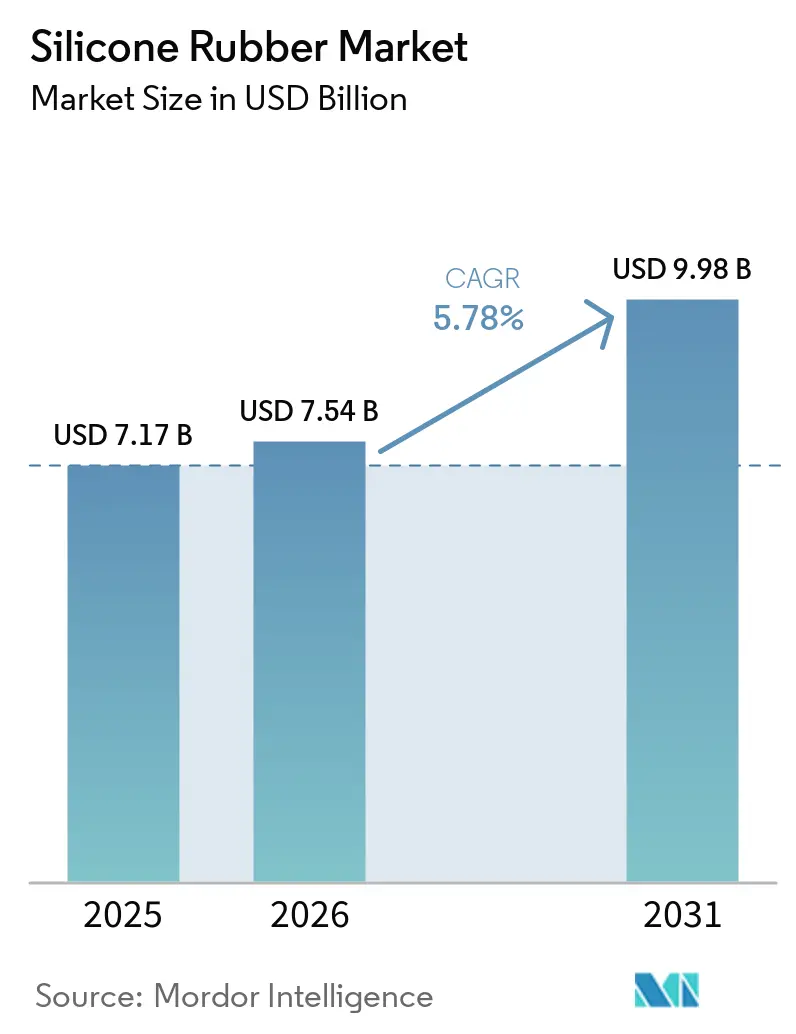
The global silicone rubber market size was valued at USD 7.17 billion in 2025 and is estimated to grow from USD 7.54 billion in 2026 to USD 9.98 billion by 2031, at a CAGR of 5.78% during the forecast period (2026-2031). Tighter medical device quality requirements, vehicle electrification, and greater thermal management needs in electronics support demand. These factors connect regulated healthcare demand with the evolving needs of transport and computing equipment, positioning silicone rubber for components that must perform reliably in fluid-contact, high-voltage, and heat-management applications. Medical, thermally conductive, and conductive grades are accounting for a larger share of the product mix, supporting higher selling prices for integrated producers and shifting revenue toward products that require more extensive qualification and application testing before selection for medical devices, battery assemblies, and electronics packages. Integrated suppliers are also better protected against swings in silicon metal and siloxane costs than downstream compounders, as their upstream positions provide a clearer link between feedstock availability and finished-material production, helping limit disruption when regional feedstock prices change quickly. The silicone rubber market has room to grow in regulated and technically demanding applications, while lower-value uses face pressure from cost and material substitution. Growth will depend on whether suppliers can align capacity, specialized formulations, and processing methods with the different needs of medical device makers, EV component producers, electronics manufacturers, and established industrial customers, whose requirements vary widely across applications. Over the forecast period, the silicone rubber market will depend on a mix of premium specialty demand and large, established sealing applications, with medical, automotive, electronics, industrial, and consumer uses each shaping the balance among output, performance, and price.
Key Report Takeaways
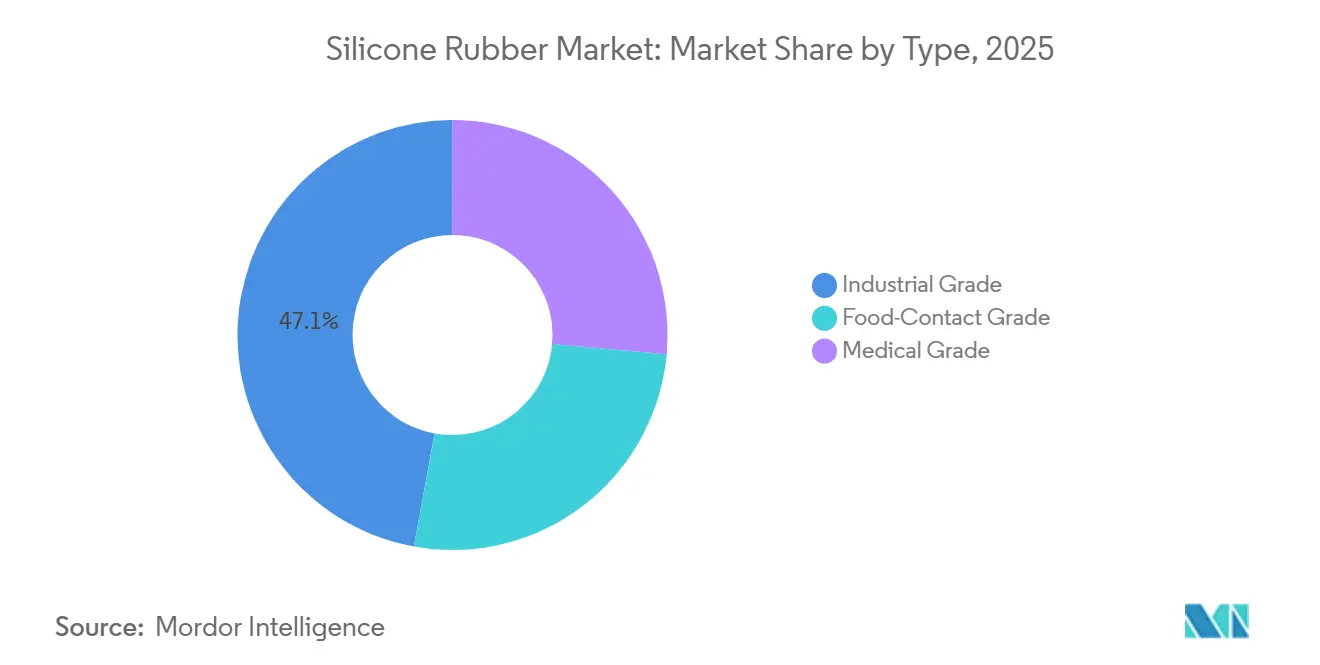
- By type, Industrial Grade accounted for 47.13% of revenue in 2025, while Medical Grade is forecast to grow at a 6.14% CAGR through 2031.
- By processing method, Liquid Injection Molding accounted for 64.67% of revenue in 2025 and is forecast to grow at a 6.43% CAGR through 2031.
- By application, Seals, Gaskets, and O-Rings held 45.71% revenue share in 2025, while Catheters and Medical Tubing are forecast to grow at a 6.56% CAGR through 2031.
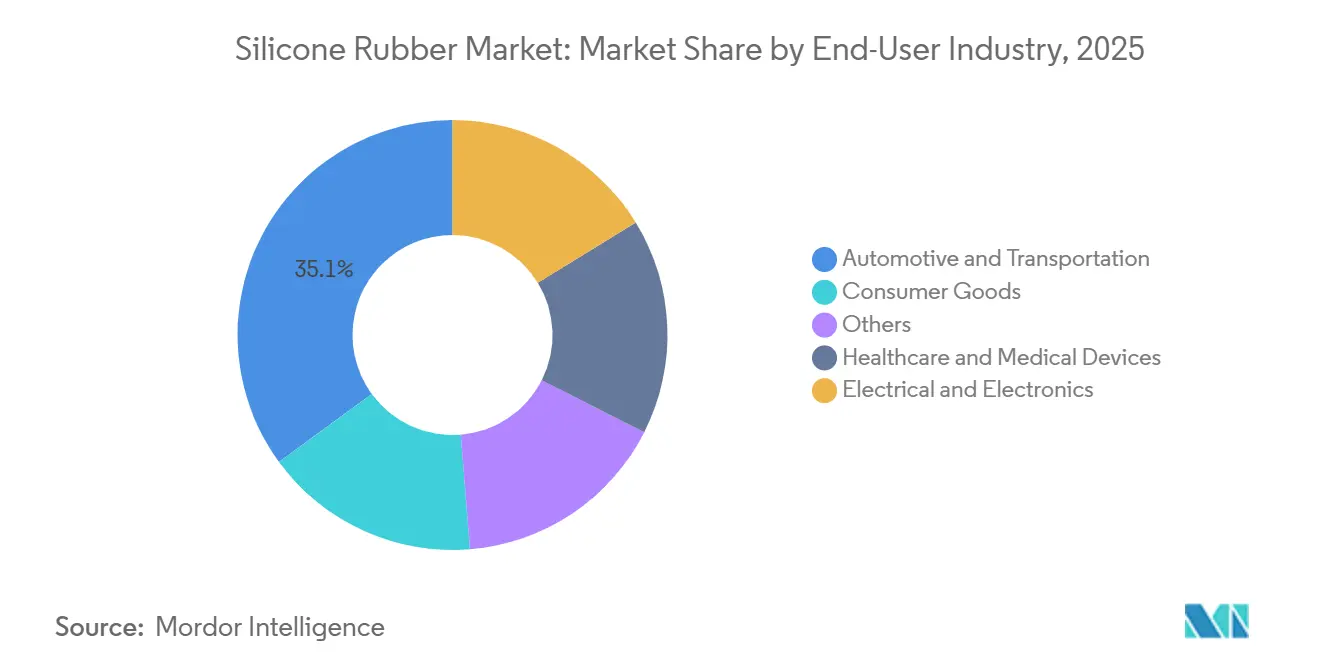
- By end-user industry, Automotive and Transportation held a 35.06% revenue share in 2025, while Healthcare and Medical Devices are forecast to expand at a 6.92% CAGR through 2031.
- By geography, Asia-Pacific accounted for 46.68% of revenue in 2025 and is forecast to grow at a 6.34% CAGR through 2031.
Note: Market size and forecast figures in this report are generated using Mordor Intelligence’s proprietary estimation framework, updated with the latest available data and insights as of January 2026.
Global Silicone Rubber Market Trends and Insights
Drivers Impact Analysis*
| Drivers | (~) % Impact on CAGR Forecast | Geographic Relevance | Impact Timeline |
|---|---|---|---|
| Growth in Medical-Grade and Implantable Components | +1.5% | Global, concentrated in North America and Europe | Long term (≥ 4 years) |
| Electric Vehicle (EV) Battery Sealing and High-Voltage Insulation Demand | +1.3% | Asia-Pacific and Europe | Medium term (2-4 years) |
| Electronics Miniaturization and Thermal Management | +0.9% | Asia-Pacific and North America | Short term (≤ 2 years) |
| Expansion of Automated Liquid Injection Molding | +0.8% | Global, led by Asia-Pacific | Medium term (2-4 years) |
| Antimicrobial and Conductive Silicone Formulations | +0.7% | North America and Europe, spillover to the Asia-Pacific | Long term (≥ 4 years) |
| Source: Mordor Intelligence | |||
Growth in Medical-Grade and Implantable Silicone Components
Medical-grade silicone rubber benefits from qualification requirements that are difficult for suppliers to meet and that apply to material selection before devices reach clinical or commercial use. The FDA Quality Management System Regulation took effect on February 2, 2026, aligning U.S. device manufacturing requirements with ISO 13485:2016. These requirements make it harder to replace qualified materials in Class II and Class III devices, because a change can require renewed documentation, testing, and approval activity by device manufacturers. Manufacturers with United States Pharmacopeia (USP) Class VI and ISO 10993 compliant formulations retain a qualification advantage that takes 2 to 4 years to reproduce. In June 2026, Dongguan Ruixiang Silicone released platinum-cured medical-grade tubing for fluid-contact cardiac assist and hemodialysis applications. Higher-value implantable materials also support a premium over industrial-grade products, even when output growth is moderate, as suppliers provide materials for uses where reliability, biocompatibility, and traceable quality are central requirements.
EV Battery Sealing and High-Voltage Insulation Demand
China's GB 38031-2025 battery safety standard took effect in July 2026 and requires battery systems to protect occupants and emergency personnel during thermal runaway. The standard increases the technical focus on battery-housing seals and related components, particularly where a component must continue to perform under severe heat, pressure, and chemical exposure. WEVO-CHEMIE developed WEVOSIL 23130 for formed-in-place gasket sealing, with adhesive strength above 2 MPa and durability during gas-pressure spikes. WACKER's ELASTOSIL LR 3822 is intended for connector seals and cooling-circuit elements in EV traction batteries, maintaining integrity after 1,000 hours in glycol-water mixtures at 125°C. These requirements favor purpose-built compounds rather than reformulated industrial materials, since battery applications combine sealing, thermal, electrical, and safety requirements into a single vehicle system. The silicone rubber market stands to benefit as product development shifts toward application-specific materials for battery systems, with this segment shaped by battery safety, material durability, and the need for components that support automated vehicle production.
Electronics Miniaturization and Thermal Management
Silicone-based thermal interface materials are increasingly relevant as high-performance computing adopts 2.5D and 3D chip-stacking designs, in which heat must be dissipated from dense components without compromising package reliability. A 2025 IEEE study found that silicone-matrix composites containing liquid-metal materials maintained a bond-line thickness of 50-60 µm in large 2.5D HPC packages[1]. The study addressed local hotspots reaching 3 W/mm² in advanced packaging. A 2025 study in the International Journal of Thermophysics reported a specific heat capacity of up to 6,500 J·kg⁻¹·K⁻¹ for silicone rubber containing 30 wt% paraffin-wax microcapsules. Demand rises with chip power density, not only with the number of devices produced, because more demanding processors require materials that can manage local heat loads within tighter package dimensions. The silicone rubber market has an opening for higher-value thermal management materials as AI and HPC deployments expand, meeting material needs that are growing in importance as computing systems concentrate more heat in smaller spaces.
Expansion of Automated Liquid Injection Molding
Liquid injection molding is replacing older processing methods through more integrated automation, giving processors a route to consistent output while reducing the manual steps associated with flash removal and rework. At Fakuma 2026, ENGEL demonstrated flash-free production of large-format Liquid Silicone Rubber (LSR) seals on a tie-bar-less electric machine with a clamping force of 2,200 kN. The process removes secondary deburring by improving platen parallelism. Elmet GmbH showed its Smartshot i cold-runner system, which automatically balances cavity fill and reduces startup time by up to 95% on a 16-cavity mold. Automated Liquid Injection Molding (LIM) makes high-cavity production with less rework more practical for smaller production runs, improving the case for silicone parts where output levels are not large enough to absorb extensive secondary operations. The silicone rubber market gains access to industrial and medical applications that were less economical with older methods, and benefits as automated equipment lowers the practical cost of producing detailed silicone components.
Restraints Impact Analysis*
| Restraints | (~) % Impact on CAGR Forecast | Geographic Relevance | Impact Timeline |
|---|---|---|---|
| Volatility in Siloxane, Silicon Metal, and Energy Costs | -1.6% | Global, most acute for non-integrated processors | Short term (≤ 2 years) |
| Competition from High-Performance Thermoplastic Elastomers | -1.0% | Global, especially in price-sensitive segments | Medium term (2-4 years) |
| Recycling Challenges for Cross-Linked Silicone Rubber | -0.8% | Europe, followed by global markets | Long term (≥ 4 years) |
| Source: Mordor Intelligence | |||
Volatility in Siloxane, Silicon Metal, and Energy Costs
Raw material costs remain a major risk for silicone rubber processors without upstream integration, as material costs can change faster than customer pricing can be adjusted under established supply agreements. U.S. silicon metal prices averaged 21% lower in 2025 than in 2024 due to Chinese oversupply and weaker demand from aluminum and chemical applications. In the first half of 2026, silicone dimethylcyclosiloxane (DMC) prices in China recovered 13% year over year while domestic capacity remained at 3.44 million tons through June 2026. Siloxane prices in Germany rose 7.0% in the second quarter of 2026 to USD 6,100 per metric ton from USD 5,700 per metric ton in the first quarter. This reversal followed the softer global pricing seen in late 2025, indicating that cost relief available in one period may not provide a stable basis for longer-term operating decisions. Non-integrated compounders remain more exposed to these fluctuations, as they lack the upstream cost buffer available to vertically integrated suppliers.
Competition from High-Performance Thermoplastic Elastomers
High-performance thermoplastic elastomers are gaining use in mid-market applications where cost and processability take priority, particularly where sufficient rather than specialized performance is acceptable. Thermoplastic vulcanizates and styrenic block copolymers provide flexibility and chemical resistance in automotive weather-stripping, consumer grips, and general industrial seals. Unlike cross-linked silicone, these materials can also be recycled through standard thermoplastic processing. Silicone retains a stronger position in medical implants, high-voltage insulation, and EV thermal management, where biocompatibility, performance above 200°C, and USP-grade compliance are required. This dynamic supports continued growth for premium grades alongside price pressure in commodity applications, distinguishing uses that require silicone's specific performance profile from those where a lower-cost alternative can meet the requirement. The silicone rubber market must therefore compete more directly for lower-margin output while focusing on applications with clear performance requirements, and it remains better positioned where established material performance matters more than processing convenience or recyclability.
*Our forecasts treat driver/restraint impacts as directional, not additive. The impact forecasts reflect baseline growth, mix effects, and variable interactions.
Segment Analysis
By Type: Medical Grade Outpacing the Broader Portfolio
Industrial Grade accounted for 47.13% of the silicone rubber market share in 2025. It remained widely used in seals, gaskets, and O-rings for automotive, manufacturing, and construction applications, where resistance to heat and environmental exposure supports routine component performance. Purchasing decisions in these applications are driven by the balance between cost and performance. Medical Grade is the fastest-growing type and is forecast to grow at a 6.14% CAGR through 2031. Material qualification requirements support its pricing position and reduce the scope for substitution in Class II and Class III devices, as suppliers must demonstrate that materials are suitable for sensitive patient-contact and implantable applications.
Elkem introduced SILBIONE Liquid Silicone Rubber (LSR) Select EC 70 in October 2025 as a biocompatible and electrically conductive LSR. It has resistivity below 10 ohm-centimeters and ISO 10993-5 cytotoxicity certification. The material is intended for wearables, prosthetics, and flexible circuits, reflecting the overlap between healthcare-oriented design requirements and electrically functional silicone materials. Food-Contact Grade serves bakeware, dairy tubing, and food-processing equipment and is a stable segment whose demand follows the expansion of organized food manufacturing in emerging Asian economies. Demand in this segment includes equipment and tubing applications that require food-contact performance and reliable processing characteristics. The silicone rubber market continues to place greater value on formulations that meet demanding medical and electrical requirements, as these formulations are used in applications with defined technical and quality needs.

By Processing Method: LIM Consolidating Its Lead
Liquid Injection Molding (LIM) held 64.67% of processing-method revenue in 2025 and is projected to grow at a 6.43% CAGR through 2031, faster than other processing methods. This position reflects continued movement away from compression and transfer methods toward automated systems, particularly for applications where repeatable part quality and lower labor content are important to customer economics. ENGEL demonstrated at Fakuma 2026 that a tie-bar-less electric LIM machine could produce large-format seals without secondary deburring, removing a rework cost that had previously limited LIM adoption for lower-complexity parts.
Elmet's Smartshot i system reduced startup time by up to 95% on 16-cavity molds by automatically balancing cavity fill. Extrusion remains important for continuous profiles such as hoses, tubing, and wire jacketing, as these products require continuous geometry rather than the discrete part shapes produced by injection molding. Transfer Molding and Compression Molding are still used for precision-critical, low-volume aerospace and industrial parts, which often have long product cycles that justify higher tooling investment. Automated LIM strengthens the silicone rubber market's ability to serve production programs that require repeatability and less manual finishing. For processors, automation reduces the variability and labor associated with traditional methods, improving the production case for LIM. The silicone rubber market is also applying LIM to improve efficiency where customer volumes do not support extensive downstream processing.
By Application: Seals and Gaskets Anchor Revenue While Catheters Lead Growth
Seals, gaskets, and O-rings accounted for 45.71% of application revenue in 2025, reflecting demand from the automotive, industrial machinery, aerospace, and food-processing equipment sectors. These applications depend on silicone's compression-set resistance and thermal stability. China's GB 38031-2025 standard introduces specific requirements for EV battery-housing gasket materials, requiring adhesive strength above 2 MPa, resistance to corrosive gases, and compatibility with automated formed-in-place gasket dispensing, combining assembly needs with performance requirements specific to battery enclosures.
Catheters and Medical Tubing are forecast to grow at a 6.56% CAGR through 2031. Demand is linked to catheterization procedures, hemodialysis infrastructure, and single-use medical-grade tubing, each of which requires materials that support fluid-contact applications under established quality requirements. Dongguan Ruixiang Silicone released platinum-cured tubing in June 2026 for cardiac assist and hemodialysis systems, manufactured at an FDA-registered facility. Wearable and Implantable Drug-Delivery Systems are gaining use in self-adhesive patches and subcutaneous infusion devices. These systems require skin-contact biocompatibility, breathability, and drug compatibility, supporting demand in the silicone rubber market for applications that depend on medical-grade material properties.
By End-User Industry: Automotive Leads, Healthcare Accelerates
Automotive and Transportation held 35.06% of end-user revenue in 2025. Conventional sealing needs and greater material content per electric vehicle (EV) both support this position, as EVs add demand for battery-housing gaskets and insulation around high-voltage components. WACKER introduced ELASTOSIL R 531/60, an extrudable rubber that forms a stable ceramic layer around high-voltage busbars during fires, illustrating how EV designs extend silicone use beyond conventional seals to safety-related components. Electrical and Electronics also uses silicone rubber in thermal interface materials, potting compounds, and semiconductor packaging, extending the silicone rubber market into component designs where thermal control and reliable insulation are linked requirements.
Healthcare and Medical Devices are projected to grow at a 6.92% CAGR through 2031. Demand for cardiac, orthopedic, and wearable devices supports output in this segment, while the technical requirements of these devices place greater importance on biocompatibility and a consistently qualified material supply. Medical-grade compliance also supports a price premium relative to industrial-grade materials. Research published in 2025 reported thermal conductivity above 1.37 W·m⁻¹·K⁻¹ in advanced filler-engineered silicone-matrix composites. Consumer Goods uses silicone in kitchenware, infant care, personal-care applicators, and wearable housings, while industrial and other end users select it for UV, ozone, and temperature resistance.
Geography Analysis
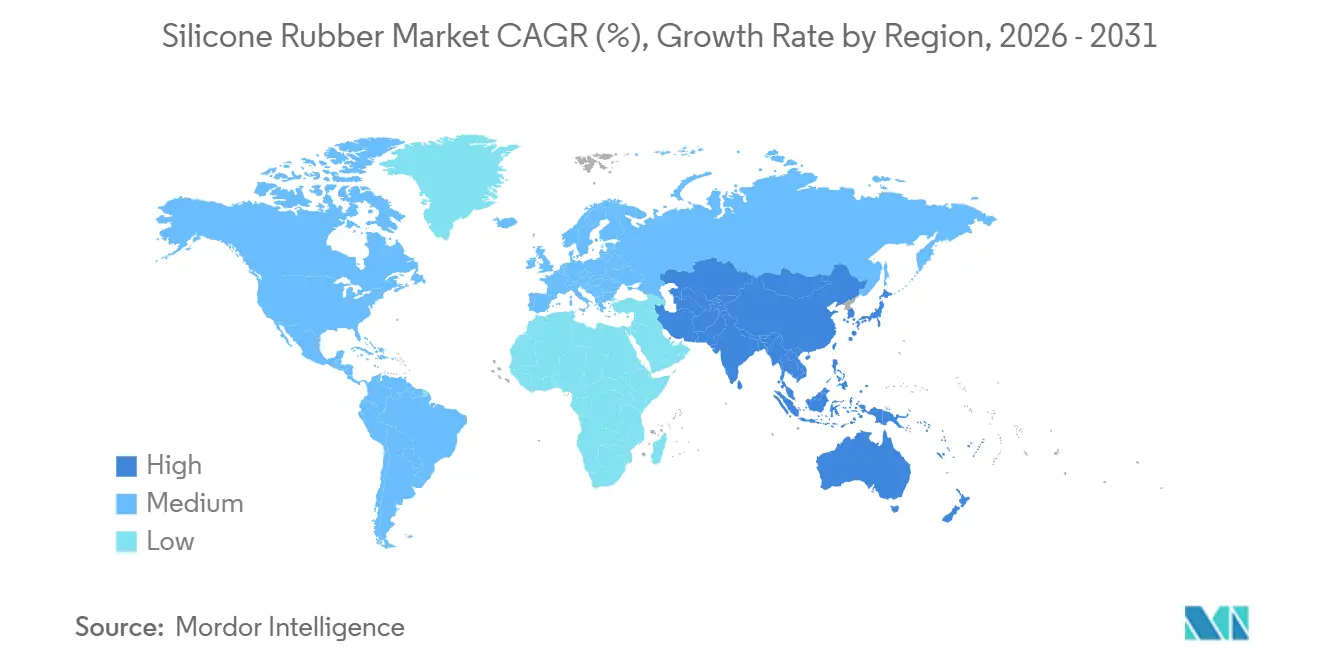
Asia-Pacific held 46.68% of the silicone rubber market share in 2025 and is forecast to grow at a 6.34% CAGR through 2031. China is both the main production center and a major demand center for electric vehicle (EV) battery systems, consumer electronics, and medical devices. It also exports general-purpose grades to Southeast Asia, India, and the Middle East. India is the fastest-growing country market in the region, supported by healthcare infrastructure, automotive manufacturing, and organized food processing. Japan remained a high-specification market in 2025, supported by compliance requirements under the Pharmaceutical and Medical Device Act (PMD Act) for healthcare applications and the Japanese Industrial Standards framework for industrial materials. Together, these frameworks drive demand for materials that meet closely defined performance and quality requirements, making silicone rubber relevant to customers who base their purchasing decisions on established standards and product qualification.
South Korea and ASEAN countries contribute to the sector through consumer electronics and automotive components. ASEAN markets also benefit from the relocation of manufacturing from China. North America is an important revenue base for medical devices, aerospace, and the expanding EV supply chain in the United States and Mexico, where locally produced, qualified materials and dependable supply are valued by customers. The FDA Quality Management System Regulation reinforces a compliance-focused environment that supports the use of qualified silicone materials in medical applications. In June 2026, Dow announced targeted investments in specialty silicones totaling USD 100 million, including expansions of liquid silicone rubber (LSR) manufacturing in Carrollton, Kentucky[2].
Europe combines demand from electromobility with regulatory compliance requirements, creating demand for suppliers that can serve automotive, medical technology, and industrial customers with materials designed for defined applications. On June 17, 2026, WACKER opened its Karlovy Vary production site in the Czech Republic to manufacture room-temperature-curing silicones and high-consistency rubber for automotive, medical technology, and electromobility customers. South America, the Middle East, and Africa are smaller markets, with Brazil supporting demand for pipeline sealing, automotive components, and food processing. Saudi Arabia and South Africa are key regional demand centers due to industrial diversification and vehicle assembly. These regions import most specialty and medical grades from Asia-Pacific and European suppliers due to limited domestic compounding capacity, leaving local users dependent on established international producers for technically demanding products.
Competitive Landscape
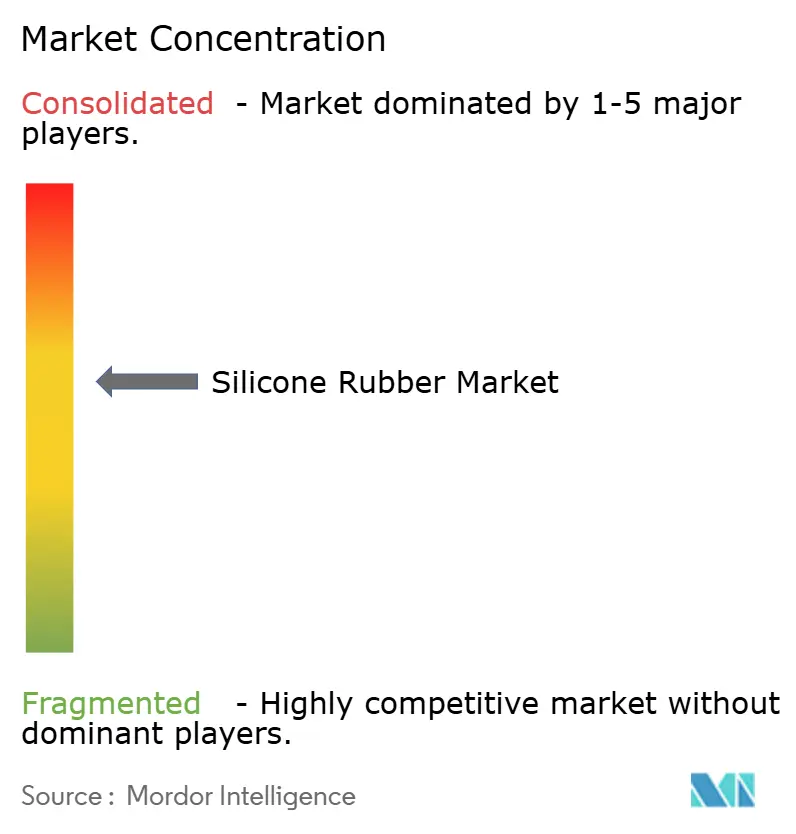
The silicone rubber market is moderately consolidated in specialty grades, where Shin-Etsu Chemical, Dow, WACKER, and Elkem hold integrated positions from silicon metal through finished elastomers. The compounding and distribution tiers are more fragmented, with regional suppliers serving local sealing, construction, and consumer applications, where proximity, customer service, and application-specific formulation influence purchasing decisions. Integrated producers are expanding capacity in growth regions and developing products for EV thermal management, biocompatible liquid silicone rubber (LSR), and conductive formulations, aligning investment with applications where silicone performance is difficult for competing materials to replicate. Compounders compete through application engineering, qualification speed, and customer-specific formulations. This structure favors suppliers that can manage raw material exposure while meeting demanding technical and regulatory requirements. In specialty applications, integrated suppliers hold an advantage because material supply, production capability, and qualification experience are closely connected.
On June 23, 2026, Dow announced USD 100 million in targeted investments in specialty silicones. The program includes LSR manufacturing expansions in Carrollton, Kentucky, and Zhangjiagang, China, targeting mobility, electronics, and regulated healthcare applications. In June 2026, WACKER commissioned its Karlovy Vary site to supply room-temperature-curing silicones and high-consistency rubber to European automotive, medical technology, and power-grid customers. These investments place production closer to compliance-sensitive customers and strengthen local supply for specialty applications.
Chinese integrated producers are building capabilities in medical-grade and conductive LSR beyond commodity high-temperature vulcanizing materials. This is adding price pressure in lower tiers of medical silicone applications across Asia, as suppliers move into products positioned between commodity grades and the most demanding implantable material categories. A U.S. patent covers a conductive liquid silicone rubber that uses single-walled carbon nanotubes as a conductive filler, reflecting a focus on functional formulations. In September 2025, Elkem validated a proof of concept for mechanically recycling cross-linked high-consistency rubber, with reincorporation rates above 50%. If scaled, this could improve silicone's circularity relative to thermoplastic elastomers. Sustainability requirements in European and North American procurement are also becoming more relevant, and the silicone rubber market may increasingly favor producers that can combine specialty performance with credible circularity options.
Silicone Rubber Industry Leaders
-
Dow
-
Wacker Chemie AG
-
Shin-Etsu Chemical Co., Ltd.
-
Elkem ASA
-
Momentive
- *Disclaimer: Major Players sorted in no particular order
Recent Industry Developments
- June 2026: Dow announced approximately USD 100 million in specialty silicones investments to be completed by end of 2027, covering liquid silicone rubber expansions in Carrollton, Kentucky, and Zhangjiagang, China; engineered silicone capacity expansions in Songjiang, China, and Fukui, Japan; and Cooling Science Labs in Shanghai and Midland, Michigan, supporting its local-for-local manufacturing strategy across mobility, electronics, and healthcare.
- June 2026: WACKER commissioned its new silicone production site in Karlovy Vary, Czech Republic, on June 17, 2026, dedicated to room-temperature-curing silicones and high-consistency rubber for automotive, electromobility, medical technology, and power-grid applications. The site complements its Burghausen LSR facility and Plzeň thermally conductive silicones plant.
Global Silicone Rubber Market Report Scope
Silicone rubber is a synthetic elastomer composed of a silicon-oxygen backbone with carbon, hydrogen, and oxygen substituents. It is widely used across industries due to its thermal stability, flexibility, and resistance to environmental factors such as moisture, UV radiation, and extreme temperatures.
The silicone rubber market is segmented by type, processing method, application, end-user industry, and geography. By type, the market is segmented into industrial grade, medical grade, and food-contact grade. By processing method, the market is segmented into liquid injection molding, extrusion, transfer molding, compression molding, and others. By application, the market is segmented into seals, gaskets, and o-rings, catheters and medical tubing, wearable and implantable drug-delivery systems, and others. By end-user industry, the market is segmented into healthcare and medical devices, automotive and transportation, electrical and electronics, consumer goods, and others. The report also covers market size and forecasts for silicone rubber across 15 countries in major regions. The market sizes and forecasts are provided in terms of value (USD).
| Industrial Grade |
| Medical Grade |
| Food-Contact Grade |
| Liquid Injection Molding |
| Extrusion |
| Transfer Molding |
| Compression Molding |
| Others |
| Seals, Gaskets and O-Rings |
| Catheters and Medical Tubing |
| Wearable and Implantable Drug-Delivery Systems |
| Others |
| Healthcare and Medical Devices |
| Automotive and Transportation |
| Electrical and Electronics |
| Consumer Goods |
| Others |
| Asia-Pacific | China |
| India | |
| Japan | |
| South Korea | |
| ASEAN Countries | |
| Rest of Asia-Pacific | |
| North America | United States |
| Canada | |
| Mexico | |
| Europe | Germany |
| United Kingdom | |
| France | |
| Italy | |
| NORDIC Countries | |
| Rest of Europe | |
| South America | Brazil |
| Argentina | |
| Rest of South America | |
| Middle East and Africa | Saudi Arabia |
| South Africa | |
| Rest of Middle East and Africa |
| By Type | Industrial Grade | |
| Medical Grade | ||
| Food-Contact Grade | ||
| By Processing Method | Liquid Injection Molding | |
| Extrusion | ||
| Transfer Molding | ||
| Compression Molding | ||
| Others | ||
| By Application | Seals, Gaskets and O-Rings | |
| Catheters and Medical Tubing | ||
| Wearable and Implantable Drug-Delivery Systems | ||
| Others | ||
| By End-User Industry | Healthcare and Medical Devices | |
| Automotive and Transportation | ||
| Electrical and Electronics | ||
| Consumer Goods | ||
| Others | ||
| By Geography | Asia-Pacific | China |
| India | ||
| Japan | ||
| South Korea | ||
| ASEAN Countries | ||
| Rest of Asia-Pacific | ||
| North America | United States | |
| Canada | ||
| Mexico | ||
| Europe | Germany | |
| United Kingdom | ||
| France | ||
| Italy | ||
| NORDIC Countries | ||
| Rest of Europe | ||
| South America | Brazil | |
| Argentina | ||
| Rest of South America | ||
| Middle East and Africa | Saudi Arabia | |
| South Africa | ||
| Rest of Middle East and Africa | ||
Key Questions Answered in the Report
What is current market size of Silicone Rubber Market?
The global silicone rubber market size was valued at USD 7.17 billion in 2025 and is estimated to grow from USD 7.54 billion in 2026 to USD 9.98 billion by 2031, at a CAGR of 5.78% during the forecast period (2026-2031).
Which silicone rubber type is growing the fastest?
Medical Grade is forecast to expand at a 6.14% CAGR through 2031 because regulated medical devices require qualified materials.
Which applications account for the largest share of silicone rubber demand?
Seals, gaskets, and O-rings held 45.71% of application revenue in 2025, supported by automotive, industrial, aerospace, and food-processing use.
Which region is the largest consumer of silicone rubber?
Asia-Pacific accounted for 46.68% of global revenue in 2025 and is forecast to grow at a 6.34% CAGR through 2031, making the region's silicone rubber market central to global demand.