
Butyl Rubber Market Size and Share
Market Overview
| Study Period | 2021 - 2031 |
|---|---|
| Market Size (2026) | USD 4.66 Billion |
| Market Size (2031) | USD 6.03 Billion |
| Growth Rate (2026 - 2031) | 5.29 % |
| Fastest Growing Market | North America |
| Largest Market | Asia-Pacific |
| Market Concentration | Medium |
Major Players *Disclaimer: Major Players sorted in no particular order Image © Mordor Intelligence. Reuse requires attribution under CC BY 4.0. | |
Butyl Rubber Market Analysis by Mordor Intelligence
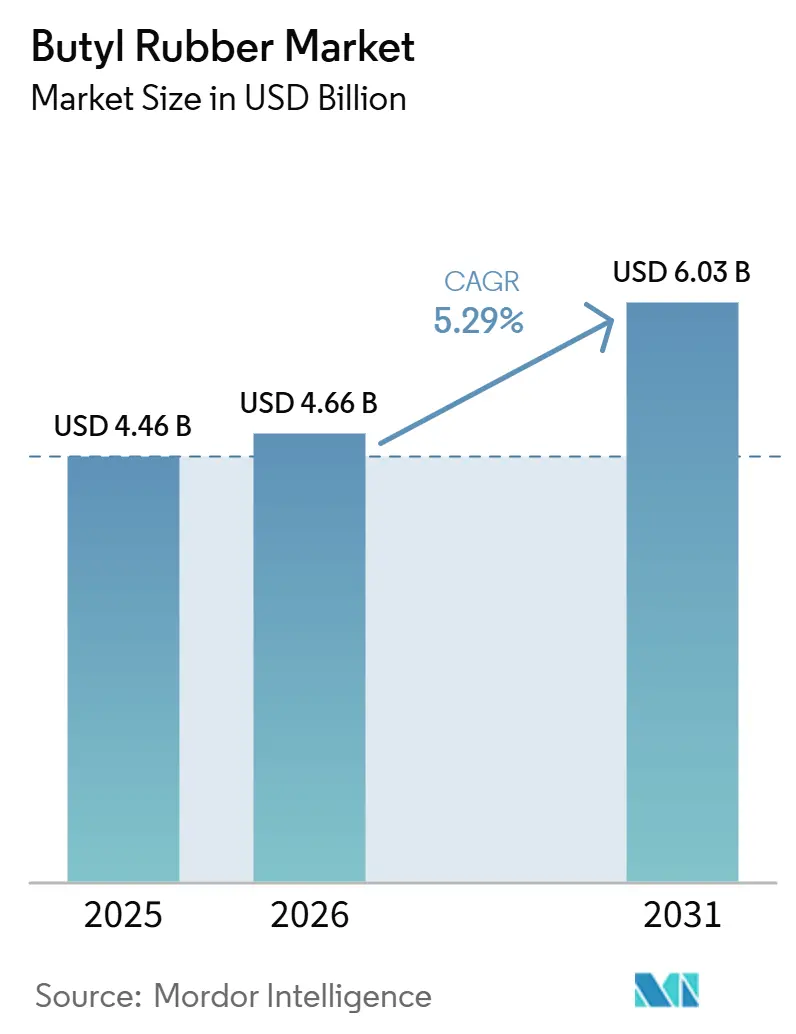
The Butyl Rubber Market size is projected to expand from USD 4.46 billion in 2025 and USD 4.66 billion in 2026 to USD 6.03 billion by 2031, and is expected to register a CAGR of 5.29% between 2026 and 2031. Electric vehicle tire requirements and the wider use of injectable medicines are shaping the butyl rubber market. Both uses favor materials with strong air retention, sealing, and sterilization performance. Chinese capacity additions and import duties are changing regional supply conditions, while Western suppliers are focusing more on specialized grades than additional volume. Capacity investment is moving toward South and Southeast Asia, where tire production is expanding. These conditions give the butyl rubber market a broader demand base, although feedstock exposure and qualification requirements continue to limit some suppliers.
Key Report Takeaways
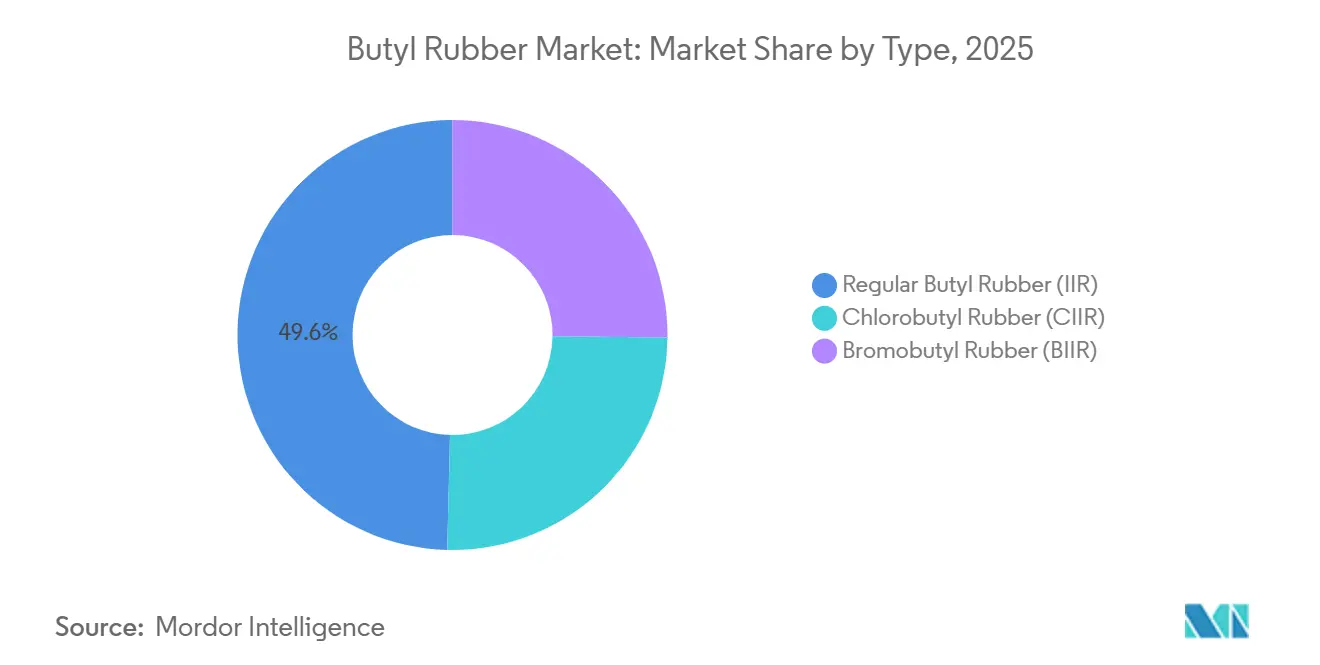
- By type, Regular Butyl Rubber (IIR) held 49.62% of the butyl rubber market share in 2025, while Bromobutyl Rubber (BIIR) is forecast to grow at a 6.18% CAGR through 2031.
- By application, tire manufacturing accounted for 74.68% of the butyl rubber market share in 2025, while medical and pharmaceutical is projected to expand at a 6.47% CAGR through 2031.
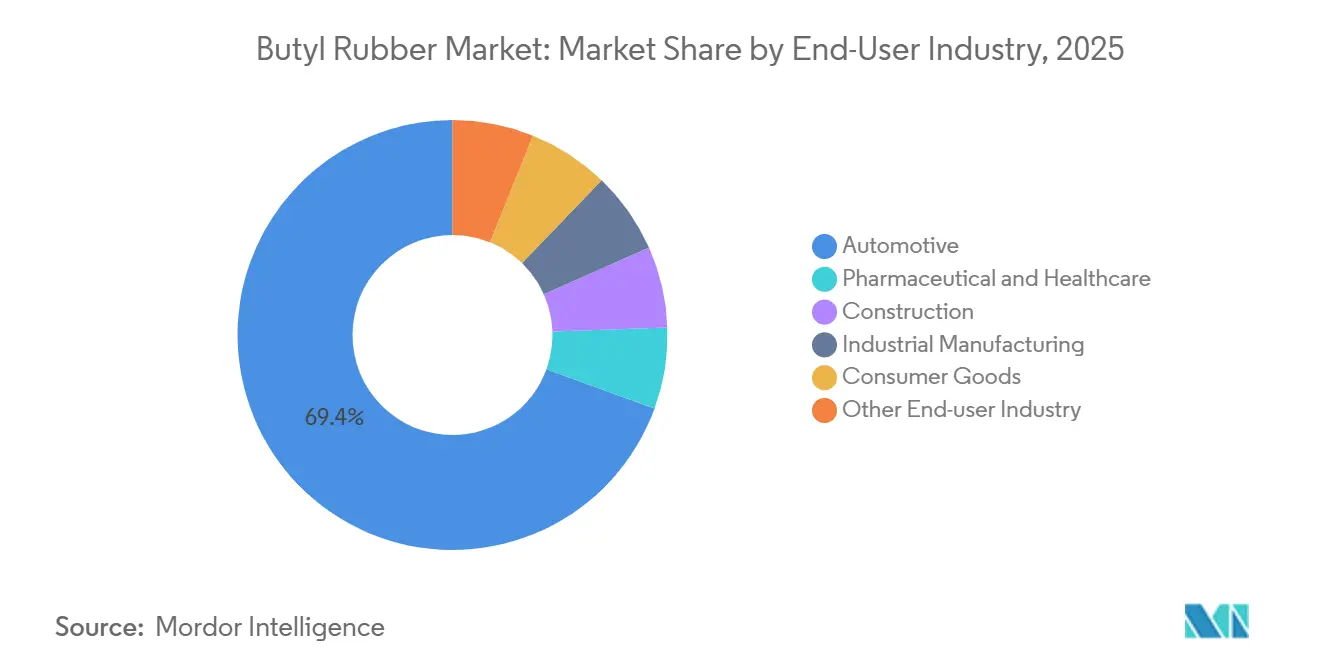
- By end-user industry, automotive held 69.44% of the butyl rubber market share in 2025, while pharmaceutical and healthcare is forecast to record a 7.32% CAGR through 2031.
- By geography, Asia-Pacific held 46.37% of the butyl rubber market share in 2025, while North America is forecast to grow at a 6.53% CAGR through 2031.
Note: Market size and forecast figures in this report are generated using Mordor Intelligence’s proprietary estimation framework, updated with the latest available data and insights as of January 2026.
Market Trends and Insights
Drivers Impact Analysis of Butyl Rubber Market*
| Driver | (~) % Impact on CAGR Forecast | Geographic Relevance | Impact Timeline |
|---|---|---|---|
| Increasing adoption of electric vehicles boosting demand for high-performance butyl rubber tires | +1.5% | Global, concentrated in China, US, Germany, and South Korea | Short term (≤ 2 years) |
| Rising use of butyl rubber in pharmaceutical closures and sterile packaging applications | +1.0% | Global, concentrated in US, EU, and emerging biopharma hubs in India and China | Medium term (2-4 years) |
| Growing adoption of halobutyl rubber in high-performance and premium tire manufacturing | +0.9% | Global, led by Asia-Pacific and North America | Medium term (2-4 years) |
| Expansion of tire manufacturing capacity across Asia-Pacific supporting market growth | +0.7% | Asia-Pacific core, spill-over to South Asia and Southeast Asia | Short term (≤ 2 years) |
| Increasing demand for butyl rubber in adhesives, sealants, and construction applications | +0.5% | Global, strongest in Asia-Pacific and North America | Long term (≥ 4 years) |
| Source: Mordor Intelligence | |||
Increasing EV Adoption Driving Demand for High-Performance Butyl Rubber Tires
Battery electric vehicles place greater demands on tire inner liners than internal-combustion vehicles because battery packs increase vehicle weight and stress the air-barrier layer. Instant torque can also increase wear at liner junctions, making durable compounds more important for vehicle manufacturers and tire suppliers. Exxon Mobil states that high-performance halobutyl inner liners can extend electric-car tire life by up to 17% through improved air retention. This performance need is increasing the use of bromobutyl and chlorobutyl compounds in new electric vehicle tire specifications. The butyl rubber market, therefore, faces a gradual shift away from standard IIR in premium tire programs. Higher material use per electric vehicle also links growth in vehicle production with greater demand for specialized inner-liner compounds across the butyl rubber market.
Rising Use of Butyl Rubber in Pharmaceutical Closures and Sterile Packaging Applications
Butyl rubber is used in stoppers, plunger components, and needle shields for injectable medicines because it offers low gas permeability, sterilization resistance, and resealing after needle penetration. Pharmaceutical closures must also meet demanding requirements for extractables, leachables, and dimensional consistency. The International Council for Harmonisation of Technical Requirements for Pharmaceuticals for Human Use (ICH) Q3E draft guideline for extractables and leachables was endorsed in August 2025 and opened for public consultation, including its relevance to elastomeric container-closure systems. This process raises the documentation and testing requirements for new suppliers of pharmaceutical-grade material. Qualification work can take 6 to 12 months, which supports the position of producers with existing technical records and customer approvals. The butyl rubber market benefits from growth in biologics, biosimilars, and prefilled syringes, although entry into this application remains difficult for new suppliers.
Growing Adoption of Halobutyl Rubber in High-Performance and Premium Tire Manufacturing
Halogenated grades cure faster and work more effectively with adjacent natural-rubber compounds in tire construction. ARLANXEO describes its X_Butyl product family as covering regular and halogenated butyl rubber grades for these demanding uses. The supplied material indicates that liner thickness can decline by 10% to 15% compared with standard IIR while air-retention requirements are maintained. Thinner liners can support lower rolling resistance, which matters for vehicle efficiency and tire design. China renewed duties of 23.1% to 75.5% on selected halogenated butyl imports in September 2024, supporting local supply in its large tire-production base. The growth outlook for BIIR reflects both higher performance requirements and more protected regional supply conditions.
Expansion of Tire Manufacturing Capacity Across Asia-Pacific Supporting Market Growth
New tire capacity across Asia-Pacific is creating a direct volume requirement for butyl rubber inner liners. Continental inaugurated an expansion at Rayong, Thailand, in May 2026, adding 3 million passenger-car and light-truck tires per year and starting radial motorcycle tire production. The company stated that the site supplied original-equipment tires to 7 of the 10 highest-volume electric vehicle manufacturers in Asia-Pacific during 2025. Those investments support demand for both conventional IIR and higher-value halobutyl compounds. Construction-related uses of butyl adhesives and sealants add a separate, longer-term source of demand, particularly in airtight building systems.
Restraints Impact Analysis of Butyl Rubber Market*
| Restraint | (~) % Impact on CAGR Forecast | Geographic Relevance | Impact Timeline |
|---|---|---|---|
| Volatility in isobutylene and petrochemical feedstock prices affecting production costs | -1.2% | Global, acute in non-integrated producers across North America, Europe, and smaller Asian plants | Short term (≤ 2 years) |
| Limited recycling infrastructure and challenges in processing halogenated butyl rubber waste | -0.6% | Global, pronounced in North America and Europe; emerging regulatory response in China | Medium term (2-4 years) |
| Stringent regulatory approval and lengthy qualification processes for pharmaceutical-grade butyl rubber | -0.4% | Global, concentrated in pharmaceutical manufacturing hubs in US, EU, and Japan | Long term (≥ 4 years) |
| Source: Mordor Intelligence | |||
Volatility in Isobutylene and Petrochemical Feedstock Prices Affecting Production Costs
Isobutylene is the main feedstock used to produce all butyl rubber grades, so changes in crude oil and refining economics affect producer costs. Integrated producers can manage this exposure better than suppliers that buy feedstock on the open market. The supplied research notes that price changes can compress margins when input costs rise faster than finished-product prices. This risk is more severe for mid-scale producers in Asia, North America, and Europe that do not have integrated upstream operations. Chinese supply additions have also reduced the ability of some suppliers to pass higher costs to customers. The butyl rubber market, therefore, remains sensitive to feedstock cycles even where tire and pharmaceutical demand is growing in established and emerging regions.
Limited Recycling Infrastructure and Challenges in Processing for Halogenated Butyl Rubber Waste
Halogenated butyl rubber is difficult to recycle because chlorine and bromine affect conventional devulcanization methods and require control during disposal. A 2024 peer-reviewed study found that gamma irradiation can provide a degradation pathway for IIR, CIIR, and BIIR, while bromobutyl-rich waste remains the most technically difficult stream to process. China issued HG/T 6310-2024 in December 2024, effective July 2025, covering reclaimed halogenated butyl rubber from tire inner layers and medical-stopper scrap. The framework recognizes separate categories for waste from tires and pharmaceutical closures. Comparable pathways are less established in North America and Europe, which keeps many uses dependent on virgin material. Limited recycling capacity can restrict the use of secondary material in cost-sensitive applications and slow broader circular-economy adoption.
*Our forecasts treat driver/restraint impacts as directional, not additive. The impact forecasts reflect baseline growth, mix effects, and variable interactions.
Butyl Rubber Market Segment Analysis
By Type:
Halobutyl Grades Are Growing Faster Than Regular IIRRegular Butyl Rubber (IIR) held 49.62% of the butyl rubber market share in 2025, while Bromobutyl Rubber (BIIR) is forecast to grow at a 6.18% CAGR from 2026 to 2031. IIR retained this leading position because it has established uses in tire inner tubes, vibration dampers, cable insulation, industrial hoses, and chewing gum base. Its low gas permeability and chemical resistance remain important across these applications. The butyl rubber market size for regular IIR continues to depend heavily on tire volume and general industrial demand. Premium tire designs are gradually moving toward halogenated grades where faster curing and stronger compatibility with adjacent compounds are needed.
Bromobutyl Rubber is gaining from electric vehicle tire specifications, premium original-equipment programs, and its co-vulcanization performance with natural-rubber tread compounds. Exxon Mobil’s Exxpro bromobutyl ionomer range and ARLANXEO’s X_Butyl BB range address performance-focused applications where approval cycles can take several years. These qualification cycles help protect established suppliers from rapid replacement in approved tire designs. CIIR serves a different role in pharmaceutical closure production, where automated processes require repeatable dimensions and low extractable profiles. Suppliers that improve their mix of halogenated grades can access faster-growing and more specialized demand. Suppliers focused only on commodity IIR face greater pressure from regional capacity additions and price competition.



By Application:
Tire Manufacturing Holds Volume While Pharmaceutical Uses Grow FasterTire Manufacturing accounted for 74.68% of the butyl rubber market size in 2025, making vehicle output and replacement-tire demand central to overall consumption. Inner liners require low gas permeability, so the application remains the core use for IIR, CIIR, and BIIR. The size of this application also means changes in tire manufacturing capacity can materially affect regional purchasing patterns. Electric vehicle tires increase attention to air retention, rolling resistance, and liner durability. That supports a shift toward halobutyl grades in higher-value tire programs. Tire demand in the butyl rubber market can still be affected by vehicle production cycles, consumer replacement patterns, and local manufacturing investment.
The medical and pharmaceutical is expected to grow fastest, with a forecast CAGR of 6.47% through 2031. Injectable biologics, biosimilars, and prefilled syringes require closures that are tested against the specific drug formulation. Container-closure integrity and resealability remain central design criteria for parenteral systems. Adhesives and Sealants form a mid-growth application, supported by construction activity and airtight sealing around windows and curtain walls. Hoses and Belts use the material’s heat and chemical resistance in automotive systems, including hybrid thermal-management applications. Roofing and Waterproofing Membranes benefit from commercial construction standards, while protective clothing and industrial products remain smaller, stable channels. Pharmaceutical demand offers diversification because it follows drug development and healthcare access rather than vehicle production alone.
By End-User Industry:
Automotive Leads Demand While Healthcare Gains ValueAutomotive held 69.44% of demand in 2025, giving it the largest share of the butyl rubber industry across end-user industries. Tire manufacturing explains much of this position, while vibration isolation, hoses, and sealing components provide additional uses. Automotive purchasing is increasingly affected by the change from conventional vehicles to electric and hybrid platforms. These vehicles require tires and seals that can manage higher weight, faster torque delivery, and demanding thermal conditions. Automotive remains the largest end-user category, but its material mix is changing toward products with stronger performance characteristics. This shift favors suppliers that can support tire makers through technical approvals and reliable regional supply.
Pharmaceutical and healthcare is projected to grow at a 7.32% CAGR through 2031, the highest rate among end-user industries. BIIR and CIIR used in pharmaceutical packaging can produce 3 to 5 times the revenue per kilogram of comparable IIR used in tire inner-tube applications. This difference reflects the testing, quality control, and certification needed for container-closure systems. Construction is the third-largest end-user and uses butyl rubber in roofing membranes, HVAC sealing, and expansion-joint systems. Industrial Manufacturing uses it in vibration mounts, conveyor components, and chemical-resistant liners. Consumer Goods include weather stripping, sports equipment, and food-grade sealing applications. Long qualification procedures limit healthcare demand in the butyl rubber market, but it can support pricing and reduce dependence on the wider automotive cycle.
Geography Analysis
APAC Butyl Rubber Market
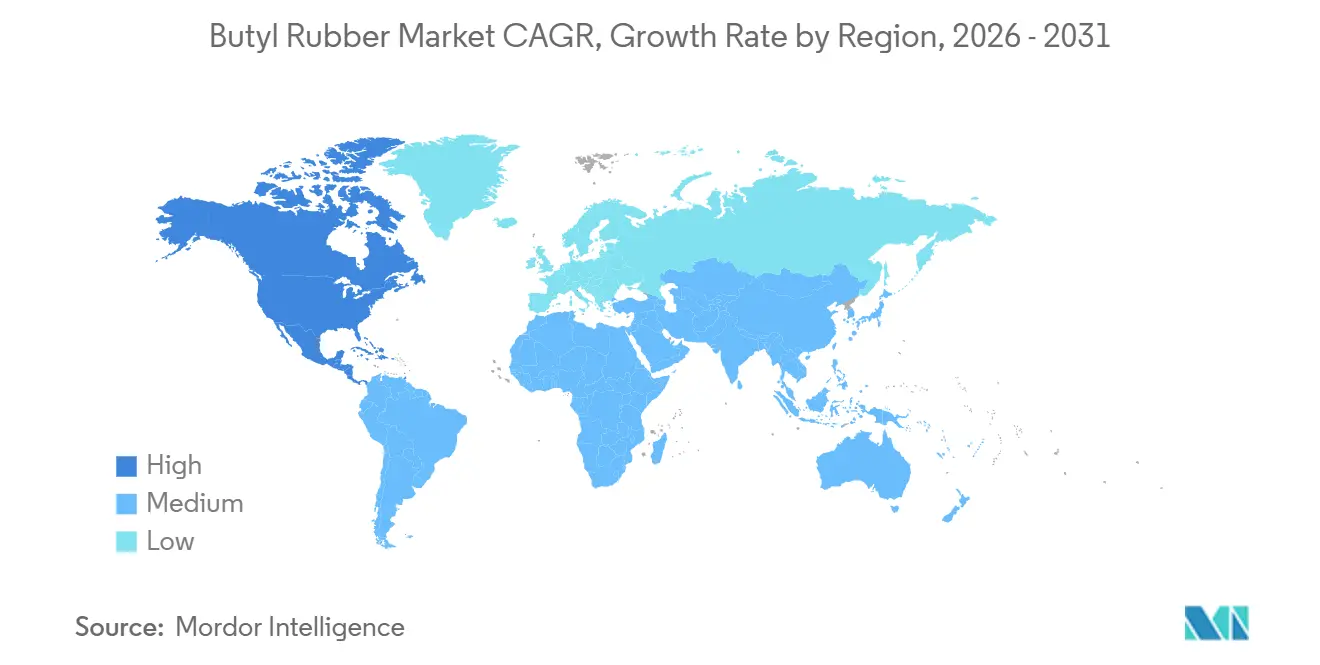
Asia-Pacific held 46.37% of global demand in 2025, giving the region the leading position worldwide. China’s duties on selected imported halogenated butyl rubber support local sourcing and limit access for some foreign suppliers[1]Ministry of Commerce of China, “Anti-Dumping Duty Extension on Halogenated Butyl Rubber from the United States, European Union, United Kingdom, and Singapore,” mofcom.gov.cn. Reliance Sibur Elastomers’ Jamnagar facility has 120 kilotons per annum (ktpa) of regular butyl capacity and 60 ktpa of halobutyl capacity, strengthening India’s domestic supply position. India’s tire capacity additions also support higher consumption of inner-liner materials. Japan and South Korea retain positions in premium halobutyl exports, particularly for markets outside China. This regional mix gives the butyl rubber market high-volume tire demand, growing local supply, and an important role for trade protection.
North America and Europe Butyl Rubber Market
North America is forecast to grow at a 6.53% CAGR through 2031, the fastest rate among the geographic segments. Pharmaceutical packaging demand and electric vehicle tire requirements provide the principal support for the butyl rubber market in the region. The region also benefits from proximity between tire makers, pharmaceutical producers, and specialty-material development activity. Exxon Mobil’s product portfolio addresses tire inner-liner requirements for automotive customers, including electric vehicle applications. European demand is supported by pharmaceutical packaging and premium tire specifications, despite a more limited regional supply. European buyers consequently place greater value on specialized grades and dependable supply arrangements.
South America and MEA Butyl Rubber Market
South America and Middle-East and Africa remain smaller markets, but each has distinct demand conditions. The supplied material identifies continued investment in Brazil’s industrial-rubber base, which is consistent with demand from automotive and construction activity. Brazil’s automotive and construction activity supports local consumption of tires, seals, and related rubber products. In the Middle East, integrated petrochemical assets can support upstream feedstock availability, while construction investment supports waterproofing membranes and adhesive sealants. African demand remains smaller and is linked to urbanization, infrastructure investment, and vehicle adoption. These regions provide additional outlets for the butyl rubber market, although their scale remains below that of Asia-Pacific, North America, and Europe, and their demand is less concentrated.

Competitive Landscape
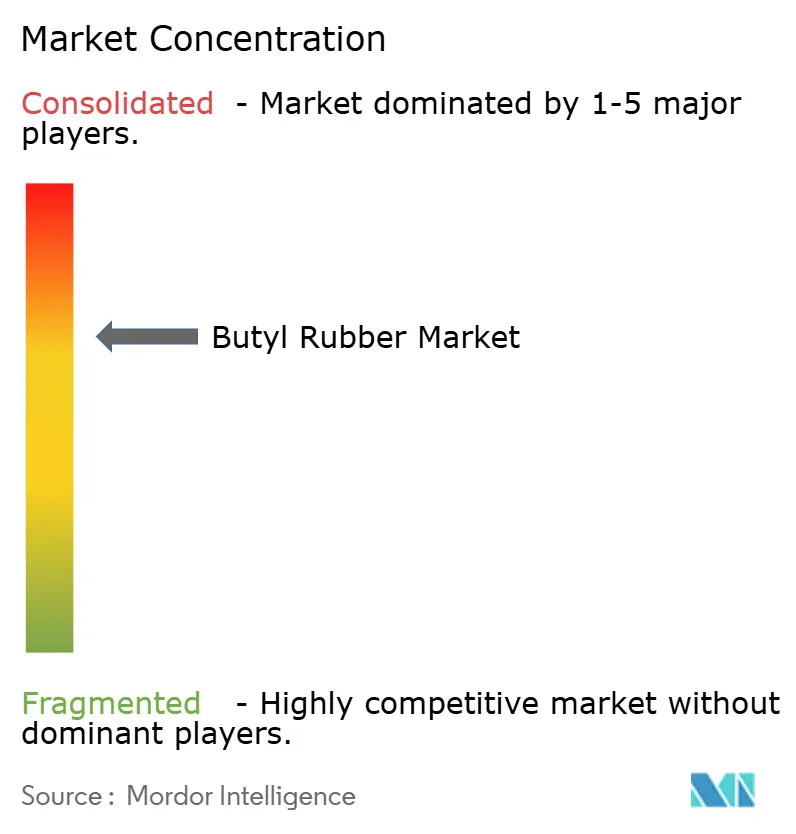
The butyl rubber market has a moderate concentration level because major multinational producers and expanding Chinese suppliers both influence supply conditions. Exxon Mobil and ARLANXEO remain important producers of specialized butyl and halobutyl materials for tire and industrial uses. Exxon Mobil offers the Exxpro family for applications requiring high air retention and performance in tire inner liners. ARLANXEO’s X_Butyl range covers regular and halogenated grades for automotive, tire, and other rubber applications. Their scale adds price pressure in standard grades and changes the role of imports in China. Competition in the butyl rubber market, therefore, depends on grade capability, customer approvals, feedstock access, and regional trade rules rather than production scale alone.
Strategic activity is centered on product specialization, customer relationships, and regional supply chains. Exxon Mobil’s development of bromobutyl ionomers for electric vehicle tire liners is an example of a strategy focused on a higher-performance application. ARLANXEO’s halogenated X_Butyl family similarly targets tire applications where performance and approval history matter. ENEOS Materials completed the transfer of JSR’s elastomer logistics operations and Yokkaichi plant land in April 2026, simplifying its specialty-material production and customer chain. The transaction followed wider structural reform between ENEOS Materials and JSR[2]JSR Corporation, “Promoting Structural Reforms at JSR and ENEOS Materials,” jsr.co.jp. Such moves can improve customer access and operational coordination, particularly in specialty grades. Long tire approval cycles and pharmaceutical qualification requirements give established suppliers an advantage where material changes require extensive validation.
The supplied research identifies opportunities in low-extractable BIIR for biologic-drug delivery, recycled or bio-based IIR, and localized compounding in Southeast Asia and India. These opportunities reflect the gap between commodity supply and higher-value application requirements. Recycled halobutyl remains limited by technical processing barriers and incomplete regulatory pathways. Pharmaceutical closure materials can command stronger value, but only suppliers with testing records and dependable quality systems can compete consistently. Local compounding can help tire producers reduce reliance on one supplier or one country.
Butyl Rubber Industry Leaders
Exxon Mobil Corporation
LANXESS
SIBUR Holding PJSC
Reliance Sibur Elastomers Private Limited
JSR Corporation
- *Disclaimer: Major Players sorted in no particular order
Butyl Rubber Market Companies Covered in this Report
- ARLANXEO
- China Petrochemical Corporation
- Denka Elastlution Co., Ltd.
- ENEOS Materials Corporation
- Exxon Mobil Corporation
- Formosa Synthetic Rubber (Ningbo) Corporation Limited
- JSR Corporation
- Kumho Petrochemical Co., Ltd.
- LANXESS
- Reliance Sibur Elastomers Private Limited
- SABIC
- SIBUR Holding PJSC
- Zeon Corporation
- Zhejiang Cenway Materials Co., Ltd.

Recent Industry Developments in Butyl Rubber Market
- April 2026: ENEOS Materials Corporation completed the acquisition of JSR Corporation’s elastomer logistics operations and Yokkaichi plant land. Combined with ENEOS’s February 2026 acquisition of JSR’s electronics rubber sales business, the move creates a vertically integrated Japanese synthetic rubber supplier with full production-to-customer accountability, strengthening ENEOS Materials’ position in specialty halobutyl grades.
- March 2026: China’s Ministry of Commerce imposed five-year anti-dumping duties on halogenated butyl rubber imports from Japan and Canada, effective March 14, 2026. The measure restricts imported halobutyl access to China and changes trade conditions for suppliers from those countries.


Global Butyl Rubber Market Report Scope
Butyl rubber is a synthetic elastomer produced by copolymerizing isobutylene with a small amount of isoprene. It is known for its low permeability to gases, effective shock absorption, and strong resistance to heat, weather, ozone, and chemicals.
The Butyl Rubber Market is segmented by type, application, end-user industry, and geography. By type, the market is segmented into regular butyl rubber (IIR), chlorobutyl rubber (CIIR), and bromobutyl rubber (BIIR). By application, the market is segmented into tire manufacturing, medical and pharmaceutical, adhesives and sealants, hoses and belts, protective clothing and industrial products, roofing and waterproofing membranes, and other applications. By end-user industry, the market is segmented into automotive, pharmaceutical and healthcare, construction, industrial manufacturing, consumer goods, and other end-user industries. The report also covers the market size and forecasts for butyl rubber in 16 countries across major regions. For each segment, the market sizing and forecasts have been done on the basis of value (USD).
| Regular Butyl Rubber (IIR) |
| Chlorobutyl Rubber (CIIR) |
| Bromobutyl Rubber (BIIR) |
| Tire Manufacturing |
| Medical and Pharmaceutical |
| Adhesives and Sealants |
| Hoses and Belts |
| Protective Clothing and Industrial Products |
| Roofing and Waterproofing Membranes |
| Other Applications |
| Automotive |
| Pharmaceutical and Healthcare |
| Construction |
| Industrial Manufacturing |
| Consumer Goods |
| Other End-user Industry |
| Asia-Pacific | China |
| India | |
| Japan | |
| South Korea | |
| Rest of Asia-Pacific | |
| North America | United States |
| Canada | |
| Mexico | |
| Europe | Germany |
| United Kingdom | |
| France | |
| Italy | |
| Russia | |
| Rest of Europe | |
| South America | Brazil |
| Argentina | |
| Rest of South America | |
| Middle-East and Africa | Saudi Arabia |
| South Africa | |
| Rest of Middle-East and Africa |
| By Type | Regular Butyl Rubber (IIR) | |
| Chlorobutyl Rubber (CIIR) | ||
| Bromobutyl Rubber (BIIR) | ||
| By Application | Tire Manufacturing | |
| Medical and Pharmaceutical | ||
| Adhesives and Sealants | ||
| Hoses and Belts | ||
| Protective Clothing and Industrial Products | ||
| Roofing and Waterproofing Membranes | ||
| Other Applications | ||
| By End-User Industry | Automotive | |
| Pharmaceutical and Healthcare | ||
| Construction | ||
| Industrial Manufacturing | ||
| Consumer Goods | ||
| Other End-user Industry | ||
| By Geography | Asia-Pacific | China |
| India | ||
| Japan | ||
| South Korea | ||
| Rest of Asia-Pacific | ||
| North America | United States | |
| Canada | ||
| Mexico | ||
| Europe | Germany | |
| United Kingdom | ||
| France | ||
| Italy | ||
| Russia | ||
| Rest of Europe | ||
| South America | Brazil | |
| Argentina | ||
| Rest of South America | ||
| Middle-East and Africa | Saudi Arabia | |
| South Africa | ||
| Rest of Middle-East and Africa | ||


Key Questions Answered in the Report
What is the size of the butyl rubber market?
The Butyl Rubber Market size is projected to expand from USD 4.46 billion in 2025 and USD 4.66 billion in 2026 to USD 6.03 billion by 2031, and is expected to register a CAGR of 5.29% between 2026 and 2031.
Which butyl rubber type is expected to grow fastest through 2031?
Bromobutyl Rubber (BIIR) is expected to grow at a 6.18% CAGR through 2031.
Why are electric vehicles important for butyl rubber demand?
Electric vehicles require tire inner liners with strong air retention and durability. High-performance halobutyl liners can extend tire life by up to 17%, according to Exxon Mobil.
What application led the market demand in 2025?
Tire manufacturing accounted for 74.68% of demand in 2025. Its scale makes vehicle production and replacement-tire sales important for overall consumption.
Page last updated on:





