
Automotive Silicone Market Size and Share
Market Overview
| Study Period | 2021 - 2031 |
|---|---|
| Market Size (2026) | USD 2.81 Billion |
| Market Size (2031) | USD 3.98 Billion |
| Growth Rate (2026 - 2031) | 7.21 % |
| Fastest Growing Market | Asia-Pacific |
| Largest Market | Asia-Pacific |
| Market Concentration | Medium |
Major Players *Disclaimer: Major Players sorted in no particular order Image © Mordor Intelligence. Reuse requires attribution under CC BY 4.0. | |
Automotive Silicone Market Analysis by Mordor Intelligence
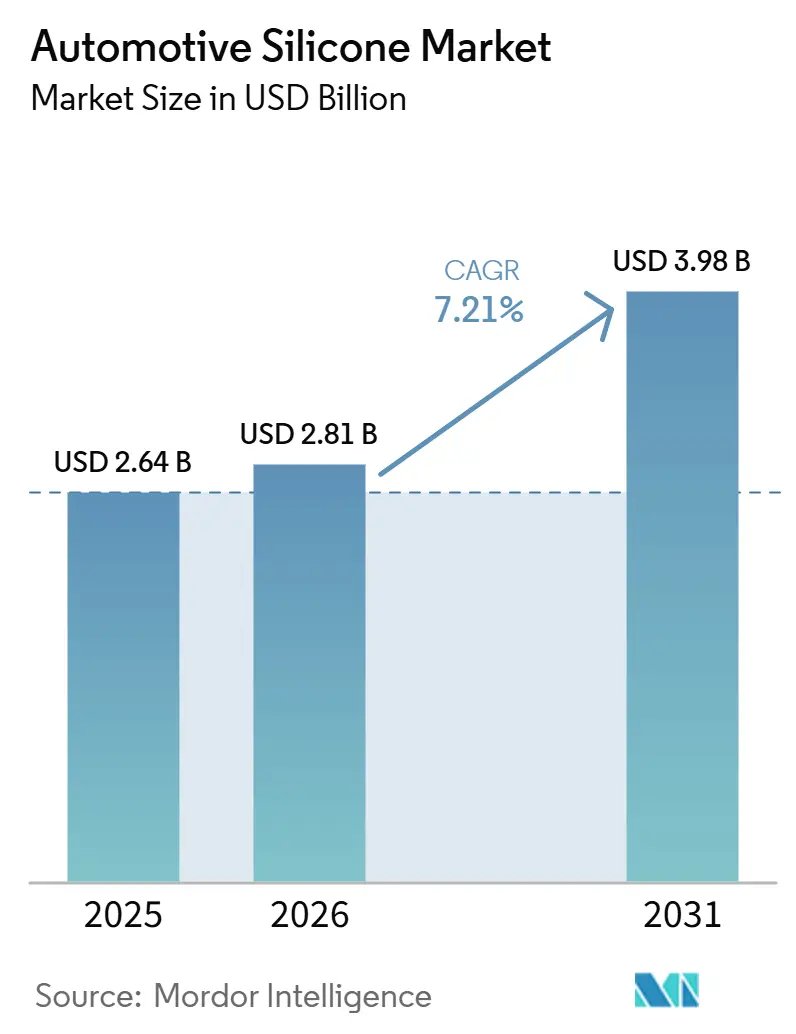
The automotive silicone market size was estimated at USD 2.64 billion in 2025 and is estimated to grow from USD 2.81 billion in 2026 to reach USD 3.98 billion by 2031, at a CAGR of 7.21% during the forecast period (2026-2031). The automotive silicone market is driven by demand in powertrain sealing, battery thermal interfaces, and automotive electronics protection. Silicone materials are used in these applications due to their heat resistance, chemical stability, and electrical insulation properties. Electric vehicle platforms require sealing for high-voltage connectors, battery packs, and inverters, which is changing material requirements for vehicle suppliers. Thermal runaway requirements and multi-material vehicle structures are also increasing demand for bonding, sealing, and protective materials. Suppliers are responding by developing application-specific grades and providing technical support to vehicle manufacturers.
Key Report Takeaways
- By product type, silicone elastomers held 38.75% of global revenue in 2025, while adhesives and sealants are forecast to grow at a CAGR of 8.63% through 2031.
- By vehicle type, SUVs accounted for 42.33% of global revenue in 2025 and are projected to expand at a CAGR of 8.48% through 2031.
- By application, powertrain and engine components represented 31.67% of the automotive silicone market size in 2025, while thermal management systems are forecast to advance at a CAGR of 10.25% through 2031.
- By geography, Asia-Pacific held 45.72% of global revenue in 2025 and is projected to grow at a CAGR of 8.51% through 2031.
Note: Market size and forecast figures in this report are generated using Mordor Intelligence’s proprietary estimation framework, updated with the latest available data and insights as of January 2026.
Global Automotive Silicone Market Trends and Insights
Drivers Impact Analysis*
| Drivers | (~) % Impact on CAGR Forecast | Geographic Relevance | Impact Timeline |
|---|---|---|---|
| Electric Vehicle Production and High-Voltage Sealing | +1.8% | Global, with the highest concentration in China, Germany, and the United States | Short term (≤ 2 years) |
| Thermal Management and Fire Safety Requirements | +1.5% | Global, with regulatory leadership in the EU and China | Medium term (2-4 years) |
| Lightweight and Multi-Material Vehicle Architectures | +0.9% | North America, Europe, and the Asia-Pacific | Medium term (2-4 years) |
| Durability Needs in Powertrain and Underbody Applications | +1.1% | Global, with spillover to the Middle-East, Africa, and South America | Long term (≥ 4 years) |
| Low-Volatile Materials for Advanced Driver-Assistance Systems (ADAS) and Automotive Electronics | +0.7% | North America, Europe, Japan, and South Korea | Medium term (2-4 years) |
| Source: Mordor Intelligence | |||
Growing Electric Vehicle Production Driving Demand for High-Voltage Sealing Solutions
The shift to 800V electric vehicle architecture has raised sealing requirements for batteries, connectors, and power electronics. Conventional Ethylene Propylene Diene Monomer (EPDM) rubber compounds have limitations in applications that require durable electrical insulation at higher temperatures and voltages. Dow introduced DOWSIL EG-4175 Silicone Gel in September 2025 for systems transitioning from 400V to 800V, with a stated temperature capability of 180°C. The automotive silicone market has a growing need for grades that reduce the risks of thermal degradation, partial discharge, and electrical tracking. Low-permittivity and platinum-cured formulations can address these demands in high-voltage hardware. These requirements favor suppliers that can meet qualification standards for battery and power-electronics applications.
Stringent Thermal Management and Fire Safety Requirements in Automotive Electronics
Battery thermal runaway mitigation requires several protective functions within the same battery pack. Silicone materials can serve as ceramifying foams, fire barriers, potting gels, and high-consistency rubber coatings. Wacker Chemie presented ELASTOSIL R 531/60 in October 2025, stating that it can operate continuously at 205°C and form a ceramic layer at 800°C to 1,000°C. Evonik described TEGO Therm coatings for battery housings as sprayable, fire-resistant, and suitable for complex three-dimensional surfaces. European Commission guidance published in February 2025 supports layered fire-containment approaches for electric vehicles in covered parking areas[1]European Commission, “Guidance on Fire Safety for Electric Vehicles Parked in Covered Parking Areas,” European Alternative Fuels Observatory, alternative-fuels-observatory.ec.europa.eu. The automotive silicone market benefits when vehicle manufacturers opt for integrated material systems rather than single-barrier materials.
Increasing Adoption of Lightweight and Multi-Material Vehicle Architectures
Vehicle structures increasingly combine aluminum, glass-fiber composites, structural polymers, and other materials. Silicone adhesives can retain bond integrity between dissimilar materials during the thermal cycling experienced by electrified vehicles. Porsche Engineering described its TABASKO program in 2025 as an example of the use of carbon-fiber composites in lightweight construction. These material combinations require bonding systems that accommodate different rates of thermal expansion. The automotive silicone market offers vehicle makers an opportunity to develop joints that avoid stress concentrations while preserving structural performance. This need is particularly relevant in SUVs and light commercial vehicles, where reducing body mass can help preserve payload and driving range in electrified models.
Rising Use of Silicone Materials for Enhanced Durability in Powertrain and Underbody Applications
Silicone remains relevant in underbody applications such as gaskets, seals, hose jacketing, and vibration dampers. Conventional and hybrid powertrains continue to require materials that perform through repeated high-temperature cycles. Mild hybrid systems retain conventional powertrain components while adding battery and power-electronics sealing requirements. KCC Silicone presented 18 technologies with Hyundai Mobis in July 2025, including low-compression-set liquid silicone rubber for powertrain seals and flame-retardant V-0 insulating liquid silicone rubber for high-voltage connectors. Wacker also described a low-density thermal gap filler with volatile content below 100 ppm and a UL 94 V-0 rating. These product characteristics extend silicone's use into thermal-management applications near powertrain systems.
Restraints Impact Analysis*
| Restraints | (~) % Impact on CAGR Forecast | Geographic Relevance | Impact Timeline |
|---|---|---|---|
| Raw Material Price Volatility and Supply Concentration | -1.2% | Global, most acute in Europe and North America, because of dependence on Asian feedstock | Short term (≤ 2 years) |
| Competition From Alternative Elastomers and Polymers | -0.8% | Global, with Ethylene Propylene Diene Monomer (EPDM) competition strongest in Asia-Pacific, and Thermoplastic Elastomer (TPE) substitution in interior applications | Medium term (2-4 years) |
| Recycling and End-of-Life Management Challenges | -0.5% | EU and China, with early-stage pressure in North America | Long term (≥ 4 years) |
| Source: Mordor Intelligence | |||
Volatility in Silicone Raw Material Prices and Supply Chain Concentration
Automotive silicone formulators are exposed to changes in silicone feedstock availability and pricing, particularly those without integrated upstream material positions. Supply disruptions can create price movements that compress margins when suppliers cannot pass costs to vehicle customers quickly. Silicon metal capacity requires long construction timelines and environmental approvals, which can delay supply responses. This limits buyer flexibility when supply is concentrated. As a result, the automotive silicone market remains exposed to short-term procurement and margin pressure.
Growing Competition from Alternative Elastomers and Polymer Materials
EPDM rubber holds a cost advantage in exterior sealing and weatherstripping applications where high-temperature and electrical requirements are less demanding. Thermoplastic elastomers can substitute for silicone in some interior sealing applications, and fluorosilicone competes with standard silicone grades in fuel-system and aggressive-media sealing due to its chemical resistance. The substitution threat varies by product form. Silicone adhesives and sealants face less competitive pressure in battery assemblies that require multi-substrate bonding and thermal stability. Suppliers can defend their position in specialist applications by demonstrating performance against the qualification thresholds used by major electric vehicle manufacturers.
*Our forecasts treat driver/restraint impacts as directional, not additive. The impact forecasts reflect baseline growth, mix effects, and variable interactions.
Segment Analysis
By Product Type: Adhesives Drive Growth as Elastomers Lead
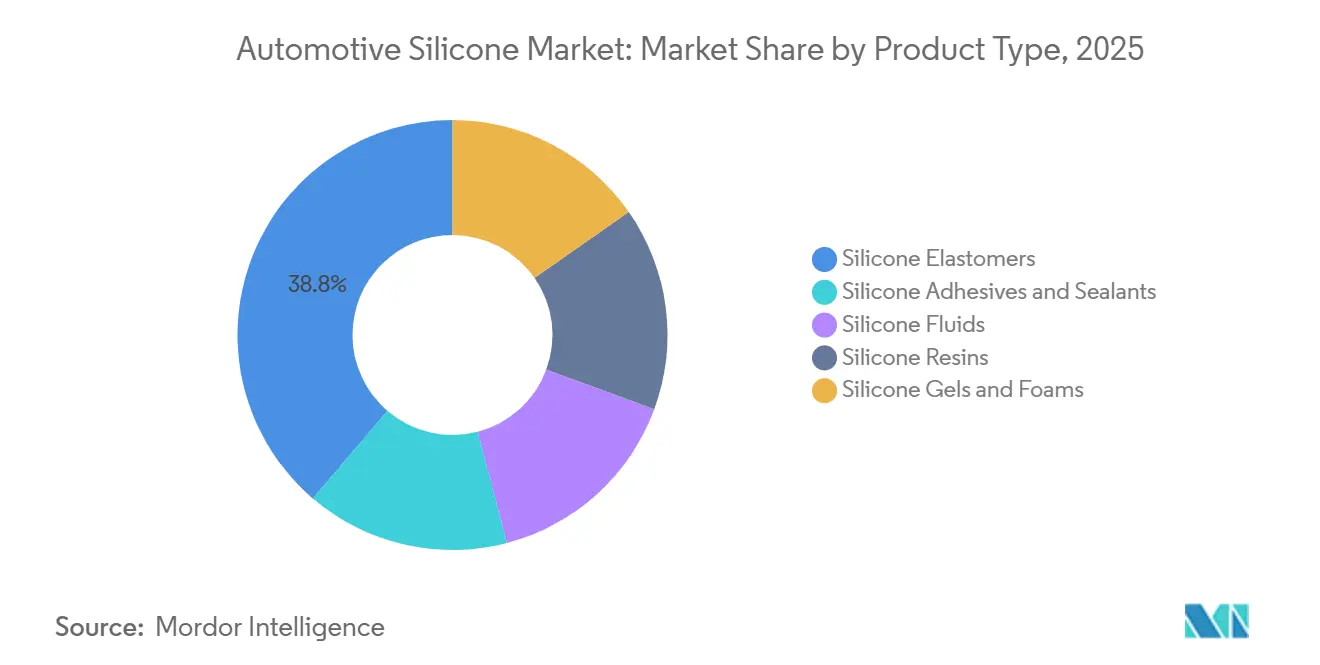
Silicone elastomers held 38.75% of the automotive silicone market share in 2025, making them the largest product category. They are used in gaskets, O-rings, hoses, and powertrain seals that require low compression set performance and heat resistance above 150°C. Adhesives and sealants are forecast to grow at 8.63% CAGR from 2026 to 2031, the highest rate among the listed product types. Cell-to-pack battery designs require materials that exclude moisture, provide electrical isolation, and support thermal management. The automotive silicone market benefits when these functions are combined in fewer components.
Silicone fluids support damping mechanisms and connector lubrication, while resins can form fire-barrier laminates for battery covers. Gels and foam protect and encapsulate vibration-sensitive electronics. Restrictions on D4, D5, and D6 cyclic siloxanes are influencing reformulation in fluids and adhesives. Dow announced a USD 100 million investment in specialty silicone manufacturing in June 2026, including engineered silicone materials capacity in Songjiang and Fukui, expected to come online in 2026. As a result, the automotive silicone market is placing greater emphasis on high-purity adhesives and gels for automotive electronics.



By Vehicle Type: SUVs Sustain Both Leadership and Momentum
SUVs accounted for 42.33% of the automotive silicone market size in 2025 and are projected to grow at an 8.48% CAGR through 2031. Larger battery packs require more sealing and thermal interface materials across a broader surface area. SUVs also require extensive underbody sealing and acoustic management. These requirements increase material content per vehicle.
Hatchbacks and sedans face stronger cost-reduction pressure and can use Ethylene Propylene Diene Monomer (EPDM) or thermoplastic elastomers in noncritical exterior sealing applications. Light commercial vehicle electrification creates additional demand for battery-grade materials in last-mile delivery vehicles. Heavy commercial vehicles continue to require powertrain seals and may need specialist seals for natural gas and hydrogen fuel systems. KCC Silicone completed its merger with Momentive Performance Materials Korea in January 2025, expanding its elastomer and liquid silicone rubber portfolio for Korean and Chinese electrified SUV manufacturers. Increasing battery energy density also benefits the automotive silicone market by raising thermal management material use per SUV.
By Application: Thermal Management Outpaces All Segments as Battery Density Rises
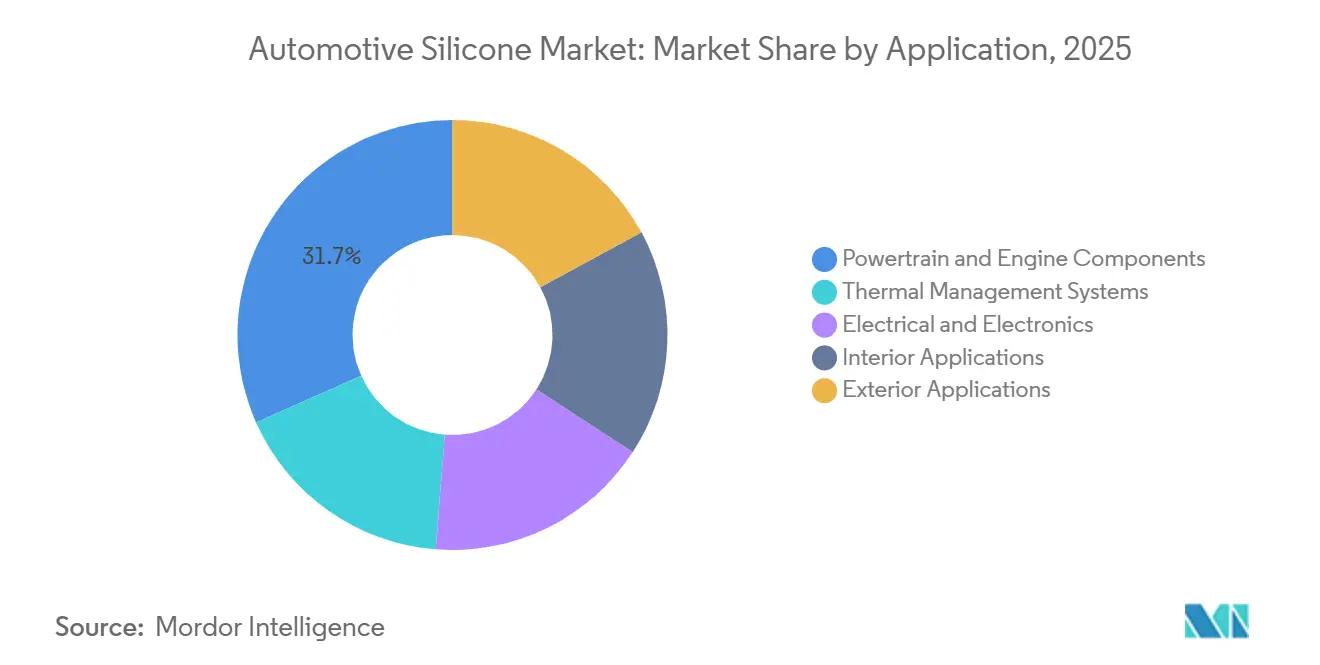
Powertrain and engine components accounted for 31.67% of global application revenue in 2025, maintaining this application group as the largest revenue base. Silicone hoses, gaskets, and seals remain necessary in internal combustion, hybrid, and fuel-cell powertrains. Thermal management systems are forecast to expand at a 10.25% CAGR through 2031, the fastest rate across applications. Higher battery cell energy density raises demand for silicone gap fillers and ceramifying foam barriers at cell-module interfaces. The automotive silicone market depends on materials that manage heat while maintaining performance in automated battery assembly processes.
Dow launched DOWSIL TC-3120 Thermal Gel in May 2026 with a thermal conductivity of 12 W/(m·K). Henkel introduced Bergquist TGF 2030APS with 1.7 W/(m·K) conductivity and Loctite TLB 9270APS with 2.0 W/(m·K) conductivity in May 2026 for cell-to-pack battery designs. Electrical and electronic applications are growing as domain controllers and zonal architectures increasingly integrate electronics into vehicles. Henkel launched Bergquist Gap Filler TGF 6500LVO in July 2026, with a conductivity of 6.5 W/(m·K), for Advanced Driver Assistance Systems (ADAS) modules and electronic control units. Interior and exterior applications remain stable but face substitution by lower-cost alternatives where specifications are less demanding.
Geography Analysis
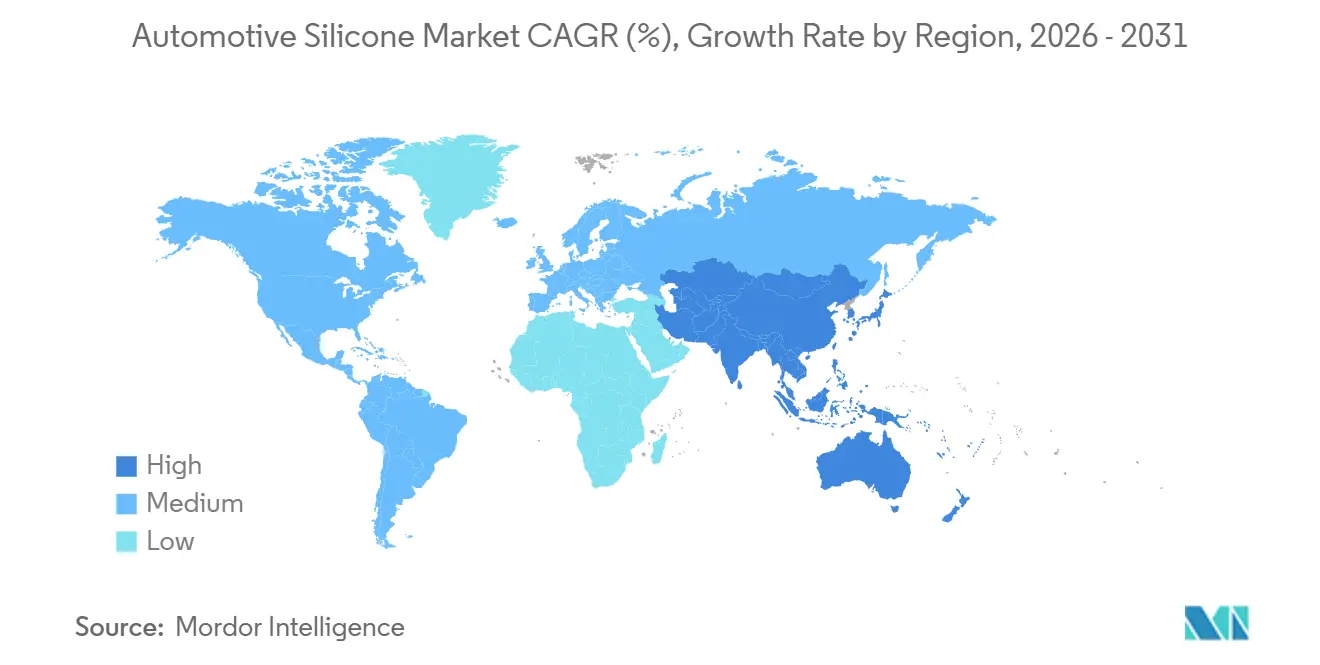
Asia-Pacific held 45.72% of the automotive silicone market share in 2025 and is expected to grow at a CAGR of 8.51% through 2031, making it both the largest and fastest-growing regional market. China drives demand for battery-grade sealing and thermal interface materials through its large base of new-energy vehicle production. Japan and South Korea contribute to regional innovation through companies such as Shin-Etsu Chemical and KCC Silicone. KCC Silicone's collaboration with Hyundai MOBIS in July 2025 highlighted the role of Korean OEM co-development in the automotive silicone market.
North America holds a significant position in the market, supported by the United States' Tier 1 automotive supply base and domestic battery manufacturing investment. In September 2025, Henkel completed an expansion of its Brandon, South Dakota, facility, doubling its production area to 6,500 square meters for thermal management materials and adhesives[2]Henkel AG & Co. KGaA, “Henkel Celebrates Expansion of Flagship Manufacturing Facility in Brandon, South Dakota,” Henkel, henkel.com. Henkel also opened its North America Battery Application Center in Madison Heights, Michigan, in September 2025. These investments brought technical development and material supply closer to OEM engineering teams. Mexico contributes to demand as part of the North American vehicle assembly network under the United States-Mexico-Canada Agreement (USMCA).
Europe's automotive silicone market is supported by fleet-average CO₂ regulations that encourage electrification and increase demand for battery sealing materials. Germany remains a key co-development location for OEMs, Tier 1 suppliers, and specialty material producers. Elkem's recycling research provides European suppliers with a potential technical advantage in end-of-life silicone processing. South America, the Middle-East, and Africa represent smaller demand centers, with lower silicone content per vehicle reflecting lower electric vehicle adoption rates in these regions.

Competitive Landscape
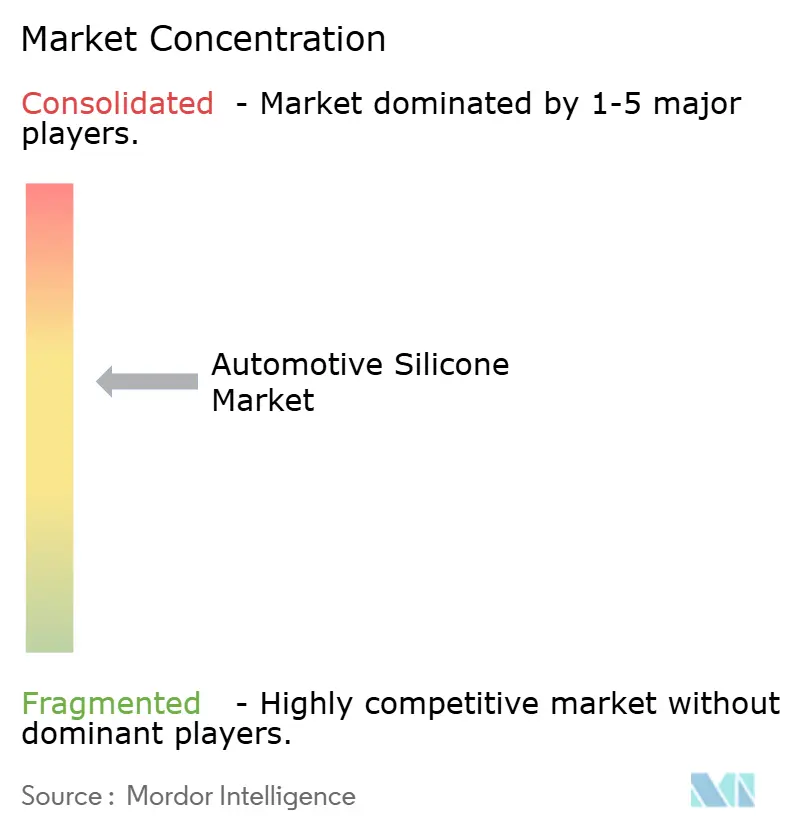
The automotive silicone market is moderately consolidated, with large integrated suppliers accounting for most of the global supply. Dow, Wacker Chemie, Shin-Etsu Chemical, Elkem ASA, and the combined KCC Silicone and Momentive Korea entity are identified as major producers. They compete through thermal management specialization, manufacturing reach, material quality, and application engineering depth. Dow expanded engineered silicone materials capacity in Songjiang and Fukui in 2026 as part of a USD 100 million investment program targeting specialty materials for power electronics and thermal protection.
Specialty suppliers such as Sika, Henkel, and H.B. Fuller compete through product formulation and customer co-development rather than upstream silicone scale. Henkel's application centers in Madison Heights and Düsseldorf demonstrate how technical service can support customer development work. The automotive silicone market also presents opportunities in low-volatile formulations and ceramifying composites for battery fire barriers. Smaller specialists can establish positions where intellectual property and qualification expertise matter more than production scale. Recycling capability represents another potential point of competition as vehicle producers seek practical end-of-life material solutions.
Elkem's gallium-catalyzed depolymerization process remains at laboratory scale, leaving commercial automotive silicone recycling infrastructure undeveloped. A supplier that industrializes this process and offers take-back programs could gain preference in OEM procurement. KCC Silicone's January 2025 merger with Momentive Korea expanded its elastomer and liquid silicone rubber portfolio. Dow's 2026 capacity program and Henkel's September 2025 South Dakota expansion reflect greater supplier focus on specialty materials and local support.
Automotive Silicone Industry Leaders
Dow
Wacker Chemie AG
Shin-Etsu Chemical Co., Ltd.
Elkem ASA
KCC Corporation
- *Disclaimer: Major Players sorted in no particular order

Recent Industry Developments
- June 2026: Dow launched DOWSIL TC-3120 Thermal Gel with a thermal conductivity of 12 W/(m·K), the highest in its commercial silicone gel portfolio, targeting autonomous vehicle electronic controllers and high-power automotive electronics modules.
- October 2025: Henkel completed the expansion of its Brandon, South Dakota, facility, doubling the production area to 6,500 square meters for Loctite and Bergquist-branded thermal management materials and adhesives serving EV OEM and electronics manufacturing customers.


Global Automotive Silicone Market Report Scope
Automotive silicone is a specialized synthetic elastomer or fluid used in vehicles to seal, bond, insulate, and protect components from extreme temperatures, chemicals, and moisture. It is available in various forms, including spray lubricants, adhesives, and Room-Temperature-Vulcanizing (RTV) sealants.
The automotive silicone market is segmented by product type, vehicle type, application, and geography. By product type, the market is segmented into silicone elastomers, silicone adhesives and sealants, silicone fluids, silicone resins, and silicone gels and foams. By vehicle type, the market is segmented into hatchback and sedan, SUV, light commercial vehicles (ICV), and heavy commercial vehicles (HCV). By application, the market is segmented into powertrain and engine components, electrical and electronics, interior applications, exterior applications, and thermal management systems. The report also covers the market size and forecasts for the automotive silicone market in 16 countries across major regions. The market sizes and forecasts are provided in terms of value (USD).
| Silicone Elastomers |
| Silicone Adhesives and Sealants |
| Silicone Fluids |
| Silicone Resins |
| Silicone Gels and Foams |
| Hatchback and Sedan |
| SUV |
| Light Commercial Vehicles (LCV) |
| Heavy Commercial Vehicles (HCV) |
| Powertrain and Engine Components |
| Electrical and Electronics |
| Interior Applications |
| Exterior Applications |
| Thermal Management Systems |
| Asia-Pacific | China |
| India | |
| Japan | |
| South Korea | |
| Rest of Asia-Pacific | |
| North America | United States |
| Canada | |
| Mexico | |
| Europe | Germany |
| United Kingdom | |
| France | |
| Italy | |
| Russia | |
| Rest of Europe | |
| South America | Brazil |
| Argentina | |
| Rest of South America | |
| Middle-East and Africa | Saudi Arabia |
| South Africa | |
| Rest of Middle-East and Africa |
| By Product Type | Silicone Elastomers | |
| Silicone Adhesives and Sealants | ||
| Silicone Fluids | ||
| Silicone Resins | ||
| Silicone Gels and Foams | ||
| By Vehicle Type | Hatchback and Sedan | |
| SUV | ||
| Light Commercial Vehicles (LCV) | ||
| Heavy Commercial Vehicles (HCV) | ||
| By Application | Powertrain and Engine Components | |
| Electrical and Electronics | ||
| Interior Applications | ||
| Exterior Applications | ||
| Thermal Management Systems | ||
| By Geography | Asia-Pacific | China |
| India | ||
| Japan | ||
| South Korea | ||
| Rest of Asia-Pacific | ||
| North America | United States | |
| Canada | ||
| Mexico | ||
| Europe | Germany | |
| United Kingdom | ||
| France | ||
| Italy | ||
| Russia | ||
| Rest of Europe | ||
| South America | Brazil | |
| Argentina | ||
| Rest of South America | ||
| Middle-East and Africa | Saudi Arabia | |
| South Africa | ||
| Rest of Middle-East and Africa | ||


Key Questions Answered in the Report
What is current market size of Automotive Silicone Market?
The automotive silicone market size was estimated at USD 2.64 billion in 2025 and is estimated to grow from USD 2.81 billion in 2026 to reach USD 3.98 billion by 2031, at a CAGR of 7.21% during the forecast period (2026-2031).
Which vehicle type creates the most demand for automotive silicones?
SUVs held 42.33% of demand in 2025 and are forecast to grow at an 8.48% CAGR through 2031. Larger battery packs, underbody sealing requirements, and acoustic management increase silicone content on electrified SUV platforms, while higher battery energy density can further increase demand for thermal management materials.
Why are thermal management systems important for automotive silicone suppliers?
Thermal management systems are forecast to grow at 10.25% CAGR through 2031 as higher battery energy density increases the need for gap fillers and protective barriers. Battery designs also require materials that manage heat while supporting electrical protection and automated assembly requirements, including gap fillers, potting gels, and protective barriers.
What limits the wider use of silicone materials in vehicles?
Feedstock price volatility, competition from EPDM and thermoplastic elastomers, and end-of-life recycling needs can limit adoption in cost-sensitive applications. Suppliers without integrated upstream positions face greater margin pressure when silicone input costs change, while recycling requirements create longer-term pressure to develop practical take-back and material recovery programs.
Page last updated on:





