
Chloroprene Rubber Market Size and Share
Market Overview
| Study Period | 2021 - 2031 |
|---|---|
| Market Size (2026) | USD 1.28 Billion |
| Market Size (2031) | USD 1.62 Billion |
| Growth Rate (2026 - 2031) | 4.77 % |
| Fastest Growing Market | Asia-Pacific |
| Largest Market | Asia-Pacific |
| Market Concentration | High |
Major Players *Disclaimer: Major Players sorted in no particular order Image © Mordor Intelligence. Reuse requires attribution under CC BY 4.0. | |
Chloroprene Rubber Market Analysis by Mordor Intelligence
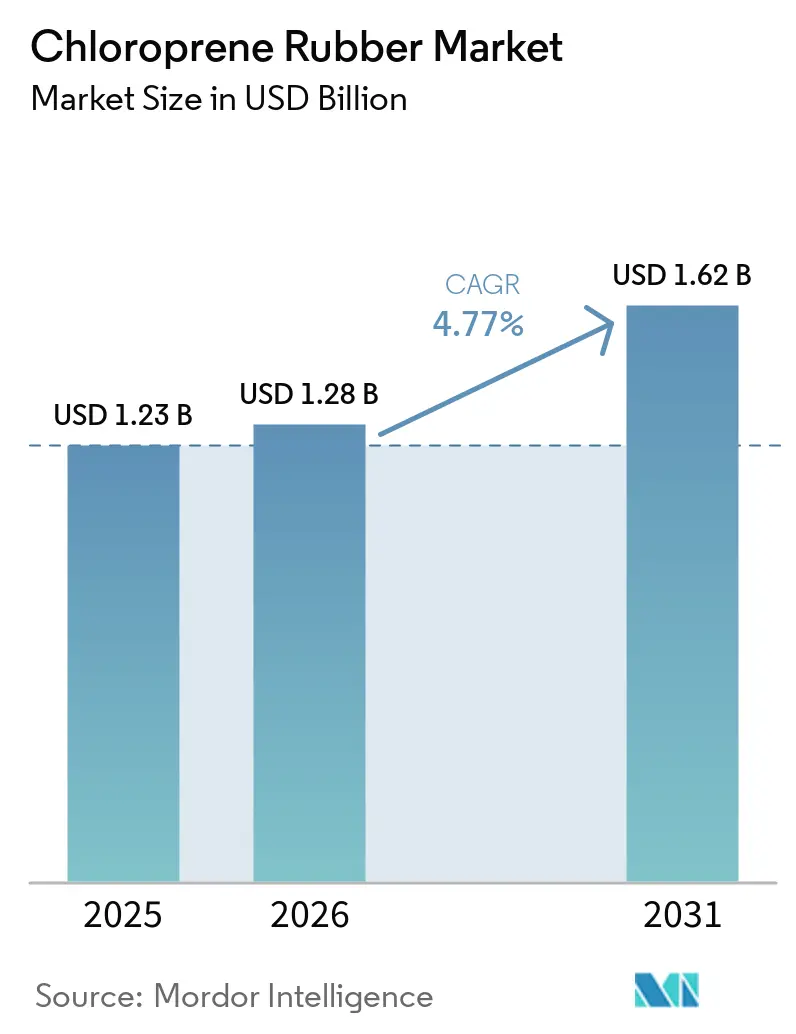
The Chloroprene Rubber Market size was estimated at USD 1.23 billion in 2025 and is estimated to grow from USD 1.28 billion in 2026 to USD 1.62 billion by 2031, at a CAGR of 4.77% during the forecast period (2026-2031). Vehicle electrification is increasing demand beyond conventional hoses and belts, including battery cooling systems, high-voltage cable jackets, and fire-barrier components. These applications require manufacturers to address heat resistance, fluid resistance, vibration, electrical protection, and fire performance simultaneously. Grid investment and infrastructure construction also support demand for weather-resistant gaskets, bearings, and expansion-joint materials, which must provide durable performance in exposed environments throughout project and maintenance cycles. Supply expansion remains challenging because high-grade polymerization capacity is concentrated among a limited number of producers and remains subject to feedstock cost fluctuations and operational constraints. As a result, converters have limited short-term alternatives when integrated suppliers raise prices or experience supply disruptions. Producers are responding by developing premium-grade products, expanding capacity, and using lower-footprint production inputs. Meanwhile, converters face pressure to preserve margins amid rising raw material costs and continued customer requirements for reliable, qualified materials. These conditions support growth in the chloroprene rubber market and favor suppliers that meet specifications through reliable supply, consistent technical performance, and a defined customer-qualification strategy for higher-value applications.
Key Report Takeaways
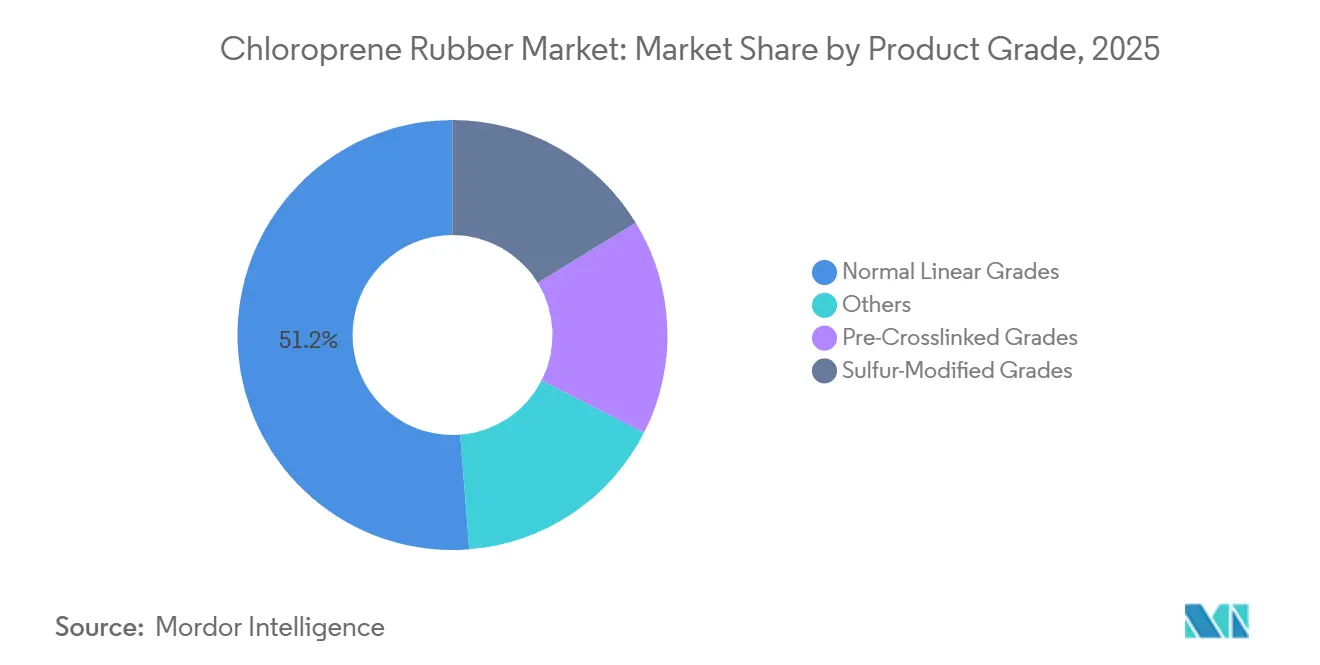
- By product grade, Normal Linear Grades held 51.24% of the chloroprene rubber market share in 2025, while Sulfur-Modified Grades are forecast to expand at a 5.13% CAGR through 2031.
- By application, Hoses and Tubes accounted for 33.15% of the chloroprene rubber market share in 2025 and are forecast to grow at a 5.45% CAGR through 2031.
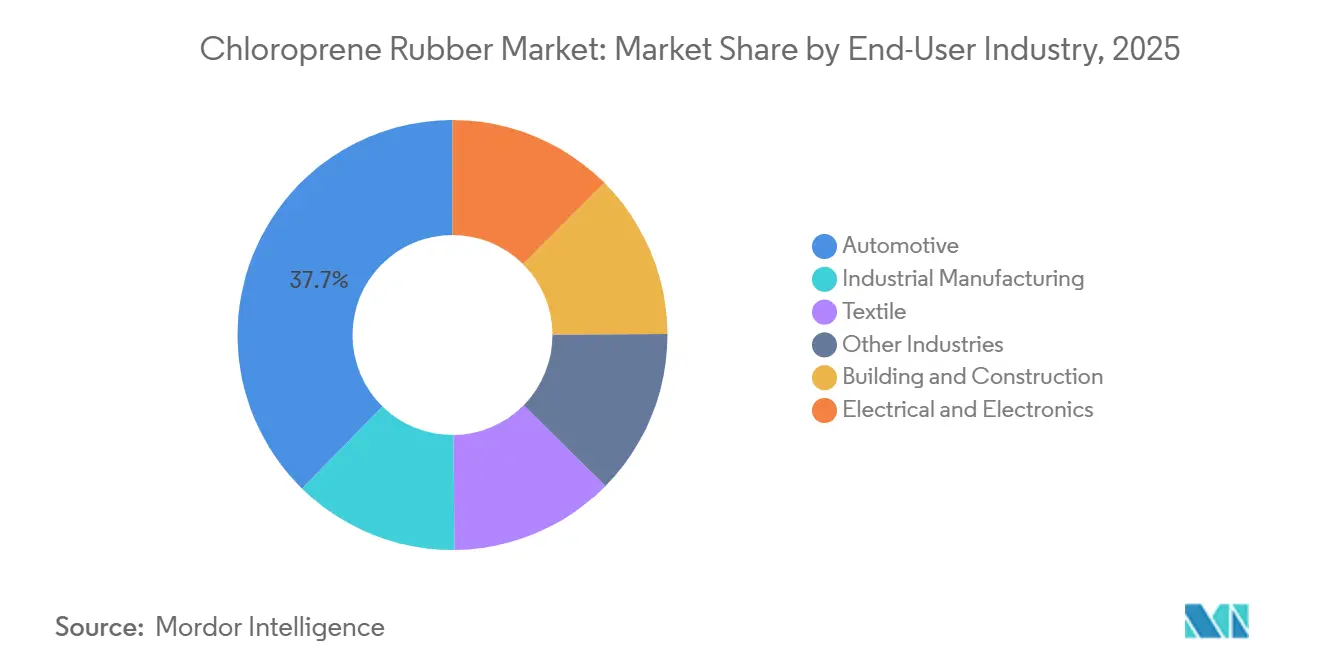
- By end-user industry, Automotive held 37.67% of the chloroprene rubber market share in 2025, while Electrical and Electronics is forecast to expand at a CAGR of 5.76% through 2031.
- By geography, Asia-Pacific held 48.34% of the chloroprene rubber market share in 2025 and is forecast to expand at a 5.22% CAGR through 2031.
Note: Market size and forecast figures in this report are generated using Mordor Intelligence’s proprietary estimation framework, updated with the latest available data and insights as of January 2026.
Market Trends and Insights
Drivers Impact Analysis of Chloroprene Rubber Market*
| Drivers | (~) % Impact on CAGR Forecast | Geographic Relevance | Impact Timeline |
|---|---|---|---|
| Electric Vehicle Sealing and Thermal-Management Demand | +1.8% | Global, with concentrated pull from China, South Korea, and Germany as EV production hubs | Medium term (2-4 years) |
| Infrastructure Spending on Weather-Resistant Elastomers | +1.2% | APAC core (India, Indonesia, Vietnam), spill-over to MENA and Sub-Saharan Africa | Long term (≥ 4 years) |
| Electrification of Wire, Cable, and Control Systems | +0.9% | Global, strongest in North America and the EU (grid modernization), ASEAN (rural electrification) | Medium term (2-4 years) |
| Growth of Waterborne Chloroprene Latex and Adhesives | +0.5% | East Asia (China, Japan, South Korea), with adoption moving into Southeast Asia and India | Short term (≤ 2 years) |
| EV Battery-Pack Fire-Barrier and Cooling-Loop Requirements | +0.8% | Global; regulatory influence through China GB/T 31467.3, United Nations Economic Commission for Europe (UNECE) norms, and US Underwriters Laboratories (UL) 9540A shaping material specifications | Medium term (2-4 years) |
| Source: Mordor Intelligence | |||
Electric Vehicle Sealing, Thermal Management, and Battery Protection Demand
Electric vehicle manufacturers require sealing materials that retain their shape during repeated temperature fluctuations and vibration. Chloroprene rubber meets oil- and glycol-resistance requirements in battery cooling loops, where concentrated ethylene glycol places greater demands on hoses and seals. A 2026 SAE International (SAE) technical paper covering more than 100 electric vehicle models from over 50 brands identified rubber gaskets and adhesive-based sealants as the two main sealing methods used in battery-pack designs[1]SAE International, “A Comprehensive Analysis of Sealing Methods for EV Battery Packs Trends and Insights,” SAE Mobilus, saemobilus.sae.org. This application shifts demand toward tighter-tolerance grades rather than standard hose compounds. Battery gaskets also require controlled compression-set performance and fire protection, increasing the requirement for sulfur-modified materials in qualified designs. The chloroprene rubber market is supported by expanding electric vehicle production and higher specification requirements for each thermal-management component. Components operating near batteries require predictable sealing performance throughout the vehicle's life rather than materials selected solely for low initial cost. This shift also increases the importance of compound selection, component testing, and supply consistency, supporting producers with experience in technically demanding automotive programs.
Infrastructure Spending on Weather-Resistant Elastomers
Infrastructure projects support demand for chloroprene rubber in bridge joints, tunnel gaskets, waterproofing systems, and seismic bearing pads. These applications require resistance to ozone, ultraviolet exposure, flame, and mechanical stress over long service periods. Although the material competes with silicone and ethylene-propylene-diene monomer (EPDM) in certain building applications, its combination of flame resistance and toughness remains relevant for bearing and sealing assemblies. Project specifications can also create long replacement cycles once an asset adopts a chloroprene-based compound. This provides suppliers with a source of demand that is less directly tied to passenger vehicle production. In the chloroprene rubber market, infrastructure demand is particularly relevant as public construction and transportation upgrades expand across Asia and the Middle East. The same technical requirements apply to original projects, maintenance activities, and the eventual replacement of exposed sealing and bearing components. Long planning cycles also make this demand more stable than short-cycle purchasing, as project teams typically determine performance specifications before construction begins and cannot easily change them after installation.
Electrification of Wire, Cable, and Control Systems
Grid modernization and rural electrification are expanding the use of flame-resistant elastomers in wire and cable systems. Chloroprene rubber provides low-temperature flexibility and flame resistance for certain outdoor, buried, and specialized cable applications. Electric vehicle battery-management harnesses and high-voltage interconnects represent another area of demand, as they operate near heat-generating inverters and require reliable mechanical protection. Compliance testing under the International Electrotechnical Commission (IEC) 60332 supports the use of materials with established flame-propagation performance in public infrastructure cable specifications. However, requirements vary across the category. Power-transmission cables can use more conventional materials, while vehicle wiring requires tighter control. This grade differentiation supports the use of specialty materials in the chloroprene rubber market, as consistent electrical insulation and physical durability are important in tightly packed vehicle and control-system assemblies. It also directs suppliers toward applications where material reliability and processing cost are both relevant, rather than broad applications that several standard elastomers can serve.
Growth of Waterborne Chloroprene Latex and Adhesives
Waterborne chloroprene latex is gaining adoption in construction adhesives, asphalt waterproofing, footwear assembly, and interior bonding applications. The shift is most evident in East Asian manufacturing clusters, where users are moving away from solvent-based systems. Research published in Polymers in 2024 found that chloroprene latex modified with methyl methacrylate and vinyl-polyhedral oligomeric silsesquioxane (POSS) achieved a peel strength of 20.2 kgf at 100°C. This result supports its use in applications that require thermal performance while reducing solvent consumption. The development addresses a historical performance barrier that has limited the use of waterborne formulations in demanding joinery and automotive interior applications. The chloroprene rubber market can address demand from adhesive users seeking waterborne systems without sacrificing heat-resistant bonding performance, particularly as customers balance bonding strength and application handling while transitioning from solvent-based production processes. This trend supports broader adoption in applications where adhesives must be practical for factory processing while meeting the service requirements of automotive interiors and durable construction assemblies.
Restraints Impact Analysis of Chloroprene Rubber Market*
| Restraints | (~) % Impact on CAGR Forecast | Geographic Relevance | Impact Timeline |
|---|---|---|---|
| Chloroprene Monomer and Feedstock Price Volatility | -0.9% | Global; acute in Northeast Asia (butadiene route) and China (calcium-carbide/acetylene route) | Short term (≤ 2 years) |
| Volatile Organic Compound (VOC), Hazardous Substance, and Workplace-Exposure Compliance Costs | -0.7% | North America and the EU most exposed; regulatory influence under the US EPA National Emission Standards for Hazardous Air Pollutants (NESHAP) and the EU REACH frameworks | Medium term (2-4 years) |
| Concentrated Global Polymerization Capacity | -0.5% | Global, with North America structurally vulnerable following Denka Performance Elastomer (DPE) closure | Long term (≥ 4 years) |
| Source: Mordor Intelligence | |||
Chloroprene Monomer, Feedstock, and Capacity Volatility
Chloroprene rubber costs reflect both butadiene-based production and acetylene routes that rely on calcium carbide. This dual-feedstock structure exposes producers to petrochemical price fluctuations and changes in Chinese energy policy. In April 2026, Tosoh announced a price increase of JPY 80/kg or more for chloroprene rubber, citing higher raw material costs. Resonac also announced price adjustments in April 2026, followed by a further increase of USD 350/ton or more for shipments beginning July 1, 2026[2]Resonac Corporation, “Price Adjustment of Chloroprene Rubber,” Resonac Corporation, resonac.com. A limited number of integrated producers account for the production of high-grade chloroprene rubber. Consequently, unscheduled outages or constrained feedstock availability provide few immediate supply alternatives. The chloroprene rubber market is therefore subject to rapid cost pass-through. Smaller compounders face higher margin risk than large converters, which can negotiate contractual pass-through mechanisms and plan purchases through longer-term customer agreements or diversified sourcing arrangements. This difference can affect which companies continue to supply qualified compounds during extended periods of elevated input costs, particularly when buyers are slow to accept price increases.
Volatile Organic Compound (VOC), Hazardous-Substance, and Workplace-Exposure Compliance Costs
Chloroprene manufacturing is subject to emissions, material-handling, workplace-exposure, and product-registration requirements. In April 2024, the U.S. Environmental Protection Agency issued revised hazardous air pollutant standards for chloroprene rubber manufacturing. Denka subsequently confirmed the dismantling of its Louisiana chloroprene facility, leaving North America without domestic chloroprene polymerization capacity. In Europe, the Registration, Evaluation, Authorization and Restriction of Chemicals (REACH) regulation continues to govern chemical-risk management and supply chain obligations. Large integrated producers can distribute monitoring, engineering, and registration costs across broader operations, while smaller operators have less flexibility. These requirements may prompt formulators to adopt alternative adhesive chemistries when compliance costs exceed the performance benefits of chloroprene rubber. However, chloroprene rubber provides resistance, durability, and processing characteristics required for specific applications. The impact is most pronounced in applications where a less complex formulation can meet customer requirements, rather than in applications where chloroprene rubber supports product reliability.
*Our forecasts treat driver/restraint impacts as directional, not additive. The impact forecasts reflect baseline growth, mix effects, and variable interactions.
Chloroprene Rubber Market Segment Analysis
By Product Grade:
Linear Grades Retain Scale While Sulfur-Modified Grades Gain Specialty DemandNormal Linear Grades held 51.24% of the chloroprene rubber market in 2025, supported by their use in general-purpose automotive hoses, industrial belts, and construction adhesives. Their position reflects a balance of processability, cost, and performance in applications that do not require advanced specifications. These grades remain suitable for established construction applications and conventional vehicle components that meet minimum technical requirements. Pre-Crosslinked Grades occupy a middle position in continuous extrusion and profile production. Their dimensional stability can reduce material losses during processing, enabling fabricators to prioritize stable output and repeatable profiles over the additional performance features required in specialized sealing or electrical components.
Sulfur-Modified Grades are forecast to grow at a 5.13% CAGR through 2031, making them the fastest-growing product grade in the chloroprene rubber market. Their controlled crystallization and resistance to compression set support battery-gasket applications, including those requiring UL94 V-0 fire performance. The segment benefits when original equipment manufacturers (OEMs) prioritize performance at elevated temperatures over lower initial material costs. Other specialty grades serve smaller applications, such as low-temperature cable jackets and medical gloves, where polymerization control provides differentiation. In June 2026, ARLANXEO stated that its Baypren portfolio had used International Sustainability and Carbon Certification (ISCC) PLUS-certified chlorine since January 2026, reducing its average global warming potential by 20% compared with 2025 levels. This product-grade structure maintains standard grades for broad demand, while qualified specialty grades serve applications where safety, operating temperature, or long-term sealing performance are critical.



By Application:
Hoses and Tubes Combine Leading Scale with the Fastest GrowthHoses and Tubes accounted for 33.15% of the chloroprene rubber market by application in 2025. The segment is forecast to grow at a CAGR of 5.45% through 2031, making it both the largest and fastest-growing application category. Battery thermal-management loops are a key source of demand, as coolant hoses must withstand glycol-based fluids, pressure, and extended operating cycles. These requirements support demand for tighter-tolerance compounds with heat stabilizers and reinforcement systems rather than commodity materials. Component manufacturers require compounds that maintain performance under sustained thermal cycling and vehicle operating conditions.
Gaskets, Seals, and O-Rings represent the next major application group, supported by compression-set resistance and outdoor durability in infrastructure assemblies. Belts and vibration-control components are more mature applications, as lower demand for certain internal-combustion-engine belts is partly offset by demand for anti-vibration mounts and noise-isolation components in electric drivetrains. Wire and Cable Products generate lower value but benefit from investments in grid modernization and electrification. Adhesives and Coatings are evolving to incorporate waterborne chloroprene latex, achieving a peel strength of 20.2 kgf at 100°C, supporting higher-temperature bonding applications. Other applications include medical gloves and specialty foam products, which provide stable but limited demand. Overall, the application mix supports established uses, while battery systems, cable protection, and waterborne bonding address more demanding product requirements.
By End-User Industry:
Automotive Leads Current Demand, While Electrical and Electronics Sets the Growth RateAutomotive accounted for 37.67% of the chloroprene rubber market in 2025. The transition to electric vehicles shifts demand rather than eliminating the use of chloroprene rubber in vehicles. Conventional under-the-hood hoses, drive boots, and vibration mounts are supplemented by battery-cooling hoses, battery-pack gaskets, and high-voltage cable grommets. This continuity maintains the automotive industry's role in the chloroprene rubber industry as vehicle architectures evolve. The material remains relevant where sealing, vibration control, fluid handling, and cable protection must perform under changing thermal and mechanical conditions.
Electrical and Electronics is forecast to expand at a 5.76% CAGR through 2031, the highest growth rate among end-user industries. Flame resistance, dielectric stability, and a broad operating temperature range support its use in cable jackets, connector seals, and battery management harnesses. Building and Construction also benefit from demand for bearing pads, expansion joints, and waterproofing systems in infrastructure projects. Industrial Manufacturing provides steady demand through conveyor belts, chemical-process hoses, and pump seals. Textile, medical, sports equipment, and marine applications remain smaller but offer specialized uses where performance requirements can justify higher-value materials. This end-user mix balances an established demand base with electrical-system requirements, reducing dependence on a single application while increasing the importance of material qualification in higher-growth applications.
Geography Analysis
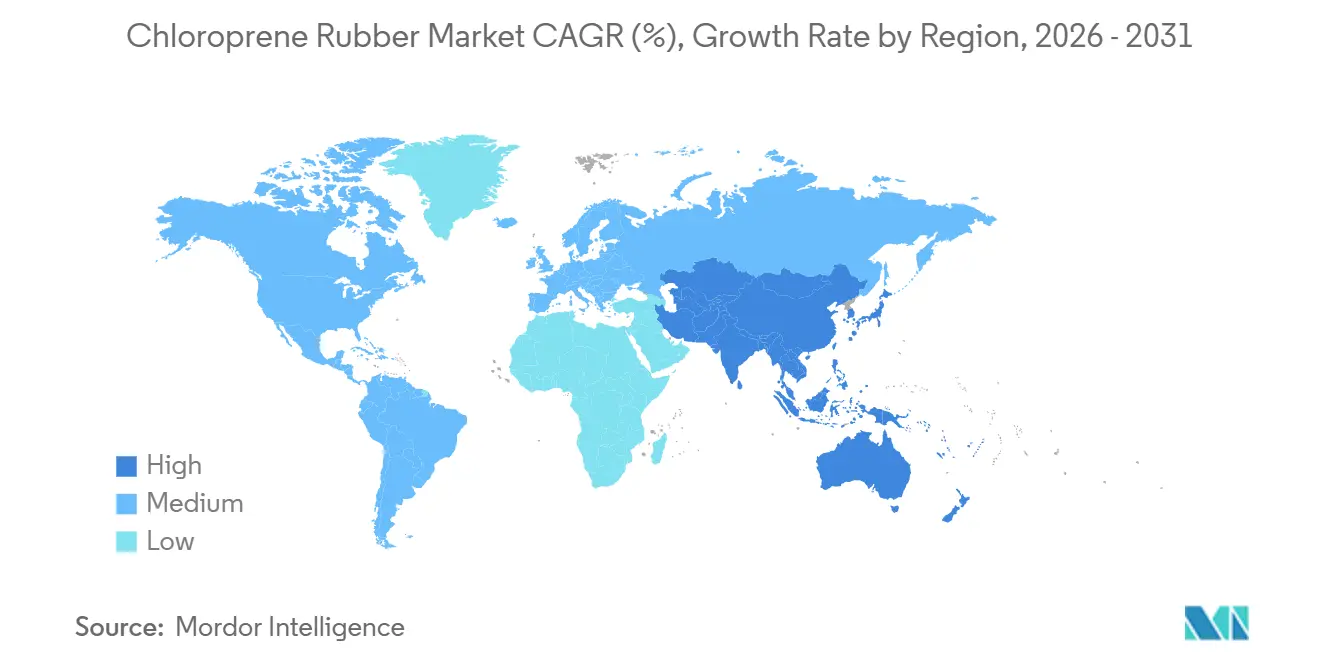
APAC Chloroprene Rubber Market
Asia-Pacific accounted for a 48.34% share of the chloroprene rubber market in 2025 and is projected to grow at a CAGR of 5.22% through 2031. China combines a significant consumption base with production via butadiene and calcium carbide-acetylene routes. Imported grades remain relevant in thermal management and medical applications where domestic alternatives do not meet all specifications. Japan supplies materials through producers such as Tosoh and Denka. In June 2025, Tosoh announced an investment of JPY 75 billion (USD 0.47 billion) in a new plant at its Nanyo Complex, which is expected to add 22,000 tons per annum (tpa) when commercial operations begin in spring 2030.
APAC and Europe Chloroprene Rubber Market
South Korea and ASEAN countries support demand through expanding automotive and electronics production. India also contributes to regional consumption as domestic procurement of vehicle components increases. Europe remains important for precision sealing and high-voltage cable applications, particularly in Germany, the United Kingdom, and France. Automotive quality requirements and advanced manufacturing capabilities sustain demand for specification-driven grades. Chemical restrictions have made latex adhesive formulations more challenging in certain European applications. Consequently, demand for imported grades persists alongside greater scrutiny of formulation choices.
The Americas and MEA Chloroprene Rubber Market
North America is increasingly dependent on imported polymer following the closure and dismantling of Denka’s Louisiana operation. This dependence exposes converters to Asian pricing fluctuations and supply disruptions, increasing the importance of stable procurement and material qualification for regional fabricators. South America remains centered on Brazil’s automotive manufacturing and construction waterproofing demand, while Argentina faces less predictable procurement conditions. Saudi Arabia’s infrastructure and industrial diversification programs support demand for construction sealants and seismic bearing systems. South Africa maintains demand through automotive assembly serving domestic and Sub-Saharan markets. Collectively, these regions contribute incremental demand but do not match Asia-Pacific’s production and consumption scale. They also remain more dependent on the availability, pricing, and technical support provided by international suppliers.

Competitive Landscape
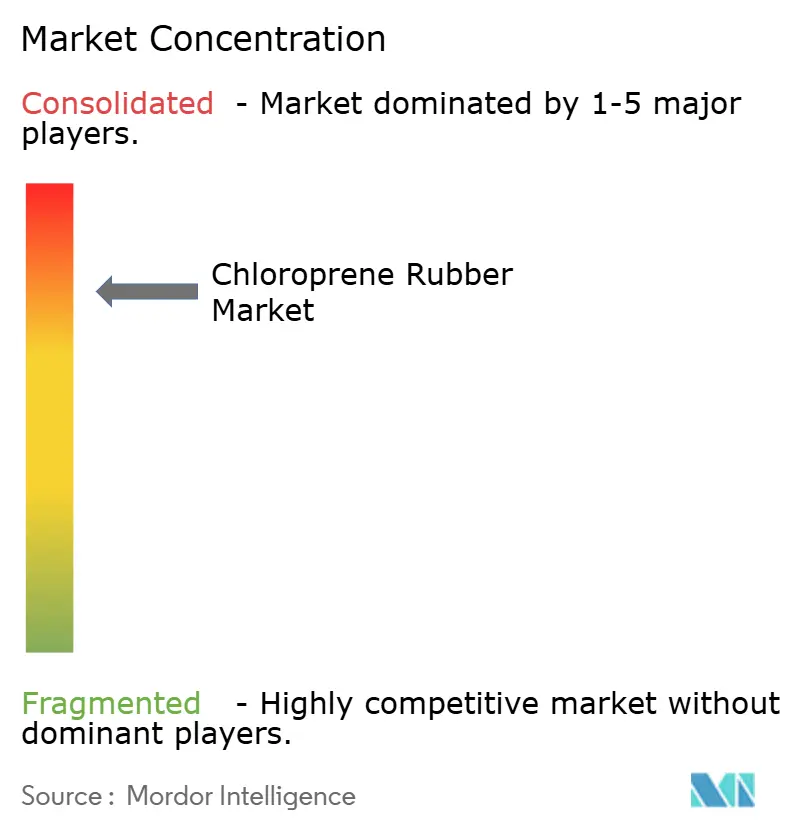
The chloroprene rubber market is consolidated. ARLANXEO, Denka, Tosoh, and Resonac supply high-grade materials from Germany and Japan, while Chinese producers have expanded their production of commodity-grade materials. Key Chinese producers include Shanxi Synthetic Rubber Group, Shanxi-Nairit Synthetic Rubber, Shanxi Huojia Changhua, Chongqing Huayi Changshou, and Sundow Polymers. The competitive landscape distinguishes materials used in demanding applications from price-driven commodity-grade materials.
This distinction is most evident in electric vehicle thermal management and medical applications, where customer qualification requirements and material consistency limit substitution. Denka’s closure and dismantling of its Louisiana facility removed North America’s last domestic chloroprene polymerization plant, increasing reliance on Japanese and European supply to meet Western demand for high-grade materials. ARLANXEO’s transition to ISCC PLUS-certified chlorine across its Baypren portfolio combines documented improvements in environmental footprint with product traceability.
Custom compounds for battery cooling hoses and fire-resistant battery gaskets remain specialized application areas. These components require a verified balance of fluid resistance, thermal stability, sealing performance, and customer approval. Waterborne chloroprene latex also represents an opportunity, as adhesive users seek lower-solvent alternatives that retain thermal performance in applications where bond strength cannot be compromised for simpler processing. Trelleborg and Celanese presented Hytrel thermoplastic copolyester (TPC)-based automotive sealing boots at K 2025, citing a part-cost reduction of at least 10% compared with chloroprene-based boots. This competitive pressure is greatest in standardized sealing geometries, where molding efficiency is more important than material performance requirements. In complex applications, traceability, thermal resistance, and approval requirements increase switching costs. Product selection in these applications is based on demonstrated service performance rather than direct comparisons of component costs alone.
Chloroprene Rubber Industry Leaders
Denka Company Limited
ARLANXEO
Tosoh Corporation
Shanxi Synthetic Rubber Group Co.Ltd
Sundow Polymers Co., Ltd.
- *Disclaimer: Major Players sorted in no particular order
Chloroprene Rubber Market Companies Covered in this Report
- ARLANXEO
- BRP Manufacturing
- C. Otto Gehrckens GmbH & Co. KG
- Chongqing Huayi Changshou Chemical Group Co., Ltd.
- Denka Company Limited
- RADO Gummi GmbH
- Resonac Holdings Corporation
- SEDO Chemicals
- Shanxi Huojia Changhua Synthetic Rubber Co., Ltd.
- Shanxi Synthetic Rubber Group Co.Ltd
- Shanxi-Nairit Synthetic Rubber Co.,Ltd.
- Sundow Polymers Co., Ltd.
- Tosoh Corporation
- Trelleborg Group
- Zenith Rubber

Recent Industry Developments in Chloroprene Rubber Market
- June 2026: ARLANXEO and Covestro announced that, since January 2026, ARLANXEO has used International Sustainability and Carbon Certification (ISCC) PLUS-certified chlorine from Covestro in its chloroprene rubber production. This initiative has reduced the average global warming potential of the Baypren portfolio by approximately 20% compared with 2025 levels. It marks the first portfolio-wide sustainability certification in the chloroprene rubber (CR) polymer market and provides a verifiable product environmental footprint document for each grade.
- June 2026: Resonac Corporation announced a second price increase for its Resonac Chloroprene product line. Effective for shipments from July 1, 2026, the company increased prices by USD 350 per ton or more, citing continued escalation in raw material costs resulting from instability in the Middle East.


Global Chloroprene Rubber Market Report Scope
Chloroprene rubber is a synthetic elastomer produced through the polymerization of chloroprene. It offers strong chemical resistance, high resistance to aging and ozone, and greater wear resistance than natural rubber. It retains its shape after deformation and does not melt when heated; however, it decomposes at high temperatures.
The chloroprene rubber market is segmented by product grade, application, end-user industry, and geography. By product grade, the market is segmented into normal linear grades, pre-crosslinked grades, sulfur-modified grades, and others. By application, the market is segmented into hoses and tubes, gaskets, seals and o-rings, belts and vibration-control components, wire and cable products, adhesives and coatings, and other applications. By end-user industry, the market is segmented into automotive, building and construction, electrical and electronics, industrial manufacturing, textile, and other industries. The report also covers market size and forecasts for the chloroprene rubber across 15 countries in major regions. The market sizes and forecasts are provided in terms of value (USD).
| Normal Linear Grades |
| Pre-Crosslinked Grades |
| Sulfur-Modified Grades |
| Others |
| Hoses and Tubes |
| Gaskets, Seals and O-Rings |
| Belts and Vibration-Control Components |
| Wire and Cable Products |
| Adhesives and Coatings |
| Other Applications |
| Automotive |
| Building and Construction |
| Electrical and Electronics |
| Industrial Manufacturing |
| Textile |
| Other Industries |
| Asia-Pacific | China |
| India | |
| Japan | |
| South Korea | |
| ASEAN Countries | |
| Rest of Asia-Pacific | |
| North America | United States |
| Canada | |
| Mexico | |
| Europe | Germany |
| United Kingdom | |
| France | |
| Italy | |
| NORDIC Countries | |
| Rest of Europe | |
| South America | Brazil |
| Argentina | |
| Rest of South America | |
| Middle East and Africa | Saudi Arabia |
| South Africa | |
| Rest of Middle East and Africa |
| By Product Grade | Normal Linear Grades | |
| Pre-Crosslinked Grades | ||
| Sulfur-Modified Grades | ||
| Others | ||
| By Application | Hoses and Tubes | |
| Gaskets, Seals and O-Rings | ||
| Belts and Vibration-Control Components | ||
| Wire and Cable Products | ||
| Adhesives and Coatings | ||
| Other Applications | ||
| By End-User Industry | Automotive | |
| Building and Construction | ||
| Electrical and Electronics | ||
| Industrial Manufacturing | ||
| Textile | ||
| Other Industries | ||
| By Geography | Asia-Pacific | China |
| India | ||
| Japan | ||
| South Korea | ||
| ASEAN Countries | ||
| Rest of Asia-Pacific | ||
| North America | United States | |
| Canada | ||
| Mexico | ||
| Europe | Germany | |
| United Kingdom | ||
| France | ||
| Italy | ||
| NORDIC Countries | ||
| Rest of Europe | ||
| South America | Brazil | |
| Argentina | ||
| Rest of South America | ||
| Middle East and Africa | Saudi Arabia | |
| South Africa | ||
| Rest of Middle East and Africa | ||


Key Questions Answered in the Report
What is current market size of Chloroprene Rubber Market?
The Chloroprene Rubber Market size was estimated at USD 1.23 billion in 2025 and is estimated to grow from USD 1.28 billion in 2026 to USD 1.62 billion by 2031, at a CAGR of 4.77% during the forecast period (2026-2031).
Which product grade is growing fastest in chloroprene rubber?
Sulfur-Modified Grades are forecast to expand at a 5.13% CAGR through 2031, supported by battery-gasket and fire-protection requirements. Their performance is relevant where controlled crystallization and compression-set resistance are required, particularly in applications that require dependable sealing at higher temperatures rather than a standard general-purpose grade.
Why are electric vehicles important for chloroprene rubber demand?
Electric vehicles use chloroprene rubber in battery cooling hoses, gaskets, cable jackets, and protection systems that need heat, fluid, and vibration resistance. These uses shift demand toward tighter-tolerance compounds with higher qualification requirements, making component reliability and consistent material performance important throughout the vehicle design and sourcing process.
Which application leads to the demand for chloroprene rubber?
Hoses and Tubes held a 33.15% share in 2025 and are forecast to grow at a 5.45% CAGR through 2031. Battery cooling loops support demand because hoses must withstand glycol-based fluids under pressure over a long service life, favoring compounds designed for sustained thermal cycling and careful fluid handling.
Page last updated on:





