

Shampoo Market Analysis by Mordor Intelligence
The shampoo market size was valued at USD 37.26 billion in 2026 and estimated to grow from USD 39.04 billion in 2027 to reach USD 48.7 billion by 2032, at a CAGR of 4.52% during the forecast period (2027-2032).
Ingredient-led premium lines and multifunctional rinse-off offers give shampoo suppliers routes to value growth beyond basic cleansing. In India, general-trade expansion connects differentiated products with wider retail access. Men's ranges offer another route to distinct purchases, broadening the potential revenue earned from a cleansing routine. The Iran war that began in February 2026 added shipping and crude-linked input pressures for Indian producers, while EU rules raised reformulation and labeling work. Higher-value shampoo sales offer revenue growth, but reformulation and freight spending determine how much of that gain suppliers retain.
Key Report Takeaways
- By product type, standard shampoo held a 90.92% shampoo market share in 2026, while natural/organic/medicated shampoo is forecast to be the fastest-growing segment at a 6.68% CAGR during 2027-2032.
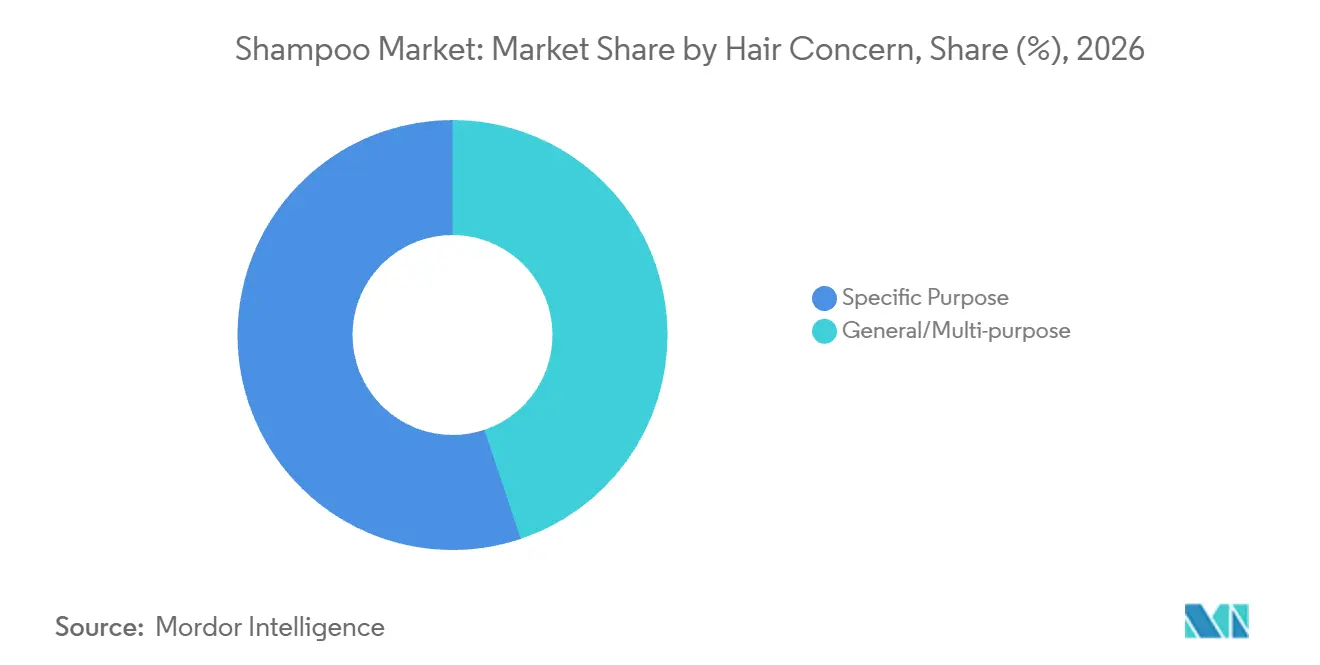
- Specific-purpose products led the hair-concern category with a 55.15% share of the shampoo market size in 2026 and are forecast to grow fastest at a 4.62% CAGR during 2027-2032.
- Across price categories, mass shampoo accounted for 64.04% of revenue in 2026, with luxury/premium shampoo forecast to grow fastest at a 4.7% CAGR during 2027-2032.
- By distribution channel, supermarkets/hypermarkets held 35.05% of revenue in 2026, whereas online retail stores are forecast to grow fastest at a 6.12% CAGR during 2027-2032.
- Geographically, Asia-Pacific accounted for 47.36% of revenue in 2026 and is forecast to grow fastest at a 5.1% CAGR during 2027-2032.
Note: Market numbers in this report are based on Mordor Intelligence's proprietary estimation framework, which combines nine months of actuals with Q4 projections for base year 2026.
Market Trends and Insights
Drivers Impact Analysis of Shampoo Market*
| Driver | (~) % Impact on CAGR Forecast | Geographic Relevance | Impact Timeline |
|---|---|---|---|
| Growing preference for organic and herbal shampoos | +0.6% | Asia-Pacific, particularly India | Medium term (2-4 years) |
| Influence of social media and digital marketing | +2.4% | North America, particularly the United States | Short term (≤ 2 years) |
| Increasing demand for men's segment shampoos | +0.7% | North America, Europe and Asia-Pacific | Medium term (2-4 years) |
| Rise of multifunctional shampoos with innovative active ingredients | +2.1% | North America, particularly the United States | Short term (≤ 2 years) |
| Sustainability and eco-friendly packaging | +0.5% | Europe, particularly Italy | Medium term (2-4 years) |
| Growing demand for AI-personalized and custom shampoos | +0.3% | United States and Canada | Long term (≥ 4 years) |
| Source: Mordor Intelligence | |||
Growing preference for organic and herbal shampoos
Preference for organic and herbal ingredients gives shampoo buyers a reason to choose a brand for more than cleansing alone. Dabur reported double-digit growth in Vatika Shampoo in the fourth quarter of fiscal 2025-26. In its FY2025-26 India FMCG discussion, Dabur said a campaign positioned Vatika as a natural/herbal shampoo choice. Dabur also reported that Vatika Shampoo delivered its highest-ever revenue in FY2025-26. These brand-level results show a revenue opportunity around a natural/herbal identity, giving suppliers a basis to seek purchases from ingredient-conscious shoppers rather than competing only on routine washing.
Influence of social media and digital marketing
Social platforms can bring shampoo brands into consideration before shoppers encounter competing bottles on a store shelf. An April 2025 U.S. survey found that 49% of consumers discovered personal-care products through social platforms, compared with 37% through word of mouth.[1] The surveyed personal-care category included shampoo. For suppliers, that discovery channel creates an opportunity to explain a product's benefits outside the constraints of its physical placement. Converting attention into demand requires a recognizable connection between the message and the product shoppers can subsequently select. A brand absent from social feeds therefore misses a route to the nearly half of surveyed consumers who discover personal-care products there, making social visibility part of gaining consideration among those shoppers.
Increasing demand for men's segment shampoos
A men's shampoo range offers a route from a shared household cleanser to a product selected specifically for the male user. Its demand contribution depends on whether the men's bottle replaces the household bottle at a higher price or sits beside it as an extra purchase. A higher price needs a hair or scalp benefit that the male buyer values, because a gender label alone adds no cleansing function. If that benefit earns an additional purchase, revenue can increase without requiring the user to wash more often. Revenue per wash, not the number of washes, is therefore the measure of whether a men's range adds demand.
Rise of multifunctional shampoos with innovative active ingredients
Active-ingredient and technology-led propositions give shampoo suppliers a way to connect cleansing with a wider hair-care routine. Unilever reported double-digit growth for Dove within its hair-care business in the first quarter of 2026, following the 2025 launch of its Fibre Repair technology range. L'Oréal Paris launched its glycolic-acid Glycolic + Gloss shampoo exclusively at Walmart stores in the United States on August 1, 2025. Its smoothing claim applied to the full system of shampoo, conditioner, and leave-in serum. Because the smoothing claim depends on the full system, selling the shampoo alone cannot carry the promise attached to the combined routine.
Restraints Impact Analysis of Shampoo Market*
| Restraint | (~) % Impact on CAGR Forecast | Geographic Relevance | Impact Timeline |
|---|---|---|---|
| Regulatory challenges | -0.9% | European Union member states | Medium term (2-4 years) |
| High competition and market saturation | -0.6% | North America, Europe and Asia-Pacific | Long term (≥ 4 years) |
| Supply chain disruptions | -0.4% | Asia-Pacific, particularly India | Short term (≤ 2 years) |
| Availability of counterfeit shampoos | -0.2% | Jordan's northern region | Short term (≤ 2 years) |
| Source: Mordor Intelligence | |||
Regulatory challenges
Ingredient rules can turn continued anti-dandruff sales into a reformulation task for suppliers with affected formulas. EU rules prohibited zinc pyrithione in cosmetics from March 1, 2022. In the European Commission's 2025 review, stakeholders reported that frequent EU cosmetics ingredient reclassifications required repeated reformulations and raised operating and compliance costs. For a small shampoo supplier, ingredient review and claim maintenance can consume development resources before a replacement product reaches buyers. On June 16, 2026, the Commission reported a provisional agreement intended to reduce cosmetics paperwork and business costs. Reformulation places development spending ahead of replacement-product revenue, extending the cost of keeping an affected anti-dandruff offer on sale.
High competition and market saturation
A crowded shampoo range limits category expansion when a brand's gain replaces an existing purchase instead of creating additional cleansing demand. The constraint is sharper for another anti-dandruff or damage-care launch whose purpose overlaps shampoos already serving the same buyer. Switching between those products redistributes revenue without necessarily increasing the amount of shampoo bought. A supplier seeking those sales may need to fund differentiation and promotion from purchases won away from rivals. Those selling expenses leave less launch revenue available for another overlapping shampoo, even when the new product wins buyers.
*Our forecasts treat driver/restraint impacts as directional, not additive. The impact forecasts reflect baseline growth, mix effects, and variable interactions.
Shampoo Market Segment Analysis
By Product Type:
Core Cleansing and Condition-Directed UseStandard shampoo accounted for a 90.92% share of the shampoo market size in 2026. The largest segment serves buyers choosing a routine cleanser, giving suppliers a broad base of purchases to defend through the washing benefit they promise. Standard formulas are the default purchase, so they compete on familiarity and price per wash rather than on a special claim. The leader's position consequently depends on remaining a dependable everyday cleanser that buyers can choose again without reassessing a treatment need.
Natural/organic/medicated shampoo is forecast to be the fastest-growing segment, at a 6.68% CAGR during 2027-2032. BaWang International's natural-based Litao series, mainly shower gels and laundry detergents but also including shampoo, recorded approximately 40.3% revenue growth in 2025 from 2024. In guidance updated December 11, 2023, the American Academy of Dermatology recommended over-the-counter dandruff shampoo when regular washing does not relieve mild dandruff. It also advised alternating dandruff shampoos with different active ingredients if one shampoo fails. Ingredient identity and an alternative after treatment failure give suppliers distinct reasons to win purchases beyond standard cleansing, supporting the combined segment's faster-growth outlook.


By Hair Concern:
Specific Benefits Shape the Core OfferSpecific-purpose shampoos were the largest segment, with 55.15% of revenue in 2026, and are forecast to be the fastest-growing segment, at a 4.62% CAGR during 2027-2032. According to Mandi's prospectus, its anti-hair-loss shampoo sold more than 500,000 bottles in the first 6 months after its 2025 launch in China. The product is sold against one stated problem, hair loss, and contains kopexil as an active ingredient. A buyer who arrives with that problem can judge the shampoo by one outcome, so a supplier in this segment sells the concern the formula addresses rather than a general promise of better hair.
General/multipurpose shampoos retain a distinct role when hair-care needs extend beyond treatment of one scalp concern. In December 2023 guidance, the American Academy of Dermatology said people can use their normal shampoo and conditioner after dandruff shampoo if needed for hair care. The conditional routine gives normal products a complementary application alongside a concern-directed cleanser. General cleansing therefore need not lose its commercial role whenever a shopper also selects a shampoo for a particular condition.
By Category:
Price Tiers Create Different Product DecisionsMass shampoo represented a 64.04% shampoo market share in 2026. The largest segment requires manufacturers to fit each cleansing benefit within a price that a mass-tier buyer will accept. Adding a formulation feature creates value only when the buyer finds its contribution worth the resulting price. The manufacturer has to recover any additional formulation cost from the selling price of the rinse-off shampoo. That price ceiling limits spending on each added benefit before the shampoo leaves its intended mass position.
Luxury/premium shampoo is forecast to be the fastest-growing segment, at a 4.7% CAGR during 2027-2032. In its 2025 annual report, L'Oréal said L'Oréal Professionnel recruited 29% more new consumers to high-performance shampoos such as Absolut Repair Molecular and Vitamino Color in Brazil by promoting refill formats in stores and online. L'Oréal's Professional Products Division grew 11.6% on an adjusted like-for-like basis in the first half of 2026, with premium hair care the key driver. Refill-led recruitment gives premium suppliers a route to broaden their customer base while keeping the high-performance product proposition at the center of the sale.
By Distribution Channel:
Retail Scale and Repeat Online PurchasesSupermarkets and hypermarkets were the largest segment by distribution channel, accounting for a 35.05% share of shampoo revenue in 2026. As one channel participant, Walmart reported 3,569 Walmart Supercenters in the United States as of July 31, 2026. On October 15, 2026, Procter & Gamble Company reported that Head & Shoulders Scalp Care shampoos and conditioners were available at Walmart in the United States. Access to a retailer's network puts store reach partly under the retailer's control, making a shampoo launch depend on that relationship as well as the brand.
Online retail stores are forecast to be the fastest-growing segment, at a 6.12% CAGR during 2027-2032. In the United States in 2025, online accounted for most prestige-hair retail sales, with convenience and replenishment the leading stated reasons for buying hair products online. For online shampoo sellers, those stated purchase reasons favor easy reordering of the product a buyer already uses. Other distribution channels include the salon route, illustrated by L'Oréal's Professional Products Division presence across 400,000 salons worldwide in 2025. The same division reported double-digit growth in selective retail and e-commerce while strengthening its presence across those salons, so this professional business pursued online reach and salon reach together.
Geography Analysis
Asia-Pacific Shampoo Market
Asia-Pacific was the largest and fastest-growing geography, representing 47.36% of the shampoo market size in 2026 and forecast to expand at a 5.1% CAGR during 2027-2032. In the quarter ended March 31, 2026, Hindustan Unilever Limited reported a 25% increase in distribution of shampoo bottles in India's general trade channel. Dabur India Limited reported 23% growth in its shampoo business in the quarter ended June 30, 2026.[3] Both results come from companies already established in India, so the growth examples in this region belong to incumbents with existing local distribution rather than to new entrants.
In Europe, EU operators must individually list covered Annex III fragrance allergens when their concentrations exceed 0.01% in rinse-off products, enabling sensitized consumers to identify ingredients they need to avoid. From July 31, 2026, noncompliant products may not be newly placed on the EU market. Products placed before that date may be made available until July 31, 2028. Within North America, shampoo-and-conditioner combo packs were the fastest-growing U.S. mass-market hair segment in 2025. Label compliance governs access to EU sales, while the U.S. combo-pack example points to value within a combined purchase as a different route to buyers.
In South America, Brazilian shampoo value sales in Scanntech's tracked perfumery channel fell 8.2% in September 2026 from September 2025 on a same-store basis. A supplier assessing Brazilian distribution consequently faces a channel-exposure question before treating forecast regional expansion as uniform retail momentum. In the Middle East and Africa, NIQ's 2026 Saudi Arabia analysis described hair-care products designed for local climate conditions and lifestyle needs. For a shampoo brand entering Saudi Arabia, the opportunity is to make the intended local use explicit in its product proposition. Brazil's earlier May 2026 reading, when shampoo made up 16% of Scanntech's same-store perfumery-channel value and its value sales fell 5% from May 2025, shows that the perfumery exposure predates the September decline.

Regulatory Framework and Outlook
Selected jurisdictions are compared for nonexempt suppliers launching new prepacked, nonmedicinal shampoos classified as ordinary cosmetics. The United Kingdom comparison covers Great Britain, where a UK-established Responsible Person is required. China's 2025 announcement concerned an electronic-label pilot in 6 provinces and municipalities, while Anvisa published ingredient-list updates and proposed a second-part restricted-substances revision in 2026. In the United States, the Modernization of Cosmetics Regulation Act (MoCRA) assigns registration duties to covered facility owners or operators and product-listing duties to responsible persons.
Regulatory Table of Shampoo Market
| Decision factor | United States | United Kingdom | China | Brazil | South Africa |
|---|---|---|---|---|---|
| Primary authority | Food and Drug Administration | Secretary of State and local trading standards | National Medical Products Administration | Anvisa | National Department of Health and Environmental Health Practitioners |
| Key instruments or direction | MoCRA registration and listing; fragrance-allergen proposal scheduled for November 2026 | Great Britain cosmetics regime and pre-market notification | Pre-import filing for ordinary cosmetics | RDC 907/2024 notification and company operation authorization (AFE) | Prepacked-cosmetics labeling; 2025 microbead draft with a proposed 24-month existing-stock phase-out requiring notice and a plan |
| Commercial effect | Covered facility owners or operators renew registration every 2 years; responsible persons update product listings annually | UK-established Responsible Person and notification before a new product's placement in Great Britain | Formula, product standard, label sample, inspection report, and safety assessment for imported ordinary cosmetics | A Brazilian company holding a valid AFE submits registration-exempt shampoo notification | Main-panel product name at least 4 mm high; business address of manufacturer, seller, or person for whom prepacked, with imported cosmetics address-exempt |
| Current policy attractiveness | Medium | Medium | Medium | High | Medium |
| Future direction of policy attractiveness | Hardening | Hardening | No change | No change | Hardening |
| Source: Mordor Intelligence | |||||
U.S. renewal and listing obligations create recurring work, while the November 2026 proposal timetable adds prospective labeling exposure. Great Britain combines local responsibility with the December 31, 2027 end of permission to retain EU Responsible Person details on labels, making packaging adaptation part of entry planning. China's dossier and Brazil's simplified notification support continuity in entry administration, alongside China's announced electronic-label pilot in 6 provinces and municipalities and Brazil's published ingredient-list updates and July 2026 second-part consultation proposal. South Africa's labeling duties create pack-preparation work, while the Department of Forestry, Fisheries and Environment's proposal would add composition constraints for products containing plastic microbeads.
Value Chain Stages
The comparison follows ingredient supply, branded product development, and retail distribution to show where suppliers earn revenue. BASF SE supplies ingredients through its Shampoo & Conditioning segment, while L'Oréal S.A. and Henkel AG & Co. KGaA operate branded hair-care businesses. These roles create different claims on value, because selling a formulation input, developing a consumer proposition, and reselling a finished product involve different commercial responsibilities.
Value Chain Analysis Table of Shampoo Market
| Primary activity | Key participants | Value capture | Bottleneck | Resilience response |
|---|---|---|---|---|
| Ingredient supply | Shampoo and conditioning ingredient suppliers such as BASF SE | Ingredient sales | Formulation-dependent ingredient qualification | Qualify substitute inputs before changing formulas |
| Branded product development and marketing | Hair-care brand owners such as L'Oréal S.A. and Henkel AG & Co. KGaA | Branded finished-product sales | Keeping benefit claims aligned with the formulation | Review claims alongside formulation changes |
| Retail distribution and sale | Health and beauty retailers such as Walmart Inc., through Walmart U.S. | Retail resale revenue | Coordination of supplier and distribution-center shipments | Plan direct and distribution-center replenishment together |
| Source: Mordor Intelligence | ||||
Within L'Oréal's Consumer Products Division, hair care advanced in double digits in 2025 and was the division's single biggest growth contributor, with Garnier Fructis Curl Method among its launches. Branded development can therefore capture value beyond the ingredient transaction, although that requires a proposition buyers select. In fiscal 2026, Walmart Inc. received most store and club merchandise through distribution facilities and most remaining merchandise directly from suppliers. Shampoo brands capture the return from a revised formula at the finished-product sale, tying formulation work to the claims and delivery decisions required to reach retailers.
Competitive Landscape
The industry has a moderately concentrated core of large producers, with scope for regional and specialist brands to challenge specific product propositions. Major participants include Unilever PLC, Procter & Gamble Company, Henkel AG & Co. KGaA, Kao Corporation, and L'Oréal S.A. Unilever reported high-single-digit hair-care growth in the first half of 2026, with mid-single-digit volume and low-single-digit price growth, while L'Oréal's group-level global hair-care sales grew 9.6% on published data in 2025 versus 2024. Unilever's gains in both volume and price show why shampoo challengers face pressure on 2 fronts, attracting purchases and justifying what buyers pay.
Product strategies address both the formulation proposition and the physical way hair care is delivered. Kao reported higher hair-care product sales in the first half of 2026, with THE ANSWER and a new Cape product contributing to growth in Japan. In 2025, P&G announced Gemz, a water-activated shampoo and conditioner format of concentrated, single-dose tiles. These approaches create different development tasks, extending an established brand range in one case and specifying a different unit of shampoo use in the other. For shampoo suppliers, dose and activation format can become part of the product proposition, allowing commercial differentiation to include use as well as formulation.
P&G's global hair-care market share fell 0.5 percentage points in fiscal 2026, which ended June 30, 2026. Henkel completed the Not Your Mother's acquisition on April 27, 2026, following its March agreement. The deal expanded Henkel's North American hair-care and styling portfolio. The acquired brand's range spans shampoos, conditioners, treatments and styling products, so the deal widens Henkel's North American hair-care offer beyond shampoo. P&G's 0.5 percentage point share decline shows that even a major producer's position in global hair care can erode within 12 months.
Shampoo Industry Leaders
-
Unilever PLC
-
Procter & Gamble Company
-
Henkel AG & Co. KGaA
-
Kao Corporation
-
L'Oréal S.A.
- *Disclaimer: Major Players sorted in no particular order

Shampoo Market Companies Covered in this Report
- Procter & Gamble Company
- Unilever PLC
- L'Oréal S.A.
- Kenvue Inc.
- Henkel AG & Co. KGaA
- Kao Corporation
- Shiseido Company, Limited
- Amorepacific Corporation
- LG Household & Health Care Ltd.
- Colgate-Palmolive Company
- Beiersdorf AG
- Revlon Group Holdings LLC
- Natura Cosméticos S.A.
- O Boticário S.A. (Grupo Boticário)
- Dabur India Limited
- Patanjali Ayurved Limited
- Emami Limited
- Marico Limited
- The Himalaya Drug Company (Himalaya Wellness Company)
- Godrej Consumer Products Limited
Key Opportunities for Market Participants
The opportunities compare accommodation packaging, pharmacy refills, and shampoo used with assisted hair-washing devices. From January 1, 2030, economic operators may not place single-use shampoo packaging on the EU market if it is intended for one accommodation booking and disposal before the next guest arrives.[2] That deadline creates a reason for suppliers to develop accommodation offers whose packaging falls outside the covered single-use format.
Market Opportunities Table of Shampoo Market
| Opportunity | Why now | Buyer / lead segment | Recommended play | Main barrier | Likely beneficiaries |
|---|---|---|---|---|---|
| Alternative accommodation packaging | EU restriction begins January 1, 2030 for single-use shampoo packaging intended for one booking and disposal before the next guest | EU accommodation operators | Develop a package suited to repeated guest-service use | Changes to amenity handling between guest stays | Accommodation shampoo brands and packaging suppliers |
| Pharmacy shampoo refills | In June 2026, Laboratoires Pierre Fabre planned a Ducray EXTRA-DOUX refill for gradual introduction by 2027 | Pharmacy hair-care shoppers | Develop a refill offer around the existing shampoo routine | Cost of maintaining a dedicated refill format | Pharmacy hair-care suppliers such as Laboratoires Pierre Fabre |
| Scent choice for assisted washing | COW SOAP was developing a SUSUGU Mist Shampoo fragrance in September 2026, with release expected around summer 2027 | Medical facilities, care facilities, and home-care users | Develop scent options for device-linked shampoo | Dependence on adoption of the washing-device set | Device-linked shampoo suppliers such as COW SOAP |
| Source: Mordor Intelligence | |||||
Accommodation packaging offers the clearest deadline-led opening because the rule constrains future market placement for a defined use. The January 1, 2030 restriction leaves more than 3 years for suppliers to redesign covered packaging before new market placements become prohibited. A binding placement deadline gives packaging development a firmer commercial basis than dependence on demand for a planned shampoo release.
Recent Industry Developments in Shampoo Market
- Oct 2026: Procter & Gamble Company introduced the Head & Shoulders Scalp Care Collection in the United States, with its shampoos and conditioners available at Walmart.
- May 2026: Marico Limited announced the launch of Parachute Advansed Protein Shampoo in India, with the range available through general trade, modern trade, and e-commerce.
- Apr 2026: Henkel AG & Co. KGaA completed its acquisition of North American hair-care and styling brand Not Your Mother's on April 27.
Shampoo Market Report Scope and Research Methodology
Market Definition and Coverage
Global shampoo market measures annual manufacturer-level sales value of rinse-off shampoo products sold worldwide through retail and professional channels. Values are expressed in USD.
Scope exclusions: Hair conditioners, hair oils, hair colorants, styling products, bar soaps used for hair, and salon services are excluded.
Segments Covered in This Report
- By Product Type
- Standard Shampoo
- Natural/Organic/Medicated Shampoo
- By Hair Concern
- General/Multi-purpose
- Specific Purpose
- Anti-Dandruff and Scalp Health
- Volumizing and Thickening
- Strengthening and Repair
- Hair Regrowth and Hair Repair
- Others
- By Category
- Mass
- Luxury/Premium
- By Distribution Channel
- Supermarkets/Hypermarkets
- Convenience/Grocery Stores
- Online Retail Stores
- Other Distribution Channels
- By Geography
- North America
- United States
- Canada
- Mexico
- Rest of North America
- Europe
- Germany
- United Kingdom
- Italy
- France
- Spain
- Netherlands
- Poland
- Belgium
- Sweden
- Rest of Europe
- Asia-Pacific
- China
- India
- Japan
- Australia
- Indonesia
- South Korea
- Thailand
- Singapore
- Rest of Asia-Pacific
- South America
- Brazil
- Argentina
- Colombia
- Chile
- Peru
- Rest of South America
- Middle East and Africa
- South Africa
- Saudi Arabia
- United Arab Emirates
- Nigeria
- Egypt
- Morocco
- Turkey
- Rest of Middle East and Africa
- North America
Data Sources, Market Sizing, and Validation
Desk Research
Public and official sources such as the European Commission's Cosmetics Regulation on product safety and market access, and the American Academy of Dermatology's seborrheic dermatitis guidance on dandruff shampoo use, inform regulatory and product-use checks. The U.S. Census Bureau's retail e-commerce series and World Bank population indicators then supply channel and country-level demographic context.
Company 10-Ks, annual reports, investor materials, reputable press releases, customs data, peer-reviewed formulation research, and national statistics can supplement those sources to cross-check disclosed hair-care sales, product launches, trade flows, and regional exposure. These named sources are not exhaustive, and further sources inform collection, validation and clarification.
Primary Interviews and Surveys
The research design would seek interviews with personal-care brand executives, shampoo category and product-development leaders, retail and distribution buyers, and formulation or regulatory specialists, with structured surveys where comparable estimates are needed. Respondents would check secondary findings on manufacturer realization, product classification, channel and regional coverage, while follow-up questions and comparison with company disclosures and independent channel signals would help resolve gaps.
Distribution of primary research fieldwork respondents
| Company type | Respondent position | Region |
|---|---|---|
| Top tier: 35% | CXOs: 20% | APAC: 42% |
| Mid tier: 45% | Functional/Unit leaders: 35% | EMEA: 32% |
| Smaller Players: 20% | Managers: 45% | Americas: 26% |
Market-Sizing & Forecasting
A top-down model starts with annual global sales of rinse-off shampoo at the manufacturer level, then checks the value against selective supplier and channel evidence. Core indicators include shampoo-only company disclosures, population and household growth, customs flows for shampoo under HS 330510, retail-channel trends, and price and product mix. These indicators reflect different parts of demand and supply. Broader hair-care disclosures and retail resale values are adjusted or used only as checks. Scenario analysis projects value by region using population, category sales direction, distribution shifts, and price and mix changes, then extends the global total across product type, hair concern, price category, channel, and geography using observed splits and relevant supplier or channel evidence.
Selective bottom-up checks can multiply sampled manufacturer selling prices by observed shipment volumes or reconcile supplier estimates across sampled routes, with uncovered companies and channels treated as a gap against the top-down total rather than assumed sales. Primary respondents would test the direction and relevance of individual forecast inputs, such as the pace of premium mix, online distribution, or regional replenishment, and analysts would compare those judgments with reported sales and public indicators before revising a scenario.
Data Validation & Update Cycle
Analysts triangulate company disclosures, government indicators, customs records, channel evidence, and respondent checks, then investigate variances in year, currency, product coverage, and transaction stage. Anomalies are reviewed through source rechecks, calculation checks, and a second analyst review before sign-off, with respondent re-contact when a material estimate, definition, or forecast input remains unexplained. The full series is refreshed annually, reviewed between cycles after material regulatory, supply, or market events, and checked again in a fresh pre-delivery pass.
Mordor Intelligence's Shampoo Market Size Compared With Other Published Estimates
Published estimates can differ in the transactions and products they count and the inputs used to model demand. Global shampoo market measures annual manufacturer-level sales value of rinse-off shampoo products sold worldwide through retail and professional channels.
Key Gap Drivers include the study's defined coverage and market-specific modeling choices. Primary respondents would test the direction and relevance of individual forecast inputs, such as the pace of premium mix, online distribution, or regional replenishment, and analysts would compare those judgments with reported sales and public indicators before revising a scenario.
Benchmark comparison
| Source | Market Size | Gaps in Research Methodology |
|---|---|---|
| Mordor Intelligence | USD 39.04 B (2027) | |
| Regional Consultancy A | USD 34.7 B (2025) | At its 2025 base, this estimate is 11.1% below this report's 2027 value of USD 39.04 B, 2 years later. Its page projects growth from the earlier 2025 base through 2032. |
| Global Consultancy B | USD 35.89 B (2025) | At its 2025 base, this estimate is 8.1% below this report's 2027 value of USD 39.04 B, 2 years later. Its page projects growth from its earlier 2025 base through 2032. |
Mordor Intelligence's analysts triangulate company disclosures, government indicators, customs records, channel evidence, and respondent checks, then investigate variances in year, currency, product coverage, and transaction stage.
Key Questions Answered in the Report
What is the shampoo market size and growth outlook?
The market is estimated at USD 39.04 billion in 2027 and forecast to reach USD 48.7 billion by 2032, at a 4.52% CAGR during 2027-2032.
What factors support shampoo demand?
Social discovery and benefit-led propositions support demand. Unilever reported double-digit Dove growth within its hair-care business in the first quarter of 2026.
Which shampoo product type has the largest share?
Standard shampoo was largest at 90.92% of revenue in 2026. Natural/organic/medicated shampoo is forecast to grow fastest at a 6.68% CAGR during 2027-2032.
Which companies are major shampoo suppliers?
Unilever PLC, Procter & Gamble Company, Henkel AG & Co. KGaA, Kao Corporation, and L'Oréal S.A. are major suppliers.
What challenges could constrain shampoo growth?
Reformulation work and input-cost pressures can limit commercial returns. In May 2026, Indian consumer-goods companies faced higher shampoo production costs as the Iran war disrupted shipping and raised crude-linked raw-material and freight costs.
Which region leads shampoo revenue and forecast growth?
Asia-Pacific held 47.36% of revenue in 2026 and is forecast to grow fastest at a 5.1% CAGR during 2027-2032.