
Senegal Molded Case Circuit Breaker Market Size and Share
Market Overview
| Study Period | 2021 - 2031 |
|---|---|
| Forecast Data Period | 2026 - 2031 |
| Base Year Market Size (2025) | USD 16.01 Million |
| Market Size (2026) | USD 16.76 Million |
| Market Size (2031) | USD 23.24 Million |
| Growth Rate (2026 - 2031) | 6.77 % |
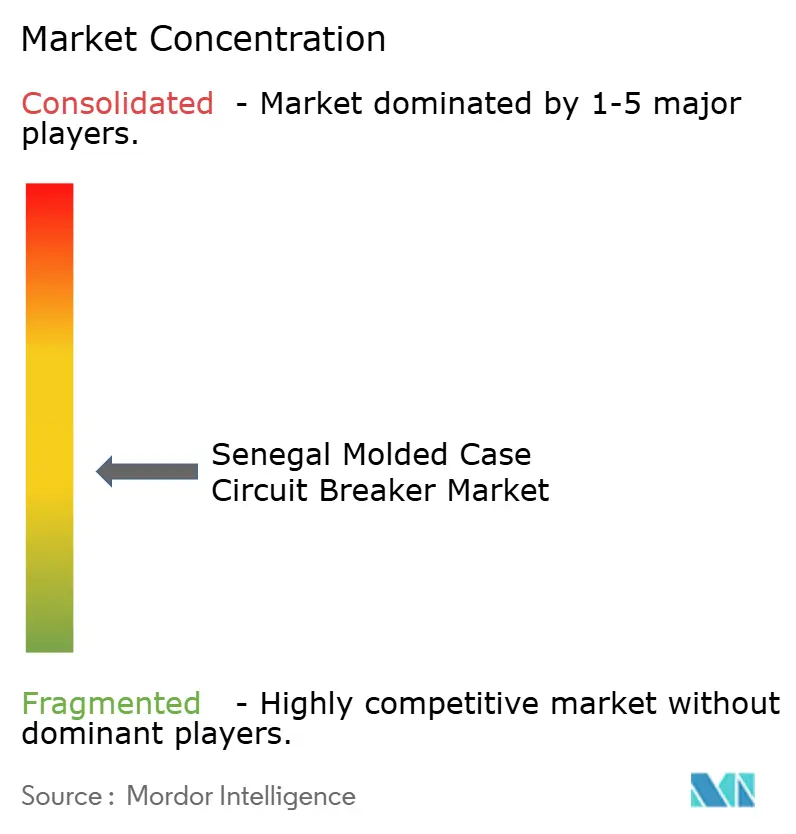
| Market Concentration | Medium |
Major Players *Disclaimer: Major Players sorted in no particular order Image © Mordor Intelligence. Reuse requires attribution under CC BY 4.0. | |
Senegal Molded Case Circuit Breaker Market Analysis by Mordor Intelligence
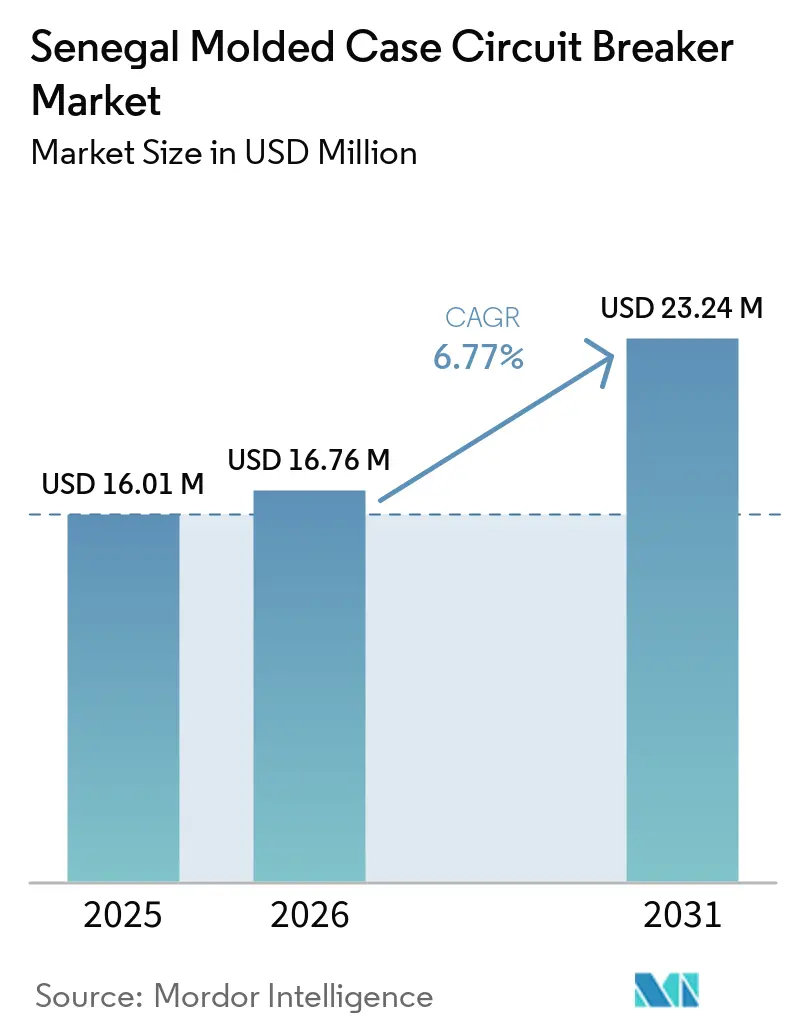
The Senegal Molded Case Circuit Breaker Market size is expected to grow from USD 16.01 million in 2025 to USD 16.76 million in 2026 and is forecast to reach USD 23.24 million by 2031 at 6.77% CAGR over 2026-2031. The Senegal molded case circuit breaker market is being supported by late-stage grid modernization works under the Senegal Power Compact, where key transmission activities were reported 90% to 99% complete in January 2026 and are now moving closer to downstream electrical fit-out stages that draw in low-voltage protection demand.[1]Source: MCA-Sénégal II, “Projet Transport D’électricité Du Senegal Power Compact, Des Taux D’avancement Compris Entre 90 Et 99%,” MCA-Sénégal II, mcasenegal.sn The Senegal molded case circuit breaker market is also benefiting from broader network expansion, as VINCI Energies is building 1,350 km of high-voltage and very-high-voltage lines together with 8 transformer stations, which enlarges the future base for secondary-side protection panels and related switchgear assemblies.[2]Source: VINCI Energies, “VINCI Energies to Build Electrical Infrastructure in Senegal,” VINCI Energies, vinci-energies.com Demand is rising faster in applications that need selective tripping, stronger fault-clearing performance, and metering visibility, while commercial buyers still focus heavily on upfront equipment cost and fast local availability. Supplier positioning in the Senegal molded case circuit breaker market now depends on technical compliance, project references, and in-country service reach, with Dakar remaining the key operating center for advanced support and Schneider Electric maintaining a local presence there.[3]Source: Schneider Electric Sénégal, “Schneider Electric Sénégal,” Schneider Electric, se.com Import dependence and thin installer depth outside Dakar still limit rollout speed in the Senegal molded case circuit breaker market, especially for high-frame and microprocessor-based devices that need stronger commissioning support.
Key Report Takeaways
- By rated current, the 75 A-250 A band led with 44.3% of revenue in 2025, while above - 800 A is projected to expand at an 8.7% CAGR through 2031.
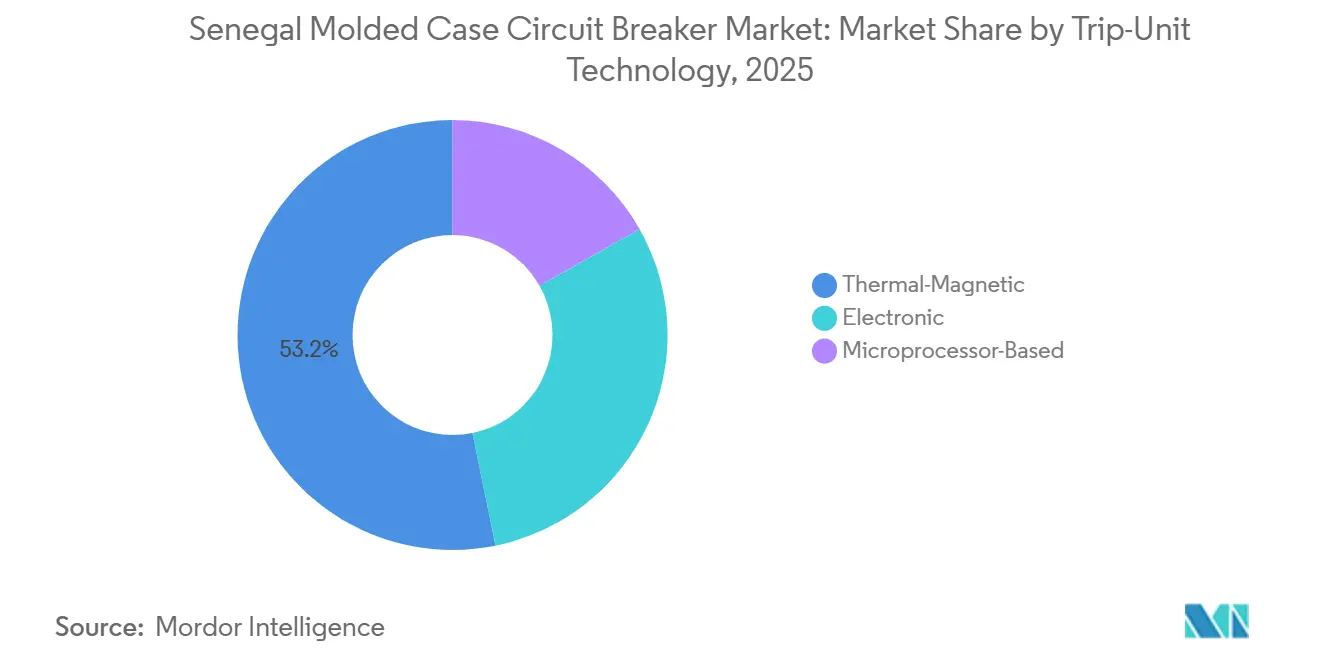
- By trip-unit technology, thermal-magnetic held 53.2% of revenue in 2025, while microprocessor-based is forecast to grow at a 9.7% CAGR through 2031.
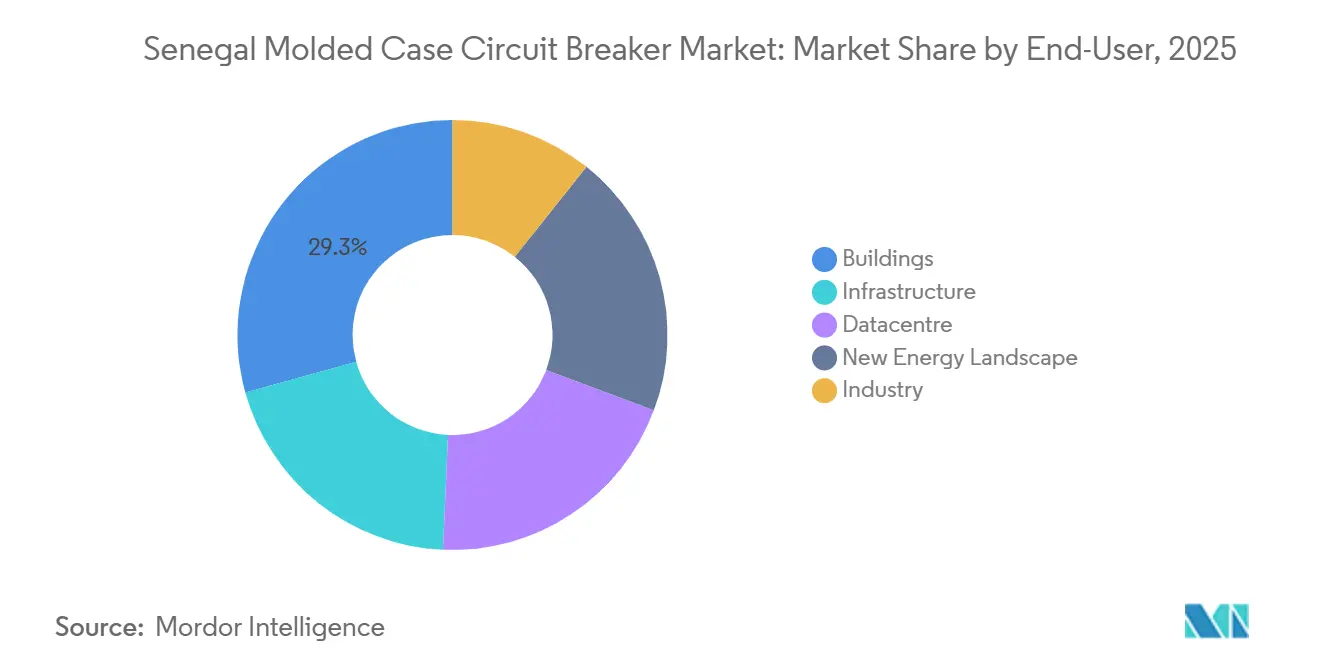
- By end user, buildings accounted for 29.3% of revenue in 2025, while data center is projected to record the highest CAGR at 8.1% through 2031.
Note: Market size and forecast figures in this report are generated using Mordor Intelligence’s proprietary estimation framework, updated with the latest available data and insights as of January 2026.
Senegal Molded Case Circuit Breaker Market Trends and Insights
Drivers Impact Analysis*
| Driver | (~) % Impact on CAGR Forecast | Geographic Relevance | Impact Timeline |
|---|---|---|---|
| Grid transmission and distribution backbone expansion | +1.8% | National, with concentration in Dakar metro and the Ferlo corridor | Short term (≤ 2 years) to Medium term (2-4 years) |
| Solar-plus-storage integration build-out | +1.5% | National, including rural south, central regions, and peri-urban Dakar | Short term (≤ 2 years) to Medium term (2-4 years) |
| Dakar data-center capacity additions | +1.0% | Dakar metro area, including Almadies, Diamniadio, and Plateau | Short term (≤ 2 years) |
| Utility and commercial power reliability upgrades | +0.9% | Urban centers, including Dakar, Thiès, Saint-Louis, and Touba | Medium term (2-4 years) |
| 30 kV feeder smartgrid protection rollout | +0.7% | National medium-voltage network outside Dakar | Medium term (2-4 years) |
| Rural electrification protection-device deployment | +0.6% | Rural Senegal, including Kolda, Tambacounda, Fatick, Kaolack, and Sédhiou | Long term (≥ 4 years) |
| Source: Mordor Intelligence | |||
Grid Transmission and Distribution Backbone Expansion
Transmission modernization is pushing the Senegal molded case circuit breaker market into a stage where downstream panel and protection procurement becomes more visible than the earlier civil and high-voltage packages. MCA-Sénégal II reported in January 2026 that submarine cable laying, underground 225 kV cabling, and substation extensions were 90% to 99% complete, which means the main network backbone is close to operational handover in several workstreams.[4]Source: MCA-Sénégal II, “Projet Transport D’électricité Du Senegal Power Compact, Des Taux D’avancement Compris Entre 90 Et 99%,” MCA-Sénégal II, mcasenegal.sn VINCI Energies is also executing a EUR 200 million package that includes 1,350 km of high-voltage and very-high-voltage lines and 8 transformer stations, extending the long-run installed base that will need secondary low-voltage protection assemblies. For the Senegal molded case circuit breaker market, this timing matters because LV protection boards are usually specified and installed after the main transport assets and substations move toward completion and energization. CHINT’s 2025 supply of 225/30 kV transformers and variable shunt reactors for the Boucle de Ferlo project shows that utility-grade packages are already pulling in vendors that can serve higher-complexity electrical systems. This combination supports a stronger pull for 250 A-800 A and above - 800 A frames in the Senegal molded case circuit breaker market than a purely building-led cycle would normally produce.
Solar-Plus-Storage Integration Build-Out
Solar-plus-storage activity is shifting part of the Senegal molded case circuit breaker market toward applications that need higher voltage ratings, stronger interrupt capacity, and more project-specific protection design. Large photovoltaic systems and battery-backed plants do not use the same protection profile as ordinary commercial buildings, so equipment selection moves upward in both frame class and specification depth. On the DC side, project developers typically work with higher-voltage string architecture, which increases the need for MCCBs designed for solar duty instead of general-purpose building protection. On the AC-coupling and grid-tie side, larger renewable assets create a heavier draw for 250 A-800 A and above - 800 A devices because feeder, inverter, and interconnection duties require more robust protection coordination. This is important for the Senegal molded case circuit breaker market because renewable projects can concentrate a large amount of procurement into a limited number of sites, which makes each award meaningful for suppliers. As more solar-plus-storage assets move from financing and construction into commissioning, the market will continue to benefit from both first-fit demand and follow-on service activity.
Dakar Data-Center Capacity Additions
Data-center additions in and around Dakar are raising the technical ceiling of the Senegal molded case circuit breaker market. These sites are designed around redundancy, uptime discipline, and tighter fault isolation, so each megawatt of IT load can require materially more protection points than a standard office or mixed-use building. The Diamniadio Digital Technology Park adds a strong institutional anchor to this theme because the African Development Bank provided additional financing for the site, which includes a Tier III data center and broader digital infrastructure ambitions near Dakar. That pattern favors electronic and microprocessor-based trip units because operators need better selectivity, event visibility, remote metering, and maintenance control than simpler thermal-magnetic devices can provide. It also supports the premium end of the Senegal molded case circuit breaker market because data-center buyers place more weight on operating reliability than on entry-level purchase price alone. As Dakar’s digital corridor deepens, the market gains a durable demand layer that is less tied to routine building cycles and more tied to critical-power architecture.
Utility And Commercial Power Reliability Upgrades
Reliability upgrades across public and commercial power networks are creating steady retrofit demand in the Senegal molded case circuit breaker market. SENELEC stated in December 2025 that the PEEAE program upgraded 9 cities from 6.6kV to 30 kV and constructed or rehabilitated more than 630 km of medium- and low-voltage lines, which expands the footprint that now needs modern protection devices and panel integration. The World Bank also approved additional financing for the PADAES energy access project in June 2025, extending electrification and grid densification across 5 regions and widening the base for low-voltage protection deployment. In the Senegal molded case circuit breaker market, these programs matter because reliability work often leads to replacement of older switchboard components even when the headline project is framed as feeder strengthening or service expansion. Commercial buildings and utility-linked facilities also respond to tighter power-quality expectations by replacing legacy trip units with devices that offer better protection coordination and easier reset behavior. The result is a recurring layer of demand that sits between large infrastructure awards and everyday construction-led purchases.
Restraints Impact Analysis*
| Restraint | (~) % Impact on CAGR Forecast | Geographic Relevance | Impact Timeline |
|---|---|---|---|
| Import dependence and Foreign Exchange (FX) -sensitive landed costs | -1.2% | National, across all segments and regions | Short term (≤ 2 years) to Medium term (2-4 years) |
| Price-led competition from low-cost imports | -0.9% | National, strongest in commercial and building applications below 250A | Short term (≤ 2 years) |
| Limited advanced trip-unit availability and service depth | -0.6% | Primarily outside Dakar, including secondary cities and rural projects | Medium term (2-4 years) to Long term (≥ 4 years) |
| Installer capability gaps and underspecified panels | -0.5% | National, with stronger exposure in rural electrification and mining sites | Medium term (2-4 years) |
| Source: Mordor Intelligence | |||
Import Dependence And FX-Sensitive Landed Costs
Import dependence remains the clearest structural cap on how fast the Senegal molded case circuit breaker market can widen across all applications. Senegal does not have domestic MCCB manufacturing capability, so every major frame class and trip-unit type must be sourced from external suppliers and shipped through import channels. That raises exposure to currency movement, freight cost, stocking delays, and working-capital pressure, especially because distributors often bear procurement risk before project collections are finalized. The constraint is sharper for high-frame and microprocessor-based products because buyers cannot easily substitute them with whatever is currently available on the local channel. This means the Senegal molded case circuit breaker market can show healthy project demand while still facing temporary delays in actual equipment availability and installation. The effect is strongest outside Dakar, where replacement stock, technical spares, and service access are much thinner than in the capital.
Price-Led Competition from Low-Cost Imports
Price-led competition is compressing margins across the Senegal molded case circuit breaker market, especially in ratings below 250A where product comparison often starts with landed cost. World Bank World Integrated Trade Solution (WITS) data show that Chinese suppliers dominated a relevant electrical-machinery import category in Senegal in 2024, which helps explain the strong price reference visible in contractor purchasing patterns. This environment affects distributor behavior because inventory depth tends to follow the highest-volume and lowest-friction product bands rather than the most advanced protection technologies. It also narrows the premium that European brands can sustain in standard commercial work, even when certification strength and service quality remain better. In the Senegal molded case circuit breaker market, pricing power improves only when buyers enter utility, mining, data-center, or renewable applications where documented performance and selective coordination become harder to compromise. Until that mix shifts further upward, low-cost competition will remain a persistent brake on average selling prices.
*Our forecasts treat driver/restraint impacts as directional, not additive. The impact forecasts reflect baseline growth, mix effects, and variable interactions.
Segment Analysis
By Rated Current: High-Frame Demand Gains While Mid-Tier Anchors Revenue
The 75 A-250 A frame class held 44.3% of the Senegal molded case circuit breaker market share in 2025, making it the largest rated-current band in the country’s demand structure. Its position reflects how often this range is used in commercial building main boards, light-industrial feeder panels, and grid-access metering enclosures that support routine construction and connection activity. In Dakar and nearby growth corridors, this range remains the practical center of procurement because it fits the most common load and panel configurations found in offices, retail sites, apartment blocks, schools, and smaller industrial premises. The Senegal molded case circuit breaker market therefore continues to rely on this mid-tier band for revenue stability even as the project mix becomes more technically varied. Up-to-75 A units also benefit from the expansion of smaller residential and commercial installations, particularly where new housing and local service connections add incremental low-voltage demand.
Above - 800 A MCCBs are projected to grow at an 8.7% CAGR through 2031, the fastest rate within the rated-current structure of the Senegal molded case circuit breaker market. This end of the range is supported by substation secondary-side protection, large captive generation assets, higher-capacity solar interconnection duties, mine-site power systems, and primary-feeder protection for data-center facilities. The 250 A-800 A range sits between these two poles and serves utility feeders, industrial facilities, larger building complexes, and mid-scale renewable installations where standard commercial frames are no longer sufficient. That makes rated-current demand in Senegal less linear than it first appears, because project-led purchases are pushing value upward even while the most common volume remains concentrated in the 75 A-250 A class. For the molded case circuit breaker industry in Senegal, the key shift is that higher-capacity projects are carrying more influence on value growth than on unit count alone. Suppliers that can serve both routine mid-tier volume and technically demanding high-frame packages should be better placed as procurement becomes more polarized.
By Trip-Unit Technology: Thermal-Magnetic Dominates, Smart Units Accelerate
Thermal-magnetic trip units held 53.2% of revenue in 2025, keeping them at the center of the Senegal molded case circuit breaker market by technology. Their lead reflects lower upfront cost, easier stocking, simpler maintenance expectations, and strong familiarity among contractors and panel assemblers working across standard commercial and light-industrial jobs. In many installations, buyers still prioritize dependable basic protection and quick availability rather than advanced diagnostics or digital communication layers. That keeps thermal-magnetic devices relevant in a large share of new building work and replacement demand, especially when project budgets are tight and system complexity is limited. Electronic trip units sit in the middle ground and are gaining acceptance where users need adjustable overload and short-circuit settings without the higher cost and commissioning depth associated with full microprocessor platforms.
Microprocessor-based MCCBs are projected to grow at a 9.7% CAGR through 2031, which makes them the fastest-moving technology block in the Senegal molded case circuit breaker market. Their adoption is being pulled by data-center operators, smart-grid deployments, selective coordination needs, and industrial sites that value real-time measurement and better visibility into fault behavior. Eaton’s Digital NZM illustrates this direction because it combines high switching capacity with integrated energy metering and communication features aimed at higher-specification users. The shift will not be uniform across the country because digital trip units need stronger commissioning support, clearer management, and more consistent after-sales capability than simple thermal-magnetic products. Even so, the Senegal molded case circuit breaker market is moving steadily toward smarter protection in the parts of the system where uptime, remote visibility, and protection coordination are becoming more important. This gives premium suppliers room to differentiate, but it also means they must support training and field service if they want adoption to expand beyond Dakar.


By End User: Buildings Lead, Data Center and New Energy Add Momentum
Buildings accounted for 29.3% of revenue in 2025, making them the largest end-user group in the Senegal molded case circuit breaker market. This position is tied to sustained construction activity in greater Dakar and to the continuing build-out of Diamniadio, which is planned as a major urban pole with housing, ministries, and business infrastructure. Demand from this segment is broad rather than narrow because offices, residential blocks, retail spaces, hospitality assets, and mixed-use sites all require routine low-voltage protection at panel and distribution-board level. That makes buildings the most stable end-user base in revenue terms even when other categories attract more attention for technical complexity. Infrastructure remains another important demand layer because substations, transport nodes, utilities, and public-service facilities consume substantial volumes of dependable protection devices during both new installation and retrofit cycles.
Data center is projected to record the highest CAGR at 8.1% through 2031, making it the fastest-growing end-user block in the Senegal molded case circuit breaker market. This growth reflects tighter uptime requirements, redundant power architecture, and the use of electronically and digitally tripped protection devices in facilities where outage costs are high. New energy projects and mining-linked power systems add another source of momentum because solar, storage, and captive-generation installations need industrial-grade protection across both AC and DC sections of the system. That broadens the demand base beyond urban construction and gives the market exposure to project-led capital spending in power and extractive operations. For the Senegal molded case circuit breaker market size by end user, this means the center of gravity is no longer only about buildings, even though that category still leads on current revenue. The result is a more balanced opportunity set in which conventional construction, infrastructure programs, digital facilities, and energy-transition assets all contribute to future growth.
Geography Analysis
Dakar remained the largest demand center in 2025 and continues to anchor the Senegal molded case circuit breaker market because commercial construction, digital infrastructure activity, and distributor inventory are concentrated there. The capital also holds the deepest local service and commissioning base for advanced protection devices, which matters for buyers that need faster troubleshooting and spare-part access. Schneider Electric’s local presence in Keur Gorgui supports that service advantage and helps explain why locally supported brands can preserve better pricing in higher-specification applications. Diamniadio adds to Dakar’s pull because the urban pole is designed for large-scale housing and institutional development, while the Digital Technology Park introduces more critical-power requirements near the capital. For that reason, Dakar captures the most specification-sensitive portion of the Senegal molded case circuit breaker market even when substantial equipment volume is also deployed elsewhere in the country.
The northern and central grid corridors are becoming more important as transmission and distribution projects move from backbone delivery into lower-voltage fit-out and operational stages. MCA-Sénégal II stated in January 2026 that the major transport works were near completion, which points to a stronger requirement for downstream protection panels and associated switchgear assemblies as final electrical integration progresses. CHINT’s role in the Boucle de Ferlo project also shows that high-value utility work is extending beyond Dakar into the Ferlo corridor and adjacent transmission routes. In parallel, additional World Bank financing for PADAES (Programme d'Accès et de Diversification des Approvisionnements en Energie au Sénégal) is widening electrification and grid densification across 5 regions, which expands the installed base for protection devices over time. These areas matter more to the Senegal molded case circuit breaker market because they pull procurement toward feeder protection, metering cabinets, and utility-linked distribution hardware rather than only toward urban building panels.
Secondary cities such as Thiès, Saint-Louis, Touba, and Kaolack form the next layer of opportunity, but they face a slower path for advanced-trip adoption than Dakar does. SENELEC’s 30 kV upgrades across 9 cities improve the network base, yet technical service depth and installer capability remain much thinner outside the capital. This makes high-frame and microprocessor-based deployment less even across the country, especially where rural electrification and project-led industrial sites need field commissioning support. Over time, the supplier that can extend credible service beyond Dakar should be well placed to capture a larger share of the Senegal molded case circuit breaker market.
Competitive Landscape
The Senegal molded case circuit breaker market is moderately fragmented in national volume terms, but procurement is more concentrated in premium utility and data-center applications where qualification standards are tighter. European brands retain an edge where buyers require documented compliance, selective coordination, and dependable fault-clearing performance under demanding operating conditions. Chinese brands remain strong in the commercial and construction tiers where landed price carries more weight and replacement cycles are faster. This split keeps margin pressure high below 250A and preserves better pricing above 800A, where technical acceptance matters more than entry cost. The result is a two-speed structure inside the Senegal molded case circuit breaker market rather than a single national pricing pattern.
Schneider Electric benefits from an in-country operating base in Dakar, which gives it a service and response advantage in projects that need commissioning and after-sales support. CHINT has strengthened its position by supplying 225 kV transformers and variable shunt reactors for SENELEC’s Boucle de Ferlo project, demonstrating that it can participate in higher-value power infrastructure in Senegal and not only in price-led volume bands. Eaton’s Digital NZM product direction shows how premium suppliers are pushing MCCBs toward integrated metering and communication features that suit data-center and industrial buyers. These moves matter because the Senegal molded case circuit breaker market is shifting part of its value growth toward advanced trip functions rather than toward device count alone. Vendors that combine certification, digital capability, and local support are therefore better placed in the most demanding tenders.
The main white space remains outside Dakar, where credible technical service for above - 800 A and microprocessor-based units is still limited. That gap gives local distributors and global Original Equipment Manufacturers (OEMs) room to differentiate through training, spare parts, and commissioning support instead of competing only on price. It also means that project references in utility, mining, and renewable applications can influence buying decisions across adjacent demand brands as customers try to reduce execution risk. Within this setting, the Senegal molded case circuit breaker market should remain competitive, with the clearest share gains likely for suppliers that can move across both value and premium tiers without weakening service quality.
Senegal Molded Case Circuit Breaker Industry Leaders
Schneider Electric SE
ABB Ltd
Siemens AG
Eaton Corp plc
Legrand SA
- *Disclaimer: Major Players sorted in no particular order

Recent Industry Developments
- January 2026: CHINT announced its 2025 supply plan for 225 kV Variable Shunt Reactors (VSR) and Power Transformers for SENELEC's Boucle de Ferlo project. The initial commissioning of the VSR was completed in October 2024, demonstrating the company's capability to deliver high-voltage equipment to Senegal on a large scale.
- July 2025: ACWA Power signed agreements with Senegal's government for the Grande-Côte seawater desalination project, delivering 400,000 m³ of potable water daily to Dakar using renewable energy. The ceremony, held at Dakar's Presidential Palace, formalized the Public-Private Partnership and Government Support Agreement, attended by Senegalese officials, SONES representatives, and ACWA Power, marking a key step in regional water security.
- May 2025: The MCA-Sénégal II Senegal Power Compact Transport Project reported 90–99% physical completion across all major activities, including submarine cable laying, underground 225 kV cabling, and substation extensions, in Dakar. This progress enables the installation of Low Voltage (LV) panels and protection devices on the secondary distribution side.
- May 2025: Phase3 and Sonatel activated a 3,500 km terrestrial fibre route from Lagos to Dakar, achieving 32 ms latency and creating a dedicated high-speed corridor that accelerates data-centre investment in Dakar.


Senegal Molded Case Circuit Breaker Market Report Scope
A Molded Case Circuit Breaker (MCCB) is an electrical protection device used to prevent damage to circuits caused by overloads, short circuits, and ground faults. Enclosed in a robust, insulated housing, MCCBs are commonly utilized in commercial and industrial applications with higher amperage requirements, supporting currents of up to 2,500 Amps.
The Senegal Molded Case Circuit Breaker Market is segmented into rated current, trip-unit technology, and end-user. By rated current, the market is segmented into up to 75A, 75 A–250 A, 250 A–800 A, and above 800 A. By trip-unit technology, the market is segmented into thermal-magnetic, electronic, and microprocessor-based trip units. By end-user, the market is segmented into buildings, industry, infrastructure, datacentres, and the new energy landscape. For each segment, the market sizing and forecasts have been done on the basis of value (USD).
| Upto 75A |
| 75A - 250A |
| 250A - 800A |
| Above 800A |
| Thermal-Magnetic |
| Electronic |
| Microprocessor-Based |
| Buildings |
| Industry |
| Infrastructure |
| Datacentre |
| New Energy Landscape |
| By Rated Current | Upto 75A |
| 75A - 250A | |
| 250A - 800A | |
| Above 800A | |
| By Trip-Unit Technology | Thermal-Magnetic |
| Electronic | |
| Microprocessor-Based | |
| By End User | Buildings |
| Industry | |
| Infrastructure | |
| Datacentre | |
| New Energy Landscape |


Key Questions Answered in the Report
What is the current size of Senegal's molded case circuit breaker business?
The Senegal Molded Case Circuit Breaker Market size is expected to grow from USD 16.01 million in 2025 to USD 16.76 million in 2026 and is forecast to reach USD 23.24 million by 2031 at 6.77% CAGR over 2026-2031.
What is driving growth in Senegal over the next 5 years?
Growth is being supported by grid modernization, wider transmission and distribution build-out, stronger reliability upgrades, solar-plus-storage deployment, and more critical-power demand in Dakar.
Which rated-current category leads demand today?
The 75 A-250 A range led the Senegal molded case circuit breaker market with 44.3% of revenue in 2025 because it fits the most common commercial and light-industrial panel applications.
Which product type is growing the fastest?
Microprocessor-based trip units are forecast to grow at 9.7% CAGR through 2031 as data centers, smart-grid systems, and higher-specification projects require metering, logging, and tighter coordination.
Why is Dakar so important for suppliers?
Dakar remains the main demand and service hub because it combines commercial construction, digital infrastructure, distributor inventory, and the deepest local commissioning support.
What is the main risk to future expansion?
Import dependence remains the main risk because Senegal relies on overseas supply for MCCBs, which exposes distributors and project schedules to currency pressure, shipping lead times, and limited local stock depth.
Page last updated on:


 Your data is secure and never sold or shared.


