
Self-Expanding Stents Market Size and Share
Market Overview
| Study Period | 2020 - 2031 |
|---|---|
| Market Size (2026) | USD 3.77 Billion |
| Market Size (2031) | USD 4.71 Billion |
| Growth Rate (2026 - 2031) | 4.53 % |
| Fastest Growing Market | Asia-Pacific |
| Largest Market | North America |
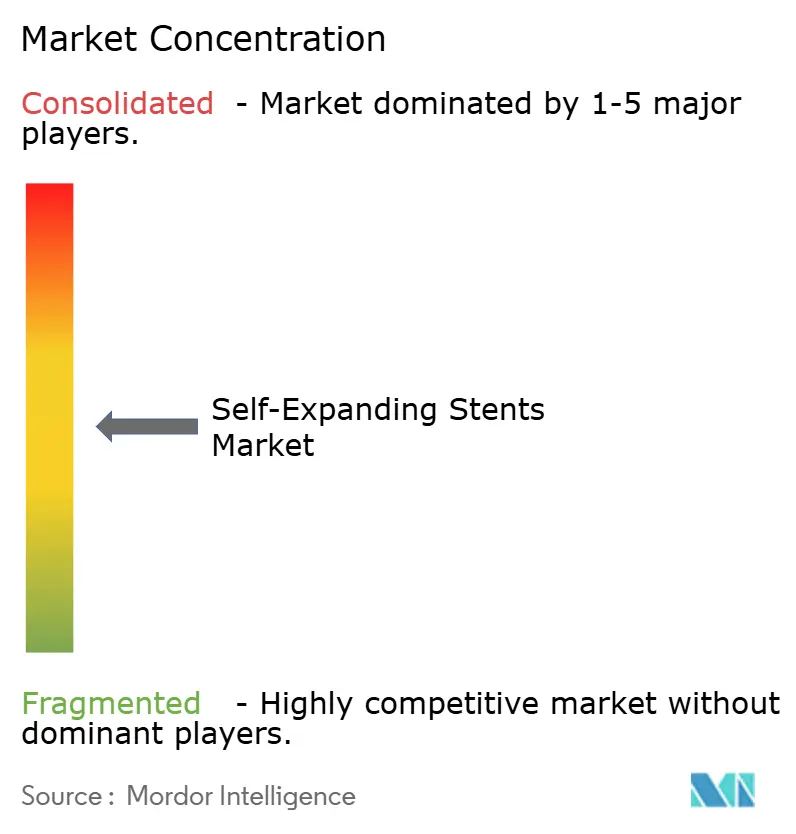
| Market Concentration | Medium |
Major Players
*Disclaimer: Major Players sorted in no particular order Image © Mordor Intelligence. Reuse requires attribution under CC BY 4.0. |
|
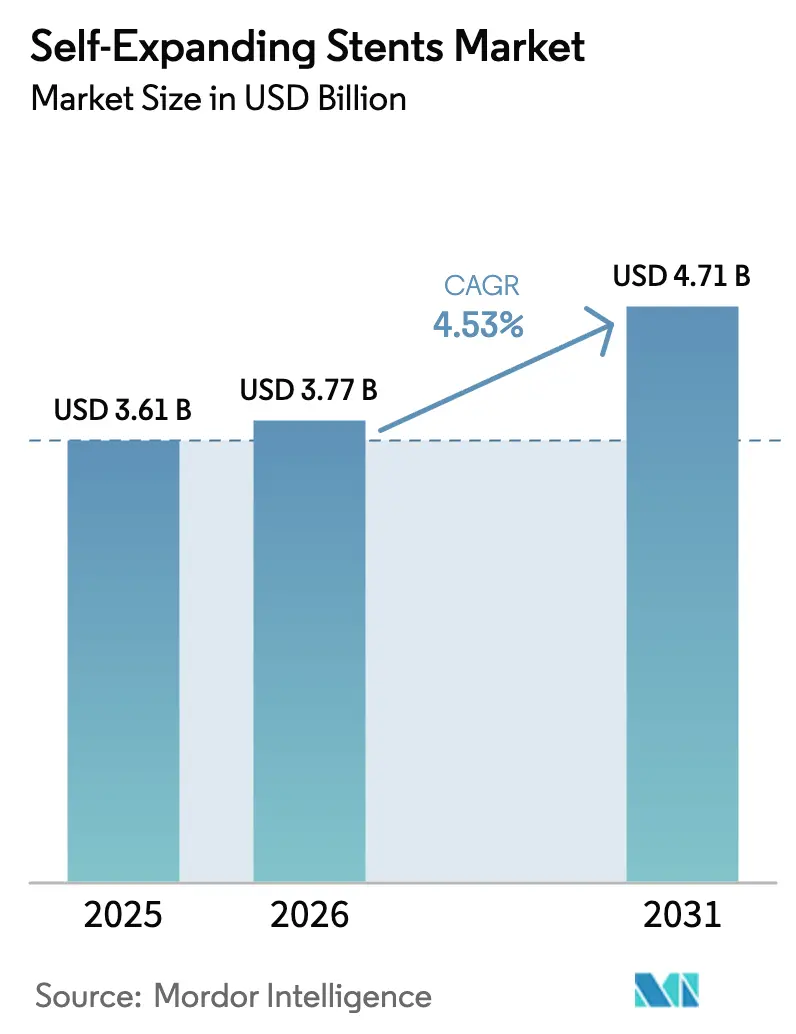
Self-Expanding Stents Market Analysis by Mordor Intelligence
Self expanding stents market size in 2026 is estimated at USD 3.77 billion, growing from 2025 value of USD 3.61 billion with 2031 projections showing USD 4.71 billion, growing at 4.53% CAGR over 2026-2031. Moderate expansion reflects a mature competitive environment, rising head-to-head pressure from drug-coated balloons, and increasing availability of alternative interventional therapies. Nevertheless, larger elderly populations and a steady climb in minimally invasive procedure volumes continue to anchor demand. Technology remains the axis of competition: nitinol-based designs prevail for their flexibility and radial strength, yet polymer-hybrid scaffolds are challenging metallic dominance through superior biocompatibility. Regionally, high reimbursement ceilings in North America sustain premium device uptake, while regulatory streamlining and local manufacturing spur rapid growth in Asia-Pacific.
Key report Takeaways
- By product type, endovascular and peripheral systems led with 32.02% of self expanding stents market share in 2025; intracranial devices are projected to expand at a 6.58% CAGR through 2031.
- By material, nitinol retained a 68.77% share of the self expanding stents market size in 2025, whereas polymer-hybrid composites are advancing at an 7.93% CAGR to 2031.
- By application, femoropopliteal procedures accounted for 39.02% of the self expanding stents market size in 2025; below-the-knee interventions record the highest 7.45% CAGR outlook.
- By end-user, hospitals captured 62.88% revenue share in 2025, while ambulatory surgical centers are rising at a 7.01% CAGR.
- By delivery mode, over-the-wire systems accounted for 52.02% of self expanding stents market share in 2025, whereas stent-on-a-wire platforms show the quickest 7.52% CAGR through 2031.
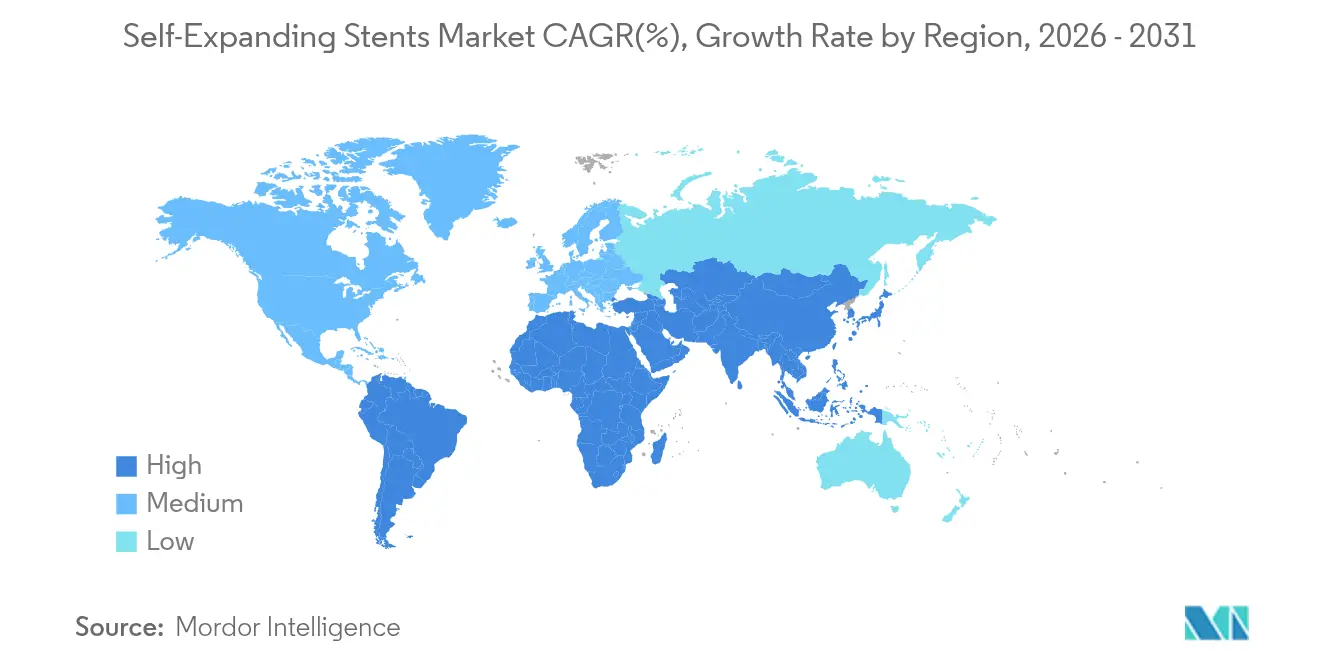
- By geography, North America commanded 38.11% of the self expanding stents market share in 2025; Asia-Pacific is the fastest-growing region at 7.32% CAGR to 2031
Note: Market size and forecast figures in this report are generated using Mordor Intelligence’s proprietary estimation framework, updated with the latest available data and insights as of 2026.
Market Trends and Insights
Drivers Impact Analysis of Self-Expanding Stents Market*
| Driver | (~) % Impact on CAGR Forecast | Geographic Relevance | Impact Timeline |
|---|---|---|---|
| High Prevalence Of Cardiovascular & PAD Cases | +1.2% | Global, with highest impact in North America & Europe | Long term (≥ 4 years) |
| Surge In Minimally-Invasive Peripheral Interventions | +0.9% | Global, led by Asia-Pacific growth | Medium term (2-4 years) |
| Rapid Nitinol & Imaging Technology Improvements | +0.7% | North America & EU, expanding to APAC | Medium term (2-4 years) |
| Ambulatory Surgery Shift In Vascular Care | +0.6% | North America & EU core markets | Short term (≤ 2 years) |
| Drug-Coated Self-Expanding Stents For BTK Ischemia | +0.5% | Global, early adoption in US & EU | Long term (≥ 4 years) |
| AI-Enabled Procedural Planning & Sizing Tools | +0.4% | North America & EU, selective APAC markets | Medium term (2-4 years) |
| Source: Mordor Intelligence | |||
High prevalence of cardiovascular and PAD cases
Cardiovascular disease still affects 127.9 million U.S. adults, representing 48.6% of residents aged 20 years and older, despite a fall in heart-disease death rates to 162.1 per 100,000 in 2023. Peripheral artery disease (PAD) now burdens 113 million people aged 40 years and older worldwide. Diabetic patients show an 11.2% PAD prevalence, and elevated triglycerides further heighten risk. These figures guarantee a steady procedural pipeline for the self expanding stents market.
Surge in minimally-invasive peripheral interventions
Endovascular approaches achieve a 97.7% technical success rate in iliac artery lesions classified as TASC II A/B.[1]Le Duc Tin, "Outcomes of balloon angioplasty and stent placement for iliac artery lesions," Frontiers in Surgery, frontiersin.org Office-based labs and ambulatory surgical centers are performing an increasing share of PAD treatments, which lowers admission costs while maintaining comparable outcomes. AI-enhanced real-time device tracking for carotid stent placements has reached remarkable precision levels.[2]Yuya Sakakura et al., "Real time artificial intelligence assisted carotid artery stenting," Journal of NeuroInterventional Surgery, jnis.bmj.com These efficiency gains reinforce adoption.
Rapid nitinol & imaging technology improvements
Titanium-nitride-oxide coatings cut 5-year major adverse cardiac events to 16% versus 39% for bare metal comparators. Deep-learning plaque quantification aligns closely with intravascular ultrasound, improving procedural planning. Such advances enlarge the addressable pool for self expanding stents market therapies.
Ambulatory surgery shift in vascular care
Ambulatory centers show a 7.35% CAGR to 2030 as payers reward shorter stays. Medicare already reimburses outpatient carotid artery stenting following favorable stroke-prevention data. Same-day discharge protocols boost patient satisfaction and capacity utilization.
Restraints Impact Analysis of Self-Expanding Stents Market*
| Restraint | (~) % Impact on CAGR Forecast | Geographic Relevance | Impact Timeline |
|---|---|---|---|
| Balloon-Angioplasty & Drug-Therapy Alternatives | -0.8% | Global, strongest in EU markets | Medium term (2-4 years) |
| Product Recalls & Stringent Regulatory Pathways | -0.6% | Global, highest impact in US & EU | Long term (≥ 4 years) |
| Nitinol Supply-Chain Bottlenecks | -0.5% | Global manufacturing impact | Short term (≤ 2 years) |
| Limited Long-Term Clinical Surveillance Data | -0.4% | Global, regulatory focus markets | Long term (≥ 4 years) |
| Source: Mordor Intelligence | |||
Balloon-angioplasty & drug-therapy alternatives
The BASIL-3 trial found major amputation or death in 58% of drug-eluting stent cases versus 66% for plain balloon angioplasty.[3]Haozhi Gong et al., “Drug-eluting stents versus bare-metal stents for intracranial atherosclerotic stenosis,” BMJ Open, bmjopen.bmj.com Drug-coated balloons and optimized pharmacotherapy offer competitive outcomes without a permanent implant, constraining the self expanding stents market.
Product recalls & stringent regulatory pathways
Warning letters underscore strict data-integrity expectations, stretching device development to 5-7 years. European MDR certification further raises compliance costs, favoring incumbents with robust quality systems.
*Our forecasts treat driver/restraint impacts as directional, not additive. The impact forecasts reflect baseline growth, mix effects, and variable interactions.
Self-Expanding Stents Market Segment Analysis
By Product Type:
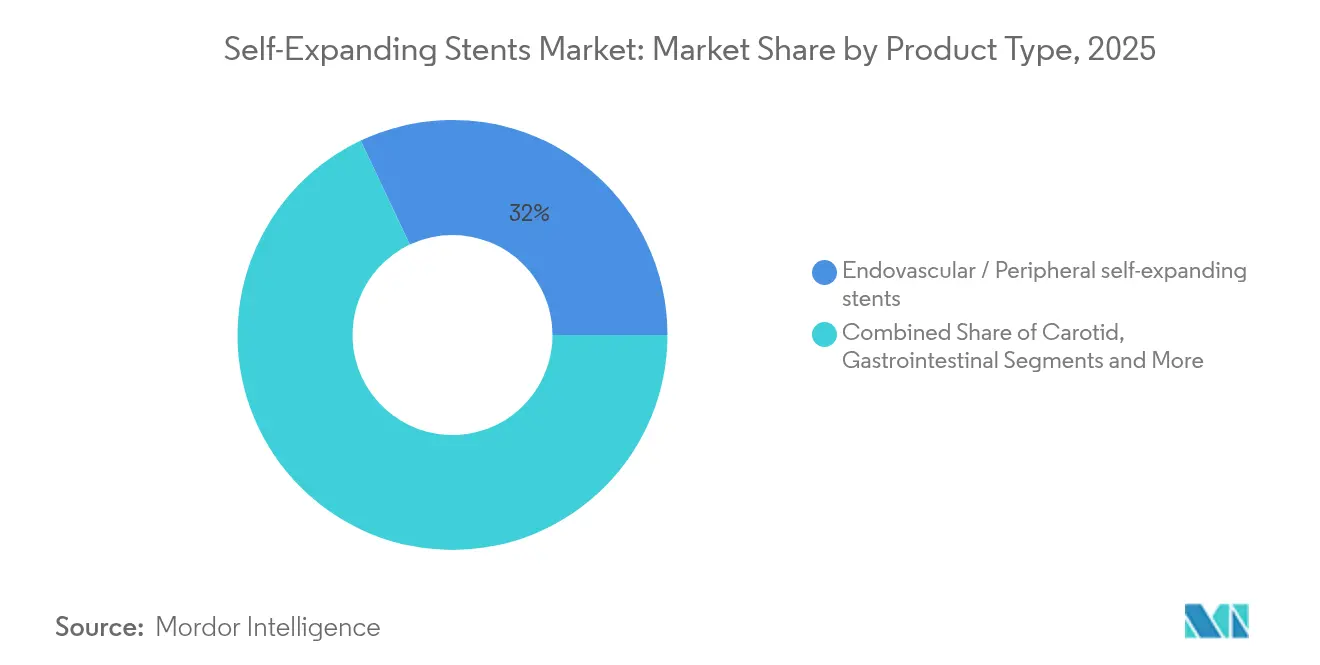
Peripheral dominance drives innovationPeripheral and endovascular systems held 32.02% of the self expanding stents market in 2025. Femoral and iliac disease prevalence, together with reimbursement parity for minimally invasive approaches, underpins steady hospital demand. Intracranial devices are advancing at 6.58% CAGR on the back of drug-eluting designs that cut restenosis by 77% versus bare metal. Gastrointestinal units pivot toward biodegradable alternatives after Japan’s 2025 clearance of the ELLA-BD polymer esophageal scaffold. Airway and lung indications benefit from polydioxanone stents demonstrating 89.7% clinical effectiveness across a decade.



By Material:
Nitinol supremacy faces polymer challengeNitinol retained a 68.77% self expanding stents market share in 2025 on the strength of shape-memory performance. Cost pressure aside, suppliers continue to refine fatigue resistance and deliver smaller-profile platforms. Polymer-hybrid composites, expanding at 7.93% CAGR, use tailored collagen to hasten endothelial repair without eluting drugs. Iron-based bioresorbables and cobalt-chromium alloys serve niche high-force applications.
By Application:
Fem-Pop leadership amid BTK innovationFemoropopliteal disease accounted for 39.02% of the self expanding stents market size in 2025. Boston Scientific’s Eluvia drug-eluting line achieved 85.4% primary patency at 1 year versus 76.3% for bare metal controls. Below-the-knee chronic limb-threatening ischemia is the fastest-growing application following Abbott’s dissolving scaffold approval, widening therapy options for severe diabetes-related PAD.
By End-User:
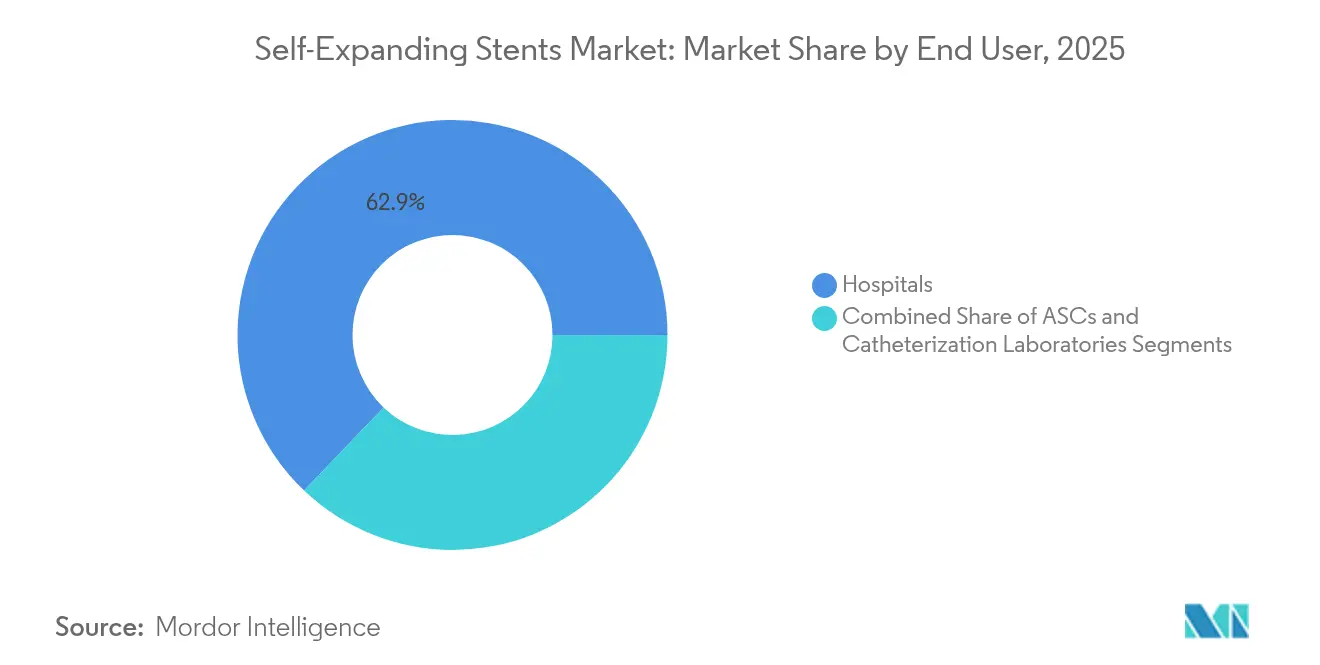
Hospital dominance shifts toward ambulatory careHospitals captured 62.88% of 2025 revenue, yet ambulatory surgical centers grow at 7.01% CAGR as payers incentivize outpatient models. Integrated embolic-protection systems permit “one-stop” peripheral work in same-day settings, reducing bed demand and bolstering physician-owned center economics.
By Delivery Mode:
OTW systems lead innovation pushOver-the-wire (OTW) platforms contributed 52.02% of 2025 sales thanks to superior torque and lesion-crossing ability. Stent-on-a-wire hybrids expand at 7.52% CAGR as operators favor simplified exchanges. Through-the-scope devices remain critical for bile duct and tracheal work, benefiting from continuous miniaturization.
Geography Analysis
North America Self-Expanding Stents Market
North America retained 38.11% of 2025 revenue. Broad insurance coverage for carotid, coronary, and peripheral procedures sustains premium adoption. Breakthrough device designations accelerate U.S. launches, illustrated by Abbott’s Esprit BTK scaffold win in 2024. Canada adopts similar protocols, while Mexico enlarges access through public-hospital investments.
Europe Self-Expanding Stents Market
Europe remains a clinical excellence hub with cautious spending. The SPORTS trial in 2025 reported 94.5% freedom from target-lesion revascularization for Eluvia versus 80.7% for drug-coated balloons, reinforcing evidence-based uptake. MDR certification rules, however, raise compliance costs and slow rollouts, ultimately consolidating supplier ranks.
APAC Self-Expanding Stents Market
Asia-Pacific delivers a 7.32% CAGR through 2031. China’s NMPA cleared MicroPort’s VitaFlow Liberty Flex system in 2025, underscoring domestic innovation. Japan leads biodegradable gastrointestinal stents, and India embraces next-generation coronary designs such as Abbott’s XIENCE Sierra. Government insurance expansion and localized manufacturing lower per-procedure costs, broadening market reach.

Regulatory Landscape
Regulatory Landscape: In 2026, the European Commission advanced delegated acts under Regulation (EU) 2017/745 for implantable devices. This expanded the scope of Article 61(6)(b) exemptions following MDCG consultations, and it reinforced the MDR clinical-evidence framework for higher-risk devices while maintaining rigorous post-market evaluation.
In the United States, FDA pathways for vascular and venous stents continue to depend on PMA for higher-risk implants and 510(k) for qualifying device types. IDE-supported pivotal studies are used where needed, with emphasis on data integrity and quality systems to support cross-border regulatory strategies.
Value Chain Analysis
Value Chain Analysis: Upstream supply risk remains concentrated around nitinol and tight-tolerance tubing, while material innovation is shifting toward proprietary platforms such as MiRus SIEGEL. Boston Scientific's USD 1.5 billion investment in MiRus LLC in May 2026 secures access to next-generation materials and a platform basis for future stent designs.
Midstream differentiation increasingly comes from coatings, imaging compatibility, and deliverability engineering, and major players continue partnerships to secure pipeline access for next-generation vascular devices. The 2026 MiRus investment shows how incumbents combine internal scale with external biomaterial capabilities to accelerate development and regulatory readiness.
Competitive Landscape
Industry consolidation continued as Teleflex agreed to acquire Biotronik’s vascular intervention unit for EUR 760 million, while Boston Scientific purchased Silk Road Medical for USD 1.26 billion. Leaders aim to provide complete procedure ecosystems blending stents, guidewires, and AI-planning software. Emerging entrants focus on polymer-hybrid and retrievable designs; Reflow Medical secured FDA de novo status in May 2025 for the Spur retrievable stent, signaling novel competitive angles. Material price instability—especially nitinol—adds cost risk, encouraging vertical integration and diversified sourcing.
Self-Expanding Stents Industry Leaders
-
Medtronic
-
Boston Scientific
-
Abbott
-
Cook Medical
-
BD
- *Disclaimer: Major Players sorted in no particular order
Self-Expanding Stents Market Companies Covered in this Report
- Boston Scientific
- Medtronic
- Abbott Laboratories
- Beckton Dickinson
- Cook Group
- Terumo
- BIOTRONIK
- Cordis
- Merit Medical Systems
- Veryan Medical
- W. L. Gore & Associates
- MicroPort
- Taewoong Medical
- Micro-Tech (Nanjing)
- Lepu Medical
- SINOMED
- Endologix
- Shockwave Medical
- InspireMD
- EndoVascular Engineering

Market Opportunities and Future Outlook
Market Opportunities and Future Outlook: Evidence from 2026 points to strategic investments and regulatory milestones that affect how capabilities are deployed. Boston Scientific's USD 1.5 billion investment in MiRus LLC in May 2026, along with MiRus's FDA IDE for the STAR trial, indicates a focus on expanding data-backed indications and supporting next-generation transcatheter platforms.
EU MDR updates in 2026 also continue to shape compliance infrastructure and data packages. This environment supports multi-region rollout for scaled manufacturers and providers that can build evidence through post-market surveillance and clinical-evaluation planning.
Recent Industry Developments in Self-Expanding Stents Market
- June 2026: The CE Mark approval for the GORE VIABAHN FORTEGRA Venous Stent expands Gore's venous stent portfolio and enables broader patient access across markets. The development strengthens Gore's leadership in venous self expanding stents and supports cross border commercialization.
- March 2026: The Revello Vascular Covered Stent for iliac artery treatment gains CE marking, expanding BD's covered-stent portfolio for complex peripheral lesions. The move positions BD to capture more challenging cases in the iliac and peripheral arterial market.
- January 2026: The GORE VIABAHN FORTEGRA Venous Stent receives FDA approval, unlocking US commercialization potential for Gore's venous self expanding stents. The clearance reinforces Gore's leadership in venous interventions and broadens access in the US market.


Self-Expanding Stents Market Report Scope and Research Methodology
Market Definition and Coverage
This market covers revenues generated from self-expanding stents used in minimally invasive procedures, counted at the point of sale to end users such as hospitals and ambulatory surgical centers across major regions.
Scope exclusions: We exclude guidewires, catheters, balloons, imaging disposables, and procedure service fees that can be billed alongside a stent.
Segments Covered in This Report
-
By Product Type
- Carotid self-expanding stents
- Gastrointestinal self-expanding stents
- Endovascular / Peripheral self-expanding stents
- Airway / Lung self-expanding stents
- Intracranial self-expanding stents
- Others
-
By Material
- Nitinol
- Cobalt-chromium
- Stainless steel
- Polymer / Hybrid
-
By Application
- Fem-Pop artery
- Iliac artery
- Carotid artery
- Biliary strictures
- Tracheo-bronchial airway
- Intracranial stenosis
- Others
-
By End-User
- Hospitals
- Ambulatory Surgical Centers
- Catheterization Laboratories
-
By Delivery Mode
- Over-the-Wire (OTW) systems
- Through-the-Scope (TTS) systems
- Stent-on-a-Wire systems
-
By Geography
-
North America
- United States
- Canada
- Mexico
-
Europe
- Germany
- United Kingdom
- France
- Italy
- Spain
- Rest of Europe
-
Asia-Pacific
- China
- Japan
- India
- Australia
- South Korea
- Rest of Asia-Pacific
-
Middle East and Africa
- GCC
- South Africa
- Rest of Middle East and Africa
-
South America
- Brazil
- Argentina
- Rest of South America
-
North America
Data Sources, Market Sizing, and Validation
Desk Research
Desk work started with mapping the disease and procedure backdrop that drives stent demand, and then layering in policy and trade signals that can shift volumes and pricing. We used public sources such as the US FDA device databases and safety communications, the US CDC, the OECD health statistics, and the World Bank for macro health indicators that influence procedure access and budgets.
To ground the model in real market activity, we also reviewed sources such as CMS reimbursement and payment rules, UN Comtrade trade statistics (where relevant for device flows), and published clinical guidance and peer-reviewed papers that discuss utilization patterns and outcomes. Company filings, investor presentations, and reputable medical press were used to understand product mix changes and regional commercialization timing. For structured cross-checks, we referenced paid subscriptions that support company financial intelligence, patent landscaping, and shipment-level import-export screening selectively. This list is illustrative only, and many other public and proprietary sources were used for data collection, validation, and clarification.
Primary Interviews and Surveys
Primary work focused on verifying what really moves the revenue line, which includes procedure volumes, channel mix, and the price bands seen across hospital and outpatient settings. We spoke with a mix of clinical users, procurement teams, distributors, and product or commercial leaders across key regions so that assumptions from desk research could be confirmed and adjusted where practice patterns differ.
Input from these discussions helped us pressure test adoption drivers, replacement cycles, and the practical impact of reimbursement changes and tender wins, and then align the final market model to what is being purchased today.
Distribution of primary research fieldwork respondents
| Company type | Respondent position | Region |
|---|---|---|
| Top tier: 36% | CXOs: 16% | APAC: 43% |
| Mid tier: 45% | Functional/Unit leaders: 39% | EMEA: 36% |
| Smaller Players: 19% | Managers: 45% | Americas: 21% |
Market-Sizing & Forecasting
Sizing begins with a top-down build where procedure demand pools are reconstructed by geography, and then translated into stent volumes using realistic penetration and usage rates for self-expanding designs. Once that total is built, it is corroborated using selective bottom-up approximations such as sampled price bands multiplied by estimated units for key care settings, followed by distributor and channel checks to correct obvious gaps.
Key inputs used in the model include procedure volume trends for relevant endovascular and endoscopic interventions, the share shift between hospital and ambulatory centers, average selling price ranges by region, the pace of material and design upgrades (for example, nitinol preference in flexible vessels), and reimbursement or tender-related price pressure. Where direct data is thin, assumptions are filled using proxy indicators like import patterns, regulatory approvals timing, and expert ranges from primary work, and then narrowed through iterative review.
For forecasting, scenario analysis is applied around variables that can change quickly, especially procedure growth, pricing compression, and adoption speed in faster-growing health systems. The final forecast path is then checked against clinical utilization expectations and budget signals gathered from interviews, so the growth curve remains practical rather than purely trend-driven.
Data Validation & Update Cycle
Outputs are validated through triangulation across independent signals, including procedure indicators, pricing bands, and region-level adoption comments from fieldwork. Outliers are flagged when implied units or revenue per procedure drift beyond reasonable ranges, and those areas are reworked with an extra pass on assumptions and source notes.
Before sign-off, the model is reviewed in steps so that logic, inputs, and calculations are consistent across countries and end users, and any large variance is explained in plain terms. Reports are refreshed annually, and interim updates are done when material events occur, such as major regulatory actions, reimbursement revisions, or step-change pricing moves. Right before delivery, a final check is performed so clients receive the most current view available at that time.
Mordor Intelligence's Self Expanding Stents Market Estimate Compared With Other Published Estimates
Published market values for self-expanding stents often look different because the included device basket and the time basis for pricing are not the same across studies, and even small scope choices can shift totals. Differences also come from how procedure volumes are interpreted, which settings are counted, and how quickly assumptions are updated after major policy or pricing changes.
Some published figures fold in adjacent stent categories or only track a narrower vascular subset, and price can be modeled using list levels instead of realized bands. For Mordor Intelligence, revenue is counted only for self-expanding stents sold into hospitals and ambulatory surgical centers, and pricing is tied to region-specific purchase realities that were rechecked through recent field interviews and refreshed inputs.
Benchmark comparison
| Source | Market Size | Gaps in Research Methodology |
|---|---|---|
| Mordor Intelligence | USD 3.77 B (2026) | |
| Industry Publisher A | USD 4.00 B (2025) | Uses an earlier base year and a broader device interpretation that can blend self-expanding stents with nearby stent types, and the pricing logic is not clearly tied to end-user purchase bands by region. |
| Global Data Portal B | USD 3.80 B (2024) | Anchors on older period values and relies on high-level growth application without showing procedure-to-unit conversion or care-setting splits, which can understate shifts toward ambulatory sites and newer pricing pressure. |
The table shows that the spread is mainly explained by scope inclusion choices and how price and volume are rebuilt from procedures into unit demand. By keeping the counted product set specific, rechecking care-setting mix, and aligning assumptions to observable procedure and pricing signals, the final number stays traceable and repeatable for decision making.


Key Questions Answered in the Report
What is the current size of the self expanding stents market?
The self expanding stents market is valued at USD 3.77 billion in 2026 and is projected to reach USD 4.71 billion by 2031, growing at a 4.53% CAGR.
Which material dominates the self expanding stents market?
Nitinol dominates with 68.77% market share due to its unique shape-memory properties and superior flexibility, though polymer-hybrid composites are growing faster at 7.93% CAGR through 2031.
What is driving growth in the intracranial stent segment?
Intracranial self-expanding stents are growing at 6.58% CAGR due to breakthrough clinical evidence showing drug-eluting designs reduce restenosis rates by 77% compared to bare-metal alternatives.
How are ambulatory surgical centers affecting the self expanding stents market?
Ambulatory surgical centers are the fastest-growing end-user segment at 7.01% CAGR, driven by improved device deliverability, favorable reimbursement policies, and the shift toward outpatient procedures.
Page last updated on:


 Your data is secure and never sold or shared.


