
Purple Team Automation Market Size and Share
Market Overview
| Study Period | 2021 - 2032 |
|---|---|
| Market Size (2027) | USD 2.9 Billion |
| Market Size (2032) | USD 8.79 Billion |
| Growth Rate (2027 - 2032) | 24.80 % |
| Fastest Growing Market | Asia-Pacific |
| Largest Market | North America |
| Market Concentration | Medium |
Major Players *Disclaimer: Major Players sorted in no particular order Image © Mordor Intelligence. Reuse requires attribution under CC BY 4.0. | |
Purple Team Automation Market Analysis by Mordor Intelligence
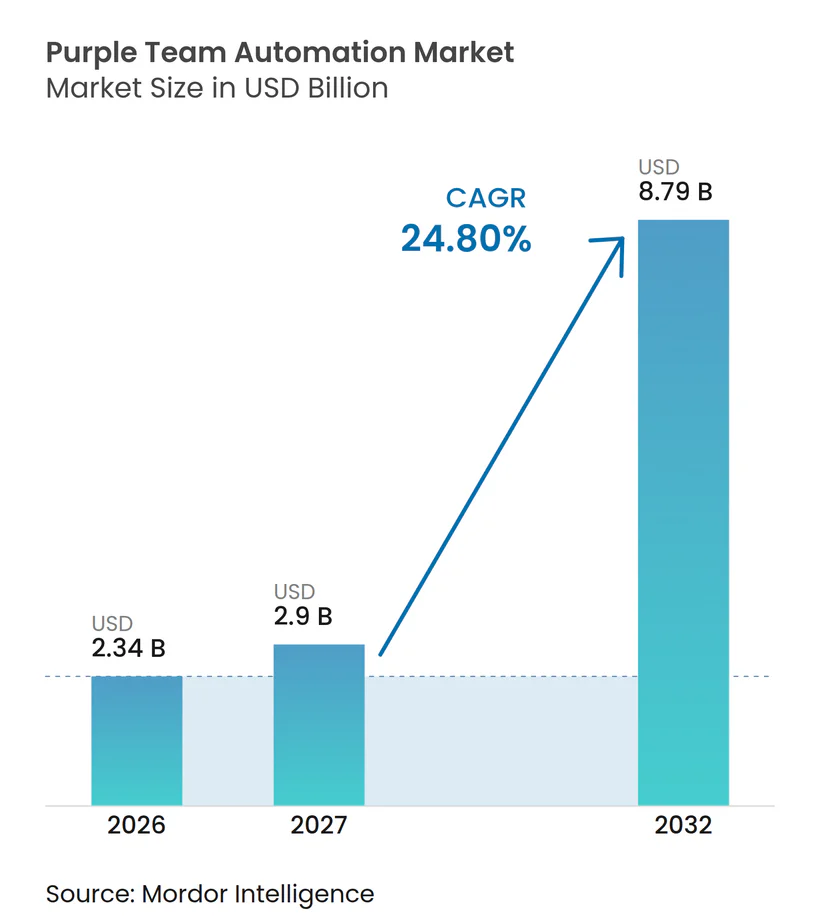
The purple team automation market size was valued at USD 2.34 billion in 2026 and estimated to grow from USD 2.95 billion in 2027 to reach USD 8.79 billion by 2032, at a CAGR of 24.80% during the forecast period 2027-2032. The purple team automation market is moving from occasional testing toward continuous validation of controls against realistic attack paths. Rising attack frequency, formal security requirements, and wider use of cloud and AI systems are increasing demand. Cyber insurers and boards are also asking for clearer evidence that security controls work in practice. Vendors are combining attack simulation, exposure analysis, and remediation workflows into wider platforms. The purple team automation market, therefore, presents opportunities for providers that can offer usable evidence, safe testing, and easier deployment.
Key Report Takeaways
- By offering platforms, held 67.15% of the purple team automation market share in 2026, while services are projected to expand at a 26.77% CAGR through 2032.
- By deployment, on-premises held 71.22% of the purple team automation market revenue share in 2026, while cloud deployment is projected to expand at a 26.02% CAGR through 2032.
- By organization size, large enterprises held 66.48% of the purple team automation market revenue share in 2026, while SMEs are projected to expand at a 26.35% CAGR through 2032.
- By end-user industry, BFSI held 28.14% of the purple team automation market revenue share in 2026, while government and public administration are projected to expand at a 25.23% CAGR through 2032.
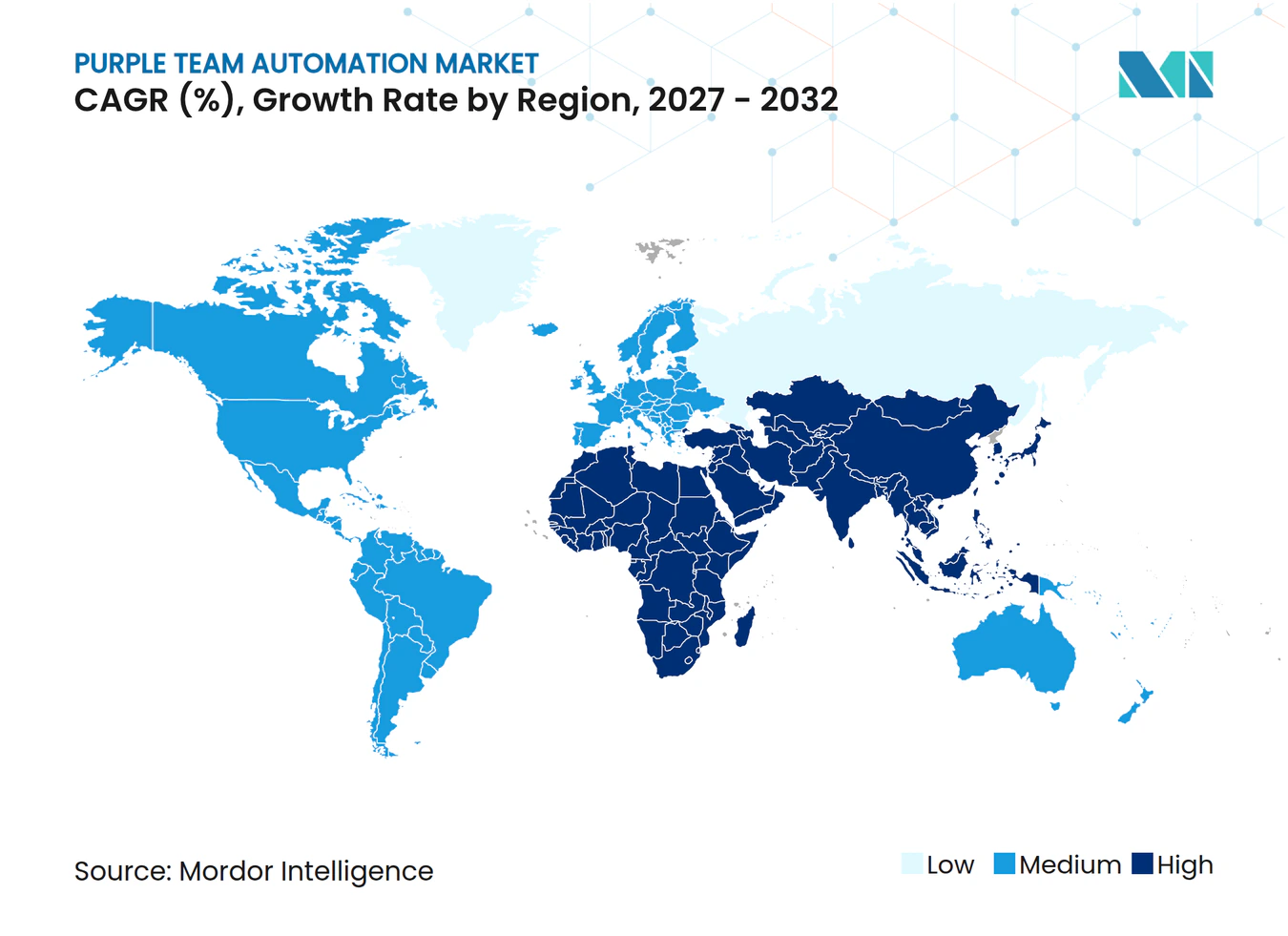
- By geography, North America held 35.18% of the purple team automation market revenue share in 2026, while Asia-Pacific is projected to expand at a 25.71% CAGR through 2032.
Note: Market numbers in this report are based on Mordor Intelligence's proprietary estimation framework, which combines nine months of actuals with Q4 projections for base year 2026.
Market Trends and Insights
Drivers Impact Analysis of Purple Team Automation Market*
| Driver | (~) % Impact on CAGR Forecast | Geographic Relevance | Impact Timeline |
|---|---|---|---|
| Rising Cyber-Attack Frequency and Sophistication | +5.8% | Global, most acute in North America, Europe, and Asia-Pacific | Short term (≤ 2 years) |
| Regulatory Mandates for Continuous Security Validation | +5.0% | EU, United States, and progressively Asia-Pacific national frameworks | Medium term (2-4 years) |
| Expansion of Cloud, Identity, API, and Hybrid Attack Surfaces | +4.3% | Global, with the largest concentration in North America and Asia-Pacific hyperscaler corridors | Medium term (2-4 years) |
| Convergence of Red-Team and Blue-Team Workflows | +3.5% | North America and Europe, with spillover into GCC and Singapore | Medium term (2-4 years) |
| AI-Enabled Adversary Emulation and Detection Engineering | +3.0% | Global, with fastest uptake in North America and East Asia | Long term (≥ 4 years) |
| Cyber-Insurance and Board-Level Evidence Requirements | +2.2% | North America and the EU, with early gains in Singapore and Australia | Short term (≤ 2 years) |
| Source: Mordor Intelligence | |||
Rising Cyber-Attack Frequency and Sophistication
The pace of hostile activity has exceeded the coverage that periodic security testing can provide. Check Point reported an average of 1,968 cyberattacks per organization per week in 2025, which was 70% higher than in 2023. Its January 2026 update recorded 2,086 weekly attacks per organization in February 2026. CrowdStrike reported an 89% rise in attacks by AI-enabled adversaries and a 27-second eCrime breakout time in its 2026 report. This shortens the time available to identify and contain lateral movement. The purple team automation market benefits from continuous simulations, which can give teams more up-to-date evidence of whether their controls respond as intended.
Regulatory Mandates for Continuous Security Validation
Regulatory requirements increasingly focus on documented testing rather than self-attested security status. DORA has been applied since January 17, 2025, and calls for vulnerability assessments and threat-led penetration testing for significant financial entities. Article 21 of NIS2 requires covered entities to assess the effectiveness of their cybersecurity risk-management measures. ENISA published implementation guidance in June 2025 that maps expectations to ISO/IEC 27001:2022 and NIST CSF 2.0. The SEC cybersecurity disclosure rule also places governance responsibility with public-company leadership. These requirements can move the purple team automation market from discretionary spending toward a defined compliance budget.
Expansion of Cloud, Identity, API, and Hybrid Attack Surfaces
Cloud, identity, API, and hybrid environments expand the range of systems that security teams must test. Google Cloud found that weak or absent credentials accounted for 47.1% of cloud incidents in the first half of 2025, while API and UI compromise accounted for another 11.8%.[1] ENISA reported that identity, cloud, and SaaS environments collectively accounted for 22% of recorded cyber incidents by the end of 2025. A cloud control can appear secure even when identity relationships still allow access to on-premises systems. This makes cross-surface attack-path testing more valuable than isolated control checks. The purple team automation market gains when platforms can demonstrate how distinct weaknesses combine to create a path to critical assets.
Convergence of Red-Team and Blue-Team Workflows
Purpose-built platforms are bringing offensive and defensive teams into a shared operating process. Shared dashboards, telemetry feeds, and detection-gap maps can reduce the delay between an attack simulation and detection tuning. MITRE’s Secure AI v2.0 release in May 2026 added playbooks for AI-enabled threat vectors to its threat-informed defense work. Those playbooks can support more consistent adversary emulation across teams. Continuous testing also allows each completed cycle to inform improvements in later detection. The purple team automation market has room for suppliers that make this feedback loop easy to govern and use.
Restraints Impact Analysis of Purple Team Automation Market*
| Restraint | (~) % Impact on CAGR Forecast | Geographic Relevance | Impact Timeline |
|---|---|---|---|
| High Automation-Safety and Governance Requirements | -1.8% | Global, most acute in financial services, healthcare, and critical infrastructure | Short term (≤ 2 years) |
| Shortage of Purple-Team and Detection-Engineering Talent | -1.5% | Global, most severe in North America, Western Europe, and parts of Asia-Pacific | Medium term (2-4 years) |
| Data-Sovereignty and Production-Testing Constraints | -1.1% | EU, GCC, and markets with active data-localization legislation, with spillover to Asia-Pacific | Medium term (2-4 years) |
| Interoperability Gaps Across Security Operations Technology Stacks | -0.9% | Global, most pronounced in large enterprises and governments using heterogeneous tools | Long term (≥ 4 years) |
| Source: Mordor Intelligence | |||
High Automation-Safety and Governance Requirements
Automated adversary emulation on live systems can introduce operational risks that conventional security tools do not. A poorly scoped test can disrupt services, affect logs, or complicate audit records. Financial services, healthcare, and critical infrastructure organizations, therefore, require defined scope, rollback plans, and approvals before testing production networks. These checks can involve security committees, change advisory boards, and supervisory notifications. Deployment can be delayed by 6 to 12 months where multiple national frameworks apply. The purple team automation market will depend on vendors strengthening guardrails, authorization controls, and rollback features.
Shortage of Purple-Team and Detection-Engineering Talent
Automation can quickly attack simulations, but teams still need expertise to identify gaps and build detection responses. ISC2 reported that 59% of organizations had critical or significant cybersecurity skills needs in 2025, up from 44% in 2024. ISACA reported in 2026 that 58% of cybersecurity teams were understaffed and 61% had open roles. The reported gaps in cloud security and machine learning security operations are particularly relevant to these platforms. Managed services can reduce routine workloads, but customers still need specialists to set priorities and remediate findings. This tension may slow adoption while also supporting demand for expert-led services.
*Our forecasts treat driver/restraint impacts as directional, not additive. The impact forecasts reflect baseline growth, mix effects, and variable interactions.
Purple Team Automation Market Segment Analysis
By Offering:
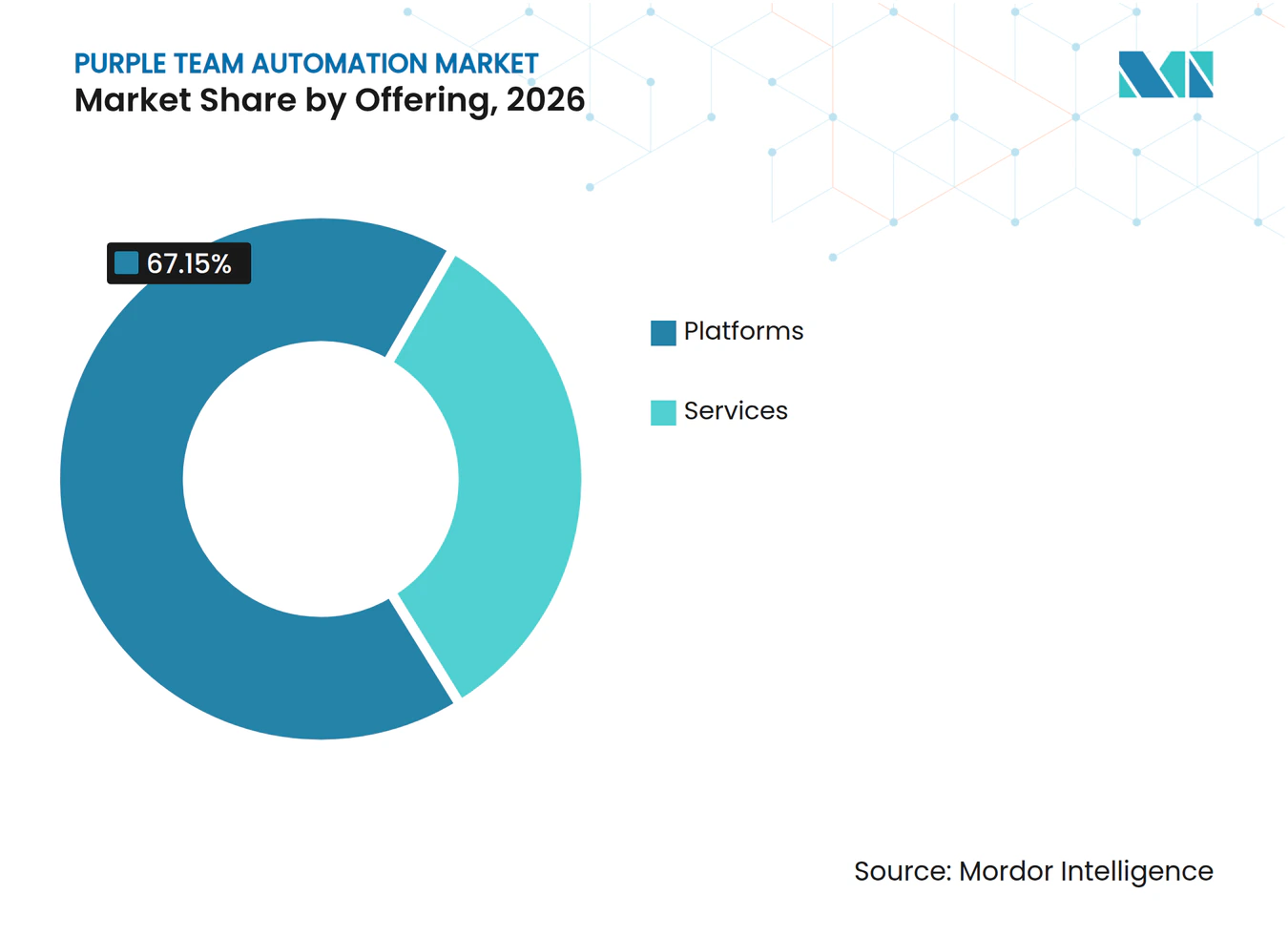
Platforms Lead While Services Gain MomentumPlatforms held 67.15% of revenue in 2026. They include continuous security validation products that combine breach-and-attack simulation, automated red teaming, and adversarial exposure validation. They also include attack-path management tools that show how an attacker could link smaller weaknesses into a breach scenario. This is valuable because it shifts attention from a single alert or control to a route toward critical assets.
Services are projected to expand at a 26.77% CAGR through 2032. Managed and professional services help customers configure platforms, maintain playbooks, and interpret results. The growth reflects the limited availability of staff who can manage continuous validation programs. The purple team automation industry also benefits when providers offer co-managed delivery that extends internal security teams. SANS described a shift toward continuous penetration testing and an Offensive SOC model that supports ongoing service delivery rather than project-based work.


By Deployment:
On-Premises Retains Control While Cloud Broadens AccessOn-premises systems accounted for 71.22% of the purple team automation market size in 2026. Sensitive simulation telemetry and forensic records can be subject to data residency and production governance rules. Financial services, government, and critical infrastructure operators may need to retain control of that data inside their own environments. Those obligations create sustained demand for on-premises delivery.
Cloud deployment is projected to expand at a 26.02% CAGR through 2032. It can reduce the infrastructure expense that prevents smaller organizations from operating large internal platforms. Subscription models also allow teams to scale validation activity with their exposure and budget. CrowdStrike recorded a 266% increase in cloud-conscious intrusions by state-nexus actors during 2025.[2] Hybrid designs can connect cloud orchestration with agents running on-premises, giving customers a middle option where sovereignty constraints are partial.
By Organization Size:
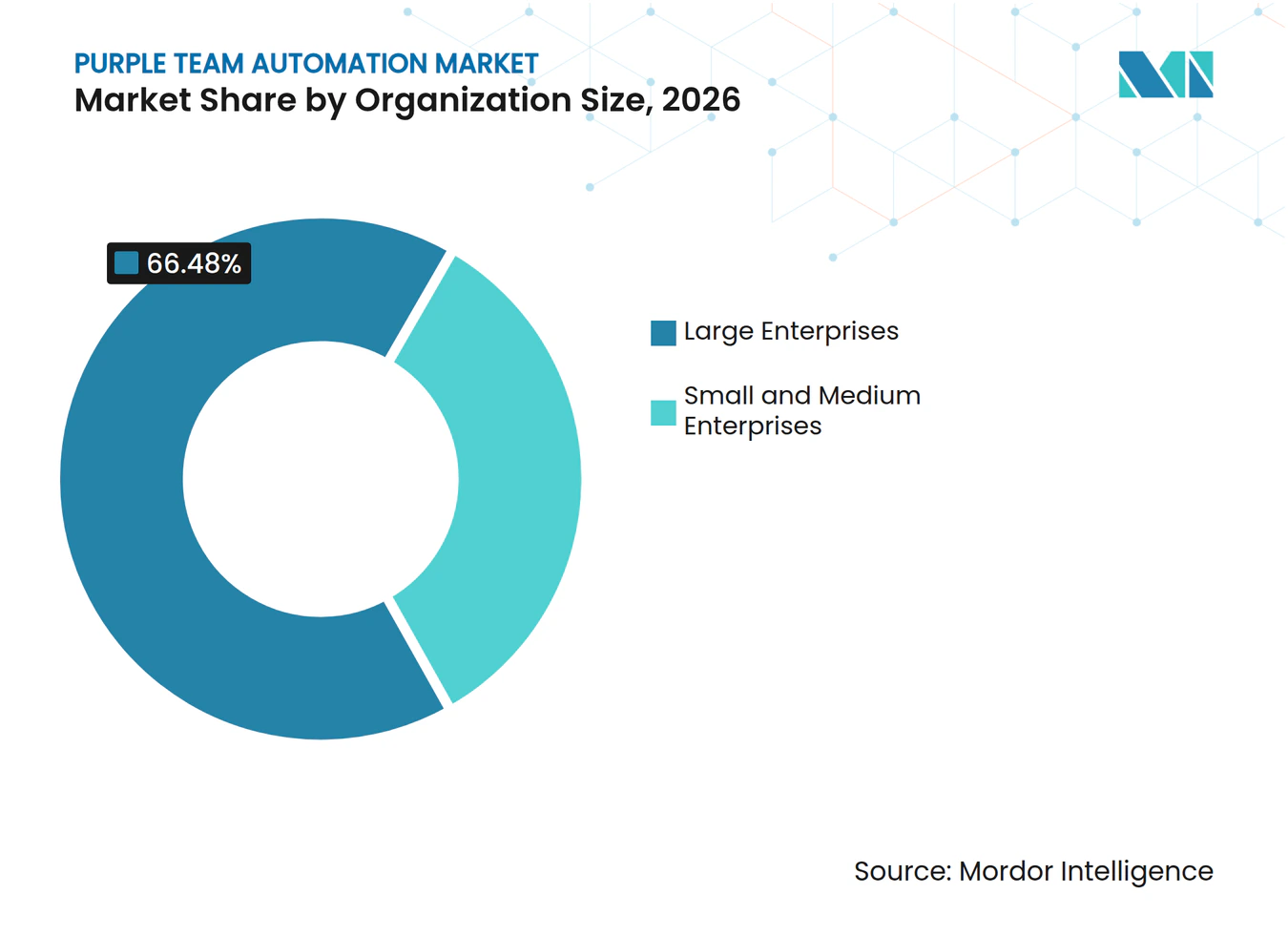
Large Enterprises Lead While SMEs Increase AdoptionLarge enterprises accounted for 66.48% of the revenue share in the purple team automation market in 2026. They often have multi-cloud operations, established security operations centers, and red and blue teams that can use continuous validation outputs. BFSI and government organizations are particularly important buyers because they face complex risk and evidence requirements. Their requirements also favor broad platforms that connect testing, reporting, and exposure analysis.
SMEs are projected to expand at a 26.35% CAGR through 2032. ISC2 found that 70% of respondents from small organizations experienced at least 1 AI-related security incident in the preceding 12 months, compared with 52% of respondents from enterprise-scale organizations. Cloud-delivered products and prebuilt playbooks can give smaller teams access to adversarial validation without a large infrastructure commitment. Vendors are responding with simpler product tiers and less demanding setups. Broader security and disclosure obligations for mid-sized organizations may also shorten procurement decisions.

By End-User Industry:
BFSI Anchors Demand While Government ExpandsBFSI held 28.14% of revenue in 2026. Financial organizations must show structured evidence that their controls work across regulated environments. DORA, SEC disclosure requirements, and U.S. financial-sector guidance reinforce that need. Attack-path tools can be important because they show how a compromised API credential or identity could reach core systems.
Government and public administration are projected to expand at a 25.23% CAGR through 2032. ENISA recorded 4,709 hacktivist claims against EU member states during its 2025 reporting period, with public administration among the most targeted sectors. Government procurement is increasing attention on continuous validation for public systems and contractors. Healthcare, IT and telecommunications, manufacturing, retail and e-commerce, and energy and utilities remain earlier-stage sources of demand. Energy and utilities face additional challenges because tests must account for the interaction of operational technology and IT without interrupting production.
Geography Analysis
North America Purple Team Automation Market
North America held 35.18% of revenue in 2026. The United States accounts for much of this demand because it has mature enterprise security programs, a dense vendor base, and major defense procurement. Check Point reported 2,090 attacks per organization per week in North America in January 2026, up 17% year over year.[3] Canada adds demand through financial services and government users. Board-level governance and cyber-insurance requirements also support continued investment in evidence-based validation.
Europe and South America Purple Team Automation Market
Europe is the second-largest regional market in 2026. Germany, the United Kingdom, and France generate most regional revenue. DORA and NIS2 have raised the need for tested evidence across financial entities and operators of essential services. ENISA’s technical guidance gives organizations a reference for mapping controls to ISO/IEC 27001:2022 and NIST CSF 2.0. Italy, Russia, and the rest of Europe are at earlier stages of adoption. South America, led by Brazil and Argentina, is smaller but is expanding as multinational validation programs extend to regional operations.
APAC and MEA Purple Team Automation Market
Asia-Pacific is projected to expand at a 25.71% CAGR through 2032. The region averaged 3,087 attacks per organization per week in January 2026, the second-highest level globally in Check Point’s data. Japan and South Korea have established enterprise security programs, while India is emerging as both a demand market and a managed-services delivery center. China follows a separate path shaped by MLPS 2.0 requirements for critical information infrastructure. Saudi Arabia and the UAE are increasing public-sector demand through national transformation programs. South Africa and Nigeria remain earlier-stage markets, although expanding digital infrastructure is creating new enterprise demand.
Competitive Landscape
Market Concentration
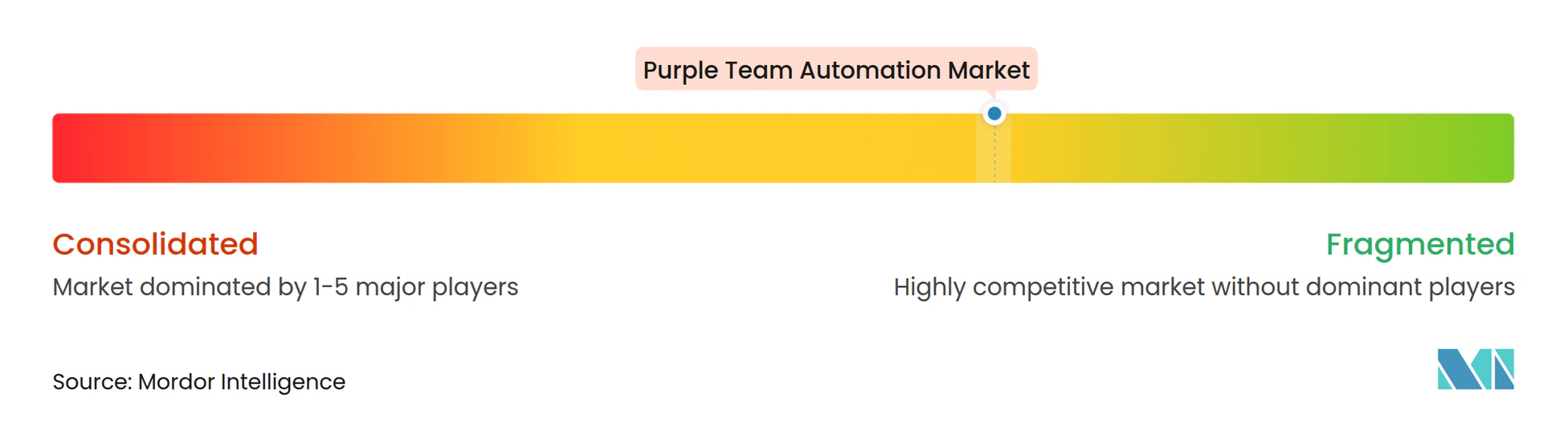
The purple team automation market is moderately fragmented, with Pentera, Cymulate, AttackIQ, SafeBreach, XM Cyber, Picus Security, SCYTHE, FireCompass, and Horizon3.ai among the specialist vendors. Competition centers on attack coverage, automation depth, integrations, and the usefulness of evidence for reporting. Customers also assess how accurately a platform maps activity to MITRE ATT&CK and whether it can show practical attack paths. The purple team automation market is increasingly linked with continuous threat exposure management platforms. This rewards vendors that can connect validation findings to prioritization and remediation workflows.
Vendors are integrating their products with SIEM, XDR, cloud security, and threat-intelligence systems. Cymulate introduced Vero AI, Mitigation Hub, and Detection Studio in June 2026 as a closed-loop system for validation, remediation coordination, and detection engineering.[4] Pentera added AI-native web application testing and partnered with Recorded Future in July 2026. AttackIQ acquired DeepSurface in February 2025 to expand its adversarial exposure validation capabilities and strengthen attack-path prioritization. These moves show a shift from isolated simulations toward connected security operations workflows.
Mid-market and SME customers remain an important opportunity because many enterprise tools require substantial configuration. Cloud-native and API-first products can shorten the time to initial validation and support consumption-based pricing. Standards support is also becoming important in regulated sectors, where buyers want reporting aligned with MITRE ATT&CK, NIST CSF 2.0, and ISO/IEC 27001:2022. This supports providers that can present technical results in a form that security leaders and auditors can use. The purple team automation market may consolidate as broader security platforms seek validation and attack-path capabilities. The purple team automation market also rewards suppliers that can translate technical test results into clear remediation priorities.
Purple Team Automation Industry Leaders
-
AttackIQ, Inc.
-
Cymulate Ltd.
-
SafeBreach Inc.
-
XM Cyber Ltd.
-
Pentera Security Ltd.
- *Disclaimer: Major Players sorted in no particular order
Purple Team Automation Market Companies Covered in this Report
- AttackIQ, Inc.
- Cymulate Ltd.
- SafeBreach Inc.
- XM Cyber Ltd.
- Pentera Security Ltd.
- Picus Security, Inc.
- SCYTHE Inc.
- FireCompass Technologies, Inc.
- MazeBolt Technologies Ltd.
- Cronus Cyber Technologies, Inc.
- FourCore Labs Private Limited
- CybExer Technologies OÜ
- Patrowl SAS
- ThreatConnect, Inc.
- PlexTrac, Inc.
- Horizon3.ai, Inc.
- Foreseeti AB
- PurpleSharp, Inc.
- Shadowmap Technologies GmbH
- Rimator, Inc.
Recent Industry Developments in Purple Team Automation Market
- August 2026: Horizon3.ai raised USD 250 million in a Series E round co-led by NightDragon and NEA at a valuation exceeding USD 650 million. The funding supports entry into Singapore and Australia, a deeper push across EMEA, and the development of autonomous blue-team agents that remediate vulnerabilities directly from NodeZero's findings, extending the platform from offensive validation into closed-loop remediation automation.
- August 2026: DISA selected AttackIQ as the Department of War's enterprise platform for Adversarial Exposure Validation, establishing a large-scale federal procurement foothold and signaling that the US government recognizes continuous automated adversarial validation as a strategic security capability. This selection is expected to cascade compliance requirements across the Defense Industrial Base.
- August 2026: Horizon3.ai announced a USD 20 million investment in its global partner ecosystem, expanding channel programs and launching strategic alliances with World Wide Technology and Brinqa to extend NodeZero's reach into exposure management and remediation orchestration workflows.
- July 2026: Pentera launched AI-native web application pentesting within its Autonomous Security Validation Platform and partnered with Recorded Future to deliver threat intelligence-led exposure validation, linking threat intelligence to real-world threat actor tactics, techniques, and procedures to automate continuous security validation workflows.
Global Purple Team Automation Market Report Scope
The Purple Team Automation Market comprises software platforms and services that automate collaboration between offensive security teams (red teams) and defensive security teams (blue teams) to continuously validate security controls, improve detection engineering, assess cyber resilience, and accelerate remediation activities. These solutions support adversary emulation, attack-path analysis, attack simulation, threat validation, and security control testing across enterprise environments. The market includes platform subscriptions, managed services, professional services, implementation, support, maintenance, and training associated with purple-team operations and continuous security validation programs.
The Purple Team Automation Market Report is Segmented by Offering (Platforms [Continuous Security Validation Platforms and Attack-Path Management Tools], and Services [Managed Services and Professional Services]), Deployment (On-Premises, and Cloud), Organization Size (Large Enterprises, and Small and Medium Enterprises), End-User Industry (Banking, Financial Services, and Insurance [BFSI], Government and Public Administration, Healthcare and Life Sciences, IT and Telecommunication, Industrial Manufacturing, Retail and E-commerce, Energy and Utilities, and Other End-User Industries), and Geography (North America, South America, Europe, Asia-Pacific, Middle East, and Africa). The Market Forecasts are Provided in Terms of Value (USD).
Segmentation Overview
| Platforms | Continuous Security Validation Platforms |
| Attack-Path Management Tools | |
| Services | Managed Services |
| Professional Services |
| On-Premises |
| Cloud |
| Large Enterprises |
| Small and Medium Enterprises |
| Banking, Financial Services, and Insurance (BFSI) |
| Government and Public Administration |
| Healthcare and Life Sciences |
| IT and Telecommunication |
| Industrial Manufacturing |
| Retail and E-commerce |
| Energy and Utilities |
| Other End-User Industries |
| North America | United States |
| Canada | |
| South America | Brazil |
| Argentina | |
| Mexico | |
| Rest of South America | |
| Europe | Germany |
| United Kingdom | |
| France | |
| Italy | |
| Russia | |
| Rest of Europe | |
| Asia-Pacific | China |
| Japan | |
| India | |
| South Korea | |
| Rest of Asia-Pacific | |
| Middle East | Saudi Arabia |
| United Arab Emirates | |
| Rest of Middle East | |
| Africa | South Africa |
| Nigeria | |
| Rest of Africa |
| By Offering | Platforms | Continuous Security Validation Platforms |
| Attack-Path Management Tools | ||
| Services | Managed Services | |
| Professional Services | ||
| By Deployment | On-Premises | |
| Cloud | ||
| By Organization Size | Large Enterprises | |
| Small and Medium Enterprises | ||
| By End-User Industry | Banking, Financial Services, and Insurance (BFSI) | |
| Government and Public Administration | ||
| Healthcare and Life Sciences | ||
| IT and Telecommunication | ||
| Industrial Manufacturing | ||
| Retail and E-commerce | ||
| Energy and Utilities | ||
| Other End-User Industries | ||
| By Geography | North America | United States |
| Canada | ||
| South America | Brazil | |
| Argentina | ||
| Mexico | ||
| Rest of South America | ||
| Europe | Germany | |
| United Kingdom | ||
| France | ||
| Italy | ||
| Russia | ||
| Rest of Europe | ||
| Asia-Pacific | China | |
| Japan | ||
| India | ||
| South Korea | ||
| Rest of Asia-Pacific | ||
| Middle East | Saudi Arabia | |
| United Arab Emirates | ||
| Rest of Middle East | ||
| Africa | South Africa | |
| Nigeria | ||
| Rest of Africa | ||
Key Questions Answered in the Report
What is the projected size of the purple team automation market by 2032?
The purple team automation market is projected to reach USD 8.79 billion by 2032, from USD 2.95 billion in 2027, at a 24.80% CAGR.
What is driving adoption of automated purple teaming?
Higher attack frequency, regulatory testing requirements, larger cloud and identity attack surfaces, and board demand for evidence are supporting adoption.
Which offering leads revenue in this field?
Platforms lead with 67.15% revenue share in 2026, while services are projected to grow faster at a 26.77% CAGR through 2032.
Why do organizations still use on-premises deployments?
On-premises deployment held 71.22% revenue share in 2026 because sensitive telemetry, data residency, and production-governance rules remain important.
Which end-user group has the highest revenue share?
BFSI leads with 28.14% revenue share in 2026 because financial organizations need evidence that security controls work in regulated environments.
Which region is projected to grow fastest?
Asia-Pacific is projected to grow at a 25.71% CAGR through 2032, supported by high attack volumes, cloud investment, and national resilience programs.