
Securities Lending Market Size and Share
Market Overview
| Study Period | 2020 - 2031 |
|---|---|
| Market Size (2026) | USD 4.60 Trillion |
| Market Size (2031) | USD 6.60 Trillion |
| Growth Rate (2026 - 2031) | 7.50 % |
| Fastest Growing Market | Asia-Pacific |
| Largest Market | North America |
| Market Concentration | High |
Major Players *Disclaimer: Major Players sorted in no particular order Image © Mordor Intelligence. Reuse requires attribution under CC BY 4.0. | |
Securities Lending Market Analysis by Mordor Intelligence
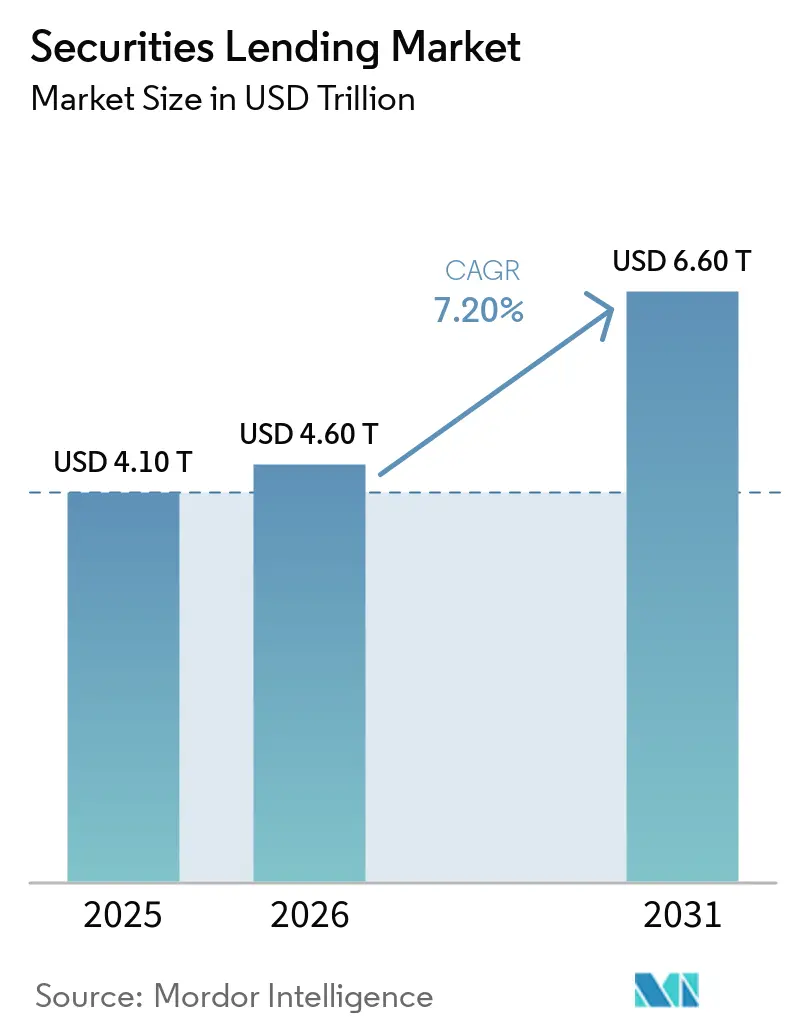
The Securities Lending Market size was estimated at USD 4.1 trillion in 2025 and is projected to grow from USD 4.6 trillion in 2026 to reach USD 6.6 trillion by 2031, growing at a CAGR of 7.5% from 2026 to 2031.
Lending revenue reached USD 14.9 billion in 2025, supported by equity volatility tied to artificial intelligence, larger exchange-traded fund lending balances, and renewed activity in Asian markets after South Korea lifted its short-selling ban in March 2025. Loan balances reached USD 4.4 trillion in the first half of 2026, while lender-to-broker revenue rose 34% year over year to USD 7 billion. The securities lending market now has a more direct role in institutional portfolio construction because asset owners seek recurring income while borrowers require reliable access to inventory. Demand is increasingly split between high-volume general collateral activity and scarce securities that earn higher fees. Higher sovereign issuance is also expanding the pool of lendable high-quality liquid assets, which supports multi-asset programs that can serve both fixed-income and equity demand.
Key Report Takeaways
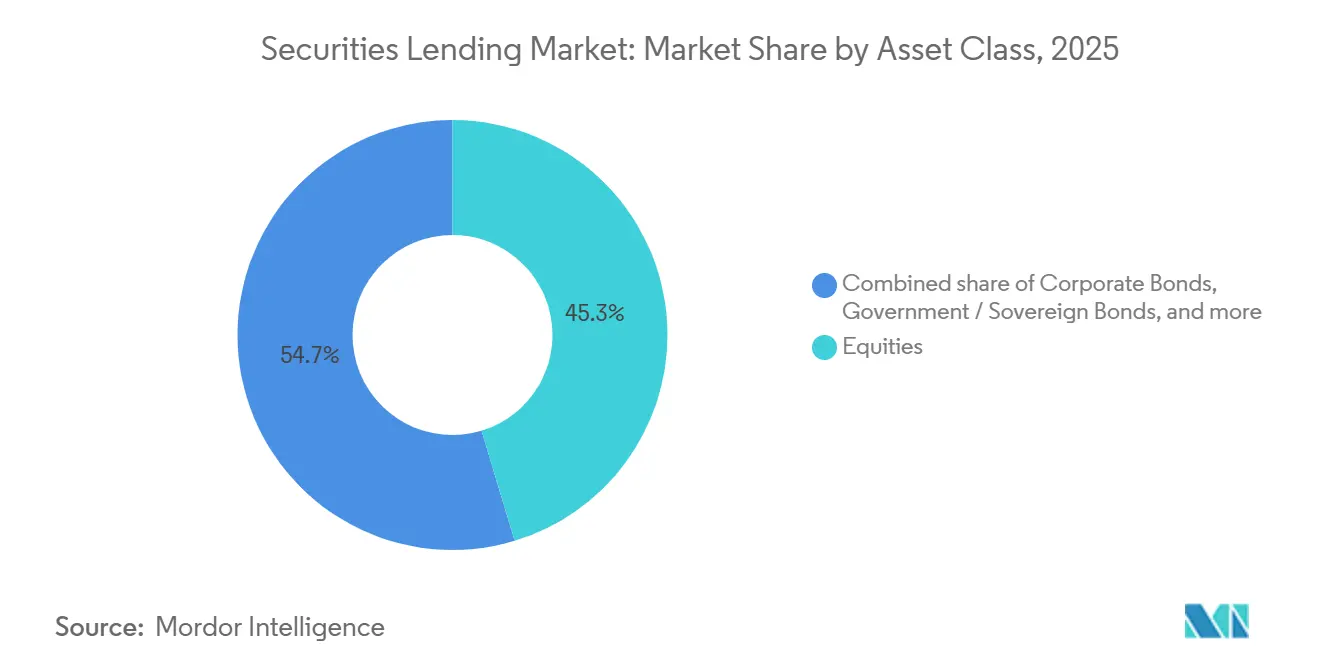
- By asset class, equities captured 45.3% of the securities lending market share in 2025 and are projected to grow at an 8% CAGR through 2031.
- By participant type, government and sovereign entities captured 28.1% of the securities lending market share in 2025, while collective investment vehicles and asset managers are projected to grow at a 9.2% CAGR through 2031.
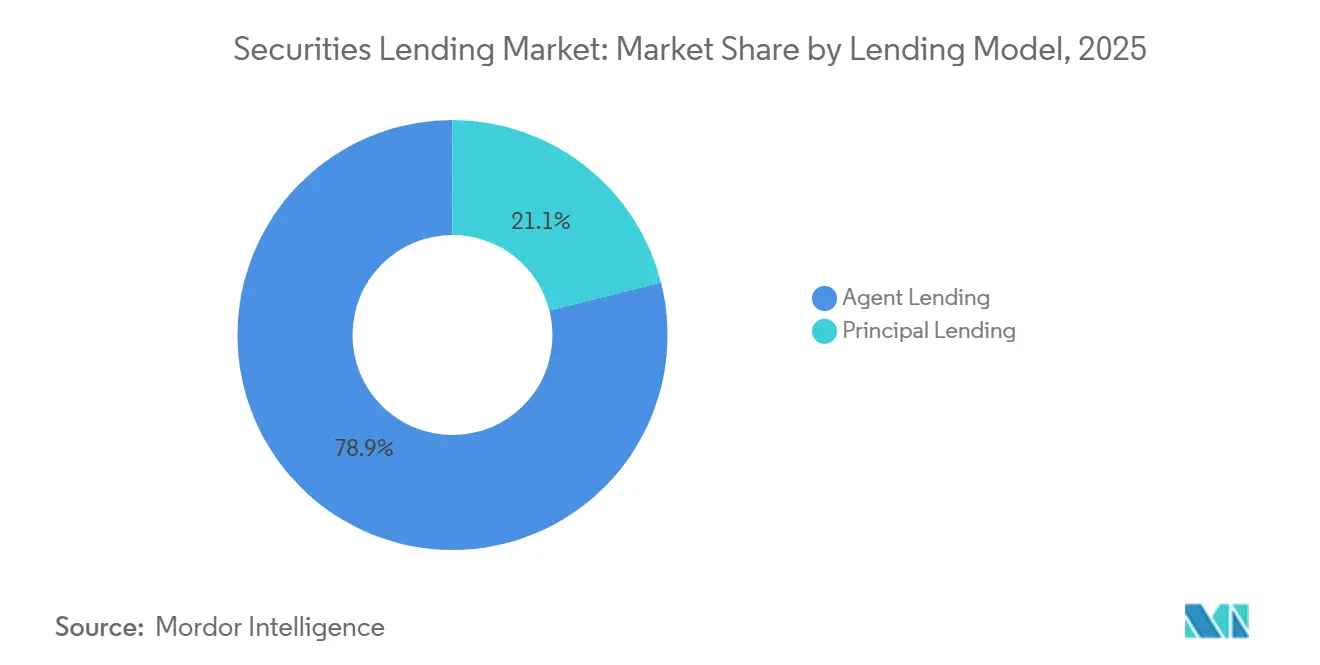
- By lending model, agent lending captured 78.9% of the securities lending market share in 2025, while principal lending is projected to grow at an 8.5% CAGR through 2031.
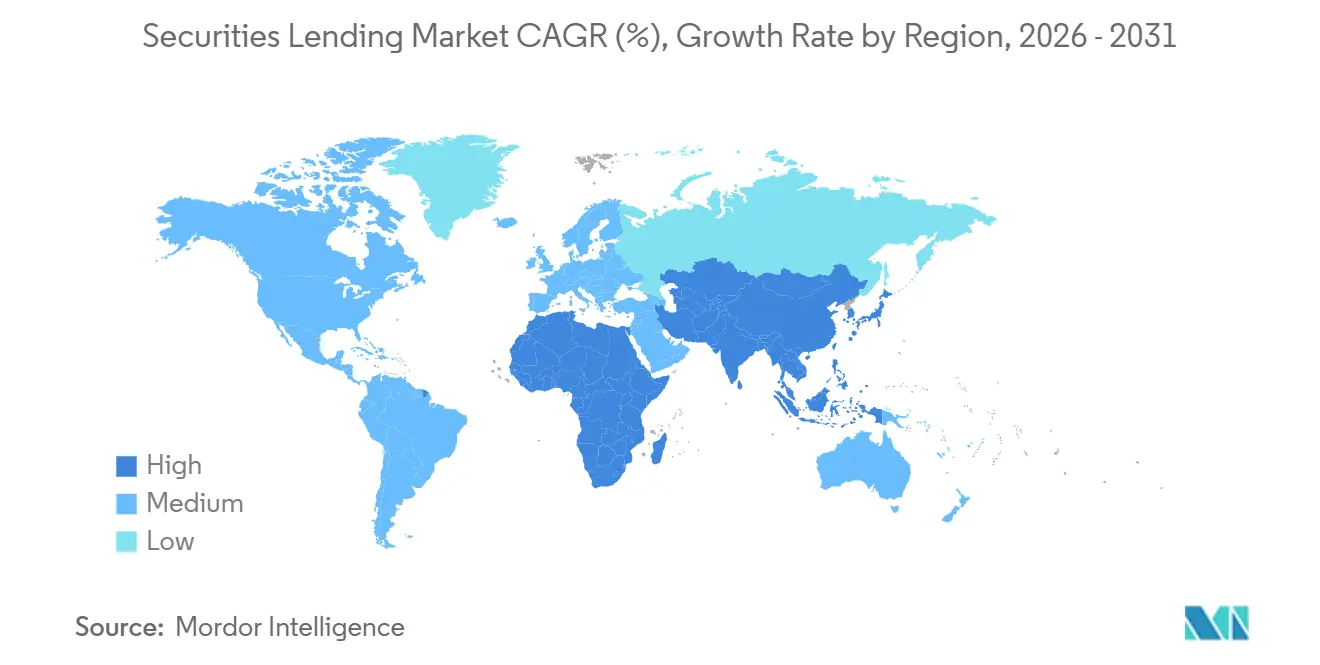
- By geography, North America captured 38.2% of the securities lending market share in 2025, while Asia-Pacific is projected to grow at 10.2% CAGR through 2031.
Note: Market size and forecast figures in this report are generated using Mordor Intelligence’s proprietary estimation framework, updated with the latest available data and insights as of January 2026.
Market Trends and Insights
Drivers Impact Analysis of Securities Lending Market*
| Driver | (~) % Impact on CAGR Forecast | Geographic Relevance | Impact Timeline |
|---|---|---|---|
| Short-Selling And Relative-Value Trading Expanding Borrow Demand | +1.5% | Global, concentrated in North America and Asia-Pacific | Short term (≤ 2 years) |
| Institutional And ETF Assets Expanding Lendable Supply | +1.8% | Global, strongest in North America and Europe | Medium term (2-4 years) |
| Institutional Adoption For Portfolio Income | +1.2% | Global, with early acceleration in Asia-Pacific and Middle East and Africa | Medium term (2-4 years) |
| Market Making And Settlement Coverage Increasing Borrowing | +0.9% | North America and Europe, with spillover to Asia-Pacific | Short term (≤ 2 years) |
| Higher Utilization Of Scarce And Special Securities | +0.8% | Global, highest in Asia-Pacific and select United States names | Short term (≤ 2 years) |
| Agency And Centralized Programs Improving Asset Mobilization | +0.7% | Global, with early gains in Middle East and Africa and South America | Long term (≥ 4 years) |
| Source: Mordor Intelligence | |||
Growing Short-Selling and Relative-Value Trading Activity Increasing Securities Borrow Demand
Short-selling and relative-value positions are increasing the need for borrowed securities across the securities lending market. Global equity lending revenue rose 38% year over year to USD 5.4 billion in the first half of 2026. Asia-Pacific generated USD 2.1 billion as semiconductor, artificial intelligence infrastructure, and electric vehicle positions remained on loan for longer periods[1]. Curated counterparty lists and flexible term-lending arrangements can improve fee capture when demand centers on a smaller group of special securities. Convertible issuance linked to artificial intelligence infrastructure financing also expanded convertible-arbitrage borrowing demand in 2026. EquiLend processed 121,800 United States equity trades on the June 2026 Russell reconstitution date, showing the operational importance of managing large event-driven demand peaks
Expansion of Institutional and ETF Asset Pools Increasing the Supply of Lendable Securities
Institutional portfolios and exchange-traded funds are widening the inventory available to the securities lending market. Larger exchange-traded fund portfolios give lenders more individual positions that can be offered to borrowers, instead of relying only on broad custodial pools. Active, leveraged, and crypto-related exchange-traded fund holdings can have distinct borrowing patterns from passive index positions. Exchange-traded fund lending revenue reached USD 405 million in the first half of 2026, an increase of 62% from the prior year. This broader inventory can support lending programs with more specific securities and loan terms. It also helps programs respond when demand shifts between index positions, concentrated equity trades, and other collateral needs.
Rising Institutional Adoption of Securities Lending for Incremental Portfolio Income
Large asset owners increasingly treat lending income as part of portfolio management within the securities lending market. BNY reported USD 6.1 trillion in lendable assets and USD 695 billion on loan across 34 local markets at the end of 2025[2]. Its mandate structures accommodate environmental, social, and governance restrictions, proxy-voting thresholds, and counterparty concentration limits. The Global Principles for Sustainable Securities Lending framework addresses the treatment of green bonds and stewardship concerns in lending arrangements. Those requirements add governance work for lenders and agents, particularly when investors must balance voting objectives with income opportunities. Scale, therefore, matters because larger providers can support customized restrictions across multiple markets and asset classes.
Increasing Securities Borrow Demand for Market Making and Settlement Coverage
Market making and settlement coverage are raising the structural need for borrowed securities in the securities lending market. The United States Treasury clearing mandate takes effect on December 31, 2026, and requires central clearing for covered Treasury transactions[3]. Clearing participants need efficient funding and inventory arrangements as transactions move into centrally cleared workflows. Government bond lending revenue rose 27% during the first half of 2026. United States Treasuries, French OATs, and United Kingdom gilts each recorded higher lending revenue as sovereign volatility and primary issuance increased hedging activity. Agency and centralized programs can mobilize assets more effectively, while higher utilization of scarce securities supports the economics of specialized lending programs.
Restraints Impact Analysis of Securities Lending Market*
| Restraint | (~) % Impact on CAGR Forecast | Geographic Relevance | Impact Timeline |
|---|---|---|---|
| Capital And Balance-Sheet Constraints On Intermediaries | -0.6% | Global, most acute in North America and Europe | Medium term (2-4 years) |
| Counterparty And Collateral Risks For Beneficial Owners | -0.4% | Global | Short term (≤ 2 years) |
| Cross-Border Tax, Legal, And Settlement Complexity | -0.5% | Asia-Pacific, Middle East and Africa, and cross-border Europe and United States flows | Medium term (2-4 years) |
| Collateral Management And Post-Trade Processing Costs | -0.3% | Global, highest in multi-jurisdictional programs | Long term (≥ 4 years) |
| Source: Mordor Intelligence | |||
Capital and Balance-Sheet Constraints Limiting Intermediary Lending Capacity
Capital requirements are limiting how much balance sheet some intermediaries can devote to the securities lending market. The United Kingdom Prudential Regulation Authority published final Basel 3.1 rules in January 2026, with implementation scheduled for January 2027. Regulation (EU) 2025/1215 changed net stable funding ratio requirements for certain securities financing transactions with residual maturities below 6 months[4]. These rules can make short-term general collateral intermediation less attractive for bank balance sheets. Centrally cleared structures can help participants use multilateral netting and reduce risk-weighted assets. The resulting economics favor agents that can provide cleared triparty arrangements and broader collateral-management support.
Cross-Border Tax, Legal, and Settlement Complexity Restricting International Lending
Cross-border participation remains constrained by tax, legal, and settlement requirements in the securities lending market. The United States Internal Revenue Service issued Notice 2025-63 in October 2025 on proposed rules for sourcing borrow fees by recipient residence. The notice addressed withholding treatment that affects many non-United States lenders. ISLA updated its United Kingdom Tax Addendum for the Global Master Securities Lending Agreement in February 2026 to clarify manufactured-payment withholding obligations. Foreign ownership limits in Thailand and source-income taxation in Taiwan can restrict access to fee-rich lending activity. Counterparty and collateral risks also make beneficial owners cautious, while multi-jurisdictional collateral management and post-trade processing raise operating costs.
*Our forecasts treat driver/restraint impacts as directional, not additive. The impact forecasts reflect baseline growth, mix effects, and variable interactions.
Securities Lending Market Segment Analysis
By Asset Class:
Equities Lead on Specials, Fixed Income DeepensEquities accounted for 45.3% of the securities lending market size in 2025 and are forecast to grow at an 8% CAGR through 2031. Equity lending is supported by exchange-traded fund activity, semiconductor-linked positions, and volatility surrounding artificial intelligence-related securities. Common shares, ADRs, and equity exchange-traded products generated USD 11.5 billion of USD 14.9 billion in global lending revenue during 2025. Asian technology and semiconductor names were among the higher-earning special securities. Exchange-traded fund lending revenue then rose to USD 405 million in the first half of 2026.
Government and sovereign bonds formed the next major fixed-income source of lending activity. Revenue from government bond lending increased 27% in the first half of 2026 as high-quality liquid asset demand and clearing deadlines increased borrowing needs. Corporate bond lending balances in North American investment-grade securities also expanded as managers used holdings to manage credit-spread risk and monetize inventory during issuance periods. Agency bonds, supranationals, and convertibles expanded the range of fixed-income and hybrid collateral available to programs. Convertible issuance connected to artificial intelligence infrastructure financing created related convertible-arbitrage equity borrowing demand. This cross-asset mix broadens the securities lending market size opportunity by enabling lenders to capture both collateral-driven demand and higher-margin special-security opportunities.
By Participant Type:
Sovereigns Anchor Supply, Asset Managers Drive GrowthGovernment and sovereign entities held 28.1% of the securities lending market share in 2025. Their portfolios usually provide stable inventory and support longer lending tenors. Their governance mandates tend to prioritize controlled program operation over the highest possible fee rate. Collective investment vehicles and asset managers are forecast to expand at a 9.2% CAGR through 2031. Actively managed exchange-traded funds, interval funds, and UCITS vehicles are activating programs to offset management-fee pressure.
Banks and broker-dealers primarily participate as borrowers that finance short positions, manage inventory, and address settlement obligations. Their demand is increasingly affected by capital costs and the growing use of cleared structures. BNY launched a centrally cleared triparty model for UCITS clients with Cboe Clear Europe in November 2025. The structure allows UCITS lenders to participate without posting margin while supporting risk-weighted asset efficiency for borrowers. Insurance companies, endowments, foundations, and corporate treasuries provide a meaningful but comparatively underutilized source of supply, creating additional opportunities to expand the securities lending market size as participation broadens.
By Lending Model:
Agent Dominates, Principal Gains Ground on Revenue CertaintyAgent lending commanded 78.9% of the securities lending market share in 2025. Beneficial owners use this model because custodian banks can administer global programs, manage collateral, and provide indemnification arrangements. BNY reported USD 6.1 trillion in lendable assets across 34 local markets at the end of 2025. Its program includes directed loans, indemnified and non-indemnified structures, asset segregation, and collateral-investment options. Cleared, peer-to-peer, and pledge-based structures give beneficial owners additional choices for program design.
Principal lending is forecast to grow at an 8.5% CAGR between 2026 and 2031. Broker-dealers value guaranteed-term supply, and institutional lenders may prefer contracted revenue during volatile periods. BNP Paribas offers principal lending arrangements with revenue fixed for a defined period, regardless of market events. This approach suits owners who place greater value on income visibility than on maximizing changing fee rates. Centrally cleared principal structures may further support the securities lending market size by enabling participants to use multilateral netting under stricter capital requirements.
Geography Analysis
North America Securities Lending Market
North America held 38.2% of the securities lending market share in 2025. Deep equity custodial pools and a high concentration of hedge-fund borrowers support the region's position. North American equity lending revenue reached USD 2.3 billion in the first half of 2026. Artificial intelligence trading, biotechnology event positions, credit exchange-traded fund demand, and energy short positions drove activity. The December 2026 Treasury clearing deadline is changing how participants manage inventory and funding.
EMEA Securities Lending Market
Europe has growing fixed-income borrowing needs as liquidity conditions change and participants manage high-quality liquid assets. EMEA equity lending revenue reached USD 959 million in the first half of 2026, led by industrial, financial, and merger-related positions. Germany generated USD 132 million as industrial and auto-sector positions increased. SFTR compliance and CSDR provisions add cost and operational requirements for European programs. SAB Invest appointed J.P. Morgan as agent for its Saudi equity securities lending program in June 2026.
APAC Securities Lending Market
Asia-Pacific is forecast to grow at a 10.2% CAGR, the fastest regional rate in the securities lending market size. Asia-Pacific equity lending revenue rose to USD 2.1 billion in the first half of 2026. South Korea's reopening to short selling increased on-loan balances after the prior ban was removed. Taiwan has become important for artificial intelligence hardware supply-chain positions. Japan's policy normalization supports yield-enhancement demand in Japanese government bonds.
Competitive Landscape
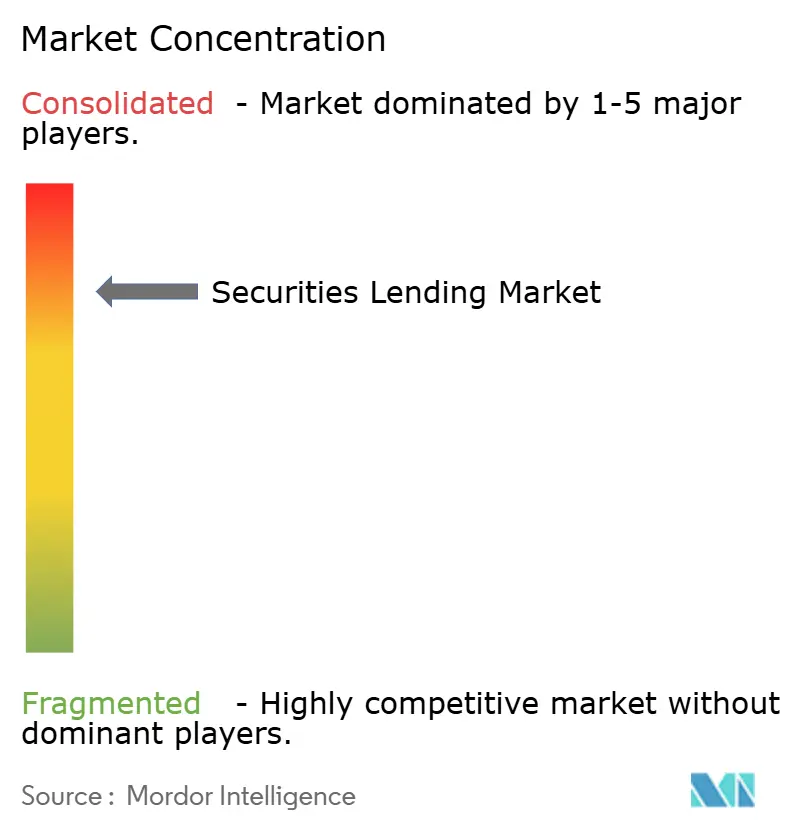
The securities lending market is consolidated among a group of major agent lenders and global financial institutions. J.P. Morgan, BNY, State Street, and Northern Trust are prominent providers of agency securities lending services to institutional beneficial owners. Goldman Sachs, Morgan Stanley, Deutsche Bank, Barclays, and BNP Paribas are significant participants across borrower financing, principal lending, and related securities-finance activities. Competitive positioning is influenced by provider scale, technology infrastructure, collateral management capabilities, indemnification capacity, and global market coverage. Increasingly, integrated operating models that combine agency lending, collateral management, automated workflows, and access to central clearing are becoming important differentiators for institutional clients.
Technology investment is changing bilateral processing across the securities lending market. EquiLend's 1Source platform uses distributed ledger technology to automate mark-to-market calculations, recalls, substitutions, and other lifecycle events. EquiLend acquired Finadium in May 2026, adding research and data capabilities to its securities finance activities. BNY's November 2025 UCITS model with Cboe Clear Europe widened access to centrally cleared triparty securities financing transactions. These moves show that providers are linking automation with clearing access and servicing depth.
Cleared institutional lending and tokenized collateral are areas of emerging activity. DTCC announced in May 2026 that its Collateral AppChain will use Chainlink's Runtime Environment for near-real-time, 24/7 collateral management, with a target launch in the fourth quarter of 2026. The proposed service is intended to automate collateral eligibility, valuation, margining, and settlement across traditional and blockchain-based markets. These initiatives address the need to mobilize collateral and process transactions with less manual reconciliation. Their adoption will depend on institutional controls, legal clarity, and integration with established post-trade systems.
Securities Lending Industry Leaders
-
J.P. Morgan
-
BNY Mellon
-
State Street Corporation
-
BNP Paribas
-
Citi
- *Disclaimer: Major Players sorted in no particular order
Securities Lending Market Companies Covered in this Report
- J.P. Morgan
- BNY Mellon
- State Street Corporation
- Northern Trust Corporation
- Citi
- BNP Paribas
- Goldman Sachs
- Morgan Stanley
- UBS Group
- Bank of America
- Deutsche Bank
- Barclays
- HSBC Holdings
- Société Générale
- Wells Fargo
- Mizuho Financial Group
- Natixis Corporate & Investment Banking
- Jefferies Financial Group
- RBC Capital Markets
- Brown Brothers Harriman
Recent Industry Developments in Securities Lending Market
- August 2026: Transparence IO LLC acquired a securities lending technology platform from South Street Securities Holdings Inc., launching as an outsourced technology and operational solutions provider for United States broker-dealers, banks, custodians, and global financial institutions. The platform covers workflow automation, real-time inventory and cash management, risk monitoring, and regulatory reporting.
- June 2026: SAB Invest appointed J.P. Morgan as agent for its Saudi equity securities lending program, marking the formal entry of a major Saudi investment firm into institutional-grade securities lending
- May 2026: EquiLend acquired Finadium, expanding its market intelligence and data products across securities finance, repo, and prime brokerage.
- May 2026: DTCC announced that Collateral AppChain will integrate Chainlink's Runtime Environment for near-real-time, 24/7 tokenized collateral management, targeting a fourth-quarter 2026 launch.
Global Securities Lending Market Report Scope
Segmentation Overview
| Equities (including common shares, preferred shares, equity ETFs/ETPs, ADRs, and other equity securities) |
| Government / Sovereign Bonds |
| Corporate Bonds |
| Other Fixed Income and Hybrid Securities (agency/supranational bonds, convertible securities, and other eligible fixed-income or hybrid instruments) |
| Pension Funds |
| Insurance Companies |
| Banks |
| Broker-Dealers |
| Collective Investment Vehicles / Asset Managers |
| Government / Sovereign Entities and Official Institutions |
| Other Institutional Investors (endowments, foundations, corporations, etc.) |
| Agent Lending |
| Principal Lending |
| North America | United States |
| Canada | |
| Mexico | |
| South America | Brazil |
| Argentina | |
| Rest of South America | |
| Europe | United Kingdom |
| Germany | |
| France | |
| Italy | |
| Spain | |
| Rest of Europe | |
| Asia-Pacific | China |
| Japan | |
| India | |
| South Korea | |
| Australia | |
| Indonesia | |
| Thailand | |
| Malaysia | |
| Singapore | |
| Vietnam | |
| Rest of Asia-Pacific | |
| Middle East and Africa | Saudi Arabia |
| United Arab Emirates | |
| Turkey | |
| South Africa | |
| Egypt | |
| Rest of Middle East and Africa |
| By Asset Class | Equities (including common shares, preferred shares, equity ETFs/ETPs, ADRs, and other equity securities) | |
| Government / Sovereign Bonds | ||
| Corporate Bonds | ||
| Other Fixed Income and Hybrid Securities (agency/supranational bonds, convertible securities, and other eligible fixed-income or hybrid instruments) | ||
| By Participant Type | Pension Funds | |
| Insurance Companies | ||
| Banks | ||
| Broker-Dealers | ||
| Collective Investment Vehicles / Asset Managers | ||
| Government / Sovereign Entities and Official Institutions | ||
| Other Institutional Investors (endowments, foundations, corporations, etc.) | ||
| By Lending Model | Agent Lending | |
| Principal Lending | ||
| By Geography | North America | United States |
| Canada | ||
| Mexico | ||
| South America | Brazil | |
| Argentina | ||
| Rest of South America | ||
| Europe | United Kingdom | |
| Germany | ||
| France | ||
| Italy | ||
| Spain | ||
| Rest of Europe | ||
| Asia-Pacific | China | |
| Japan | ||
| India | ||
| South Korea | ||
| Australia | ||
| Indonesia | ||
| Thailand | ||
| Malaysia | ||
| Singapore | ||
| Vietnam | ||
| Rest of Asia-Pacific | ||
| Middle East and Africa | Saudi Arabia | |
| United Arab Emirates | ||
| Turkey | ||
| South Africa | ||
| Egypt | ||
| Rest of Middle East and Africa | ||
Key Questions Answered in the Report
What is the projected growth rate for securities lending through 2031?
The securities lending market is forecast to grow at a 7.5% CAGR from 2026 to 2031 and reach USD 6.6 trillion.
Which asset class leads securities lending activity?
Equities led with 45.3% of value in 2025 and are forecast to grow at an 8% CAGR through 2031.
Why are institutional investors expanding lending programs?
Asset owners use lending programs to earn portfolio income while applying controls for collateral, proxy voting, and counterparty exposure.
Which region is growing fastest in securities lending?
Asia-Pacific is forecast to grow at a 10.2% CAGR through 2031, supported by regulatory normalization and technology-related special securities.
How is central clearing affecting lending programs?
Central clearing can improve netting and balance-sheet efficiency, especially as Treasury clearing requirements take effect in the United States.
What is the leading lending model?
Agent lending led with 78.9% of value in 2025 because large asset owners require global administration, collateral management, and indemnification options.