
Sealing And Strapping Packaging Tapes Market Size and Share
Market Overview
| Study Period | 2020 - 2031 |
|---|---|
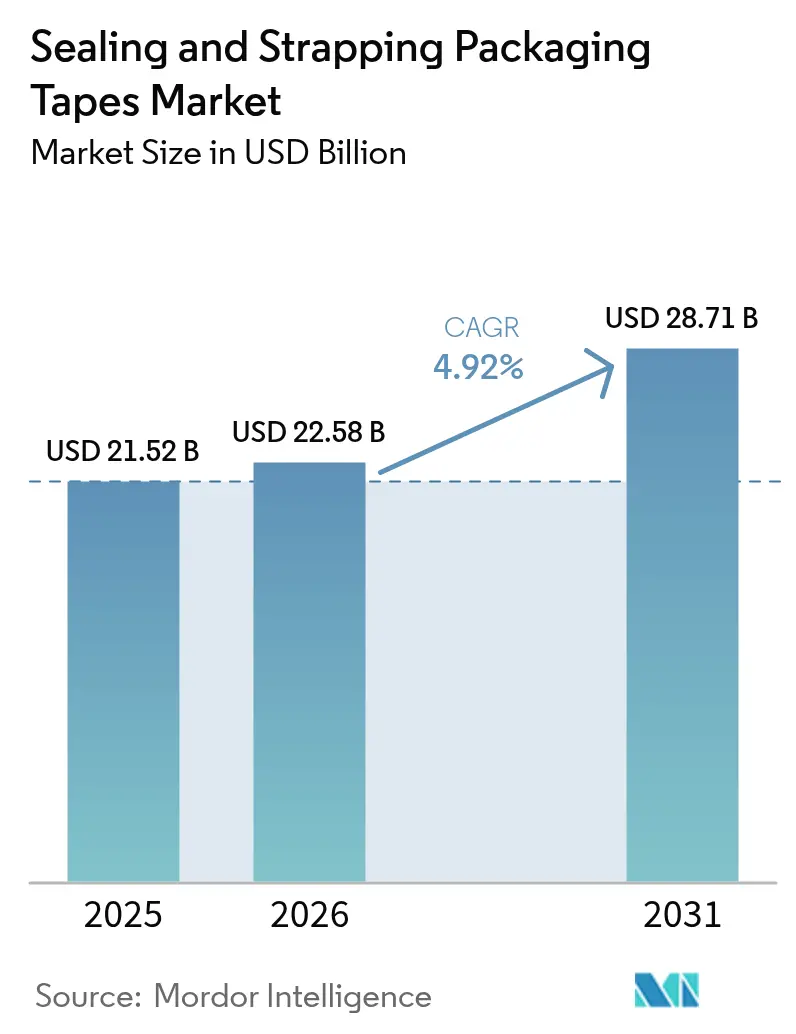
| Market Size (2026) | USD 22.58 Billion |
| Market Size (2031) | USD 28.71 Billion |
| Growth Rate (2026 - 2031) | 4.92 % |
| Fastest Growing Market | Asia Pacific |
| Largest Market | Asia Pacific |
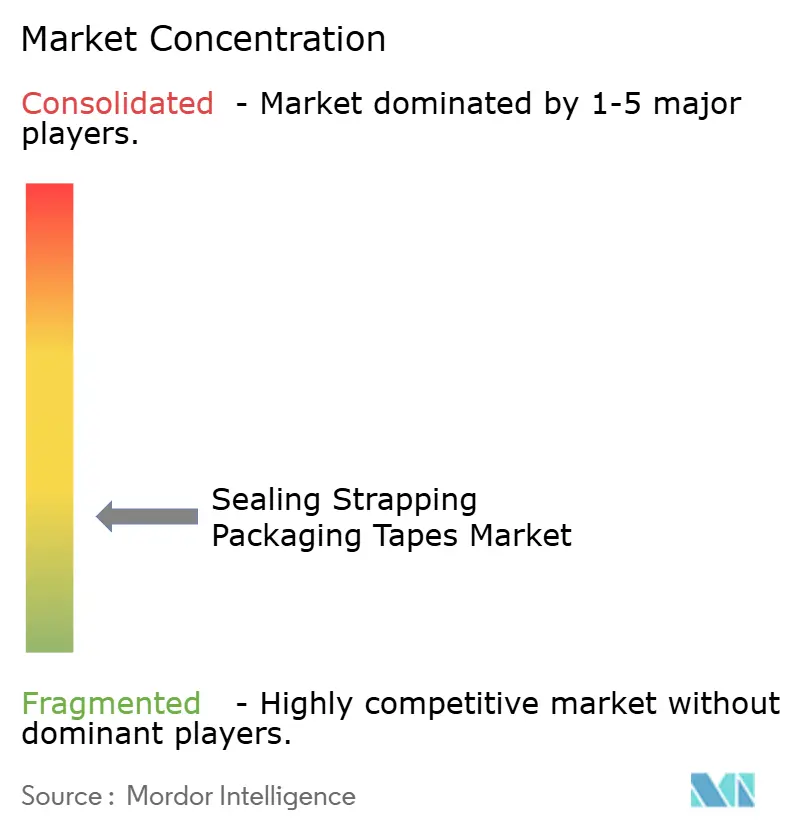
| Market Concentration | Low |
Major Players *Disclaimer: Major Players sorted in no particular order Image © Mordor Intelligence. Reuse requires attribution under CC BY 4.0. | |
Sealing And Strapping Packaging Tapes Market Analysis by Mordor Intelligence
The sealing and strapping packaging tapes market size is expected to grow from USD 21.52 billion in 2025 to USD 22.58 billion in 2026 and is forecast to reach USD 28.71 billion by 2031 at 4.92% CAGR over 2026-2031. Consistent demand from e-commerce fulfillment centers, automated logistics hubs, and consumer-goods brands positions the sealing and strapping packaging tapes market as a critical component of global supply-chain continuity. Growth stems from surging parcel volumes, rapid warehouse automation, and rising requirements for tamper-evidence and track-and-trace features that enhance shipment integrity. Material reformulations that lower carbon footprints and improve recyclability expand the addressable customer base, while smart tapes equipped with RFID and QR technologies add value through real-time inventory visibility. Competitive dynamics favor companies that balance cost efficiency, technical performance, and sustainability credentials in line with tightening regulatory standards.
Key Report Takeaways
- By end-use industry, logistics and warehousing held 55.02% of the sealing and strapping packaging tapes market share in 2025, whereas pharmaceuticals and medical devices are projected to grow at an 8.12% CAGR through 2031.
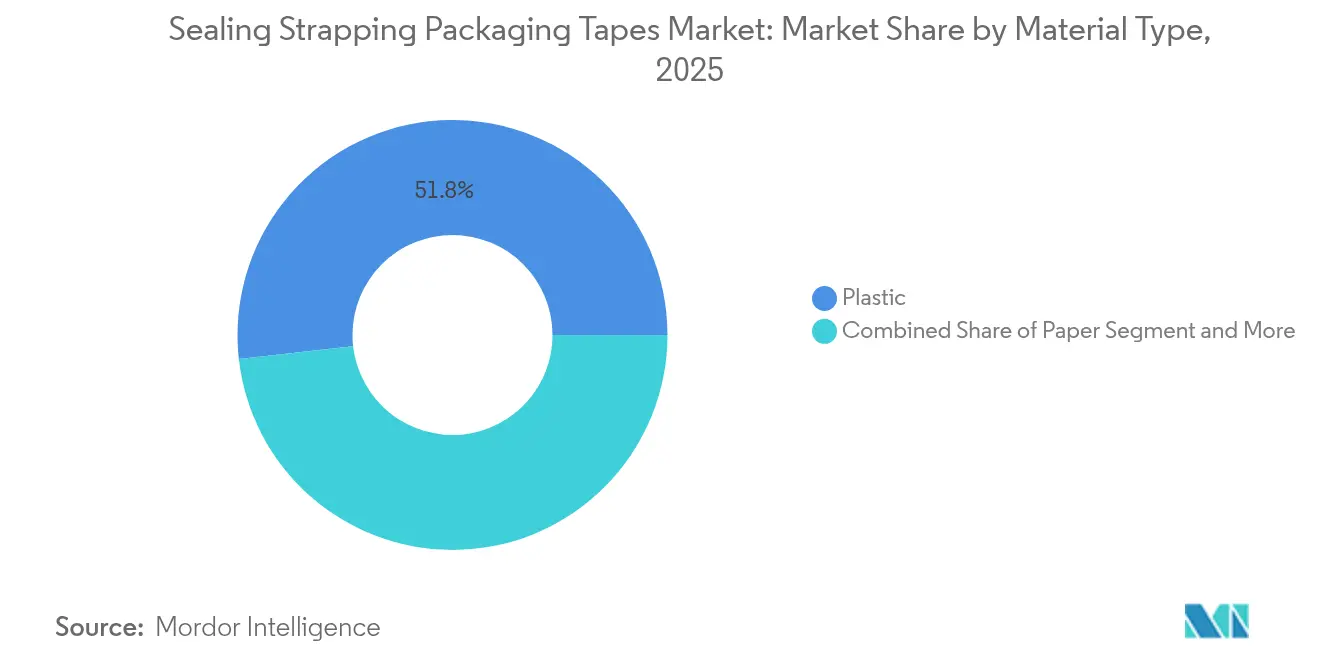
- By material type, plastic tapes captured 51.78% of revenue in 2025, while paper tapes are expected to climb at a 8.78% CAGR to 2031.
- By adhesive chemistry, acrylic formulations accounted for 46.92% of the sealing and strapping packaging tapes market size in 2025; rubber-based systems represent the fastest trajectory with an 7.94% CAGR through 2031.
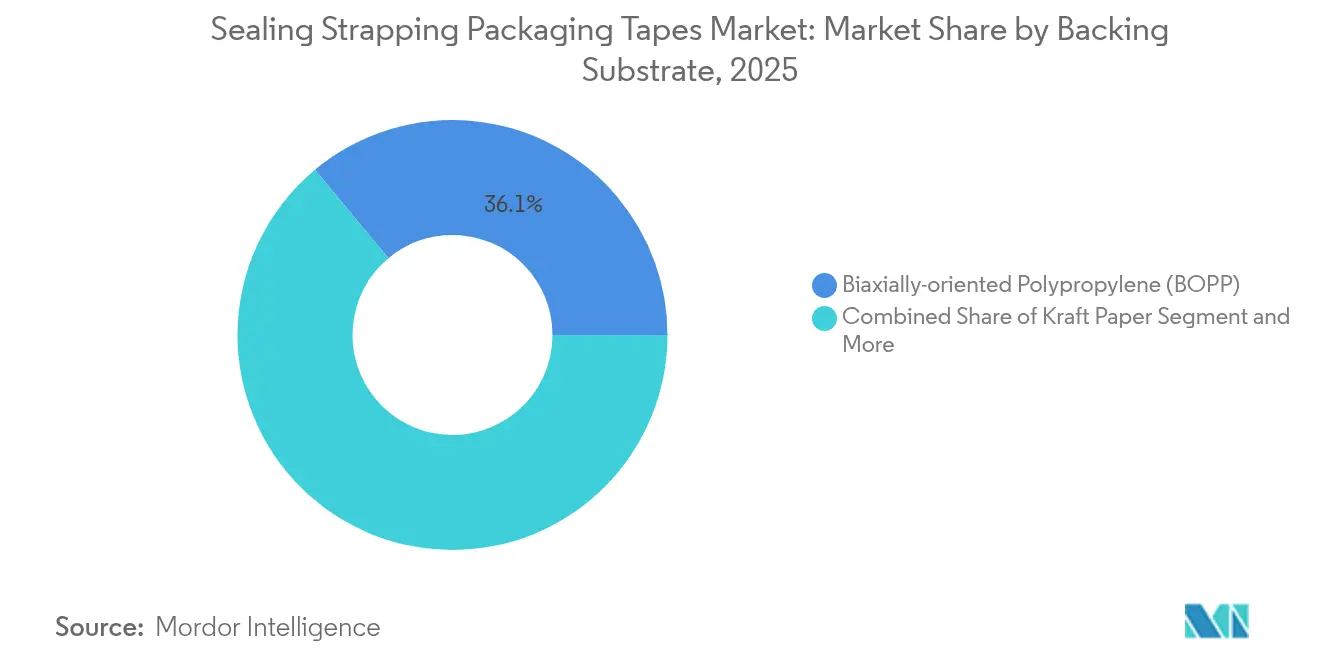
- By backing substrate, biaxially oriented polypropylene (BOPP) led with 36.05% revenue share in 2025; PVC backings are forecast to register a 7.05% CAGR to 2031.
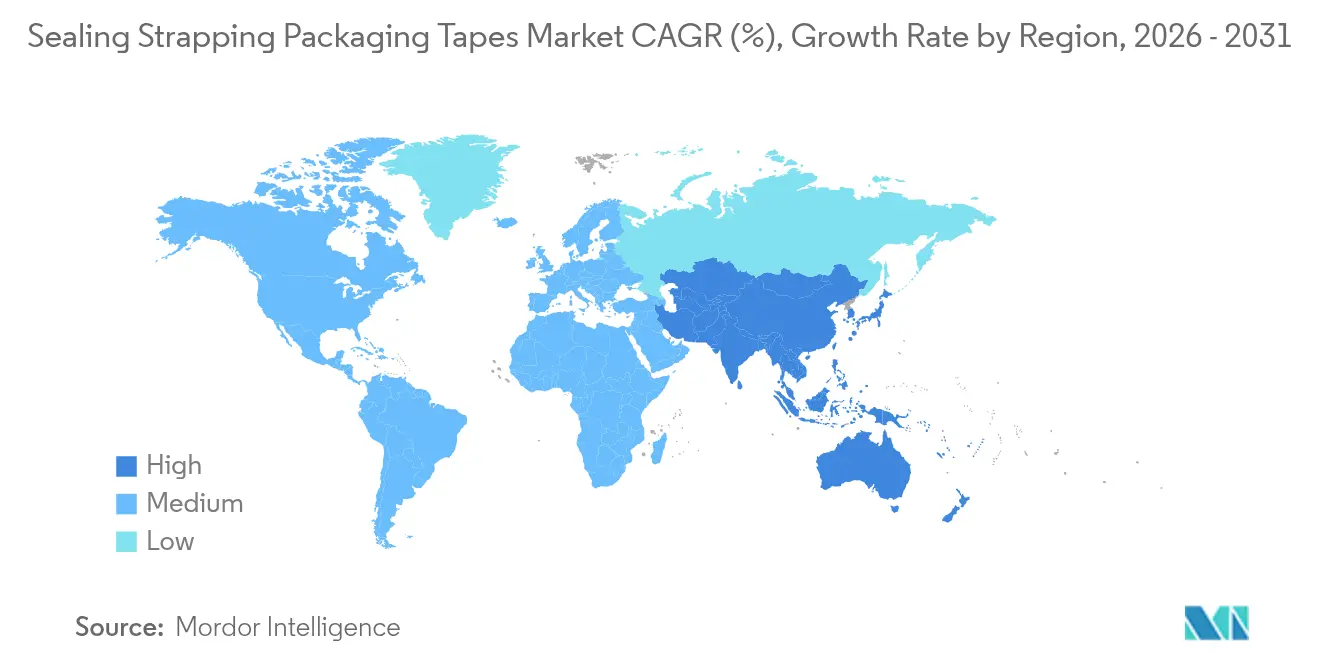
- By geography, Asia-Pacific dominated with 38.10% revenue share in 2025 and is poised for an 8.55% CAGR to 2031.
Note: Market size and forecast figures in this report are generated using Mordor Intelligence’s proprietary estimation framework, updated with the latest available data and insights as of 2026.
Market Trends and Insights
Drivers Impact Analysis of Sealing And Strapping Packaging Tapes Market*
| Driver | (~) % Impact on CAGR Forecast | Geographic Relevance | Impact Timeline |
|---|---|---|---|
| E-commerce boom boosting carton-sealing tape consumption | +1.80% | Global, with Asia-Pacific and North America leading | Medium term (2–4 years) |
| Expansion of global logistics and warehousing hubs | +1.20% | Global, concentrated in Asia-Pacific and Europe | Long term (≥ 4 years) |
| Cost-performance shift toward BOPP and PET tapes | +0.90% | Global, particularly in emerging markets | Medium term (2–4 years) |
| Smart tamper-evident tapes with RFID/QR for traceability | +0.60% | North America and EU, expanding to Asia-Pacific | Long term (≥ 4 years) |
| Growth in recyclable water-activated paper tapes | +0.50% | Europe and North America, driven by regulations | Short term (≤ 2 years) |
| Rise of automated packaging lines increasing demand for machine-grade tapes | +0.70% | North America, Europe, and rapidly in Asia-Pacific | Medium term (2–4 years) |
| Source: Mordor Intelligence | |||
E-commerce boom boosting carton-sealing tape consumption
Digital retail accelerates parcel counts, multiplying tape usage per shipment as each box requires primary sealing, reinforcement, and tamper evidence. High-speed fulfillment centers specify low-noise, high-adhesion tapes capable of withstanding temperature swings from cold-chain nodes to desert delivery routes. Custom-printed tapes double as security devices and brand assets, supporting direct-to-consumer marketing strategies. Cross-border sellers demand multi-certified products that comply with food-contact and pharmaceutical rules, creating premium niches for suppliers able to verify conformity.[1]3M, “Scotch Brand celebrates 100 years of innovation and reliability,” 3m.com The sealing and strapping packaging tapes market is therefore tightly coupled to the volume and sophistication of last-mile delivery operations.
Expansion of global logistics and warehousing hubs
Automated warehouses rely on robotic taping systems that require substrates with consistent unwind profiles and controlled adhesion curves. Investments in cold-storage and pharma distribution centers spur demand for low-temperature adhesives that avoid brittleness at sub-zero conditions. Regional hubs in the UAE and Saudi Arabia broaden supply footprints, lifting tape consumption in the Middle East and Africa. Meanwhile, just-in-time inventory models shorten production lots, driving smaller but more frequent tape orders that benefit converters with flexible scheduling capabilities. Through 2030, the sealing and strapping packaging tapes market is expected to shadow global warehouse square-footage growth.
Cost-performance shift toward BOPP and PET tapes
Scale economies in Asian film manufacturing keep BOPP price points attractive, while new resins deliver stronger tensile strength and better printability. PET backings gain favor in electronics and automotive packaging, where chemical resistance and dimensional stability are mission-critical.[2]Ahlstrom, “Ahlstrom Completes Paper Machine Conversion at Thilmany Mill,” paperage.com As these films better withstand strapping tension and environmental stress, users transition away from PVC, cutting material costs without sacrificing security. Performance improvements, coupled with developing recycling streams for polyolefin films, reinforce BOPP and PET adoption across the sealing and strapping packaging tapes market.
Smart tamper-evident tapes with RFID/QR for traceability
Retail mandates from major chains accelerate uptake of RFID-enabled tapes that broadcast SKU-level data and detect pilferage. QR-coded variants connect consumers to authentication portals, supporting anti-counterfeit programs in pharmaceuticals compliant with ISO 21976 requirements. Partnerships such as DataLase–TamperTech embed security pigments directly into tape substrates, trimming waste while raising barrier properties. As printing costs decline and smartphone scanning becomes universal, smart tapes transition from niche to mainstream, underpinning digital supply-chain strategies throughout the sealing and strapping packaging tapes market.
Restraints Impact Analysis of Sealing And Strapping Packaging Tapes Market*
| Restraint | (~) % Impact on CAGR Forecast | Geographic Relevance | Impact Timeline |
|---|---|---|---|
| Volatile petroleum-based raw-material prices | -1.4% | Global, particularly affecting Asian producers | Short term (≤ 2 years) |
| Strict regulations on single-use plastics | -0.8% | Europe and North America, expanding globally | Medium term (2-4 years) |
| Adhesive-VOC emission compliance costs | -0.6% | North America and EU, with Asia-Pacific adoption | Medium term (2-4 years) |
| Automation bottlenecks in paper-tape dispensing lines | -0.4% | Global, concentrated in developed markets | Short term (≤ 2 years) |
| Source: Mordor Intelligence | |||
Volatile petroleum-based raw-material prices
Propylene and ethylene cost swings squeeze converters’ margins as polypropylene and polyethylene account for a significant slice of input spnd. Cracker shutdowns in Southeast Asia heighten supply risk, forcing producers to hedge inventories or negotiate formula-based contracts. Adhesive ingredients follow similar volatility, particularly natural rubber used in high-tack tapes. Short-term price spikes strain smaller manufacturers with limited purchasing leverage, potentially slowing capacity additions in the sealing and strapping packaging tapes market.
Strict regulations on single-use plastics
Europe’s Packaging and Packaging Waste Regulation compels 100% recyclability and minimum recycled content, triggering reformulation costs for conventional polyolefin tapes.[3]European Commission, “New rules for more sustainable and competitive packaging economy,” environment.ec.europa.eu Extended Producer Responsibility schemes shift disposal fees onto material suppliers, altering total delivered costs. Parallel plastic-tax initiatives and labeling mandates add administrative burdens, accelerating customer migration to paper or hybrid substrates. While compliance fuels innovation, near-term capex requirements can deter investment, tempering growth in regulated regions of the sealing and strapping packaging tapes market.
*Our forecasts treat driver/restraint impacts as directional, not additive. The impact forecasts reflect baseline growth, mix effects, and variable interactions.
Sealing And Strapping Packaging Tapes Market Segment Analysis
By Material Type:
Plastic Leads as Paper AcceleratesPlastic tapes retained 51.78% of revenue in 2025 thanks to durable BOPP and PET films that combine moisture resistance and competitive pricing. The sealing and strapping packaging tapes market size attributed to plastics is set to climb alongside e-commerce corrugated box usage, though its share gradually erodes as regulations favor fiber-based products. Paper tapes, especially water-activated varieties, post a 8.78% CAGR to 2031, buoyed by recyclability mandates and brand owners’ zero-plastic pledges. European rules calling for fully recyclable packaging by 2030 catalyze paper adoption, while North American retailers promote fiber-based sealing options to meet corporate ESG targets. Hybrid substrates that apply thin poly coatings onto kraft backings emerge, marrying barrier performance with easy repulpability. Material innovators target carbon-neutral formulations by blending recycled content with bio-resins, positioning paper to capture incremental share across premium consumer segments. Over the forecast horizon, plastic producers focus on downgauging and chemical-recycling alliances to maintain relevance within the sealing and strapping packaging tapes market.



By Adhesive Type:
Acrylic Dominance Meets Rubber-Based MomentumAcrylic chemistries delivered 46.92% of 2025 sales, favored for UV stability and storage durability in hot and cold supply chains. Rubber-based systems, including synthetic variants, grow 7.94% annually as high-speed automated lines demand instant tack for faster case-forming cycles. Hot-melt grades gain traction in refrigerated environments, avoiding condensation-related failures. Silicone adhesives, though niche, serve automotive battery and electronics assemblies that face extremes from -300°F to 1000°F. Water-activated starch glues resurge alongside paper backings, with converters investing in precision dispensers to improve cycle times. Partnerships such as Dow–Henkel pursue bio-based polymer designs to cut cradle-to-gate emissions by 25% Dow. Suppliers therefore segment offerings by application, optimizing resin blends to capture diverse opportunities within the sealing and strapping packaging tapes industry.
By Backing Substrate:
BOPP Still in Front as PVC Rises in Niche RolesBOPP represented 36.05% of 2025 revenue, capitalizing on thin-gauge films that lower gram-per-meter costs while maintaining tear resistance. PVC gains market traction at a 7.05% CAGR through 2031, primarily in wire harnessing and heavy-duty industrial wrapping where chemical shields justify higher cost per roll. Kraft paper continues a steady climb as recyclability pressures intensify, particularly in Europe. Polyester backings cater to high-precision electronics and automotive environments requiring dimensional stability. Fiberglass-reinforced tapes dominate pallet strapping and metal-coils bundling, trading volume for margin. Substrate suppliers leverage multi-layer coextrusion technologies to deliver matte finishes for quieter unwinds and ink-receptive surfaces for branding. Continuous film innovation ensures the sealing and strapping packaging tapes market offers tailored solutions for both budget-constrained shippers and highly regulated industries.
By End-Use Industry:
Logistics Rules while Pharma Gains PaceLogistics and warehousing consumed 55.02% of global revenue in 2025, reflecting parcel-based fulfillment’s appetite for dependable sealing. Temperature-sensitive pharmaceuticals emerge as the fastest-moving vertical at an 8.12% CAGR through 2031, propelled by vaccine distribution and biologic drugs requiring validated cold chains. Food-and-beverage producers specify FDA-compliant adhesives resistant to humidity shifts, while electronics shippers demand static-dissipative coatings that shield microchips from electrostatic discharge. Automotive suppliers use filament and specialty masking tapes for component bundling, and renewable-energy assemblers adopt high-performance tapes for solar-panel packaging. Sector-specific regulations drive product diversification, with tape makers offering SKUs fine-tuned for chemical compatibility, temperature profiles, and audit documentation—all supporting continuous expansion of the sealing and strapping packaging tapes market.
Geography Analysis
APAC Sealing and Strapping Packaging Tapes Market
Asia-Pacific dominated the sealing and strapping packaging tapes market with 38.10% share in 2025 and is projected to advance at 8.55% CAGR to 2031. China sustains volume demand through export-oriented manufacturing, while India’s digital commerce boom elevates parcel counts and paper-tape penetration. Regional governments channel infrastructure spending toward smart warehouses and 5G-enabled logistics corridors, stimulating demand for RFID-compatible tapes. Cross-border e-marketplaces intensify service-level competition, prompting carriers to standardize on global adhesives to minimize in-transit failures. Local suppliers benefit from proximate resin and film capacity, yet multinationals scale up regional plants, as evidenced by tesa’s new Mumbai and Bengaluru hubs that bolster technical support and cut lead times.
North America Sealing and Strapping Packaging Tapes Market
North America, though mature, remains lucrative due to premium adoption of smart and sustainable solutions. Tariff dynamics with Canada and Mexico influence raw-material flows and sourcing strategies, pushing converters to balance domestic and imported substrate. Retail consolidation amplifies vendor qualification hurdles, but it also rewards suppliers capable of nationwide service and data-driven performance reporting. Smart-packaging mandates from big-box chains accelerate RFID tape rollouts, turning warehouses into real-time visibility nodes for omnichannel inventory.

Regulatory Landscape
The regulatory environment for sealing and strapping packaging tapes is tightening around recyclability, labeling, and chemical compliance, with the European Union Packaging and Packaging Waste Regulation (EU) 2025/40 entering into force on February 11, 2025 and shifting the bloc from directive-based requirements to a directly applicable regulation. General application starting August 12, 2026 raises compliance requirements for packaging placed on the EU market, affecting tape substrate selection (paper, BOPP, PET, PVC) and converter documentation. It also increases attention on harmonized labeling and forthcoming implementing acts that standardize how material composition is communicated.
In the United States, tapes used in food-contact applications must comply with FDA indirect food additive rules for adhesives, including 21 CFR 175.105 and 21 CFR 175.125. This drives formulation control and supplier declarations for pressure-sensitive and water-activated systems used in food packaging. Industry alignment with test and performance standards such as ASTM D5486 (box-closure pressure-sensitive tapes) and ASTM D5330 (filament-reinforced tape) supports qualification with large shippers and automated fulfillment networks, particularly where procurement specifications embed environmental conditioning, adhesion, and break-strength testing.
Competitive Landscape
The sealing and strapping packaging tapes market shows moderate fragmentation, with global leaders exploiting scale economies in resin procurement, coating technology, and distribution. Companies such as 3M, tesa, Avery Dennison, and Intertape Polymer Group maintain broad product portfolios, international customer-support networks, and dedicated R&D centers. Mid-tier regional firms specialize in application-specific niches—such as cold-chain labels or filament strapping—leveraging localized service to compete on responsiveness
Merger and acquisition activity intensifies as players seek technology additions and geographical reach. Berry Global’s USD 540 million divestiture of its specialty tapes business to Nautic Partners and Atlas Tapes’ acquisition of PPM Industries expand their combined scale and product breadthe. The February 2025 Amcor–Berry Global merger further elevates competitive thresholds as the new entity targets USD 650 million in synergies through integrated resin sourcing and innovation pipelines.
Sealing And Strapping Packaging Tapes Industry Leaders
3M Company
Tesa SE (Beiersdorf)
Nitto Denko Corporation
Intertape Polymer Group
Amcor Plc
- *Disclaimer: Major Players sorted in no particular order
Sealing And Strapping Packaging Tapes Market Companies Covered in this Report
- 3M Company
- Tesa SE (Beiersdorf)
- Nitto Denko Corporation
- Intertape Polymer Group
- Berry Global Inc.
- Avery Dennison Corporation
- Shurtape Technologies
- Scapa Group plc
- Nichiban Co., Ltd.
- CCT Tapes
- Mactac LLC
- Ajit Industries
- Saint-Gobain Performance Plastics
- Henkel AG & Co. KGaA
- Rogers Corporation
- You-San Technology
- Dow Inc. (Hot-melt resins)
- Bostik SA
- UPM Raflatac (Paper-backed tapes)
- Duck Brand (ShurTech)
Read Analysis of Sealing And Strapping Packaging Tapes Companies

Market Opportunities and Future Outlook
Regulatory and buyer-led shifts toward recyclable packaging create whitespace for fiber-based and recycled-content solutions that can keep pace with throughput needs on automated packaging lines. EU PPWR (EU) 2025/40 applies from August 12, 2026 and strengthens demand for tape constructions that support recyclability claims and simplified sorting. That dynamic supports adoption of water-activated paper tapes and paper-compatible release-liner systems. In February 2026, Ahlstrom launched Acti-V RRF Natural, a double-sided silicone-coated release liner for PSA tapes with recyclability-with-paper certification under CEPI standards, giving converters a pathway to improve end-of-life compatibility for paper-based or paper-integrated tape offerings.
Opportunities are also moving along security, traceability, and automated production capabilities. In June 2026, Securikett introduced recycled-material security tapes with a center adhesive-free zone designed to reduce premature void-effect activation, tying sustainability to tamper-evidence use cases in logistics and higher-value shipments. Capacity and process modernization are opening additional supply routes for global brand owners and fulfillment operators. In May 2026, tesa marked a topping-out ceremony for a 4,500-square-meter expansion at its Offenburg plant to increase high-performance industrial tape capacity (operations scheduled to start in 2027). In July 2026, Qingdao Norpie Packaging completed an intelligent workshop upgrade to lift monthly industrial adhesive tape output while tightening dimensional control, reflecting a broader move toward automated, precision manufacturing to maintain consistent unwind and adhesion behavior.
Recent Industry Developments in Sealing And Strapping Packaging Tapes Market
- July 2026: Intertape Polymer Group (IPG) launched PCR Air Pillow Film with 50% total recycled content, produced in a TRUE Zero Waste certified facility. The initiative strengthens IPG's sustainability positioning with materials that support e-commerce and fulfillment packaging systems where tapes and protective packaging are sourced together. It also increases competitive pressure on suppliers to offer higher recycled content and documented environmental attributes across adjacent packaging consumables.
- February 2026: Intertape Polymer Group (IPG) introduced its Packaging Diagnostics program, combining tools such as iTrack, AF2K, and Gear Up to help customers optimize packaging line performance. This expands IPG's role from tape supply into productivity and troubleshooting support for automated packaging operations. The capability can deepen customer lock-in where machine-grade tape performance and line uptime are procurement priorities.
- December 2024: Atlas Tapes completed the acquisition of PPM Industries Group, expanding its specialty tape footprint. The deal increased portfolio breadth in technical and application-specific tapes used across industrial and logistics settings. Consolidation at the specialty end of the market supports scale advantages in product development, sourcing, and access to multinational customers.


Sealing And Strapping Packaging Tapes Market Report Scope and Research Methodology
Market Definition and Coverage
This market covers sealing and strapping packaging tapes used to close cartons, bundle loads, and secure packaged goods during storage and transport, measured in value terms from tape sales across the supply chain.
Scope exclusions: we exclude stretch film, straps (plastic or steel), shrink wraps, and non-packaging adhesive products such as medical or electrical tapes.
Segments Covered in This Report
- By Material Type
- Plastic
- BOPP
- PP
- PET
- PVC
- Paper
- Foil and Filament
- Others
- Plastic
- By Adhesive Type
- Acrylic (Water-/Solvent-/UV)
- Rubber-based (Natural and Synthetic)
- Hot-melt
- Silicone
- Water-activated Starch-based
- By Backing Substrate
- Biaxially-oriented Polypropylene (BOPP)
- Kraft Paper
- Polyester (PET)
- PVC
- Glass-fibre Filament
- By End-use Industry
- Logistics and Warehousing
- E-commerce and Retail Fulfilment
- Food and Beverage
- Pharmaceuticals and Medical Devices
- Electronics and Electricals
- Automotive and Industrial
- Others
- By Geography
- North America
- United States
- Canada
- Mexico
- Europe
- Germany
- United Kingdom
- France
- Italy
- Spain
- Russia
- Rest of Europe
- Asia-Pacific
- China
- India
- Japan
- South Korea
- Australia and New Zealand
- Rest of Asia-Pacific
- Middle East and Africa
- Middle East
- United Arab Emirates
- Saudi Arabia
- Turkey
- Rest of Middle East
- Africa
- South Africa
- Nigeria
- Egypt
- Rest of Africa
- Middle East
- South America
- Brazil
- Argentina
- Rest of South America
- North America
Data Sources, Market Sizing, and Validation
Desk Research
Desk research was used to set the demand context and build the first set of sizing assumptions around packaging activity and tape consumption intensity. We leaned on public datasets and technical references such as UN Comtrade trade statistics, World Bank and IMF macro indicators, OECD industry and logistics indicators, US Census Bureau manufacturing and wholesale series, and Eurostat production and trade tables, which help explain how packaging volumes and shipment movements are trending.
On the supply side, we reviewed company filings and investor presentations to understand product mix (carton sealing versus strapping and bundling) and pricing commentary. Patent databases were also checked to track changes in backing materials and adhesive chemistries that can shift average selling prices over time. For cross-checks, we used paid subscriptions for company financials and a shipment-level import and export view to validate directional trade flows in key resin-backed tape categories. The sources listed here are illustrative only, and other public documents and datasets were also used for data collection, validation, and clarification.
Primary Interviews and Surveys
Primary work focused on interviews and structured surveys with tape manufacturers, converters, distributors, and large packaging users, so we could verify application splits and pricing movements across carton sealing and bundling use cases. Coverage was balanced across major consumption regions, and discussions also tested assumptions on e-commerce parcel growth, industrial output trends, and substitution between paper and film backings before we finalized the model.
Distribution of primary research fieldwork respondents
| Company type | Respondent position | Region |
|---|---|---|
| Top tier: 29% | CXOs: 15% | APAC: 51% |
| Mid tier: 50% | Functional/Unit leaders: 39% | EMEA: 31% |
| Smaller Players: 21% | Managers: 46% | Americas: 18% |
Market-Sizing & Forecasting
Sizing starts with a top-down build where packaging activity is reconstructed by region using a demand pool that reflects manufacturing output, e-commerce shipment intensity, and trade-linked goods movement, which is then translated into tape value through application-level usage and pricing. We used practical inputs such as corrugated box demand signals, parcel and express volumes, industrial production indexes, tape backing mix (paper versus plastic films), and typical adhesive mix shifts that affect realized pricing. When the main totals were formed, we checked them with selective bottom-up approximations, including sampled average selling price ranges from channels and a roll-up of visible supplier revenues for packaging tape-related lines.
Forecasts were prepared using scenario analysis supported by short-run trend smoothing on the demand indicators, followed by adjustments based on what industry participants expect for pricing, stocking behavior, and sustainability-driven material shifts. Where bottom-up views were incomplete, such as in fragmented local converting, we filled gaps by using region-level channel share logic and then rechecked that the implied per-unit usage stayed within interview-confirmed ranges.
Data Validation & Update Cycle
Validation is done by comparing model outputs against independent signals, including trade movement direction, packaging production trends, and the implied tape spend per shipment or per unit of industrial output. If a region shows an unusual jump, we review the assumptions step-by-step, and we trigger follow-up calls to re-check application splits or price ranges before the numbers are signed off.
Each report is refreshed on an annual cycle, and interim updates are made when material events occur, such as sharp resin price moves, regulatory changes on packaging materials, or major capacity additions. Before delivery, a fresh analyst pass is completed so clients receive the latest updated view, with consistency checks across historical and forecast years.
Mordor Intelligence's Sealing Strapping Packaging Tapes Market Size Compared Against Other Published Estimates
Published market values for sealing and strapping packaging tapes often vary because different studies do not count the same tape set, and they also use different price timing and demand indicators. We kept the discussion simple by tying value to packaging activity and then stress-testing assumptions through interviews, so the final number remains traceable to real usage patterns.
The biggest gaps usually come from whether strapping tapes are treated as a narrow bundling tape category or broadened to include adjacent unitizing products, and from how paper-backed tapes are counted when they are marketed as sustainable alternatives. Another common source of spread is pricing, since some estimates bake in aggressive resin-led ASP expansion even when channel feedback points to lagged pass-through by region, which is then amplified by currency conversion timing.
Benchmark comparison
| Source | Market Size | Gaps in Research Methodology |
|---|---|---|
| Mordor Intelligence | USD 21.52 B (2025) | |
| Global Consultancy A | USD 26.30 B (2025) | This figure appears to apply a wider inclusion set for packaging securing solutions, and its segmentation language suggests a broader application scope that can lift the counted value beyond tapes sold strictly for carton sealing and tape-based bundling. |
| Industry Publisher B | USD 22.62 B (2024) | This estimate is anchored to a 2024 base year and may reflect a different price capture window, which can shift results in a market where resin-linked pricing changes are unevenly passed through by region and channel. |
The table shows that the spread is largely explained by scope choices and how price timing is handled, rather than a single demand driver moving in isolation. By separating tape-only demand from adjacent packaging securing products and applying a region-specific price pass-through check, the 2025 value stays closer to an observable demand pool, a modeling choice applied by Mordor Intelligence.


Key Questions Answered in the Report
What is the current value of the sealing and strapping packaging tapes market?
The sealing and strapping packaging tapes market size stands at USD 22.58 billion in 2026 and is projected to reach USD 28.71 billion by 2031.
Which sector uses the most sealing and strapping tapes today?
Logistics and warehousing leads demand, accounting for 55.02% of 2025 global revenue because of rising e-commerce parcel volumes.
Which region is growing the fastest?
Asia-Pacific is the growth engine, forecast at an 8.55% CAGR to 2031 due to manufacturing expansion and digital commerce adoption.
How are regulations affecting material choices?
Europe’s Packaging and Packaging Waste Regulation mandates fully recyclable packaging by 2030, steering many buyers toward paper or hybrid tapes.
Page last updated on:


 Your data is secure and never sold or shared.


