
Market Overview
| Study Period | 2019 - 2031 |
|---|---|
| Market Size (2026) | USD 15.79 Billion |
| Market Size (2031) | USD 23.45 Billion |
| Growth Rate (2026 - 2031) | 8.23 % |
| Fastest Growing Market | Asia-Pacific |
| Largest Market | North America |
| Market Concentration | Medium |
Major Players *Disclaimer: Major Players sorted in no particular order Image © Mordor Intelligence. Reuse requires attribution under CC BY 4.0. | |
School Bus Market Analysis by Mordor Intelligence
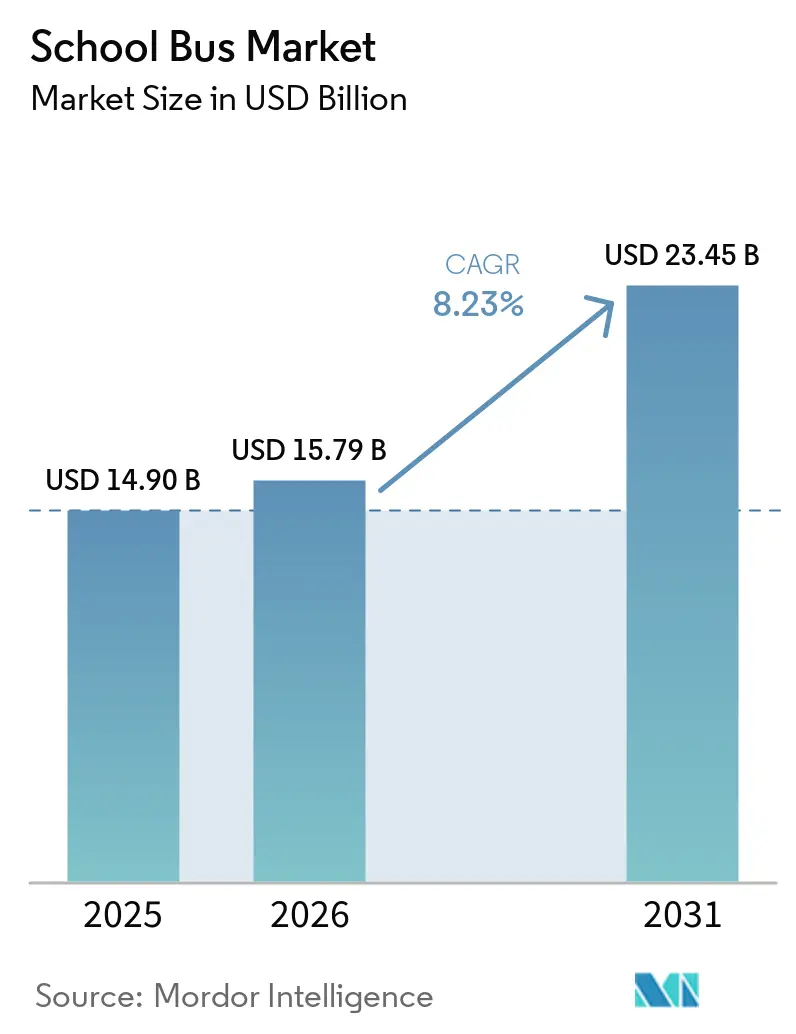
The School Bus Market size was valued at USD 14.90 billion in 2025 and is estimated to grow from USD 15.79 billion in 2026 to reach USD 23.45 billion by 2031, at a CAGR of 8.23% during the forecast period (2026-2031). Accelerated federal and state funding programs, tightening emissions standards, and rapid strides in vehicle electrification collectively underpin that growth trajectory. Manufacturers continue to rebalance portfolio investments toward battery electric lines as total cost-of-ownership parity with diesel narrows in high-utilization districts. Simultaneously, subscription-based fleet-as-a-service contracts unlock procurement flexibility for budget-constrained operators that lack capital for outright purchases. Competitive intensity has increased as vertically integrated Chinese suppliers leverage their cost advantages to challenge North American incumbents. Meanwhile, software-centric features, such as telematics and vehicle-to-grid (V2G) readiness, are now considered in tender decisions alongside hardware specifications.
Key Report Takeaways
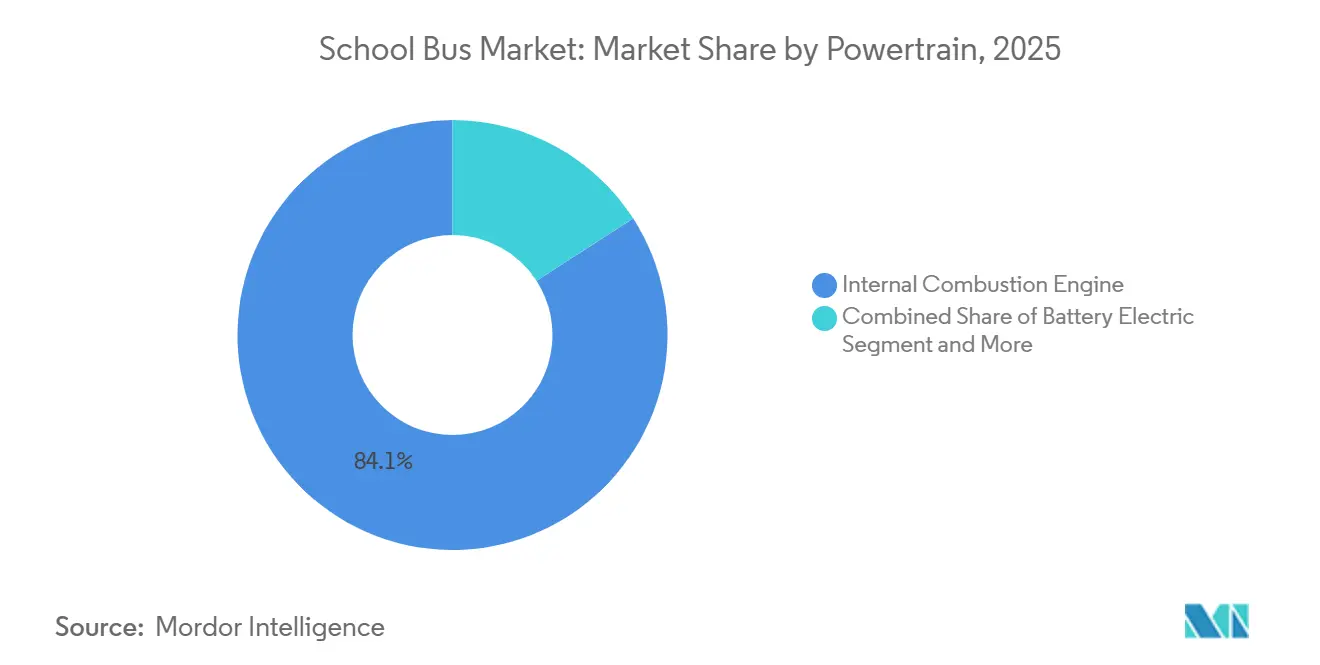
- By powertrain, internal combustion engines led with 84.12% of the school bus market share in 2025, while battery electric variants are projected to expand at a 9.42% CAGR through 2031.
- By seating capacity, the 31–60 seats category accounted for a 49.25% share of the school bus market size in 2025, while units with less than or equal to 30 seats will advance at an 8.94% CAGR over the forecast horizon.
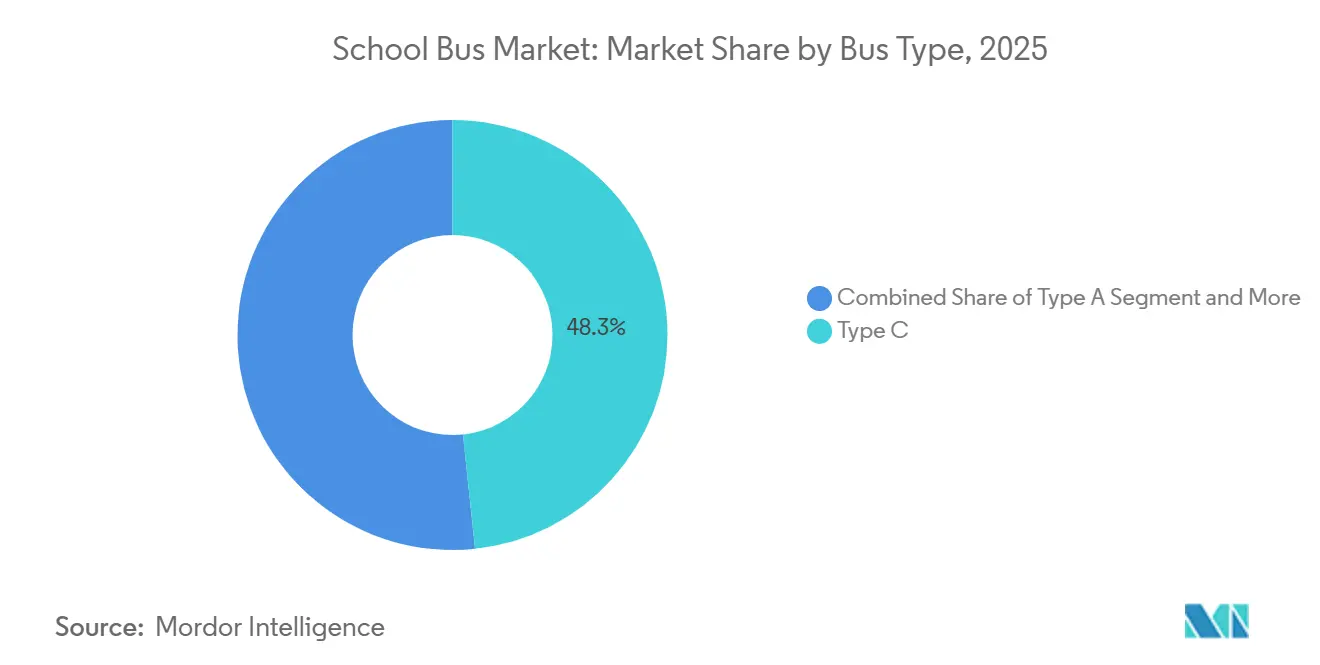
- By bus type, Type C configurations held 48.33% of the school bus market share in 2025, while Type A buses will experience the fastest growth, with an 9.76% CAGR through 2031.
- By end user, public school districts commanded 64.21% of the school bus market share in 2025, while private and charter operators are projected to have the highest CAGR at 11.22% through 2031.
- By geography, North America led with 39.24% of the school bus market share in 2025; however, Asia-Pacific is poised for the fastest expansion at a 10.24% CAGR through 2031.
Note: Market size and forecast figures in this report are generated using Mordor Intelligence’s proprietary estimation framework, updated with the latest available data and insights as of 2026.
Global School Bus Market Trends and Insights
Drivers Impact Analysis*
| Driver | (~) % Impact on CAGR Forecast | Geographic Relevance | Impact Timeline |
|---|---|---|---|
| Government Emissions Standards | +1.2% | North America and EU, expanding to Asia Pacific | Medium term (2-4 years) |
| Federal and State Funding Pools | +0.9% | North America core, pilot programs in EU | Short term (≤ 2 years) |
| Adoption of Advanced Safety | +0.6% | Global, with early adoption in developed markets | Long term (≥ 4 years) |
| Vehicle-To-Grid (V2G) Revenue | +0.4% | North America and EU pilot regions | Medium term (2-4 years) |
| Subscription-Based Fleet-as-a-Service Models | +0.3% | Global, concentrated in urban districts | Medium term (2-4 years) |
| AI-Driven Route Optimization | +0.2% | Global, technology-forward districts | Long term (≥ 4 years) |
| Source: Mordor Intelligence | |||
Government Emissions Standards Accelerating Fleet Electrification
California’s Advanced Clean Fleets Rule requires all new purchases to be zero-emission by 2035, a standard mirrored by several U.S. states and now influencing European municipal tenders. Compliance frameworks include tradable carbon credits, enabling districts to monetize avoided emissions and reinvest those proceeds in further fleet modernization efforts. Euro VII particulate limits come into effect in 2025 and will effectively phase out legacy diesel powertrains, compelling European operators to identify zero-emission alternatives. Failure to comply results in route restrictions that reduce service flexibility, making electrification an operational imperative rather than an environmental preference [1].
Dedicated Federal and State Funding Pools for Zero-Emission School Buses
The United States Infrastructure Investment and Jobs Act allocated a massive amount exclusively to clean school bus acquisition grants, the most significant single stimulus in the sector's history. Disbursements prioritize disadvantaged communities, accelerating the diffusion of technology where budget gaps have historically hindered modernization. Complementary state vouchers, such as California’s HVIP, add up to a substantial amount per bus, effectively eliminating virtually all incremental capital premiums relative to diesel. Domestic-content rules embedded in many of those incentives tilt purchasing decisions toward local assembly lines, shaping global sourcing strategies [2].
Rising Adoption of Advanced Safety Technologies
Revised FMVSS regulations require automatic emergency braking and blind-spot detection systems on new school buses. Compliance drives deeper integration of ADAS stacks alongside telematics, allowing real-time oversight of driver behavior and vehicle health. Larger OEMs capitalize on scale in R&D, widening the capability gap with smaller rivals. Districts also benefit from a 20% insurance premium reduction when robust safety suites are in place, which further strengthens the purchase justification [3].
Vehicle-to-Grid Revenue Potential for School Districts
School buses, typically idle for most of the day, present a prime opportunity for bidirectional charging. In pilots across Massachusetts and California, each vehicle generates significant ancillary service revenue, as utilities cover the costs for peak shaving and frequency response services. These additional revenues transform buses from mere cost centers into valuable grid assets, significantly reducing the payback period on electric models in regions with high participation.
Restraints Impact Analysis*
| Restraint | (~) % Impact on CAGR Forecast | Geographic Relevance | Impact Timeline |
|---|---|---|---|
| High Upfront Cost | -0.8% | Global, most acute in developing markets | Short term (≤ 2 years) |
| Charging/Hydrogen Refueling Infrastructure | -0.6% | Rural areas globally, developing markets | Medium term (2-4 years) |
| Battery-Supply Volatility | -0.4% | Global, concentrated in lithium-dependent regions | Medium term (2-4 years) |
| Shortage of Skilled Technicians | -0.3% | Global, most severe in rural and developing markets | Long term (≥ 4 years) |
| Source: Mordor Intelligence | |||
High Upfront Cost of Electric and Fuel-Cell Variants
Electric buses are significantly more expensive than their diesel counterparts due to the high cost of battery packs, which make up a substantial portion of the vehicle's overall cost. The volatility in raw material prices, particularly for lithium and nickel, creates budget uncertainties, further complicating procurement decisions. Fuel-cell platforms are even more costly, primarily due to the expenses associated with onboard hydrogen storage, high-pressure lines, and fuel-cell stacks, which are still expensive to produce. Financing challenges are most pronounced in rural and low-income districts, where access to traditional bonds or green financing tools is limited. This results in uneven adoption rates, even in regions where subsidies are widely available.
Limited Charging or Hydrogen Refueling Infrastructure
Purchasing a single Level 3 depot charger involves high costs. Additionally, these chargers often require substantial grid upgrades, which can further increase expenses for districts. Installation timelines are typically lengthy, usually extending well beyond a year, which can delay projects past their intended academic-year deadlines. Hydrogen refueling infrastructure is even more limited, with very few publicly accessible heavy-duty refueling sites available nationwide. This limitation restricts the adoption of fuel-cell vehicles to specific regions, such as certain corridors in California. Furthermore, rural grid capacity constraints could either leave vehicles inoperable or force operational adjustments, ultimately compromising the expected service improvements.
*Our forecasts treat driver/restraint impacts as directional, not additive. The impact forecasts reflect baseline growth, mix effects, and variable interactions.
Segment Analysis
By Powertrain: Electrification Accelerates Despite ICE Dominance
Internal combustion engines held 84.12% of the school bus market share in 2025, as existing maintenance infrastructure and familiarity with diesel procurement kept diesel engines steady among cash-strapped districts. Battery electric buses are set to become the fastest-growing subcategory, on track for a 9.42% CAGR through 2031, as operators leverage federal grants and declining battery prices to justify the economics of the transition. Fuel-cell variants remain a niche market, concentrated in regions with policy mandates and accessible hydrogen supply lines. Regenerative braking and fewer moving parts enable 60–70% lower maintenance costs for electric buses, thereby reducing total lifecycle expenses.
Current battery densities enable single-charge ranges of 150–200 miles, sufficient to cover most daily routes without midday charging. Fuel-cell systems offer quick refueling but rely on a sparse network of refueling stations, which limits their adoption to demonstration fleets. Overall, the powertrain shift is re-architecting supplier contracts as battery pack sourcing becomes the critical bottleneck in the school bus market.

By Seating Capacity: Compact Configurations Address Changing Demographics
Buses with 31–60 seats accounted for 49.25% of the school bus market share in 2025, an optimal compromise that meets average route demand without oversizing fleets. Vehicles with ≤30 seats are projected to chart an 8.94% CAGR through 2031, benefiting districts that increasingly segment routes by grade level, special needs, or after-school activities.
Models exceeding 60 seats fill high-density corridors but face infrastructure constraints, such as limited turning radii and curb lengths, that slow their growth. Smaller capacity aligns with demographic trends, including reduced household sizes and higher school-choice variability, both of which increase route diversity. Districts also redeploy smaller buses for field trips or athletic transport, maximizing asset utilization. This resizing trend suggests that future manufacturing lines may shift towards multiple models rather than single, high-volume models, reshaping the capacity-planning calculus in the school bus market.
By Bus Type: Smaller Formats Gain Urban Traction
Type C buses accounted for 48.33% of the school bus market in 2025, favored for suburban and rural routes that balance capacity with moderate operating speeds. Type A buses will experience the fastest uptake, with a 9.76% CAGR through 2031, because their compact footprints help them navigate congested city streets and accommodate special education routes with fewer passengers. Type B units fill mid-demand corridors while high-capacity Type D models dominate densely populated districts, albeit at lower incremental growth rates.
Many municipalities prefer Type A platforms for magnet school and extracurricular programs, where agile maneuvering offsets higher per-seat cost. Conversely, Type D adoption remains tied to major metropolitan systems that can support a larger curbside footprint and driver license requirements. The shift underscores a broader focus on route optimization over maximum capacity, offering differentiated opportunities among chassis suppliers in the school bus market.
By End User: Private Operators Embrace Innovation
Public districts accounted for 64.21% of the school bus market share in 2025, largely due to their statutory responsibility for student transportation in most North American jurisdictions. Private and charter operators will deliver the highest growth trajectory, with a 11.22% CAGR, driven by flexible financing schemes and shorter decision cycles. Contractors and leasing specialists bundle vehicles, drivers, and maintenance into performance-based contracts, transferring operational risk from education boards to fleet professionals.
Private entities can more readily pilot electric or fuel-cell platforms because they can adjust the route mix without school board approvals, thereby accelerating technology validation at a smaller scale. This dynamic positions service providers as channels for innovation diffusion, enabling broader adoption of fleet electrification once early hurdles are overcome.
Geography Analysis
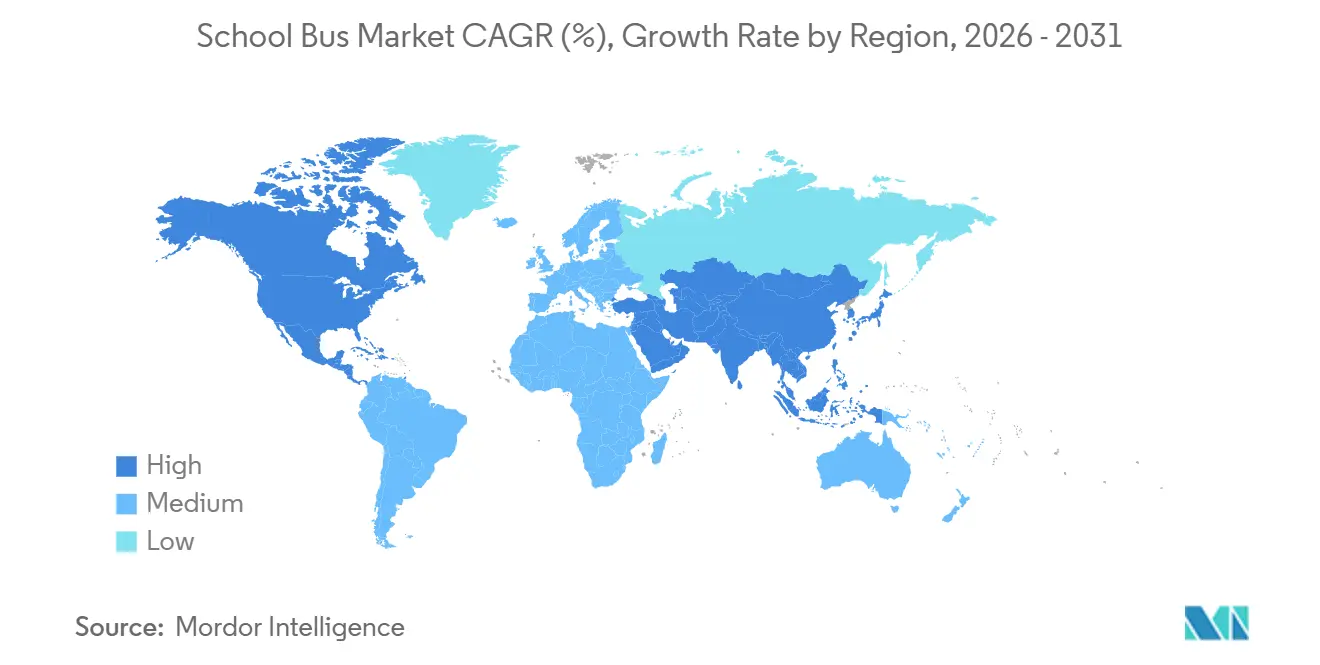
North America secured 39.24% of the school bus market share in 2025, reflecting cumulative advantages in funding, manufacturing, and grid integration. State-utility partnerships support V2G pilots that transform parked fleets into distributed energy resources, helping offset higher acquisition costs. Canada contributes additional momentum through green infrastructure funding and emissions-reduction targets, while Mexico’s role in the USMCA streamlines supply chains but leaves adoption centered in metropolitan corridors.
The Asia-Pacific will register the sector’s highest forward momentum, with a 10.24% CAGR through 2031, as China couples compulsory electrification targets with domestic battery capacity, which compresses cost curves. India’s National Electric Bus Program widens the addressable base, with tier-two cities procuring purpose-built school buses for the first time. Japan and South Korea embed advanced ADAS, elevating regional safety benchmarks that reverberate into international standards.
Europe maintains stable gains as Euro VII standards phase out high-sulfur diesel and national stimulus funds subsidize alternative drivetrains. Germany explores hydrogen routes, leveraging existing fuel-cell competencies, while the United Kingdom emphasizes rural service connectivity through smaller bus footprints. Southern European economies progress more cautiously due to fiscal headroom constraints, yet municipal congestion-charging schemes indirectly hasten diesel replacement.
Regulatory Landscape
Safety and emissions requirements continue to tighten across the school bus market, and this is pushing OEMs and operators toward active safety, ADAS, and cleaner powertrains. In the United States, the statutory basis for federal school bus safety standards is set under 49 USC 30125, with NHTSA administering the Federal Motor Vehicle Safety Standards that cover emergency exits, seating, crashworthiness, and fuel system integrity. These baseline specifications shape what buses must meet for tenders from public districts.
In Europe, Regulation (EU) 2019/2144 (General Safety Regulation) expands the required fitment of advanced safety technologies, including advanced emergency braking and lane departure warning for relevant bus categories, which accelerates ADAS content per vehicle. In China, the national standard GB 24407-2025 for dedicated school bus safety was issued on December 31, 2025, updating the 2012 version with upgraded active safety requirements (including automatic emergency braking and tire blowout emergency response). The noted implementation date is July 1, 2027, giving manufacturers a defined window to redesign platforms and validate new safety architectures.
Value Chain Analysis
The school bus value chain runs from chassis and body engineering to specialized safety systems, powertrain, and energy storage (diesel components or batteries and electric drive units), and final assembly at OEM-controlled plants and dealer networks. After that, procurement is supported by financing and charging infrastructure deployment for electric fleets, followed by lifecycle service covering parts, diagnostics, and maintenance. Major OEMs such as Blue Bird, Thomas Built Buses (Daimler), and IC Bus (Navistar) rely on proprietary component networks and certified dealers to support district uptime, while electrification increases the importance of battery packs, e-axles, thermal systems, and software for telematics and charge management.
Upstream constraints are increasingly tied to tariffs and supply volatility in materials (steel and aluminum) and electronics (semiconductors), which is pushing more reshoring and nearshoring and longer-term sourcing agreements. Component consolidation is also shifting supplier leverage and bundling in interiors and HVAC, highlighted by the July 2026 definitive merger agreement between Patrick Industries and LCI Industries (parent of Lippert Components, including Trans/Air Manufacturing and Freedman Seating). On the demand side, public funding and documentation requirements affect order timing and specifications. The US EPA Clean School Bus Program provides USD 5 billion for 2022-2026 via grants and rebates, and state-level rules, including NYSERDA incentive tiers tied to a Fleet Electrification Plan, pull infrastructure and planning activities into earlier stages of the procurement cycle.
Competitive Landscape
Top North American brands dominate the school bus market, leveraging historical contracts. However, they're increasingly feeling the heat from competitors like BYD and Yutong, who are pushing for sharper pricing. Blue Bird and Thomas Built Buses are pivoting their assembly lines toward battery electric models, a move bolstered by United States funding rules that emphasize local content. In contrast, Lion Electric is focusing on purpose-built electric chassis, steering clear of retrofits, and gaining favor with forward-thinking districts.
Chinese players are reaping benefits from a vertically integrated battery supply, significantly reducing bill-of-materials costs. This development has prompted established players to forge long-term cell agreements, a strategy aimed at cushioning against margin declines. Simultaneously, collaborations between OEMs and telematics companies underscore the rising significance of data insights, overshadowing traditional hardware. These alliances offer predictive maintenance alerts, route analytics, and safety compliance dashboards, giving partners a competitive edge in bids.
Strategic maneuvers highlight the industry's evolving landscape. In early 2025, Thomas Built Buses introduced its next-generation Saf-T-Liner C2 Jouley, featuring advanced e-axle technology and an extended range. Lion Electric is expanding its manufacturing facility in Illinois to substantially increase annual output, with a notable focus on battery-electric models. BYD's move to localize pack assembly in California underscores its commitment to the United States content standards. Together, these initiatives signal a decisive pivot from diesel to full electrification, altering supplier dynamics and capital investment strategies in the school bus arena.
School Bus Industry Leaders
-
Tata Motors Ltd.
-
Zhengzhou Yutong Bus Co., Ltd.
-
Ashok Leyland Ltd.
-
Thomas Built Buses Inc.
-
IC Bus LLC (International Motors, LLC)
- *Disclaimer: Major Players sorted in no particular order

Market Opportunities and Future Outlook
Electrification is widening the opportunity from bus hardware into turnkey deployment, including depot charging, utility coordination, telematics, and vehicle-to-grid (V2G) enablement that districts can use to monetize idle assets. A clear indicator of this shift is Zum and the San Francisco Unified School District launching a 238-bus electric fleet project in May 2026 that incorporates bidirectional charging and V2G integration, with 104 buses slated to begin operation in August 2026. This points to fleet operators and school systems contracting for integrated energy and operational outcomes rather than purchasing vehicles alone.
Funding design is also expanding the solution space for OEMs and fleet providers that can offer multiple compliant powertrains and fueling pathways. Under the Infrastructure Investment and Jobs Act, the EPA Clean School Bus Program is authorized at USD 5 billion (FY2022-FY2026), and the EPA reported USD 2.37 billion in remaining unallocated funds as of the beginning of fiscal year 2026. In February 2026, the agency initiated a formal process to revamp the program to include additional fuel options such as biofuels, CNG, and hydrogen alongside zero-emission electric buses. This creates whitespace for suppliers that connect compliant vehicles with infrastructure delivery, technician training, and financing or subscription models that help districts manage upfront costs and multi-year implementation timelines.
Recent Industry Developments
- July 2026: Tata Motors launched the Ultra Prime and Starbus Prime bus range at Prawaas 5.0, including variants designed for school transportation. The refresh broadens product choice for Indian operators and supports tenders that increasingly weigh safety and comfort features alongside purchase price.
- July 2026: EKA Mobility launched the EKA 9M Electric School Bus at the Prawaas 5.0 exhibition in Gandhinagar, expanding its electric commercial vehicle portfolio with a model purpose-built for student transportation. The company developed the vehicle specifically for school applications, further broadening its range of battery-electric commercial vehicles.
- July 2026: Duval County Public Schools (DCPS) added a new fleet of electric school buses ahead of the 2026–2027 school year. District leaders stated that the investment would introduce new technology to student transportation while helping reduce long-term costs.
- March 2026: The School of the Nations acquired its first electric school bus from BasiGo, becoming the first school in Kenya to electrify its student transportation fleet. This initiative formed part of the school’s broader sustainability and environmental education strategy.
Research Methodology Framework and Report Scope
Market Definition and Coverage
This market covers the revenue generated from complete school buses used for student transportation, across public and private operators. The sizing reflects vehicle sales value by major bus types and powertrains, counted where the vehicle is purchased for dedicated school transport service.
Scope exclusions: We exclude aftermarket parts, routine maintenance services, and general-purpose transit buses that are not procured and registered for school transportation use.
Segmentation Overview
- By Powertrain
- Internal Combustion Engine (ICE)
- Battery Electric
- Fuel-Cell Electric
- By Seating Capacity
- Less than or equal to 30 Seats
- 31–60 Seats
- More than 60 Seats
- By Bus Type
- Type A
- Type B
- Type C
- Type D
- By End User
- Public School Districts
- Private & Charter Operators
- Contractors & Leasing Companies
- By Geography
- North America
- United States
- Canada
- Rest of North America
- South America
- Brazil
- Argentina
- Rest of South America
- Europe
- Germany
- United Kingdom
- France
- Italy
- Spain
- Russia
- Rest of Europe
- Asia-Pacific
- China
- Japan
- India
- South Korea
- Rest of Asia-Pacific
- Middle East and Africa
- Saudi Arabia
- United Arab Emirates
- Turkey
- South Africa
- Egypt
- Rest of Middle East and Africa
- North America
Data Sources, Market Sizing, and Validation
Desk Research
Desk research helps set the market perimeter and gathers base signals that influence school bus demand year to year. We referenced public sources such as the U.S. Department of Transportation and NHTSA school transportation safety standards, U.S. EPA emissions rules and clean vehicle program updates, National Center for Education Statistics enrollment and district data, and the U.S. Energy Information Administration fuel price series.
To widen coverage beyond the United States, we also used official education and transport statistics released by national agencies in key countries, along with customs and trade reporting where available. Company filings, investor presentations, reputable press coverage, and school district or municipality procurement portals were reviewed to understand ordering cycles, delivery timing, and average contract values. A paid subscription for company financials and news intelligence was used selectively to cross-check revenue exposure and major contract announcements, and an import and export shipment-level database was used when trade flows helped validate supply movement. The sources mentioned here are illustrative, and many other public documents were also referred to for data collection, validation, and clarification.
Primary Interviews and Surveys
Primary work was carried out through expert interviews and structured questionnaires with OEM-side leaders, fleet operators, dealership and distributor participants, and school transport contractors, so the real purchasing cycle and replacement timing could be confirmed. Because this is a global market, discussions were balanced across APAC, EMEA, and the Americas to reflect how safety requirements, funding programs, and electrification readiness shift demand in practice.
Distribution of primary research fieldwork respondents
| Company type | Respondent position | Region |
|---|---|---|
| Top tier: 37% | CXOs: 17% | APAC: 42% |
| Mid tier: 45% | Functional/Unit leaders: 32% | EMEA: 37% |
| Smaller Players: 18% | Managers: 51% | Americas: 21% |
Market-Sizing & Forecasting
The core build starts with a top-down demand pool where student counts, route density, and typical bus-to-student coverage are translated into an active fleet, and then into replacement and incremental purchase volumes. Those volumes are priced using region-appropriate average selling prices that reflect shifts by bus type (Type A to Type D) and powertrain mix (diesel, alternative fuels, hybrid, and battery-electric).
Before finalizing totals, we corroborate results with selective bottom-up checks, including sampling of published contract values, channel checks on delivery lead times, and a reasonableness roll-up of supplier and assembler revenue exposure where it can be tied back to school bus programs. Key inputs used in the model include school-age enrollment trends, municipal and district funding cycles, emissions and safety compliance timelines, fuel price differentials that influence total cost of ownership, and the share of electrified school bus awards that convert to deliveries. Forecasting is run using scenario analysis supported by expert expectations on funding continuity and electric bus adoption pace, and gaps in local data are handled by applying proxy ratios from comparable regions and validating them with interview feedback.
Data Validation & Update Cycle
Outputs are checked in multiple ways so one data series does not drive the whole result. We compare implied bus sales volumes against independent signals such as procurement announcements, fleet replacement narratives from operators, and broad vehicle production and trade patterns, then recheck any large jumps by region or powertrain.
A second analyst review is used to challenge assumptions like ASP progression, electric share ramp, and replacement cycles, and follow-up calls are triggered when a variance cannot be explained by a clear policy or tender event. The report is refreshed annually, and interim updates are made when material items occur, such as major funding rounds, new safety mandates, or step-changes in battery-electric order flow. Before delivery, a final pass is completed so clients receive the most current view available at that time.
Mordor Intelligence's School Bus Market Size Compared Against Other Published Estimates
Published market numbers for school buses often look far apart because the same label gets measured in different ways. Gaps usually come from how a school bus is defined, whether all major regions are modeled, and if the value is built from fleet demand signals or from manufacturer-side revenue reporting.
The main gap comes from what is counted as market value, where complete school buses tied to student transportation demand are priced using type and powertrain mix, a treatment applied by Mordor Intelligence that differs from narrower factory gate revenue reporting or older-year conversions.
Benchmark comparison
| Source | Market Size | Gaps in Research Methodology |
|---|---|---|
| Mordor Intelligence | USD 53.44 B (2026) | |
| Global Consultancy A | USD 19.31 B (2025) | Uses factory gate value logic and a manufacturer revenue lens, which can exclude downstream pricing layers and can also follow a different year cut, making totals look smaller versus a demand pool build. |
| Industry Publisher B | USD 14.83 B (2025) | Often applies a tighter product and reporting scope and can treat regional coverage and volume units differently, which shifts the implied average price and reduces the stated total for the same broad market label. |
The spread in the table is mainly explained by value definition, year timing, and how the demand pool is constructed from enrollment, fleet, and procurement signals. When scope is kept specific and the pricing logic is tied to bus type and powertrain mix, the resulting market value stays traceable to clear variables and repeatable checks over time.
Key Questions Answered in the Report
How large is the global school bus market in 2026?
The school bus market size is expected to be USD 15.79 billion by 2026.
What is the forecasted growth rate for the sector to 2031?
The market is expected to register a 8.23% CAGR between 2026 and 2031.
Which powertrain is growing fastest within school transportation?
Battery electric buses are projected to demonstrate the highest forecast CAGR of 9.42%, driven by federal funding and lower maintenance costs.
Why is Asia Pacific viewed as the prime growth engine?
Mandatory electrification mandates in China and India’s large-scale bus programs will push Asia-Pacific to a 10.24% CAGR, outpacing other regions.
What revenue can a school district expect from vehicle-to-grid programs?
Pilot programs have documented USD 2,000–USD 4,000 in yearly revenue per electric bus through demand-response and frequency-regulation services.
Which bus type is expanding fastest in urban routes?
Compact Type A models lead growth at a 9.76% CAGR as city districts favor easier maneuverability in tight traffic environments.