
Saudi Arabia Quick Commerce Logistics Market Size and Share
Market Overview
| Study Period | 2020 - 2031 |
|---|---|
| Forecast Data Period | 2026 - 2031 |
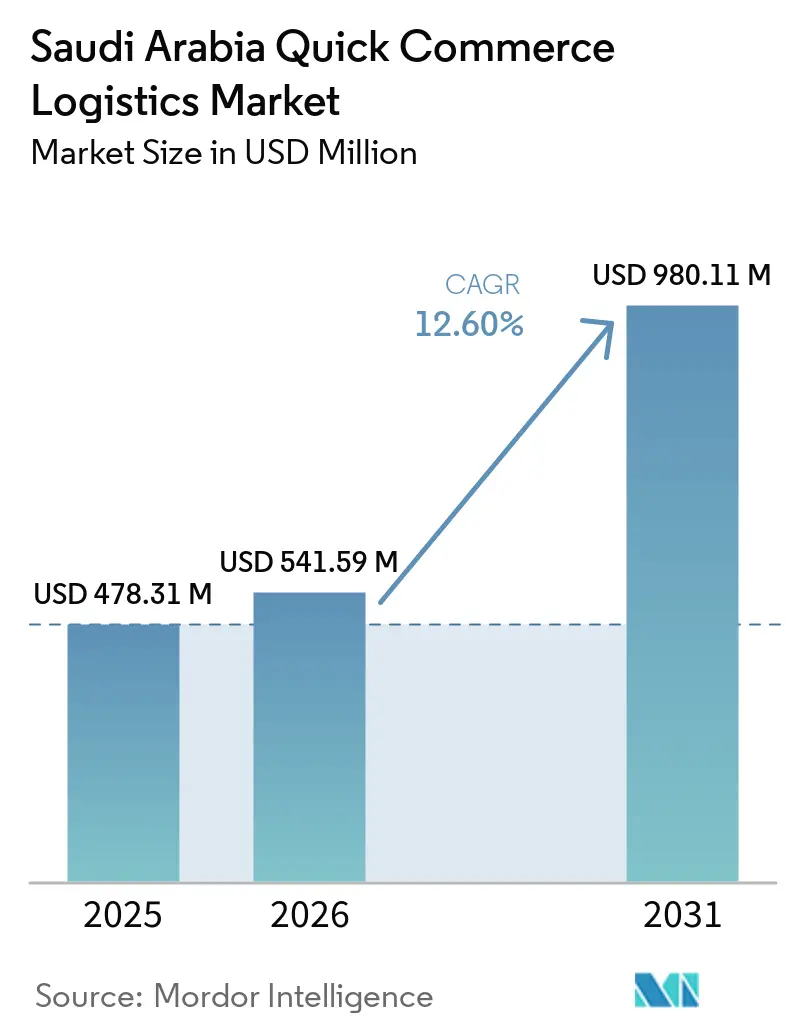
| Base Year Market Size (2025) | USD 478.31 Million |
| Market Size (2026) | USD 541.59 Million |
| Market Size (2031) | USD 980.11 Million |
| Growth Rate (2026 - 2031) | 12.60 % |
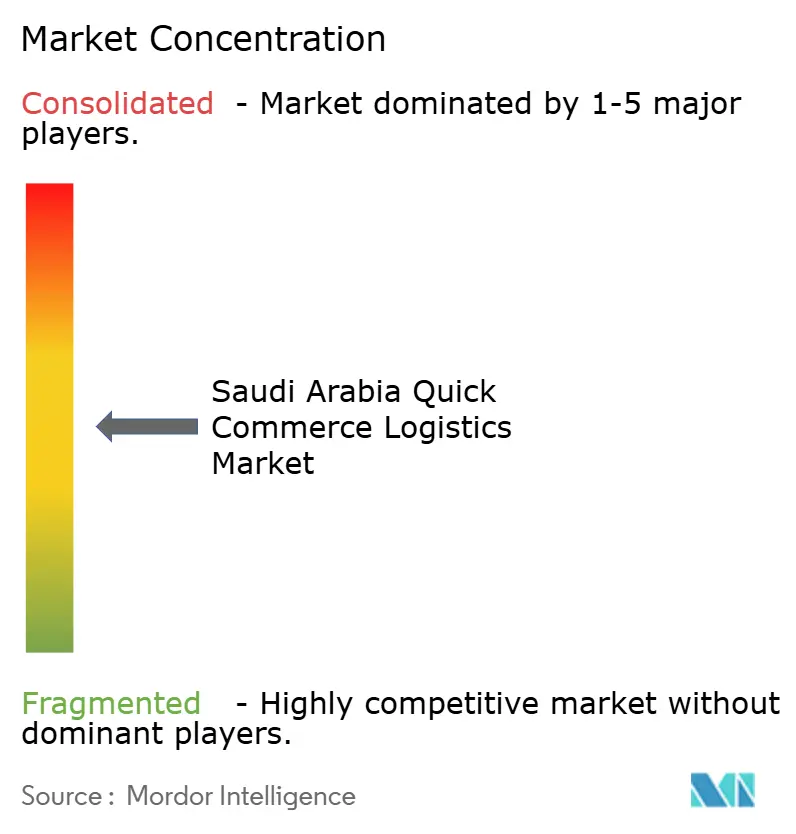
| Market Concentration | Medium |
Major Players *Disclaimer: Major Players sorted in no particular order Image © Mordor Intelligence. Reuse requires attribution under CC BY 4.0. | |
Saudi Arabia Quick Commerce Logistics Market Analysis by Mordor Intelligence
The Saudi Arabia quick commerce logistics market size was valued at USD 478.31 million in 2025 and is estimated to grow from USD 541.59 million in 2026 to reach USD 980.11 million by 2031, at a CAGR of 12.60% during the forecast period (2026-2031).
The Saudi Arabia quick commerce logistics market is supported by logistics investment under Vision 2030, including SAR 280 billion (USD 74.6 billion), committed to transport and logistics infrastructure. The national address system, effective from January 2026, gives delivery operators a more consistent basis for planning routes and locating recipients. Demand is also expanding, as the delivery sector processed more than 118 million orders in the first quarter of 2026, up 49% from the prior year. The Saudi Arabia quick commerce logistics market, therefore, favors operators that can combine local fulfillment capacity, reliable address data, and controlled last-mile networks. The model also creates space for service providers that can support merchants with storage, replenishment, and returns, rather than just delivery.
Key Report Takeaways
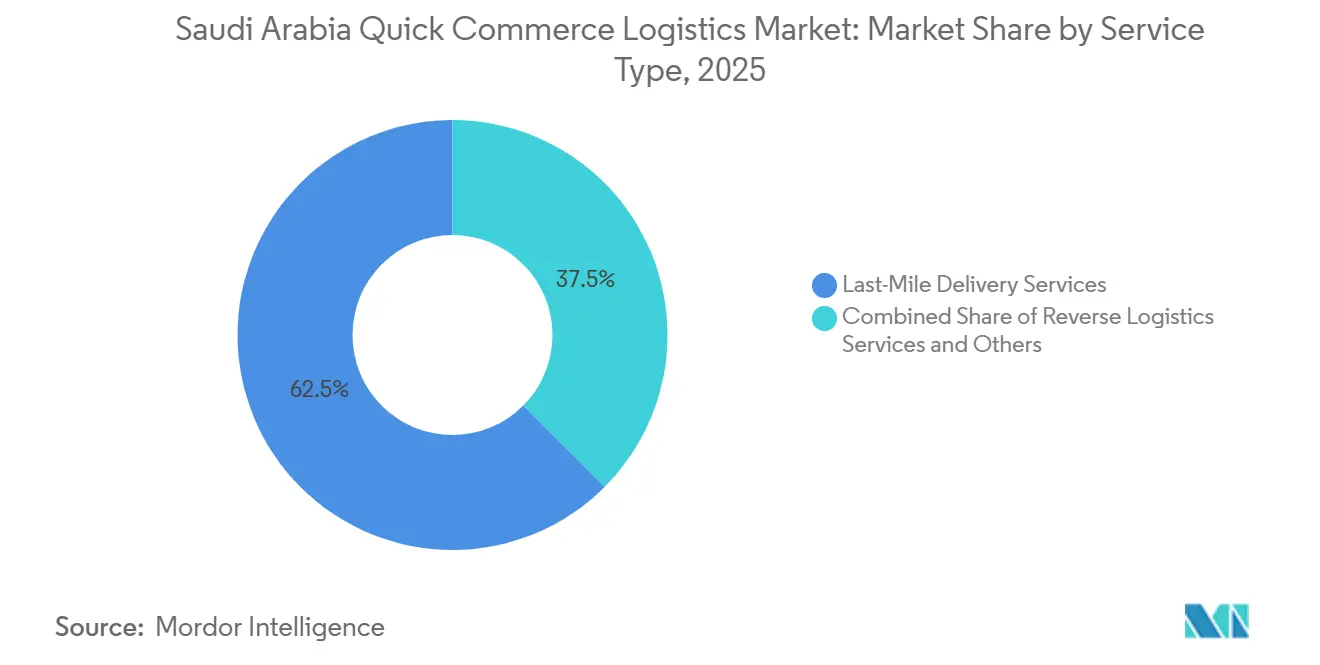
- By service type, last-mile delivery services accounted for 62.53% of the Saudi Arabia quick commerce logistics market share in 2025, while reverse logistics services recorded the highest projected CAGR at 16.96% through 2031.
- By fulfillment model, dark-store-based fulfillment accounted for 42.08% of the Saudi Arabia quick-commerce logistics market size in 2025, while micro-fulfillment center-based fulfillment is forecast to grow at a 16.54% CAGR through 2031.
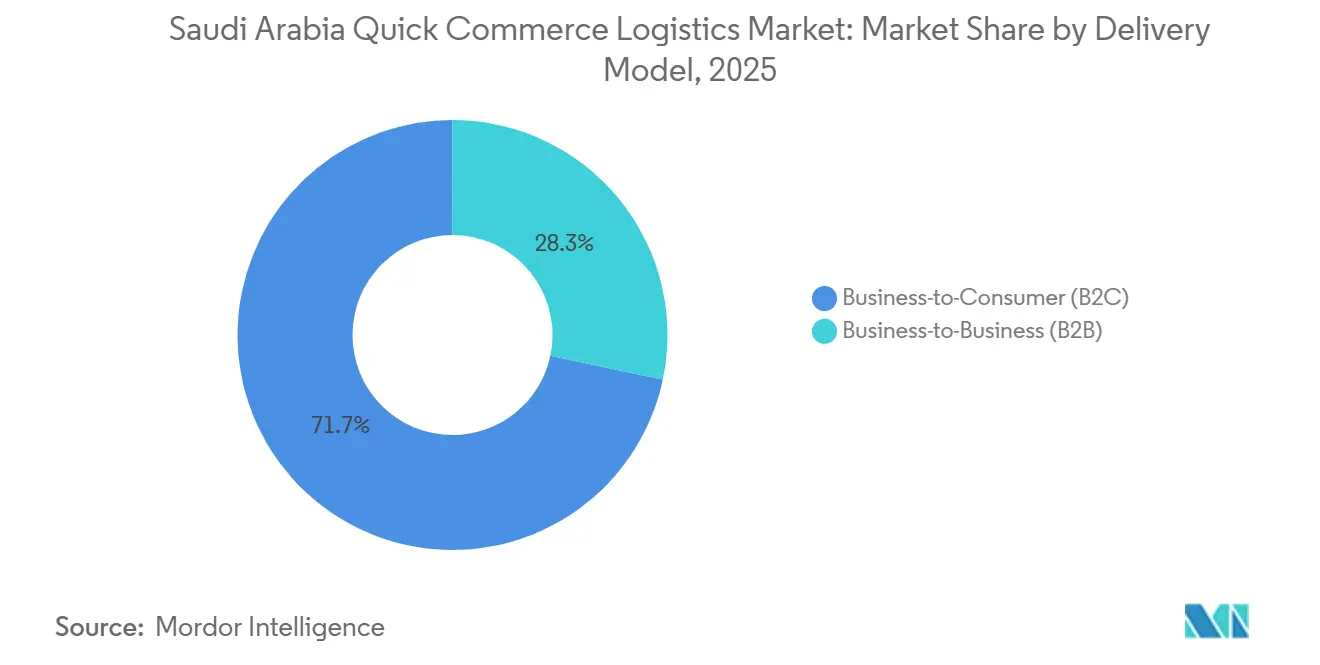
- By delivery model, business-to-consumer accounted for 71.68% of the Saudi Arabia quick-commerce logistics market share in 2025, while business-to-business quick commerce is projected to expand at a 19.70% CAGR through 2031.
- By city tier, Tier 1 cities accounted for 51.97% of the Saudi Arabia quick-commerce logistics market size in 2025, while Tier 3 and below markets are forecast to grow at a 22.55% CAGR through 2031.
- By region, the Central region accounted for 45.76% of the Saudi Arabia quick-commerce logistics market share in 2025, while the Western Corridor is projected to grow at a 19.56% CAGR through 2031.
Note: Market size and forecast figures in this report are generated using Mordor Intelligence’s proprietary estimation framework, updated with the latest available data and insights as of January 2026.
Saudi Arabia Quick Commerce Logistics Market Trends and Insights
Drivers Impact Analysis*
| Driver | (~) % Impact on CAGR Forecast | Geographic Relevance | Impact Timeline |
|---|---|---|---|
| Accelerating Grocery and Convenience Delivery Penetration | +2.8% | National, with the highest concentration in Riyadh and Jeddah | Short term (≤ 2 years) |
| Rising Adoption of Dark Stores and Micro-Fulfillment in Dense Urban Zones | +2.3% | Central Region core, with spillover to the Western Corridor | Short term (≤ 2 years) |
| Expansion of Platform-Owned Logistics Capacity for Faster Order Batching | +1.8% | National, especially Tier 1 and Tier 2 cities | Medium term (2-4 years) |
| Restaurant and Retail Aggregation Driving Multi-Category Quick Commerce Density | +1.6% | Riyadh, Jeddah, and Dammam | Short term (≤ 2 years) |
| Wider Use of Real-Time Dispatch, Route Optimization, and Demand Forecasting | +1.7% | National, with the highest return in the Riyadh metropolitan areas | Medium term (2-4 years) |
| Merchant Push for Same-Day Inventory Visibility and Fulfillment SLA Control | +1.3% | National, especially merchant-dense Tier 1 cities | Medium term (2-4 years) |
| Source: Mordor Intelligence | |||
Accelerating Grocery and Convenience Delivery Penetration
Saudi Arabia’s online grocery market remains at an early stage of adoption, leaving significant headroom for growth as smartphone penetration, digital-payment accessibility, and consumer confidence in e-commerce continue to improve. Strong momentum in digital transactions across retail categories is expected to further support the shift toward online grocery purchasing[1]Source: Saudi Central Bank, “E-Commerce Statistics and Mada Transaction Data,” Saudi Central Bank, sama.gov.sa. Digital wallets accounted for 18% of online checkouts by mid-2025, reducing reliance on cash-on-delivery. In Saudi Arabia's quick-commerce logistics market, higher grocery order frequency increases the need for steady replenishment at local inventory sites. This shifts part of the logistics demand toward fulfillment arrangements measured by service levels and predictable throughput. Operators with more than 100 dark stores across 28 cities require frequent inventory turns for staple products. The operating requirement makes inventory planning as important as the final delivery itself. Ninja generated USD 1 billion in revenue in 2025 and targets USD 1.6 billion in 2026, showing the scale that grocery-led platforms aim to achieve. Its approach shows how a consumer delivery platform can develop into a provider of logistics capacity. The Saudi Arabia quick-commerce logistics market is likely to reward networks that can maintain availability without increasing waste or extending delivery times. Grocery demand also makes fulfillment quality more visible, as customers order frequently and quickly notice inconsistencies.
Rising Adoption of Dark Stores and Micro-Fulfillment in Dense Urban Zones
Dark-store density in Riyadh’s metropolitan corridors nearly doubled between 2023 and 2025. The added locations reduced delivery radii to less than 2 kms and supported service windows of 10 to 30 minutes. A leading grocery chain invested USD 390 million in automated hub infrastructure with more than 250 mobile robots. A third-party logistics company also committed SAR 100 million (USD 26.7 million) to a 400,000-ft² center capable of processing 3.6 million orders per month. These investments show that the Saudi Arabia quick commerce logistics market depends on infrastructure located close to major demand zones. They also raise the entry threshold for operators that do not control fulfillment assets. Local inventory placement can reduce last-mile variable costs by up to 40% and help protect chilled products from longer trips. The approach gives platform-owned networks more control over stock, preparation, and delivery quality than a delivery-only model. CJ Logistics opened a Global Distribution Center in Riyadh’s Special Integrated Logistics Zone in February 2026. The center processes more than 20,000 parcels a day using automated guided vehicle technology. The project demonstrates how micro-fulfillment methods can increase throughput within an urban logistics setting. In Saudi Arabia's quick-commerce logistics market, these facilities can enable operators to expand capacity without relying solely on larger, more distant warehouses.
Expansion of Platform-Owned Logistics Capacity for Faster Order Batching
Platform operators that combine grocery, restaurant, and pharmacy orders into a single routing layer can better utilize riders and vehicles. Their van utilization is 15% to 25% higher than that of single-vertical operators. This advantage can be used to shorten delivery windows rather than improve margins. Keeta expanded from 9 to 20 Saudi cities in 2025, added more than 18,000 riders, and onboarded 7,500 merchants. The expansion shows that geographic coverage has become an important source of order growth. In the Saudi Arabia quick-commerce logistics market, owned capacity gives platforms greater control over how quickly they enter new city tiers. Order batching can group 2 to 4 deliveries on a rider trip during busy periods. This helps platforms handle baskets below SAR 20 (USD 5.33), where single-order trips put greater cost pressure on them. Platform-owned operations can also set schedules around prayer-time pauses and Ramadan evening surges. These local patterns are more difficult to manage when third-party couriers work across several competing platforms. Restaurant and retail aggregation adds further density by combining multiple categories into a single customer journey. The Saudi Arabia quick commerce logistics market, therefore, benefits when platforms can coordinate merchant supply, inventory availability, and route planning through a unified operating model.
Wider Use of Real-Time Dispatch, Route Optimization, and Demand Forecasting
AI-based forecasting for Saudi quick-commerce dark stores reduced stockouts by 80% and overstock by 35%. Better inventory signals are important because thin delivery margins leave little capacity to absorb write-downs. Route optimization that reflects Riyadh traffic conditions and prayer-time windows reduced last-mile costs by 30% to 40% compared with static routing. These systems make technology spending part of everyday operating performance rather than a separate support activity. The Saudi Arabia quick-commerce logistics market can leverage this capability to position high-turnover products before demand peaks. This helps local sites prepare orders quickly while limiting excess inventory. Fiber coverage reached 95% of urban households by 2025. The coverage provides the connectivity required for real-time dispatch and order-preparation systems. Predictive inventory placement also enables operators to place fast-moving products in dark stores before demand increases. This is different from moving stock only after sales have already risen. The change gives logistics operators a greater role in retail planning, as their systems influence product availability at each site. In the Saudi Arabia quick commerce logistics market, the practical value comes from fewer failed substitutions, faster preparation, and more dependable customer delivery windows.
Restraints Impact Analysis*
| Restraint | (~) % Impact on CAGR Forecast | Geographic Relevance | Impact Timeline |
|---|---|---|---|
| High Cost per Drop in Low-Density Delivery Corridors | -1.8% | Northern Region, including Al-Jouf and Arar, and Southern Region, including Asir, Jazan, and Najran | Long term (≥ 4 years) |
| Rider Availability and Workforce Compliance Constraints | -1.5% | National, concentrated in Tier 2 and Tier 3 cities | Medium term (2-4 years) |
| Cold Chain and Packaging Losses for Perishable Assortments | -1.2% | National, with the strongest effect in secondary cities with limited refrigerated van coverage | Medium term (2-4 years) |
| Basket Size, Pressure, and Margin Compression in Hyperlocal Delivery | -1.0% | National, primarily Tier 1 platform operators | Short term (≤ 2 years) |
| Source: Mordor Intelligence | |||
High Cost per Drop in Low-Density Delivery Corridors
Quick commerce economics depend on a delivery density of 15 to 20 drops per km² each day. Central and Western Corridor cities can sustain this density more readily than Northern and Southern delivery areas. In lower-density corridors, the cost per drop can exceed the maximum delivery fee that platforms consider viable. This requires cross-subsidy from urban operations or withdrawal from the corridor. Summer outdoor work bans from 12:00 to 15:00 reduce productive delivery time by 18%-20%. The resulting constraints are more pronounced where route density is already below the level needed to cover costs. Operators with owned infrastructure in Tier 1 cities can use their established urban base to support trials in secondary cities. Providers with mostly variable third-party delivery costs have less scope to keep unprofitable corridors open for long periods. This creates a difference in expansion capability between networks that own fleet and fulfillment assets and networks that broker delivery capacity. Low density also limits the financial case for dedicated cold-chain assets. The Saudi Arabia quick commerce logistics market may remain concentrated in urban cores until order frequency in secondary locations improves. National road investment can improve access, but it does not, by itself, create the order density needed for rapid-delivery models.
Rider Availability and Workforce Compliance Constraints
Gig-rider turnover in Saudi quick commerce exceeded 50% a year. Heat exposure, variable surge pay, and limited career progression contributed to this level of churn. The Ministry of Human Resources and Social Development requires 70% Saudi national staffing across 12 supply chain and procurement roles for qualifying establishments, effective from November 2025. As of April 15, 2026, only workers with digitally documented Qiwa contracts will count toward Saudization calculations. These requirements underscore the importance of workforce documentation and staffing plans in the Saudi Arabia quick-commerce logistics market. They also increase the cost of retaining workers in roles that involve outdoor activity and demanding delivery schedules. Operators using largely expatriate rider workforces face both documentation costs and a wage premium needed to attract Saudi nationals. Certified logistics training programs reduced 6-month rider turnover by 10% in early operator data. The programs are still difficult to extend across large gig-worker populations. iMile signed a 5-year partnership with the Saudi Logistics Academy in June 2026 to train and employ 100 Saudi logistics professionals[2]Source: Saudi Logistics Academy, “Saudi Logistics Academy,” Saudi Logistics Academy, sela.edu.sa. The agreement shows how workforce development has become part of operational capacity planning. The Saudi Arabia quick commerce logistics market will require sustained compliance and retention measures as providers expand beyond their original metropolitan delivery zones.
*Our forecasts treat driver/restraint impacts as directional, not additive. The impact forecasts reflect baseline growth, mix effects, and variable interactions.
Segment Analysis
By Service Type: Last-Mile Revenue Dominates, Reverse Logistics Accelerates
Last-mile delivery services accounted for 62.53% of the Saudi Arabia quick commerce logistics market share in 2025. The segment remains the primary consumer touchpoint because delivery speed and reliability strongly affect the customer experience. Platforms that use third-party couriers give up some control over service-level commitments. Sub-30-minute delivery can matter more to retention than the number of dark stores within a network. Reverse logistics services are the fastest-growing service at a 16.96% CAGR from 2026 to 2031. The segment reflects the need to handle returns from fashion, electronics, and consumable products at the same speed customers expect for outbound orders.
iMile recorded 3 escalated complaints per 100,000 shipments in the first quarter of 2026. The result came during Ramadan, when more than 56 million express shipments moved through the Kingdom. Value-added logistics services include kitting, co-packing, and assortment management for merchant customers. Fulfillment and dark-store operations support this service structure by placing products within less than 2 kilometers of consumers in dense areas. iMile also procured 100 JAC Sunray commercial vehicles in March 2026 to expand last-mile coverage. The Saudi Arabia quick commerce logistics market is moving toward an integrated model in which a single provider manages fulfillment, delivery, and returns.



By Fulfillment Model: Dark Stores Lead, MFCs Drive the Next Growth Phase
Dark-store-based fulfillment accounted for 42.08% of the Saudi Arabia quick-commerce logistics market size in 2025. Purpose-built locations enable operators to control stock and select products based on local demand patterns. Picking times can be kept below 2 minutes per order, supporting sub-15-minute preparation windows. Traditional stores are not designed for the same level of preparation consistency during busy periods. Micro-fulfillment center-based fulfillment is projected to grow at a 16.54% CAGR through 2031. It combines automated guided vehicles and conveyor sorting with smaller urban footprints.
CJ Logistics’s February 2026 Global Distribution Center in Riyadh processes more than 20,000 parcels a day with automated guided vehicle technology[3]Source: CJ Logistics, “CJ Logistics Launches Global Distribution Center in Saudi Arabia,” CJ Logistics, cjlogistics.com. The site shows the difference in throughput between early dark-store designs and more automated facilities. Retail-store-based and hybrid fulfillment models offer transitional options for supermarket groups. A leading retailer’s USD 390 million hub investment combined store and dark-store inventory into a single network. Shared facilities can lower overhead, although retail picking and rapid online orders can compete for the same labor and storage space. The Saudi Arabia quick-commerce logistics market favors sites that can achieve profitability at lower order thresholds when expanding into Tier 2 and Tier 3 locations.
By Delivery Model: B2C Dominant, B2B Offers Higher-Growth Demand
Business-to-consumer deliveries accounted for 71.68% of the Saudi Arabia quick-commerce logistics market share in 2025. The category reflects the consumer-facing origins of rapid grocery, food, and pharmacy delivery. Business-to-business quick commerce is forecast to expand at a 19.70% CAGR from 2026 to 2031. This demand includes dark-store replenishment, restaurant ingredient delivery, and pharmaceutical runs to retail pharmacies. B2B customers often operate with defined delivery windows and recurring order schedules. The Saudi Arabia quick commerce logistics market size for B2B services can therefore grow as merchants seek reliable supply between planned replenishment cycles.
J&T Express Saudi Arabia contributed to the new markets segment that reported a positive adjusted EBIT of USD 4 million in fiscal year 2025 across Saudi Arabia, the UAE, Mexico, Brazil, and Egypt. The result indicated the role that contracted logistics volume can play in improving operating economics. B2C activity has a higher volume but faces margin pressure from discount-led competition. Discount intensity in Saudi food delivery rose to 36% of gross booking value in 2025. Providers are building merchant-service operations beside consumer platforms so scheduled B2B revenue can support their delivery networks.
By City Tier: Tier 1 Dominates, Tier 3 and Below Shows Faster Growth
Tier 1 cities, including Riyadh, Jeddah, and Dammam, accounted for 51.97% of the Saudi Arabia quick-commerce logistics market size in 2025. These cities combine dark-store density, more mature rider networks, and customers prepared to pay for rapid delivery. Tier 3 and below is the fastest-growing city-tier segment, with a 22.55% CAGR through 2031, as road connectivity improves and platforms leverage established city revenues to finance expansion.
Same-day delivery is possible in Tier 2 locations, such as Khobar and Tabuk, for orders placed before midday via regional hub partnerships. Sub-4-hour delivery requires dark-store investments, which remain limited outside Riyadh and Jeddah. Tier 2 cities are the near-term area of competition because they sit between Tier 1 density and Tier 3 growth potential. Quiqup launched full-scale operations in Saudi operations in April 2025, offering fulfillment, same-day delivery, and cold-chain logistics for cosmetics. The company began in Tier 1 locations before expanding into Tier 2 cities. The Saudi Arabia quick-commerce logistics market must balance expansion ambitions with the lower order density that drives up delivery costs outside the largest metropolitan areas.
Geography Analysis
The Central Region accounted for 45.76% of the Saudi Arabia quick-commerce logistics market in 2025, making it the largest geographic area. Riyadh is the central driver of the region because of its dense dark-store footprint and established dispatch networks. The national address system provides a more formal location standard for delivery operations from 2026. This helps reduce the routing uncertainty that affected first-attempt delivery performance. The Eastern Region combines rapid-delivery demand in Dammam and Khobar with a larger industrial supply-chain base. ASMO, a joint venture of Saudi Aramco and DHL Supply Chain, began construction of a logistics center at King Salman Energy Park in May 2026. The facility includes temperature-controlled warehousing, chemical-grade storage, and industrial yard capacity.
The Western Corridor is forecast to grow at a 19.56% CAGR through 2031. Makkah and Medina support frequent delivery activity and add sustained demand for fast-moving consumer goods. A regional revenue share is not provided for this corridor, but its growth rate is the highest among the regions. Jeddah’s logistics base supports the corridor through port-linked storage and distribution capacity. Maersk’s Jeddah park includes cold storage that can support temperature-sensitive product flows. This infrastructure helps connect national supply flows with local delivery operations.
The Southern Region includes Asir, Jazan, and Najran, while the Northern Region includes Al-Jouf and Arar. Both areas experience lower delivery density and limited coverage by refrigerated vehicles. These conditions increase the cost of serving rapid-delivery orders compared with those in large urban centers. Operators currently focus more on corridor and government-service deliveries than on commercial quick commerce at scale. Road connectivity can improve access to these areas, but dark-store investment still needs a sufficient local order base. The Saudi Arabia quick commerce logistics market will expand more gradually in these regions unless operators find delivery models suited to longer routes and lower basket density.
Competitive Landscape
Saudi Arabia’s quick commerce logistics sector is moderately consolidated at the platform level and fragmented across last-mile execution. More than 20 providers compete in fulfillment, delivery, and reverse logistics, while Saudi Post SPL, through Naqel Express, Aramex, and SMSA Express retain broad national coverage beyond Tier 1 cities. iMile, J&T Express, and AJEX compete through technology, delivery performance, and service-level reporting. DHL eCommerce completed a minority investment in AJEX in August 2025. The transaction gave DHL access to AJEX’s more than 60 facilities and 1,200 vehicles, with an option to increase its ownership stake[4]Source: DHL Group, “DHL eCommerce Enters Saudi Arabian Market by Acquiring Equity Stake in Parcel Logistics Company AJEX,” DHL Group, dhl.com.
Naqel Express pursued partnerships with CJ Logistics and MSC in 2025 to deepen cross-border supply chain links and expand last-mile coverage. This approach focuses on logistics integration rather than direct competition for the fastest hyperlocal delivery times. iMile reported a 99.5% on-time delivery rate during the Ramadan 2026 peak and 3 complaints per 100,000 shipments in the TGA rating. Aramex introduced a robotic sorting facility at Jeddah Islamic Port in January 2025 and announced a drone delivery pilot. These measures show that established carriers are using automation to protect service quality and operating capacity.
White-space demand remains in cold-chain delivery for pharmacy and fresh products, automated reverse logistics for fashion and electronics, and B2B services for platforms without their own fulfillment assets. In contrast, fewer than 500 refrigerated delivery vans serve the national cold chain. Operators must also meet Nitaqat requirements or risk limits on visa issuance and access to Etimad government contracts. Aramex and ASX eMobility expanded electric-vehicle charging infrastructure for Aramex’s delivery fleet in July 2026. The Saudi Arabia quick-commerce logistics market is competitive in both service performance and the ability to build compliant, controlled delivery capacity.
Saudi Arabia Quick Commerce Logistics Industry Leaders
Aramex
SMSA Express
Saudi Post SPL
Careem Express
iMile
- *Disclaimer: Major Players sorted in no particular order

Recent Industry Developments
- July 2026: Aramex Saudi Arabia and ASX eMobility expanded electric vehicle charging infrastructure to support Aramex's delivery fleet, deploying multiple new charging units, including a Sungrow DC fast charger, identified as the first of its kind installed in the Kingdom, reinforcing Aramex's fleet electrification aligned with Vision 2030 and its Carbon-Neutrality 2030 target.
- June 2026: iMile Delivery Saudi Arabia signed a 5-year talent development partnership with the Saudi Logistics Academy, targeting the training and employment of 100 Saudi logistics professionals, having already advanced 25 trainees through 4 cohorts, with 12 placed into permanent roles.
- May 2026: ASMO, the joint venture between Saudi Aramco and DHL Supply Chain, commenced construction of a purpose-built logistics center at King Salman Energy Park in the Eastern Province, designed with temperature-controlled warehousing, chemical-grade storage, and industrial yard facilities for energy-sector customers.
- February 2026: CJ Logistics launched its Global Distribution Center at Riyadh's Special Integrated Logistics Zone, processing over 20,000 parcels daily with automated guided vehicle technology, forming part of a broader Asia-Middle East logistics hub strategy that also serves the UAE and Kuwait.


Saudi Arabia Quick Commerce Logistics Market Report Scope
| Fulfillment and Dark Store Operations |
| Last-Mile Delivery Services |
| Reverse Logistics Services |
| Value-Added Logistics Services |
| Dark Store-Based Fulfillment |
| Micro-Fulfillment Center (MFC)-Based Fulfillment |
| Retail Store-Based Fulfillment |
| Hybrid Fulfillment Model |
| Business-to-Consumer (B2C) |
| Business-to-Business (B2B) |
| Tier 1 |
| Tier 2 |
| Tier 3 and Below |
| Central (Riyadh, Al-Qassim, and Hail) |
| Eastern (Ash-Sharqiyah) |
| Western (Al-Bahah, Makkah, Medina, and Tabuk) |
| Northern (Al-Jouf and Arar) |
| Southern (Asir, Jazan, and Najran) |
| By Service Type | Fulfillment and Dark Store Operations |
| Last-Mile Delivery Services | |
| Reverse Logistics Services | |
| Value-Added Logistics Services | |
| By Fulfillment Model | Dark Store-Based Fulfillment |
| Micro-Fulfillment Center (MFC)-Based Fulfillment | |
| Retail Store-Based Fulfillment | |
| Hybrid Fulfillment Model | |
| By Delivery Model | Business-to-Consumer (B2C) |
| Business-to-Business (B2B) | |
| By City Tier | Tier 1 |
| Tier 2 | |
| Tier 3 and Below | |
| By Region | Central (Riyadh, Al-Qassim, and Hail) |
| Eastern (Ash-Sharqiyah) | |
| Western (Al-Bahah, Makkah, Medina, and Tabuk) | |
| Northern (Al-Jouf and Arar) | |
| Southern (Asir, Jazan, and Najran) |


Key Questions Answered in the Report
What is the forecast for quick-commerce logistics in Saudi Arabia?
The sector is forecast to rise from USD 541.59 million in 2026 to USD 980.11 million by 2031, at a 12.60% CAGR.
Which service generates the most revenue in Saudi rapid delivery logistics?
Last-mile delivery services accounted for 62.53% of revenue in 2025, underscoring the importance of delivery speed and service consistency.
Which fulfillment method is growing fastest in Saudi Arabia's rapid-delivery market?
Micro-fulfillment center-based fulfillment is forecast to grow at a 16.54% CAGR through 2031 as operators add automation to urban sites.
Why are B2B delivery services becoming more important in Saudi Arabia?
B2B quick commerce is projected to grow at a 19.70% CAGR through 2031, driven by merchants' need for planned replenishment and defined delivery windows.
Which Saudi region has the strongest growth outlook for rapid delivery logistics?
The Western Corridor is projected to grow at a 19.56% CAGR through 2031, supported by delivery demand in Makkah and Medina and logistics capacity in Jeddah.
What limits the expansion of quick commerce beyond major Saudi cities?
Lower order density, high cost per drop, rider availability, and limited cold-chain capacity make rapid delivery more economically challenging in Northern and Southern regions.
Page last updated on:





