
Market Overview
| Study Period | 2021 - 2031 |
|---|---|
| Forecast Data Period | 2026 - 2031 |
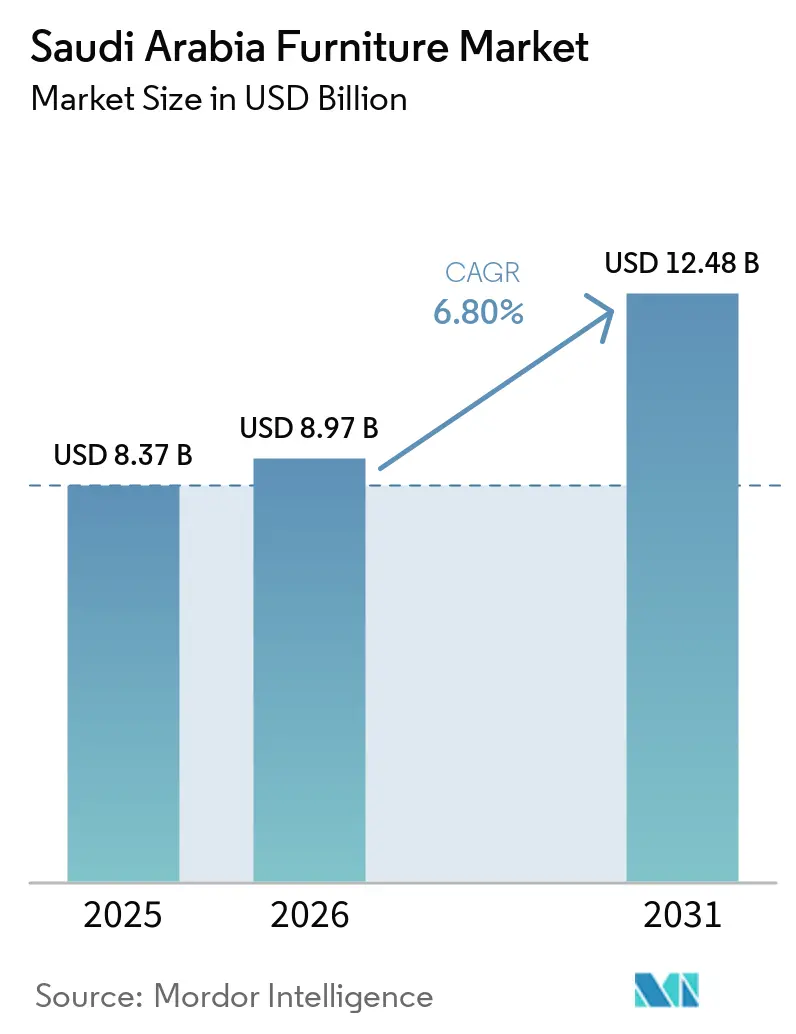
| Base Year Market Size (2025) | USD 8.37 Billion |
| Market Size (2026) | USD 8.97 Billion |
| Market Size (2031) | USD 12.48 Billion |
| Growth Rate (2026 - 2031) | 6.80 % |
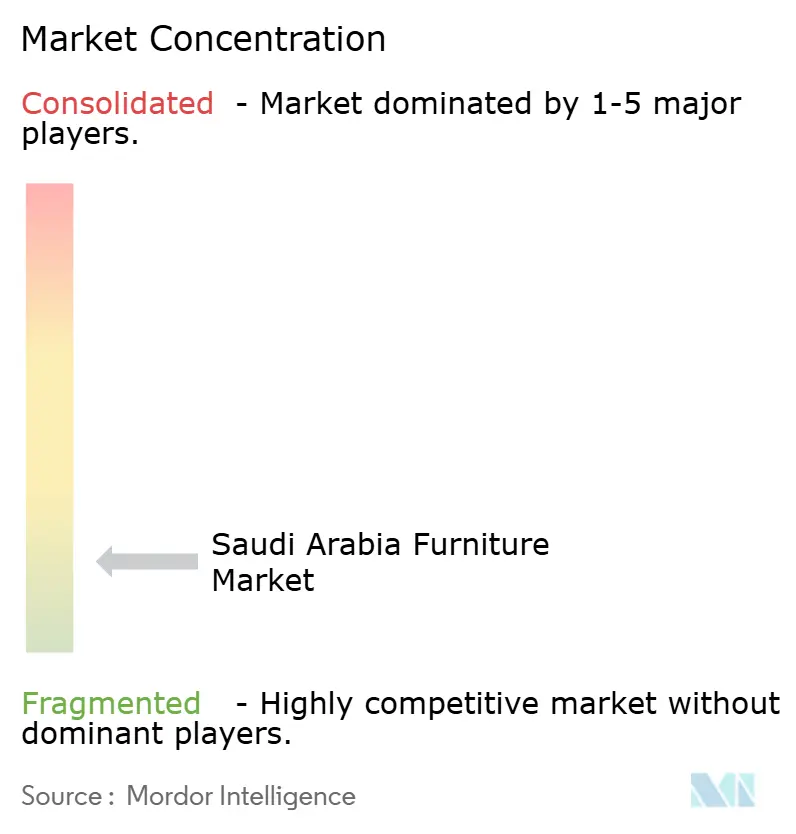
| Market Concentration | Low |
Major Players *Disclaimer: Major Players sorted in no particular order Image © Mordor Intelligence. Reuse requires attribution under CC BY 4.0. | |
Saudi Arabia Furniture Market Analysis by Mordor Intelligence
The Saudi Arabia furniture market was valued at USD 8.37 billion in 2025 and is estimated to grow to USD 8.97 billion in 2026 and USD 12.48 billion by 2031, at a CAGR of 6.8% during the forecast period (2026-2031). Saudi furniture demand is driven by a large residential base that generates recurring first-time purchase and replacement demand, along with a Public Investment Fund (PIF)-backed giga-project pipeline that creates demand for specification-grade furniture, fixtures, and equipment (FF&E) as properties open. GASTAT’s 2025 Housing Statistics Publication highlights a mature but expanding housing stock, with 4.5 million Saudi-occupied dwellings and more than 118,000 net new housing units added in 2025[1]. PIF-backed giga-projects, including Diriyah, The Red Sea, NEOM, Qiddiya, and AMAALA, are generating FF&E demand linked to project completion, with Diriyah’s Waldorf Astoria and Four Seasons projects accounting for a combined USD 1.55 billion in FF&E value in 2026. Major retailers are expanding their distribution capabilities: IKEA Alsulaiman targets 30 customer meeting points nationwide by 2028[2]; Home Centre and Pan Home are expanding into secondary cities; Ashley HomeStore opened its eighth Saudi Arabian showroom in January 2026; Almutlaq combines retail operations with manufacturing at its Dammam plant; and ABYAT is developing a 110,000-square-meter logistics hub at King Abdulaziz Port with a SAR 100 million (USD 26.65 million) investment.
Key Report Takeaways
- By application, home furniture held 45.8% of the Saudi Arabia furniture market share in 2025, while hospitality furniture is forecast to expand at a 9.6% CAGR through 2031.
- By material, wood held 53.9% of the Saudi Arabia furniture market share in 2025, while plastic and polymer furniture is forecast to expand at a 9.0% CAGR through 2031.
- By price range, mid-range furniture held 46.1% revenue share in 2025, while premium furniture is forecast to expand at an 8.3% CAGR through 2031.
- By distribution channel, B2C and retail held 62.9% revenue share in 2025, while B2B and project sales are forecast to expand at a 7.8% CAGR through 2031.
- By geography, the Central Region held a 37.5% revenue share in 2025, while the Northern Region is forecast to expand at a 9.2% CAGR through 2031.
Note: Market size and forecast figures in this report are generated using Mordor Intelligence’s proprietary estimation framework, updated with the latest available data and insights as of January 2026.
Market Trends and Insights
Drivers Impact Analysis of Saudi Arabia Furniture Market*
| Driver | (~) % Impact on CAGR Forecast | Geographic Relevance | Impact Timeline |
|---|---|---|---|
| Vision 2030 Residential Build-Out Is Accelerating Home-Furniture Demand | +2.0% | Kingdom-wide, concentrated in Riyadh, Jeddah, Madinah, and ROSHN communities | Medium term (2-4 years) |
| Hospitality Giga-Projects Fueling Contract and Luxury Segments | +1.5% | Western seaboard, including NEOM, Red Sea, Diriyah, and Qiddiya, with spillover to Riyadh luxury hotels | Medium term (2-4 years) |
| Rapid E-Commerce and BNPL Adoption Boosting Online Furniture Sales | +0.9% | National, strongest in Riyadh, Jeddah, and Dammam Metropolitan Area | Short term (≤ 2 years) |
| ESG-Linked Public Tenders Favoring Certified Wood Furniture | +0.5% | NEOM project zones, Red Sea Global sites, and Mostadam-certified government buildings | Medium term (2-4 years) |
| Saudization Spurring Ergonomic Office Furniture Upgrades | +0.6% | Riyadh, including KAFD, Al-Malqa, and Al-Olaya, with secondary spillover to Jeddah commercial hubs | Short term (≤ 2 years) |
| Panel-Board Localization Amid Red Sea Shipping Risk | +0.4% | Industrial cities in Riyadh, Jeddah, and Dammam, with national supply-chain benefits | Medium term (2-4 years) |
| Source: Mordor Intelligence | |||
Vision 2030 Residential Build-Out Is Accelerating Home-Furniture Demand
Saudi Arabia’s Housing Program has steadily progressed toward its 70% homeownership target, adding a growing number of newly owned homes to the market each year. Each net-new household represents a potential furniture buyer, making annual homeownership and housing delivery data a key leading indicator of furniture demand. In 2025, the homeownership rate reached 66.24%, up from 63.74% in 2023 and 65.40% in 2024[3]. In 2024, the Sakani program served 117,000 families, including 93,000 families that moved into completed homes. According to GASTAT, Saudi Arabia added more than 118,000 net-new Saudi-occupied dwellings in 2025. Homeownership increased by approximately 2.5 percentage points between 2023 and 2025. At this annual pace, achieving the remaining approximately 3.76 percentage points required to reach the 70% target would support around three additional years of sustained first-fill furniture demand. New homeowners do not typically furnish their homes immediately upon handover. In a typical Riyadh villa, furniture purchases generally occur 12–18 months later, following fit-out contracting and household savings.
Hospitality Giga-Projects Fueling Contract and Luxury Segments
Diriyah, the Red Sea, and Qiddiya continue to add operational hotel keys annually, with each property requiring operator-specified furniture, fixtures, and equipment (FF&E) before procurement begins. Annual hotel key openings and confirmed operator awards, rather than announced capital expenditure (CapEx), convert giga-project pipelines into tangible furniture demand. Diriyah Gate and Wadi Safar plan to include approximately 18,000 homes, 450 retail and food and beverage (F&B) outlets, and nearly 40 hotels. As Bab Samhan is already operational, the order book includes both first-fill and replacement FF&E demand. Hassan Allam–UCC's USD 727 million Waldorf Astoria block and Midad's USD 827 million Four Seasons project continue to represent clear demand signals[4]. Phase 1 of the Red Sea project opened The St. Regis Red Sea Resort and Nujuma, a Ritz-Carlton Reserve, in 2024. The remaining island hotels are tendering FF&E contracts in phases. Specifications for regenerative coastal developments, including requirements related to salt exposure, moisture resistance, and outdoor durability, do not directly transfer from Diriyah's heritage-luxury design manuals. Operator FF&E specifications require compliance with fire ratings, moisture classifications, and Forest Stewardship Council (FSC) and Programme for the Endorsement of Forest Certification (PEFC) chain-of-custody requirements before price discussions begin.
Rapid E-Commerce, BNPL Adoption, and Workplace Demand
Furniture is a structurally difficult e-commerce category due to logistics costs, return rates, and assembly needs. Even so, adoption is accelerating in Saudi Arabia, with leading platforms reporting furniture among their top-trafficked categories and BNPL checkout converting high-ticket purchases into installment transactions. Licensed BNPL capacity and dependable last-mile delivery, not traffic volume, are what convert this demand into realized revenue. Bulky products, high return costs, and assembly requirements historically limited furniture e-commerce. This is changing: 2026 website traffic rankings place ikea.com first, homecentre.com second, and panhomestores.com third among furniture retailers in Saudi Arabia. IKEA Saudi Arabia offers same-day delivery starting at SAR 39 (USD 10.4) and supports checkout through four licensed Buy-Now-Pay-Later (BNPL) providers, Amwal, Tamara, Tabby, and Baseeta. Full upfront payment is no longer the default purchasing method, allowing full-room furniture sets to be purchased without requiring a credit card. New licenses issued by the Saudi Central Bank (SAMA) allow BNPL providers such as Tabby to raise maximum transaction limits and extend installment terms to up to twelve months. This applies to merchants already including IKEA, Noon, and Almanea, positioning the mid-market furniture segment as a direct beneficiary.
Certified Materials and Local Panel-Board Capacity Support Tender Readiness
Public and giga-project procurement in Saudi Arabia operates through three compliance gates: SABER registration, LCGPA local-content thresholds, and Mostadam/SBC 1001 sustainability certification. Suppliers must meet all requirements before price evaluation, as failure to meet any requirement disqualifies them from award consideration. This framework favors certified, locally compliant furniture manufacturers over price-only competitors. SASO’s SABER platform is mandatory for most finished furniture entering the Kingdom. The 2026 update requires 12-digit HS codes and links certificate issuance to ZATCA VAT records; delayed or rejected filings can halt customs clearance and VAT accounting. Wooden furniture typically requires structural stability, coating, and formaldehyde-class test files, bilingual Arabic-English labeling, and phytosanitary documentation for raw or semi-processed wood. The LCGPA national product list includes a furniture chapter covering 26 product categories and hundreds of registered factories. Suppliers need an audited local-content certificate, in addition to SABER registration, to qualify for list preference.
Restraints Impact Analysis of Saudi Arabia Furniture Market*
| Restraint | (~) % Impact on CAGR Forecast | Geographic Relevance | Impact Timeline |
|---|---|---|---|
| High Logistics and Import Duties Are Squeezing Margins | -1.1% | Eastern ports and long-haul domestic distribution corridors | Short term (≤ 2 years) |
| Volatile Timber and Foam Input Prices | -0.9% | Import-dependent manufacturing hubs in Riyadh, Jeddah, and Dammam | Short term (≤ 2 years) |
| Permitting Delays Postponing Fit-Out Schedules | -0.7% | Urban commercial development zones | Short term (≤ 2 years) |
| Skilled Labor Shortages in Upholstery and Joinery | -0.7% | Industrial furniture manufacturing clusters in Riyadh and Jeddah | Short term (≤ 2 years) |
| Source: Mordor Intelligence | |||
High Logistics Costs, Import Duties Are Squeezing Margins
Imported furniture incurs a 15% customs duty on its Cost, Insurance, and Freight (CIF) value, followed by a 15% VAT on the duty-inclusive amount, creating a combined tax burden of approximately 32.25% above the factory-gate price before warehousing, last-mile delivery, or retail margins. As of September 30, 2026, CMA CGM and Maersk continue to impose emergency surcharges of up to USD 3,000 per container for timber and furniture shipments, in addition to already elevated base freight rates. Landed costs remain 15–20% higher than pre-2024 levels, requiring retailers to either absorb the margin impact or raise prices, which constrains demand in the price-sensitive Economy segment. International brands and distributors sourcing from China, Southeast Asia, and Europe face the greatest margin compression because their product assortments depend heavily on imports. Fixed project budgets can render initially competitive supplier quotations unviable when fully landed costs, including freight, customs duties, and VAT, increase. Retailers in lower-priced categories cannot absorb cost increases without risking volume losses, while premium retailers can pass through a greater share of these increases because they operate with higher absolute margins.
Volatile Timber & Foam Input Prices
Volatile timber and upholstery foam prices squeeze margins across Saudi Arabia’s domestic furniture factories because foam follows the petrochemical cycle linked to crude oil and derivatives and is difficult to hedge, while timber stays unstable due to logging limits in major producing countries, Red Sea freight disruption, and penalties for unauthorized sourcing. Mid-range and economy manufacturers lack the pricing power to absorb these spikes without losing volume, and upholstered producers face simultaneous foam and fabric cost peaks, which together constrain output and restrain growth of the Saudi Arabia furniture market. Timber and upholstery foam volatility compresses margins across 363 domestic factories. Foam tracks the petrochemical cycle (crude and derivatives) and is hard to hedge directly. Logging limits in Indonesia, Malaysia, and Brazil; Red Sea disruption adding freight onto already-volatile commodity prices; and Saudi Arabia penalties of up to SAR 30 million (USD 8 million) for unauthorized timber sourcing. Volatility persists because source-country logging rules, Red Sea freight, Kingdom of Saudi Arabia timber-compliance risk, and the oil-linked foam cycle move independently of furniture demand.
*Our forecasts treat driver/restraint impacts as directional, not additive. The impact forecasts reflect baseline growth, mix effects, and variable interactions.
Saudi Arabia Furniture Market Segment Analysis
By Application:
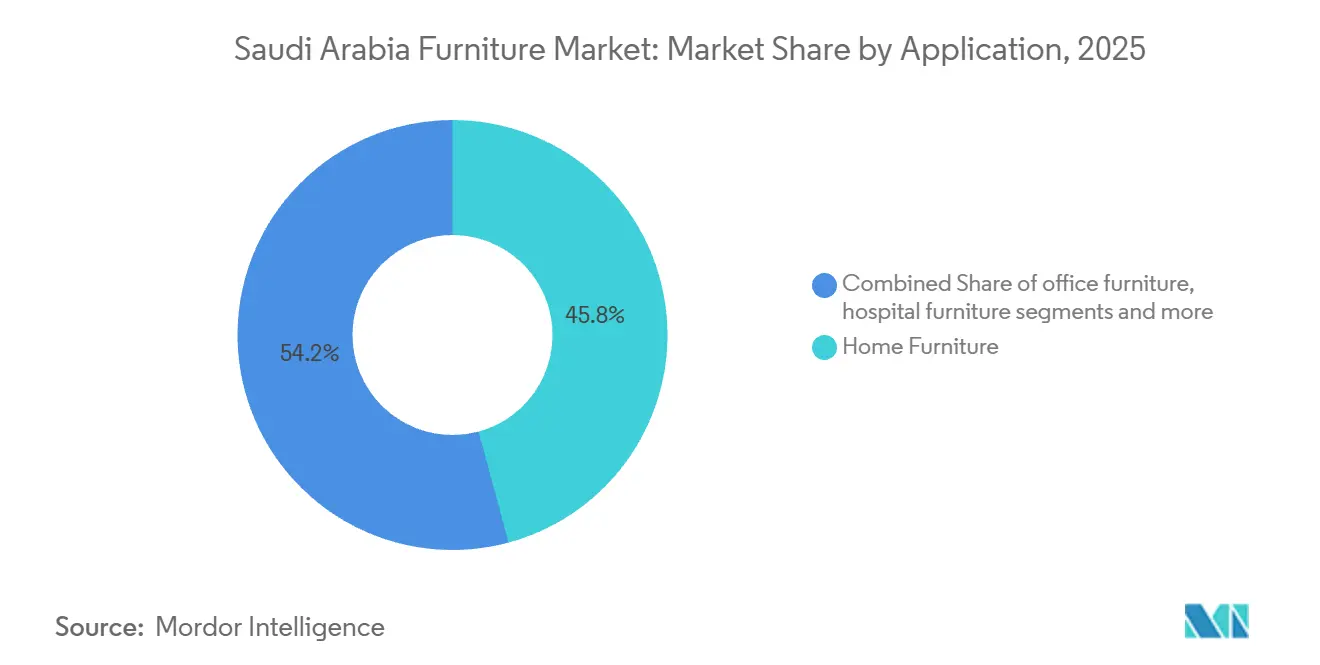
Home Furniture Leads While Hospitality Gains MomentumHome furniture accounted for 45.8% of the Saudi Arabia furniture market size in 2025. New residential occupancy supports demand for beds, sofas, dining sets, storage products, and fitted kitchens. Families furnishing a first home often purchase several categories during a short period. Retailers with showroom networks, delivery capacity, and installation services are well placed to serve these purchases. Office furniture also benefits from commercial fit-outs in Riyadh and other business centers. Employers moving into new buildings require desks, seating, storage, meeting-room systems, and reception products. The Saudi Arabia furniture industry benefits from this demand because commercial buyers often need consistent products across several floors or sites.
Hospitality furniture is forecast to grow at a 9.6% CAGR through 2031. Hotels and resorts need guest-room furniture, lobby seating, restaurant tables, outdoor pieces, and back-of-house products. Branded operators often set detailed design and durability standards for each package. Their procurement process favors suppliers that can document compliance and support installation. Educational and healthcare furniture remain smaller application areas but can produce repeat orders through institutional procurement. Schools require desks, seating, storage, and cafeteria products, while healthcare facilities require durable furnishings suited to clinical settings. This mix broadens demand beyond household purchases within the Saudi Arabia furniture market.

By Material:
Wood Retains Its Lead While Polymer Use ExpandsWood held 53.9% of furniture revenue in Saudi Arabia in 2025. Solid wood, veneers, and MDF remain common in residential bedroom, living room, and dining products. Local panel-board supply can support faster production of cabinets and case goods. Buyers also continue to associate wood finishes with established home furnishing styles. Material documentation is becoming more relevant when suppliers pursue hospitality or public tenders. Certified timber sources and product records can improve tender readiness. Wood products remain supported by residential preferences and local manufacturing capability.
Plastic and polymer furniture is forecast to grow at a 9.0% CAGR through 2031. This category suits outdoor venues, school canteens, worker accommodation, and hospitality sites exposed to heat and humidity. Polymer designs can offer lower maintenance and easy cleaning in high-use settings. Metal furniture continues to serve offices, schools, and industrial facilities where structural durability is important. Recycled and engineered materials remain a developing area for suppliers that can verify their composition. Procurement standards may give these products a clearer role where recycled content is requested. The Saudi Arabia furniture industry can therefore support several material choices rather than relying on a single input category.
By Price Range:
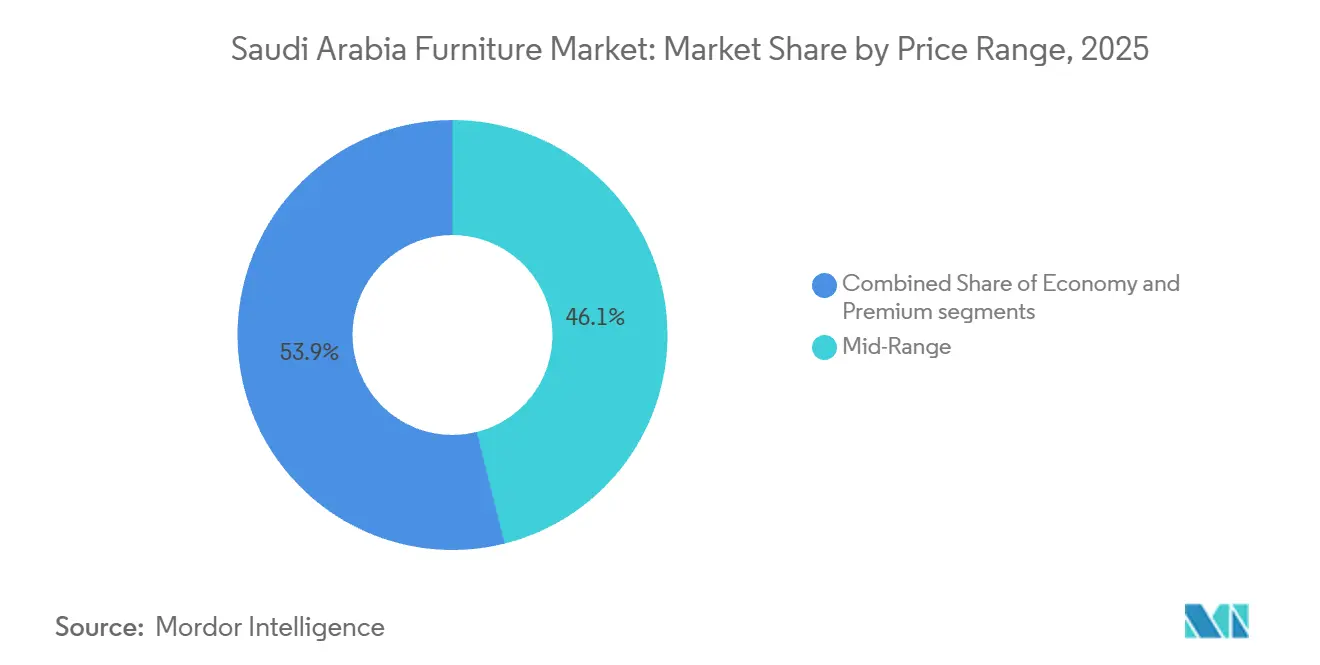
Mid-Range Demand Remains Broad While Premium Sales RiseMid-range furniture accounted for 46.1% of the Saudi Arabia furniture market size in 2025. Young households furnishing newly occupied homes often seek durable products at a manageable total cost. Installment payment options can make a better-specified sofa, dining set, or bedroom package easier to afford. This supports movement from entry-level products toward mid-range offerings. Retailers also use bundle promotions, delivery, and assembly to compete for these customers. The segment remains important because it serves a wide range of household budgets. It is the core volume tier for much of the Saudi Arabia furniture market.
Premium furniture is forecast to grow at an 8.3% CAGR through 2031. Luxury hotels, branded residences, and higher-income households seek custom designs, better materials, and established international labels. These buyers place greater value on finish quality, product origin, and design consistency. Contract suppliers can benefit when they meet the exact standards in hotel and residential specifications. Economy products face more pressure from import costs and price competition. IKEA Saudi Arabia introduced its Buyback Service in September 2026, creating a formal channel for used products to re-enter consumer use. This service may extend the useful life of some entry-level furniture while strengthening customer engagement.
By Distribution Channel:
Retail Leads While Project Sales Expand FasterB2C and retail held 62.9% of furniture revenue in Saudi Arabia in 2025. Showrooms remain important for sofas, beds, dining sets, and other purchases where consumers want to inspect comfort, color, and finish. Specialty stores and home-improvement centers also provide planning advice and local delivery. Online retail is widening the reach of these formats by letting customers compare products before visiting or ordering. Digital fulfillment is becoming a standard capability rather than a separate channel. Custom joinery retains a role in premium homes and majlis interiors where standard dimensions do not fit the design. These options keep the retail side of the Saudi Arabia furniture market broad and competitive.
B2B and project sales are forecast to grow at a 7.8% CAGR through 2031. Hotel, office, education, and government projects buy in larger volumes and often require one supplier to manage delivery and installation. These customers expect product compliance, set lead times, and clear warranty terms. In September 2026, ALMUTLAQ Furniture completed the EY regional headquarters project at King Abdullah Financial District using Haworth systems across 2 towers. The example shows how project suppliers can compete for high-value workplace packages. Retailers without dedicated project teams may have limited access to this faster-growing route. The Saudi Arabia furniture industry is responding by adding specification, procurement, and installation services.
Geography Analysis
The Central Region held 37.5% of furniture revenue in Saudi Arabia in 2025. Riyadh alone anchors this growth: the capital's residential supply reached approximately 1.93 million units in 2025, with roughly 63,000 further units scheduled for 2026–2027 delivery via ROSHN, the National Housing Company, and MoMAH-affiliated projects. Simultaneously, Riyadh is the epicenter of the RHQ-driven office boom, with Grade-A office stock alone projected to grow toward nearly half of the combined 15 million m² Riyadh/Jeddah/Dammam Metropolitan Area (DMA) total by 2028, and Grade-A rents having risen 86% cumulatively since 2019. This dual engine, mass residential furnishing plus premium corporate fit-out, gives the Central Region the most diversified demand base of any region. Al-Qassim contributes a smaller, more traditional residential and agricultural-economy-linked furniture demand base alongside Riyadh's dominant metropolitan contribution.
The Western Region is the second-largest demand area because Makkah, Madinah, and Jeddah combine household purchases with hospitality requirements. Makkah and Madinah collectively account for over 252,000 planned hotel rooms, with projects including Rua Al Haram, Rua Al Madinah, Knowledge Economic City, and Masar Makkah, of which 64% will be four- and five-star category properties commanding premium FF&E specifications. The Northern Region is forecast to grow at a 9.2% CAGR through 2031. The Northern region’s furniture demand here is predominantly residential and government/institutional (schools, healthcare facilities, and administrative offices), given the region's lower population density and more limited large-scale giga-project or hospitality pipeline exposure relative to the Central, Western, and Eastern regions.
The Eastern region's furniture demand is shaped by its industrial and energy-sector economic base, a comparatively higher share of expatriate professional households, and an established domestic furniture retail heritage. Hamad M. Al Rugaib & Sons, one of the Kingdom's oldest furniture retailers (founded 1958), is headquartered in Dhahran and continues to expand its Eastern Province footprint, including its eighth Ashley-branded showroom opened in Dammam. The Southern region is growing marginally faster, reflecting incremental tourism and infrastructure investment (including nascent Red Sea coast and Asir-region development activity) layered on top of a residential and institutional demand base similar in character to the Northern Region.
Competitive Landscape
The Saudi Arabian furniture market is structurally fragmented. The six named organized retailers together hold only about 20.4% of the market value, while “Other Market Players” account for 79.58%. This is a low-concentration industry: no firm approaches a dominant share, and the long tail of independent showrooms, workshops, importers, and contract suppliers still sets most of the competitive tone.
IKEA Saudi Arabia, operated by Alsulaiman Group, is the clear major player at 8.11%. That lead is meaningful in brand recognition, store format, and omnichannel reach, but it is modest in absolute terms. IKEA’s position reflects scale in ready-to-assemble and mid-range home furnishings, franchise expansion toward more customer meeting points, and operational upgrades such as leaner fulfillment. Abyat follows at 3.61%, competing as a large-format home-finishing and furnishing platform rather than a single-brand furniture specialist. Almutlaq Furniture (2.54%), Home Centre of Landmark Group (2.28%), Al Rugaib Furniture (2.08%), and Al-Jedaie Furniture (1.80%) form a second tier of organized chains. Combined, these five challengers hold roughly 12.3%, less than 1.6 times IKEA’s share. Competition among them is based on assortment breadth, showroom networks in Riyadh, Jeddah, and the Eastern Province, multi-brand premium ranges, loyalty and cashback programs, and growing digital channels, not on oligopolistic control of supply.
The 79.58% residual share is the defining feature of concentration. It comprises thousands of small manufacturers and traders, traditional carpentry and upholstery workshops, unorganized specialty stores, and project-based suppliers serving housing, hospitality, and government fit-outs. Low technical barriers to entry, high import intensity, and localized taste keep this tail large. Fragmentation has two strategic implications. First, organized players can still take a share as Vision 2030 housing, tourism, and mega-projects raise demand for standardized, warrantied, and delivered products. Second, rivalry remains intense on price, lead time, and customization, so leadership is contestable. Concentration is therefore expected to rise only gradually, through store expansion, omnichannel scale, and selective consolidation, not through sudden market closure.
Saudi Arabia Furniture Industry Leaders
-
IKEA Saudi Arabia
-
Almutlaq Furniture
-
Al-Rugaib Furniture
-
Home Centre (Landmark Group)
-
ABYAT
- *Disclaimer: Major Players sorted in no particular order
Saudi Arabia Furniture Market Companies Covered in this Report
- IKEA Saudi Arabia
- ABYAT
- ALMUTLAQ Furniture
- Home Centre (Landmark Group)
- Al Rugaib Furniture
- Al-Jedaie Furniture
- Al Makateb Co. Ltd
- Midas Furniture
- Ashley
- Modern Woodworks LLC
- Tanatel Furniture
- Foamco
- Gautier
- Habitat Furniture Co. Ltd
- Wefal International Est
- Arabian Furniture & Design Co.
- Aflak Office Furniture
- B Design
- Jeraisy Furniture Factory (JFF)
Recent Industry Developments in Saudi Arabia Furniture Market
- September 2026: IKEA Alsulaiman launched the Buyback Service in Saudi Arabia through the "Reverse Shop" campaign, the brand’s first circular-economy retail initiative in the Kingdom. The service enables consumers to sell used IKEA furniture back to the company through stores in Riyadh, Jeddah, Madinah, and Dhahran. The campaign positions IKEA as a large-format retailer with a formal furniture take-back program in Saudi Arabia.
- September 2026: ALMUTLAQ Furniture completed the EY regional headquarters project at King Abdullah Financial District in Riyadh. The company delivered Haworth workplace furniture across 3 phases and 2 towers. The project demonstrated its ability to manage specification, procurement, and installation for multinational workplace fit-outs.
- August 2026: Jeraisy Furniture Factory, in partnership with Riyadh House Al-Jeraisy, launched the ABTIKAR modular workstation system. The system was designed and manufactured in Riyadh and bears the Saudi Made designation. It targets the specification-grade office furniture segment under Saudization and local-content requirements.
- June 2026: Al Rugaib Furniture opened its 8th showroom in Riyadh, deepening its Central Region retail coverage ahead of continued residential community absorption in Riyadh’s expanding urban periphery.
Saudi Arabia Furniture Market Report Scope
Segmentation Overview
By Application
| Home Furniture | Chairs |
| Tables | |
| Beds | |
| Wardrobes | |
| Sofas | |
| Dining Sets | |
| Kitchen Cabinets | |
| Other Home Furniture | |
| Office Furniture | Chairs |
| Desks & Workstations | |
| Storage Cabinets | |
| Soft Seating | |
| Table | |
| Other Office Furniture | |
| Hospitality Furniture | |
| Educational Furniture | |
| Healthcare Furniture | |
| Other Applications |
By Material
| Wood |
| Metal |
| Plastic & Polymer |
| Other Materials |
By Price Range
| Economy |
| Mid-Range |
| Premium |
By Distribution Channel
| B2C / Retail | Home-Improvement Centers |
| Specialty Furniture Stores | |
| Online | |
| Local Carpenter | |
| Other Distribution Channels | |
| B2B / Project |
By Region
| Central Region (Riyadh, Al-Qassim) |
| Western Region (Makkah, Madinah) |
| Eastern Region |
| Northern Region |
| Southern Region |
| By Application | Home Furniture | Chairs |
| Tables | ||
| Beds | ||
| Wardrobes | ||
| Sofas | ||
| Dining Sets | ||
| Kitchen Cabinets | ||
| Other Home Furniture | ||
| Office Furniture | Chairs | |
| Desks & Workstations | ||
| Storage Cabinets | ||
| Soft Seating | ||
| Table | ||
| Other Office Furniture | ||
| Hospitality Furniture | ||
| Educational Furniture | ||
| Healthcare Furniture | ||
| Other Applications | ||
| By Material | Wood | |
| Metal | ||
| Plastic & Polymer | ||
| Other Materials | ||
| By Price Range | Economy | |
| Mid-Range | ||
| Premium | ||
| By Distribution Channel | B2C / Retail | Home-Improvement Centers |
| Specialty Furniture Stores | ||
| Online | ||
| Local Carpenter | ||
| Other Distribution Channels | ||
| B2B / Project | ||
| By Region | Central Region (Riyadh, Al-Qassim) | |
| Western Region (Makkah, Madinah) | ||
| Eastern Region | ||
| Northern Region | ||
| Southern Region | ||
Key Questions Answered in the Report
What is the forecast for furniture sales in Saudi Arabia?
The Saudi Arabia furniture market is forecast to reach USD 12.48 billion by 2031, growing at a 6.8% CAGR from 2026.
Which furniture application is growing fastest in Saudi Arabia?
Hospitality furniture is the fastest-growing application, with a forecast CAGR of 9.6% through 2031.
What material leads furniture demand in Saudi Arabia?
Wood led material demand with 53.9% revenue share in 2025, supported by household preferences and cabinet production.
Why are B2B furniture sales gaining importance in Saudi Arabia?
Hotel, office, education, healthcare, and public projects need large orders, verified compliance, delivery coordination, and installation services.
Which region is growing fastest for furniture demand?
The Northern Region is forecast to grow at a 9.2% CAGR through 2031, supported by project activity around Tabuk.