
Saudi Arabia Built To Rent Residential Market Size and Share
Market Overview
| Study Period | 2020 - 2031 |
|---|---|
| Forecast Data Period | 2026 - 2031 |
| Base Year Market Size (2025) | USD 0.33 Billion |
| Market Size (2026) | USD 0.41 Billion |
| Market Size (2031) | USD 0.87 Billion |
| Growth Rate (2026 - 2031) | 16.24 % |
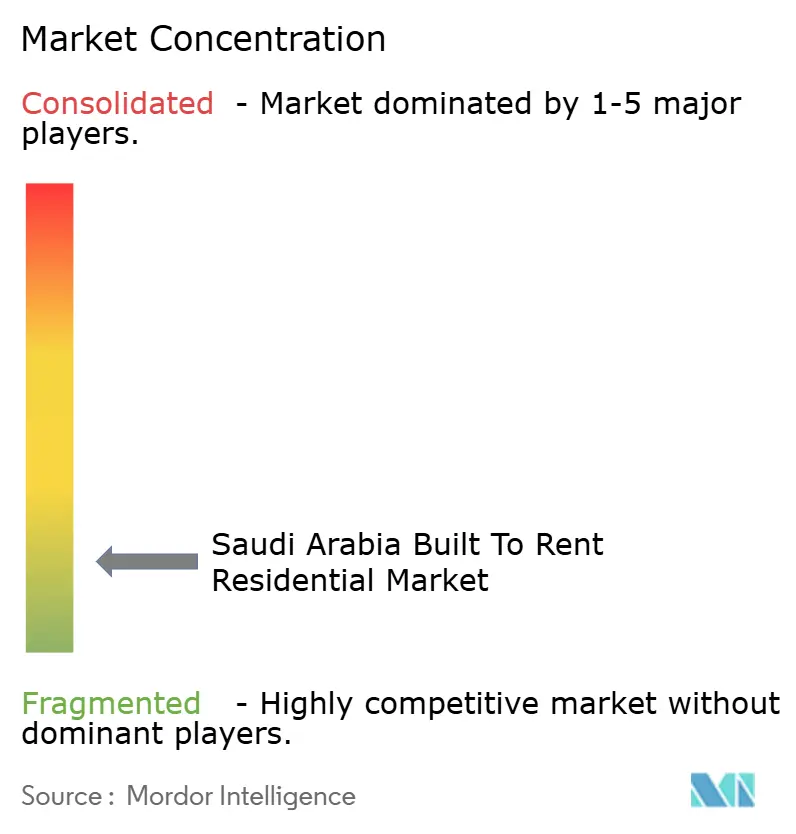
| Market Concentration | Low |
Major Players *Disclaimer: Major Players sorted in no particular order Image © Mordor Intelligence. Reuse requires attribution under CC BY 4.0. | |
Saudi Arabia Built To Rent Residential Market Analysis by Mordor Intelligence
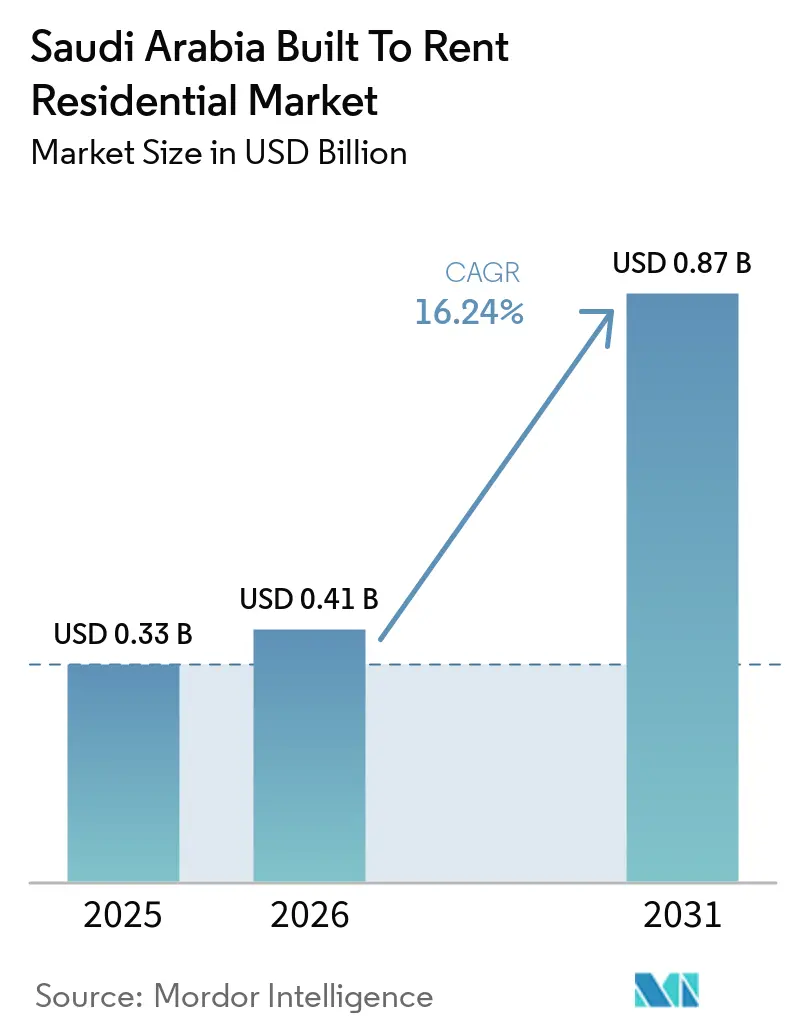
The Saudi Arabia Built To Rent Residential Market size was valued at USD 0.33 billion in 2025 and is estimated to grow from USD 0.41 billion in 2026 to reach USD 0.87 billion by 2031, at a CAGR of 16.24% during the forecast period (2026-2031).
Population growth, expatriate arrivals, and employer relocations are expanding the tenant base for professionally managed rental homes. The government’s Vision 2030 housing and urban development agenda is also widening the setting for organized rental supply. The five-year rent freeze in Riyadh improves cost certainty for tenants but constrains revenue assumptions for new projects in the capital. This setting favors operators that can offer clear lease terms, reliable maintenance, and digital compliance. It also makes Jeddah and secondary cities more relevant to developers seeking growth outside Riyadh.
Key Report Takeaways
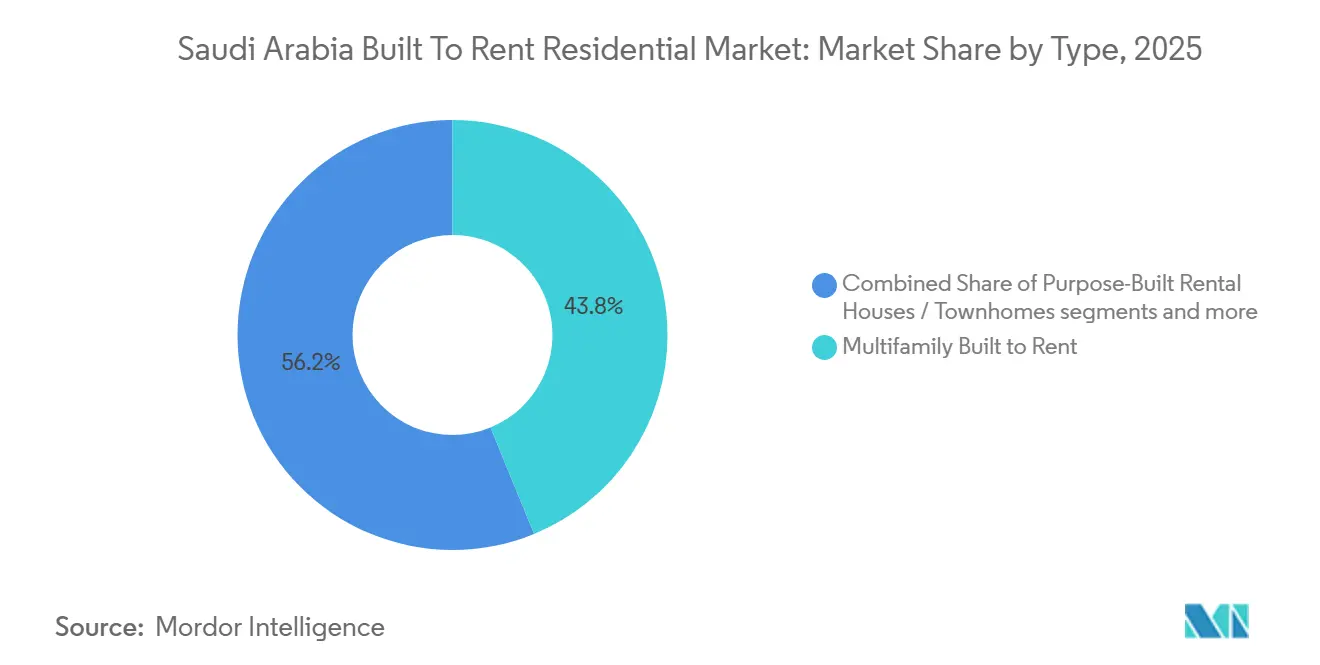
- By type, multifamily built to rent held 43.8% of the Saudi Arabia built to rent residential market share in 2025, while single-family built to rent / built to rent communities are forecast to grow at a CAGR of 18.1% through 2031.
- By management model, third-party operators held 52.4% of the Saudi Arabia built to rent residential market share in 2025, while hybrid management is forecast to grow at a CAGR of 17.6% through 2031.
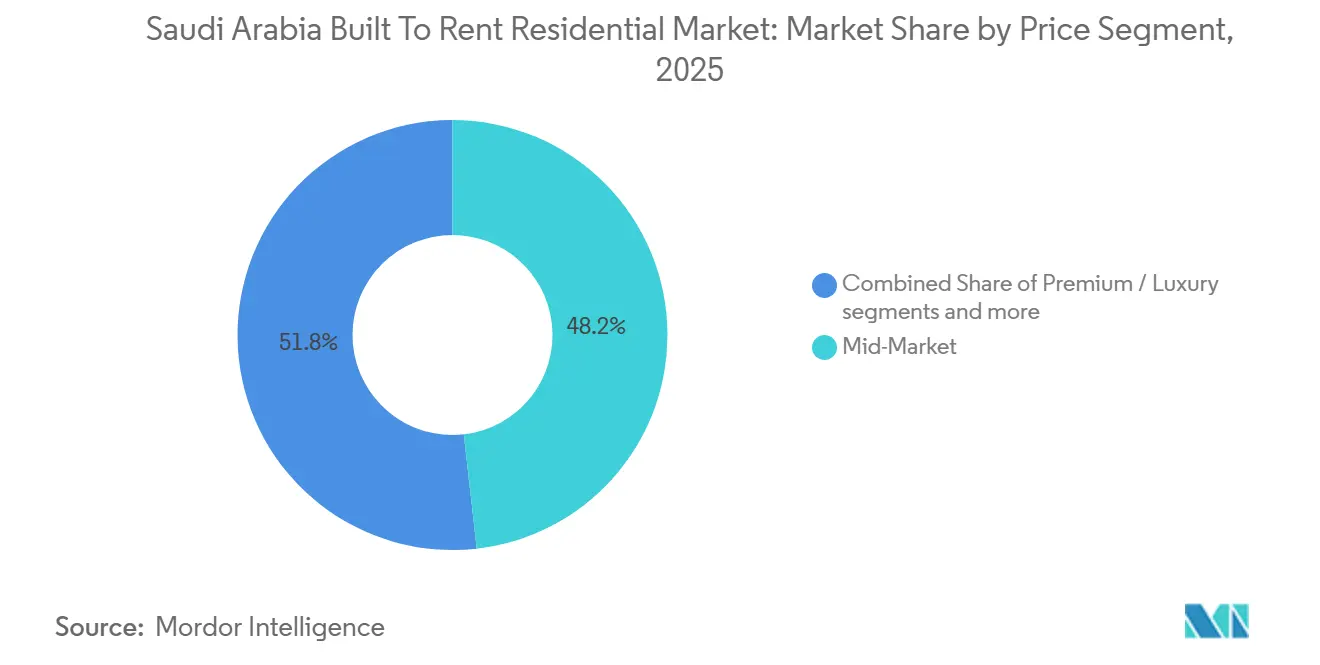
- By price segment, mid-market properties held 48.2% of the Saudi Arabia built to rent residential market size in 2025, while affordable & workforce housing are forecast to grow at a CAGR of 18.0% through 2031.
- By region, Riyadh held 40.5% of the Saudi Arabia built to rent residential market size in 2025, while the rest of Saudi Arabia is forecast to grow at a CAGR of 18.5% through 2031.
Note: Market size and forecast figures in this report are generated using Mordor Intelligence’s proprietary estimation framework, updated with the latest available data and insights as of January 2026.
Saudi Arabia Built To Rent Residential Market Trends and Insights
Drivers Impact Analysis*
| Drivers | (~) % Impact on CAGR Forecast | Geographic Relevance | Impact Timeline |
|---|---|---|---|
| Population Growth and Expatriate Inflows Increase Rental Demand | +4.2% | Riyadh and Jeddah, supported by international inflows | Medium term (2-4 years) |
| Vision 2030 Housing and Urban Development Initiatives Drive BTR Growth | +3.5% | National, especially Riyadh, Jeddah, and the project corridors | Long term (≥ 4 years) |
| NHC Build-to-Rent Programs Institutionalize Rental Housing Supply | +3.0% | National, with a major Riyadh presence and an expanding portfolio elsewhere | Medium term (2-4 years) |
| Employment Relocation to Riyadh and Economic Hubs Expands Rental Demand | +2.5% | Riyadh, Jeddah, Dammam, and Al Khobar | Short term (≤ 2 years) |
| Preference for Amenity-Rich Managed Apartments Boosts BTR Adoption | +1.8% | Urban centers and young professional corridors | Short term (≤ 2 years) |
| Digital Rental Formalization Through Ejar Improves Market Efficiency | +1.2% | National, with strong relevance in Riyadh | Long term (≥ 4 years) |
| Source: Mordor Intelligence | |||
Population Growth and Expatriate Inflows Increase Rental Demand
Saudi Arabia’s growing population continues to support demand for formal rental housing. Expatriates represented 44.4% of the national population in 2025, which reinforced the importance of rental options in the main employment centers. Net expatriate arrivals reached 1.2 million between 2023 and 2024, with Riyadh receiving a large share of new residents. The Regional Headquarters program had attracted more than 700 international company headquarters by the end of 2025, exceeding its original 2030 target of 500 headquarters[1]Royal Commission for Riyadh City, “Saudi Program to Attract the Regional Headquarters of International Companies,” Royal Commission for Riyadh City, rcrc.gov.sa.. These relocations support recurring demand from employers that provide housing allowances to senior staff and professional employees. Saudi Arabia built to rent residential market can serve this group with managed buildings, standardized leases, and faster tenant onboarding than fragmented individual rentals.
Vision 2030 Housing and Urban Development Initiatives Drive BTR Growth
Vision 2030 is linking large urban projects with new housing requirements across the country. Construction activity in NEOM, Red Sea Global, Qiddiya, Diriyah, and New Murabba creates demand from workers, suppliers, and new residents through successive project phases. The Housing Program reported that homeownership reached 65.4% in 2025, moving toward the 70% target under Vision 2030[2]Saudi Vision 2030, “Housing Program,” Saudi Vision 2030, vision2030.gov.sa.. Rental demand remains relevant for people who are not ready to buy, including mobile workers, younger households, and expatriates. Ejar had registered more than 10 million rental contracts since launch, and it recorded an average of 19,000 contracts per day[3]Real Estate General Authority, “Ejar Registers Over 10 million Rental Contracts Since Launch,” Real Estate General Authority, rega.gov.sa.. Saudi Arabia has built a residential rental market, therefore benefiting from a cleaner operating environment for long-term rental assets.
NHC Build-to-Rent Programs Institutionalize Rental Housing Supply
National Housing Company, known as NHC, is helping establish a larger and more standardized residential supply base. NHC is committed to delivering 300,000 housing units by the end of 2025 and 600,000 units by 2030. Its scale gives it a role in setting product, pricing, and management expectations for the broader housing sector. Standardized lease processes and community management make professionally run rental projects more visible to both tenants and investors. NHC’s activity can also make the mid-market segment more accessible, where development benefits from coordinated planning and land availability. In the Saudi Arabia built to rent residential market, private operators must differentiate through location, tenant experience, or specialized rental formats rather than compete only on scale.
Employment Relocation to Riyadh and Economic Hubs Expands Rental Demand
Employment relocation is reshaping residential demand in Riyadh and other economic hubs. The Regional Headquarters program brings senior executives and operating teams that need different types of rental homes. Executive families often look for larger homes, security, and shared facilities, while the wider workforce needs managed mid-market homes near employment areas. In Riyadh, rents for family-sized two- and three-bedroom units rose 16.7% to USD 18,667 per year in the second quarter of 2025, while studio and one-bedroom apartment rents declined. This difference reflected the housing needs of relocating family households rather than only single-person expatriates. Saudi Arabia built to rent residential market has room for both apartment projects and planned communities, provided that developers match the unit mix with local employment patterns.
Restraints Impact Analysis*
| Restraints | (~) % Impact on CAGR Forecast | Geographic Relevance | Impact Timeline |
|---|---|---|---|
| Rental Affordability Pressure in Riyadh Limits Tenant Capacity | -0.6% | Riyadh, with emerging concerns in northern Jeddah | Short term (≤ 2 years) |
| Elevated Construction and Financing Costs Reduce Project Feasibility | -0.5% | National, most strongly in Riyadh and Jeddah | Medium term (2-4 years) |
| Limited Institutional Operating and Asset Management Depth Restricts Market Growth | -0.2% | National, with larger gaps in secondary cities | Long term (≥ 4 years) |
| Concentration of Demand and Supply in Riyadh Increases Market Exposure | -0.1% | Riyadh | Medium term (2-4 years) |
| Source: Mordor Intelligence | |||
Rental Affordability Pressure in Riyadh Limits Tenant Capacity
Rental affordability is a major constraint on absorption in Riyadh. Apartment rents in the city rose 82% between 2019 and 2025, while Gross Domestic Product (GDP) per capita declined from USD 38,500 in 2022 to USD 35,000 in 2024. Median expatriate monthly income was USD 975, and average apartment rent used more than 50% of non-Saudi household income. The five-year Riyadh rent freeze introduced in September 2025 limits further rent increases under covered contracts and strengthens tenant cost certainty. However, the policy limits the revenue growth expected by owners of newly committed projects in the capital. Saudi Arabia built to rent residential market may therefore see greater interest in lower-cost formats and in cities where rental pricing is not subject to the same restrictions.
Elevated Construction and Financing Costs Reduce Project Feasibility
High construction and financing costs continue to challenge project feasibility. The General Authority for Statistics reported that construction costs increased 2.3% year over year in July 2026, while residential equipment and machinery rental charges rose 4.2%. Land costs remain an important source of housing cost pressure, particularly where planning controls restrict available sites. A peer-reviewed study found that land prices and land-use rules reduce the ability of housing supply to respond quickly to demand in Saudi Arabia. Government-backed land access gives NHC and ROSHN Group a structural advantage in projects that target price-sensitive tenants. Private developers in Saudi Arabia built to rent the residential market need disciplined site selection and product design to protect returns.
*Our forecasts treat driver/restraint impacts as directional, not additive. The impact forecasts reflect baseline growth, mix effects, and variable interactions.
Segment Analysis
By Type: Multifamily Built to Rent Leads Market Share, While Single-Family Built to Rent / Built to Rent Communities Grow Faster
Multifamily built to rent accounted for 43.8% of the Saudi Arabia built to rent residential market share in 2025. This format benefits from apartment-led housing preferences in Riyadh, Jeddah, Dammam, and Al Khobar. Apartments can provide higher density in urban areas where employment, transport, and daily services are concentrated. They also offer a practical option for younger Saudi nationals and newly arrived expatriate professionals. A 2025 review of living conditions in Saudi cities noted that apartments remained the preferred property type in major urban locations. Saudi Arabia built to rent residential market is therefore likely to retain multifamily projects as its main source of unit volume.
Single-family built to rent / built to rent communities are forecast to grow at a CAGR of 18.1% through 2031. These developments address demand from relocating executive families and Saudi households looking for more space and shared facilities. ROSHN Group’s SEDRA and WAREFA communities show how integrated communities can combine homes with lifestyle infrastructure. In SEDRA, selected villa plots range from 400 to 650 square meters, which supports larger household requirements. Research on Riyadh multifamily preferences found that construction quality, security, room count, and location were valued highly. Developers can apply these preferences across apartment buildings, townhomes, and managed communities as the Saudi Arabia built to rent residential market expands.



By Management Model: Third-Party Operators Lead, While Hybrid Management Gains Ground
Third-party operators accounted for 52.4% of the 2025 market. Developers use these operators for lease administration, tenant support, and facility management when they do not yet have extensive in-house operating teams. This approach can reduce the time needed to establish a rental platform. More than 1.5 million rental contracts have been documented through Ejar since the beginning of 2024, supporting the use of formal and auditable management processes. Third-party firms can apply standardized tenancy practices across multiple properties.
Hybrid management is forecast to grow at a CAGR of 17.6% through 2031. Under this model, owners retain key governance and brand decisions while outsourcing day-to-day work to specialist operators. NHC and ROSHN Group can use hybrid arrangements to maintain service standards without building every operating function internally. Ejar also supports more consistent documentation through unified rental contracts and digital processes. In-house management may become more viable as portfolios gain scale and recurring operating data improves. The shift toward hybrid structures shows how Saudi Arabia built to rent residential market is moving from basic outsourcing toward more controlled operating models.
By Price Segment: Mid-Market Homes Form the Core, While Affordable & Workforce Housing Grows Faster
Mid-market properties accounted for 48.2% of the 2025 market. This segment serves dual-income Saudi households and mid- to senior-level expatriate professionals who form a substantial tenant base in Riyadh and Jeddah. Its demand rests on a balance between household budgets, location, and the quality of managed services. Mid-market projects also fit the supply plans of developers that can use standard unit designs and shared facilities. NHC’s large delivery commitments make it an important reference point for broad-based residential supply. Saudi Arabia built to rent residential market should continue to depend on the mid-market segment for a large share of occupied units.
The affordable & workforce housing segment is forecast to grow at a CAGR of 18% through 2031. The Sakani program lowered its eligibility age from 25 to 20 years in May 2025, which widened access to housing support among younger Saudi adults. This group may spend time in rental housing before purchasing a home. Premium and luxury built to rent remains smaller but has drawn early interest from branded and serviced residential operators. The Ascott Limited plans to open Ascott Villas Riyadh, an 86-villa serviced community in the Hittin district, in the fourth quarter of 2026. The company also signed an agreement to introduce The Crest Collection in Riyadh’s An Nakheel district, with opening planned for January 2028. These formats target tenants who value brand standards, hospitality-style services, and larger homes. Their performance will depend on corporate relocation, tourism-linked stays, and the depth of premium household demand. Saudi Arabia built to rent residential market can accommodate these projects, although they will not replace the larger mid-market and workforce housing needs.
Geography Analysis
Riyadh held 40.5% of the 2025 Saudi Arabia built to rent residential market. Its position reflects the concentration of employers, corporate relocations, and public housing activity in the capital. The city had 1.93 million residential units in 2025, with 63,000 more units expected in the 2026 to 2027 pipeline. More than 700 international companies had established regional headquarters in Riyadh by the end of 2025. This supports demand from senior staff, professional employees, and their families. The rent freeze moderates the ability to raise rents, but it also makes household costs more predictable under covered contracts.
Jeddah presents a different investment setting because it had no rental price freeze in 2026. Apartment rents rose 4.7% year over year in 2025, and the city had a pipeline of 40,000 units for 2026 and 2027. The city can attract developers who want clearer rental pricing conditions. Makkah adds another demand pattern through its resident base and pilgrimage-related accommodation needs. Its residential stock reached 428,000 units by the second quarter of 2025 and is projected to approach 462,000 units by 2028. These city-level conditions give the Saudi Arabia built to rent residential market several paths beyond the capital.
The rest of Saudi Arabia is the fastest-growing segment and is forecast to expand at a CAGR of 18.5% through 2031. Dammam, Al Khobar, Madinah, and project corridors can gain from workforce movements related to new development activity. NHC also launched Lazurde Destination in Al Khobar in June 2025, with 8,100 homes for Saudi Aramco employees and Eastern Province residents. Secondary cities can offer less expensive land and a closer fit with local workforce needs. Their operating challenge is a shallower base of institutional property and asset management capability. As more rental contracts move through Ejar, standardized documentation can help improve transparency across these locations.
Competitive Landscape
The Saudi Arabia built to rent residential market is fragmented, with government-backed entities and large developers holding meaningful advantages in land access, development scale, and housing delivery, while private and specialized players compete across geographic gaps, tenant segments, and differentiated service offerings. NHC and ROSHN Group benefit from their scale, land access, and role in national housing delivery. NHC’s stated target is 600,000 units by 2030. These organizations influence supply, quality, and pricing expectations across the market, but the presence of private developers, specialized operators, and international participants creates a diverse competitive environment. This fragmentation allows smaller and specialized developers to compete through geographic focus, targeted tenant groups, and differentiated service levels rather than scale alone.
ROSHN Group has used planned communities to address mid-market demand in several cities. Its SEDRA offering includes larger villas and an expanding apartment program, supporting a broader residential mix. In March 2026, ROSHN Group signed a USD 173 million agreement with Miskan Real Estate Development Company for residential units within the WAREFA community in East Riyadh. NHC also launched 11 residential projects in Riyadh’s Khuzam district in May 2026 as part of its multi-segment housing activity. These moves show that leading developers are expanding both product range and project partnerships, while contributing to a competitive environment in which project scale and delivery capability remain important differentiators.
Private and international participants are targeting narrower opportunities. Dedicated Housing Company was launched in October 2025 with an initial USD 533 million fund and a target of 10,000 purpose-built co-living units for professionals and students. The Ascott Limited is preparing an 86-villa serviced community in Riyadh for the fourth quarter of 2026, adding a premium managed format. SEDCO Capital Real Estate Investment Trust completed a USD 137 million sale and purchase agreement for the Atelier Lavie property in Jeddah in 2025, with an 8-year binding lease. Digital lease administration through Ejar creates further pressure for formal operating standards. The fragmented nature of the Saudi Arabia built to rent residential market allows participants to pursue opportunities across different locations, tenant segments, housing formats, and service models, with compliance, appropriate pricing, and tenant-focused offerings serving as key competitive considerations.
Saudi Arabia Built To Rent Residential Industry Leaders
National Housing Company
ROSHN Group
RAFAL Real Estate Development Company
Saudi Real Estate Company (Al Akaria)
Ewaan Global Residential Company
- *Disclaimer: Major Players sorted in no particular order

Recent Industry Developments
- May 2026: National Housing Company launched 11 residential projects in Riyadh’s Khuzam district. The projects ranged from luxury villas to mid-market townhouses and formed part of its USD 19 billion planned housing investment for 2026. The launches reflected a wider move from an affordable housing focus toward a multi-segment supply model.
- March 2026: ROSHN Group signed a USD 173 million strategic agreement with Miskan Real Estate Development Company to develop residential units within the WAREFA community in East Riyadh. The agreement covered more than 68,000 square meters of land and extended ROSHN’s use of strategic development partnerships.
- March 2026: Grova Developments, Tilal Real Estate, and NHC launched Noor Khuzam in North Riyadh. The fully integrated residential community included 3,018 units and had a value of USD 879 million. The project was launched at the RESTATEX Riyadh Real Estate Exhibition 2026.


Saudi Arabia Built To Rent Residential Market Report Scope
| Multifamily Built to Rent |
| Single-Family Built to Rent / Built to Rent Communities |
| Purpose-Built Rental Apartments |
| Purpose-Built Rental Houses / Townhomes |
| In-house Operator |
| Third-party Operator |
| Hybrid Management |
| Premium / Luxury |
| Mid-Market |
| Affordable & Workforce Housing |
| Riyadh |
| Jeddah |
| Makkah |
| Rest of Saudi Arabia |
| By Type | Multifamily Built to Rent |
| Single-Family Built to Rent / Built to Rent Communities | |
| Purpose-Built Rental Apartments | |
| Purpose-Built Rental Houses / Townhomes | |
| By Management Model | In-house Operator |
| Third-party Operator | |
| Hybrid Management | |
| By Price Segment | Premium / Luxury |
| Mid-Market | |
| Affordable & Workforce Housing | |
| By Region | Riyadh |
| Jeddah | |
| Makkah | |
| Rest of Saudi Arabia |


Key Questions Answered in the Report
What is the projected value of Saudi Arabia’s build to rent residential sector by 2031?
The sector is forecast to reach USD 0.87 billion by 2031, growing at a 16.24% CAGR from 2026.
Which build to rent property type has the largest share in Saudi Arabia?
Multifamily built to rent led in 2025 with a 43.8% share, supported by apartment demand in major urban areas.
Which rental format is growing fastest in Saudi Arabia?
Single-family built to rent and built to rent communities are forecast to grow at a CAGR of 18.1% through 2031.
Why is Riyadh important for rental housing developers?
Riyadh held 40.5% of the 2025 market and has a large residential base, corporate relocations, and a substantial future housing pipeline.
How does Ejar affect professional rental housing?
Ejar formalizes tenancy through standardized contracts and digital documentation. It has registered more than 10 million rental contracts since launch.
What is the main challenge facing new rental projects in Riyadh?
Developers face affordability pressure, the five-year rent freeze, and higher construction and financing costs.
Page last updated on:


 Your data is secure and never sold or shared.


