
SaaS Data Protection Market Size and Share
Market Overview
| Study Period | 2020 - 2031 |
|---|---|
| Market Size (2026) | USD 3.42 Billion |
| Market Size (2031) | USD 7.54 Billion |
| Growth Rate (2026 - 2031) | 17.13 % |
| Fastest Growing Market | Asia-Pacific |
| Largest Market | North America |
| Market Concentration | Medium |
Major Players *Disclaimer: Major Players sorted in no particular order Image © Mordor Intelligence. Reuse requires attribution under CC BY 4.0. | |
SaaS Data Protection Market Analysis by Mordor Intelligence
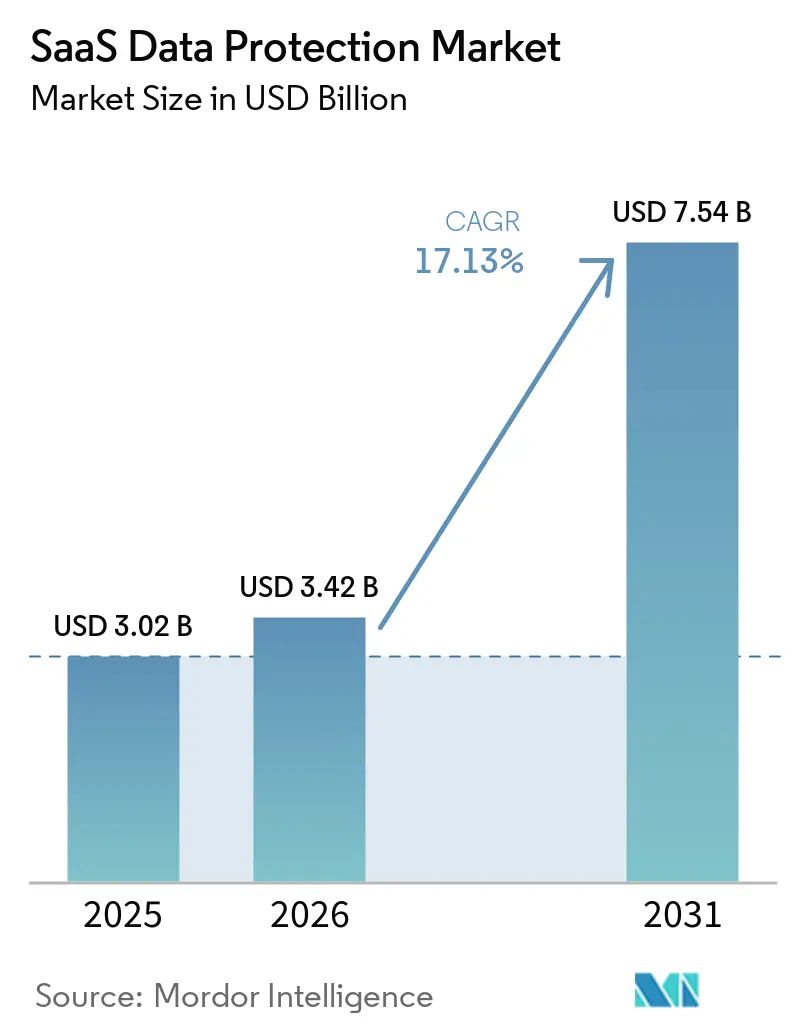
The SaaS data protection market size is projected to expand from USD 3.02 billion in 2025 to USD 3.42 billion in 2026, and to USD 7.54 billion by 2031, registering a CAGR of 17.13% between 2026 and 2031. The adoption of cloud software for core business operations has increased the volume of information organizations must protect. Data loss, ransomware, and accidental deletion have kept recovery capabilities central to technology planning, especially where employees rely on cloud applications to manage communication, customer activity, records, and the day-to-day processes that keep business functions available. Buyers are increasingly looking for tested recovery, data isolation, and support for multiple cloud applications, rather than relying solely on the assumption that a standard application service will meet all retention, restoration, governance, and operational continuity requirements. Providers are expanding application coverage and partnering to reach small and medium-sized businesses, which can help customers obtain backup capabilities through existing technology relationships and select a service model that fits their available skills and operating resources. Data residency rules also favor platforms that can meet local storage and governance requirements, as organizations assess where copies are maintained, how access is governed, and whether recovery arrangements can support local regulatory responsibilities.
Key Report Takeaways
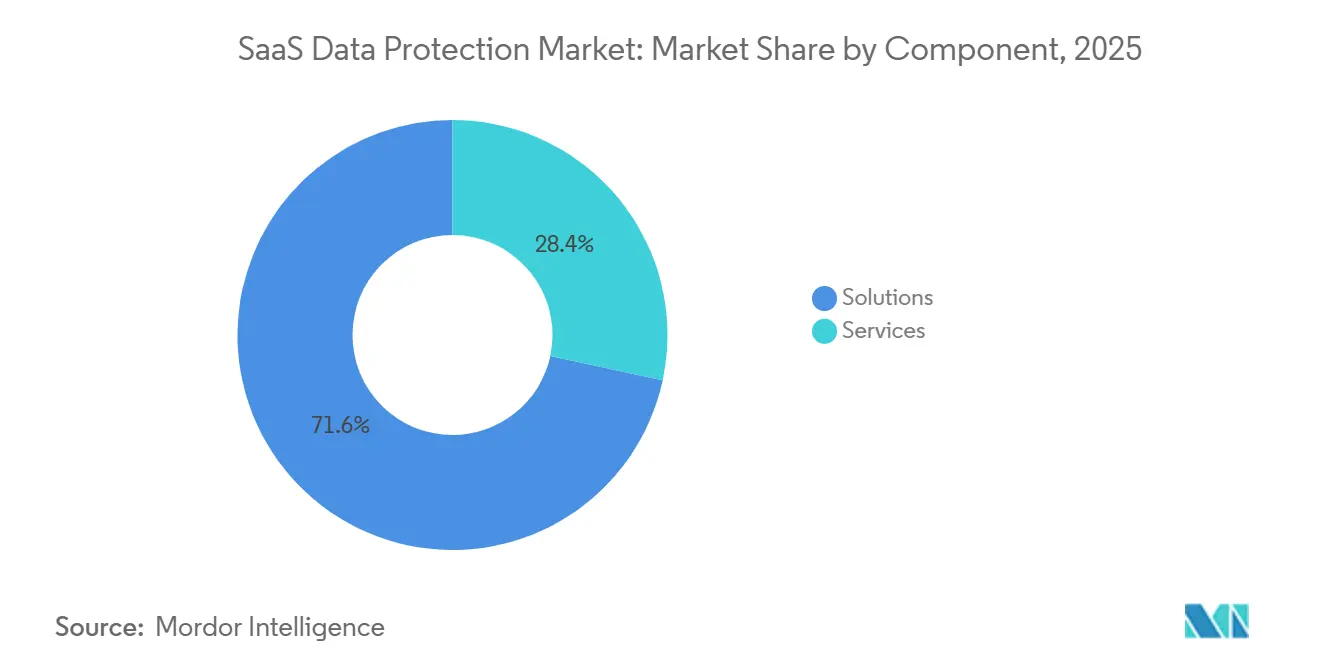
- By component, solutions held 71.63% of the SaaS data protection market share in 2025, while services are projected to expand at a 23.58% CAGR through 2031.
- By protected workload, Microsoft 365 held 34.78% of revenue in 2025, while Salesforce is projected to expand at a 24.63% CAGR through 2031.
- By deployment model, public cloud held 56.83% of the SaaS data protection market revenue in 2025, while hybrid cloud is projected to expand at a 21.66% CAGR through 2031.
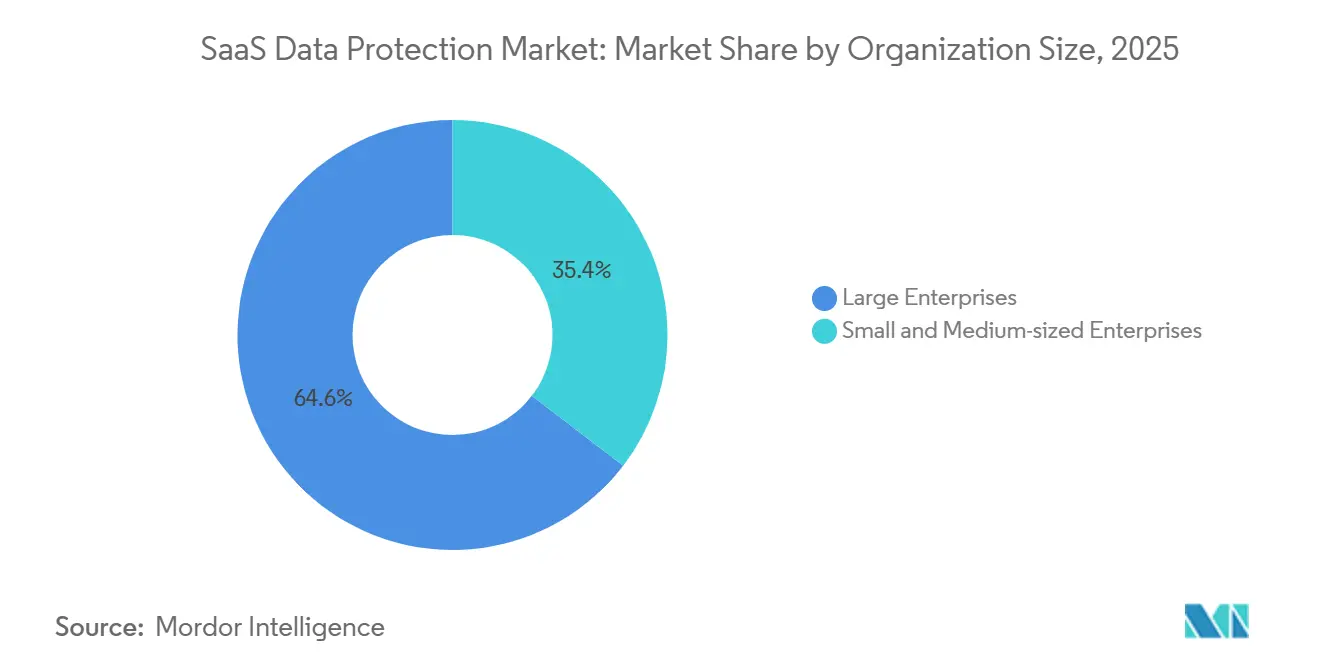
- By organization size, large enterprises held 64.59% of revenue in 2025, while small and medium-sized enterprises are projected to expand at a 24.81% CAGR through 2031.
- By industry vertical, BFSI held 27.82% of revenue in 2025, while the healthcare and life sciences industry is projected to expand at a 22.96% CAGR through 2031.
- By geography, North America accounted for 36.43% of revenue in 2025, while Asia-Pacific is projected to expand at a 24.71% CAGR through 2031 in the SaaS data protection market.
Note: Market size and forecast figures in this report are generated using Mordor Intelligence’s proprietary estimation framework, updated with the latest available data and insights as of January 2026.
Global SaaS Data Protection Market Trends and Insights
Drivers Impact Analysis*
| DRIVER | (~) % IMPACT ON CAGR FORECAST | GEOGRAPHIC RELEVANCE | IMPACT TIMELINE |
|---|---|---|---|
| Ransomware and Accidental Deletion Exposure | +4.8% | Global, highest intensity in North America and Europe | Short term (≤ 2 years) |
| Accelerating SaaS Adoption for Business-Critical Workloads | +3.6% | Global, with acceleration in Asia-Pacific and South America | Medium term (2-4 years) |
| Regulatory and Data-Sovereignty Requirements | +2.8% | European Union core, spillover to Asia-Pacific and Middle East | Medium term (2-4 years) |
| Demand for Automated Recovery and Business Continuity | +2.1% | Global, led by BFSI and healthcare verticals | Short term (≤ 2 years) |
| Application Programming Interface Dependency Mapping | +1.3% | Global, concentrated in large enterprise deployments | Long term (≥ 4 years) |
| Recovery Validation for Artificial Intelligence Workloads | +1.0% | North America and Europe core, early gains in Asia-Pacific | Long term (≥ 4 years) |
| Source: Mordor Intelligence | |||
Ransomware and Accidental Deletion Exposure
Ransomware creates demand because attackers often target backup repositories before production systems. An organization with a clean recoverable copy has less reason to pay a ransom. IBM recorded 109 active ransomware and extortion groups in 2025, up from 73 in 2024.[1]IBM, “IBM X-Force Threat Intelligence Index 2025,” IBM, ibm.com This setting makes isolated backup copies more important for the SaaS data protection market, because a protected copy must remain usable when production systems, user accounts, or the primary administrative environment have been compromised during an attack. Spanning reported that 87% of information technology and security professionals experienced SaaS data loss during the prior 12 months. Its report also identified malicious deletion in more than 50% of reported incidents, which supports the demand for automated recovery services.
Accelerating SaaS Adoption for Business-Critical Workloads
Business-critical work is moving into cloud applications faster than many organizations are expanding their protection policies. More than 50% of workloads and applications operated in public cloud environments in 2025, according to Spanning.[2]Backupify, “The State of SaaS Backup and Recovery 2025,” Backupify, backupify.com The SaaS data protection market, therefore, needs broader connectors for productivity, CRM, identity, and developer tools. Keepit has stated that it plans to support hundreds of SaaS applications by 2028. AvePoint added protection sources for ServiceNow, AWS S3, Azure Kubernetes, and Entra External ID in 2026. Lower protection coverage for Salesforce, Jira Cloud, and Confluence Cloud leaves vendors room to extend established Microsoft 365 relationships into other applications, using familiar policy controls and partner relationships to address workloads that buyers may not yet have placed under a formal backup program.
Regulatory and Data-Sovereignty Requirements
Regulatory requirements have become a direct factor in purchasing backup platforms. The Digital Operational Resilience Act applies to financial entities and certain ICT third-party providers in the European Union as of January 17, 2025. Article 12 requires backup copies to be segregated from production systems and tested regularly. These conditions favor the SaaS data protection market, where providers can demonstrate isolation, recovery procedures, and documented controls for regulated customers. The requirements also make data location and subcontractor arrangements relevant during procurement, requiring buyers to review storage location, access procedures, testing responsibilities, retention practices, and the service provider’s ability to support documented recovery objectives. India’s Digital Personal Data Protection Act and sector-specific financial rules encourage local storage preferences for sensitive information.
Demand for Automated Recovery and Business Continuity
Buyers are placing more emphasis on recovery outcomes than on the existence of a backup copy. Veeam reported in April 2026 that nearly 3 in 10 organizations had experienced a cyber incident causing data loss or downtime. Rubrik reported that 88% of business leaders were concerned about meeting recovery time objectives as agentic threats increase. The SaaS data protection market is responding by introducing automated testing and orchestration features. DORA and SOC 2 Type II reviews also raise the value of evidence that recovery processes have been tested. This demand supports managed services that can run validation and provide documented results, as organizations may need external support to schedule tests, review recovery outcomes, address gaps in policy design, and demonstrate that their resilience procedures work under practical operating conditions.
Restraints Impact Analysis*
| RESTRAINT | (~) % IMPACT ON CAGR FORECAST | GEOGRAPHIC RELEVANCE | IMPACT TIMELINE |
|---|---|---|---|
| Data Control and Privacy Concerns in Third-Party Clouds | -1.5% | European Union core, spillover to Asia-Pacific and Middle East | Medium term (2-4 years) |
| Vendor Lock-In and Proprietary Backup Formats | -1.1% | Global, particularly large enterprise deployments | Long term (≥ 4 years) |
| SaaS Application Programming Interface Rate Limits | -0.9% | Global | Long term (≥ 4 years) |
| Incomplete Recovery of Configuration, Metadata, and Relationships | -0.7% | Global, concentrated in complex enterprise environments | Medium term (2-4 years) |
| Source: Mordor Intelligence | |||
Data Control and Privacy Concerns in Third-Party Clouds
Organizations protecting sensitive SaaS information remain concerned about data location, access, and legal jurisdiction. GDPR data-processor accountability can increase scrutiny when a backup provider uses additional processors. This concern can lengthen buying cycles in financial services and healthcare, where decision-makers may involve security, legal, compliance, technology, procurement, and business continuity teams before approving the transfer of protected data to a third-party service. It also increases the importance of storage design, contractual controls, and clear recovery processes in the SaaS data protection market. Providers that maintain direct control of their storage architecture can address some buyer concerns, especially when they can explain the location of protected copies, identify access roles, limit additional processing parties, and align their service terms with the customer’s internal privacy requirements. The issue may reduce adoption by cautious organizations while directing demand toward sovereignty-focused offerings.
Vendor Lock-In and Proprietary Backup Formats
Closed backup formats can make it difficult to change providers without risking data integrity or losing historical records. Large enterprises may face complex migrations when they move from legacy platforms to SaaS-native services. Long retention periods under financial, healthcare, and recordkeeping rules can increase this difficulty. The SaaS data protection market also faces this issue, where a provider’s own data vault limits portability. Professional services costs and testing requirements can delay a decision to replace an existing platform, since the transition may require teams to review retention obligations, migrate historical records, test recovery paths, train users, and confirm that critical application data remains intact. Buyers will continue to assess export capability and recovery compatibility when selecting a provider, since they need confidence that historical records remain accessible, recoverable, and manageable if technology needs regulatory obligations, application portfolios, or supplier relationships change over time.
*Our forecasts treat driver/restraint impacts as directional, not additive. The impact forecasts reflect baseline growth, mix effects, and variable interactions.
Segment Analysis
By Component: Services Gain Ground Through Managed Backup Models
Solutions accounted for 71.63% of the SaaS data protection market share in 2025. This position reflected software-led deployments managed internally by information technology teams. Within the SaaS data protection market, the segment includes platforms for configuring backups, retaining copies, and coordinating restoration activities across common cloud applications. Solutions remain relevant for large organizations that want direct control over policy design, day-to-day operations, application priorities, retention rules, access permissions, and the timing of recovery activities across their internal technology environments. Cloud-delivered products also reduce the infrastructure burden associated with older backup environments, as teams can use provider-managed capacity while retaining policies aligned with their application estate and documented recovery requirements. The SaaS backup and recovery industry continues to rely on these products as the base layer for protection across applications. DORA and SOC 2 Type II requirements increase the need for documented recovery procedures. Those requirements also encourage buyers to consider how solutions support repeatable testing, clear evidence collection, access control, retention management, and records that can be reviewed during an audit or an internal resilience assessment. The largest providers are adding automation and broader workload support to retain their positions.
Services are projected to record a 23.58% CAGR from 2026 to 2031. Growth reflects the wider adoption of Backup as a Service, managed backup, and externally operated recovery functions, which can provide customers with a defined operating model when their own teams cannot continuously manage alerts, policies, tests, and restoration workflows. Veeam launched Data Cloud for Managed Service Providers in October 2025 to extend SaaS data resilience to partner-served accounts.[3]Veeam, “New Veeam Data Cloud for Managed Service Providers,” Veeam, veeam.com Managed service providers are also becoming a wider route to SaaS data protection for small and mid-market customers. AvePoint reported Q2 2026 revenue of USD 124.5 million, up 22% year over year, supported by its partner and managed service approach. Services can help smaller buyers that lack recovery expertise and regulated organizations that need ongoing validation, since providers can apply standard policies, monitor the protected environment, assist with tests, and document activities for customers over the subscription period. Solutions are expected to retain the majority of revenue, but service adoption is likely to outpace them. The shift reflects demand for recurring support rather than a one-time software installation.


By Protected Workload: Salesforce Coverage Creates a Growth Opportunity
Microsoft 365 held 34.78% of protected-workload revenue in 2025. Its lead reflected broad enterprise use of email, collaboration, and productivity applications. Spanning estimated that 70% of Microsoft 365 users had a backup strategy in place in 2025. Even so, malicious deletion remained a leading cause of SaaS data loss. Microsoft 365 protection is therefore an established entry point in the SaaS data protection market because it addresses widely used email, files, collaboration records, and user content that organizations must be able to restore after an application-level incident. Google Workspace represents another core workload for vendors seeking broad collaboration coverage. Other SaaS applications include identity platforms, developer tools, and human resources systems, which can hold user credentials, source materials, administrative settings, project records, and operational information that teams need to maintain normal business activity. Jira Cloud and Confluence Cloud had lower backup coverage, indicating continued scope for workload expansion. Vendors are using a breadth of connectors to compete for accounts with diverse application portfolios.
Salesforce is projected to grow at 24.63% CAGR from 2026 to 2031. An Arcserve survey reported 20.5% backup adoption for Salesforce, compared with 63.1% for Microsoft 365. The difference matters because Salesforce may contain revenue pipelines, customer contracts, service records, account information, sales activity, and related configuration data that are important to commercial operations and customer support functions. Salesforce completed its acquisition of Own Company in late 2024 for USD 1.9 billion.[4]Salesforce, “Salesforce Completes Acquisition of Own Company,” Salesforce, salesforce.com The transaction added native Backup and Recover capabilities to its platform. Independent protection may still be needed by regulated organizations operating multiple production environments, particularly where internal policy requires a separate recovery copy and teams need to restore information outside the original application environment. These buyers can require recovery across metadata, configuration, and relationships. The SaaS data protection market can therefore address a coverage gap that remains outside the most mature productivity workloads. Vendors that already protect Microsoft 365 can use this gap to extend their customer relationships.
By Deployment Model: Hybrid Cloud Supports Regulated Requirements
The public cloud accounted for 56.83% of the SaaS data protection market in 2025. The segment benefited from cloud-native architectures, object storage, and the ability to scale without dedicated on-site infrastructure, allowing providers to support growing data volumes without requiring each customer to purchase, maintain, and refresh physical storage equipment. The public cloud can also reduce management workload for mid-market deployments. Many providers use cloud infrastructure to offer a straightforward backup destination for common SaaS workloads, combining routine backup schedules, centralized policy management, retention settings, and recovery options that can be accessed without the need to build a separate local environment. Platform-native services can further limit the need to operate traditional hybrid environments. These advantages make public cloud the default choice for many organizations. Private cloud remains the smallest deployment segment. It is used where legal or policy requirements restrict the use of public cloud storage. The SaaS backup and recovery industry must still offer choices for buyers with stricter location and control needs.
Hybrid cloud is projected to expand at 21.66% CAGR from 2026 to 2031. Growth is linked to rules that require separation between backup copies and production systems. DORA requires backup data to be stored at geographically separate locations and logically isolated from primary ICT systems. These requirements can support hybrid or isolated cloud designs for financial institutions seeking evidence of compliance. Hybrid environments can combine local control with offsite protection and recovery capabilities, helping organizations separate sensitive systems while retaining an alternate location for protected copies and a practical path for restoration after a disruptive event. Huawei Cloud updated its Cloud Backup and Recovery service in March 2026 with WORM-based backup locking. This feature targets Asia-Pacific organizations that need local redundancy and immutable copies. The approach supports buyers who want recovery controls without placing every workload in a single environment. It also shows why deployment decisions are increasingly tied to regulation and operational resilience.
By Organization Size: Small and Medium-Sized Enterprises Drive Adoption
Large enterprises held 64.59% of revenue in 2025. Their lead came from complex environments that require protection across productivity, CRM, identity, and developer applications, often with many user groups, business units, permissions, policies, and data types, all of which must be managed within a consistent recovery plan. These organizations often purchase integrated cyber-resilience platforms and related professional services. Rubrik reported fiscal year 2026 subscription annual recurring revenue of USD 1.46 billion, up 34% year over year. This performance reflected continued enterprise spending on integrated data resilience capabilities. Large accounts can also generate revenue for providers from managed security and professional services, as deployment, testing, policy design, application onboarding, governance reviews, and recovery preparation may require work beyond the core subscription service. The SaaS data protection market remains dependent on these accounts for substantial contract values. Their requirements favor broad application coverage, governance, and recovery assurance. Their purchasing processes also give established vendors an advantage in complex deployments.
Small and medium-sized enterprises are projected to expand at a 24.81% CAGR from 2026 to 2031. Subscription pricing and preconfigured policies reduce the expertise and capital barriers that once limited adoption, allowing smaller teams to use standard protection settings without buying extensive infrastructure or assigning dedicated staff to each stage of backup administration. A smaller organization may struggle to absorb weeks of disruption after losing a CRM or financial system. This risk makes fast and dependable recovery valuable even for buyers with limited internal technology staff, as an extended outage can affect customer communication, billing, sales administration, accounting activities, employee coordination, and access to the operational information needed each day. AvePoint said its Elements platform recorded mid-market signups at a record pace in Q2 2026. The SaaS data protection market is reaching these customers through simplified products and managed service providers. Preconfigured policies can reduce the work needed to begin protecting common workloads. Providers also benefit from recurring subscription revenue as smaller customers adopt protection across more applications, because an account can begin with core productivity systems and later add CRM, identity, developer, administrative, and other cloud services as operational needs develop. This segment is moving beyond a narrow focus on the largest corporate accounts and toward wider adoption among resource-constrained buyers.
By Industry Vertical: BFSI Holds Revenue While Healthcare Expands Faster
BFSI accounted for 27.82% of the SaaS data protection market size in 2025. Banks, insurers, investment firms, and payment institutions face regulations that make backup and recovery a compliance requirement, since failure to restore information can affect customer service, transaction processing, reporting, operational continuity, and an organization’s ability to demonstrate control over critical systems. DORA applies directly to many financial entities in the European Union. The regulation requires documented backup policies and tested recovery procedures. Payment Card Industry Data Security Standard requirements reinforce the need to protect cardholder data environments, including supporting information, access controls, and recovery practices that organizations use to maintain the availability and integrity of systems that handle payment-related records. The cost-of-service interruption also supports continued spending on data protection. BFSI buyers commonly require clear retention, isolation, and audit capabilities. These requirements create a steady demand base for the SaaS data protection market. Vendors serving this vertical must demonstrate both technical recovery capability and governance controls.
Healthcare and life sciences are projected to grow at a 22.96% CAGR from 2026 to 2031. Growth is linked to HIPAA obligations, wider use of electronic health records, and concern over ransomware. These organizations need reliable recovery for information that supports care delivery and operations, including digital records, administrative processes, collaboration tools, and cloud applications that staff use to coordinate services and maintain continuity across dispersed teams. Backup capabilities can help reduce disruption when cloud applications or their data become unavailable. Government and public administration, retail and e-commerce, and information technology and telecommunications remain mid-tier demand areas. Energy, utilities, and oil and gas are also relevant as operational and information technology systems become more connected. The SaaS data protection market must support different retention and governance needs across these sectors, because each customer group may set its own requirements for access, data isolation, recovery timing, audit records, application coverage, and the length of time copies must remain available. Healthcare buyers are likely to focus on recovery speed, access control, and evidence of testing. This vertical growth reflects the importance of protecting digital records that cannot remain unavailable for extended periods during normal operations.
Geography Analysis
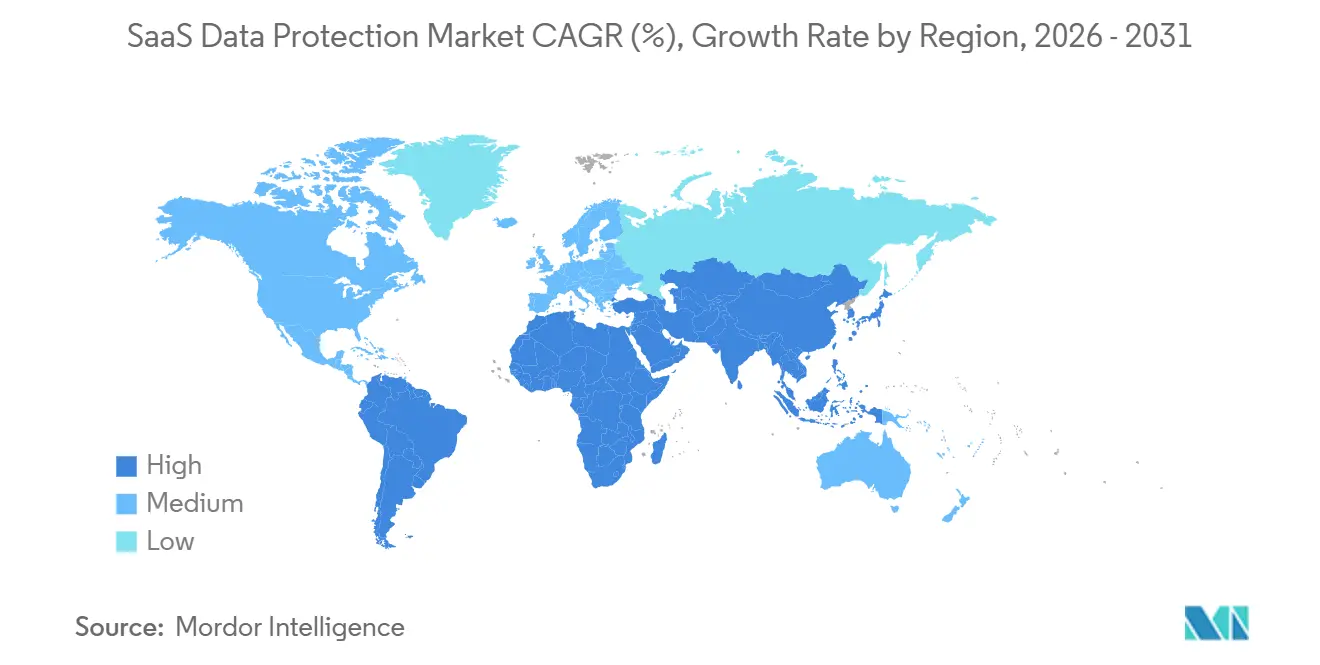
North America accounted for 36.43% of revenue in 2025. The region benefits from deep SaaS use, mature cybersecurity spending, and regulated financial, healthcare, and defense organizations, where technology teams often have established resilience programs and the budget, skills, and governance structures needed to evaluate several backup approaches. HIPAA, the Sarbanes-Oxley Act, and the U.S. Securities and Exchange Commission’s 2024 cybersecurity disclosure rules support ongoing data protection investments. The region also hosts Druva, Rubrik, Commvault, Cohesity, and AvePoint. This concentration provides vendors with early-adopter enterprise customers and regular product feedback, allowing suppliers to refine workload connectors, recovery processes, management interfaces, partner services, and compliance features in response to complex operational needs. The SaaS data protection market in North America is therefore supported by both demand maturity and a strong supplier base, with buyers able to compare established offerings that address common productivity, CRM, cloud infrastructure, identity, and broader enterprise recovery requirements within a familiar regulatory setting.
Asia-Pacific is projected to expand to a 24.71% CAGR from 2026 to 2031. Digital infrastructure investment, local data rules, and a large base of small and medium-sized businesses support this pace, as organizations adopt cloud applications for everyday operations and seek protection that can be purchased, deployed, managed, and expanded without extensive internal infrastructure. China reported 10.6% year-over-year growth in information transmission, software, and information technology services in the first quarter of 2026. Alibaba Cloud and Huawei Cloud are adding enterprise backup capabilities within their platforms. India’s Digital Personal Data Protection Act also supports a preference for India-resident backup storage for sensitive workloads. The SaaS data protection market is benefiting from the wider adoption of Backup as a Service in the region, as providers and partners make protection available through subscription models that suit customers adopting cloud systems at different speeds and operating across countries with varying data-location expectations.
Europe is the second-largest geographic area in the SaaS data protection market, and DORA’s January 2025 application date increased backup procurement by financial institutions. GDPR has made sovereignty-aware storage and processor controls important in financial and public-sector tenders, with buyers examining where data is held, who processes it, how access is controlled, and whether backup arrangements meet contractual and regulatory responsibilities. Germany, the United Kingdom, France, Italy, and the BENELUX countries are central to this demand. South America is advancing, as Brazil’s Lei Geral de Proteção de Dados supports the adoption of compliance-aware cloud backup. The Middle East and Africa are gaining momentum through digital-government programs in the Gulf Cooperation Council. The UAE and Saudi Arabia are prioritizing locally hosted backup options through Vision 2030 and sovereign cloud programs, linking cloud modernization to a preference for infrastructure and service arrangements that offer local control over sensitive data, support continuity planning, and meet public-sector expectations.

Competitive Landscape
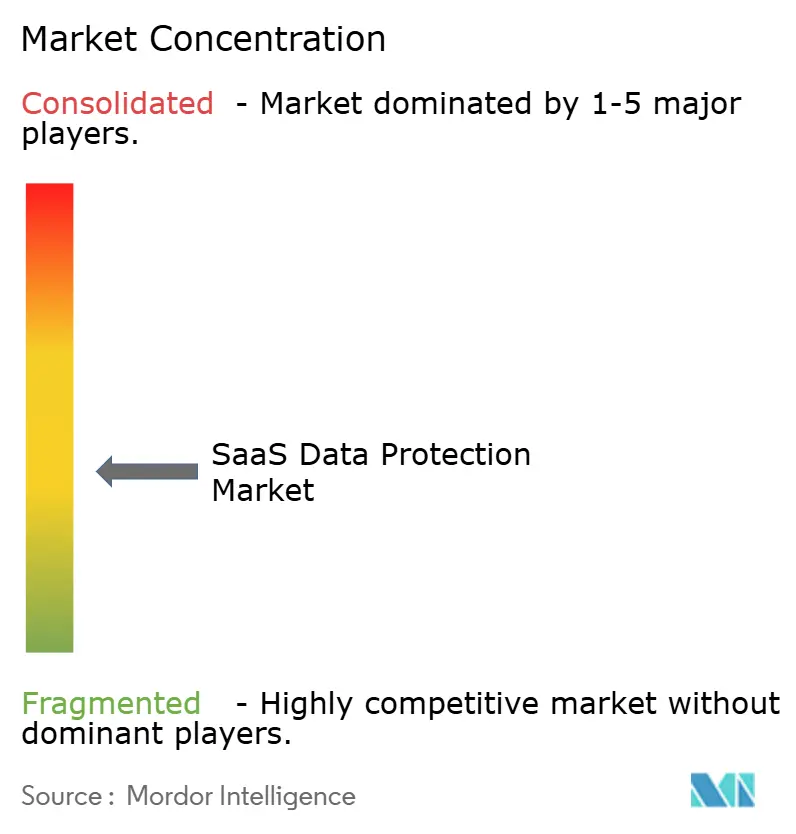
The SaaS data protection market is moderately fragmented and has a two-tier competitive structure. Large platform providers compete for enterprise accounts through breadth of coverage and integrated services, seeking to protect multiple applications through coordinated policies, centralized management, security controls, validation features, and professional support for customers with complex data environments. SaaS-native specialists compete through workload depth, sovereignty design, and channel pricing, focusing on application-specific recovery needs, storage choices, partner accessibility, and deployment models that can appeal to organizations with narrower but demanding protection requirements. Druva, Veeam, Rubrik, Cohesity, and Commvault hold leading positions in enterprise data protection. Rubrik reported annual recurring revenue from subscriptions of USD 1.46 billion in fiscal year 2026, up 34% year over year. Keepit, HYCU, and AvePoint compete with specialized SaaS protection and focused deployment models, offering alternatives for customers who prioritize specific application coverage, data location, straightforward administration, partner-delivered services, or a backup approach tailored to a particular set of cloud workloads.
Providers are using artificial intelligence capabilities, acquisition, and partner channels to widen their reach, while also improving their ability to cover more data types, support new cloud applications, automate recovery work, and offer services through established managed service providers. Veeam completed its USD 1.725 billion acquisition of Securiti AI in December 2025. launched the DataAI Command Platform in May 2026, combining data security, governance, and resilience capabilities. Rubrik introduced Autonomous Business Recovery for Cloud Applications in June 2026. The product addresses recovery across data, network, identity, and configurations, reflecting the need to restore connected cloud application elements rather than treat files and databases as separate assets with no relationship to permissions, supporting systems, or the operational settings that make an application usable. These moves show that recovery validation and automation are becoming important points of competition, as customers seek confidence that protected data, applications, configurations, identities, and related infrastructure can be restored in a controlled and timely manner after an incident.
Commvault launched Cloud Unified Data Vault in January 2026 and extended Clumio to Google Cloud Storage in April 2026. COMMVAULT Keepit launched AI Truth Cloud in August 2026, positioning its platform as a sovereign data foundation for enterprise artificial intelligence deployments. AvePoint added protections for ServiceNow, AWS S3, Azure Kubernetes, and Entra External ID in July 2026. Salesforce backup, identity-provider backup, and developer-platform protection remain areas with lower reported coverage, creating a need for policies and recovery capabilities that extend beyond email and collaboration workloads into systems that support revenue, access, engineering, and administrative processes. These workloads give the SaaS data protection market additional room for further expansion, because buyers can add protection as their SaaS portfolios mature and as they identify application records, administrative controls, identity data, and developer assets that need consistent retention and tested recovery processes.
SaaS Data Protection Industry Leaders
Druva Inc.
Veeam Software Group GmbH
Keepit A/S
HYCU, Inc.
Kaseya US LLC, Spanning
- *Disclaimer: Major Players sorted in no particular order

Recent Industry Developments
- August 2026: Keepit launched AI Truth Cloud, repositioning its SaaS data protection platform as a sovereign, verifiable data foundation for enterprise AI deployments. An ISV partnership strategy embeds Keepit’s trust layer directly into third-party software ecosystems, enabling AI agents to build on immutable, governed backup data.
- July 2026: Veeam released Veeam Data Cloud Vault Archive, an archival-class cloud-storage tier for secure, compliant long-term backup retention, alongside Veeam Data Platform v13.1, which added NAS Direct to Archive and expanded threat detection for cloud workloads.
- June 2026: Rubrik introduced Autonomous Business Recovery for Cloud Applications at Rubrik FORWARD, an agentic cyber-resilience solution powered by the Preemptive Recovery Engine that recovers cloud applications across data, network, identity, and configurations, rebuilding an organization’s Minimum Viable Business at machine speed.
- April 2026: Commvault extended Clumio to Google Cloud Storage, enabling protection and recovery of large-scale datasets supporting AI and analytics workloads through isolated, immutable, air-gapped backups, targeted for general availability in summer 2026.
- January 2026: Commvault launched Cloud Unified Data Vault, a cloud-native service extending air-gapped, immutable protection to S3-protocol application and AI data under a unified, policy-driven framework, without requiring agents.


Global SaaS Data Protection Market Report Scope
SaaS data protection market consists of backup, recovery, archiving, and security solutions specifically designed to protect data stored in cloud-based Software-as-a-Service applications including Microsoft 365 (Exchange, SharePoint, OneDrive, Teams), Google Workspace (Gmail, Drive, Meet), Salesforce, ServiceNow, Workday, and other enterprise SaaS platforms from data loss, corruption, accidental deletion, insider threats, ransomware attacks, and compliance violations. These platforms provide automated backup scheduling, granular item-level recovery, immutable storage, eDiscovery and legal hold capabilities, compliance reporting, cross-tenant migration, and API-based data extraction to address the shared responsibility model gap where SaaS providers ensure platform availability but customers remain responsible for their data protection, enabling organizations to meet regulatory retention requirements (GDPR, HIPAA, FINRA, SEC), maintain business continuity, and protect critical business data across distributed SaaS environments without relying on native SaaS provider retention policies or manual export processes.
The SaaS Data Protection Market Report is Segmented by Component (Solutions, and Services), Protected Workload (Microsoft 365, Google Workspace, Salesforce, and Other SaaS Applications), Deployment Model (Public Cloud, Private Cloud, and Hybrid Cloud), Organization Size (Large Enterprises, and Small and Medium-Sized Enterprises), Industry Vertical (Government and Public Administration, Industrial Manufacturing, Retail and E-Commerce, Transportation and Logistics, Energy and Utilities, Oil and Gas, IT and Telecommunication, Media and Entertainment, Education and Research Institutions, Healthcare and Life Sciences, Banking, Financial Services, and Insurance (BFSI), and Other Industry Verticals), and Geography (North America, South America, Europe, Asia-Pacific, and Middle East and Africa). The Market Forecasts are Provided in Terms of Value (USD).
| Solutions |
| Services |
| Microsoft 365 |
| Google Workspace |
| Salesforce |
| Other SaaS Applications |
| Public Cloud |
| Private Cloud |
| Hybrid Cloud |
| Large Enterprises |
| Small and Medium-sized Enterprises |
| Government and Public Administration |
| Retail and E-Commerce |
| Transportation and Logistics |
| IT and Telecommunication |
| Media and Entertainment |
| Healthcare and Life Sciences |
| Banking, Financial Services, and Insurance (BFSI) |
| Other Industry Verticals |
| North America | United States | |
| Canada | ||
| Mexico | ||
| South America | Brazil | |
| Argentina | ||
| Rest of South America | ||
| Europe | Germany | |
| United Kingdom | ||
| France | ||
| Italy | ||
| BENELUX | ||
| Rest of Europe | ||
| Asia-Pacific | China | |
| Japan | ||
| India | ||
| South Korea | ||
| Australia | ||
| Rest of Asia-Pacific | ||
| Middle East and Africa | Middle East | United Arab Emirates |
| Saudi Arabia | ||
| Rest of Middle East | ||
| Africa | South Africa | |
| Nigeria | ||
| Egypt | ||
| Rest of Africa | ||
| By Component | Solutions | ||
| Services | |||
| By Protected Workload | Microsoft 365 | ||
| Google Workspace | |||
| Salesforce | |||
| Other SaaS Applications | |||
| By Deployment Model | Public Cloud | ||
| Private Cloud | |||
| Hybrid Cloud | |||
| By Organization Size | Large Enterprises | ||
| Small and Medium-sized Enterprises | |||
| By Industry Vertical | Government and Public Administration | ||
| Retail and E-Commerce | |||
| Transportation and Logistics | |||
| IT and Telecommunication | |||
| Media and Entertainment | |||
| Healthcare and Life Sciences | |||
| Banking, Financial Services, and Insurance (BFSI) | |||
| Other Industry Verticals | |||
| By Geography | North America | United States | |
| Canada | |||
| Mexico | |||
| South America | Brazil | ||
| Argentina | |||
| Rest of South America | |||
| Europe | Germany | ||
| United Kingdom | |||
| France | |||
| Italy | |||
| BENELUX | |||
| Rest of Europe | |||
| Asia-Pacific | China | ||
| Japan | |||
| India | |||
| South Korea | |||
| Australia | |||
| Rest of Asia-Pacific | |||
| Middle East and Africa | Middle East | United Arab Emirates | |
| Saudi Arabia | |||
| Rest of Middle East | |||
| Africa | South Africa | ||
| Nigeria | |||
| Egypt | |||
| Rest of Africa | |||


Key Questions Answered in the Report
What is the SaaS data protection market size?
The SaaS data protection market size is projected to expand from USD 3.02 billion in 2025 to USD 3.42 billion in 2026, and to USD 7.54 billion by 2031, registering a CAGR of 17.13% between 2026 and 2031.
What is driving demand for SaaS data protection?
Ransomware, accidental deletion, wider SaaS use, recovery testing, and data-sovereignty requirements are key factors, with buyers also seeking isolation, broader application support, documented controls, and managed services that reduce the work required to maintain protection.
Which SaaS workload has the highest growth outlook?
Salesforce is projected to expand at a 24.63% CAGR through 2031, supported by a lower reported backup adoption rate than Microsoft 365.
Why do organizations use hybrid cloud backup?
Hybrid cloud supports separation of production and backup environments, which can help regulated organizations meet recovery and data-control requirements while maintaining a practical combination of local oversight, offsite copies, and recovery capacity for critical applications.
Which customer group is expanding fastest?
Small and medium-sized enterprises are projected to grow at a 24.81% CAGR through 2031 as subscription services reduce adoption barriers, provide more accessible policy options, and let organizations seek dependable recovery without extensive dedicated infrastructure or specialist staff.
Which vertical has the largest role in SaaS data protection?
BFSI held 27.82% of revenue in 2025, while healthcare and life sciences are projected to expand faster at a 22.96% CAGR.
Page last updated on:


 Your data is secure and never sold or shared.


