
Roundwood Market Size and Share
Roundwood Market Analysis by Mordor Intelligence
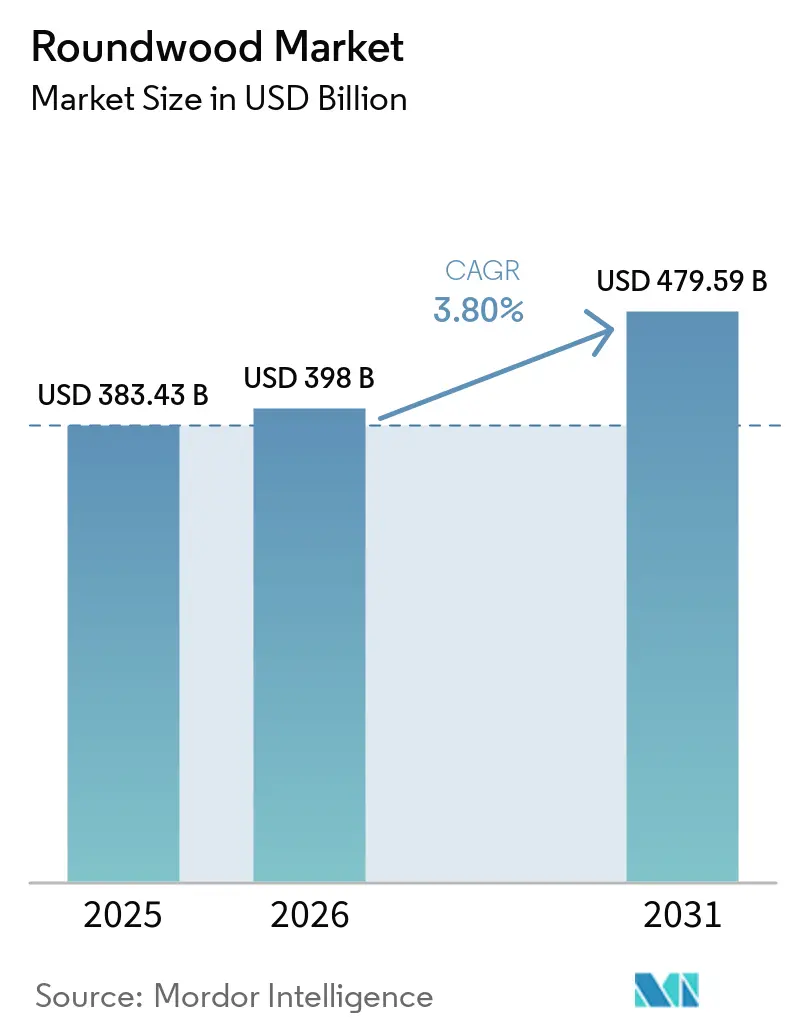
The roundwood market size is projected to grow from USD 383.43 billion in 2025 and USD 398.00 billion in 2026 to USD 479.59 billion by 2031, reflecting a CAGR of 3.8% between 2026 and 2031. Factors such as corporate decarbonization commitments, the International Building Code (IBC) provisions for taller timber structures, and capacity expansions in Southeast Asian pulp mills are influencing the pricing dynamics of fiber in the roundwood market. Supply constraints persist in regions with limited afforestation and ongoing logistics challenges, particularly in South Africa and Central Europe. Certification requirements from the Forest Stewardship Council (FSC) and the Programme for the Endorsement of Forest Certification (PEFC) impose additional costs per audit cycle in Romania, creating financial pressure on smaller producers. The market is also accommodating increased low-grade volumes for European Union (EU) biomass cofiring, while high-quality sawlogs are being directed toward cross-laminated timber (CLT) and glue-laminated timber (GLT) production lines.
Key Report Takeaways
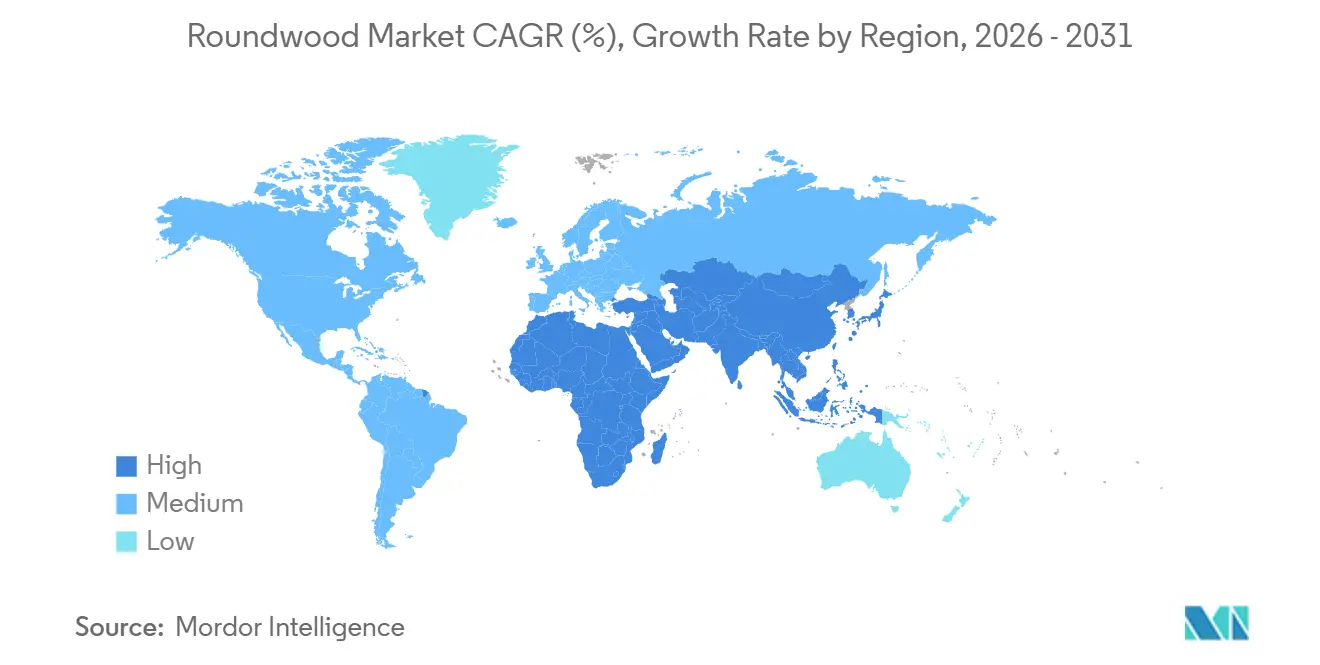
- By geography, Asia-Pacific accounted for the largest 34% roundwood market share in 2025, and Africa's market size is projected to grow at the fastest CAGR of 5.8% from 2026 to 2031.
Note: Market size and forecast figures in this report are generated using Mordor Intelligence’s proprietary estimation framework, updated with the latest available data and insights as of January 2026.
Market Trends and Insights
Drivers Impact Analysis of Roundwood Market*
| Driver | (~) % Impact on CAGR Forecast | Geographic Relevance | Impact Timeline |
|---|---|---|---|
| Rising adoption of engineered wood construction | +0.9% | North America, Europe, Asia-Pacific (Japan, Australia), select urban hubs in South America and Middle East | Medium term (2–4 years) |
| Data-center growth driving cable-drum roundwood demand | +0.2% | Global hubs in North America, Europe, and Asia-Pacific | Short term (≤ 2 years) |
| Increasing pulp capacity expansions in Southeast Asia | +0.7% | Indonesia, Vietnam, Thailand, and Southern China | Medium term (2–4 years) |
| European Union coal-to-biomass cofiring targets boosting demand | +0.5% | European Union and United Kingdom, indirect pull on North America and South America | Long term (≥ 4 years) |
| Voluntary carbon markets funding sustainable forestry | +0.4% | North America, South America, Africa, and Southeast Asia | Long term (≥ 4 years) |
| Growing off-grid bioenergy demand in Sub-Saharan Africa | +0.6% | Ethiopia, Zambia, Nigeria, Kenya, and Tanzania | Medium term (2–4 years) |
| Source: Mordor Intelligence | |||
Rising Adoption of Engineered Wood Construction
The adoption of engineered wood construction is increasing, with materials like cross-laminated timber (CLT) and glued laminated timber (GLT) progressively replacing steel and concrete due to their lower embodied carbon and favorable building regulations. These structural wood products depend on sawnwood derived from roundwood, driving significant upstream demand for logs. According to the Food and Agriculture Organization (2024), global roundwood production reached 390.4 million cubic meters against last year's production of 386.6 million cubic meters[1]Source: Food and Agriculture Organization (FAO), “FAOSTAT Database – Forestry Production and Trade (Roundwood Production, 2024),” fao.org. The expanding use of mass timber in mid- and high-rise buildings is anticipated to maintain demand for high-quality roundwood.
Data-Center Growth Driving Cable-Drum Roundwood Demand
The rapid expansion of data center infrastructure is driving a significant increase in demand for upstream materials, including for applications such as cable transportation systems. According to the International Energy Agency, electricity generation to support data centers is anticipated to grow from 460 TWh in 2024 to over 1,000 TWh by 2030, reflecting substantial global capacity additions[2]Source: International Energy Agency, “Energy and AI – Energy Supply for AI,” iea.org. This growth highlights the large-scale deployment of hyperscale facilities and the extensive expansion of fiber-optic networks. These infrastructures require durable cable-handling solutions, with wooden drums made from roundwood remaining the preferred choice due to their strength and compliance with standards. As data center construction accelerates across key regions, the demand for roundwood is projected to rise steadily.
Increasing Pulp Capacity Expansions in Southeast Asia
Pulp capacity expansions in Southeast Asia are driving increased demand for roundwood, particularly hardwood species used in fiber production. Countries like Indonesia and Vietnam are scaling up export-oriented pulp manufacturing, supported by robust global demand for packaging and tissue products. According to the Food and Agriculture Organization (2024), the Asia-Pacific region remains a significant growth area for forest product consumption and trade, fueled by industrial growth and rising paper demand. With new mills commencing operations, the consistent supply of plantation and mixed hardwood logs is becoming essential, further intensifying pressure on regional and imported roundwood supplies.
European Union Coal-to-Biomass Cofiring Targets Boosting Demand
Stricter renewable energy targets in the European Union are driving the transition from coal to biomass-based power generation, resulting in consistent demand for wood-derived fuel. Biomass cofiring is being adopted as a transitional baseload solution, utilizing inputs such as wood pellets made from pulpwood, forest residues, and low-grade roundwood. European Union regulations emphasize sustainability requirements, mandating certified and traceable feedstock, which prompts utilities to secure compliant wood supplies. This shift is bolstering structured demand for forest-based biomass, indirectly increasing the consumption of roundwood in both domestic and import-reliant markets.
Restraints Impact Analysis of Roundwood Market*
| Restraint | (~) % Impact on CAGR Forecast | Geographic Relevance | Impact Timeline |
|---|---|---|---|
| Expansion of plastic composites replacing packaging lumber | -0.3% | North America, Europe, and Asia-Pacific logistics nodes | Short term (≤ 2 years) |
| Rising phytosanitary barriers including ISPM-15 regulations | -0.4% | Export corridors from Asia-Pacific, South America, Africa to Europe and North America | Medium term (2–4 years) |
| Higher costs of sustainable forest certification compliance | -0.5% | North America, Europe, export-oriented South America, Oceania, and Africa | Long term (≥ 4 years) |
| Labor shortages in mechanized logging operations | -0.6% | North America, Europe, Oceania, spreading to South America and Asia-Pacific | Medium term (2–4 years) |
| Source: Mordor Intelligence | |||
Expansion of Plastic Composites Replacing Packaging Lumber
The growing adoption of plastic composite pallets is decreasing dependence on wood-based packaging materials, particularly in regulated export markets. High-density polyethylene pallets provide enhanced durability for repeated use and are exempt from ISPM-15 phytosanitary requirements, reducing compliance costs and minimizing inspection-related risks. With stricter enforcement of international wood packaging standards, exporters using untreated or non-compliant wooden pallets face increased rejection risks and operational challenges. This trend is driving the logistics and retail sectors to shift toward plastic alternatives. As a result, the demand for low-grade softwood roundwood used in pallet production is gradually declining, particularly in trade-intensive regions with stringent inspection protocols.
Rising Phytosanitary Barriers Including ISPM-15 Regulations
Stricter phytosanitary regulations are intensifying compliance requirements across global wood packaging and roundwood supply chains. The United States Department of Agriculture Animal and Plant Health Inspection Service (USDA APHIS) announced that full enforcement of ISPM-15 marking requirements will resume in January 2026, mandating that all wood packaging materials adhere to heat-treatment and certification standards. This development is increasing operational costs and creating shipment risks for exporters without a compliant infrastructure. Small and medium-sized mills, especially in developing regions, are encountering difficulties in securing financing for kilns and implementing traceability systems. Consequently, the disparity between certified and non-certified suppliers is growing, impacting competitiveness and participation in trade.
*Our forecasts treat driver/restraint impacts as directional, not additive. The impact forecasts reflect baseline growth, mix effects, and variable interactions.
Geography Analysis
APAC Roundwood Market
Asia-Pacific accounted for the largest 34% roundwood market share in 2025, supported by strong construction demand and expanding pulp and paper industries. The region remains dependent on imports due to limited domestic forest resources in key economies such as China and Japan. Demand is further bolstered by infrastructure development and industrial activities, particularly in packaging and housing applications. Southeast Asia is emerging as a significant supplier and processing hub, benefiting from the expansion of plantation forestry. Trade flows within the region are dynamic, with consistent sourcing from Oceania and North America to meet industrial needs.
Africa Roundwood Market
Africa's market size is projected to grow at the fastest CAGR of 5.8% from 2026 to 2031, driven by sustained reliance on wood for energy and the gradual expansion of plantation forestry. Household fuel consumption remains the primary driver across Sub-Saharan economies, while industrial usage is gradually increasing. Government-led afforestation initiatives are contributing to long-term supply development, although progress varies by country. Infrastructure and logistics limitations continue to constrain export potential. Despite these challenges, domestic consumption remains structurally strong, and improving policy frameworks are projected to enhance supply chain efficiency and support future growth.
North America and Europe Roundwood Market
North America and Europe exhibit stable demand driven by construction activities, energy transition policies, and industrial wood applications. According to the United States Department of Agriculture, in March 2026, the government announced USD 115.2 million in loan guarantees across eight states to enhance sawmill and timber processing capacity, thereby bolstering domestic wood supply chains[3]Source: United States Department of Agriculture, “Timber Production Investment Announcement (2026),” usda.gov. In Europe, the promotion of biomass energy adoption continues to support demand for certified wood. Both regions benefit from well-developed supply chains and sustainable forest management practices, ensuring a steady timber supply while addressing changing environmental and regulatory standards.


Competitive Landscape
The industry structure remains characterized by a mix of large timberland owners and integrated forestry companies, which leverage scale and certification capabilities to maintain competitive advantages. Leading companies prioritize sustainable forest management, long-term supply contracts, and diversified revenue streams, including timber sales and carbon-related opportunities. Increasing certification standards and compliance requirements are raising operational barriers, making it challenging for smaller participants to compete effectively. As global sustainability regulations become stricter, companies with established traceability systems and access to certified forests are better positioned to secure premium pricing and long-term supply agreements.
Technology adoption is emerging as a significant differentiator among major forestry operators. Companies are utilizing digital tools such as remote sensing, artificial intelligence, and automated harvesting systems to enhance productivity and optimize resource utilization. Mechanization in logging operations is improving efficiency and reducing labor dependency, particularly in developed markets. However, high capital investment requirements limit the adoption of these technologies among smaller contractors, creating a technological divide within the industry. Additionally, digital platforms for logistics and supply chain tracking are enhancing transparency, facilitating compliance with sustainability standards, and strengthening relationships with downstream buyers.
Investment activity is reshaping competitive dynamics, particularly in timberland ownership and asset management. In March 2026, Gresham House completed the acquisition of Molpus Woodlands Group, forming a combined platform managing USD 8 billion in assets across 2.2 million acres. This development underscores growing investor interest in forestry-linked assets. The trend reflects an increasing focus on timber as a dual-purpose investment, providing both raw material supply and carbon sequestration potential. Strategic consolidation and capital inflows are projected to bolster the position of large, well-capitalized players in the roundwood market.
Recent Industry Developments in Roundwood Market
- April 2026: Gresham House has acquired a majority stake in Molpus Woodlands Group, creating one of the largest timberland investment managers globally, with approximately USD 8 billion in forestry assets and over 2.2 million acres under management. This acquisition enhances timber harvesting and forest management capabilities, contributing to long-term supply stability in the roundwood market.
- March 2026: The United States Department of Agriculture announced USD 115.2 million in loan guarantees through the Timber Production Expansion Program. This funding aims to modernize and expand sawmills across eight states, supporting domestic timber supply chains and increasing roundwood processing capacity within the United States market.
- December 2025: The European Union has delayed the enforcement of the EU Deforestation Regulation (EUDR) for large companies, while maintaining strict due diligence requirements for wood and timber products. This development continues to impact sourcing transparency and compliance standards within the roundwood market.


Global Roundwood Market Report Scope
Roundwood is timber harvested from forests in its natural cylindrical form (logs), without undergoing sawing, chipping, or further processing beyond basic cutting and debarking. It serves as the primary raw material for the wood-based value chain. The Roundwood Market Report is Segmented by Geography (North America, South America, Europe, Asia-Pacific, and More). The Report Includes Production Analysis (Volume), Consumption Analysis (Value and Volume), Import Analysis (Value and Volume), Export Analysis (Value and Volume), Wholesale Price Trend Analysis and Forecast, and More. The Market Forecasts are Provided in Terms of Value (USD) and Volume (Metric Tons).
| North America | United States | Production Analysis (Volume) |
| Consumption Analysis (Consumption Value and Volume) | ||
| Import Market Analysis (Import Value, Volume, and Key Supplying Markets) | ||
| Export Market Analysis (Export Value, Volume, and Key Destination Markets) | ||
| Wholesale Price Trend Analysis and Forecast | ||
| Regulatory Framework | ||
| List of Key Players | ||
| Logistics and Infrastructure | ||
| Seasonality Analysis | ||
| Canada | Production Analysis (Volume) | |
| Consumption Analysis (Consumption Value and Volume) | ||
| Import Market Analysis (Import Value, Volume, and Key Supplying Markets) | ||
| Export Market Analysis (Export Value, Volume, and Key Destination Markets) | ||
| Wholesale Price Trend Analysis and Forecast | ||
| Regulatory Framework | ||
| List of Key Players | ||
| Logistics and Infrastructure | ||
| Seasonality Analysis | ||
| Mexico | Production Analysis (Volume) | |
| Consumption Analysis (Consumption Value and Volume) | ||
| Import Market Analysis (Import Value, Volume, and Key Supplying Markets) | ||
| Export Market Analysis (Export Value, Volume, and Key Destination Markets) | ||
| Wholesale Price Trend Analysis and Forecast | ||
| Regulatory Framework | ||
| List of Key Players | ||
| Logistics and Infrastructure | ||
| Seasonality Analysis | ||
| South America | Brazil | Production Analysis (Volume) |
| Consumption Analysis (Consumption Value and Volume) | ||
| Import Market Analysis (Import Value, Volume, and Key Supplying Markets) | ||
| Export Market Analysis (Export Value, Volume, and Key Destination Markets) | ||
| Wholesale Price Trend Analysis and Forecast | ||
| Regulatory Framework | ||
| List of Key Players | ||
| Logistics and Infrastructure | ||
| Seasonality Analysis | ||
| Chile | Production Analysis (Volume) | |
| Consumption Analysis (Consumption Value and Volume) | ||
| Import Market Analysis (Import Value, Volume, and Key Supplying Markets) | ||
| Export Market Analysis (Export Value, Volume, and Key Destination Markets) | ||
| Wholesale Price Trend Analysis and Forecast | ||
| Regulatory Framework | ||
| List of Key Players | ||
| Logistics and Infrastructure | ||
| Seasonality Analysis | ||
| Europe | Germany | Production Analysis (Volume) |
| Consumption Analysis (Consumption Value and Volume) | ||
| Import Market Analysis (Import Value, Volume, and Key Supplying Markets) | ||
| Export Market Analysis (Export Value, Volume, and Key Destination Markets) | ||
| Wholesale Price Trend Analysis and Forecast | ||
| Regulatory Framework | ||
| List of Key Players | ||
| Logistics and Infrastructure | ||
| Seasonality Analysis | ||
| France | Production Analysis (Volume) | |
| Consumption Analysis (Consumption Value and Volume) | ||
| Import Market Analysis (Import Value, Volume, and Key Supplying Markets) | ||
| Export Market Analysis (Export Value, Volume, and Key Destination Markets) | ||
| Wholesale Price Trend Analysis and Forecast | ||
| Regulatory Framework | ||
| List of Key Players | ||
| Logistics and Infrastructure | ||
| Seasonality Analysis | ||
| Poland | Production Analysis (Volume) | |
| Consumption Analysis (Consumption Value and Volume) | ||
| Import Market Analysis (Import Value, Volume, and Key Supplying Markets) | ||
| Export Market Analysis (Export Value, Volume, and Key Destination Markets) | ||
| Wholesale Price Trend Analysis and Forecast | ||
| Regulatory Framework | ||
| List of Key Players | ||
| Logistics and Infrastructure | ||
| Seasonality Analysis | ||
| Russia | Production Analysis (Volume) | |
| Consumption Analysis (Consumption Value and Volume) | ||
| Import Market Analysis (Import Value, Volume, and Key Supplying Markets) | ||
| Export Market Analysis (Export Value, Volume, and Key Destination Markets) | ||
| Wholesale Price Trend Analysis and Forecast | ||
| Regulatory Framework | ||
| List of Key Players | ||
| Logistics and Infrastructure | ||
| Seasonality Analysis | ||
| Asia-Pacific | China | Production Analysis (Volume) |
| Consumption Analysis (Consumption Value and Volume) | ||
| Import Market Analysis (Import Value, Volume, and Key Supplying Markets) | ||
| Export Market Analysis (Export Value, Volume, and Key Destination Markets) | ||
| Wholesale Price Trend Analysis and Forecast | ||
| Regulatory Framework | ||
| List of Key Players | ||
| Logistics and Infrastructure | ||
| Seasonality Analysis | ||
| Japan | Production Analysis (Volume) | |
| Consumption Analysis (Consumption Value and Volume) | ||
| Import Market Analysis (Import Value, Volume, and Key Supplying Markets) | ||
| Export Market Analysis (Export Value, Volume, and Key Destination Markets) | ||
| Wholesale Price Trend Analysis and Forecast | ||
| Regulatory Framework | ||
| List of Key Players | ||
| Logistics and Infrastructure | ||
| Seasonality Analysis | ||
| Australia | Production Analysis (Volume) | |
| Consumption Analysis (Consumption Value and Volume) | ||
| Import Market Analysis (Import Value, Volume, and Key Supplying Markets) | ||
| Export Market Analysis (Export Value, Volume, and Key Destination Markets) | ||
| Wholesale Price Trend Analysis and Forecast | ||
| Regulatory Framework | ||
| List of Key Players | ||
| Logistics and Infrastructure | ||
| Seasonality Analysis | ||
| India | Production Analysis (Volume) | |
| Consumption Analysis (Consumption Value and Volume) | ||
| Import Market Analysis (Import Value, Volume, and Key Supplying Markets) | ||
| Export Market Analysis (Export Value, Volume, and Key Destination Markets) | ||
| Wholesale Price Trend Analysis and Forecast | ||
| Regulatory Framework | ||
| List of Key Players | ||
| Logistics and Infrastructure | ||
| Seasonality Analysis | ||
| Malaysia | Production Analysis (Volume) | |
| Consumption Analysis (Consumption Value and Volume) | ||
| Import Market Analysis (Import Value, Volume, and Key Supplying Markets) | ||
| Export Market Analysis (Export Value, Volume, and Key Destination Markets) | ||
| Wholesale Price Trend Analysis and Forecast | ||
| Regulatory Framework | ||
| List of Key Players | ||
| Logistics and Infrastructure | ||
| Seasonality Analysis | ||
| Middle East | Saudi Arabia | Production Analysis (Volume) |
| Consumption Analysis (Consumption Value and Volume) | ||
| Import Market Analysis (Import Value, Volume, and Key Supplying Markets) | ||
| Export Market Analysis (Export Value, Volume, and Key Destination Markets) | ||
| Wholesale Price Trend Analysis and Forecast | ||
| Regulatory Framework | ||
| List of Key Players | ||
| Logistics and Infrastructure | ||
| Seasonality Analysis | ||
| Turkey | Production Analysis (Volume) | |
| Consumption Analysis (Consumption Value and Volume) | ||
| Import Market Analysis (Import Value, Volume, and Key Supplying Markets) | ||
| Export Market Analysis (Export Value, Volume, and Key Destination Markets) | ||
| Wholesale Price Trend Analysis and Forecast | ||
| Regulatory Framework | ||
| List of Key Players | ||
| Logistics and Infrastructure | ||
| Seasonality Analysis | ||
| Africa | South Africa | Production Analysis (Volume) |
| Consumption Analysis (Consumption Value and Volume) | ||
| Import Market Analysis (Import Value, Volume, and Key Supplying Markets) | ||
| Export Market Analysis (Export Value, Volume, and Key Destination Markets) | ||
| Wholesale Price Trend Analysis and Forecast | ||
| Regulatory Framework | ||
| List of Key Players | ||
| Logistics and Infrastructure | ||
| Seasonality Analysis | ||
| Kenya | Production Analysis (Volume) | |
| Consumption Analysis (Consumption Value and Volume) | ||
| Import Market Analysis (Import Value, Volume, and Key Supplying Markets) | ||
| Export Market Analysis (Export Value, Volume, and Key Destination Markets) | ||
| Wholesale Price Trend Analysis and Forecast | ||
| Regulatory Framework | ||
| List of Key Players | ||
| Logistics and Infrastructure | ||
| Seasonality Analysis | ||
| By Geography | North America | United States | Production Analysis (Volume) |
| Consumption Analysis (Consumption Value and Volume) | |||
| Import Market Analysis (Import Value, Volume, and Key Supplying Markets) | |||
| Export Market Analysis (Export Value, Volume, and Key Destination Markets) | |||
| Wholesale Price Trend Analysis and Forecast | |||
| Regulatory Framework | |||
| List of Key Players | |||
| Logistics and Infrastructure | |||
| Seasonality Analysis | |||
| Canada | Production Analysis (Volume) | ||
| Consumption Analysis (Consumption Value and Volume) | |||
| Import Market Analysis (Import Value, Volume, and Key Supplying Markets) | |||
| Export Market Analysis (Export Value, Volume, and Key Destination Markets) | |||
| Wholesale Price Trend Analysis and Forecast | |||
| Regulatory Framework | |||
| List of Key Players | |||
| Logistics and Infrastructure | |||
| Seasonality Analysis | |||
| Mexico | Production Analysis (Volume) | ||
| Consumption Analysis (Consumption Value and Volume) | |||
| Import Market Analysis (Import Value, Volume, and Key Supplying Markets) | |||
| Export Market Analysis (Export Value, Volume, and Key Destination Markets) | |||
| Wholesale Price Trend Analysis and Forecast | |||
| Regulatory Framework | |||
| List of Key Players | |||
| Logistics and Infrastructure | |||
| Seasonality Analysis | |||
| South America | Brazil | Production Analysis (Volume) | |
| Consumption Analysis (Consumption Value and Volume) | |||
| Import Market Analysis (Import Value, Volume, and Key Supplying Markets) | |||
| Export Market Analysis (Export Value, Volume, and Key Destination Markets) | |||
| Wholesale Price Trend Analysis and Forecast | |||
| Regulatory Framework | |||
| List of Key Players | |||
| Logistics and Infrastructure | |||
| Seasonality Analysis | |||
| Chile | Production Analysis (Volume) | ||
| Consumption Analysis (Consumption Value and Volume) | |||
| Import Market Analysis (Import Value, Volume, and Key Supplying Markets) | |||
| Export Market Analysis (Export Value, Volume, and Key Destination Markets) | |||
| Wholesale Price Trend Analysis and Forecast | |||
| Regulatory Framework | |||
| List of Key Players | |||
| Logistics and Infrastructure | |||
| Seasonality Analysis | |||
| Europe | Germany | Production Analysis (Volume) | |
| Consumption Analysis (Consumption Value and Volume) | |||
| Import Market Analysis (Import Value, Volume, and Key Supplying Markets) | |||
| Export Market Analysis (Export Value, Volume, and Key Destination Markets) | |||
| Wholesale Price Trend Analysis and Forecast | |||
| Regulatory Framework | |||
| List of Key Players | |||
| Logistics and Infrastructure | |||
| Seasonality Analysis | |||
| France | Production Analysis (Volume) | ||
| Consumption Analysis (Consumption Value and Volume) | |||
| Import Market Analysis (Import Value, Volume, and Key Supplying Markets) | |||
| Export Market Analysis (Export Value, Volume, and Key Destination Markets) | |||
| Wholesale Price Trend Analysis and Forecast | |||
| Regulatory Framework | |||
| List of Key Players | |||
| Logistics and Infrastructure | |||
| Seasonality Analysis | |||
| Poland | Production Analysis (Volume) | ||
| Consumption Analysis (Consumption Value and Volume) | |||
| Import Market Analysis (Import Value, Volume, and Key Supplying Markets) | |||
| Export Market Analysis (Export Value, Volume, and Key Destination Markets) | |||
| Wholesale Price Trend Analysis and Forecast | |||
| Regulatory Framework | |||
| List of Key Players | |||
| Logistics and Infrastructure | |||
| Seasonality Analysis | |||
| Russia | Production Analysis (Volume) | ||
| Consumption Analysis (Consumption Value and Volume) | |||
| Import Market Analysis (Import Value, Volume, and Key Supplying Markets) | |||
| Export Market Analysis (Export Value, Volume, and Key Destination Markets) | |||
| Wholesale Price Trend Analysis and Forecast | |||
| Regulatory Framework | |||
| List of Key Players | |||
| Logistics and Infrastructure | |||
| Seasonality Analysis | |||
| Asia-Pacific | China | Production Analysis (Volume) | |
| Consumption Analysis (Consumption Value and Volume) | |||
| Import Market Analysis (Import Value, Volume, and Key Supplying Markets) | |||
| Export Market Analysis (Export Value, Volume, and Key Destination Markets) | |||
| Wholesale Price Trend Analysis and Forecast | |||
| Regulatory Framework | |||
| List of Key Players | |||
| Logistics and Infrastructure | |||
| Seasonality Analysis | |||
| Japan | Production Analysis (Volume) | ||
| Consumption Analysis (Consumption Value and Volume) | |||
| Import Market Analysis (Import Value, Volume, and Key Supplying Markets) | |||
| Export Market Analysis (Export Value, Volume, and Key Destination Markets) | |||
| Wholesale Price Trend Analysis and Forecast | |||
| Regulatory Framework | |||
| List of Key Players | |||
| Logistics and Infrastructure | |||
| Seasonality Analysis | |||
| Australia | Production Analysis (Volume) | ||
| Consumption Analysis (Consumption Value and Volume) | |||
| Import Market Analysis (Import Value, Volume, and Key Supplying Markets) | |||
| Export Market Analysis (Export Value, Volume, and Key Destination Markets) | |||
| Wholesale Price Trend Analysis and Forecast | |||
| Regulatory Framework | |||
| List of Key Players | |||
| Logistics and Infrastructure | |||
| Seasonality Analysis | |||
| India | Production Analysis (Volume) | ||
| Consumption Analysis (Consumption Value and Volume) | |||
| Import Market Analysis (Import Value, Volume, and Key Supplying Markets) | |||
| Export Market Analysis (Export Value, Volume, and Key Destination Markets) | |||
| Wholesale Price Trend Analysis and Forecast | |||
| Regulatory Framework | |||
| List of Key Players | |||
| Logistics and Infrastructure | |||
| Seasonality Analysis | |||
| Malaysia | Production Analysis (Volume) | ||
| Consumption Analysis (Consumption Value and Volume) | |||
| Import Market Analysis (Import Value, Volume, and Key Supplying Markets) | |||
| Export Market Analysis (Export Value, Volume, and Key Destination Markets) | |||
| Wholesale Price Trend Analysis and Forecast | |||
| Regulatory Framework | |||
| List of Key Players | |||
| Logistics and Infrastructure | |||
| Seasonality Analysis | |||
| Middle East | Saudi Arabia | Production Analysis (Volume) | |
| Consumption Analysis (Consumption Value and Volume) | |||
| Import Market Analysis (Import Value, Volume, and Key Supplying Markets) | |||
| Export Market Analysis (Export Value, Volume, and Key Destination Markets) | |||
| Wholesale Price Trend Analysis and Forecast | |||
| Regulatory Framework | |||
| List of Key Players | |||
| Logistics and Infrastructure | |||
| Seasonality Analysis | |||
| Turkey | Production Analysis (Volume) | ||
| Consumption Analysis (Consumption Value and Volume) | |||
| Import Market Analysis (Import Value, Volume, and Key Supplying Markets) | |||
| Export Market Analysis (Export Value, Volume, and Key Destination Markets) | |||
| Wholesale Price Trend Analysis and Forecast | |||
| Regulatory Framework | |||
| List of Key Players | |||
| Logistics and Infrastructure | |||
| Seasonality Analysis | |||
| Africa | South Africa | Production Analysis (Volume) | |
| Consumption Analysis (Consumption Value and Volume) | |||
| Import Market Analysis (Import Value, Volume, and Key Supplying Markets) | |||
| Export Market Analysis (Export Value, Volume, and Key Destination Markets) | |||
| Wholesale Price Trend Analysis and Forecast | |||
| Regulatory Framework | |||
| List of Key Players | |||
| Logistics and Infrastructure | |||
| Seasonality Analysis | |||
| Kenya | Production Analysis (Volume) | ||
| Consumption Analysis (Consumption Value and Volume) | |||
| Import Market Analysis (Import Value, Volume, and Key Supplying Markets) | |||
| Export Market Analysis (Export Value, Volume, and Key Destination Markets) | |||
| Wholesale Price Trend Analysis and Forecast | |||
| Regulatory Framework | |||
| List of Key Players | |||
| Logistics and Infrastructure | |||
| Seasonality Analysis | |||


Key Questions Answered in the Report
How big is the Roundwood Market?
The Roundwood Market size is USD 383.43 billion in 2025.
What is the projected value of the roundwood market by 2031?
The roundwood market size is forecast to reach USD 479.59 billion by 2031.
Which region held the largest share of global roundwood demand in 2025?
Asia-Pacific accounted for the largest 34% of roundwood market share in 2025, led by China’s pulp sector and Japan’s timber housing initiatives.
How fast is Africa’s roundwood demand projected to grow?
Driven by bioenergy needs and new plantations, Africa’s demand is projected to rise at the fastest 5.8% CAGR from 2026 to 2031.
How are voluntary carbon markets influencing forestry operations?
Improved Forest Management projects generate tradable carbon credits, encouraging landowners to extend rotation lengths and manage stands for carbon sequestration.
Page last updated on:


 Your data is secure and never sold or shared.


