Romania Road Freight Transport Market Size and Share
Market Overview
| Study Period | 2018 - 2031 |
|---|---|
| Forecast Data Period | 2026 - 2031 |
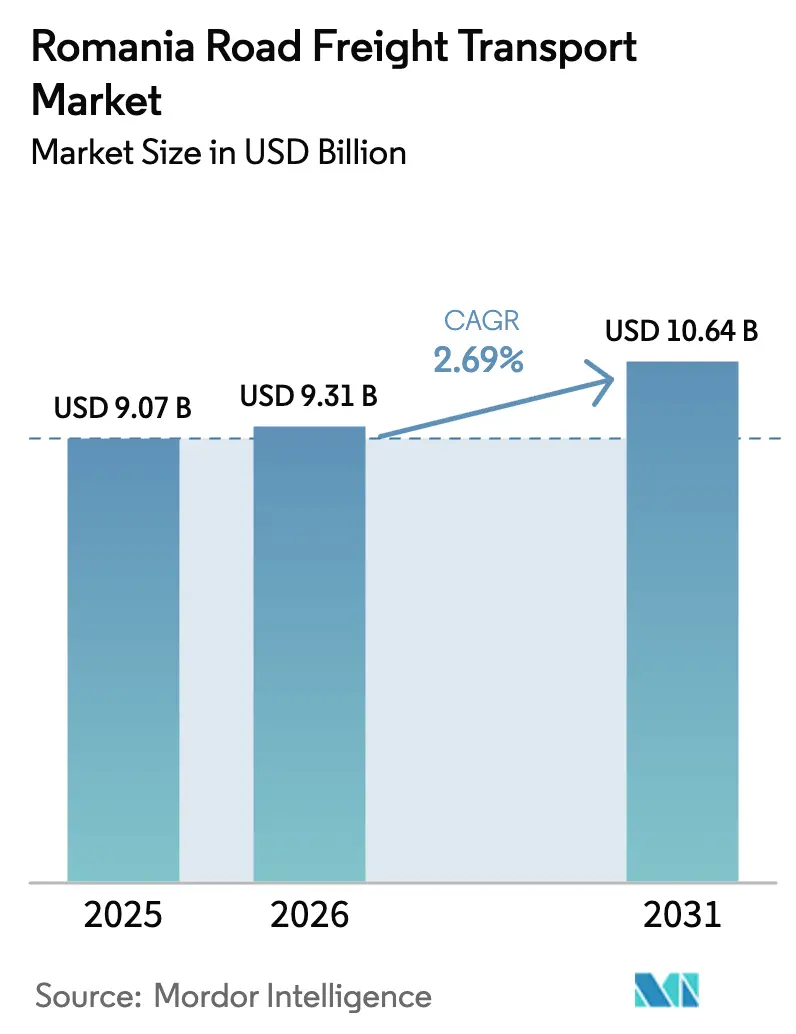
| Base Year Market Size (2025) | USD 9.07 Billion |
| Market Size (2026) | USD 9.31 Billion |
| Market Size (2031) | USD 10.64 Billion |
| Growth Rate (2026 - 2031) | 2.69 % |
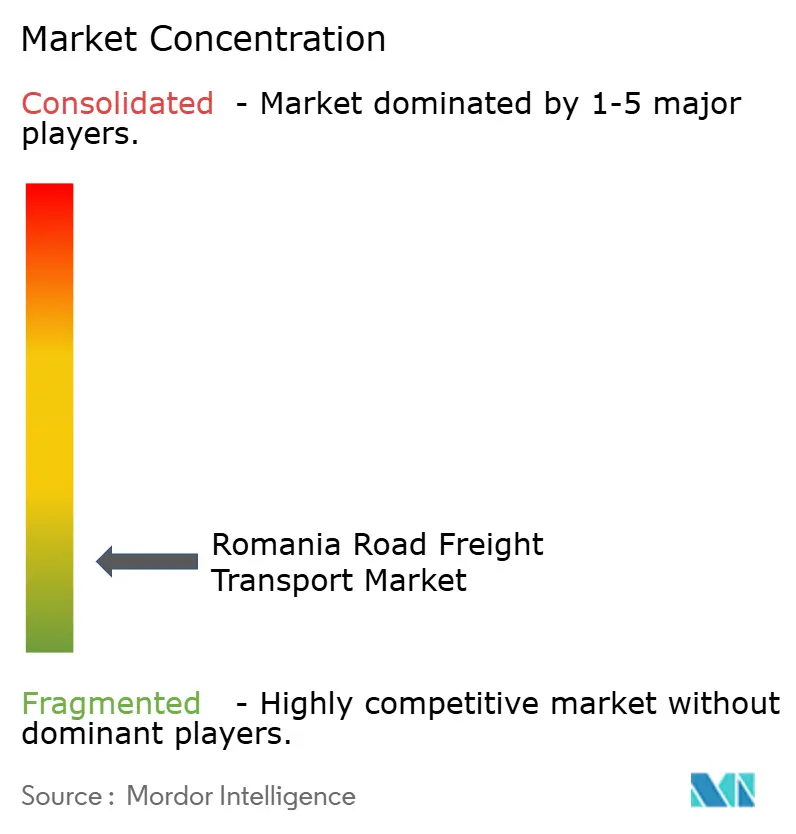
| Market Concentration | Low |
Major Players *Disclaimer: Major Players sorted in no particular order Image © Mordor Intelligence. Reuse requires attribution under CC BY 4.0. | |
Romania Road Freight Transport Market Analysis by Mordor Intelligence
The Romania road freight transport market size was valued at USD 9.07 billion in 2025 and estimated to grow from USD 9.31 billion in 2026 to reach USD 10.64 billion by 2031, at a CAGR of 2.69% during the forecast period (2026-2031). Demand momentum rests on four reinforcing pillars: Schengen accession in January 2025 removed land-border checks and stripped an estimated EUR 2.55 billion (USD 2.81 billion) in annual friction costs from cross-border trucking, directly improving network velocity; a parallel EUR 7.6 billion (USD 8.38 billion) state-backed infrastructure program is eliminating chronic corridor bottlenecks and drawing near-shoring production from Western Europe; sustained automotive exports, valued at EUR 23.8 billion (USD 26.26 billion) in 2024, keep component and finished-vehicle flows dense and predictable; and digital freight platforms are expanding load-matching transparency for the sector’s mostly small and mid-sized fleets. These fundamentals underpin service diversification, yet driver scarcity, escalating fuel taxes, and looming EU fleet-emission targets introduce counter-pressures that operators must absorb through consolidation and technology upgrades.
Key Report Takeaways
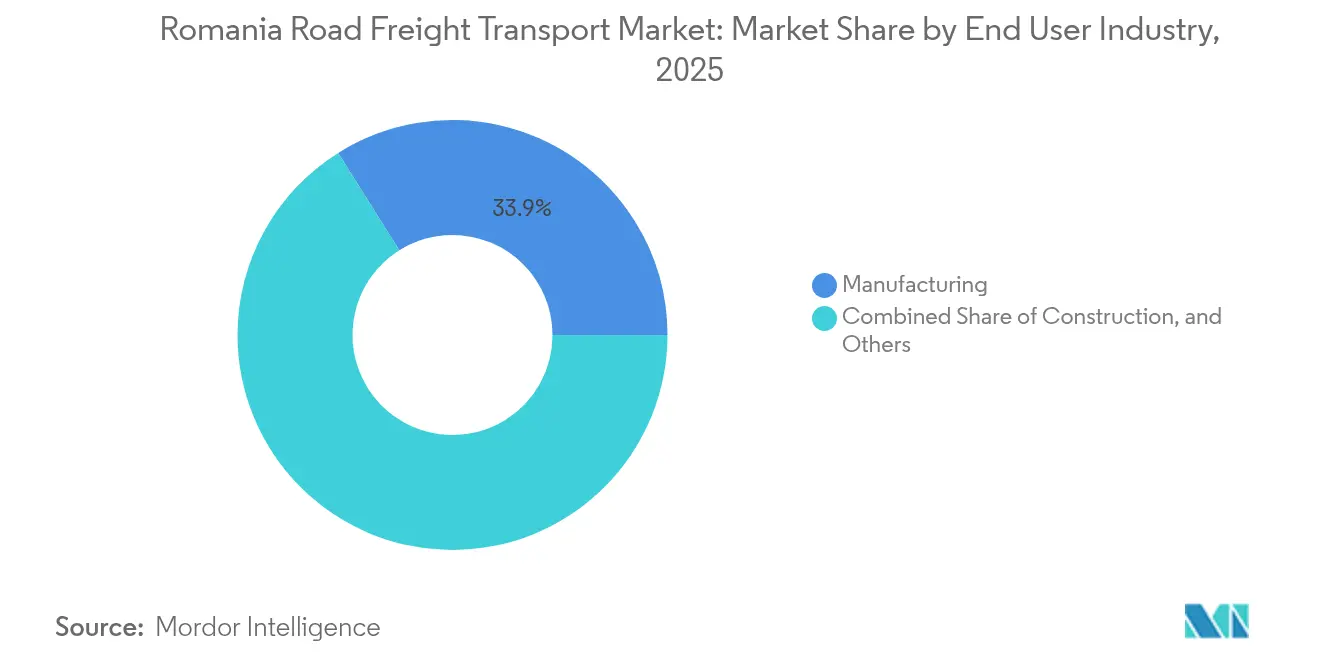
- By end user industry, manufacturing captured 33.92% of the Romania road freight transport market share in 2025, whereas wholesale and retail trade exhibits the fastest expansion at a 3.07% CAGR between 2026-2031.
- By destination, international shipments commanded 76.42% share of the Romania road freight transport market size in 2025 and are forecast to grow at 2.75% CAGR between 2026-2031.
- By truckload specification, full-truck-load services held 79.98% share in 2025 while less-than-truck-load posts the highest projected CAGR at 3.00% between 2026 and 2031.
- By containerization, non-containerized cargo controlled 90.35% share in 2025; containerized freight is advancing at a 2.73% CAGR between 2026-2031.
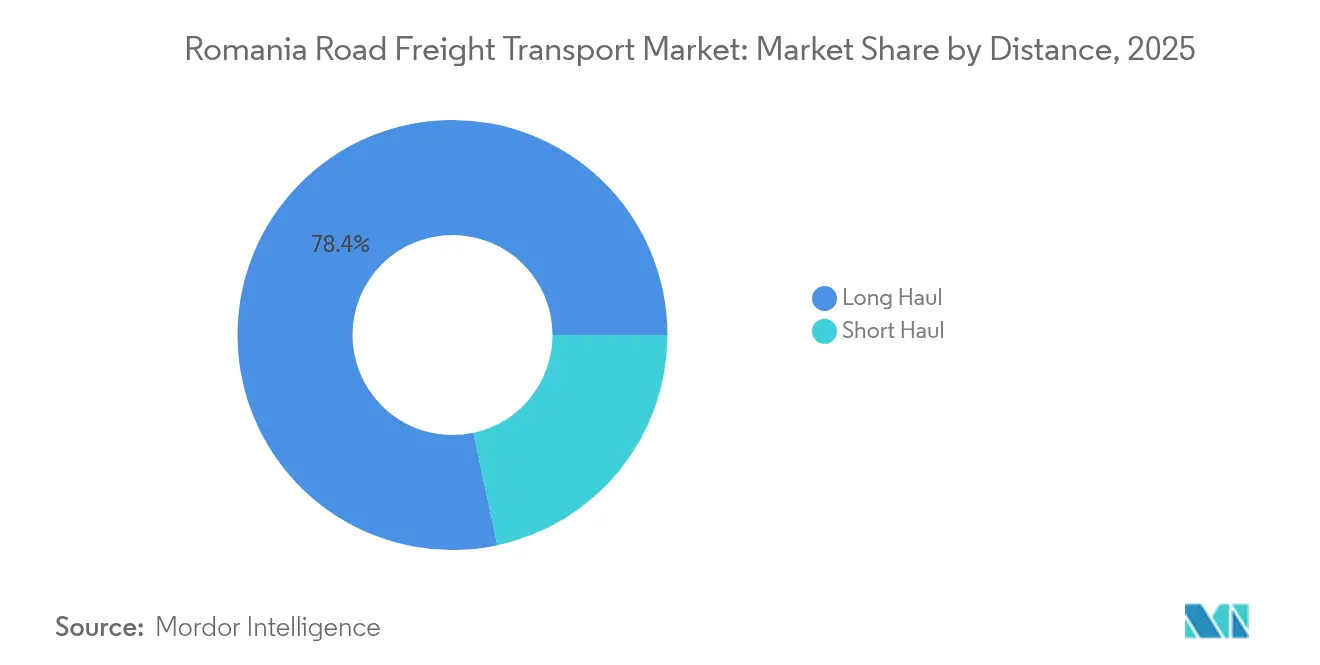
- By distance, long-haul operations accounted for 78.35% of 2025 value and are set to increase at 2.82% CAGR between 2026-2031.
- By goods configuration, solid goods comprised 71.43% of spend in 2025; fluid goods are slated to rise at a 2.88% CAGR between 2026-2031.
- By temperature control, non-temperature-controlled moves represented 94.05% in 2025, whereas temperature-controlled logistics leads growth at 2.94% CAGR between 2026-2031.
Note: Market size and forecast figures in this report are generated using Mordor Intelligence’s proprietary estimation framework, updated with the latest available data and insights as of 2026.
Romania Road Freight Transport Market Trends and Insights
Drivers Impact Analysis*
| Driver | (~) % Impact on CAGR Forecast | Geographic Relevance | Impact Timeline |
|---|---|---|---|
| Expansion of Romania's automotive export value-chains | 0.8% | National, with concentration in Argeș, Dolj, Timiș counties | Medium term (2-4 years) |
| Surge in cross-border e-commerce parcel volumes | 0.6% | National, with spillover to Hungary, Bulgaria | Short term (≤ 2 years) |
| EU-funded road infrastructure modernisation | 0.5% | National, priority on TEN-T corridors | Long term (≥ 4 years) |
| Accelerated adoption of digital freight-matching platforms | 0.3% | National, early gains in Bucharest, Cluj-Napoca, Timișoara | Medium term (2-4 years) |
| Near-shoring shift of West-European supply-chains to Romania | 0.4% | National, with concentration in western counties | Long term (≥ 4 years) |
| Growth of temperature-controlled pharma logistics | 0.2% | National, with early gains in Bucharest, Constanța | Medium term (2-4 years) |
| Source: Mordor Intelligence | |||
Expansion of Romania's Automotive Export Value-Chains
Automotive exports worth EUR 23.8 billion (USD 26.26 billion) in 2024 positioned Romania as Europe’s fourth-largest vehicle producer, catalyzing a dense web of component movements that keep trailers full in both outbound and reverse logistics lanes. Ford’s ongoing EUR 300 million (USD 330 million) upgrade of its Craiova plant illustrates OEM commitment to local EV volume, driving just-in-time inbound flows from tier-1 suppliers setting up in proximity. Higher model-mix complexity translates into more frequent, smaller part batches that load both full-truck-load and less-than-truck-load operations. Because finished vehicles travel predominantly on specialized carriers, component freight benefits from predictable backhauls that minimize empty kilometers. The automotive cluster’s location along the A1, A6, and A10 corridors also means new highway segments immediately translate into shorter transit windows to Western European assembly plants, strengthening the Romania road freight transport market’s pull factor for adjacent supplier investments[1].
Surge in Cross-Border E-Commerce Parcel Volumes
Regional e-commerce leader eMAG tripled cross-border order volumes in the three years to 2024, enrolling more than 12,000 Romanian merchants that now ship daily to Hungary and Bulgaria. Sameday’s EUR 30 million (USD 33.10 million) rollout of 8,500 pickup lockers and its June 2025 acquisition of Cargus expand last-mile density to an unmatched tri-country footprint, lowering unit delivery costs on high-frequency lanes. Road freight wins share in this parcel economy because private couriers offer end-to-end tracking and next-day guarantees that postal systems cannot match. Route-optimization software further compresses stem mileage while improving trailer fill, supporting the Romania road freight transport market’s pivot toward value-added, small-lot distribution. As marketplace sellers adopt pan-regional fulfillment, back-and-forth flows accelerate, ensuring both inbound returns and outbound parcels sustain round-trip truck utilization[2].
EU-Funded Road Infrastructure Modernization
Romania’s EUR 7.6 billion (USD 8.38 billion) National Recovery and Resilience Plan allocates the largest slice to highway construction, led by the 440-kilometer A7 Moldavia corridor now under simultaneous multi-lot build contracts. Every new kilometer of divided motorway replaces congested two-lane segments, shaving transit times and stabilizing arrival windows for time-critical loads. Ten new Hungary-Romania border crossings will lift crossing capacity 83%, absorbing peak-season surges without the historic tailbacks that cost operators idle driver hours and fuel. Digital overlay projects, notably mandatory RO e-Transport declarations, give authorities real-time visibility while furnishing carriers with predictive wait-time analytics. Combined, physical and digital upgrades elevate reliability and reduce total landed costs, reinforcing the competitiveness of the Romania road freight transport market against rail alternatives on European corridors.
Near-Shoring Shift of Western European Supply Chains
Geopolitical uncertainty and pandemic-era supply disruptions are prompting brands to pull production closer to demand centers. Romania benefits from EU membership, skilled labor, and wages roughly half of Western Europe, making it a natural node for assemblies feeding Germany, Italy, and France. Investors cite Schengen entry as a tipping point because eliminated border checks remove both time and paperwork, often equals 60-90 minutes saved per crossing, which compounds on round-trip loops. Contract electronics, apparel, and furniture producers are replicating the automotive playbook by clustering supplier parks around Arad and Timișoara, deepening freight density. As multi-national groups allocate more European regional stock points to Romania, the Romania road freight transport market becomes a favored dispatch base, reinforcing cross-border truckload volumes and stabilizing backhauls into domestic consumption centers.
Restraints Impact Analysis*
| Restraint | (~) % Impact on CAGR Forecast | Geographic Relevance | Impact Timeline |
|---|---|---|---|
| Persistent driver shortage and ageing work-force | -0.4% | National, acute in rural areas | Short term (≤ 2 years) |
| Rising tolls and fuel excise taxes | -0.3% | National, with cross-border impact | Short term (≤ 2 years) |
| Stricter EU fleet carbon-emission mandates | -0.2% | National, EU-wide compliance required | Medium term (2-4 years) |
| Border-crossing delays at external EU frontiers | -0.1% | Eastern borders with Ukraine, Moldova | Short term (≤ 2 years) |
| Source: Mordor Intelligence | |||
Persistent Driver Shortage and Ageing Workforce
Romania’s fleets report 9,091 vacant driver seats and predict a need for roughly 100,000 additional non-EU recruits to meet growth, a gap widened by migration of younger drivers to higher-pay West-European positions. Carriers elevate wages and per-diem allowances yet still struggle to fill seats, forcing tractors to sit idle even as order books rise. Prolonged vacancies inflate wage costs faster than freight rates, eroding small-operator margins and encouraging mergers that place drivers on pooled rosters. The demographic imbalance also means experienced drivers retire faster than trainees qualify, risking service disruptions on long-haul segments that require high-skill compliance with EU hours-of-service rules. Autonomous truck pilots remain exploratory, leaving human resource availability a structural cap on the near-term Romania road freight transport market expansion[3].
Rising Tolls and Fuel Excise Taxes
Diesel remains the sector’s largest controllable cost line, and EU-wide carbon-pricing schemes add incremental cents per liter every quarter, pressuring operating ratios. Meanwhile, Eurovignette toll harmonization brings satellite-based charging on weight-distance metrics that raise invoices for older, heavier rigs. Fleet-modernization outlays for Euro VI-E compliance further stretch balance sheets, particularly for owner-operators who lack group purchasing power. Inflationary pressures limit carriers’ ability to fully pass surcharges to shippers, squeezing net margins and expediting bankruptcy risks among micro-fleets that compose the bulk of Romania’s 36,000 licensed trucking companies. In reaction, shippers gravitate toward asset-heavy providers that can hedge fuel with forward contracts, accelerating the Romania road freight transport market’s consolidation curve[4].
*Our forecasts treat driver/restraint impacts as directional, not additive. The impact forecasts reflect baseline growth, mix effects, and variable interactions.
Segment Analysis
By End User Industry: Manufacturing Anchors Freight Demand
Manufacturing generated 33.92% of 2025 freight spend, underscoring its position as the load-density engine of the Romania road freight transport market; wholesale and retail trade, though smaller, is forecast to clock the fastest 3.07% CAGR between 2026-2031 and will narrow the gap by 2031. Automotive, electrical, and machinery verticals schedule inbound component flows on tight takt times, enabling carriers to pre-plan capacity months ahead and keep trailer turns high. Regular cadence yields cost efficiency that filters across the Romania road freight transport industry’s subcontractor networks, stabilizing rates even in seasonal troughs.
Retail-centric freight differs markedly, favoring palletized general-merchandise loads and high parcel densities propelled by next-day delivery promises. Cross-docking hubs near Bucharest and Cluj-Napoca orchestrate SKU mixing for regional store replenishment, translating into frequent less-than-truck-load movements. Infrastructure projects maintain a steady baseline for construction materials, yet their logistical footprint is geographically concentrated near major highway and rail builds, producing episodic surges rather than secular growth. Agriculture triggers harvest-time demand spikes, often forcing spot-market rate premiums when grain and sunflower crops converge with peak export windows. Servicing these divergent cycles demands fleet flexibility and underscores why integrated operators that blend contract and spot revenue outperform in the Romania road freight transport market.

By Destination: International Flows Drive Market Growth
International traffic represented 76.42% of 2025 revenue, reflecting Romania’s pivotal location between Central European consumption zones and Black Sea exits; it is also projected to outpace domestic at a 2.75% CAGR between 2026-2031 as Schengen benefits accrue. Eliminated land-border checks remove multi-hour queuing and random physical inspections, making Romanian carriers more cost-competitive on Western corridors versus Polish or Slovak peers. Shippers redistributing European inventory away from congested North-Sea ports increasingly book Romanian depots as secondary hubs, elevating export backhaul availability.
Domestic flows, though only 23.58% share in 2025, underpin last-mile fulfillment and short-haul construction materials moves. Their growth hinges on rising disposable income and continued urban retail footprint expansion. Rural roads still pose axle-weight limits and travel-speed constraints, pushing some intra-country moves onto rail or river, although upcoming county-road resurfacing financed under Cohesion Funds may gradually mitigate these frictions. The Romania road freight transport market, therefore, remains oriented toward continental reach while progressively smoothing internal route productivity.
By Truckload Specification: FTL Dominance Faces LTL Challenge
Full-truck-load (FTL) services commanded 79.98% share in 2025, capitalizing on bulk cargoes and consistent industrial shuttles that fill a trailer end-to-end and grant cost leadership per ton-kilometer. Digital bidding platforms, however, are eroding FTL’s moat by giving smaller shippers dynamic access to less-than-truck-load (LTL) capacity, catalyzing LTL’s 3.00% CAGR between 2026-2031 trajectory. FTL still retains structural advantages on long-haul lanes where stop frequency is limited by drivers’ hours-of-service windows and border documentation.
E-commerce parcelization fragments shipment profiles, pulling volumes into LTL and even parcel carrier networks. Algorithms on 123cargo aggregate complementary pallet groups, translating stochastic order patterns into viable truckloads, lifting fleet utilization from 73% to beyond 85% for platform adopters. For the Romania road freight transport market, the coexistence of high-volume automotive parts and dispersed consumer goods creates a balanced demand matrix that invites hybrid operators capable of flexing between FTL and LTL micro-hubs.
By Containerization: Non-Containerized Freight Maintains Dominance
Non-containerized freight accounted for 90.35% in 2025 due to grain, raw timber, coil steel, and oversized vehicle components that either exceed ISO-container dimensions or require top-loading. Yet containerized traffic’s 2.73% CAGR between 2026-2031 signals early modal convergence as inland depots invest in reach-stackers and rail sidings compatible with 45-foot units. Growing adoption of returnable packaging in automotive and electronics could further tilt volumes, especially as shippers seek damage reduction and easier customs clearance that standardized seals facilitate.
Port Constanța’s ongoing berth deepening and rail-spur electrification shorten transfer times to Bucharest and Ploiești warehouses, incentivizing shippers to test sea-rail-road combinations. While the Romania road freight transport market keeps its non-containerized core, container growth introduces new chassis fleet requirements and forces carriers to master terminal slot booking, an operational discipline traditionally confined to coastal peers.
By Distance: Long-Haul Operations Lead Growth
Long-haul hauls absorbed 78.35% of 2025 expenditure and will widen their lead with a 2.82% CAGR between 2026-2031, propelled by transit services bridging Germany-Greece and Poland-Turkey corridors. The A1 and A3 motorways, plus upcoming A7, reduce door-to-door days by shaving 20-25% off previous detours through secondary roads. Cross-border lanes thus transition from two-day to sub-twenty-hour runs, realigning driver shift scheduling and attracting higher-value freight.
Short-haul services remain indispensable for urban replenishment, but patchy ring-road access around secondary cities adds idle fuel burn and delays. Municipal low-emission zones under discussion for Bucharest could impose timing restrictions that complicate multi-drop routing. As such, operational excellence in the Romania road freight transport market increasingly depends on carriers’ ability to integrate line-haul trunking with regionally dispersed spoke deliveries without compromising service KPIs.
By Goods Configuration: Solid Goods Dominate Transport Volumes
Solid goods composed 71.43% of turnover in 2025, driven by automotive parts, packaged food, and construction aggregates. Predictability in production cycles allows calendarized slotting at plant docks, reducing detention fees. Fluid goods—fuels, chemicals, and edible oils—register a faster 2.88% CAGR between 2026-2031 thanks to refinery upgrades and agro-industrial biodiesel capacity expansions along the Danube. Specialized stainless-steel tankers mitigate product contamination risk, commanding freight rate premiums 30–40% above dry vans.
For road-only moves above 300 kilometers, the relative advantage of pipelines and rail spur lines has capped fluid road share; however, in markets with time-sensitive delivery windows or multiple drop points, road retains the flexibility edge. Environmental, Health, and Safety standards necessitate driver certification in ADR handling, adding training overhead. Nevertheless, high rate per kilometer stabilizes the Romania road freight transport industry cashflows when solid-goods peaks subside.
By Temperature Control: Cold Chain Logistics Shows Fastest Growth
Non-temperature-controlled hauls still dominate with 94.05%, but the 2.94% CAGR between 2026-2031 posted by temperature-controlled freight makes it the sector’s sprint leader. Export-oriented pharma plants around Bucharest rely on GDP-certified reefer trucks outfitted with telematics that log temperature excursions in real time, a prerequisite for EU batch-release compliance. Retail grocery giants, led by Lidl’s aggressive store rollout, increasingly demand dual-compartment trailers capable of holding both frozen and chilled SKUs on the same route.
Capital intensity is formidable—acquisition prices for multi-temp reefers exceed dry vans by 70%—yet freight yields justify payback within four years. Operators mastering door-to-door integrity build resilient client relationships, shielded from commoditized spot rates that plague the broader Romania road freight transport market. As EU food safety audits tighten, cold chain lapses face product recalls and reputational damage, elevating the barrier to entry and conferring pricing power on incumbents.
Geography Analysis
Romania’s geographic relevance derives from its triangulation among Central Europe, the Black Sea, and the Balkans, a positioning amplified when Schengen rules took effect in January 2025, nullifying land-border formalities with fellow-member states and unlocking EUR 2.55 billion (USD 2.81 billion) in annual efficiency gains. The Romania road freight transport market consequently functions as both entry gate and consolidation hub for supply chains feeding Germany, Austria, and Italy northbound, and Greece, Turkey, and Bulgaria southbound.
Northern counties such as Cluj and Bihor attract technology assembly investment, spawning regional distribution centers that dispatch consolidated shipments overnight to Budapest and Bratislava, while inbound parts flow through Constanța’s port, making the Black Sea corridor integral to inland reach. Western clusters, notably Timișoara and Arad, capitalize on four-hour trucking access to Vienna and Munich, enabling just-in-sequence component deliveries that shrink supplier inventories along the Danube axis. The A7 Moldavia Highway’s phased openings progressively stitch the under-served eastern provinces into the national grid, promising a step-change for export-oriented agribusiness that currently detours via congested national roads. Constanța’s L-shape hinterland catchment is widening as rail-spur electrification links the port to Bucharest’s logistics parks in sub-three hours, enhancing intermodal competitiveness. Prospective completion of the Bucharest-Danube Canal would shave 180 kilometers off road diversion for bulk grain bound for inland waterway barges, potentially shifting low-margin tonnage away from trucks but creating lucrative first-mile shuttle contracts. Across the eastern frontier, Ukrainian crisis-linked flows elevate humanitarian and defense cargo volume, though non-EU customs protocols at Siret and Albița still impose dwell-time penalties that operators price into tariffs. Overall, geographic advantages coupled with infrastructural catch-up keep Romania’s network utility high, ensuring sustained volume corridors for the Romania road freight transport market.
Competitive Landscape
The Romania road freight transport market blends long-tail fragmentation with headline-grabbing mega-deals that tilt the playing field toward scale economies. DSV’s EUR 14.3 billion (USD 15.78 billion) takeover of DB Schenker completed in April 2025 doubles its European footprint, granting it unrivaled lane density across Romania’s export corridors and amplifying procurement leverage on fuel, tires, and ICT systems. Such heft permits full freight-management outsourcing contracts that mid-tier rivals cannot replicate, accelerating the flight-to-quality among multinationals seeking single-provider control towers.
Parcel express exhibits similar consolidation. Sameday’s mid-2025 acquisition of Cargus folds the two biggest indigenous couriers into a single 8,500-pickup-point grid, positioned to challenge incumbent Fan Courier’s overnight supremacy. The merged network blends dense urban lockers with rural courier reach, fortifying last-mile coverage essential for cross-border e-commerce scalability. Temperature-controlled logistics remains a less crowded niche with high barriers; a handful of GDP-certified specialists control the reefer fleet, creating premium yield that offsets capex intensity.
Digitalization is the great leveler. Platforms like 123cargo and Timocom match loads to empty kilometers in seconds, empowering micro-fleets that still account for two-thirds of licensed tractors. Compliance demands, notably RO e-Transport, push these smaller carriers to either adopt SaaS-based telematics or affiliate with larger 3PLs that embed regulatory tech costs into broader service bundles. Consequently, merger-and-acquisition momentum is expected to persist as macro-operators seek terminal density, back-office synergies, and skilled-driver pools, while niche specialists differentiate via cold chain or oversized-load expertise within the broader Romania road freight transport market.
Romania Road Freight Transport Industry Leaders
-
DSV A/S (including DB Schenker)
-
DHL Group
-
Kuehne + Nagel
-
AQUILA PART PROD COM SA
-
International Lazar Company
- *Disclaimer: Major Players sorted in no particular order
Recent Industry Developments
- June 2025: Sameday, part of eMAG Group, acquired courier rival Cargus, combining 2024 revenues of RON 1.77 billion (USD 392.40 billion) and delivering a national parcel network exceeding 8,500 pick-up points subject to antitrust clearance.
- April 2025: DSV finalized its EUR 14.3 billion (USD 15.78 billion) purchase of DB Schenker, creating Europe’s largest logistics network with significant overlap across Romanian corridors.
- March 2025: Lidl inaugurated a 55,000 m² multi-temperature logistics center near Bucharest to service the enlarged store estate, triggering dedicated reefer lane awards to regional carriers.
- January 2025: Lidl Romania confirmed plans to open 25 additional supermarkets during 2025, following twelve launches in March, thereby expanding temperature-controlled distribution flow requirements across its refrigerated DC network.
Romania Road Freight Transport Market Report Scope
Agriculture, Fishing, and Forestry, Construction, Manufacturing, Oil and Gas, Mining and Quarrying, Wholesale and Retail Trade, Others are covered as segments by End User Industry. Domestic, International are covered as segments by Destination. Full-Truck-Load (FTL), Less than-Truck-Load (LTL) are covered as segments by Truckload Specification. Containerized, Non-Containerized are covered as segments by Containerization. Long Haul, Short Haul are covered as segments by Distance. Fluid Goods, Solid Goods are covered as segments by Goods Configuration. Non-Temperature Controlled, Temperature Controlled are covered as segments by Temperature Control.| Agriculture, Fishing, and Forestry |
| Construction |
| Manufacturing |
| Oil and Gas, Mining and Quarrying |
| Wholesale and Retail Trade |
| Others |
| Domestic |
| International |
| Full-Truck-Load (FTL) |
| Less than-Truck-Load (LTL) |
| Containerized |
| Non-Containerized |
| Long Haul |
| Short Haul |
| Fluid Goods |
| Solid Goods |
| Non-Temperature Controlled |
| Temperature Controlled |
| End User Industry | Agriculture, Fishing, and Forestry |
| Construction | |
| Manufacturing | |
| Oil and Gas, Mining and Quarrying | |
| Wholesale and Retail Trade | |
| Others | |
| Destination | Domestic |
| International | |
| Truckload Specification | Full-Truck-Load (FTL) |
| Less than-Truck-Load (LTL) | |
| Containerization | Containerized |
| Non-Containerized | |
| Distance | Long Haul |
| Short Haul | |
| Goods Configuration | Fluid Goods |
| Solid Goods | |
| Temperature Control | Non-Temperature Controlled |
| Temperature Controlled |
Market Definition
- Agriculture, Fishing, and Forestry (AFF) - This end user industry segment captures the external (outsourced) logistics expenditure incurred by the AFF industry players on road freight transport service. The end user players considered are the establishments primarily engaged in growing crops, raising animals, harvesting timber, harvesting fish & other animals from their natural habitats and providing related support activities. Herein, across the value chain, Logistics Service Providers (LSPs) play a crucial role in acquisition, storage, handling, transportation, and distribution activities for the optimal & continuous flow of inputs (seeds, pesticides, fertilizers, equipment, and water) from manufacturers or suppliers to the producers and smooth flow of output (produce, agro-goods) to distributors/ consumers. This includes both termperature controlled and non-temperature controlled logistics, as and when required according to the shelf life of goods being transported or stored.
- Construction - This end user industry segment captures the external (outsourced) logistics expenditure incurred by the construction industry players, on road freight transport service. The end user players considered are the establishments primarily engaged in constructing, repairing and renovating residential & commercial buildings, infrastructure, engineering works, subdividing and developing land. Logistics Service Providers (LSPs) play a crucial role in increasing profitability of construction projects by maintaing the inventory of raw materials & equipment, time-critical supplies and by providing other value added services for effective project management.
- Containerized Road Freight Transport - The segment captures the external (outsourced) logistics expenditure incurred by the road freight transport service end users on Full-Truck-Load (FTL) services. FTL road freight transport is characterized as a full single load not combined with other shipments. It comprises of shipments (i) devoted to the goods of a single shipper (ii) taken directly from a point of origin to one or more destination points (iii) comprising of bulk mail truck transportation (iv) comprising of both Container (Full Container Load, FCL)/Non-Container trucking services (v)comprsing of goods requiring temperature controlled or non-temperature controlled transportation services (vi) comprising of bulk liquid tankering (vii) invoving trucking of waste (viii) hazardous material trucking. Related value added services (VAS) of sorting, consolidation, deconslidation are included in the other services segment of freight and logistics market.
- Export Trends and Import Trends - Overall logistics performance of an economy is positively and significantly (statistically) correlated to its trade performance (exports and imports). Hence, in this industry trend, total value of trade, major commodities/ commodity groups and the major trade partners, for the studied geography (country or region as per the scope of report) have been analysed alongside the impact of major trade/logistics infrastructure investments & regulatory environment.
- Fluid Goods - The segment captures the external (outsourced) logistics expenditure incurred by the road freight transport service end users for the transport of bulk liquids, that are often used in extraction, manufacturing, food processing, agriculture industries among others. It includes transportation of liquids like (i) Chemicals/ hazardous goods (for instance acids) (ii) Water (potable as well as waste) (iii) Oil and gas (upstream as well as downstream like gasoline, fuel, crude oil, or propane), (iv) Food grade bulk liquids (like milk, or juice), (v) Rubber, (vi) Agrichemical products, among others. These goods are generally transported through tanker trucking.
- Fuel Price - Fuel price spikes can cause delays and diruption for logistics service providers (LSPs), while drops in the same can result in higher short-term profitability and increased market rivalry to offer consumers with the best deals. Hence, the fuel price variations have been studied over the review period and presented along with the causes as well as market impacts.
- Full-Truck-Load (FTL) Road Freight Transport - The segment captures the external (outsourced) logistics expenditure incurred by the road freight transport service end users on Full-Truck-Load (FTL) services. FTL road freight transport is characterized as a full single load not combined with other shipments. It comprises of shipments (i) devoted to the goods of a single shipper (ii) taken directly from a point of origin to one or more destination points (iii) comprising of bulk mail truck transportation (iv) comprising of both Container (Full Container Load, FCL)/Non-Container trucking services (v)comprsing of goods requiring temperature controlled or non-temperature controlled transportation services (vi) comprising of bulk liquid tankering (vii) invoving trucking of waste (viii) hazardous material trucking. Related value added services (VAS) of sorting, consolidation, deconslidation are included in the other services segment of freight and logistics market.
- GDP Distribution by Economic Activity - Nominal Gross Domestic Product and distribution of the same, across major economic sectors in the geography studied (country or region as per scope of the report) have been studied and presented in this industry trend. As GDP is positively related to the profitability and growth of logistics industry, this data has been used in adjunction to the input-output tables/ supply-use tables for analyzing the potential major contributing sectors towards the logistics demand.
- GDP Growth by Economic Activity - Growth of Nominal Gross Domestic Product across major economic sectors, for the geography studied (country or region as per scope of the report) have been presented in this industry trend. This data has been utilized for assessing the growth of logistics demand from all the market end users (economic sectors considered here).
- Inflation - Variations in both Wholesale Price Inflation (YoY change in producer price index) and Consumer Price Inflation have been presented in this industry trend. This data has been used to assess the inflationary environment as it plays a vital role in smooth functioning of the supply chain, directly impacting the logistics operational cost components e.g., pricing of tyres, driver wages & benefits, energy/fuel prices, maintenace costs, toll charges, warehousing rents, custom brokerage, forwarding rates, courier rates etc. hence impacting the overall freight and logistics market.
- Key Industry Trends - The report section named "Key Industry Trends" include all the key variables/parameters studied to better analyze the market size estimates and forecasts. All the trends have been presented in the form of data points (time series or latest available data points) along with analysis of the paramter in the form of concise market relevant commentary, for the geography studied (country or region as per the scope of report).
- Key Strategic Moves - The action taken by a company to differentiate from its competitor or used as a general strategy is referred to as a key strategic move (KSM). This includes (1) Agreements (2) Expansions (3) Financial Restructuring (4) Mergers and Acquisitions (5) Partnerships, and (6) Product Innovations. Key players (Logistics Service Providers, LSPs) in the market have been shortlisted, their KSM have been studied and presented in this section.
- Less than-Truck-Load (LTL) Road Freight Transport - The segment captures the external (outsourced) logistics expenditure incurred by the road freight transport service end users on Less than-Truck-Load (LTL) services. LTL road freight transport is characterized as multiple shipments combined onto a single truck for multiple deliveries within a network. It comprises of establishments (i) primarily engaged in general and specialized freight trucking of less than complete truck-loads, (ii) characterized by the use of terminals to consolidate shipments, generally from several shippers, into a single truck for haulage between a load assembly terminal and a disassembly terminal, where the load is sorted and shipments are re-routed for delivery (iv) Less than-Container-Load (LCL) shipping/ Groupage Shipping in case of trucking services. The activities in scope include (i) local pick-up, (ii) line-haul, and (iii) local delivery. Related value added services (VAS) of sorting, consolidation, deconslidation are included in the other services segment of freight and logistics market.
- Logistics Performance - Logistics Performance and Logistics Costs are the backbone of trade, and influences trade costs, making countries compete globally. Logistics performance is influenced by market wide adopted supply chain management strategies, government services, investments & policies, fuel/ energy costs, inflationary environment etc. Hence, in this industry trend, the logistics performance of the geography studied (country/ region as per the scope of report) has been analysed and presented over the review period.
- Major Truck Suppliers - Market share of truck brands is influenced by factors like geographical preferences, portfolio of truck types, truck prices, local production, truck repair & maintenance service peneteration, customer support, technological innovations (like electric vehicles, digitalization, autonomous trucks), fuel efficiency, financing options, annual maintenance costs, availability of substitutes, marketing startegies etc. Hence, the distribution (share % for base year of the study) of truck sales volume for leading truck brands and commentary on current market scenario & market anticipation over the forecast period have been presented in this industry trend.
- Manufacturing - This end user industry segment captures the external (outsourced) logistics expenditure incurred by the Manufacturing industry players, on road freight transport service. The end user players considered are the establishments primarily engaged in the chemical, mechanical or physical transformation of materials or substances into new products. Logistics Service Providers (LSPs) play a crucial role in maintaining a smooth flow of raw materials across the supply chain, enabling timely delivery of finished goods to distributors or end customers and storing & supplying the raw materials to clients for just-in-time manufacturing.
- Modal Share - Freight Modal Share is influenced by factors like modal productivity, government regulations, containerization, distance of shipment, temperature control requirements, type of goods, international trade, terrain, speed of delivery, shipment weight, bulk shipments, etc. Also, modal share by tonnage (tons) and modal share by freight turnover (ton-km) differ as per average distance of shipments, weight of major commodity groups transported in the economy and number of trips. This industry trend represents the distribution of freight transported by mode of transport (tons as well as ton-km), for the study base year.
- Oil and Gas, Mining and Quarrying - This end user industry segment captures the external (outsourced) logistics expenditure incurred by the extraction industry players, on road freight transport service. The end user players considered are the establishments that extract naturally occurring mineral solids, such as coal and ores; liquid minerals, such as crude petroleum; and gases, such as natural gas. Logistics Service Providers (LSPs) covers entire phases from upstream to downstream and plays a crucial role in the transportation of machinery, drilling equipments, extracted minerals, crude oil & natural gas and refined/ processed products from one place to another.
- Other End Users - Other end user segment captures the external (outsourced) logistics expenditure incurred by the financial services (BFSI), real estate, educational services, healthcare, and professional services (administrative, waste management, legal, architectural, engineering, design, consulting, scientific R&D), on road freight transport service. Logistics Service Providers (LSPs) plays a crucial role in the reliable movement of supplies and documents to/from these industries such as transporting any equipment or resources required, shipping confidential documents and files, movement of medical goods & supplies (surgical supplies and instruments, including gloves, masks, syringes, equipment) to name a few.
- Producer Price Inflation - It indicates inflation from viewpoint of the producers viz. the average selling price received for their output over a period of time. Annual change (YoY) of producer price index is reported as wholesale price inflation in the "Inflation" industry trend. As WPI captures dynamic price movements in most comprehensive way, it is widely used by governments, banks, industry, business circles and is deemed important in formulation of trade, fiscal and other economic policies. The data has been used in adjunction to consumer price inflation for better understanding the inflationary environment.
- Road Freight Pricing Trends - Freight pricing by mode of transport (USD/tonkm), over the review period, has been presented in this industry trend. The data has been used in assessing the inflationary environment, impact on trade, freight turnover (tonkm), road freight transport market demand and hence the road freight transport market size.
- Road Freight Tonnage Trends - Freight tonnage (weight of goods in tons) handled by mode of transport, over the review period, has been presented in this industry trend. The data has been used as one of the parameters apart from average distance per shipment (km), freight volume (tonkm), and freight pricing (USD/tonkm) to assess the freight transport market size.
- Road Freight Transport - Hiring a road freight transport logistics service provider (LSP) or haulier (outsourced logistics), for the transport of commodities constitutes road freight transport market. The scope of study includes (i) road transport of goods reported by hauliers registered in the reporting countries (ii) transport of raw materials or manufactured goods (solids as well as fluids) (iii) transport using commerical motor vehicles (rigid trucks or tractor-trailers, (iv) Full-Truck-Load (FTL) or Less than-Truck-Load (LTL) transport (v) containerized or non-containerized transport (vi) temperature controlled or non-temperature controlled trasnport, (vii) short haul or long haul (Over-the-road, OTR) transport, (viii) used office or household goods transport (movers and packers), (ix) other specialized cargo transport (dangerous goods, oversized cargo) and (x) outsourced first mile/ middle mile/last mile delivery shipments undertaken by road freight transport players. The scope does not include (i) transport undertaken by hauliers registered in other countries (ii) last mile meal delivery market (iii) grocery delivery market (iv) transportation via road network undertaken/ reported by Courier, Express, and Parcel (CEP) players.
- Road Length - As infrastructure plays a vital role in an economy's logistics performance, variables like length of roads, distribution of road length by surface category (paved v/s unpaved), distribution of road length by road classification (expressways v/s highways v/s other roads), have been analysed and presented in this industry trend.
- Segmental Revenue - Segmental Revenue has been triangulated or computed and presented for all the major players in the market. It refers to the road freight transport market specific revenue earned by the company, over the base year of study, in the geography studied (country or region as per the scope of report). It is computed through the study and analysis of major parameters like financials, service portfolio, employee strength, fleet size, investments, number of countries present in, major economies of concern, etc. that have been reported by the company in its annual reports, webpage. For companies having scarce financial disclosures, paid databases like D&B Hoovers, Dow Jones Factiva have been resorted to and verified through industry/expert interactions.
- Short Haul Road Freight Transport - The segment captures the external (outsourced) logistics expenditure incurred by the road freight transport service end users on local trucking (less than 100 miles). It includes the road transport of goods (i) within a single administrative area and its hinterland, (ii) by smaller trucks and pickup trucks (iii) via containerized as well as dry bulk services (iv) intermodal from ports, container terminals or airports, and (v) outsourced first mile/ last mile delivery shipments undertaken by road freight transport players.
- Transport and Storage Sector GDP - Value and growth of Transport and Storage Sector GDP has a direct relation to the freight and logistics market size, and hence road freight transport market size. Therefore, this variable has been studied and presented over the review period, in value terms (USD) and as share % of total GDP, in this industry trend. The data has been supported by concise and relevant commentary around the investments, developments, and current market scenario.
- Trends in E-Commerce Industry - Enhanced internet connectivity and boom in smartphone penetration, coupled with increasing disposable incomes, has led to a phenomenal growth in the e-commerce market globally. Online shoppers require fast and efficient delivery of their orders leading to an increase in the demand for logistics services especially e-commerce fulfilment services. Hence, the Gross Merchandise Value (GMV), historial and projected growth, breakup of major commodity groups in e-commerce industry for the studied geography (country or region as per scope of the report) have been analysed and presented in this industry trend.
- Trends in Manufacturing Industry - Manufacturing industry involves the transformation of raw materials into finished products, while logistics industry ensures the efficient flow of raw materials to the factory, and the transport of manufactured products to the distributors & consumers. Demand-Supply of both industries are highly cross-linked and critical for a seamless supply chain. Hence, the Gross Value Added (GVA), breakup of GVA into major manufacturing sectors, and growth of manufacturing industry over the review period have been analysed and presented, in this industry trend.
- Trucking Fleet Size By Type - Market share of truck types is influenced by factors like geographical preferences, major end user industries, truck prices, local production, truck repair & maintenance service peneteration, customer support, technological disruptions (like electric vehicles, digitalization, autonomous trucks) etc. Hence, the distribution (share % for base year of study) of truck parc volume by type of truck, market disruptors, truck manufacturing investments, truck specifications, truck use & import regulations, and market anticipation over the forecast period have been presented in this industry trend.
- Trucking Operational Costs - The prime reasons for measuring/ benchmarking logistics performance of any trucking company are to reduce operational costs and increase profitability. On the other hand, measuring operational costs helps to identify whether and where to make operational changes to control expenses and identify areas for improved performance. Hence, in this industry trend, trucking operational costs and the variables involved viz. driver wages & benefits, fuel prices, repairs & maintenance costs, tyre costs etc. have been studied over the base year of study, and presented for the geography studied (country or region as per the scope of report).
- Wholesale and Retail Trade - This end user industry segment captures the external (outsourced) logistics expenditure incurred by the wholesalers and retailers, on road freight transport service. The end user players considered are the establishments primarily engaged in wholesaling or retailing merchandise, generally without transformation, and rendering services incidental to the sale of merchandise. Logistics Service Providers (LSPs) plays a crucial role in the reliable movement of supplies to and finished products from production houses to the distributors and finally to the end customer covering activites like material sourcing, transportation, order fulfillment, warehousing & storage, demand forecasting, inventory management etc.
| Keyword | Definition |
|---|---|
| Cabotage | Road transport by a motor vehicle registered in a country performed on the national territory of another country. |
| Cross Docking | Cross docking is a logistics procedure where products from a supplier or manufacturing plant are distributed directly to a customer or retail chain with marginal to no handling or storage time. Cross docking takes place in a distribution docking terminal; usually consisting of trucks and dock doors on two (inbound and outbound) sides with minimal storage space. The name ‘cross docking’ explains the process of receiving products through an inbound dock and then transferring them across the dock to the outbound transportation dock. |
| Cross Trade | International road transport between two different countries performed by a road motor vehicle registered in a third country. A third country is a country other than the country of loading/embarkation and than the country of unloading/disembarkation. |
| Dangerous Goods | The classes of dangerous goods carried by Road are those defined by the fifteenth revised edition of the UN Recommendations on the Transport of Dangerous Goods, United Nations, Geneva 2007. They include Class 1: Explosives; Class 2: Gases; Class 3: Flammable Liquids; Class 4: Flammable solids- substances liable to spontaneous combustion; substances which, on contact with water, emit flammable gases; Class 5: Oxidizing substances and organic peroxides; Class 6: Toxic and infectious substances; Class 7: Radioactive material and Class 8: Corrosive substances, Class 9: Miscellaneous dangerous substances and articles. |
| Direct Shipment | Direct shipment is a method of delivering goods from the supplier or the product owner to the customer directly. In most cases, the customer orders the goods from the product owner. This delivery scheme reduces transportation and storage costs, but requires additional planning and administration. |
| Drayage | A drayage is a form of trucking service that connects the different modes of shipping (intermodal), such as ocean freight or air freight. It’s a short-haul trip that transports goods from one place to another, usually before or after its long-haul shipping process. Drayage trucks move cargo to and from various destinations, such as container ships, storage lots, order fulfillment warehouses, and rail yards. Typically, drayage only transports goods in short distances and operates only in one metropolitan area. It also requires only one trucker in a single shift. But despite this, but it plays an important role in long-haul shipping because it gets the goods to the cargo and vice versa. It makes intermodal transport much more efficient and enables the seamless transfer of goods to the end customer. |
| Dry van | A dry van is a type of semi-trailer that's fully enclosed to protect shipments from outside elements. Designed to carry palletized, boxed or loose freight, dry vans aren't temperature-controlled (unlike refrigerated “reefer” units) and can't carry oversized shipments (unlike flatbed trailers). |
| Final Demand | Final demand includes all types of commodities (goods as well as services) consumed as final use and might include personal consumption, or consumption by government, by businesses as capital investment, and as exports. includes all types of commodities (goods as well as services) consumed as final use and might include personal consumption, or consumption by government, by businesses as capital investment, and as exports. |
| Flatbed Truck | A flatbed truck is a type of truck with rigid design. It has a back body that is flatly shaped for easy loading and unloading of goods. The flatbed truck is mostly used to transport heavy, oversized, wide and indelicate goods such as machinery, building supplies or equipment. Due to the truck open body, the goods transported with it must not be vulnerable to rain. By functionality, the flatbed truck is comparable to a flatbed trailer. |
| Inbound Logistics | Inbound logistics is the way materials and other goods are brought into a company. This process includes the steps to order, receive, store, transport and manage incoming supplies. Inbound logistics focuses on the supply part of the supply-demand equation. |
| Intermediate Demand | Intermediate demand includes goods, services, and maintenance and repair construction sold to businesses, excluding capital investment. |
| International Loaded | Place of loading of goods in reporting country (i.e., country in which the vehicle performing the transport is registered) and place of unloading in a different country. |
| International Unloaded | Place of unloading of goods in reporting country (i.e., country in which the vehicle performing the transport is registered) and place of loading in a different country. |
| OOG cargo | Out of Gauge (OOG) cargo is any cargo that can not be loaded into six-sided shipping containers simply because it is too large. The term is a very loose classification of all cargo with dimensions beyond the maximum 40HC container dimensions. That is a length beyond 12.05 meters – a width beyond 2.33 meters – or a height beyond 2.59 meters. |
| Pallets | Raised platform, intended to facilitate the lifting and stacking of goods. |
| Part load | A part load describes goods which only fills a truck partially. In essence, the quantity of the shipment is bigger than the Less Than Truckload (LTL) shipment. Also, the shipment cannot fully occupy a truck i.e. its capacity is much lower than a Full Truckload (FTL) shipment. |
| Paved Road | Road surfaced with crushed stone (macadam) with hydrocarbon binder or bituminized agents, with concrete or with cobblestone. |
| Reverse Logistics | Reverse logistics comprises of the sector of supply chains that process anything returning inwards through the supply chain or traveling ‘backward’ through the supply chain. |
| Road Freight Transport Service | Hiring a trucking agency for transport of commodities (raw materials or manufactured goods including both solids and liquids) form the origin to a destination within the country (domestic) or cross-border (international) constitutes road freight transport market. The service might be Full-Truck-Load or Less than-Truck-Load, containerized or non-containerized, temperature controlled or non temperature controlled, short haul or long haul. |
| Tautliner vehicle | Tautliner and curtainsider are used as generic names for curtain sided trucks/trailers. The curtains are permanently fixed to a runner at the top and detachable rails/poles at front and rear, allowing the curtains to be drawn open and forklifts used all along the sides for easy and efficient loading and unloading. When closed for travel, vertical load restraint straps are attached to a rope rail beneath the truck bed, connecting the truck bed and curtain along both sides. Winches at either end of the curtain tension it, hence the 'Tautliner' name. This stops the curtain from flapping or drumming in the wind and can also help retain light loads from slipping sideways. |
| Transport for hire or reward | The carriage for remuneration of goods. |
| Unpaved Road | Road with a stabilized base not surfaced with crushed stone, hydrocarbon binder or bituminized agents, concrete or cobblestone. |
Research Methodology
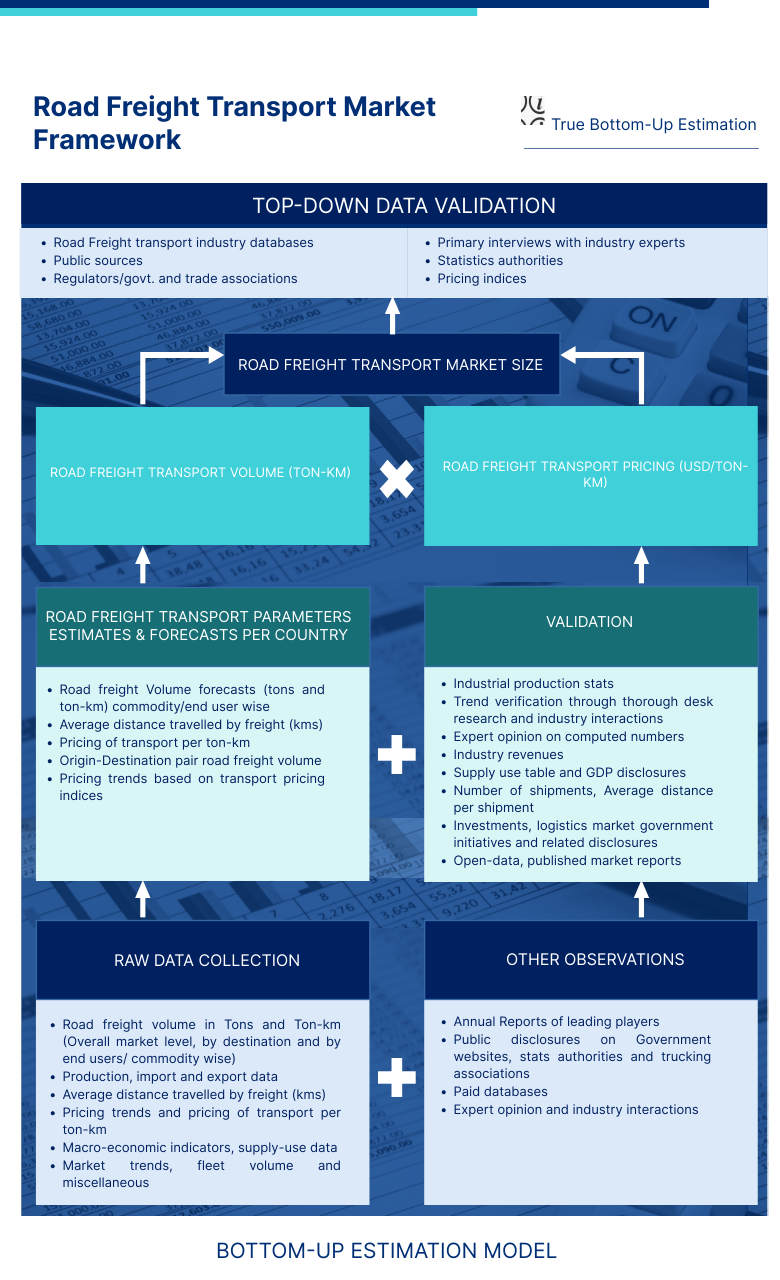
Mordor Intelligence follows a four-step methodology in all our reports.
- Step-1: Identify Key Variables: In order to build a robust forecasting methodology, the variables and factors identified in Step-1 are tested against available historical market numbers. Through an iterative process, the variables required for market forecast are set and the model is built on the basis of these variables.
- Step-2: Build a Market Model: Market-size estimations for the forecast years are in nominal terms. Inflation is considered to be a part of the pricing, and the average selling price (ASP) is varying throughout the forecast period for each country
- Step-3: Validate and Finalize: In this important step, all market numbers, variables and analyst calls are validated through an extensive network of primary research experts from the market studied. The respondents are selected across levels and functions to generate a holistic picture of the market studied.
- Step-4: Research Outputs: Syndicated Reports, Custom Consulting Assignments, Databases & Subscription Platforms