
Robotic Nurse Assistant Market Size and Share
Market Overview
| Study Period | 2020 - 2031 |
|---|---|
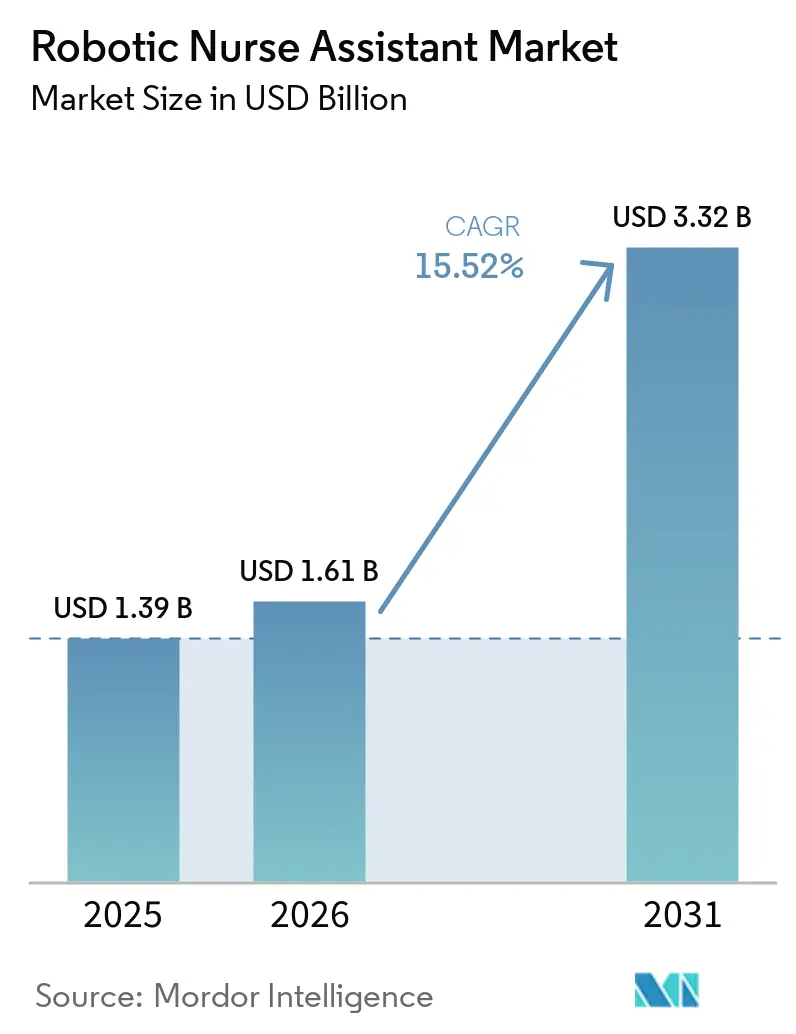
| Market Size (2026) | USD 1.61 Billion |
| Market Size (2031) | USD 3.32 Billion |
| Growth Rate (2026 - 2031) | 15.52 % |
| Fastest Growing Market | Asia Pacific |
| Largest Market | North America |
| Market Concentration | Medium |
Major Players *Disclaimer: Major Players sorted in no particular order Image © Mordor Intelligence. Reuse requires attribution under CC BY 4.0. | |
Robotic Nurse Assistant Market Analysis by Mordor Intelligence
The robotic nurse assistant market size is expected to grow from USD 1.39 billion in 2025 to USD 1.61 billion in 2026 and is forecast to reach USD 3.32 billion by 2031 at 15.52% CAGR over 2026-2031. Demand is escalating as health systems confront a widening nurse-staffing gap confirmed by multiple professional bodies, together with infection-control mandates and steady gains in artificial-intelligence autonomy. Hospitals that embed robot fleets are already demonstrating rapid payback because the machines slash non-clinical walking time, reduce lifting injuries and keep supply chains moving even when staffing is thin. Subscription-based robotics-as-a-service contracts now account for a rising share of deployments because they shift spending from capital budgets to operating outlays while guaranteeing software and hardware upgrades. At the same time, national smart-hospital programmes in China and the Gulf Cooperation Council are accelerating large-scale roll-outs, giving suppliers long visibility on unit volumes. As competition intensifies, vendors are bundling secure connectivity, workflow analytics and predictive maintenance in order to win multiyear contracts and defend margins.
Key Report Takeaways
- By product type, mobile robotic nurse assistants led with 38.12% of the robotic nurse assistant market share in 2025, whereas humanoid social robots are forecast to post the quickest 15.88% CAGR to 2031.
- By application, patient lifting and transfer accounted for 41.78% of the robotic nurse assistant market size in 2025; medication delivery and management is expected to accelerate at a 16.45% CAGR through 2031.
- By end-user, hospitals held a dominant 54.62% share of the robotic nurse assistant market size in 2025, while long-term care facilities are positioned to expand at an 17.65% CAGR to 2031.
- By geography, North America captured 42.21% revenue share in 2025; Asia-Pacific is projected to be the fastest region at a 18.2% CAGR over the same period.
Note: Market size and forecast figures in this report are generated using Mordor Intelligence’s proprietary estimation framework, updated with the latest available data and insights as of 2026.
Global Robotic Nurse Assistant Market Trends and Insights
Drivers Impact Analysis*
| Driver | (~) % Impact on CAGR Forecast | Geographic Relevance | Impact Timeline |
|---|---|---|---|
| Accelerating nurse shortage and aging population | +4.2% | Global with acute impact in North America and Europe | Long term (≥ 4 years) |
| Infection-control push for touch-less care delivery | +3.1% | Global with heightened focus in Asia-Pacific | Medium term (2-4 years) |
| AI-powered autonomy and navigation breakthroughs | +2.8% | North America and Asia-Pacific | Medium term (2-4 years) |
| Hospital focus on reducing nurse musculoskeletal injuries | +2.3% | North America and Europe | Long term (≥ 4 years) |
| Robotics-as-a-service easing capital burden | +1.9% | Global with early adoption in North America | Short term (≤ 2 years) |
| National smart-hospital programmes | +1.1% | Asia-Pacific core, Middle East expansion | Long term (≥ 4 years) |
| Source: Mordor Intelligence | |||
Accelerating Nurse Shortage and Aging Population
Professional registries report that 138,000 nurses exited the United States workforce between 2022 and 2024, and survey data show nearly 40% of those remaining intend to leave practice by 2029[1]Source: National Council of State Boards of Nursing, “2024 Nursing Workforce Survey,” ncsbn.org . Simultaneously, people aged 65 plus now outnumber children under five across many OECD countries, straining long-term care capacity. Taiwan’s Nurabot pilot achieved a 30% reduction in nursing workload while maintaining medication accuracy, demonstrating that robotics can relieve staffing gaps without sacrificing care quality. The American Hospital Association projects a shortfall of 73,000 nurse assistants by 2028, strengthening the economic case for robotic augmentation[2]Source: American Hospital Association, “2025 Workforce Projections,” aha.org . Health systems are therefore accelerating procurement plans as an essential workforce stabilisation lever.
Infection-Control Push for Touch-less Care Delivery
Ultraviolet-C and hydrogen-peroxide fogging robots now achieve a 93% drop in microbial counts in isolation units, thereby lowering hospital-acquired infection risk and reducing manual cleaning labour. Telepresence nurse robots allow clinicians to check vitals and answer call-lights without entering rooms, a practice that preserves personal-protective-equipment supplies and limits pathogen exposure. China’s Agent Hospital reports AI doctors handling 10,000 virtual patients a week with 93.06% diagnostic accuracy, underlining the clinical feasibility of touch-free workflows. Infection-control committees increasingly view robotic runners and medication couriers as permanent infrastructure, not emergency extras, because the machines keep staff safe while sustaining high throughput.
AI-Powered Autonomy and Navigation Breakthroughs
Edge-deployed convolutional neural networks now fuse lidar, video and inertial data to help robots avoid dynamic obstacles and comply with strict corridor speed limits. Children’s Healthcare of Atlanta installed 90 such units in late 2024; the fleet cut nurse walking distance by 30% and trimmed response times to pharmacy calls. Dual-arm nursing robots that leverage large-language-model reasoning record 87% fewer task failures than single-agent designs. Because the software can be updated over-the-air, hospitals gain step-wise capability improvements without swapping hardware, further extending asset life.
Hospital Focus on Reducing Nurse Musculoskeletal Injuries
In the United States, musculoskeletal disorders account for nearly half of all reported nursing injuries, with patient handling responsible for one-quarter of compensation claims. Clinical studies show that collaborative lift robots reduce peak lumbar forces by 51% and cut trunk rotation by 87% during transfers. Stanford University Medical Center saved USD 2.2 million across five years after rolling out a safe-lifting strategy anchored by robotics-assisted devices. Such hard dollar benefits convince finance departments to release funds even during tight budget cycles.
Restraints Impact Analysis*
| Restraint | (~) % Impact on CAGR Forecast | Geographic Relevance | Impact Timeline |
|---|---|---|---|
| High upfront costs and uncertain ROI | -2.7% | Global with acute impact in emerging markets | Medium term (2-4 years) |
| Patient safety and regulatory hurdles | -1.8% | North America and Europe | Long term (≥ 4 years) |
| Labour-union and staff resistance to automation | -1.4% | North America and Europe | Medium term (2-4 years) |
| Cyber-security vulnerabilities in connected robots | -0.9% | Global with heightened concern in developed markets | Short term (≤ 2 years) |
| Source: Mordor Intelligence | |||
High Upfront Costs and Uncertain ROI
Although service models are spreading, many large health networks still purchase robots outright, which can involve multimillion-dollar price tags for integrated fleets. A study on intravenous compounding robots found initial capital outlays above USD 500,000, challenging organisations that operate on thin margins frontiersin.org. CFOs demand rigorous payback modelling that includes indirect benefits such as fewer back injuries and improved retention. Because peer-reviewed cost-utility analyses remain scarce, some boards defer purchase decisions, slowing adoption in budget-restrained systems, especially across lower-income economies.
Patient Safety and Regulatory Approval Hurdles
The United States Food and Drug Administration now classifies medical robots across six autonomy levels and requires detailed cybersecurity plans as part of premarket submissions. Europe’s Medical Device Regulation necessitates even broader post-market surveillance, lengthening time-to-market and raising compliance spend. Developers must continually validate machine-learning updates, and any shift from Level 2 (assistive) to Level 3 (partial autonomy) can trigger a fresh certification cycle. Smaller start-ups face high regulatory overheads, which consolidates power among well-capitalised incumbents
*Our forecasts treat driver/restraint impacts as directional, not additive. The impact forecasts reflect baseline growth, mix effects, and variable interactions.
Segment Analysis
By Product Type: Mobile Units Extend Lead as Humanoid Robots Accelerate
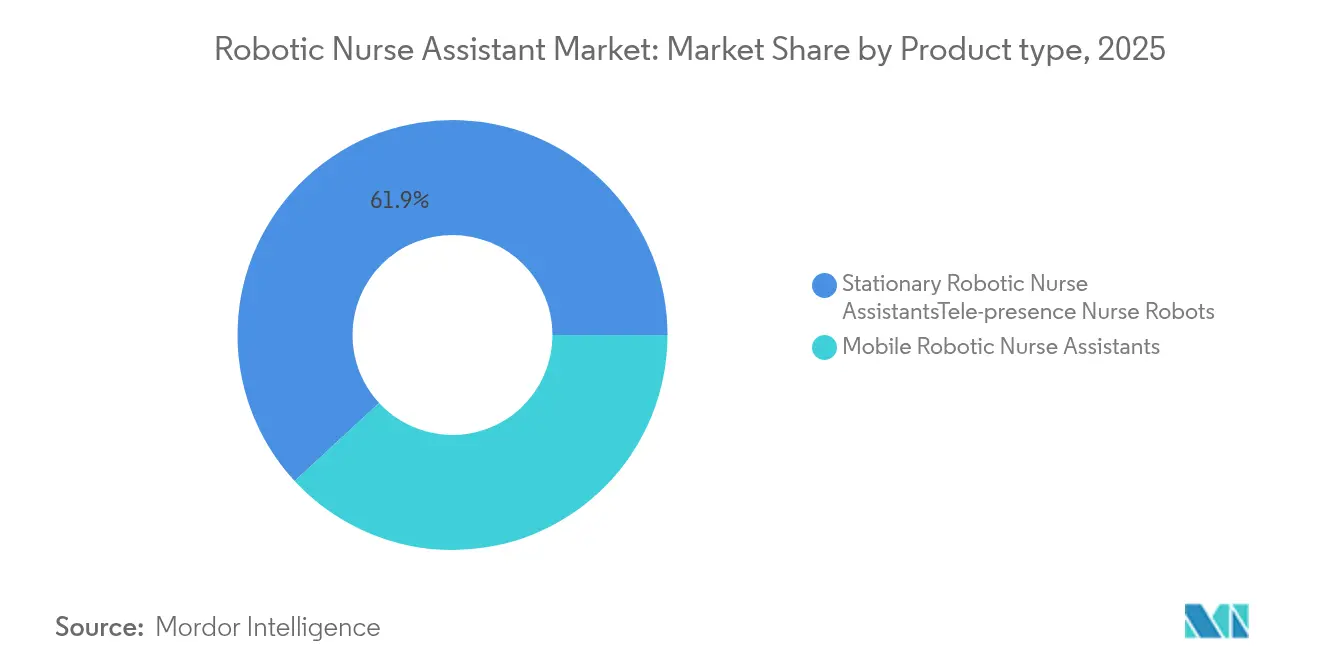
Mobile robotic nurse assistants captured 38.12% of the robotic nurse assistant market in 2025 because they glide through wards carrying linens, medications and lab specimens while interfacing seamlessly with lifts and automatic doors. Cleveland Clinic runs 81 autonomous guided vehicles that each travel 600 linear km a month, underpinning a documented two-year payback. Stationary dispensing robots remain essential in compounding pharmacies, although their addressable pool is narrower. Telepresence nurse units gained attention during COVID-19 surges and continue to prove valuable in rural outreach. Humanoid social robots, while only 8% of 2024 shipments, are forecast to log a 15.88% CAGR as ageing societies recognise the value of conversational support and emotional engagement. Exoskeleton support robots that strap onto caregivers curtail spinal compression during lifts and transfers, positioning them as an ergonomic adjunct to mobile carriers.
Second-generation humanoid platforms integrate natural-language dialogue, refined motor dexterity and cloud-delivered knowledge bases. If realised, that surge will raise the robotic nurse assistant market size for humanoid designs far faster than other sub-types. Suppliers are already bundling emotion-recognition analytics that allow the machines to adjust tone and gestures, thereby improving patient trust and acceptance.



By Application: Transfer Tasks Still Dominate but Medication Automation Climbs Fast
Patient lifting and transfer remained the single-largest use case, accounting for 41.78% of the robotic nurse assistant market size in 2025 because safe-handling regulations compel hospitals to mechanise physically demanding moves. One multi-site trial showed that collaborative lift robots reduced lost-time injuries by 63% within a year. Yet medication delivery and management is the fastest-growing slice, projected at a 16.45% CAGR, as pharmacy departments digitise end-to-end workflows to cut errors and meet tighter audit standards. Integrated carts now authenticate staff via RFID, log handoffs and upload temperature logs in real time. Clinical monitoring and rounding robots combine vital-sign sensors with video assessment so specialists can review multiple patients without leaving command centres. Sanitation robots that deploy pulsed UV or electrostatic sprayers have shifted from pandemic stop-gaps to routine infection-prevention assets. Rehabilitation-support robots deliver personalised exercise regimens, while elderly companionship units tackle loneliness and cognitive decline in long-term care facilities
Geography Analysis
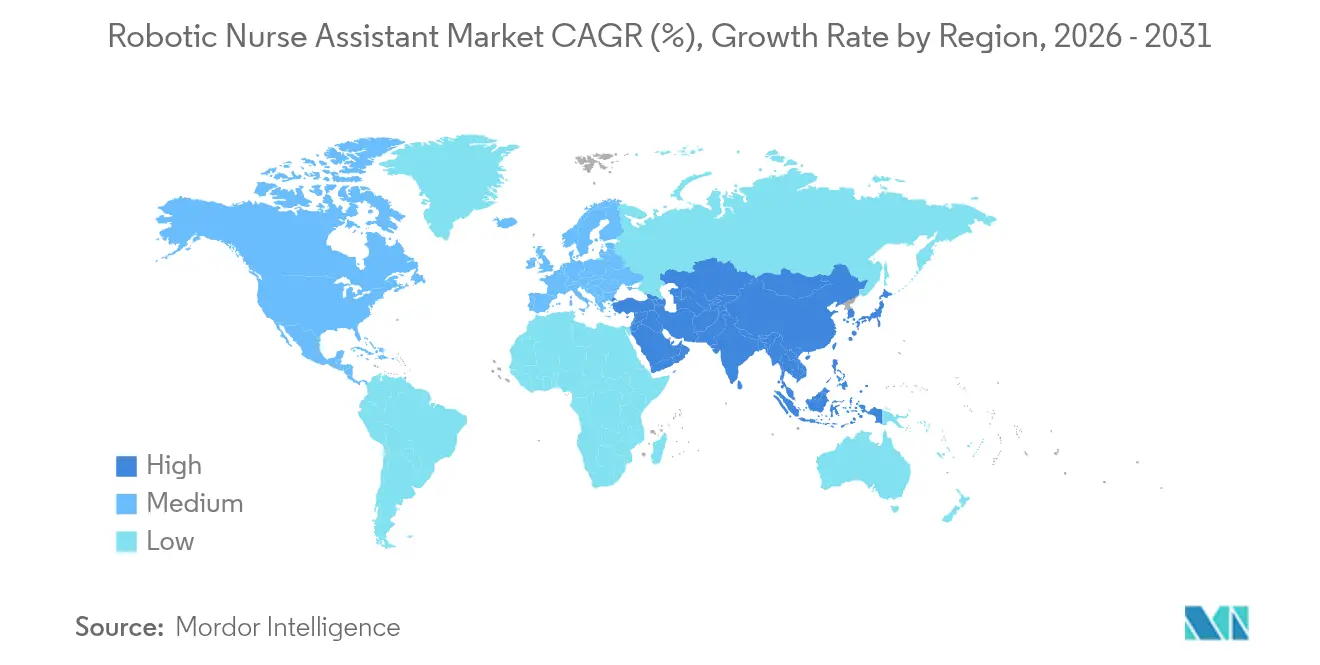
North America held 42.21% of 2025 revenue, reflecting mature healthcare infrastructure, robust Medicare and private-payer reimbursement for technology upgrades, and a proactive regulatory roadmap. The United States Food and Drug Administration issued detailed device cybersecurity guidance in December 2024, creating clarity that accelerated procurement cycles for connected robots. Large IDNs such as Mayo Clinic and Kaiser Permanente negotiate multi-site framework agreements that embed service-level guarantees into supplier contracts, further standardising adoption across the region.
Asia-Pacific represents the most dynamic theatre with a 18.2% forecast CAGR. China’s “Trinity” smart-hospital blueprint ties funding eligibility to demonstrable automation milestones, effectively ring-fencing budgets for robotic nurse assistant market deployments. Taiwan’s health ministry green-lit reimbursements for AI-enabled nursing robots after Nurabot pilots reduced nurse overtime by one-third. Japan, hosting the world’s highest median age, channels public grants to elder-care robotics consortia to mitigate pending caregiver shortages, while South Korea embeds robotics modules in nursing curricula to speed frontline acceptance.
Europe maintains steady expansion as institutions seek ergonomic safety gains and compliance with stringent worker-protection directives. Germany’s federal states finance pilot projects that pool data across university hospitals to fine-tune workflow algorithms. Scandinavian countries, where union engagement is high, emphasise co-design, allowing nurses to configure robot task lists, which improves adoption. Although European procurement cycles can be slower due to central-tender rules, cumulative installed base is rising because once compliance is achieved, roll-out across multiple hospitals proceeds with fewer technical modifications.

Competitive Landscape
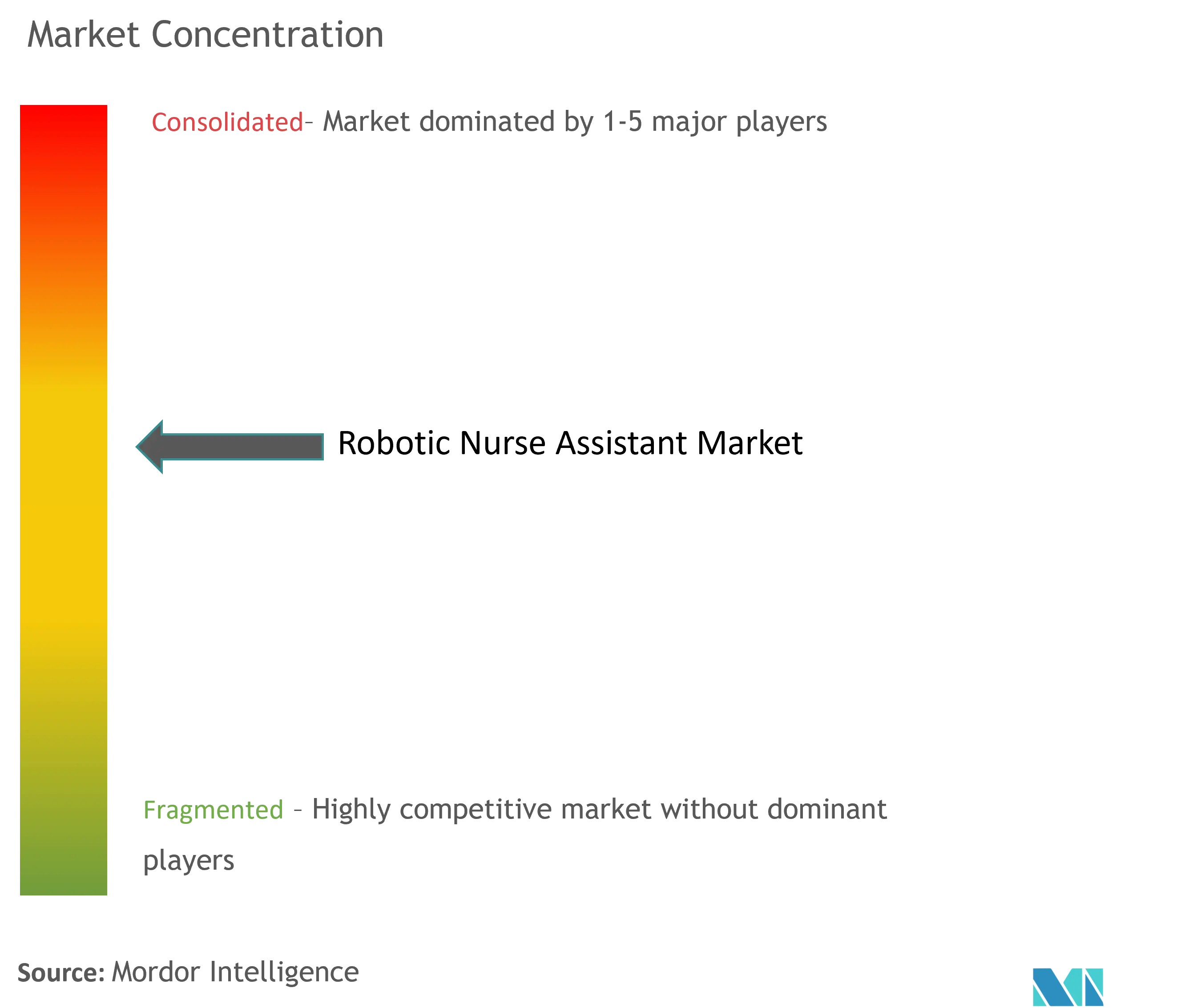
The robotic nurse assistant market is moderately concentrated. Top players include Stryker, Intuitive Surgical, Panasonic, SoftBank Robotics and Diligent Robotics. Stryker deepened its software stack by purchasing in August 2024, bringing virtual-care algorithms under the same roof as its Mako robotic platform. Intuitive Surgical, better known for operating-room robotics, is leveraging its 8,606-unit install base to cross-sell peri-operative logistic robots that move instruments and linens. Panasonic deploys autonomous carts in Japanese hospitals and bundles energy-saving batteries to cut downtime.
Diligent Robotics emphasises a pure robotics-as-a-service model. Its Moxi units schedule runs through cloud dashboards, allowing nursing managers to reprioritise tasks without IT tickets. SoftBank Robotics shifted from consumer to healthcare settings, re-engineering Pepper to handle multilingual elder-care dialogue. Smaller European firms are focusing on specialised edges, for example exoskeletons for transfer lifts and UV-C disinfection robots that meet new IEC 80601-2-77 standards ul.com. Across the landscape, vendors that prove measurable ROI, offer cybersecurity warranties and integrate with electronic medical record APIs win multi-year tenders.
Robotic Nurse Assistant Industry Leaders
Diligent Robotics
Panasonic
Fraunhofer IPA
Aethon
PARO Robots U.S., Inc.
- *Disclaimer: Major Players sorted in no particular order

Recent Industry Developments
- May 2025: Foxconn unveiled Nurabot, an AI-powered collaborative nursing robot shown in trials to cut nurse workload by 30% at Taichung Veterans General Hospital
- October 2024: The FDA issued updated device-cybersecurity guidance that mandates security plans for all connected medical robots and sets vulnerability reporting deadlines


Global Robotic Nurse Assistant Market Report Scope
As per the scope of the report, robotic nurses are used for various activities like supporting disabled, critically ill patients and older people in performing their day-to-day tasks, as well as interacting with and monitoring patients.
The robotic nurse assistant market is segmented by product type, end user, and geography. By product type, the market is segmented into independence support robots, daily care and transportation robots, and other product types. By end user, the market is segmented into hospitals and clinics, senior care facilities, homecare settings, and other end users. By geography, the market is segmented into North America, Europe, Asia-Pacific, Middle East and Africa, and South America. The market report also covers the estimated market sizes and trends for 17 countries across major regions globally. The report offers market sizes and forecasts in terms of value (USD) for the above segments.
| Mobile Robotic Nurse Assistants |
| Stationary Robotic Nurse Assistants |
| Tele-presence Nurse Robots |
| Humanoid Social Robots |
| Exoskeleton Support Robots |
| Patient Lifting & Transfer |
| Medication Delivery & Management |
| Clinical Monitoring & Rounding |
| Sanitation & Disinfection |
| Rehabilitation Support |
| Elderly Companionship |
| Hospitals |
| Long-term Care Facilities |
| Home Healthcare Settings |
| Ambulatory Surgical Centers |
| Rehabilitation Centers |
| North America | United States |
| Canada | |
| Mexico | |
| Europe | Germany |
| United Kingdom | |
| France | |
| Italy | |
| Spain | |
| Rest of Europe | |
| Asia-Pacific | China |
| India | |
| Japan | |
| South Korea | |
| Australia | |
| Rest of Asia-Pacific | |
| South America | Brazil |
| Argentina | |
| Rest of South America | |
| Middle East and Africa | GCC |
| South Africa | |
| Rest of Middle East and Africa |
| By Product Type (Value) | Mobile Robotic Nurse Assistants | |
| Stationary Robotic Nurse Assistants | ||
| Tele-presence Nurse Robots | ||
| Humanoid Social Robots | ||
| Exoskeleton Support Robots | ||
| By Application (Value) | Patient Lifting & Transfer | |
| Medication Delivery & Management | ||
| Clinical Monitoring & Rounding | ||
| Sanitation & Disinfection | ||
| Rehabilitation Support | ||
| Elderly Companionship | ||
| By End-user (Value) | Hospitals | |
| Long-term Care Facilities | ||
| Home Healthcare Settings | ||
| Ambulatory Surgical Centers | ||
| Rehabilitation Centers | ||
| By Geography (Value) | North America | United States |
| Canada | ||
| Mexico | ||
| Europe | Germany | |
| United Kingdom | ||
| France | ||
| Italy | ||
| Spain | ||
| Rest of Europe | ||
| Asia-Pacific | China | |
| India | ||
| Japan | ||
| South Korea | ||
| Australia | ||
| Rest of Asia-Pacific | ||
| South America | Brazil | |
| Argentina | ||
| Rest of South America | ||
| Middle East and Africa | GCC | |
| South Africa | ||
| Rest of Middle East and Africa | ||


Key Questions Answered in the Report
What is the current size of the robotic nurse assistant market?
The robotic nurse assistant market generated USD 1.61 billion in 2026 and is projected to reach USD 3.32 billion by 2031.
Which product segment leads the robotic nurse assistant market?
Mobile robotic nurse assistants led with 38.12% revenue share in 2025, reflecting their versatility in hospital logistics.
Which application is growing fastest within the robotic nurse assistant market?
Medication delivery and management is forecast to grow at a 16.45% CAGR through 2031 as hospitals pursue error-free pharmaceutical workflows.
Why is Asia-Pacific the fastest growing region?
Government-backed smart-hospital programmes, rapid population ageing and concentrated investments in healthcare automation drive a 18.2% CAGR in Asia-Pacific.
How are hospitals justifying the cost of robotic nurse assistants?
Institutions report reduced lifting injuries, shorter nurse walking distances and two-year payback periods, which together make the economics attractive even under tight budgets.
Page last updated on:


 Your data is secure and never sold or shared.


